Related Posts

Parents sometimes walk into a Montessori classroom and notice something missing. No stack of worksheets. No workbooks lined up on a shelf. No thick folder of papers coming home each week showing exactly what got covered that day.
If there is not much paper coming home, how do we actually know our child is learning?
That is a completely reasonable question, especially for anyone whose own school years trained them to equate “schoolwork” with “paper.” Montessori simply starts from a different place entirely.
First, Understand With Your Hands
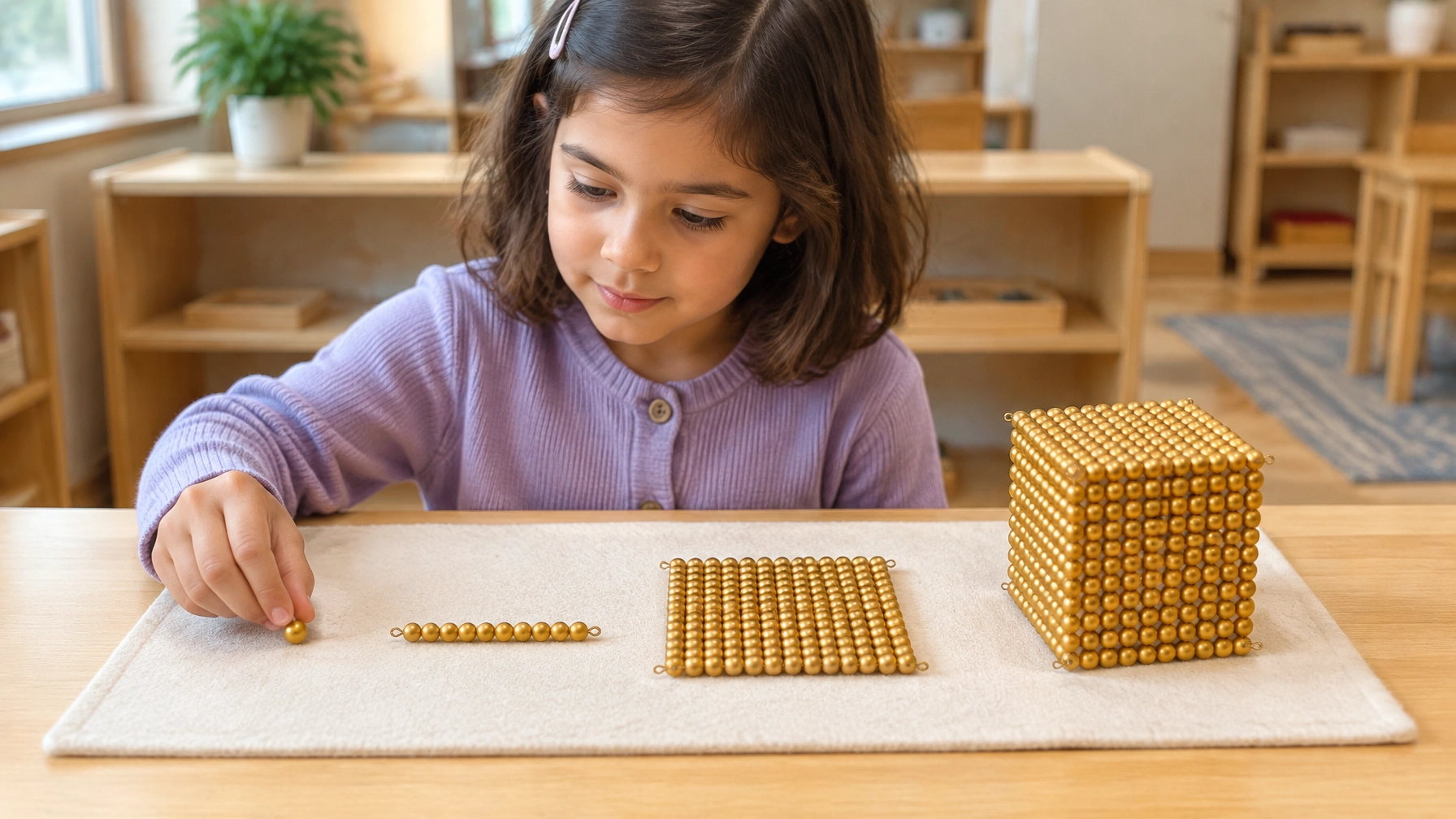
Try teaching a young child the decimal system by saying it out loud — ten units equal one ten, ten tens equal one hundred, and ten hundreds equal one thousand. A child can memorize that string of sentences well enough to repeat it back. But Montessori asks a different question — what if the child could actually hold the idea in their hands?
The Golden Bead materials let a child physically handle one small unit bead, a ten-bar made of ten beads, a hundred square made of one hundred beads arranged as ten ten-bars, and a thousand cube made of one thousand beads arranged as ten hundred squares. The relative size matters. The child can see and feel that the hundred square is larger than the ten-bar, while the thousand cube is dramatically larger than the square.
The difference between one and one thousand stops being something written on a page. It has weight. It has volume. It has a visible structure the child can turn over and inspect. The relationship is not explained to the child. It is felt.
That is the Montessori principle of concrete before abstract.
From Infancy, Learning Begins With the Real World
This principle does not begin when a child first enters a primary classroom. It begins in infancy, when a baby explores the world through the senses and movement.
An infant learns by looking carefully, reaching, grasping, shaking, dropping, listening, and noticing what changes. A wooden object feels different from a soft cloth. A bell sounds different from a basket. A ball rolls away while a solid block stays where it was placed. These experiences are not worksheets, but they are not “nothing,” either. They are the beginnings of attention, memory, coordination, and concept formation.
In a Montessori infant or toddler environment, adults prepare a safe and orderly space with real objects and carefully chosen materials. The child’s work may involve putting objects into containers and taking them out again, fitting a shape into an opening, carrying something from one place to another, or collaborating in simple activities of daily life.
Practical Life is academic preparation, even when it does not look like conventional schoolwork. Pouring water, washing a dish, folding a cloth, preparing food, and caring for a plant involve sequencing, concentration, coordination, judgment, and purposeful movement. The child is building the internal foundations that later support reading, writing, mathematics, and independent research.

Caption: Before worksheets or formal lessons, infants develop attention and understanding through purposeful sensory exploration.
Concrete Before Abstract
This same principle runs through the entire Montessori curriculum. Children handle real quantities before they lean on written numerals alone. They build words out of movable letters before handwriting comes easily. They physically manipulate geometric shapes before they study geometry as pure abstraction. They experience dimension and proportion through the Sensorial materials long before anyone hands them a formula.
The hand gives the mind something solid to think with. Eventually, the material becomes unnecessary entirely, and that is not a failure of the method. That is the whole point of it.
A young child may first compose a word by selecting wooden letters from the Movable Alphabet and arranging them carefully. The child is expressing an idea in written language before the hand is fully ready to form every letter with a pencil. In time, the letters move from the rug to the page, and then from the page into the child’s mind.
Paper is not rejected. It enters at the point when it genuinely serves the child’s development.
Paper Is Not the Same Thing as Learning
A completed worksheet proves that a child put some answers on a page. It does not actually tell you what that child understands, or whether they will remember it next week. Meanwhile, a child can spend forty genuinely demanding minutes working with Montessori materials and walk away with nothing physical to show for it.
The learning still happened. It is just not sitting in the backpack waiting to be admired.
That trade-off can take some adjusting to as a parent, especially the first few times pickup happens and there is nothing to look at. We are accustomed to receiving visible evidence — a page, a packet, a grade, a completed workbook. Montessori asks us to look more closely at the child rather than simply counting the papers.
Is the child becoming more precise? Can the child sustain concentration? Does the child return to a difficult activity voluntarily? Can the child explain an idea, apply it in a new situation, or recognize an error and try again?
Those are meaningful signs of learning.
But Montessori Children Do Use Paper
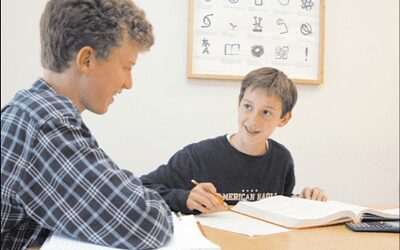
Of course they do. They write constantly. They draw. They keep records of their own work. They make books. They solve equations. They write stories and reports. They label diagrams. They record scientific observations in real notebooks.

Caption: Montessori children use paper when writing, recording, calculating, researching, and communicating genuinely understood ideas.
As children move up through the elementary years, written work becomes a bigger and bigger part of what they do every day. Montessori was never anti-pencil. The real difference is simply when and why paper shows up. It gets used when it genuinely serves the learning, not as manufactured proof that learning happened at all.
The elementary years represent a passage to abstraction. Children may still return to materials when they need to explore a difficult mathematical or scientific idea, but they increasingly use written language to organize thought. They research the natural world, study history and geography, write reports, create timelines, solve increasingly complex problems, and communicate findings in a range of forms.
The Montessori Foundation’s Curriculum Scope and Sequence describes this progression from infancy through the elementary years. It includes Practical Life, Sensorial, language, mathematics, geometry, science, history, geography, visual arts, and other areas of development. The sequence is not a rigid schedule that every child must follow on the same day. It is a framework for observing growth and planning meaningful next steps.
So How Does the Teacher Actually Know?
Montessori teachers watch closely, constantly, all day. They give lessons one-on-one or in small groups. They observe children working independently with materials. They ask questions in the moment. They keep detailed records of lessons given, skills explored, and abilities demonstrated.
They watch for whether a child can actually apply something on their own, not just repeat it back.
Assessment in a Montessori classroom is continuous, built into the fabric of the day itself. A teacher does not need to wait for Friday’s worksheet to discover that a child is confused about something. The confusion is usually visible directly in how the child works with the material, in real time, right in front of them.
A child may reverse a numeral, hesitate during an exchange with the Golden Beads, lose the sequence of a Practical Life activity, or choose a material that is not yet appropriate. These observations help the teacher decide whether to offer another lesson, invite the child to practice, change the level of challenge, or simply allow more time.
The teacher is not waiting for a paper product. The teacher is studying the child’s process.
That is why observation is such a central professional skill in Montessori education. Families can learn more about this approach through the Montessori Foundation’s observation resources and through the Montessori Family Alliance, where parents and schools can build a shared language for understanding children’s growth.
The Material Eventually Disappears
One of the most quietly beautiful moments in Montessori mathematics happens when a child who has been working with concrete materials for months suddenly says, without prompting, “I do not need this anymore.”
The relationship that once required physical beads and bars is now something the child can hold entirely in their head. What was physical has become abstract.
That is the exact progression Montessori was aiming for the whole time — hand, then experience, then understanding, then abstraction. Not a lifelong dependence on materials. The opposite of that, in fact.
The same pattern continues through the later years. An elementary student may begin with a concrete experiment, a timeline, a globe, a geometric form, or a mathematical material. The child then records observations, compares evidence, asks questions, and begins to reason symbolically. By adolescence, the “material” may be a real community responsibility, a laboratory investigation, an enterprise, a long-term research question, or an interdisciplinary project.
Adolescent Montessori students still need adults, structure, academic expectations, and careful guidance. Their work simply becomes increasingly abstract, independent, and connected to the real world. They may conduct research, write, calculate, design, present, revise, and manage the consequences of their decisions. The worksheet has not been replaced by aimlessness. It has been replaced by purposeful work that asks more of the whole person.

Caption: As children grow, written work and research become increasingly important ways to organize and communicate understanding.
Ask What Your Child Actually Understands
It is tempting, when judging a school, to count what you can see. How many worksheets came home? How many pages got filled in? How much homework was assigned this week?
Those numbers are easy to count, which is exactly why they are tempting.
The harder, more important questions do not fit neatly into a backpack. Does my child actually understand this? Can my child explain it in their own words? Can my child apply what they learned to something new and unfamiliar? Is my child curious? Can my child work independently, without someone hovering nearby? Can my child concentrate on something difficult? Is my child beginning to genuinely think, rather than simply repeat?
A thick folder of completed worksheets can feel reassuring to hold. But paper was never the same thing as learning.
Learning is what remains quietly after the worksheet itself is long gone.