Related Posts

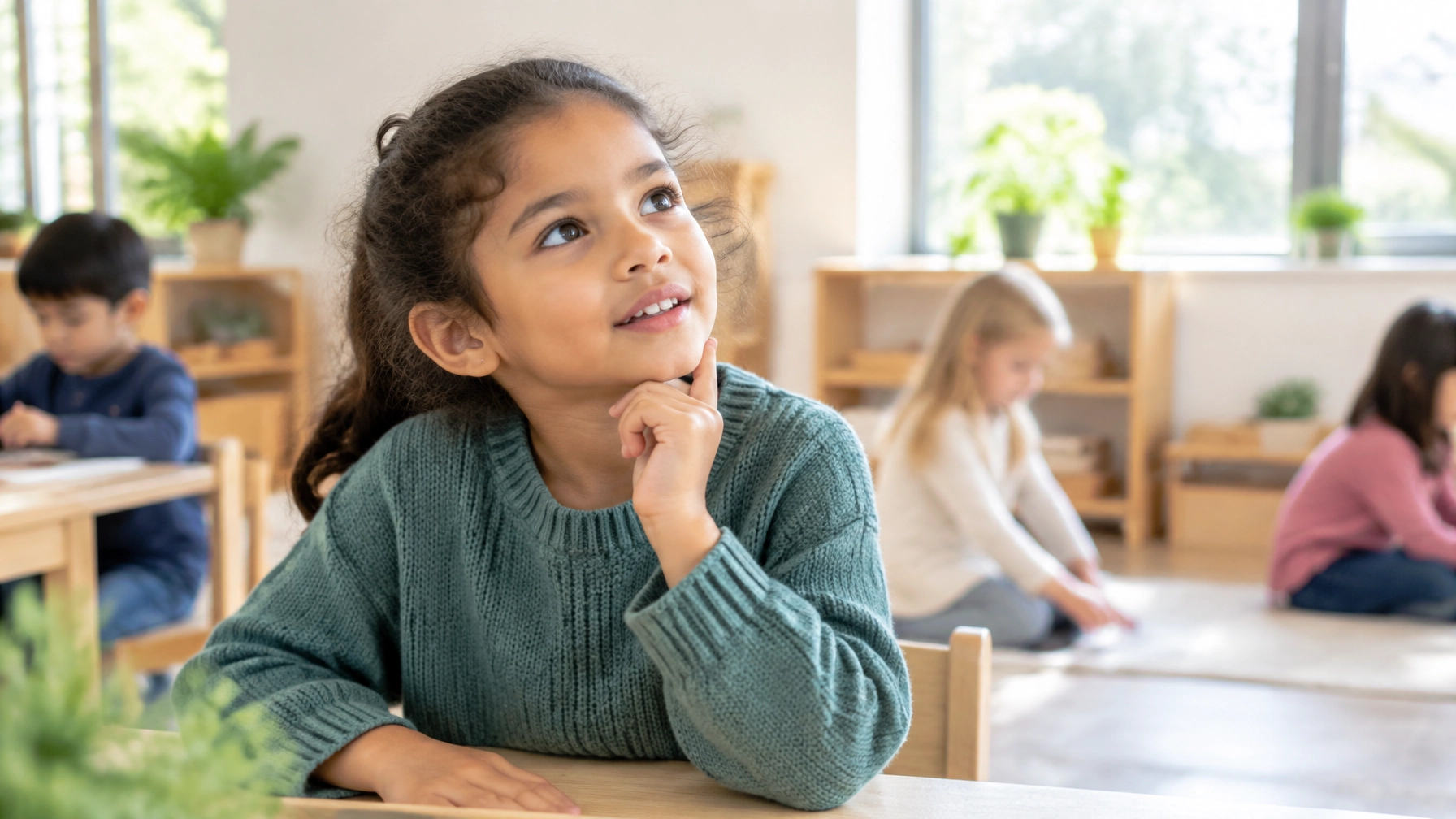
Around age 6, children begin asking bigger questions about how the world works and why. Montessori elementary education was designed for exactly this stage. In mixed-age classrooms, children follow their curiosity through research and projects, learn with materials that make abstract ideas understandable, and build confidence through real competence rather than constant comparison. Through what Maria Montessori called Cosmic Education, they come to see history, science, geography, and the arts as one connected story, and to see themselves as part of it. No school offers everything, so I encourage you to look closely at any program you are considering. A strong Montessori elementary program should show both intellectual richness and academic substance.
When the Questions Change
Around age 6, something remarkable begins to happen in children: their questions change. Your younger child wanted to know, “What is this?” Your elementary-age child begins asking, “Why is it this way? How did it happen?”
Children this age want to know where the Earth came from, why the dinosaurs disappeared, how ancient people lived, and whether the rules adults make are always fair. Their world is growing larger, and their minds are reaching outward to embrace it. This is the child Montessori elementary education was designed to serve.
If your child has attended a Montessori Children’s House, deciding whether to continue into elementary is an important choice, and I know it is not always an easy one. Public schools may offer neighborhood friendships, larger facilities, and sports. Other independent schools may promise academic rigor and a long list of extracurricular activities. So why would a family choose Montessori elementary? I believe the answer has to do with the kind of learner, and the kind of person, your child is becoming.
Learning to Think for Yourself
In a traditional classroom, much of the day may be organized around assignments chosen by the teacher, lessons delivered to the whole class, and work completed on a common schedule. There is nothing wrong with direct instruction, and good teachers in every tradition encourage independent thinking. But Montessori elementary is deliberately designed to give children increasing responsibility for their own intellectual work.
Here is how that might look. Your child receives a lesson on how mountains form and becomes fascinated by volcanoes. That interest may lead to research on plate tectonics, the Pacific Ring of Fire, or the eruption of Mount Vesuvius. Your child reads, makes drawings, builds models, writes explanations, and perhaps presents what they have discovered to classmates. Along the way, the teacher provides guidance, introduces essential knowledge, and checks understanding.

Volcano research: One lesson on mountains can become a deep investigation, as a child reads, sketches, builds, and learns how to research a question.
Your child is not simply completing an assignment. They are learning how to investigate a question, take initiative, and pursue understanding without waiting for someone to tell them every next step. Those are habits that matter long after school.
Confidence Without Constant Comparison
Many parents tell me they worry about their children’s confidence. Will my child feel capable? Will they be afraid to make mistakes?
Montessori elementary classrooms usually span 3 years, ages 6 to 9 and ages 9 to 12, which allows children to work at different levels without everyone being expected to master the same lesson on the same day. A child who finds mathematics challenging may be an accomplished reader. Another who struggles with writing may have an extraordinary grasp of science. Children can receive extra help where they need it and move ahead where they are ready.
The goal is not to remove challenge. Children need to face difficulties, make mistakes, and learn to persevere. But there is an important difference between struggling with a hard problem and feeling ashamed because someone else finished first. In a strong Montessori classroom, mistakes are treated as information. Children learn to examine their work, find their misunderstandings, and try again. I believe this creates room for a quieter, more durable kind of confidence: the belief that “I am capable of learning, even when something is difficult.”

Checking work: In a Montessori classroom, mistakes are information. Children learn to find their errors, correct them, and try again.
An Education as Wide as the Universe
Perhaps the most extraordinary feature of Montessori elementary is its curriculum, which Maria Montessori called Cosmic Education. The idea behind it is both simple and profound: children should encounter knowledge as an interconnected whole rather than as a collection of unrelated school subjects.

A Great Story: The Great Stories open the elementary years with the story of the universe, life, and humanity, sparking questions that lead to years of exploration.
Montessori elementary begins with a series of Great Stories, sometimes called the Great Lessons. They tell of the formation of the universe and the Earth, the development of life, the arrival of human beings, and the invention of writing and mathematics. These stories are starting points that invite children into an enormous world of exploration.
A study of early humans may lead your child into archaeology, migration, and the beginnings of agriculture. An investigation of an ancient civilization may bring together geography, architecture, mathematics, writing, and trade. Children study the lives of scientists, explorers, inventors, artists, and reformers, discovering how individual people have shaped the world. Instead of learning that history lives in one textbook and science in another, your child begins to see how these subjects illuminate one another. Children learn that human beings everywhere have always had the same fundamental needs, such as food, shelter, communication, and community, and they discover the ingenuity with which different cultures have met those needs.

The timeline of life: Working together on a timeline, children see how life on Earth has changed over millions of years.

Ancient civilizations: A study of ancient Egypt brings together history, geography, mathematics, art, and engineering in one shared project.
Understanding Rather Than Memorizing
Montessori elementary also places great emphasis on making abstract ideas understandable. In mathematics, your child works with concrete materials that make place value, fractions, and other relationships visible and tangible. Rather than memorizing the steps of a procedure, children explore why it works. Over time, they move toward abstraction, using the materials less and less as their understanding becomes secure. The same principle carries into other subjects, as children build models to understand geography, create timelines to explore history, and conduct experiments to investigate scientific questions.

Fractions: When children can see and hold fractions, they understand why two quarters equal one half, not just that they do.
Books remain essential. Montessori elementary students should read widely, write clearly, and learn to use increasingly sophisticated sources. But reading is connected to inquiry. A child researching ancient Egypt may consult several books, study maps, and write an account of what they have learned. And when children become genuinely interested in a subject, they often read far more deeply than they would if the only goal were to finish an assigned chapter.
Learning to Work With Other People
You have probably noticed that your elementary-age child is becoming more and more social, and intensely interested in fairness, rules, and relationships. Montessori recognized these as important developmental needs.
A Montessori elementary classroom is often filled with conversation, collaboration, and shared projects. Children plan investigations together, divide responsibilities, and work through disagreements. Older students help younger classmates, and children take part in discussions about classroom expectations. I want to be honest: this does not mean Montessori children never argue, leave others out, or behave unkindly. They do. The difference lies in how the school responds, and in whether social difficulties become opportunities to build understanding and responsibility.

Collaboration: Elementary children love working together, and planning a project teaches communication, patience, and compromise.

Class meeting: In class meetings, children help shape their community, learning to listen, speak honestly, and solve problems together.
Rediscovering the Pleasure of School
One of the most compelling reasons families continue with Montessori is surprisingly simple: they want their children to enjoy learning.
Enjoyment does not mean every day is entertaining or every assignment is easy. Serious learning takes effort. But there is a real difference between experiencing learning as meaningful work and experiencing school mainly as a series of tasks to get through. Montessori seeks to preserve the curiosity your child brought naturally to the world as a young child. When children can ask questions, make choices, investigate real problems, and feel the satisfaction of understanding something difficult, school can become a place they want to be.
What Are the Trade-Offs?
No school offers everything. A neighborhood public school may provide a larger circle of friends, extensive athletics, or specialized services a small Montessori school cannot match. Montessori schools also vary considerably. Some have strong, experienced elementary faculties. Others may struggle with staffing or with the resources needed to serve children with particular learning needs. That is why I encourage you to look carefully at the actual school you are considering, not just its philosophy.
When you visit, here are some things I would look for:
- Are children reading widely, writing well, developing mathematical understanding, and receiving appropriate academic challenges?
- Do they seem confident asking questions and explaining their thinking?
- How do teachers assess progress, respond when children struggle, and make sure essential academic knowledge is not overlooked?
A strong Montessori elementary program should be able to show you both intellectual richness and academic substance.
Discovering Our Place in the World
Underlying Montessori elementary education is a larger purpose. Cosmic Education invites children to understand that everything has a history, that all life is interconnected, and that human beings depend on one another and on the natural world. Children discover how countless people have contributed to the civilization they inherit, and they begin to recognize that they, too, have something to contribute. This is not simply a lesson in geography or history. It is the beginning of a sense of responsibility.

Our place in the world: Cosmic Education helps children understand how all life is connected and that they have something to contribute to the world.
If you are deciding whether to continue Montessori beyond kindergarten, I think this may be the most important question of all: What do we hope our children will carry with them when they leave school?
Certainly, we want them to read well, understand mathematics, and gain the knowledge they need for further education. But we also want them to think independently, approach challenges with confidence, treat others with respect, and stay curious. We want them to understand the world and to believe they have a place in it.
At its best, Montessori elementary education brings these hopes together. It offers your child not simply more years of Montessori, but a larger intellectual world in which to grow.