Related Posts
Why Montessori education can offer young adolescents something they urgently need: a place to belong, meaningful work to do, and opportunities to discover who they are becoming

On the threshold: Early adolescence brings big changes. Beneath them, a young person is beginning the work of becoming an adult.
Snapshot
Early adolescence brings dramatic physical, emotional, and social change, and many parents find themselves wondering what happened to the child they knew. Maria Montessori saw adolescence not as a problem to manage but as a distinct and hopeful stage of development, one that calls for its own kind of school. A strong Montessori middle school offers young people a community where they are genuinely known, real work that matters to others, and academics with depth and purpose. It may not offer everything a large school does, so the right choice depends on your child. But for many young adolescents, the chance to discover that they are capable, valued, and able to contribute can make an enormous difference.
What Happened to My Child?
If you are the parent of a young adolescent, you may already know this moment. The confident 10-year-old who once eagerly explained everything she had learned becomes a 12-year-old who suddenly seems unsure of herself. Friendships grow more complicated. Feelings become more intense. Questions about belonging, identity, fairness, and independence take on new urgency, and you may find yourself wondering what happened to the child you knew.
I want to reassure you that beneath these changes, something extraordinary is happening. Your child is beginning the difficult and exciting work of becoming an adult.
Maria Montessori believed that adolescence is a distinct stage of human development. She was convinced that young adolescents need an educational environment designed around their particular needs, not simply a harder version of elementary school. I find her vision a compelling alternative to the conventional middle school experience, and I'd like to share why.
A Different Kind of Growing Up
The move into adolescence brings enormous physical, emotional, and social change. Young adolescents become intensely aware of how others see them. They may be deeply sensitive to criticism, embarrassed by mistakes, and uncertain about their abilities. At the same time, they want more independence and more say over their own lives.
They also begin asking questions that reach well beyond schoolwork: Who am I? Where do I belong? What am I good at? What kind of person do I want to become?
Montessori recognized that these questions are not distractions from education. They are the central developmental work of adolescence. She believed young people need to experience themselves as capable, contributing members of a community. They need meaningful responsibilities, relationships with trustworthy adults, chances to work alongside others, and experiences that connect learning to real life. Above all, they need an environment where they can develop confidence and a genuine sense of their own worth. Montessori used the word "valorization" for this, the sense of personal value that comes from knowing your contributions matter.
A School Where You Are Known
One of the great potential strengths of a small Montessori middle school is that students are truly known.
In a large school, a young adolescent may move among several classrooms each day, see many different teachers, and spend a great deal of energy navigating a complicated social world. Some children thrive there. They enjoy the energy, variety, and opportunities a larger school provides. Others find it overwhelming.
A well-designed Montessori adolescent community offers something different. Teachers have the chance to know each student as an individual, to understand their interests and struggles, and to build relationships that go beyond a single subject. Students usually work with a fairly stable group of peers and develop a sense of shared responsibility.

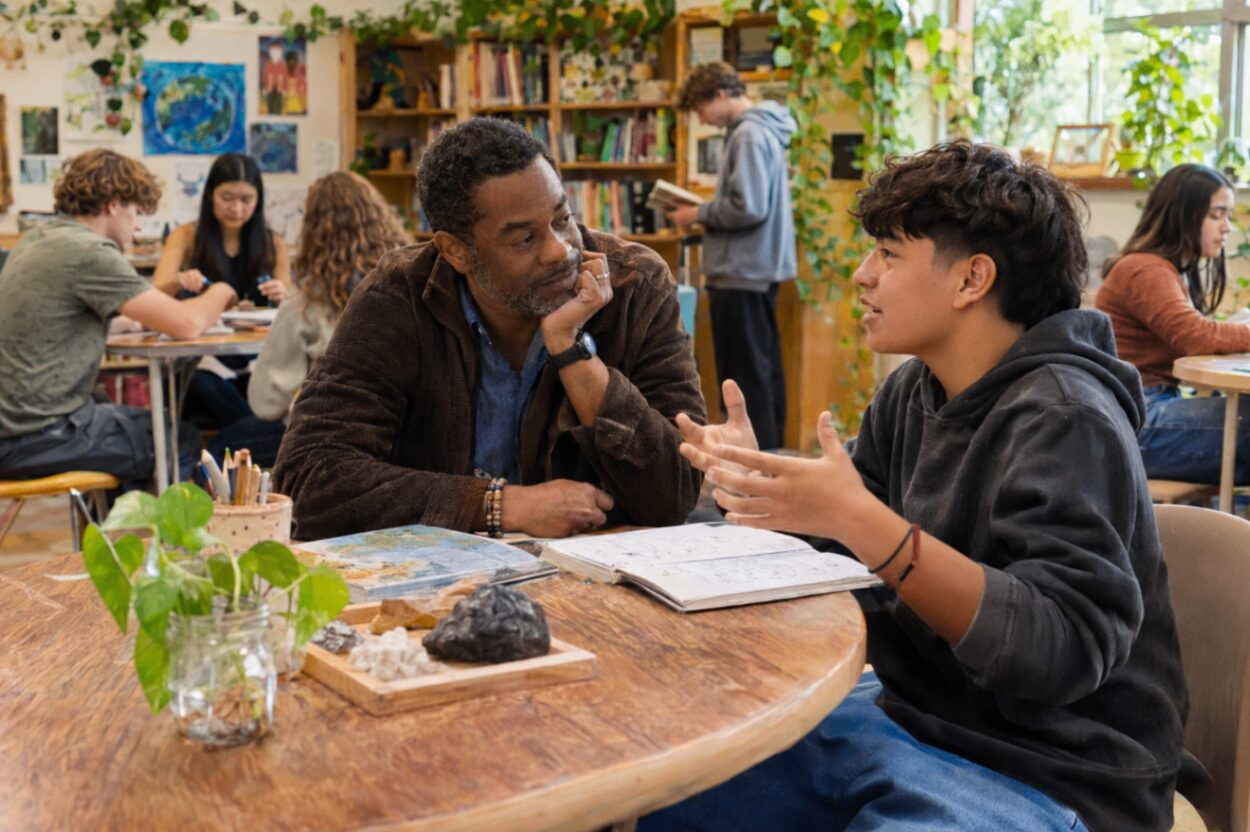
A school where you are known: In a small Montessori middle school, teachers know each student as a whole person, not just as a name on a class roster.
I don't want to paint too rosy a picture. Small communities are not free of social difficulties, and friendships are not always easy. In fact, tensions can sometimes feel more intense when there are fewer classmates. But when adults are attentive and relationships are strong, the community becomes a place where young people learn to work through those difficulties rather than simply escape them. For a child who feels invisible in a larger setting, being known can make all the difference.
Learning Through Meaningful Work
Montessori's vision for adolescence included a program she called Erdkinder, a German word usually translated as "children of the land." She imagined young adolescents living and learning in a community connected to the land, where they would take part in practical work, economic activity, and shared responsibility.

Working the land: Montessori imagined adolescents learning through real work on the land, growing food and caring for animals as part of a community.
Not every Montessori middle school runs a farm or a residential program. Many are in cities and suburbs. But the underlying principle remains essential: adolescents benefit from work that has a purpose beyond earning a grade. Students might grow food, run a small business, prepare meals, organize an event, maintain a garden, publish a newspaper, or investigate a problem affecting their community.

The kitchen: Preparing meals for the community gives young people the satisfaction of contributing something of value.
Imagine a group of students planning a school market. They have to calculate costs, create a budget, communicate with customers, organize supplies, solve unexpected problems, and work together.

The school market: When students run their own market, mathematics becomes useful, writing has an audience, and their work matters to real people.
Suddenly, mathematics is useful. Writing has a real audience. Science connects to practical questions, and cooperation becomes necessary rather than merely encouraged. Students discover that their work matters to other people, and perhaps most important, they experience themselves as capable of contributing something of value.
Academics With Depth and Purpose
Parents sometimes ask me whether a Montessori middle school puts so much emphasis on community and practical experience that academics suffer. It is a fair question, and every school should be prepared to answer it.
A strong Montessori adolescent program takes academics seriously. Students should be developing increasingly sophisticated skills in mathematics, science, literature, history, writing, and critical thinking. The difference is that subjects need not feel like disconnected assignments.
A study of water, for example, might include chemistry, ecology, geography, public policy, engineering, and the history of human settlement. Students might collect and analyze data, read scientific articles, interview local experts, write reports, and present recommendations.

The water study: A study of a local creek can bring together chemistry, ecology, data analysis, and questions about how we care for our communities.
Literature and history can help adolescents explore questions about justice, identity, courage, loyalty, and responsibility, questions that feel especially urgent at this age.

A seminar: Literature gives adolescents a place to explore questions of justice, identity, and courage that feel especially urgent at this age.
Teachers still provide direct instruction, set clear academic expectations, assess progress, and make sure students develop essential knowledge and skills. Freedom does not mean an absence of structure. The goal is to help young people take increasing responsibility for serious intellectual work.
The Courage to Be Yourself
I believe one of the greatest gifts a Montessori adolescent community can offer is the chance to develop a sense of identity that is not defined mainly by popularity, grades, or social status.
Adolescence can be a time of painful comparison. Young people notice who seems attractive, athletic, academically successful, socially confident, or popular, and they may begin measuring their own worth against everyone around them. A thoughtfully prepared Montessori environment cannot remove these pressures, but it can offer a different set of experiences through which young people discover their strengths.
The student who struggles with traditional tests may turn out to be a gifted organizer. A quiet adolescent may become an exceptional researcher. Someone who feels socially awkward may find confidence through caring for animals, building something useful, or contributing to a community project.

Caring for animals: A quiet student may find confidence in caring for animals, building something useful, or serving the community.
These experiences help young people see that competence takes many forms. They begin to discover not only what they can achieve, but who they are.
What About Sports, Friends, and the Wider World?
When families consider a Montessori middle school, they often ask whether a smaller program will offer enough. Will my child have enough friends? What about competitive sports, music, theater, and clubs? Will they be ready to move into a larger high school?
These questions deserve thoughtful answers. A small Montessori school may not have its own football team, orchestra, or long list of extracurricular activities. Some schools build partnerships with community organizations, athletic leagues, arts programs, or other schools to widen what students can experience. Many families supplement school life with activities outside the classroom.
For some adolescents, a larger school with more peers and specialized programs will be the better fit. For others, the benefits of close relationships, individual guidance, meaningful work, and a supportive community will outweigh the limitations. The real question is not whether a Montessori middle school can reproduce every feature of a conventional school. It is whether the total experience meets the needs of your particular child.
Preparing for the Next Stage
A good Montessori middle school should not shelter adolescents from the world indefinitely. It should help them build the confidence and skills to enter that world with growing independence.
Students need practice managing deadlines, meeting expectations, handling disagreements, working with unfamiliar people, and accepting responsibility for their choices. They should become increasingly able to evaluate information, express ideas clearly, organize their work, and ask for help when they need it.

Presenting to the community: Sharing their research with families and neighbors helps young people build poise and the confidence to speak up.
These abilities matter whether students continue into a Montessori high school or move to another setting, and they matter far beyond school.
Becoming Someone Who Matters
The middle school years are sometimes described as something to endure until children grow up. Montessori offers a far more hopeful view. Adolescence is not simply a collection of difficulties to manage. It is a remarkable period of human development, full of possibilities for growth, discovery, and contribution.
Your child is beginning to form an identity, develop values, and imagine the life they might lead. They need adults who take them seriously, a community where they belong, and chances to discover that their efforts can make a real difference.

What can I contribute?: At its best, Montessori adolescent education helps young people move from "How do others see me?" to "What can I contribute to the world?"
At its best, Montessori adolescent education gives them those experiences. It helps them move beyond the question "How do others see me?" toward a far more powerful one: "What can I contribute to the world?"
Helping Our Children Grow into Thoughtful, Caring, and Responsible Citizens
SNAPSHOT
Whatever our political views, every election season raises a deeper question for parents: What kind of people are we raising our children to become? Beyond happiness and success, we want children who tell the truth, disagree without disrespect, notice when others need help, and believe they can make a difference. Drawing on Maria Montessori’s vision of education for peace, this article explores how citizenship begins in everyday family life. Children learn by watching how we treat others, questioning what they hear, sharing in family decisions, and discovering through real experience that their efforts can make the world a little better.
This week, millions of Americans voted to choose the people who will represent them in government. Some families are pleased with the results. Others may be disappointed or worried about what comes next. If you are reading this elsewhere in the world, the names, parties, and issues may differ, but the hopes and worries are probably much the same.
Whatever our political views, I believe one question deserves more of our attention as parents: What kind of people are we raising our children to become?
We think a lot about our children’s futures. We want them to be happy, healthy, and successful. We hope they find work they enjoy, build loving relationships, and have the chance to follow their dreams. We want them to be confident enough to stand on their own and wise enough to make good choices.
But I hope we want something more for them, too. I hope we want them to become people who:
- Tell the truth, even when it’s uncomfortable.
- Can disagree without being disagreeable.
- Notice when someone needs help and feel responsible for responding.
- Understand that they are part of a community and that their choices affect others.
And perhaps most importantly, I hope we want them to grow up believing they can make a difference.
I believe children need more than the knowledge and skills to succeed. They need to believe that their lives matter and that they have something worthwhile to give the world.
What Maria Montessori Hoped Education Could Do
When parents first discover Montessori, they’re often drawn in by what they see in the classroom. Young children are remarkably independent. They choose meaningful work, concentrate for long stretches, and take pride in doing things for themselves. Older children dive into research, group projects, and questions that fascinate them.
These are wonderful qualities. But Maria Montessori had something much bigger in mind.
She lived through two world wars and came to believe that education could help build a more peaceful world. She knew we couldn’t simply tell children to be peaceful and expect them to grow into peaceful adults. They needed real experiences to help them develop independence, self-control, compassion, and responsibility toward others.
That’s why everyday life in a Montessori classroom matters so much:
- A three-year-old learns to wait patiently while another child finishes using a material.
- A five-year-old sees a younger child struggling with a coat and offers to help.
- Elementary children work on a project together and discover that cooperation takes listening, compromise, and openness to other people’s ideas.
These may seem like small moments, but they begin something important. Children are learning to live in a community where their own freedom matters, and so does everyone else’s.
In a very real sense, that is where citizenship begins.
Our Children Are Watching Us
Children pay much closer attention to us than we often realize. They notice how we treat the people around us. They hear how we talk about our neighbors, our relatives, and people who see things differently. They watch how we handle frustration, whether we admit our mistakes, and how we act when things don’t go our way.
We may tell our children that honesty matters, but what do they learn when they hear us stretch the truth or make an excuse?
We may tell them to be kind, but what happens when they hear us speak with contempt about someone we disagree with?
We may tell them to take responsibility, but do we apologize when we’ve been impatient or unfair?
None of us is perfect, and children don’t need us to be. In fact, some of our best teaching moments come when we admit we were wrong. Imagine saying to your child:
“I was upset earlier, and I spoke to you more harshly than I should have. I’m sorry.”
That simple apology teaches more than any lecture about respect. It shows that everyone is responsible for their behavior, adults included, and that loving relationships can handle mistakes and forgiveness.
Children learn what we value by watching how we live.
Learning to Disagree Without Losing Respect
One thing that concerns me about public life today is how quickly disagreement turns into hostility. It has become easy to divide people into opposing teams, listen only to those who agree with us, and assume people with different views must be foolish, selfish, or dishonest.
People have always argued about how their communities should be run. But today’s fast, constant flow of news and social media can make those disagreements feel especially personal. Our children are growing up surrounded by these messages, and I believe we owe them a better example.
Strong beliefs aren’t wrong. I hope our children will develop principles they’re willing to stand up for. I want them to care about fairness, honesty, freedom, and human dignity, to recognize when something is wrong, and to have the courage to speak up.
But I also want them to understand that someone can see a complicated issue differently without being a bad person. We can help them learn to:
- Say “I disagree, and here’s why,” instead of “Anyone who believes that is an idiot.”
- Listen carefully enough to understand another person’s reasoning, even if they still aren’t convinced.
- See that respecting someone doesn’t mean accepting everything they say or do.
Some ideas are simply wrong. Some claims lack evidence. Some actions are cruel or unfair and need to be challenged. Respect should never excuse staying silent when someone is being mistreated.
But we can challenge an idea without humiliating the person who holds it. We can stand firm for what we believe without treating everyone who disagrees as an enemy.
This lesson begins in childhood, and many of us adults could use a refresher.
Helping Children Respect the Truth
Children also need to develop a deep respect for the truth. This has always mattered, but it may matter even more today. Information spreads so fast that it can be hard to tell solid facts from rumors, exaggeration, or deliberate falsehoods.
Not long ago, people had far fewer sources of information. Today’s children may come across hundreds of claims, pictures, and opinions in a single day, often stated with great confidence.
One of the best gifts we can give them is the habit of asking good questions:
- “How do we know that’s true?”
- “Where did that information come from?”
- “What evidence supports it?”
- “Could there be another explanation?”
These questions fit naturally with Montessori education, which encourages children to observe carefully, investigate, compare, and draw their own conclusions.
We can bring the same spirit home. Suppose your child comes home with a surprising claim about something happening in the world. Instead of agreeing or brushing it off, you might say, “That’s interesting. Let’s find out more.” Then look for reliable information together, compare different sources, and talk about why people sometimes reach different conclusions.
Just as important, let your children see you change your mind. There’s no shame in saying, “I thought I understood that, but I’ve learned something new.” Being willing to rethink our views when we learn more is a sign of maturity, not weakness.
I hope our children will grow into adults who care more about finding the truth than about winning an argument.
The Family Is a Child’s First Community
Long before children learn about elections or government, they learn what it means to belong to a community through family life. They discover that other people have needs and feelings, that no one gets their first choice every time, and that living together takes cooperation and shared responsibility.
That’s why it helps to include children in family decisions when it makes sense. You might talk together about:
- How to spend the weekend.
- How to share household chores.
- What your family could do to help someone in need.
A family meeting doesn’t have to be formal. It can simply be a conversation around the dinner table where everyone gets a chance to speak and be heard.
Of course, parents stay in charge of decisions about safety, money, and anything beyond a child’s understanding. Giving children a voice doesn’t mean handing them control. It means letting them experience what respectful participation feels like. They learn that their opinions matter, and so do everyone else’s. They learn that decisions sometimes involve compromise, and that being part of a family means thinking beyond what they want right now.
These experiences prepare children to take part in larger communities.
Children Need to Know They Can Make a Difference
Without meaning to, we sometimes teach children to see themselves mainly as people who are cared for. We feed them, drive them, entertain them, plan their schedules, and try to give them every opportunity. Caring for our children is one of our most important jobs. But children also need chances to care for others.
- A young child can help set the table or prepare food.
- An older child can help a younger sibling or an elderly neighbor, or join a community project.
- A teenager can get involved in a cause they care about by volunteering or helping organize an effort to meet a local need.

An everyday act of help shared between neighbors.
These experiences give children something that praise alone can’t: the discovery that they are truly useful. They can see that their efforts make someone’s life a little easier, their home a little warmer, or their community a better place.
Children often take great pride in doing something that genuinely helps. They don’t need a reward. Knowing they made a difference is reward enough.
This is an important part of what Montessori meant by independence. Independence doesn’t mean we don’t need other people. It means becoming more and more able to take care of ourselves while understanding that we are all connected and depend on one another.
We want our children to stand on their own two feet, and also to reach out a hand to someone else.
Rediscovering the Honor of Public Service
I would love to see our children grow up with a renewed respect for public service.
Politics is often presented as a game where one side wins and the other loses, and public officials are often talked about mainly in terms of their ambitions, mistakes, or fights. Holding leaders accountable is essential, and children should learn to recognize dishonesty and abuse of power. But I hope they will also come to see that serving the public can be an honorable calling.
Think of the people who keep our communities running: teachers, nurses, firefighters, librarians, social workers, public health workers, volunteers, and many more. Some work for the government. Others serve through nonprofits, neighborhood groups, faith communities, or simply by helping the people around them. Their work may not get much attention, but it matters enormously.
When children meet people who are devoted to serving others, they start to imagine what’s possible for their own lives. Your child might someday become a doctor who cares for families struggling to afford treatment, a teacher, a scientist, an environmental advocate, or a community leader. Or they might choose a career unrelated to public service and still spend their evenings and weekends helping others.
There are many ways to contribute. What matters is that children grow up understanding that a meaningful life is about more than personal success.
Giving Children Reasons to Hope
As adults, one of our jobs is to help children see the world honestly but with hope. That isn’t always easy. Wars, environmental problems, political conflicts, and injustices deserve our attention. Children may overhear troubling conversations or see upsetting images long before they’re ready to make sense of them.
We shouldn’t pretend the world has no problems. But we also shouldn’t tell children that everything is hopeless or that nothing can be done.
History is full of people who worked together to overcome challenges that seemed impossible. Around the world, people have fought to expand freedom, improve health, open up education, protect human rights, and create better opportunities for the next generation. Progress has never been automatic or easy. It has always depended on people who believed things could be better and were willing to act.
Our children need to hear those stories. They need examples of courage, perseverance, generosity, and principled leadership.
They also need chances to feel hope through their own actions:
- A child who helps bring a neglected garden back to life sees that a place can become beautiful again.
- A group of students who carry out a community project discovers what they can accomplish together.
- A teenager who joins a local effort begins to see that their voice and work can matter.

Children and adults caring for a shared garden.
Hope becomes far more powerful when children have experienced their own ability to make a difference.
What Montessori Families Share
Montessori families come from many countries, cultures, faiths, and political backgrounds. We don’t all agree on government, the economy, or how best to solve the problems facing our communities, and we shouldn’t expect to.
But I believe something important connects us. We have chosen an approach to education built on respect for the child and confidence in what people can become. We believe children can do much more than memorize facts and follow instructions. We want them to:
- Think for themselves.
- Develop good judgment.
- Care about others.
- Take responsibility for their actions.
- Experience freedom within a community where everyone matters.
And I hope we share Maria Montessori’s belief that education can help create a more peaceful, humane world.
These ideals don’t belong to any political party or country. They belong to all of us. We see them when a child helps a classmate, when a family welcomes a new neighbor, when people work together to solve a community problem, and when we treat someone with dignity despite our differences. We see them whenever we choose honesty over convenience, responsibility over selfishness, and the common good alongside our own interests.
None of this requires us to agree on every issue. It simply asks us to recognize that we share responsibility for the world our children will inherit.

Working side by side can help children experience service as a shared responsibility.
The Future Begins at Home
When I think about today’s children, I wonder what their lives will be like decades from now. What challenges will they face? What opportunities will they find? What decisions will they have to make?
Some will become leaders in their fields or communities. Others will make quieter contributions through their families, friendships, and daily work. All of them will have chances to touch other people’s lives.
I hope they will remember:
- Being listened to and taken seriously.
- Adults who treated them with kindness while still expecting their best.
- Learning that mistakes can be fixed, disagreements can be worked out, and helping others feels good.
Most of all, I hope they will carry into adulthood the belief that they have something worthwhile to give.
We can’t know what the future holds, and we can’t protect our children from every hardship. But we can help them build the character, compassion, courage, and judgment they’ll need to meet whatever comes. We can teach them to honor the truth, even when it’s inconvenient. We can show them how to stand by their principles without losing respect for others. And we can help them understand that being a citizen means more than voting or obeying laws. It means taking some responsibility for the well-being of the communities we belong to.
Above all, we can give them reasons to believe their efforts matter. I believe this is one of the greatest gifts we can give our children.
We are not just preparing them to succeed in the world as it is today. We are helping them become the people who will shape tomorrow’s world.
And that work begins in the ordinary, loving, sometimes imperfect moments of family life.
Helping Our Children Grow into Thoughtful, Caring, and Responsible Citizens
SNAPSHOT
Whatever our political views, every election season raises a deeper question for parents: What kind of people are we raising our children to become? Beyond happiness and success, we want children who tell the truth, disagree without disrespect, notice when others need help, and believe they can make a difference. Drawing on Maria Montessori’s vision of education for peace, this article explores how citizenship begins in everyday family life. Children learn by watching how we treat others, questioning what they hear, sharing in family decisions, and discovering through real experience that their efforts can make the world a little better.
This week, millions of Americans voted to choose the people who will represent them in government. Some families are pleased with the results. Others may be disappointed or worried about what comes next. If you are reading this elsewhere in the world, the names, parties, and issues may differ, but the hopes and worries are probably much the same.
Whatever our political views, I believe one question deserves more of our attention as parents: What kind of people are we raising our children to become?
We think a lot about our children’s futures. We want them to be happy, healthy, and successful. We hope they find work they enjoy, build loving relationships, and have the chance to follow their dreams. We want them to be confident enough to stand on their own and wise enough to make good choices.
But I hope we want something more for them, too. I hope we want them to become people who:
- Tell the truth, even when it’s uncomfortable.
- Can disagree without being disagreeable.
- Notice when someone needs help and feel responsible for responding.
- Understand that they are part of a community and that their choices affect others.
And perhaps most importantly, I hope we want them to grow up believing they can make a difference.
I believe children need more than the knowledge and skills to succeed. They need to believe that their lives matter and that they have something worthwhile to give the world.
What Maria Montessori Hoped Education Could Do
When parents first discover Montessori, they’re often drawn in by what they see in the classroom. Young children are remarkably independent. They choose meaningful work, concentrate for long stretches, and take pride in doing things for themselves. Older children dive into research, group projects, and questions that fascinate them.
These are wonderful qualities. But Maria Montessori had something much bigger in mind.
She lived through two world wars and came to believe that education could help build a more peaceful world. She knew we couldn’t simply tell children to be peaceful and expect them to grow into peaceful adults. They needed real experiences to help them develop independence, self-control, compassion, and responsibility toward others.
That’s why everyday life in a Montessori classroom matters so much:
- A three-year-old learns to wait patiently while another child finishes using a material.
- A five-year-old sees a younger child struggling with a coat and offers to help.
- Elementary children work on a project together and discover that cooperation takes listening, compromise, and openness to other people’s ideas.
These may seem like small moments, but they begin something important. Children are learning to live in a community where their own freedom matters, and so does everyone else’s.
In a very real sense, that is where citizenship begins.
Our Children Are Watching Us
Children pay much closer attention to us than we often realize. They notice how we treat the people around us. They hear how we talk about our neighbors, our relatives, and people who see things differently. They watch how we handle frustration, whether we admit our mistakes, and how we act when things don’t go our way.
We may tell our children that honesty matters, but what do they learn when they hear us stretch the truth or make an excuse?
We may tell them to be kind, but what happens when they hear us speak with contempt about someone we disagree with?
We may tell them to take responsibility, but do we apologize when we’ve been impatient or unfair?
None of us is perfect, and children don’t need us to be. In fact, some of our best teaching moments come when we admit we were wrong. Imagine saying to your child:
“I was upset earlier, and I spoke to you more harshly than I should have. I’m sorry.”
That simple apology teaches more than any lecture about respect. It shows that everyone is responsible for their behavior, adults included, and that loving relationships can handle mistakes and forgiveness.
Children learn what we value by watching how we live.
Learning to Disagree Without Losing Respect
One thing that concerns me about public life today is how quickly disagreement turns into hostility. It has become easy to divide people into opposing teams, listen only to those who agree with us, and assume people with different views must be foolish, selfish, or dishonest.
People have always argued about how their communities should be run. But today’s fast, constant flow of news and social media can make those disagreements feel especially personal. Our children are growing up surrounded by these messages, and I believe we owe them a better example.
Strong beliefs aren’t wrong. I hope our children will develop principles they’re willing to stand up for. I want them to care about fairness, honesty, freedom, and human dignity, to recognize when something is wrong, and to have the courage to speak up.
But I also want them to understand that someone can see a complicated issue differently without being a bad person. We can help them learn to:
- Say “I disagree, and here’s why,” instead of “Anyone who believes that is an idiot.”
- Listen carefully enough to understand another person’s reasoning, even if they still aren’t convinced.
- See that respecting someone doesn’t mean accepting everything they say or do.
Some ideas are simply wrong. Some claims lack evidence. Some actions are cruel or unfair and need to be challenged. Respect should never excuse staying silent when someone is being mistreated.
But we can challenge an idea without humiliating the person who holds it. We can stand firm for what we believe without treating everyone who disagrees as an enemy.
This lesson begins in childhood, and many of us adults could use a refresher.
Helping Children Respect the Truth
Children also need to develop a deep respect for the truth. This has always mattered, but it may matter even more today. Information spreads so fast that it can be hard to tell solid facts from rumors, exaggeration, or deliberate falsehoods.
Not long ago, people had far fewer sources of information. Today’s children may come across hundreds of claims, pictures, and opinions in a single day, often stated with great confidence.
One of the best gifts we can give them is the habit of asking good questions:
- “How do we know that’s true?”
- “Where did that information come from?”
- “What evidence supports it?”
- “Could there be another explanation?”
These questions fit naturally with Montessori education, which encourages children to observe carefully, investigate, compare, and draw their own conclusions.
We can bring the same spirit home. Suppose your child comes home with a surprising claim about something happening in the world. Instead of agreeing or brushing it off, you might say, “That’s interesting. Let’s find out more.” Then look for reliable information together, compare different sources, and talk about why people sometimes reach different conclusions.
Just as important, let your children see you change your mind. There’s no shame in saying, “I thought I understood that, but I’ve learned something new.” Being willing to rethink our views when we learn more is a sign of maturity, not weakness.
I hope our children will grow into adults who care more about finding the truth than about winning an argument.
The Family Is a Child’s First Community
Long before children learn about elections or government, they learn what it means to belong to a community through family life. They discover that other people have needs and feelings, that no one gets their first choice every time, and that living together takes cooperation and shared responsibility.
That’s why it helps to include children in family decisions when it makes sense. You might talk together about:
- How to spend the weekend.
- How to share household chores.
- What your family could do to help someone in need.
A family meeting doesn’t have to be formal. It can simply be a conversation around the dinner table where everyone gets a chance to speak and be heard.
Of course, parents stay in charge of decisions about safety, money, and anything beyond a child’s understanding. Giving children a voice doesn’t mean handing them control. It means letting them experience what respectful participation feels like. They learn that their opinions matter, and so do everyone else’s. They learn that decisions sometimes involve compromise, and that being part of a family means thinking beyond what they want right now.
These experiences prepare children to take part in larger communities.
Children Need to Know They Can Make a Difference
Without meaning to, we sometimes teach children to see themselves mainly as people who are cared for. We feed them, drive them, entertain them, plan their schedules, and try to give them every opportunity. Caring for our children is one of our most important jobs. But children also need chances to care for others.
- A young child can help set the table or prepare food.
- An older child can help a younger sibling or an elderly neighbor, or join a community project.
- A teenager can get involved in a cause they care about by volunteering or helping organize an effort to meet a local need.
An everyday act of help shared between neighbors.
These experiences give children something that praise alone can’t: the discovery that they are truly useful. They can see that their efforts make someone’s life a little easier, their home a little warmer, or their community a better place.
Children often take great pride in doing something that genuinely helps. They don’t need a reward. Knowing they made a difference is reward enough.
This is an important part of what Montessori meant by independence. Independence doesn’t mean we don’t need other people. It means becoming more and more able to take care of ourselves while understanding that we are all connected and depend on one another.
We want our children to stand on their own two feet, and also to reach out a hand to someone else.
Rediscovering the Honor of Public Service
I would love to see our children grow up with a renewed respect for public service.
Politics is often presented as a game where one side wins and the other loses, and public officials are often talked about mainly in terms of their ambitions, mistakes, or fights. Holding leaders accountable is essential, and children should learn to recognize dishonesty and abuse of power. But I hope they will also come to see that serving the public can be an honorable calling.
Think of the people who keep our communities running: teachers, nurses, firefighters, librarians, social workers, public health workers, volunteers, and many more. Some work for the government. Others serve through nonprofits, neighborhood groups, faith communities, or simply by helping the people around them. Their work may not get much attention, but it matters enormously.
When children meet people who are devoted to serving others, they start to imagine what’s possible for their own lives. Your child might someday become a doctor who cares for families struggling to afford treatment, a teacher, a scientist, an environmental advocate, or a community leader. Or they might choose a career unrelated to public service and still spend their evenings and weekends helping others.
There are many ways to contribute. What matters is that children grow up understanding that a meaningful life is about more than personal success.
Giving Children Reasons to Hope
As adults, one of our jobs is to help children see the world honestly but with hope. That isn’t always easy. Wars, environmental problems, political conflicts, and injustices deserve our attention. Children may overhear troubling conversations or see upsetting images long before they’re ready to make sense of them.
We shouldn’t pretend the world has no problems. But we also shouldn’t tell children that everything is hopeless or that nothing can be done.
History is full of people who worked together to overcome challenges that seemed impossible. Around the world, people have fought to expand freedom, improve health, open up education, protect human rights, and create better opportunities for the next generation. Progress has never been automatic or easy. It has always depended on people who believed things could be better and were willing to act.
Our children need to hear those stories. They need examples of courage, perseverance, generosity, and principled leadership.
They also need chances to feel hope through their own actions:
- A child who helps bring a neglected garden back to life sees that a place can become beautiful again.
- A group of students who carry out a community project discovers what they can accomplish together.
- A teenager who joins a local effort begins to see that their voice and work can matter.
Children and adults caring for a shared garden.
Hope becomes far more powerful when children have experienced their own ability to make a difference.
What Montessori Families Share
Montessori families come from many countries, cultures, faiths, and political backgrounds. We don’t all agree on government, the economy, or how best to solve the problems facing our communities, and we shouldn’t expect to.
But I believe something important connects us. We have chosen an approach to education built on respect for the child and confidence in what people can become. We believe children can do much more than memorize facts and follow instructions. We want them to:
- Think for themselves.
- Develop good judgment.
- Care about others.
- Take responsibility for their actions.
- Experience freedom within a community where everyone matters.
And I hope we share Maria Montessori’s belief that education can help create a more peaceful, humane world.
These ideals don’t belong to any political party or country. They belong to all of us. We see them when a child helps a classmate, when a family welcomes a new neighbor, when people work together to solve a community problem, and when we treat someone with dignity despite our differences. We see them whenever we choose honesty over convenience, responsibility over selfishness, and the common good alongside our own interests.
None of this requires us to agree on every issue. It simply asks us to recognize that we share responsibility for the world our children will inherit.
Working side by side can help children experience service as a shared responsibility.
The Future Begins at Home
When I think about today’s children, I wonder what their lives will be like decades from now. What challenges will they face? What opportunities will they find? What decisions will they have to make?
Some will become leaders in their fields or communities. Others will make quieter contributions through their families, friendships, and daily work. All of them will have chances to touch other people’s lives.
I hope they will remember:
- Being listened to and taken seriously.
- Adults who treated them with kindness while still expecting their best.
- Learning that mistakes can be fixed, disagreements can be worked out, and helping others feels good.
Most of all, I hope they will carry into adulthood the belief that they have something worthwhile to give.
We can’t know what the future holds, and we can’t protect our children from every hardship. But we can help them build the character, compassion, courage, and judgment they’ll need to meet whatever comes. We can teach them to honor the truth, even when it’s inconvenient. We can show them how to stand by their principles without losing respect for others. And we can help them understand that being a citizen means more than voting or obeying laws. It means taking some responsibility for the well-being of the communities we belong to.
Above all, we can give them reasons to believe their efforts matter. I believe this is one of the greatest gifts we can give our children.
We are not just preparing them to succeed in the world as it is today. We are helping them become the people who will shape tomorrow’s world.
And that work begins in the ordinary, loving, sometimes imperfect moments of family life.