Related Posts


Learning when to step in and when to stand back
Most parents instinctively want to make life easier for their children. We open things, carry things, straighten things, explain things, and solve problems—often before our children have a chance to try. Montessori invites us to consider a different approach. Sometimes the most helpful thing we can do is stay nearby, offer encouragement, and give our children the time and space to discover what they can do for themselves.
The Instinct to Help
Picture a little child trying to put on a pair of shoes. One shoe is on the wrong foot. The other seems determined not to cooperate. The child has been working at this for several minutes, and you really do need to leave the house.
It would take you perhaps fifteen seconds to solve the problem, so you reach down, straighten everything out, and off you go.
There is nothing particularly terrible about this. Real families have schedules, responsibilities, and moments when things simply need to get done.
But imagine what happens when this becomes the pattern of a child’s life. Whenever something is difficult, someone else takes over. Whenever something takes too long, someone else finishes it. Whenever a mistake is made, someone else corrects it.
Gradually, children may begin to look to adults for assistance, even when they are quite capable of managing on their own. Without intending to, we may teach children to doubt their own abilities.
Why Children Want to Do Things for Themselves
One of Maria Montessori’s great insights was her recognition of the child’s powerful drive toward independence.
Watch a toddler who has just learned to walk. Notice how determined they are to carry something, climb a step, open a cupboard, or feed themselves. They are not particularly interested in efficiency. They are interested in becoming capable.
A child who pours water from a small pitcher into a glass may spill some of it. An adult could accomplish the same task more quickly and neatly, but the adult would miss the point. The child is developing coordination, concentration, judgment, and confidence. The spilled water is simply part of learning, and learning how to wipe it up is another valuable experience.

Pouring and wiping up a spill can both be part of learning.
Learning to Wait
One of the most difficult things for adults to learn is how to wait.
We see a child struggling with a puzzle, and we know exactly where the missing piece belongs. We watch a child attempting to button a coat, and our fingers practically ache to help. We listen to a child searching for a word, and we are tempted to finish the sentence.
What might happen if we waited a little longer? Often, children surprise us. They turn the puzzle piece around. They discover how the button works. They find the word they were looking for.
Their faces sometimes reveal a wonderful expression of satisfaction, because they have discovered something about themselves: I can do this. That discovery is worth far more than the few seconds we might have saved by helping.
Offering Just Enough Help
Of course, encouraging independence does not mean withholding assistance. Children need adults who are attentive, responsive, and available. Some tasks are genuinely beyond their current abilities, and some children need more support than others.
The challenge is to offer just enough help to allow the child to continue independently.
Imagine a child struggling to open a particularly stubborn jar. Rather than taking it away and opening it completely, you might loosen the lid slightly and hand it back.

A parent stays close while a child tries the jar lid.
A child who is learning to tie shoes might need you to demonstrate the first step. An elementary-aged child struggling with a school project might need help organizing the materials rather than having someone complete the project.
An adolescent worried about a difficult conversation with a friend might benefit from talking through several possibilities with you, rather than having you decide what to say.
In each case, we remain supportive without taking ownership of the experience.

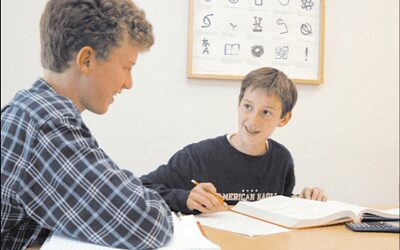
An adolescent plans while a parent offers a calm, nearby presence.
Preparing Our Homes for Independence
Montessori educators spend considerable time preparing classrooms so that children can manage as much of their daily life as possible. We can bring the same thinking into our homes.
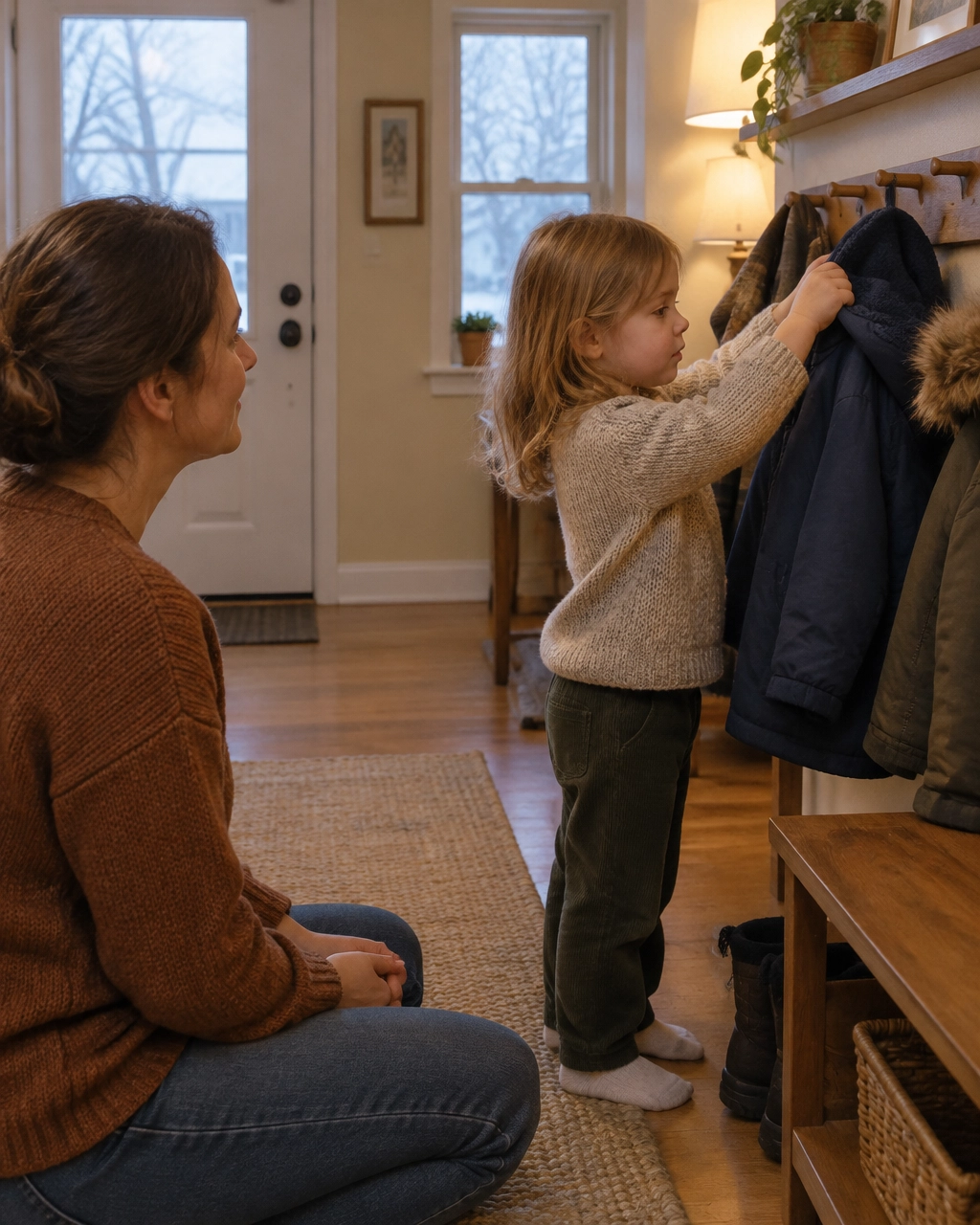
A low hook allows a young child to hang up a coat. A sturdy step stool makes it possible to reach the bathroom sink. A small pitcher allows a child to pour a drink independently.
Older children can benefit from having access to appropriate kitchen tools, laundry supplies, organized school materials, and a place to keep track of their responsibilities.
Often, children appear to need our help only because their surroundings were designed entirely for adults. A few simple adjustments can make a remarkable difference.
Growing Up Means Taking Over
As children grow older, opportunities for independence become increasingly important.
It can be tempting to remind them about every assignment, pack their belongings, organize their schedules, and rescue them from every forgotten responsibility. But at some point, they need to begin managing these things for themselves.
This does not happen suddenly on their eighteenth birthday. It develops gradually through years of practice, supported by reasonable expectations and caring adults.
Naturally, there are times when we must intervene. Safety, health, serious distress, and circumstances beyond a child’s developmental abilities all call for adult support. Independence is not abandonment. It is the gradual transfer of responsibility from parent to child.
A Small Experiment
Over the next few days, try noticing the moments when you automatically step in to help your child. Before doing so, ask yourself whether your child really needs your assistance or whether you are simply accustomed to providing it.
Perhaps you can wait a little longer. Perhaps you can offer a suggestion instead of taking over. Perhaps you can ask, “Would you like some help, or would you like to keep trying?”
You may discover that your child is capable of considerably more than you imagined.
One of the deepest expressions of our love for children is our willingness to help them become people who can manage their own lives. We want them to know that we will always be there for them, and we also want them to discover that, more and more, they can rely upon themselves.