Related Posts


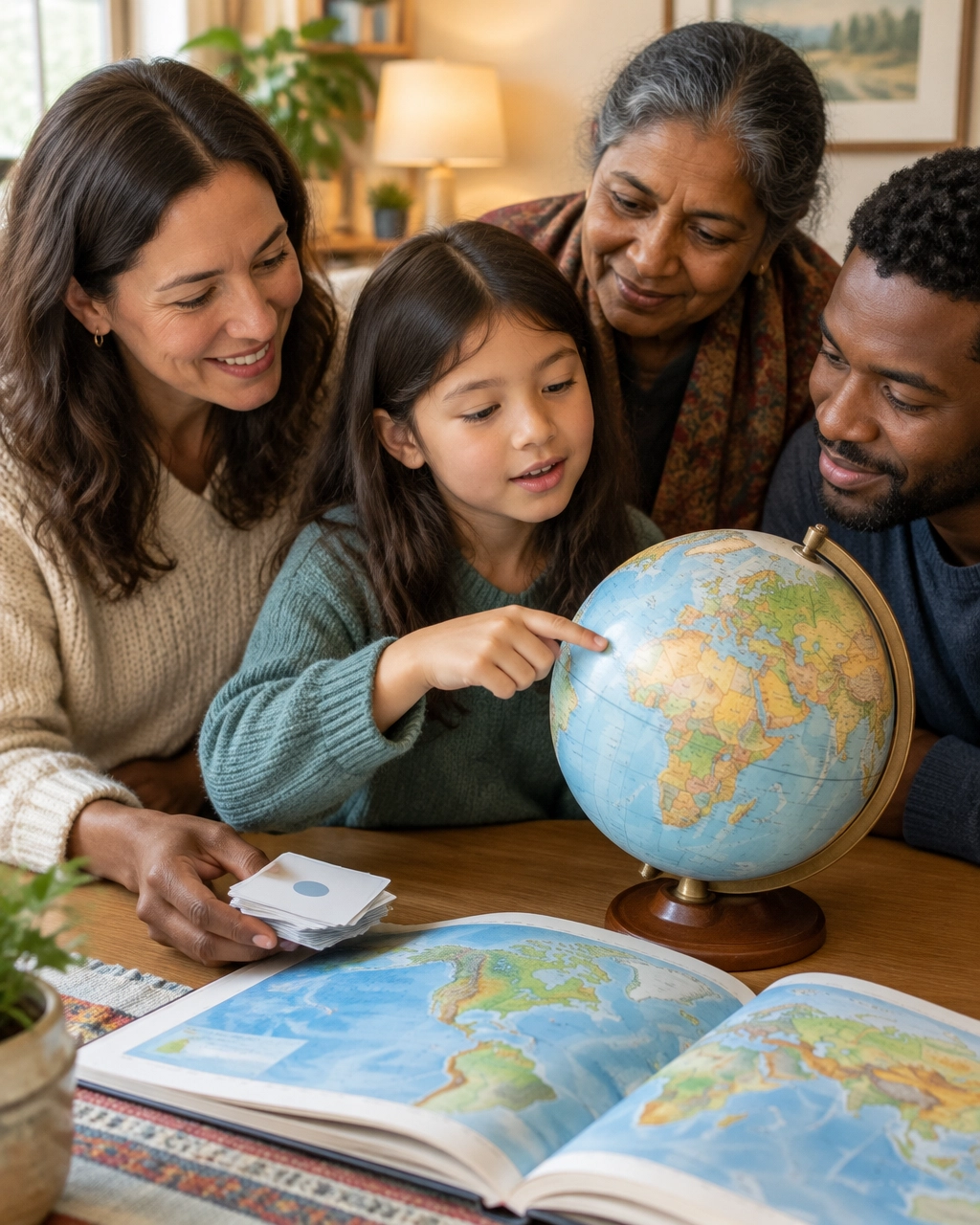
A family activity from Montessori Family Life
Can your child name these famous places?
A globe, a stack of picture cards, and a child who may know more than the grown-ups do.
Snapshot
Here is a game for the whole family. Look at twelve pictures of famous places from around the world and see who can name them and say what country they are in. Then find each one on a globe or map, pick one to learn more about, and let your child be the teacher.
Montessori children often surprise adults with how much they know about the world. A five-year-old may recognize the Taj Mahal. A seven-year-old may know where the Great Wall of China is. An older child might tell you something fascinating about the ancient Egyptians or the people who built Machu Picchu.
So let’s find out what everyone in your family knows.
How to play
Look at the twelve pictures together. Can you name each place? Do you know what country it is in?
Don’t worry about keeping score, unless everyone enjoys a little friendly competition. The real fun begins when someone says, “I know that one!” or “I’ve never seen that before!”
Once you have named the places, find each one on a globe or world map.
Choose one that interests your child, and discover something new about it together.
And here is a suggestion: let your child be the teacher. You may be surprised by what you learn.
1

One.
2

Two.
3

Three.
4

Four.
5

Five.
6

Six.
7

Seven.
8

Eight.
9

Nine.
10

Ten.
11

Eleven.
12

Twelve.
Answers, and something to discover
Each answer shows the continent in the color Montessori children know from the puzzle map and the globe.
Europe
Africa
Asia
North America
South America
Australia
1
The Eiffel Tower
Paris, France
Europe
It was built for a world’s fair in 1889 and was only supposed to stand for twenty years. It is repainted by hand about every seven years.
2
The Pyramids of Giza
Egypt
Africa
The Great Pyramid is about 4,500 years old and was built for a pharaoh named Khufu. It is made of more than two million stone blocks.
3
The Taj Mahal
Agra, India
Asia
The emperor Shah Jahan built it in memory of his wife, Mumtaz Mahal. Its white marble seems to change color, from pink at sunrise to gold in the evening.
4
The Great Wall
China
Asia
It was built and rebuilt over about 2,000 years. All its sections together stretch more than 13,000 miles. You may hear that you can see it from space, but astronauts say you can’t, at least not with your eyes alone.
5
The Statue of Liberty
New York, United States
North America
She was a gift from the people of France in 1886. Her copper skin was once shiny brown and slowly turned green in the weather. The iron frame inside was designed by Gustave Eiffel, the engineer of picture 1.
6
Machu Picchu
Peru
South America
The Inca built this town high in the Andes Mountains around 1450. Many of its stones fit together so tightly, with no mortar, that you cannot slide a knife blade between them. Llamas still wander there.
7
The Sydney Opera House
Sydney, Australia
Australia
It opened in 1973. Its roofs look like sails or seashells, and they are covered with more than a million tiles.
8
The Colosseum
Rome, Italy
Europe
It is almost 2,000 years old and could hold about 50,000 people, who came to watch gladiators and other shows.
9
Big Ben
London, England
Europe
Here is a surprise for the grown-ups: Big Ben is really the name of the giant bell inside. The tower is called the Elizabeth Tower. The bell weighs more than 13 tons.
10
Mount Fuji
Japan
Asia
It is the tallest mountain in Japan, at 12,388 feet. It is a volcano, though it has not erupted since 1707.
11
Chichen Itza
Mexico
North America
The Maya built this great stepped pyramid. Each of its four stairways has 91 steps. Add them up, plus the platform on top, and you get 365, one for every day of the year.
12
Mount Kilimanjaro
Tanzania
Africa
It is the tallest mountain in Africa, at 19,341 feet. Even though it stands near the equator, there is snow on top.
A family activity from Montessori Family Life.