Related Posts

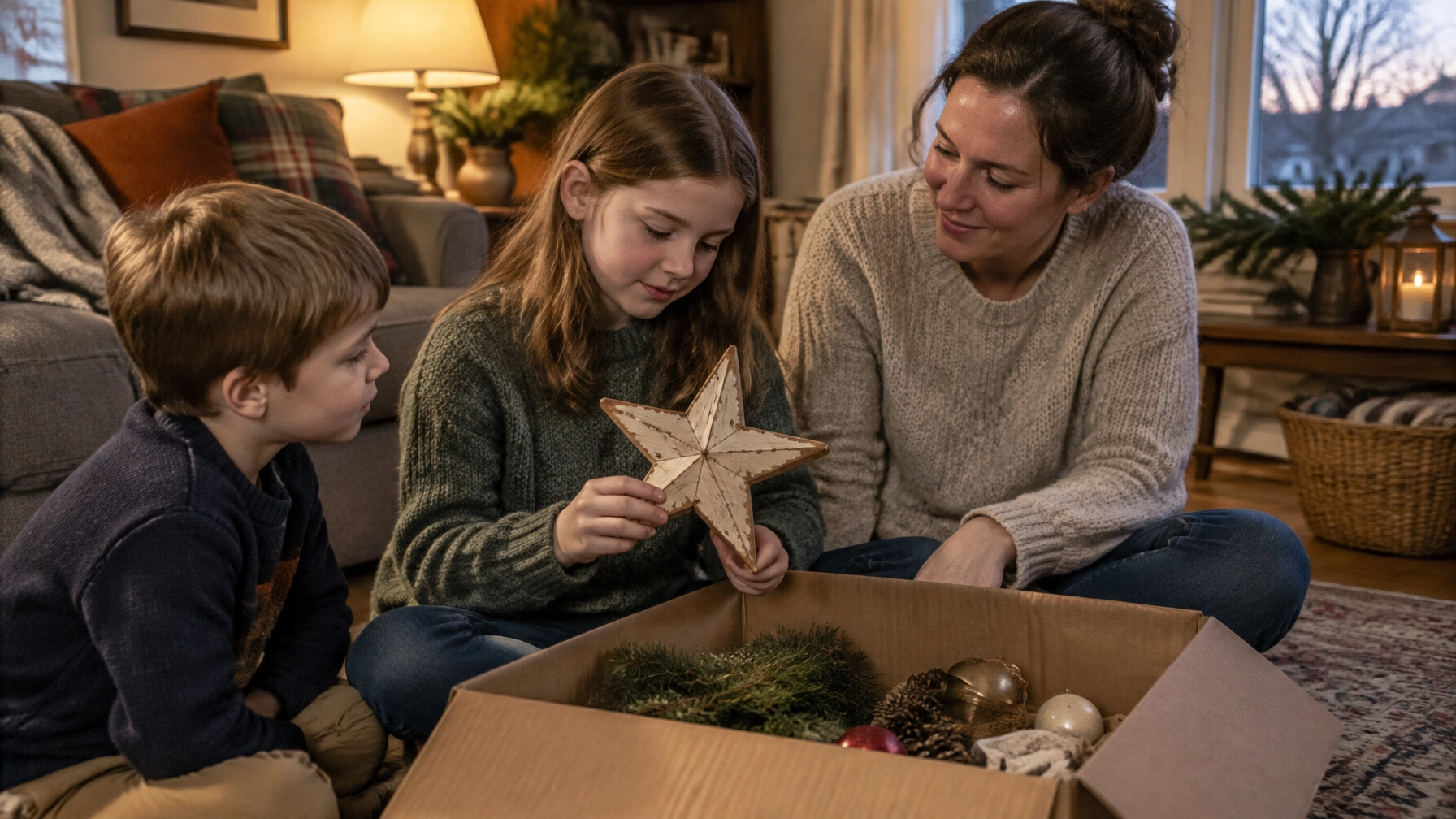
An old decoration can hold a story that belongs to the whole family.
Creating holiday rituals that give children a sense of belonging, continuity, and joy
Snapshot
Family traditions are more than pleasant customs. Repeated year after year, they give children something steady to hold on to in a world that is always changing, and a sense that they belong to something larger than themselves. The traditions that matter most are often simple: a favorite story, a walk to see the lights, pancakes on the same morning every year. As children grow, they can help keep traditions alive and even start new ones. Traditions can also change when life does, and they should never become a burden. What children carry with them is not the activity itself, but the feeling of love and belonging it leaves behind.
There are certain things we remember about childhood long after we’ve forgotten the details of individual days. The smell of something baking in the kitchen, a familiar song that everyone seems to know, decorations that appear in the same places year after year, and a special meal made only on holidays may all stay with us. So may the excitement of opening a box of ornaments, each one with its own little story, or a family tradition that seems perfectly ordinary until we discover that other families do things differently.
I remember how important these small rituals can become to children. An adult may see a slightly battered decoration that has survived twenty years of holiday celebrations. A child sees something that belongs to the holiday itself. It simply wouldn’t feel right without it.
We sometimes think of family traditions as pleasant customs, things we do because we’ve always done them. But I believe they serve a deeper purpose. Traditions help children experience continuity in a world that is constantly changing. They connect the past with the present, give children a sense of belonging, and create memories that may stay meaningful throughout their lives.
Why Children Love Things That Happen Again
Young children find comfort in repetition. They often want to hear the same story night after night. They enjoy familiar songs, predictable routines, and activities they know well.
A parent may grow tired of reading the same book for the twentieth time. But the child may find each repetition reassuring and satisfying. They know what comes next. They can say the words along with you. They can join in with growing confidence.
Family traditions offer a similar experience. The special breakfast on a holiday morning, the yearly visit to see seasonal decorations, the familiar recipe made together, and the walk the family takes after a celebration can all become landmarks in a child’s understanding of time. They help children notice the passing of the seasons and the rhythm of family life. And because children know what to expect, they can look forward to taking part. The anticipation itself becomes part of the pleasure.
Traditions Help Children Feel That They Belong
Children need to know that they are part of a community in which they are known, valued, and loved. In Montessori education, we work to build this sense of community through shared responsibilities, familiar routines, and meaningful participation.
Family traditions can offer something similar. When a child helps make the same special dish every year, they become part of a continuing family experience. When they hear stories about how a tradition began, they discover connections with the people and events that came before them. When they are trusted with a particular part of the celebration, they begin to see themselves as contributors rather than spectators.
Perhaps a grandparent always made a particular kind of bread. One year, a child learns to help. A few years later, that child can make it alone. Eventually, the recipe may become something they make for their own children. The tradition has become more than a memory. It has become something passed from one generation to the next.

Working together can make a family recipe part of a child’s own story.
The Traditions That Matter Most Are Often Simple
When we think about holiday traditions, it’s easy to imagine elaborate celebrations: beautiful decorations, special trips, expensive outings, and carefully planned meals. But some of the most meaningful traditions cost very little. Families might read a favorite story together, take an evening walk to look at holiday lights, make a simple breakfast or decorations from natural materials, sing familiar songs, play the same family game every year, or write a note to someone who lives far away.
These experiences become meaningful because they are repeated and shared. They don’t have to be impressive. In fact, children often become especially attached to traditions that adults consider rather ordinary.
Perhaps everyone drinks hot chocolate from the same mismatched mugs. Perhaps the family always makes pancakes on the morning after Thanksgiving. Perhaps a particular song is always played while decorating the house. The value lies not in how sophisticated the activity is but in the feeling that goes with it: “This is something our family does.”

A simple evening walk can become a familiar part of the season.
Let Children Become the Keepers of Traditions
As children grow, I encourage parents to give them more responsibility for family traditions. A preschooler might help arrange the decorations. An elementary-aged child could make a familiar recipe, organize a family game, or help younger brothers and sisters join in. An adolescent might take charge of planning part of a celebration.
Opportunities like these let traditions become something children help create, rather than something adults simply provide.
Children often have ideas of their own, too. One child may suggest a new holiday breakfast. Another may want to start a tradition of making handmade gifts. An older child may propose a family service project or a special outing.
We can welcome these ideas. Traditions need not stay frozen in time. They can grow as families grow. In fact, some of the most cherished family customs begin with a child’s suggestion.
Every Family Has Its Own Way of Celebrating
The winter holiday season brings together many different religious, cultural, and family traditions. Some families celebrate Christmas; others celebrate Hanukkah, Kwanzaa, or other religious and cultural observances. Some mark the winter solstice, while others celebrate the season without a religious holiday. And some families observe several traditions because their members come from different backgrounds.
Montessori education encourages children to develop respect for the richness and variety of human cultures, and family celebrations offer a natural place to begin. Children can learn about the customs their own families observe while also discovering that other families may celebrate differently.
A child might ask why a friend celebrates Hanukkah rather than Christmas. Another may wonder why some families exchange gifts on different days. Questions like these can open thoughtful conversations about history, culture, beliefs, and family life.
We don’t need to pretend that all traditions are the same. They aren’t. Each has its own meaning and history. But we can help children understand that people express belonging, gratitude, faith, remembrance, and joy in many different ways. Respect begins with curiosity and a willingness to listen.
When Families Have Different Traditions
Many families bring together people who grew up with different customs. One parent may have celebrated Christmas in a particular way, while another may have grown up in a different religious or cultural tradition. Grandparents may have strong feelings about how the holidays should be observed. Blended families may be combining traditions from several households.
These differences can enrich family life, but they can also create tension. Which traditions should be kept? Which ones should change? How do we make room for everyone?
I would encourage families to approach these questions with curiosity, rather than assuming that one way is necessarily right. Ask one another what particular traditions mean. What memories do they bring back? Why are they important? What would each person most like to keep?
Children can join these conversations in ways that suit their age, and they may have surprisingly thoughtful ideas for combining customs or creating something new.
The goal isn’t necessarily to include every possible tradition. It’s to create celebrations that reflect the people who make up the family today.
When Traditions Need to Change
One of the hard things about family traditions is that life doesn’t stay the same. Children grow older. Grandparents age. Families move. Relationships change. Someone who was always there may no longer be with us. A tradition that once brought joy may become difficult or impractical.
Perhaps the family can no longer travel to the same place every year. Perhaps a beloved relative who made the holiday meal has died. Perhaps parents have separated, and the children now divide their holidays between two homes.
Changes like these can be painful. Children may resist, insisting the celebration happen exactly as it always has. We can acknowledge their feelings.
“I know you miss the way we used to celebrate.”
“I miss that, too.”
Then we can explore what might still be possible. Perhaps you can make a familiar recipe in a new home. Perhaps a family story can be shared in memory of someone who has died. Perhaps a tradition can be adapted to fit a different schedule. And sometimes a family may decide to create something entirely new.
Traditions can help us remember the past without requiring us to live in it.
When the Holidays Bring Sadness
We sometimes assume that the holidays should be joyful for everyone. But they can also bring sadness. A child may be missing a parent or grandparent. A family may be going through money troubles. Someone may be ill. A recent move may have separated children from familiar friends and places. Or the holiday may remind family members of experiences they would rather forget.
At times like these, it is especially important not to feel pressure to create a perfect celebration. A quiet, simple holiday may be exactly what a family needs.
Children should know they can feel more than one thing at once. They can enjoy a celebration while also missing someone. They can feel grateful and sad at the same time. They can appreciate a new tradition while still wishing an old one could continue.
Mixed feelings like these are part of being human. Adults around children can help by listening, rather than insisting everyone be cheerful.
Create Traditions That Reflect Your Family’s Values
As parents, we have an opportunity to think carefully about the traditions we establish. What do we want our children to remember? What values do we hope they will carry into adulthood?
If generosity matters to us, perhaps we start a tradition of helping others. If we value nature, perhaps we take a seasonal walk or make decorations from natural materials. If family relationships are important, perhaps we make time each year to share stories, photographs, or favorite recipes. If we value learning about other cultures, perhaps we explore the history and meaning of different celebrations. And if we want children to appreciate beauty, perhaps we invite them to help create a peaceful, welcoming home.
The traditions themselves need not be elaborate. What matters is that they express something true about the life we want to share.
Don’t Let Traditions Become Obligations
I have one caution. Sometimes families collect so many traditions that the holidays become exhausting. We feel we must decorate in a particular way, make certain foods, attend every event, visit every relative, and repeat every activity from years past.
What began as a source of joy can become another item on the list of responsibilities. Children may sense the tension. Parents may feel overwhelmed. And the very traditions meant to bring families together may leave everyone tired and frustrated.
It’s worth asking from time to time whether a particular tradition still brings pleasure and meaning. Perhaps some customs can be simplified. Perhaps others can be retired. Perhaps the children are ready for something different.
A tradition should serve the family. The family shouldn’t become a servant to the tradition.
The Memories Children Carry Into Adulthood
As children grow, they gradually build lives of their own. They form friendships, pursue interests, and eventually create households and families that may look quite different from the ones they grew up in. But certain memories remain: the familiar smells of a holiday kitchen, the decorations that appeared every year, the songs everyone knew, the stories told around the table, and the special ways the family welcomed guests, remembered loved ones, or marked the changing seasons.
Some traditions will be kept. Others will be adapted. And some will eventually give way to new customs that reflect another generation’s experience. That’s as it should be.
The purpose of family traditions is not to make sure our children repeat everything exactly as we did. It is to give them experiences of love, belonging, beauty, and connection that they can carry forward in their own ways.
As Thanksgiving arrives and the winter holidays approach, I hope families will take time to enjoy the customs that make their celebrations meaningful. But I also hope we’ll remember that the most important part of any tradition is not the decoration, the recipe, or the activity itself. It’s the people who share it. It’s the sense of belonging. It’s the memories created through years of ordinary, loving repetition. And it’s the knowledge that each generation has something to contribute to the continuing story of family life.
The traditions children carry with them are not simply the things we do each year. They are the feelings of love, connection, and belonging that those experiences leave behind.