Related Posts
Gratitude is more than good manners. It is a way of seeing the world.
Snapshot
Every Thanksgiving, families go around the table saying what they are thankful for. But teaching children to say thank you is not the same as helping them feel grateful. Real gratitude begins with noticing the care that surrounds us every day, and it grows when children help with the real work of family life, see the effort behind ordinary comforts, and find their own ways to show appreciation. It grows best from empathy and generosity, not from guilt or pressure. Above all, children learn it by watching how the adults around them treat other people.
Thanksgiving is almost here, and in homes across the country, parents will be encouraging their children to think about what they are thankful for. Perhaps everyone will take a turn around the dinner table.
“I’m thankful for my family.”
“I’m thankful for my friends.”
“I’m thankful for our dog.”
And somewhere, a young child will probably announce, “I’m thankful for pumpkin pie!”
There’s nothing wrong with any of these answers. But I wonder whether we sometimes confuse teaching children to say they’re thankful with helping them actually feel gratitude. The two are not quite the same.
A child can learn to say “thank you” automatically, without giving much thought to the kindness behind a gift or gesture. Another child may feel deeply appreciative but become embarrassed when asked to say so in front of a room full of relatives. And a third may truly believe that everything good in life simply appears because adults make it happen.
How do we help children move beyond the words and develop a deeper appreciation for the people, experiences, and everyday blessings in their lives? I believe the answer begins with how we live together.
Gratitude Begins With Noticing
Think about the ordinary things that happen in a child’s day. Someone makes breakfast, someone washes the clothes, a teacher helps a child understand something difficult, a friend shares a favorite toy, a grandparent remembers a birthday, and a neighbor brings over something from the garden.
These small acts of kindness and care are so familiar that children may barely notice them. Adults often overlook them, too.
One of the simplest ways to encourage gratitude is to help children become more observant. Not by constantly reminding them how fortunate they are, but by pointing out the care that surrounds them.
“Grandpa remembered how much you love strawberries.” “Your sister spent a long time making that card for you.” “Look how carefully the gardener has cared for these flowers.”
Observations like these invite children to recognize that someone has given time, thought, or effort to make life better for another person. And that’s where gratitude begins.
Why Forced Gratitude Doesn’t Always Work
Most parents know the awkward moment when someone gives a child a present and the child forgets to say thank you. We prompt them right away: “What do you say?” Sometimes we repeat the question with growing urgency, and the child eventually mumbles the expected words.
But what has actually been learned?
Certainly, manners matter. Children need to learn the social customs that help people live together respectfully. In Montessori classrooms, we teach these through what we call grace and courtesy. We show children how to greet someone, offer help, interrupt politely, and express appreciation.
But teaching a social skill is different from demanding an emotional performance.
A young child may need time to take in a gift, a shy child may find public attention overwhelming, and another may be disappointed because the gift wasn’t what they expected.
We can still teach courtesy without embarrassing the child or insisting that they feel something they don’t yet feel. Before a birthday or holiday gathering, we might practice what to say when receiving a gift. We can model appreciation ourselves. And if a child forgets, we can offer a quiet reminder rather than turning the moment into a public confrontation.
The goal is to help children become gracious, not merely obedient.
Let Children See the Work Behind Everyday Life
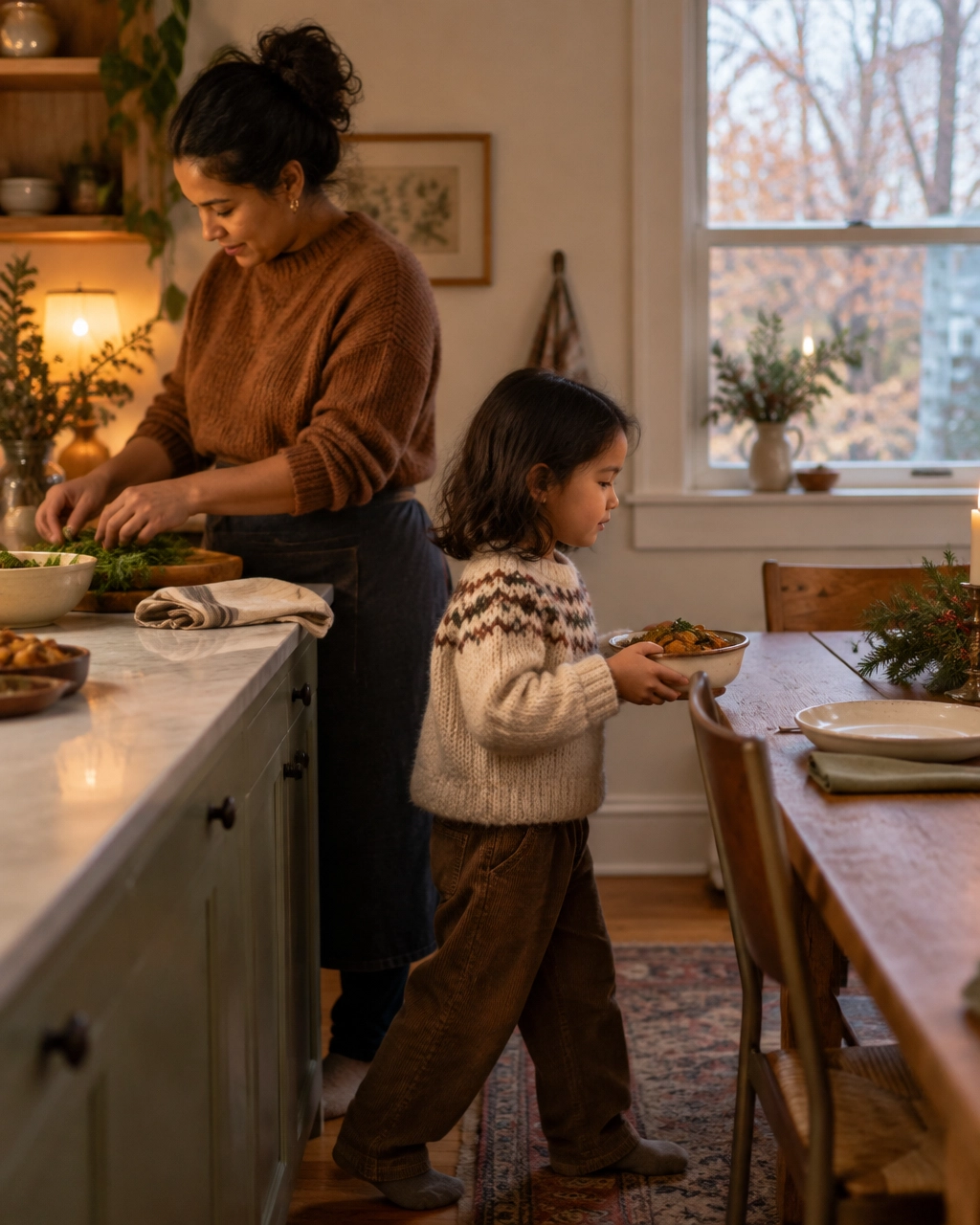
One reason Montessori education places such importance on practical life activities is that children learn by taking part. When children help prepare meals, wash dishes, care for plants, or look after their surroundings, they begin to understand the effort involved in everyday life.
A child who has helped bake bread may appreciate the work behind a loaf. A child who has grown vegetables may look at food differently. A child who helps with the family laundry begins to see that clean clothes don’t simply appear in drawers.

Shared everyday work gives children a chance to contribute.
Experiences like these nurture appreciation in a way lectures rarely do. Children discover that comfort, beauty, and order come from human effort. They also learn that they can contribute.
In this way, gratitude and responsibility begin to strengthen each other. We appreciate what others do for us, and we recognize that we have something to offer in return.
The Difference Between Gratitude and Guilt
Sometimes adults try to encourage gratitude by reminding children how much less fortunate other people are.
“Some children don’t have any toys.” “You should be grateful. Other families don’t have enough to eat.”
These statements may be true, but they can leave children feeling guilty rather than grateful. They may also, without meaning to, encourage children to see people who are poor or struggling mainly as examples of what they should be thankful to have avoided.
I would encourage a different approach. We can help children understand that people live in different circumstances, and that everyone deserves dignity, kindness, and opportunity. We can talk about unfairness honestly. We can invite children to take part in helping others. But we don’t need to make them feel ashamed of the good things in their own lives.
Gratitude grows best when it is rooted in appreciation, empathy, and generosity rather than guilt.
Help Children Express Appreciation in Their Own Ways
Not every expression of gratitude needs to be spoken.
A young child may draw a picture for someone who has been kind, an elementary child might write a short note, and an adolescent may offer to help someone who has supported them.
Sometimes a warm smile or an unexpected act of kindness says more than a formal speech.
We can encourage children to think about the person they’re thanking.
“What do you think Grandma would like to hear about the sweater she made for you?” “Would you like to draw a picture for your teacher?” “Your friend helped you with that project. Is there something thoughtful you could do for her?”
The important thing is that the thanks grows out of a real relationship. We want children to discover that gratitude is not simply a rule of politeness. It’s a way of recognizing the good that other people bring into our lives.
Gratitude Is Also About the Natural World
Montessori education encourages children to develop a deep relationship with nature. When children spend time outdoors, they begin to notice things that adults sometimes overlook: the first flower of spring, a bird building a nest, the changing colors of autumn leaves, the remarkable structure of a spider’s web, and the quiet beauty of a winter morning.

Sometimes it is enough to pause together and notice.
Experiences like these nurture wonder and appreciation. We don’t need to turn every walk into a lesson. Sometimes it’s enough to stop and notice.
“Look at the colors in that tree.” “Listen to the birds.” “Isn’t it remarkable how that tiny seed became such a big plant?”
A child who grows fond of the natural world may gradually develop a stronger sense of responsibility for it. Appreciation can become the foundation for caring for the earth.
Be Careful About Making Gratitude Another Assignment
There are many lovely ideas for family gratitude journals, thankful trees, and daily gratitude rituals. Some families enjoy these traditions. Others find that they become one more obligation in an already crowded day.
I wouldn’t insist that every family needs a formal gratitude practice. What matters more is the atmosphere of everyday life.
Do we notice when someone has helped us? Do we thank the people who serve us? Do we appreciate the work of teachers, caregivers, neighbors, and family members? Do we acknowledge kindness when we see it?
Children are extraordinarily observant. They notice how we treat people, and they often learn more from our example than from our instructions.
Thanksgiving as an Invitation
Thanksgiving offers a natural opportunity to talk about appreciation. But it doesn’t need to become an occasion when children are required to produce a list of things they’re thankful for. Instead, we might invite them to tell a story.
“Who did something kind for you this year?” “Was there a time when someone helped you when you really needed it?” “What’s something beautiful you noticed recently?” “Who would you like to thank?”
Questions like these invite reflection without demanding a particular answer.
And if a child says they’re thankful for pumpkin pie, perhaps we can smile and ask, “What do you love about it?” Maybe they’ll tell us they helped make it with Grandma. Maybe they’ll remember the wonderful smell in the kitchen. Or perhaps they’ll simply say it tastes delicious.
That’s all right, too. Gratitude doesn’t always need to be profound. Sometimes appreciation begins with the simple pleasure of enjoying something good.
Raising Children Who Appreciate Life
I don’t believe we can make children grateful simply by telling them to be grateful. But there is a great deal we can do.
We can teach manners. We can model appreciation. We can invite children into meaningful work and relationships. We can help them notice others’ contributions and the beauty of the world. We can give them chances to show kindness and appreciation in ways that feel true to them.
Over time, these experiences may help children develop something far more valuable than the habit of saying the right words. They may develop a real appreciation for life.
This Thanksgiving, I hope families will enjoy the traditions, the food, and the pleasure of being together. But I also hope we’ll remember that gratitude isn’t something to save for one special day. It’s something we can practice in the ordinary moments of family life, all year long.
The deepest gratitude isn’t simply knowing what to say. It’s learning to recognize how much of the good in our lives comes from others’ care, generosity, and effort.