Related Posts
Why the holidays are a wonderful time to share family memories, connect generations, and help children discover where they belong
Snapshot
When families gather for the holidays, the conversation often turns to old memories: the year the turkey wasn’t cooked, the time Dad got in trouble as a boy, what Grandma’s childhood was like. These stories do more than entertain. They help children see the adults in their lives as real people, understand that growing up is something everyone goes through, and feel that they belong to a family with a history. This Thanksgiving, make a little room for storytelling. Bring out an old photograph, ask a grandparent a question, and invite the children to tell their own stories, too.
Imagine a family gathered around the Thanksgiving table.
The dishes have been passed, everyone has eaten more than they intended, and the conversation begins to wander. Someone remembers a Thanksgiving many years ago when the turkey wasn’t quite cooked. An uncle tells about the time he and his brother tried to surprise their mother by making breakfast and nearly set the kitchen on fire. A grandmother remembers what holidays were like when she was a little girl.
The children listen. Perhaps they laugh. Perhaps they interrupt with questions. Perhaps one of them says, “You mean Dad used to get in trouble, too?”
And suddenly, something wonderful happens. The children begin to see the adults around them differently. Mom and Dad were once children. Grandma had a mother and father of her own. Families have lived in different places, faced challenges, made mistakes, celebrated successes, and changed over time.
These stories are more than entertainment. They help children understand who they are and where they belong.

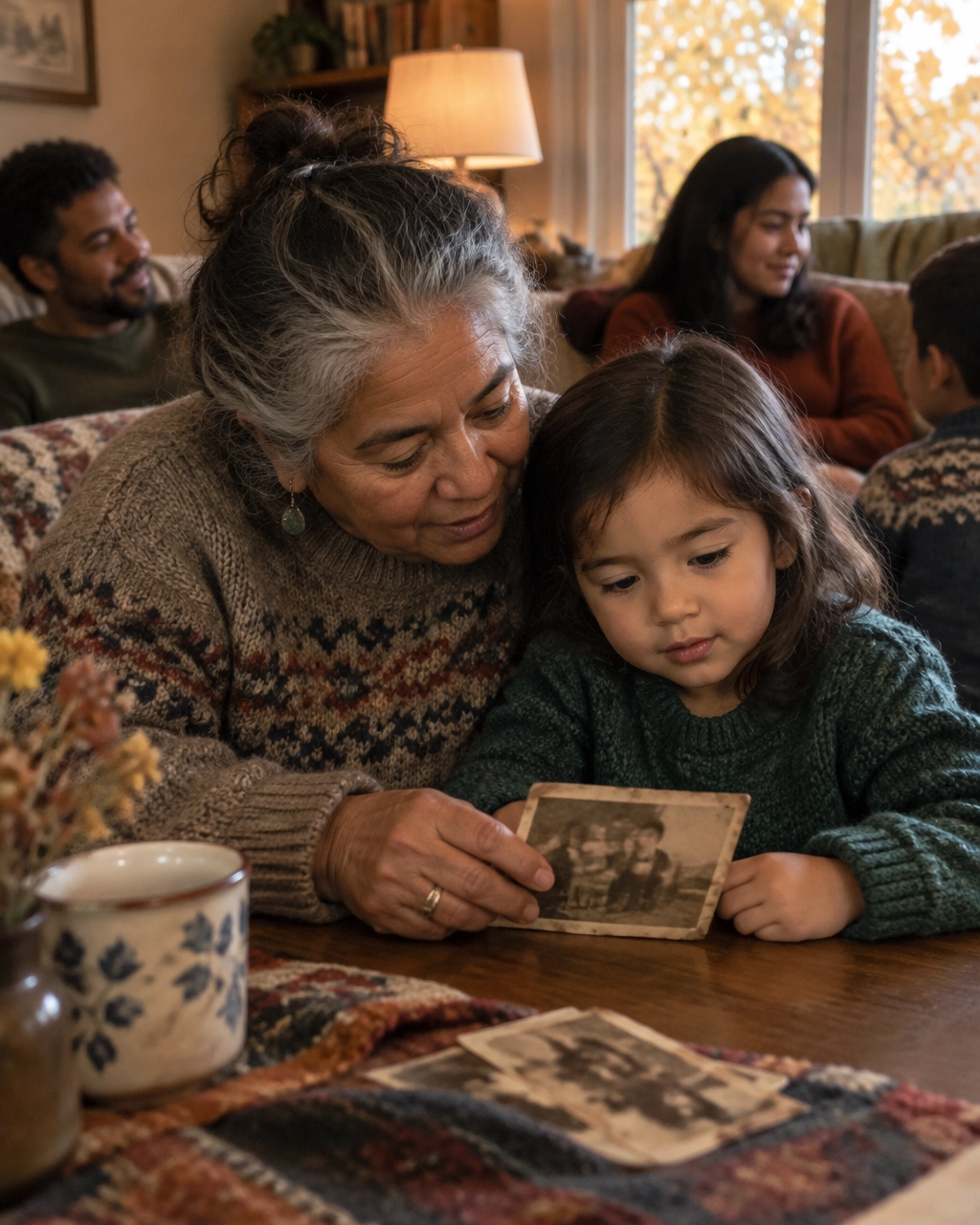
Conversation can wander naturally as family members share memories.
Every Family Has a Story
When we think about family history, we sometimes imagine elaborate genealogical research, old documents, or carefully drawn family trees. Those things can be fascinating, but family history is also found in ordinary memories.
How did your parents meet? What was your first home like? What games did you play when you were little? Who taught you to cook? What did you do when you were frightened? What was the funniest thing that ever happened at school?
Children are often delighted to discover that their parents and grandparents were once young, uncertain, mischievous, and occasionally afraid. It makes the adults in their lives seem more human, and it helps children see that growing up is a journey everyone takes.
A child struggling to learn something difficult may be reassured to hear that a parent once struggled with the same thing. A child who feels embarrassed about a mistake may enjoy hearing about a grandparent’s childhood mishap. A child who is anxious about a change may find comfort in learning how other family members adjusted to unfamiliar situations.
Family stories can offer perspective without turning every conversation into a lesson. Sometimes the story itself is enough.
The Importance of Belonging
One of the fundamental needs of childhood is the feeling of belonging. Children need to know that they have a place in the world and that they matter to the people around them.
In Montessori education, we work to create communities in which children experience themselves as valued members of a larger group. They contribute to classroom life, build relationships with children of different ages, and gradually come to understand their responsibilities toward others.
Family life offers another powerful experience of community. When children hear stories about the people who came before them, they begin to recognize that their lives are connected to something larger than themselves. They discover that they are part of a continuing story. That story may include grandparents and great-grandparents, relatives who live far away, cherished friends who have become family, and people who still matter to us even though they are no longer living.
Not every family follows a traditional pattern. Some children live with one parent, some with grandparents, some in blended or adoptive families, and others in arrangements that reflect the many ways people care for one another.
What matters is not the shape of the family. What matters is helping children understand that they are loved, that their relationships have meaning, and that they belong.
Let Children Discover the People Behind the Names
Family photographs are wonderful invitations to conversation. Instead of simply naming the people in a picture, tell children something about them.
“This was your grandfather when he was about your age. He loved climbing trees.” “That’s your aunt when she was in elementary school. She wanted to become a veterinarian.” “This was our first apartment. We had almost no furniture, but we were so excited to live there.”
Children are often most interested in the small details.
What did people wear? What did their bedrooms look like? Did they have pets? What did they eat for breakfast? Did they have televisions or computers? What did they do for fun?
Questions like these open doors to history, geography, culture, and changing ways of life. An old photograph of a grandparent’s childhood home might lead to a conversation about how people lived fifty or seventy years ago. A story about a relative who came from another country might spark curiosity about geography, language, food, and cultural traditions. A memory of life before smartphones might lead to an interesting discussion about how people kept in touch and entertained themselves.
This is very much in keeping with Montessori’s approach to learning. We begin with something real and personally meaningful, and then let curiosity lead us out into the larger world.
Tell Stories About Difficult Times, Too
Family stories don’t all have to be cheerful. Every family experiences disappointment, loss, uncertainty, and change, and children can benefit from hearing age-appropriate stories about how people faced hard times and found ways to carry on.
Perhaps a grandparent grew up when money was scarce. Perhaps a parent struggled to make friends after moving to a new school. Perhaps a family member had a serious disappointment and eventually found a different path.
Stories like these help children understand that difficulties are part of life, and that people can meet them with courage, creativity, and help from others.
But we should be thoughtful about how much we share. Young children don’t need to carry adult worries or frightening details they cannot yet understand. And family stories should never be used to suggest that a child has no right to feel unhappy because earlier generations had harder lives.
The purpose is not to compare suffering. It is to help children understand that families experience both joy and hardship, and that people often find strength in one another.
Ask Questions That Invite Stories
Sometimes adults need a little encouragement to begin reminiscing, and a family gathering offers a natural opportunity. Instead of asking anyone to make a speech, try introducing a question into the conversation.
“What was your favorite thing to do when you were ten?” “What was the best holiday gift you ever received?” “Who was your favorite teacher, and why?” “What did your family do on Sunday afternoons?” “What was something you were afraid of when you were young?” “What family tradition do you remember most fondly?”
Children can ask questions of their own. In fact, some of the most interesting conversations begin with questions adults would never think to ask. A child may want to know whether Grandpa was ever sent to the principal’s office, whether Grandma liked vegetables when she was little, or whether Mom and Dad ever argued with their brothers and sisters.
Let the conversation wander. The goal isn’t to conduct a formal interview. It’s to enjoy discovering one another.
Give Children a Role in Preserving Family Memories
Older children may enjoy taking family storytelling a step further.
An elementary-aged child could interview a grandparent and write down the answers. Another might make a family scrapbook with photographs, drawings, and short stories. A child who enjoys technology might record a relative telling a favorite memory, with that person’s permission. The family might put together a collection of favorite recipes, along with the stories behind them.
Why does Grandma always make that particular dish? Who taught her the recipe? Was it something her family made when she was young? A handwritten recipe card can become a treasured family keepsake.
Children can also make simple family timelines, or maps showing the places where relatives have lived. Activities like these connect naturally to the Montessori emphasis on history, geography, language, and meaningful independent work.
But I would avoid turning every family gathering into a project. Sometimes the most valuable thing children can do is listen, laugh, ask questions, and enjoy the people around them.
Make Room for the Stories of Children
We sometimes overlook another side of family storytelling. Children have stories, too. Their experiences may seem small compared to adults’, but they matter to them.
A preschooler may want to tell everyone about the enormous worm discovered in the garden. An elementary child may have a story about something that happened at school. An adolescent may want to share an experience with friends or describe something they’re learning.
We can help children become confident storytellers by listening with real interest. We can ask questions. We can give them time to find their words. And we can resist the temptation to interrupt, correct every detail, or take over the conversation.
Children learn the art of conversation by taking part in it. They learn that stories are something we share, not simply something adults tell while children listen.
When Family Gatherings Are Complicated
Of course, not every holiday gathering is warm and harmonious. Some families are separated by distance. Some are grieving someone who is missing from the table. Others are going through divorce, strained relationships, illness, or painful memories.
For some children, questions about family history can be sensitive, especially when parts of their own story are unknown or painful. We should never assume that every child wants to discuss every part of their background. Nor should we pressure relatives to share memories they would prefer to keep private. Family storytelling should be an invitation, not an obligation.
We can also be thoughtful about which stories we tell. Children deserve truthful, respectful accounts of their lives, shared in ways that suit their age and circumstances.
Sometimes a family tradition begins not with the people who came before us, but with the people who are here now.
A parent and child might start a new Thanksgiving ritual. A blended family might begin collecting memories of the things they have done together. A family far from relatives might invite friends to join its holiday celebrations.
Belonging is not limited to the past. It is something we keep creating.
The Stories We Tell Become Part of Us
As children grow, they begin building their own understanding of who they are: their abilities, their interests, their relationships, and their place in the world. Family stories can become part of that understanding.
A child may remember hearing that an aunt loved science. Another may take pride in learning that a grandparent was a talented gardener. Someone else may discover a connection with a relative who loved books, music, animals, or working with their hands.
These connections don’t determine who a child will become. Every child has the right to develop an identity of their own. But family stories can give children a sense of continuity. They remind children that their lives are connected to other lives, and that the people who love them have histories of their own.

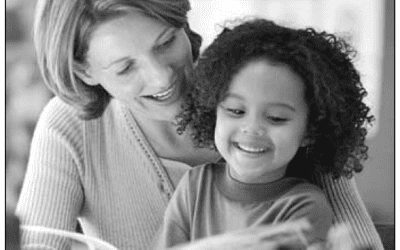
Children’s questions and attentive listening give stories room to unfold.
This Thanksgiving, Tell a Story
As Thanksgiving approaches, I would encourage families to make a little room for storytelling. Not as one more holiday activity to organize, and not as a performance. Simply as part of being together.
Bring out an old photograph. Ask a grandparent about their childhood. Tell your children about a funny mistake you made when you were young. Share the story behind a family recipe. Remember someone who is no longer with you.
And invite the children to tell their stories, too.
Years from now, your children may not remember every dish served at Thanksgiving dinner, or the decorations, or how the table was set. But they may remember the afternoon Grandpa told them about his first bicycle, or the evening Mom described the house where she grew up, or the laughter that followed a story nobody had heard before.
Most of all, they may remember the feeling of being surrounded by people whose lives were connected to their own.

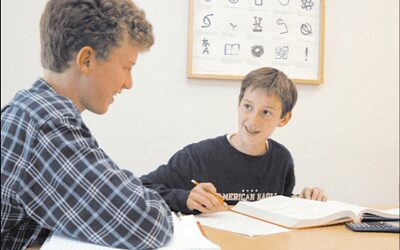
An older child can preserve a memory by listening and writing it down.
Every family has stories worth telling. And every child deserves to know that they are part of a story still being written.