We hear a lot of talk about the Montessori Materials, but what exactly are those materials? How do we determine if something ‘qualifies’ as being ‘Montessori’ or not?
There is a list of characteristics that must be considered when creating a Montessori Material. Dr. Montessori developed this list because she knew that science is always advancing. The materials she developed in the early 1900s would necessarily need to evolve as our understanding of the world and human development grew.
At the top of her list were the age and abilities of the student (from birth to dementia care). She knew that all materials must be sized to match the size of the humans they are designed to teach and be matched to the capacities of those humans. So, the materials will necessarily differ when used to teach young children as compared with adolescents or adults. Beyond that core, the material should have most (if not all) of the following attributes:
Self-teaching (auto didactic): In Montessori, we say that it is the materials that teach. The teacher (more commonly known as a ‘guide’) is there to inspire the child to use the material and show them how to use it. But it is not the teacher who teaches. It is the student’s repeated, uninterrupted experience, using the materials towards their intelligent purpose, that leads to learning.
Control of Error: The material should allow the students to discover and correct their own errors without the need for teacher intervention. When an authority figure comes in and offers a correction, there is a chance that this will trigger a stress response in the learner.
Think about when your boss or parent tells you that you are doing something wrong. How well can you hear that? But, if your friend tells you, it’s usually not a big deal and is seen as helpful, right? So, in Montessori, we try to let the students discover and fix their own errors. Designing activities that allow students to recognize their errors without help is key. For example, the Three-Part Cards (developed by Maria Montessori) are a reading activity where students:
lay out an image of an object,
read a word label and match it to that image, and
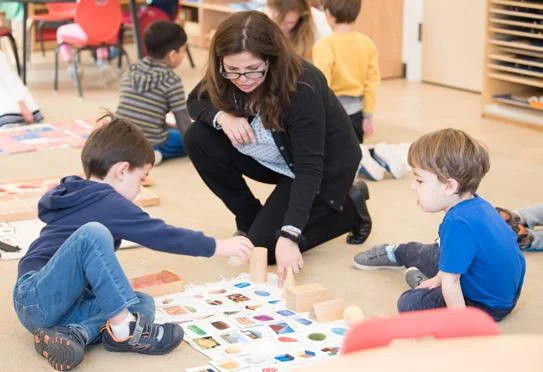
use a control card (which includes the image and its name on one card) to check their own work. The control card acts as the control of error. So, if a student places the label ‘peach’ under a picture of a watermelon, the control card will show them that they are wrong. No one else needs to be involved. We learn so much more from seeing our own errors than from being corrected by others.
Intelligent/Purposeful Uses: If you agree with the concept that the materials teach the student, then the student must have ways of using the material, repeatedly, that encourages them to master what the material presents. Typically, the adult teacher/guide will show the student specific ways of using the material, but, sometimes, the student learns by watching other students or by receiving a lesson from another student. The key here is that there are specific ways of using the material towards an intelligent end.
For example, the Number Rods are lined up, aligned on the left, to help children learn about quantity and its connection with length (e.g., the one rod is incrementally smaller than the two rod and the three rod, etc.). If a child picks up a rod and uses it like a light saber, that is not an intelligent end! It’s not helping the child to understand what it is that the material teaches. So, when we see a child do this, we might approach them and say, “I love Star Wars too! But the number rods are so special. We must use them for counting work. Let’s carefully put this back, and I’ll show you again how we use them.”
Movement: Humans need to move. Period. At all ages, but particularly in Early Childhood, movement must be incorporated into the activities. This is why you don’t see children sitting lined up at desks in Montessori classrooms. Movement is not just a biological need; it is a way to help maintain the student’s interest in the materials and extend their attention span. When a student uses a material that requires complex movement, the child must be aware of and focused on their movement to achieve the desired end. Dr. Montessori called this type of movement “synthetic movement.” Think about it like a choreographed dance. There are certain steps we must remember when we do the complex activity of flower arranging. It’s like a ceremony where there is a place for everything and a logical sequence to follow to elegantly complete the activity. Memorizing and practicing this movement pattern strengthens the brain in innumerable ways.
Isolation of a Stimulus: Each material and lesson slowly adds in one more level of complexity. Why? Because we are always trying to isolate the concept being taught. So, for example, the first time we teach children how to use the Moveable Alphabet, we don’t actually write any words. Instead, we just show them how to carry the box and take letters out of and put letters back into the box. Why? Because for a four-year-old, that is a complex series of movements, right? And if we skip this step, you will see alphabets being dropped all the time. Then, the children become averse to using the alphabets; they associate them with disaster. See how that happens? If we isolate one concept at a time, we prepare the student to succeed with whatever it is they are doing. So, one thing at a time is always the motto. It’s better that the student thinks they are too smart for the work than that the work is too smart for the student.
Refinement of the Senses: In the big picture, this means going from greater contrasts to finer gradations of difference. This concept is particularly relevant for Early Childhood, the time when the brain and body are synchronizing sensory perception. As an example, think about the fine-art cards. We introduce cards that show art from around the world first, and then we home in on art from the child’s continent and go deeper into many examples of art from within one continent. See what I mean?
Vocabulary: We always want to teach the student the names of everything we offer them. This is particularly important in Early Childhood when the child is in a sensitive period for learning language(s). In Early Childhood, we give the children a physical experience with an object before we name it. For example, when we introduce the Geometric Solids (a three-dimensional cone, cube, rectangular prism, etc.), we guide them to touch and feel the objects first, before we name them. And, when we introduce a Practical Life activity (something we do every day), we show the movements of the activity without any language at all, so that the child can focus on the movement. Then, once they have experience with the items involved, we give Three Period Lessons on everything.
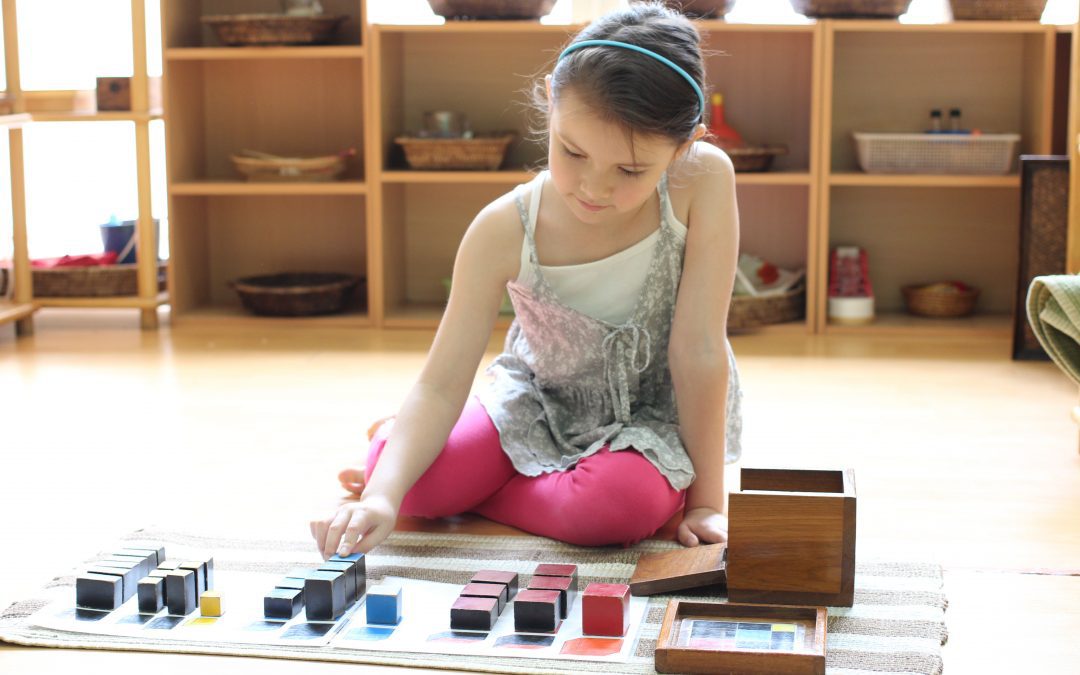
Materialized Abstraction: This may be the coolest concept Dr. Montessori discovered. It refers specifically to Math and Sensorial materials because those represent abstract concepts in a concrete way. When we think about color, for example, we can’t find anything that is red without being a red something. So, Dr. Montessori designed color tablets that are identical in every way except for their color. That makes the abstract idea of red a real thing.
Aesthetically appealing: Because we are inspiring students to use the materials rather than requiring them to do so, we need the materials to be enticing. They need to be beautiful, clean, and in good order. No one wants to pick up dusty cards! That’s why things like cloth pouches to protect and beautifully display materials are so important in Montessori environments.
Indirect preparation: While many Montessori materials directly prepare a child for something (like the Phonetic 3-Part Cards prepare them to read books independently), some materials are creating a foundation that is somewhat indirect. So, by showing a child how to scrub a table, we are indirectly preparing their hand to use a pencil. How? Because we show them to scrub in circles (like cursive handwriting) from left to right and top to bottom (the direction of English). It also strengthens their muscles and refines their motor coordination so they can control their hand in space. And yes, we are this thoughtful about everything we do in the classroom! That’s what we call a ‘prepared learning environment.’
Repetition: We’ve all heard the phrase, “practice makes perfect.” But, in neuroscience, we say, “practice makes permanent.” Anything we do repeatedly the brain gets more efficient at doing. So, the materials should allow and even invite the child to repeatedly use them.
Diagnostic Value: A key aspect of the Montessori approach (which is actually just the scientific method applied to education) is the importance of observation in understanding the humans we are working with. We must observe their behaviors to learn what we can about their developmental needs. The materials can help us do this. So, for example, if we suspect that a child may have a hearing challenge, we notice if they are able to place items down without making a sound, if they notice that something is noisy, if they can hear the difference in the sound cylinders, etc. Because the materials isolate stimuli, they also isolate a possible learning roadblock or challenge. By observing how the student is able (or not able) to interact with a material, we open a window into that student’s development.
Memory Training: In everything we do, we are subtly training the students’ attention and memory. We invite them to repeat what they have learned when they use a material again and again. This demonstrates their memory of what they have been shown. Even something as seemingly basic as asking a student to locate a material within the room is challenging their memory.
The materials you already find in an authentic Montessori school have been designed with these characteristics in mind. Each material might not contain every characteristic, but they will embody many, if not most, of them. The key here is that the materials meet the innate needs of human development, no matter the student’s age.
Julia Volkman is the Founder/President of Maitri Learning and a Teaching Fellow in the Neuroscience of Learning course at Harvard University (Extension School). Among other things, she has also been a consultant and thought partner with the National Center for Montessori in the Public Sector (NCMPS), an Advisory Panel Member for and contributor to the Annenberg Foundation’s Neuroscience & the Classroom course, and a Dekyong at Buddhist family camp. Ms. Volkman earned her AMI 3 to 6+ diploma from the Montreal Montessori Training Centre, a bilingual program. She earned her master’s degree from Harvard Extension School, where she won the Dean’s Prize for her research on preschool literacy/the Montessori Movable Alphabet. Most importantly, she is the mother of a young adult (by birth) and a high school sophomore (by adoption) who have taught her most of what she knows. She enjoys hiking with her new puppy, kayaking, researching, and conversing with her family at the dinner table. You can read more about Maitri Learning at maitrilearning.com.
INSIDE MONTESSORI (82:05) is adocumentary filmand library of short videos (chapter & focus videosandbonus videos) that reframe the national education conversation toward creating learning environments that allow children to achieve their full potential. The proven, developmental and child-centered practices of Montessori education can support ALL children, regardless of background and learning style, in having the opportunity to flourish in learning and in life.
The film explores what Montessori education is and how it differs from traditional education. It showcases how Montessori is giving children of all ages the chance to achieve their full potential.
Montessori classrooms are bright, warm, and inviting. They are filled with plants, animals, art, music, books, and interest centers filled with intriguing learning materials, fascinating mathematical models, maps, charts, fossils, historical artifacts, computers, scientific apparatus, perhaps a small natural science museum, and animals that the children are raising.
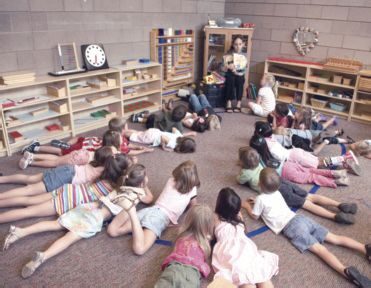
You will not find rows of desks in our classrooms. Montessori learning environments are set up to facilitate student discussion and stimulate collaborative learning. One glance and it is clear that our children feel comfortable and at home.
Students will typically be found scattered around the classroom, working alone or with one or two others. They will tend to become so involved in their work that we cannot help but be tremendously impressed by the peaceful atmosphere.
It may take a moment to spot the teachers within the classrooms. They will be found working with one or two children at a time, advising, presenting a new lesson, or quietly observing the class at work.
In her research, Dr. Montessori noted specific characteristics associated with the child’s interests and abilities at each plane of development. She argued that a school carefully designed to meet the needs and interests of the child will work more effectively because it is consistent with basic principles of psychology. Rather than fight the laws of nature, Montessori suggested that we “follow the child” and allow our children to show us how to facilitate the development of their human potential.
This focus on the “whole child” led Montessori to develop a very different sort of school from the traditional adult-centered classroom. To emphasize this difference, she named her first school the “Casa dei Bambini” or the “Children’s House.”
There is something profound in her choice of words, for the Montessori classroom is not the domain of the adults in charge, but rather a carefully prepared environment designed to facilitate the development of the children’s independence and sense of personal empowerment.
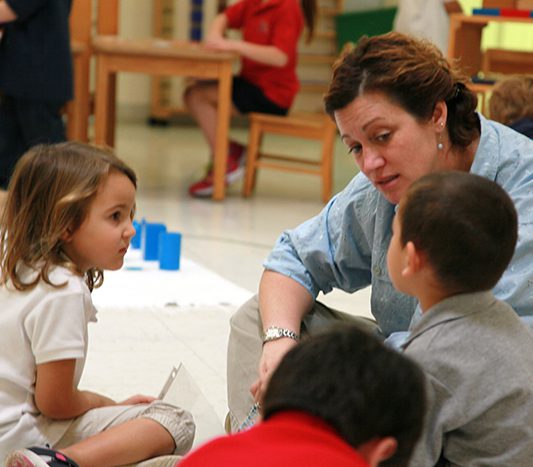
This is a true community of young children. They move freely within the rooms, selecting work that captures their interest, rather than passively participating in lessons and projects selected by the teachers.
In a very real sense, even the very youngest students in Montessori take care of their own child-sized environment. When they are hungry, they prepare their own snack and drink. They go to the bathroom without assistance. When something spills, they help each other carefully clean things up. Parents are often amazed to see small children in Montessori classrooms cut raw fruits and vegetables, sweep and dust, carry pitchers of water, and pour liquids with barely a drop spilled. These little ones normally go about their work so calmly and purposely that it is clear to even the casual observer that this is their environment: The Children’s House.
The Montessori classroom is commonly referred to as a prepared environment. This name reflects the care and attention that is given to creating a learning environment that will reinforce the children’s independence and intellectual development.
Respect, Intelligence, and Independence
We know that young children are full and complete individuals in their own right. They deserve to be treated with the full and sincere respect that we would extend to their parents. Respect breeds respect and creates an atmosphere within which learning is tremendously facilitated.
Montessori schools believe very strongly that intelligence is not fixed at birth, nor is the human potential anywhere near as limited as it sometimes seems in traditional education.
Success in school is directly tied to the degree to which children believe that they are capable and independent human beings. If they knew the words, even very young children would ask: “Help me learn to do it for myself!”
By allowing children to develop a meaningful degree of independence and self-discipline, Montessori sets a pattern for a lifetime of good work habits and a sense of responsibility. Students are taught to take pride in doing things for themselves carefully and well.
Montessori Teaches Children to Think, Collaborate, and Discover
Our program is designed to help each of our students discover and develop his or her unique talents and possibilities. We treat each as a unique individual learner. We know that no two students will learn at the same pace, nor will they necessarily learn best from the same teaching methods, and our goal is to be flexible and creative in addressing each student as a unique individual.
In Montessori, students and teachers learn to collaborate in the process of education rather than mindlessly compete. Our students discover their own innate abilities and develop a strong sense of independence, self-confidence, and self-discipline. In an atmosphere in which children learn at their own pace and compete only against themselves, they learn not to be afraid of making mistakes. They quickly find that few things in life come easily, and they can try again without fear of embarrassment.
One way of thinking about the difference between our approach and one that is more traditional is to consider that while learning the right answers may get our children through school, learning how to become a life-long independent learner will take them anywhere! Our children are learning to think, observe, and reflect; not memorize and quickly forget.
Rather than present students with loads of right answers, their teachers ask the right questions and lead the children to discover the answers for themselves. Learning will become its own reward, and each success will fuel their desire to discover even more.
The Elementary students are encouraged to do their own research, analyze what they have found, and come to their own conclusions. The teachers encourage our children to think for themselves and become actively engaged in the learning process.
Freedom of Movement and Independently Chosen Work
Montessori children are free to move about, working alone or with others at will. They may select any activity and work with it as long as they wish, so long as they do not disturb anyone or damage anything, and so long as they put it back where it belongs when they are finished.
The Integrated Montessori Curriculum
Montessori classrooms are organized into several curriculum areas, which include language arts (reading, literature, grammar, creative writing, spelling, and handwriting), mathematics and geometry, everyday living skills, sensory awareness exercises and puzzles, geography, history, science, art, music, and movement. Most rooms will include a classroom library. Each area is made up of one or more shelf units, cabinets, and display tables with a wide variety of materials on open display ready for use as the children select them.
Montessori curriculum is organized into a spiral of integrated studies, rather than a traditional model in which the curriculum is compartmentalized into separate subjects, with given topics considered only once at a specific grade level. In the early years, lessons are introduced simply and concretely and are reintroduced several times over succeeding years at increasing degrees of abstraction and complexity.
The course of study uses an integrated thematic approach that ties the separate disciplines of the curriculum together into studies of the physical universe, the world of nature, and the human experience.
Literature, the arts, history, social issues, political science, economics, science, and the study of technology all complement one another. This integrated approach is one of Montessori’s great strengths. As an example, when our students study Africa in world history, they will also read African folk tales in world literature, create African masks and make African block print t-shirts in art, learn Swahili songs in music, and make hieroglyphic calendars in math, as well as study African animals in zoology.
Our mathematics curriculum follows a European model of unified mathematics through which students are introduced to concepts in algebra, geometry, mathematical logic, and statistics from the early years of their education, rather than waiting until high school as is normal in the United States.
The same is true in our science curriculum, weaving principles of physics, chemistry, the earth sciences, botany, and zoology together from the preschool years and up, with far greater emphasis on the sciences in general than is common in most American elementary curriculums.
Typical Class Size
A typical Montessori class is made up of from twenty-five to thirty children, representing a three-year age span, taught by two certified Montessori teachers.
Parents often wonder if it would not be better to organize classes into smaller groups, but there is actually a great deal of research, thought, and successful experience behind this particular model. The key is to remember that in Montessori, the teacher is neither the center of attention nor the sole source of instruction. The children are learning on their own by independent discovery and from each other, as well as through lessons presented by the teacher. This approach allows the children to explore and learn independently as much as possible. The stimulation of older children and the encouragement of their peers fuels the process, and all so often the best teacher of a four-year-old is an older child rather than an adult. Children learn best from one another. We create classes of thirty to ensure that each child will have enough classmates of the same sex and age group, as well as the stimulation of the older children.
Montessori Classes Encompasses a Three-Year Age Span.
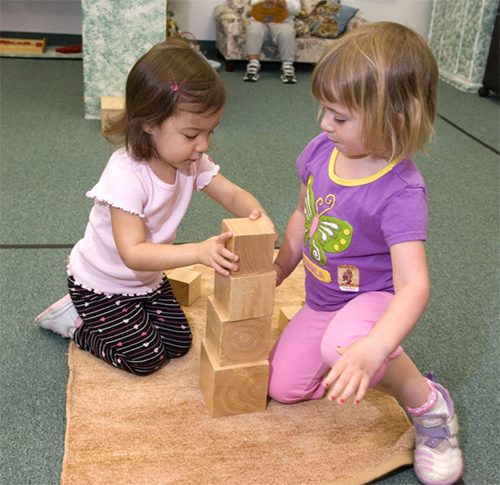
Montessori classes are organized to encompass a two- or three-year age span, which allows younger students to experience the daily stimulation of older role models, who in turn blossom in the responsibilities of leadership. Students not only learn “with” each other, but “from” each other. We find that most often the best tutor is a fellow student who is just a bit older.
Some parents worry that having younger children in the same class as older ones will leave one group or the other short changed. They fear that the younger children will absorb the teachers’ time and attention, or that the importance of covering the Kindergarten curriculum for the five-year-olds will prevent teachers from giving the three- and four-year-olds the emotional support and stimulation that they need. Both concerns are misguided.
Working in one class for two or three years allows students to develop a strong sense of community with their classmates and teachers. The age range also allows especially gifted children the stimulation of intellectual peers, without requiring that they skip a grade and feel emotionally out of place.
Each class is an essentially stable community, with only the oldest third moving on to the next level each year. At each level within a Montessori school, the curriculum and methods are logical and consistent extensions of what has come before.
How Can Montessori Teachers Meet the Needs of So Many Different Children?
Montessori teachers play a very different role from those played by traditionally trained educators. While the stern disciplinarians of the past may be an endangered species, many teachers are focused on maintaining order and on covering a pre-defined curriculum. Most see their role as dispensing facts and skills to complacent students.
The Montessori teacher’s role is that of a facilitator and guide. He or she is usually not the center of attention and will not normally spend much time working with the whole class at once. Her role centers around the preparation and organization of appropriate learning materials to meet the needs and interests of each child in the class.
The Montessori teacher has four primary goals: to awaken our children’s spirit and imagination, to encourage their normal desire for independence and high sense of self-esteem, to help them develop the kindness and self-discipline that will allow them to become full members of society, and to help them learn how to observe, question, and explore ideas independently. The Montessori teacher is a coach, mentor, and friend.
The teachers rarely present a lesson to more than one or two children at a time and limit them to a quick, efficient presentation. The objective is to intrigue the children so that they will come back on their own to work with the materials. Lessons center around clear and simple information that is necessary for the children to be able to do the work on their own: the name of the material, its place on the shelf, the ground rules for its use, and some of the possibilities inherent within it.
The teachers closely monitor their students’ progress, keeping the level of challenge high. Because they come to know the children so well, Montessori teachers can often use their own interests to enrich the curriculum and provide alternate avenues for accomplishment and success.
The Montessori Materials – A Road from the Concrete to the Abstract
The basis of our approach is the simple observation that children learn most effectively through direct experience and the process of investigation and discovery. In her studies of children’s learning, Dr. Montessori noted that most children do not learn by memorizing what they hear from their teachers or read in a text, but rather from concrete experience and direct interaction with the environment. Asking a child to sit back and watch us perform a process or experiment is like asking a one-year-old not to put everything in his mouth. Children need to manipulate and explore everything that catches their interest. This led Montessori to emphasize the overriding importance of concrete learning apparatus and to the development of the Montessori materials for mathematics, sensory development, language, science, history, and geography.
The Montessori learning materials are not the method itself, but rather tools that we use to stimulate the child into logical thought and discovery. They are provocative and simple, each carefully designed to appeal to children at a given level of development.
Each material isolates and teaches one thing or is used to present one skill at a time as the child is ready. Montessori carefully analyzed the skills and concepts involved in each subject and noted the sequence in which children most easily master them.
To facilitate the prepared order of the environment, the teacher arranges the materials on the shelf following their sequence in the curriculum flowchart. The materials are displayed on low open shelves that are easily accessible to even the youngest children. They are arranged to provide maximum eye
appeal without clutter. Each has a specific place on the shelves, arranged from the upper-left-hand corner in sequence to the lower right. Materials are always arranged in sequence, from the most simple to the most complex, and from the most concrete to those that are the most abstract.
Preparing Tomorrow’s Innovative Thinkers Today
In a world of rapid change and new discoveries, we can only guess at the skills our children will need to succeed in the 21st century. Now, more than ever, the essential lesson is learning how to learn.
The most important years in our children’s education are not high school and college, but, instead, their first twelve years of life. This is when their character and values, self-image, basic skills and knowledge, and appreciation for culture and the arts are formed.
Montessori offers our children a world-class education, along with an education of the heart, that nurtures their self-confidence, personal creativity, and entrepreneurial spirit.
It offers them the most challenging academic program that they can handle in a course of study that includes the Junior Great Books, creative writing, unified mathematics, geometry, pre-algebra, history, geography, economics, philosophy and ethics, computers, botany and zoology, the physical sciences, foreign language study, art, music, dance, and physical education.
We can see our children as they truly come to love learning and begin to discover their true potential as young men and women. Montessori’s goal is to nurture their intelligence and creativity, helping our child become renaissance individuals in the intellectual tradition of Thomas Jefferson, Buckminster Fuller, and Maria Montessori.
Granted, this lies beyond the scope of traditional education, but then Montessori schools are different.
As families, we come to Montessori schools to give our children an outstanding preparation for high school, college, and life.
In her research, Dr. Montessori noted specific characteristics associated with the children’s interests and abilities at each plane of development. She argued that a school carefully designed to meet the needs and interests of the child will work more effectively because it doesn’t fight human nature. Montessori taught teachers how to “follow the child” through careful observation, allowing students to reveal their strengths and weaknesses, interests and anxieties, and strategies that work best to facilitate the development of their human potential.
This focus on the “whole child” led Dr. Montessori to develop a very different sort of school from the traditional adult-centered classroom. To emphasize this difference, she named her first school the Casa dei Bambini—the Children’s House.
There is something profound in her choice of words, for the Montessori classroom is not the domain of the adults, but rather a carefully prepared environment designed to facilitate the development of the children’s independence and sense of personal empowerment.
This is the children’s community. They move freely within it, selecting work that captures their interest. Even very small children assist with the care of the environment. When they are hungry, they prepare their own snacks. They go to the bathroom without assistance. When something spills, they help each other carefully clean up.
Generations of parents have been amazed to see small children in Montessori classrooms cut raw fruits and vegetables, sweep and dust, carry pitchers of water, and pour liquids with barely a drop spilled. The children normally go about their work so calmly and purposely that it is clear to even the casual observer that they are the ‘masters of the house.’
Montessori’s first Children’s House, which opened in 1907, was made up of sixty inner-city children. In her book, The Montessori Method, Dr. Montessori describes the transformation that took place during the first few months, as the children evolved into a ‘family.’ ey prepared and served the daily meals, washed the pots and dishes, helped the younger children bathe and change their clothes, swept, cleaned, and worked in the garden. These very young children developed a sense of maturity and connectedness that helped them realize a much higher level of their potential as human beings.
While times have changed, the need to feel connected is still as strong as ever. In fact, for today’s children, it is probably even more important. Montessori gives children the message that they belong—that their school is like a second family.
The Prepared Environment
Montessori classrooms tend to fascinate children and their parents. ey are normally bright, warm, and inviting, filled with plants, art, music, and books. ere are interest centers filled with intriguing learning materials, mathematical models, maps, charts, fossils, historical artifacts, computers, scientific apparatus, perhaps a small natural science museum, and animals that the children are raising.
Montessori classrooms are commonly referred to as a ‘prepared environment.’ is name reflects the care and attention that is given to creating a learning environment that will reinforce the children’s independence and intellectual development.
You would not expect to nd rows of desks in a Montessori classroom. The rooms are set up to facilitate student discussion and stimulate collaborative learning. One glance and it is clear that children feel comfortable and safe.
The Montessori classroom is organized into several curriculum areas, usually including language arts (reading, literature, grammar, creative writing, spelling, and handwriting); mathematics and geometry; everyday living skills; sensory-awareness exercises and puzzles; geography; history; science; art; music; and movement. Most rooms will include a classroom library.
Each area is made up of one or more shelf units, cabinets, and display tables with a wide variety of materials on display, ready for use as the children select them.
Students are typically found scattered around the classroom, working alone or with one or two others. ey tend to become so involved in their work that visitors are immediately struck by the peaceful atmosphere.
It may take a moment to spot the teachers within the environment. ey will normally be found working with one or two children at a time: advising, presenting a new lesson, or quietly observing the class at work.
Why do Montessori schools group children together in such large multi-age classes? A typical Montessori class is made up of 25 to 35 children, more or less evenly divided between boys and girls, covering a three-year age span. is practice has been a hallmark of the Montessori approach for almost one hundred years. Classes are guided by a certified Montessori educator, teaching with one or more assistants or by two Montessori teachers. In some situations, a class may be led by someone who is still in the process of completing the extensive Montessori teacher education process. On completion, teachers receive their Montessori certification.
Classes tend to be stable communities, with only the oldest third moving on to the next level each year. With two-thirds of the children returning each fall, Montessori encourages a much closer relationship among children and their peers, as well as among children and their teachers.
The levels usually found in a Montessori school correspond to the developmental stages of childhood: infant (birth through 18 months); toddlers (18 months to age 3); early childhood (age 3 to 6); lower elementary (age 6 to 8); upper elementary (age 9 to 11); middle school (age 12 to 14); and secondary/high school (age 15 to 18).
At each level, the program and curriculum are logical and highly consistent extensions of what has come before.
Many non-Montessori preschools are proud of their very small group sizes, and parents often wonder why Montessori classes are so much larger. Schools that place children together into small groups assume that the teacher is the source of instruction; a very limited resource even in a small class.
These schools reason that as the number of children decreases, the time that teachers have to spend with each child increases. Ideally, they would have a one-on-one tutorial situation.
But the best ‘teacher’ of a three-year-old is often another child who is just a little bit older and has mastered a skill. is process is good for both the tutor and the younger child. In the Montessori approach, the teacher is not the primary focus.
Montessori encourages children to learn from each other. By having enough children in each age group, all students will nd others at, above, and below their present level of development. is also makes Montessori schools economically more viable, allowing schools to attract teachers with far greater training and experience.
Some parents worry that by having younger children in the same class as older ones, one age group or the other will be shortchanged. They fear that the younger children will absorb the teachers’ time and attention, or that the importance of covering the kindergarten curriculum for the five-year-olds will prevent them from giving the three- and four-year-olds the emotional support and stimulation that they need. Experience has shown that both concerns are misguided and Montessori guides can’t imagine teaching in any other way.
MONTESSORI ENCOURAGES CHILDREN TO LEARN FROM EACH OTHER. BY HAVING ENOUGH CHILDREN IN EACH AGE GROUP, ALL STUDENTS WILL FIND OTHERS AT, ABOVE, AND BELOW THEIR PRESENT LEVEL OF DEVELOPMENT.
There Are Several Distinct Advantages to the Montessori Classroom Model
In a well-run established Montessori class, children are typically far more independent and self-disciplined. One factor that makes this possible is that each class ideally retains two-thirds of its class as the new term begins.
Each child has her own learning style. Montessori teachers treat children as individuals and customize lessons to t their needs, personality, and interests.
Since Montessori allows children to progress through the curriculum at their own pace, there is no academic reason to group children according to one grade level. In a mixed-class, children can always nd peers who are working at their current level.
Working in one class for two or three years allows students to develop a strong sense of community with their classmates and teachers. The age range also allows the especially gifted children the stimulation of intellectual peers, without requiring that they skip a grade and feel emotionally out of place.
To accommodate the needs of individual learners, Montessori classrooms have to include curriculum to cover the entire span of interests and abilities all the way through the oldest and most accelerated students in the class. This creates a highly enriched learning environment.
In these multi-level classrooms, younger children are constantly stimulated by the interesting work in which the older ones are engaged.
At the same time, in multi-level classrooms, older students serve as tutors and role models for the younger ones, which helps them in their own mastery (we learn things best of all when we teach to someone else) and leaves them beaming with pride.
Those Mysterious Montessori Materials:
The Road from Concrete to Abstract Thinking All children and most adults learn best through direct experience and the process of investigation and discovery. Most students do not retain or truly grasp much of what they ‘learn’ through memorization.
Asking a child to sit back and watch a teacher perform a process or experiment is like asking one-year-olds not to put everything into their mouths. Children need to manipulate and explore everything that catches their interest. Anyone who has lived with children knows that this is true.
It’s ironic that most schools today still teach primarily through lectures, textbooks, and workbooks. Most students still spend their days sitting behind a desk praying for the recess bell to ring.
Dr. Montessori recognized that concrete learning apparatus makes learning much more rewarding. e Montessori learning materials are not the Method itself; they are simply tools that we use to stimulate the child into logical thought and discovery.
An important concept is that for each age level of the Montessori curriculum, there is an extensive collection of carefully defined educational materials that are the equivalent of the chapters in a traditional textbook. Each material isolates and teaches one concept or skill at a time. In developing the materials, Dr. Montessori carefully analyzed the skills and concepts involved in each subject and noted the sequence in which children most easily master them.
She then studied how children seemed to be able to most easily grasp abstract concepts and designed each element to bring the abstract into a clear and concrete form.
The materials are displayed on low, open shelves that are easily accessible to even the youngest children. They are arranged to provide maximum eye appeal without clutter. Each has a specific place on the shelves, arranged from the upper left-hand corner in sequence to the lower right, following their sequence in the curriculum.
The materials are arranged in sequence from the most simple to the most complex and from the most concrete to those that are the most abstract. Because of the order in which they are arranged in the environment, children can nd precisely what they need whenever they wish.
Each of the Montessori materials is designed to allow children to work independently, with only the slightest level of introduction and ongoing support from the teachers. This is made possible by a built-in design element, the ‘Control of Error,’ which allows students to determine for themselves if they have done each exercise correctly. The materials can be used repeatedly at different developmental levels.
Each material has multiple levels of challenge. Lessons are brief introductions, after which the children repeat the exercise over many days, weeks, or months until they attain mastery. Interest leads them to explore variations and extensions inherent within the design of the materials at many levels over the years.
For example, the Trinomial Cube, which presents a complex and challenging three-dimensional puzzle to the five-year-old, is used to introduce the elementary child to the algebraic concept of the exponential powers of polynomials.
The Montessori Curriculum Montessori offers a rigorous and innovative academic program.
The curriculum is organized into a spiral of integrated studies, rather than a traditional model in which the curriculum is compartmentalized into separate subjects, with given topics considered only once at a specific grade level.
In the early years, lessons are introduced simply and concretely and are reintroduced several times over succeeding years at increasing degrees of abstraction and complexity.
The course of study uses an integrated thematic approach that ties the separate disciplines of the curriculum together into studies of the physical universe, the world of nature, and the human experience.
Literature, the arts, history, social issues, political science, economics, science, and the study of technology all complement one another. is integrated approach is one of Montessori’s great strengths.
As an example, when students study ancient Greece, they also study Greek mythology, read stories and novels set in the Grecian world, create authentic costumes, build models of Greek buildings, and explore Grecian art. They study the climate, ecosystems, flora, fauna, and natural resources of the world of the ancient Greeks. And they prepare plays, celebrate festivals, and re-stage their own version of historical events.
A Typical Day
In Montessori, the school day is not divided into fixed-time periods for each subject. Teachers call students together as they are ready, for lessons individually or in small groups.
A typical day’s work is divided into ‘fundamentals’ that have been assigned by the faculty, and self-initiated projects and research selected by the student. Students work to complete their assignments at their own pace. Teachers closely monitor their students’ progress, keeping the level of challenge high. Teacher feedback to students and parents helps students learn how to pace themselves and take a great deal of personal responsibility for their studies—skills that are essential for later success in college and in life.
We encourage students to work together collaboratively, and many assignments can only be accomplished through teamwork. Students constantly share their interests and discoveries with each other. e youngest experience the daily stimulation of their older friends and are naturally spurred on to be able to “do what the big kids can do.”
How can Montessori teachers meet the needs of so many di erent children? Montessori teachers do more than present curriculum. e secret of any great teacher is helping learners get to the point that their minds and hearts are open and they are ready to learn, where the motivation is not focused on getting good grades but, instead, involves a basic love of learning.
As parents know their own children’s learning styles and temperaments, teachers, too, develop this sense of each child’s uniqueness by developing a relationship over a period of years with children and their parents. Dr. Montessori believed that teachers should focus on children as indivduals, not on the daily lesson plan. Montessori nurtures the human potential, leading children to ask questions, think for themselves, explore, investigate, and discover. Our ultimate objective is to help them to learn independently, retaining the curiosity, creativity, and intelligence with which they were born.
Traditional teachers tell us that they “teach students the basic facts and skills that they will need to succeed in the world.” Studies show that in many classrooms, as much as 40 percent of the day may be spent on discipline, test preparation, and classroom management. Montessori educators play a very different role.
Wanting to underscore the very di erent role played by adults in her schools, Dr. Montessori used the title directress instead of teacher. In Italian, the word implies the role of the coordinator or administrator of an o ce or factory. Today, many Montessori schools prefer to call their teachers guides. Whatever they’re called, Montessori teachers are rarely the center of attention, for this is not their class; it is the Children’s House.
Normally, Montessori teachers will not spend much time working with the whole class at once. eir primary role is to prepare and maintain the physical, intellectual, and social/emotional environment within which the children will work. Certainly, a key aspect of this is the selection of intriguing and developmentally appropriate opportunities for learning to meet the needs and interests of each child in the class.
Montessori Guides Have Five Basic Goals:
• to awaken children’s spirit and imagination;
• to encourage children’s normal desire for independence and high sense of self-esteem;
• to help children develop the kindness, courtesy, and self-discipline that will allow them to become full members of society;
• to help children learn how to observe, question, and explore ideas independently; and
• to create a spirit of joyful learning, helping children master the skills and knowledge of their society.
Montessori guides rarely present a lesson to more than a handful of children at one time, and they limit lessons to brief efficient presentations. The goal is to give the children just enough to capture their attention and spark their interest, intriguing them so that they will come back on their own to work with the materials.
Montessori guides closely monitor their students’ progress, keeping the level of challenge high. Because they normally work with children for three years, guides get to know their students’ strengths and challenges, interests, and anxieties extremely well. Montessori guides often use the children’s interests to enrich the curriculum and provide alternate avenues for accomplishment and success.
Montessori Teaches Children to Think and Discover for Themselves
Montessori schools are designed to help children discover and develop their talents and possibilities.
While learning the right answers may get children through school, learning how to become lifelong, independent learners will take them anywhere! Montessori teaches children to think, not simply to memorize, pass a test, and forget.
Rather than present students with the right answers, Montessori educators tend to ask the right questions and challenge them to discover the answers for themselves. Older students are encouraged to do their own research, analyze what they have found, and come to their own conclusions.
Respect and Independence:
The Foundation of the Montessori Approach Montessori does not believe that intelligence is fixed at birth, nor is the human potential anywhere near as limited, as it sometimes seems in traditional education. These beliefs have been confirmed by the research of Jean Piaget, Howard Gardner, Angela Duckworth and many others.
We know that each child is a full and complete individual in her own right. Even when they are very small, children deserve to be treated with the full and sincere respect that we would extend to their parents. Respect breeds respect and creates an atmosphere within which learning is tremendously facilitated.
Success in school is directly tied to the degree to which children believe that they are capable and independent human beings. If they knew the words, even very young children would ask: Help me learn to do it for myself!
By allowing children to develop a meaningful degree of independence and self-discipline, Montessori sets a pattern for a lifetime of good work habits and a sense of responsibility. Students are taught to take pride in doing things well.
Freedom of Movement and Independently Chosen Work
Children touch and manipulate everything in their environment. In a very real sense, the adult mind is ‘hand made,’ because it is through movement, exploration, and manipulation that children build up a storehouse of impressions about the physical world. Children learn by doing, and this requires movement and spontaneous investigation.
Montessori children are free to move about, working alone or with others at will. ey may select any activity and work with it as long as they wish, so long as they do not disturb anyone, damage anything, and put it back where it belongs when they are finished.
Many exercises, especially at the early childhood level, are designed to draw their attention to the sensory properties of objects within the environment: size, shape, color, texture, weight, smell, sound, etc. Gradually, children learn to pay attention, seeing more clearly small details in the things around them. They begin to observe and appreciate their environment, which is key in helping them discover how to learn.
Freedom is a critical issue as children begin their journey of discovery. Our goal is less to teach them facts and concepts, but rather to help them fall in love with the process of focusing their complete attention on something and solving its riddle with enthusiasm.
Work that has been assigned by adults rarely leads to such enthusiasm and interest as does work that children freely choose for themselves. The Montessori classroom is a learning laboratory in which children are allowed to explore, discover, and select their own work.
Children become comfortable and con dent in their ability to master the environment, ask questions, puzzle out the answer, and learn without the constant intervention of an adult.
What is the most important thing that children get from Montessori?
The Montessori approach is often described as an “education for life.” When we try to define what children take away from their years in Montessori, we need to expand our vision to include more than just basic academic skills.
Normally, Americans think of a school as a place where one generation passes down basic skills and culture to the next. From this perspective, a school only exists to cover a curriculum not to develop character and self-esteem.
In all too many traditional and highly competitive schools, students memorize facts and concepts with little understanding, only to quickly forget them when exams are over. Studies show that many bright students are passive learners. ey coast through school, earning high grades, but rarely push themselves to read material that hasn’t been assigned, ask probing questions, challenge their teacher’s opinions, or think for themselves. They typically want teachers to hand them the ‘right’ answer.
The problem isn’t with today’s children, but with today’s schools. Children are as gifted, curious, and creative as they ever were when they’re working on something that captures their interest and that they have voluntarily chosen to explore.
Montessori schools work to develop culturally literate children and nurture their fragile sparks of curiosity, creativity, and intelligence. ey have a very di erent set of priorities than traditional schools and a very low regard for mindless memorization and super cial learning.
Montessori students may not memorize as many facts, but they do tend to become self-con dent, independent thinkers who learn because they are interested in the world and enthusiastic about life—not simply to get a good grade.
Montessori believed that there was more to life than simply the pursuit of wealth and power. To her, finding one’s place in the world, work that is meaningful and fulfilling, and developing the inner peace and depth of soul that allows us to love are the most important goals in life.
Helen Keller, inspired by Montessori, wrote:
“I believe that every child has hidden away somewhere in his being noble capacities which may be quickened and developed if we go about it in the right way, but we shall never properly develop the higher nature of our little ones while we continue to fill their minds with the so-called basics. Mathematics will never make them loving, nor will accurate knowledge of the size and shape of the world help them to appreciate its beauties. Let us lead them during the first years to nd their greatest pleasure in nature. Let them run in the fields, learn about animals, and observe real things. Children will educate themselves under the right conditions. They require guidance and sympathy far more than instruction.”
Montessori schools give children the sense of belonging to a family and help them learn how to live with other human beings.
To reduce these principles to the most simplistic form, Dr. Montessori proposed that we could make peace by healing the wounds of the human heart and by producing children who are independent, at peace with themselves, and secure. Dr. Montessori envisioned her movement as essentially leading to a reconstruction of society.
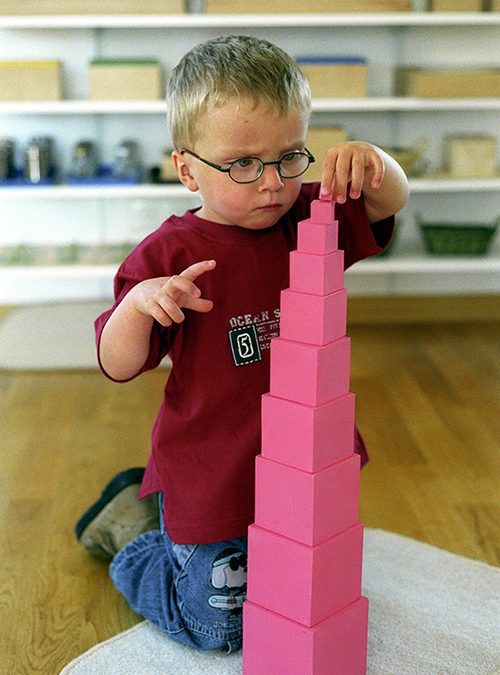
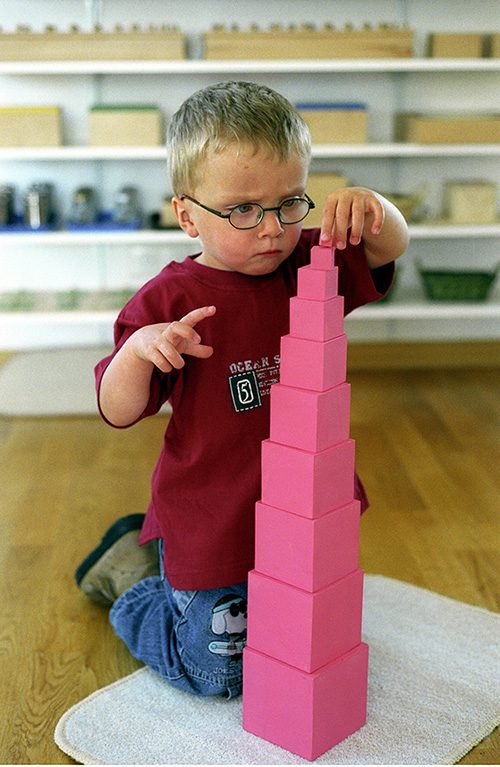
Montessori schools are different, but it isn’t just because of the materials that are used in the classrooms. Look beyond the Pink Towers and Golden Beads, and you’ll discover that the classroom is a place where children really want to be—because it feels a lot like home.
Help … Our Montessori school wants to ‘normalize’ our child!
Normalization is a term that causes a great deal of confusion and some concern among many new Montessori parents.
Normalization is a terrible choice of words. It suggests that we are going to help children who are not normal to become ‘normal.’ is is not what Dr. Montessori meant. Normalization is Montessori’s name for the process that takes place in Montessori classrooms around the world, through which young children learn to focus their intelligence, concentrate their energies for long periods, and take tremendous satisfaction from their work. One mother put it this way: “My child just does not act the same now that he’s been in Montessori awhile. He usually runs from one thing to another. In Montessori, he looks interested, sometimes puzzled, and often completely absorbed. I think of normalization as a kind of satisfaction that he seems to take from what he calls hard work.”
In his book, Maria Montessori: Her Life and Work, E.M. Standing described the following characteristics of normalization in the child between the age of three and six: • A love of order • A love of work • Profound spontaneous concentration • Attachment to reality • Love of silence and of working alone • Sublimation of the possessive instinct • Obedience • Independence and initiative • Spontaneous self-discipline • Joy • The power to act from real choice and not just from idle curiosity
Kay Futrell in her book, The Normalized Child, describes Dr. Montessori’s amazement when the sixty frightened and ill-disciplined inner-city children of her first Children’s House began to respond to the new environment. Normalization is another word for what we call Montessori’s Joyful Scholars.
What outcomes can we look for if we give our child a Montessori education? There are eight primary aspects to what we look for in children who have grown up with a Montessori education:
1. ACADEMIC PREPARATION: Montessori prepares students both for higher education and life. On an academic level, Montessori helps students attain skills that allow them to become independently functioning adults and lifelong learners.
2. INTRINSIC MOTIVATION: Innate desire drives Montessori children to engage in activities for enjoyment and satisfaction.
3. INTERNALIZED GROUND RULES AND THE ABILITY TO WORK WITHOUT EXTERNAL AUTHORITY: Montessori students are comfortable with ground rules that set the boundaries for their interactions within the school community. Because these ground rules become internalized, Montessori students normally learn to behave appropriately, whether or not teachers are present.
4. SOCIAL RESPONSIBILITY: Montessori children tend to be quite sensitive to the rights and needs of others. ey tend to make a positive contribution to their community.
5. AUTONOMY: Montessori students tend to become self-directed, composed, and morally independent.
6. CONFIDENCE AND COMPETENCE: Montessori students tend to become con dent, competent, self-reflective, and, thereby, successful. ey are generally not afraid of failure and learn from mistakes.
7. CREATIVITY AND ORIGINALITY OF THOUGHT: Montessori students become con dent in expressing their own ideas and creativity. ey recognize the value of their own work, respect the creative process of others, and are willing to share their ideas, regardless of the risk of rejection. Montessori students tend to take great satisfaction in self-expression.
8. SPIRITUAL AWARENESS: Montessori students are often exceptionally compassionate, empathetic, and sensitive to the natural world and the human condition. Will my child be able to adjust to traditional school after Montessori? Montessori children, by the end of age five, are normally curious self-confident learners who look forward to going to school. They are engaged, and enthusiastic. What teacher wouldn’t want a room filled with children like that? Well, truthfully, over the years we’ve found some who consider these children ‘disruptive.’
Disruptive? A polite, independent Montessori child, disruptive? Well, first off, let’s remember that Montessori children are real human beings, and not all children who attend Montessori schools fit the idealized description. However, enough do that the generalization is often accurate.
Montessori children, by age six, have spent three or four years in a school where they were treated with honesty and respect. While there were clear expectations and ground rules, within that framework, their opinions and questions were taken quite seriously. Unfortunately, there are still some teachers and schools where children who ask questions are seen as challenging authority.
You can imagine an independent Montessori child asking his new teacher, “But why do I have to ask each time I need to use the bathroom?” or, “Why do I have to stop my work right now?” We also have to remember that children are different. One child may be very sensitive or have somewhat special needs that might not be met well in a teacher-centered traditional classroom. Other children can go anywhere. In general, there is nothing inherent in Montessori that causes children to have a hard time if they are transferred to traditional schools. Some will be bored. Others may not understand why everyone in the class has to do the same thing at the same time. But most figure the new setting out fairly quickly, make new friends, and succeed within the definition of success understood in their new schools.
Naturally, there are trade-offs. The curriculum in Montessori schools is often much more enriched and accelerated than many found in other nursery and elementary schools in the United States. The values and attitudes of the children and teachers may also be quite different. Learning will often be focused more on adult-assigned tasks done more by rote than with enthusiasm and understanding.
There is an old saying that if something is working, don’t try to fix it. This leads many families to continue their children in Montessori at least through the sixth grade. As more Montessori high schools are opened in the United States and elsewhere around the world, it is likely that this trend will continue.
But other families, for financial or other reasons, don’t plan to have their children continue in Montessori. They often ask if there is any particular age level at which Montessori children tend to nd the transition particularly difficult? Because of individual differences in children and the next schools that are available to them, there is no absolute answer. In general, we strongly recommend that parents plan to keep their children in Montessori at least through the end of kindergarten.
MONTESSORI STUDENTS PERCEIVE THEMSELVES AS SUCCESSFUL PEOPLE BUT ARE NOT AFRAID OF MAKING AND LEARNING FROM THEIR MISTAKES.
Ideally, families should consider a commitment through at least elementary school; although, we can make a strong case that it is during the difficult middle-school years that children most need what Montessori has to offer. The development of successful Montessori high school programs means that more and more students have the opportunity to discover how well prepared they were for college and later life by their Montessori education.
Does Montessori prepare children for the real world?
In a word, yes! Here’s why. Montessori helps children master the intellectual skills and knowledge that are basic to our culture and technology.
As Montessori students master one level of academic skills, they are able to apply themselves to increasingly challenging work across the academic disciplines. ey tend to be re ective learners. ey write, speak, and think clearly and thoughtfully. ey have learned how to learn by doing real things in the real world—experiential learning. ey have learned how to integrate new concepts, analyze data, and think critically.
Children who grow up in Montessori schools tend to be culturally literate, well educated, and highly successful in university and later life. Today, these skills are commonly known as high-executive function.
Montessori develops intrinsic motivation: the innate desire that drives students to engage in an activity for enjoyment and satisfaction. Montessori cultivates creativity and originality: Montessori students are normally exceptionally creative in their thinking and con dent in self-expression. They recognize the value of their own ideas, respect the creative process of others, and are willing to explore ideas together in search of truth or new solutions.
Montessori students tend to be extraordinarily self-confident and competent. They perceive themselves as successful people but are not afraid of making and learning from their mistakes.
Montessori students do not see themselves as children, but as young members of the world. They tend to look up to teachers and other adults as mentors, friends, and guides, rather than as unwelcome taskmasters who place limits on their freedom.
Children who grow up in Montessori rarely feel the need to rebel and act out. Although even Montessori children will test their parents’ resolve, they basically follow an inner creed of self-respect. They accept limits, tend to follow common sense, and reach out to their friends and the larger community, seeking ways to help others and make a positive contribution to the world.
Montessori children are not easily in uenced by their peers. Like all of us, children who grow up in Montessori schools want to have friends, and are a ected by their interests and attitudes. On the other hand, in addition to having grown up in a culture that consistently teaches and follows universal values of kindness, honor, and respect, Montessori children tend to think for themselves.
Most Montessori students are exceptionally compassionate, empathetic, and sensitive to the natural world and the human condition.
Montessori children tend to have all the values and attitudes that pay off in college and the real world. ey aren’t afraid of hard work. ey are eager to learn, think, and explore new ideas. They enjoy people and develop strong friendships. They live from a basic sense of self-respect and rarely get themselves into self-destructive situations. ey tend to be self-disciplined, fairly well organized., and tend to meet deadlines, come to class prepared, and actually enjoy their classes. They are the average college professor’s dream come true!
They tend to become lifelong learners, creative and energetic employees, and quite often entrepreneurs. Most Montessori students grow up to be people of character; people you can trust and on whom you can depend. ey have warmth, humanity, and compassion with lives that reflect both joy and dignity. These are the men and women we hope our children will grow up to be.
Montessori schools are not completely different from other schools. Over the last century, Dr. Maria Montessori’s ideas have had a profound and growing influence on education around the world. However, while individual elements of her program are finding their way into more traditional classrooms every year, there is a cumulative impact that we see when schools fully implement the entire Montessori model, which creates something quite distinct.
Montessori schools begin with a deep respect for children as unique individuals. They work from a deep concern for their social and emotional development.
Montessori schools are warm and supportive communities of students, teachers, and parents. Children don’t get lost in the crowd!
Montessori consciously teaches children to be kind and peaceful.
Montessori classrooms are bright and exciting environments for learning.
Montessori classes bring children together in multi-age groups, rather than classes comprised of just one grade level. Normally, they span three age levels. Children stay with their teachers for three years. This allows teachers to develop close, long-term relationships with their pupils, allows them to know each child’s learning style very well, and encourages a strong sense of community among the children. Every year, more non-Montessori schools adopt this effective strategy.
Montessori classrooms are not run by the teachers alone. Students are taught to manage their own community and develop leadership skills and independence.
Montessori assumes that children are born intelligent; they simply learn in different ways and progress at their own pace. The Montessori approach to education is consciously designed to recognize and address different learning styles, helping students learn to study most effectively. Students progress as they master new skills, moving ahead as quickly as they are ready.
Montessori students rarely rely on texts and workbooks. Why? Because many of the skills and concepts that children learn are abstract, and texts simply don’t bring them to life. Also, in the case of reading, many reading series fail to collect first-rate and compelling stories and essays; instead, Montessori relies upon hands-on concrete learning materials and the library, where children are introduced to the best in literature and reference materials.
Learning is not focused on rote drill and memorization. The goal is to develop students who really understand their schoolwork.
“Bring the child to the consciousness of his own dignity, and he will feel free. We see no limit to what should be offered to the child, for his will be an immense field of chosen activity.” –Maria Montessori**
Montessori students learn through hands-on experience, investigation, and research. They become actively engaged in their studies, rather than passively waiting to be taught.
Montessori challenges and sets high expectations for all students, not only those considered ‘gifted.’
Students develop self-discipline and an internal sense of purpose and motivation. After graduation from Montessori, these values serve them well in high school, college, and in their lives as adults.
Montessori schools normally reflect a highly diverse student body, and their curriculum promotes mutual respect and a global perspective.
Students develop a love for the natural world. Natural science and outdoor education is an important elements of our children’s experience.
The Montessori curriculum is carefully structured and integrated to demonstrate the connections among the different subject areas. Every class teaches critical thinking, composition, and research. History lessons link architecture, the arts, science, and technology.
Students learn to care about others through community service.
Montessori teachers facilitate learning, coach students along, and students come to know them as friends and mentors.
Students learn not to be afraid of making mistakes; they come to see their mistakes as natural steps in the learning process.
Montessori students learn to collaborate and work together in learning and on major projects. They strive for their personal best, rather than compete against one another for the highest grade in their class.
How Do Families Choose the Right Montessori School for Their Children?
In many areas of the US, today’s families have a choice when it comes to picking a Montessori school for their children: Private/Independent; Public/Charter; Parochial; Preschool; Elementary; Secondary; International Baccalaureate (IB); Accredited/Non-Accredited. What does it all mean?
The first thing to remember is that Montessori was the name of a person — Dr. Maria Montessori, Italy’s first female physician. It is a name given to a community of schools found across the US and Canada and in virtually every country in the world. What it is not is a franchise. Each school has a distinct personality, and although differences may seem significant at first glance, authentic Montessori schools follow the principles of Montessori education and have more commonalities than differences.
What makes a school Montessori is not the name or the word alone (many Montessori schools do not use ‘Montessori’ in the name of their school) but rather three main components:
Each class is led by a formally trained and certified Montessori educator. This training, typically offered at the college-graduate level, involves more than a year or of specialized teacher education and a supervised student-teacher internship experience.
Each class has the complete set of Montessori educational materials appropriate for children of the classroom’s age group.
The class is organized and run according to basic principles that make a program Montessori instead of something else, which includes three-year, multi-age groupings.
Independent vs. Public Schools
Using US terminology, all independent schools are non-public, which means that they are not owned or operated by a state government. All private schools are independent in the sense that they have the freedom to organize their educational programs and build a faculty based on the principles that are the foundation and guidelines of the approach they embrace.
Public schools must follow a state-issued mandate. They are funded through taxation, and parents do not pay to have their children attend. Private schools, on the other hand, have more freedom to develop their own program and select families whose philosophy matches the school’s approach. These programs, whether or not they are for profit or non-profit, rely on the marketplace and the ultimate test is whether or not parents are willing to pay for their children to attend.
Montessori schools can be small or large. Some focus on a limited age range; others run from toddlers thru eighth or twelfth grade. Some schools will be using space leased from a church, synagogue or mosque. Some will have a few acres or some will have vast campuses. The quality of the program, in general, is not connected to how large or fancy the facility is. It can really be found in the nature of relationships among parents, teachers, and children. A great Montessori school is a real community.
Another difference can be its ownership. Some schools are owned by an individual family or the partnership of a couple of people who joined together to organize a new school (small groups for profit). Others will be nonprofit, run by a head of school and governed by a volunteer board of trustees. Some will be public schools run by the school district or charter Montessori schools, which are private schools serving through a charter as public schools.
The Educational Marketplace: Why Choose an Independent School
The most basic premise is that parents and schools choose each other and tend to do so very carefully. Each private school operates in an educational market place and succeeds only by establishing and serving a special niche in its community.
One of the reasons that parents turn to the private sector is that they know that their children will not be only a number among many. In addition, families often feel more comfortable with other school families that will be committed to their children’s education and share many of their same values. The reason why they do this is that they are looking for something that isn’t offered in the local schools, which is why for the last hundred years plus, almost all Montessori schools have been independent. With public funding comes public control. There is obviously a marvelous case for free public Montessori education. What’s not so obvious is the important role that independent schools play in developing innovation, offering families real alternatives and providing their students with an extraordinary level of attention and support.
The term parochial school tends to be limited to schools run by the Catholic church. Jewish, Islamic, and Christian Montessori schools also operate schools of their own with the goal of providing an education grounded in their faith. Independent schools are, by definition, not affiliated with any religious organization.
Finally, Montessori schools, like Waldorf, Regio Amelio, and other innovative schools offer a distinctly different educational program and philosophy. In the private school sector, some are run under the sponsorship of a faith. Most are independent. In the public sector, Montessori schools offer a public school program that meets the requirements and expectations of the state’s department of education in a way that is inspired by Montessori. Each school needs to be looked at individually to determine what is the best match for your family.
If this is your child’s first year in Montessori …
Most children begin their Montessori education in the 3-6 (Primary) classroom. If you are new to Montessori, perhaps the most obvious difference you will notice in a Montessori classroom is the role of the teachers (sometimes referred to as guides). Teachers are not the center of attention in the classroom, which doesn’t mean that they are not teaching. Rarely will teachers gather a group of children together to give them a lesson. In fact, children will tend to work alone or with other children more often than you’ll see them in a large or small group or with an adult. This is perfectly normal and consistent with the way children learn best.
Do not expect to be able to compare your children with their classmates. In this age when everyone is so concerned about grade levels and standards, Montessori has a decidedly different perspective. Our objective tends to be in opposition to the fundamental objectives that created and supported the traditional school systems from which most of us graduated. Our position is that the education with which we are most familiar were designed to assimilate large numbers of children from other countries and rural communities into a government-designed mindset of what was most needed in the 1900s: passive, Americanized, factory works, who knew the right answers and were not encouraged to think independently. Although the times have changed, for most children, the educational approach has not.
At the heart of Montessori education is the fundamental belief that no two children are the same; they learn at different paces and in different ways. When children are truly interested and have a choice, they tend to learn and retain much more. They do not just study for an exam, only to have the information fade away once the exam is passed.
For this reason, Montessori teachers tend to be guides and sources of inspiration. You might even refer to them as mentors and tutors. The whole secret of Montessori is that it tends to inspire in children a sense of their ownership of what they are learning in school. This assumption that children are born bright, curious, and capable tends to focus on what children are good at, while quietly working to strengthen other areas of learning that may not come as easily. Montessori focuses on the positive not the negative.
You will not see Montessori teachers hugging kids, saying “Good job.” There is a genuine sense of ownership among the children that this is their ‘house’ and this is their work. Montessori children do not work in order to achieve attention from adults. We want them to feel as partners, leaders in their classroom.
Another thing you’ll notice is that the children will tend to learn more from each other even more than from adults. This is not unique to Montessori. It is the way children have learned throughout history.
Curriculum
There is an extensive and well-defined Montessori curriculum for children from infancy through age 12. We call this Scope and Sequence, and it is way for teachers and parents to track lessons, the use of materials, and the progress of students. It constitutes about 400 printed pages and many schools are using the interactive digital version to manage classwork and communicate with parents. For schools that are interested in this tool, it is available through The Montessori Foundation (www.montessori.org). If your school has a copy, you may want to take a look. Be warned, though, it is not an easy read. What you will see is how a lesson is presented, the materials used, the age of the child when it is first presented, and how the lesson expands and transitions over the years from concrete hands-on manipulation of materials to sophisticated levels of abstraction
For those of you who are new to Montessori, your child is most likely in the Primary division. Another big difference you will notice in the 3-6 classroom is the absence of toys. You may have heard that Montessori places very little emphasis on fantasy. This is true; however, it is not that we think that fantasy has no value. We just don’t think children need any help with it. The fantasy life of young children tends to be quite rich without any help from us. Children don’t need to be taught to use their imagination. We believe that children under the age of six, in particular, are in a process of rapid brain development, which will happen naturally if they are exposed to the right stimulation. The Montessori program is designed to provide just that.
The stimulation that young children need is very different from what most people think of as formal education. Instead of listening to teachers talk, working in workbooks, or reading from a text, what they need is direct experience with real things. Very young children develop what you might think of as fundamental skills that will help them learn how to learn: development of an inner sense of order; an acute ability to observe things around them; development of the ability to voluntarily concentrate; development of strong eye-hand and large-muscle coordination and balance; and the development of a strong sense of independence and self-confidence.
To the casual observer, Montessori curriculum for children under the age of five may look like it’s focused on working with simple everyday tasks, such as sweeping, mopping, cleaning windows, etc. or with solving puzzles; however the underlying objections are much more complex and serve as the foundation for:
the development of vocabulary;
the development of an ability to problem solve, developing and implementing plans in organized ways, honing their eye-hand coordination and fine-motor skills; and
the development of observation skills (especially in the area of sensorial activities that involve acute attention to the discrimination of physical characteristics).
Experiences like this tend to lead children to an increased ability to learn new things for the rest of their lives.
As you become more accustomed to the Montessori classroom, you will notice that although the room is organized into different areas of interest, they are all inter-related. Most of what the children do shows how everything is connected to everything else. For example, lessons in geometry are also lessons in logic, artistic design, fine-motor control, vocabulary, mathematics, and so on.
Even though there is probably a classroom schedule posted, parents will find that for the most part, the students set their own schedule, especially during the morning work cycle (lasting from two to three hours).
If you observe a classroom on different days, you will notice that on some days, your children will tend to move from one activity to another, while, on other days, they will remain focused for very long periods of time on a single activity. This is how children develop the ability to voluntarily choose work, follow through, and concentrate.
You might notice that children go through phases, where they are fascinated by certain things. They may not be able to put it into words, but you will probably start hearing about puzzle maps, the Moveable Alphabet, and Metal Insets. This tendency to zero in on something, generated by the child’s own interest, is a very good thing. Parents may be worried that he’s not getting a balanced education; however, he’s learning everything about something that is his voluntary choice.
How will I know if Montessori is working for my child?
First, it’s likely that teachers will send home portfolios of paintings, papers that your child has created during the week. [Editor’s Note: Don’t be surprised if you see many, many variations of geometric drawings. Once children discover the metal insets, they love to practice fine-motor skills in every color! So many colors. I could have wallpapered my kitchen with triangles when my children were young.]
Many schools are now beginning to send out information by email. This may include videos, pictures of work, letters to the whole class, letters to you as a parent. Watch your email.
Don’t ask: What did you do in school today? Be specific. Ask: Did you work with the Pink Tower (learning the names of materials will help). Attend parent education nights and class meetings. Set up a time to observe in the classroom.
We hope that by the time you are reading this article, your children have settled into their Montessori classrooms and look forward to each new school day. If you would like to know more about Montessori, and we certainly encourage you to do so, there are many ways to become more familiar with the Montessori Method.
In addition to reading Tomorrow’s Child, there are a number of books and materials that you might find interesting and helpful. These include:
Montessori 101: A Guided Tour of the Montessori Classroom, The Montessori Foundation How to Raise an Amazing Child: The Montessori Way, Tim Seldin The Montessori Way, Tim Seldin and Paul Epstein, Ph.D. Montessori Madness, Trevor Eissler Understanding Montessori, Maren Schmidt Montessori: A Modern Approach, Angelina Stoll-Lillard
All of these, and many more, are available online through the Montessori.org store (www.montessori.org).
Membership in The Montessori Family Alliance means direct access to Montessori experts and other friends and parents of Montessori. Now, you have a one-stop resource for all of your Montessori needs. Brought to you by The Montessori Foundation.