Related Posts
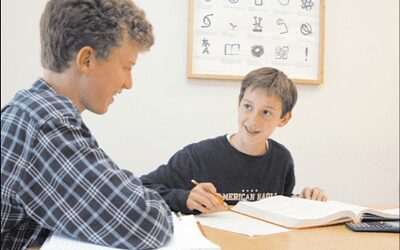



At the beginning of the year, children are learning how to participate in a community as well as how to choose and complete their work.
Parents naturally want to know that school is working. We want to see progress : children coming home talking enthusiastically about lessons, friendships, and discoveries. So the first few weeks can feel surprisingly slow.
Why is my child not bringing home more work? Why has the teacher not introduced more advanced mathematics? Why does my child seem to be doing simple Practical Life activities? Why is the teacher spending so much time on routines?
The answer is that Montessori teachers understand something important : before we can build a strong year of learning, we have to build the community in which that learning can occur.
The first curriculum is often the classroom itself
At the beginning of the year, children have a great deal to learn that never appears on a curriculum chart. Where do things belong? How do I carry a tray or roll a rug? How do I watch someone else’s work without interfering? What do I do if the material I want is already in use? How do I ask for help or join a conversation? What happens when I spill something? How do I move through the room without disturbing others?
These may look like small things. They are not.
A classroom in which twenty or thirty children can independently make good choices, find what they need, respect one another’s concentration, solve small problems, and care for their environment is capable of extraordinary learning. But that community has to be built first.
In Dr. Montessori’s view, the prepared environment includes more than shelves and materials. It also includes the relationships, routines, expectations, and habits that allow children to function with growing independence. The classroom itself becomes the first curriculum.

Caption: Grace and Courtesy lessons help children learn how to move, observe, wait, and participate respectfully in the classroom.
Montessori teachers begin by observing
During the opening weeks, teachers are relearning the children in front of them : even children they taught the year before, because those children have changed.
Who enters confidently? Who hangs back? Who is drawn to challenging work, and who avoids it? Who seems tired or wants constant adult attention? Who works well beside others, and who becomes distracted? Who concentrates intensely? Who knows how to choose work but needs reminders about returning it?
Observation tells the teacher what each child needs next. That is why Montessori teachers do not simply march through a predetermined schedule of lessons. They are teaching children, not pages in a curriculum guide.
This does not mean that Montessori classrooms lack structure. Quite the opposite. The teacher has a carefully prepared environment, a deep understanding of child development, and a thoughtful sequence of presentations. But the teacher also pays attention to readiness, interest, energy, and emotional well-being.
We can think of the guide as asking a series of practical questions:
- What is this child ready for?
- What will draw this child toward purposeful work?
- Does this child need a new lesson or more repetition?
- Is the difficulty academic, social, physical, or emotional?
- What small step would support greater independence?
A teacher may delay a lesson not because the child is being overlooked, but because the teacher is looking carefully.
Lessons are introduced with purpose
A Montessori classroom contains many materials, but children are not turned loose to experiment with everything at once. Teachers present lessons deliberately, often individually or in small groups, and then step back so children can practise, repeat, and discover.
Some children need foundational experiences before moving on. Others are ready to advance quickly. Some need to rebuild habits of concentration after a long summer; others need time to establish friendships and trust. Good teaching responds to those differences.
A child who spends the first week pouring water, washing a table, or arranging flowers may be doing exactly the work that supports the next stage of development. Practical Life activities strengthen coordination, order, concentration, and independence. They also offer a child something real to do successfully while the larger social environment is still becoming familiar.
That matters. A child who feels competent is more likely to take a healthy risk. A child who knows where materials belong is more likely to work independently. A child who has practised waiting, carrying, cleaning, and asking for help is better prepared to participate in lessons with others.
Good teaching is not a race.
What Montessorians mean by normalization
Parents occasionally hear teachers use the word normalization, and it can sound odd. It does not mean making children normal, nor does it suggest that children who are energetic, sensitive, or unsettled are somehow defective.
Maria Montessori used the term to describe a process she repeatedly observed when children became deeply engaged in purposeful activity. As concentration developed, children often grew calmer, more independent, more orderly, more socially connected, and more satisfied with their work.
The classroom community gradually settled. Children began choosing meaningful work more readily and needing less external direction. They learned to manage movement, use materials carefully, and remain with an activity long enough to experience the satisfaction of completion.
Normalization is not a switch that gets turned on after a certain number of school days. Every classroom develops differently, and individual children may move through the process at different rates. Some groups settle quickly. Others need more time, especially after a major transition, a change in staffing, or a long break.
The opening weeks are often a period of construction. Teachers are building the conditions in which concentration and independence can grow.
Sometimes progress looks like going backward
A returning child who was highly independent last spring may suddenly want more help in September. A child who separated easily before may become tearful. Someone who loved mathematics may spend several days arranging flowers or repeating familiar work.
Development is not a straight line.
Transitions take energy, and children sometimes return to familiar activities precisely because familiarity offers a sense of competence and security. That is not necessarily regression. It may be preparation for the next step forward.
At home, we can support this process by avoiding unnecessary pressure. Instead of asking, “Why are you not doing the work you did last year?” we might say, “I see that you chose something familiar today.” Instead of treating a need for help as failure, we can offer calm assistance and notice when independence returns.
Children may also come home tired, quiet, or unusually emotional during the first weeks. They have been taking in new routines, social information, sounds, expectations, and physical demands. A peaceful afternoon, an unhurried meal, and an earlier bedtime may do more to support school success than an additional worksheet.

Caption: Practical Life work gives children meaningful opportunities to build concentration, coordination, order, and independence.
Why Practical Life is real work
When parents see a child sweeping, polishing, folding, pouring, or preparing snack, they may wonder when the “real” academic work will begin. Yet these activities are not filler.
Practical Life work asks children to coordinate movement, follow a sequence, manage materials, notice results, and complete a process. It invites purposeful repetition. A child who carefully pours water is developing control of movement and attention. A child who cleans a spill is learning that mistakes can be addressed. A child who prepares food is contributing to the community.
The work also carries emotional meaning. Children want to belong. Caring for the environment gives them a concrete way to participate.
At home, we can offer similar opportunities without recreating the classroom. Invite your child to help wash fruit, place napkins on the table, water a plant, match socks, or return belongings to their places. Keep the activity manageable, use real tools when appropriate, and allow enough time for the child to participate rather than rushing to finish.
The beginning of the year is not wasted time
Establishing concentration, independence, order, and community is the real work. Once those foundations are solid, academic development often accelerates.
A child who knows how to choose work, sustain attention, tolerate difficulty, correct errors, and work independently can learn an enormous amount. A class that can move calmly, listen to one another, and solve small problems has more time and energy for language, mathematics, cultural studies, and creative expression.

Caption: Observation allows the guide to understand what each child may be ready to explore next while protecting the child’s concentration.
What can parents do during the first weeks?
We can begin by trusting the process while staying connected to the school. If you are unsure what you are seeing, ask the teacher specific questions:
- What routines is the class currently practising?
- What signs of growing independence are you noticing?
- What kinds of work seem to draw my child’s concentration?
- How can we support a similar sense of order at home?
- Is my child’s adjustment within the range you would expect?
It may also help to read the Montessori Foundation’s guidance on Montessori education and preparing for a new Montessori school year. Families can also find practical support through the Montessori Family Alliance.
The goal is not to ignore concerns. If a child remains distressed, exhausted, isolated, or unable to participate over time, parents should communicate with the teacher and school leaders. Patience and observation should accompany partnership, not replace it.
Frequently asked questions
Why does my child seem to be doing easier work than last year?
Your child may be rebuilding confidence, practising foundational skills, or adjusting to a new social environment. Repetition can be purposeful and developmentally appropriate.
Why is the teacher not giving my child more advanced lessons?
The teacher may be observing readiness, protecting concentration, or waiting for an essential foundation to develop. Ask what the teacher is seeing and what the next step may be.
Should we practise schoolwork at home?
Usually, home is best used to support rest, conversation, reading, household participation, and independence. If the teacher recommends a specific activity, follow that guidance. Otherwise, additional academic pressure can sometimes interfere with the child’s natural motivation.
How long should the adjustment take?
There is no universal timetable. Many classrooms begin to settle during the first several weeks, but children and communities develop at different rates. What matters is the pattern over time : increasing comfort, participation, concentration, and independence.
The beginning of the year is not the period before learning starts. It is the construction of the conditions that make deeper learning possible.
Give the classroom time. Give the teacher time. Most of all, give your child time.
Something important is being built.