
Related Posts

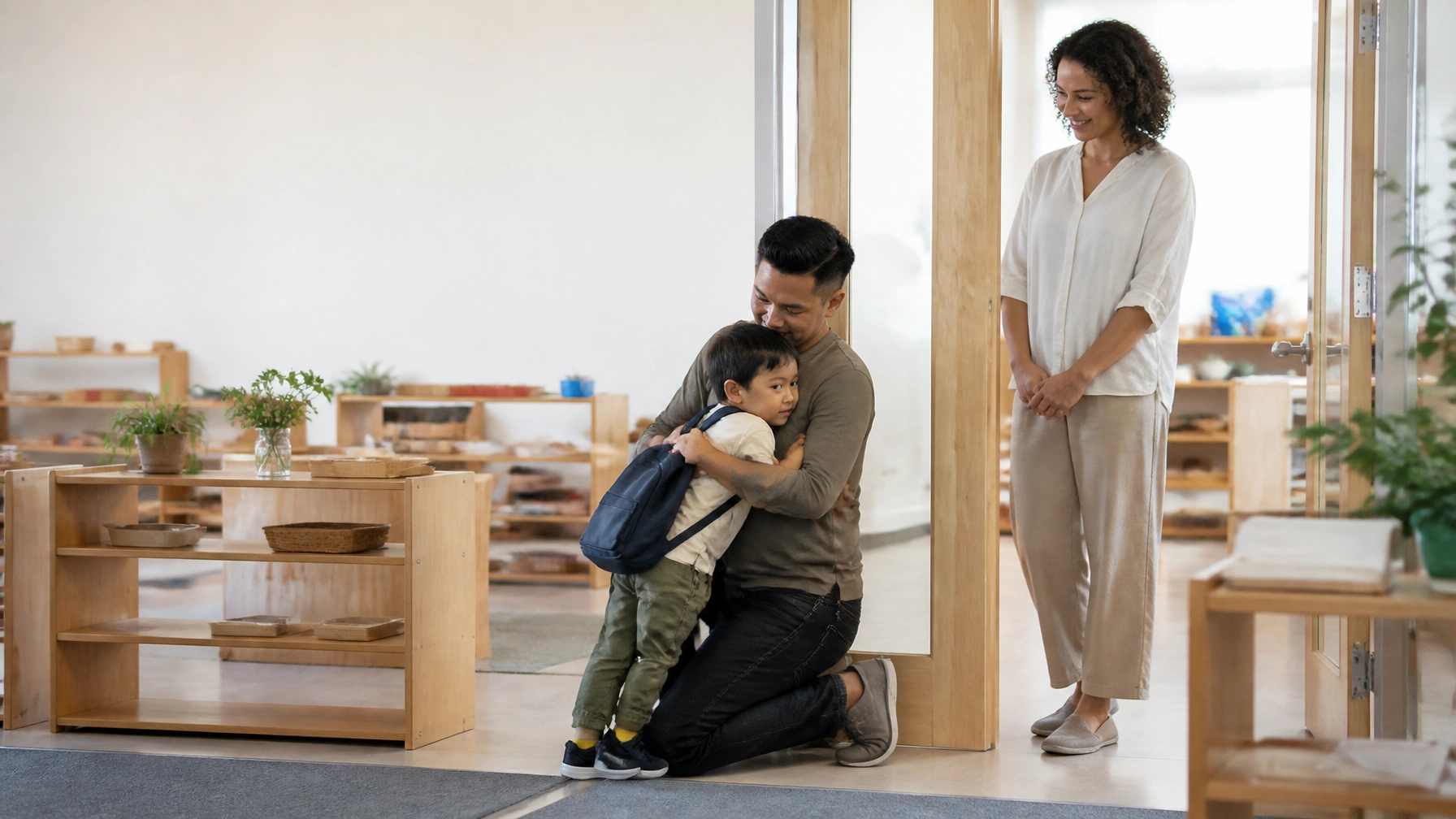
A calm, caring moment at the classroom doorway can help a child move from home to school with confidence.
Your child was excited about school last night. Everything seemed fine over breakfast. Then you arrive at the classroom door, and suddenly your child's arms are wrapped around your leg. "Don't go." There are tears : and perhaps yours aren't far behind.
Few parenting moments feel as awful as walking away from a crying child. The instinct is to stay until the child feels better. Often, though, staying longer makes the separation harder.
Tears don't automatically mean something is wrong
Children can love school and still cry when separating from a parent. Those two things aren't contradictory. Transitions are hard, and a child may be perfectly happy once inside the classroom but still struggle with the moment of goodbye. A young child can feel "I want to stay with you" and "I want to go to school" at the same time. Adults know those feelings can coexist. Children are still learning that.
From a Montessori perspective, we understand that independence develops gradually. A child may be eager to enter the classroom, choose work, greet friends, and participate in the life of the community : while still needing support when separating from a trusted parent. The tears do not automatically tell us that the child is unready, unhappy, or in the wrong school.
Sometimes they simply tell us that the transition is difficult.

A simple arrival routine can help children know what comes next.
Confidence is contagious
Children read us extraordinarily well. If we look anxious about leaving, they may reasonably conclude that something is wrong. A parent hovering at the door : "Are you sure you're okay?" "Do you want me to stay a little longer?" "Maybe I'll just wait outside" : means well. But from the child's perspective, it can communicate: apparently there's something here to worry about.
A calm, confident goodbye sends a different message: I love you. I trust these adults. I believe you can handle this. I will come back.
This does not mean that we need to hide our feelings or pretend that separation is easy. It means that we can acknowledge the child's sadness without suggesting that the situation is unsafe. We can be warm and steady at the same time.
Create a simple goodbye ritual
Predictability helps. A short routine might look like: hang up the coat, put away the lunch, one hug, one kiss, "I love you, I'll see you after school" : then leave. Not coldly, not secretly, not after twenty minutes of negotiation. Simply and confidently. A goodbye ritual only works if it actually ends with goodbye.
We might also invite the child to take part in one purposeful step before we leave. The child can carry the lunch to its place, hang up a coat, put a backpack in a cubby, or greet the guide. These small actions help shift attention toward participation in the classroom community.
The ritual should remain brief enough that the child can recognize its sequence. When the same steps happen each day, the child does not need to wonder what will happen next. The routine itself becomes reassuring.
Don't sneak away
It's tempting to disappear while the child is distracted : no tears if the child doesn't see you leave. But the problem shows up when the child looks up and discovers you're gone. For some children, that creates more anxiety, not less, because now they have to monitor your presence constantly. Better to teach: adults say goodbye, adults leave, and adults come back. That predictability builds trust.
A child may cry when we say goodbye, but the child has also received accurate information. We have not vanished. We have not made a promise we cannot keep. We have shown that goodbyes are real, that adults can leave safely, and that reunions follow.
Let the teacher take over
This is hard, especially when your child is reaching toward you. But experienced Montessori teachers have guided many children through separation. They may invite the child to water a plant, look at something interesting, greet a friend, or begin a familiar activity. The teacher isn't trying to distract the child from loving you : the teacher is helping the child make the psychological transition from home to school. Once the parent leaves, many children settle surprisingly quickly.

A familiar classroom activity can help a child make the transition from home to school.
It can help to speak with the teacher in advance about the handoff. Perhaps the teacher will greet your child at the door. Perhaps the child will begin the morning with a familiar practical-life activity. Perhaps you will use a particular phrase that signals the end of the ritual.
The important point is that the adults agree on the plan. When parents and teachers respond consistently, children receive a clear and reassuring message.
Ask what happens after you leave
If separation stays difficult, talk with the teacher away from the child. How long does it usually take her to settle? What seems to help? What are you noticing? A child who cries for thirty seconds and then happily begins work is having a very different experience than a child who stays distressed for a long stretch. The teacher can tell you what's actually happening once you're gone.
We may imagine the entire morning based on what we see at the doorway. Yet the doorway captures only one moment. The teacher's observations can help us understand the larger pattern : whether the child joins an activity, eats snack, talks with friends, or continues to show signs of distress.
If you remain concerned, ask whether the school has a way to provide a brief update after drop-off. A short message or phone call, when consistent with the school's policies, can help us avoid filling the morning with anxious speculation.
Avoid turning the car ride into a daily referendum
Try not to ask, on the way in, "Are you going to cry today?" or "Are you sure you want to go?" Those questions can unintentionally make separation the central event of every morning. Instead, treat school as a normal part of life : talk about something your child might enjoy, notice the weather, sing a song. Let the morning be about more than the goodbye.
We can also use time references our children understand. "I will come back after lunch" or "I will see you after afternoon snack" may be more meaningful than "I will be back in three hours." The goal is not to provide a complicated explanation. It is to give the child a clear, truthful sequence.
At home, we might look at the school-day routine together or talk about what will happen first, next, and later. For some children, a simple picture sequence : home, school, snack, pickup : makes the day easier to imagine.

A simple visual sequence can make the school day feel more predictable.
Some children need more support
Persistent or intense distress deserves attention. A sudden change in a child who previously loved school shouldn't be dismissed. Family changes, illness, exhaustion, classroom difficulties, or social problems may be involved, and parents and teachers should communicate openly and watch for patterns. But ordinary separation tears, especially during transitions, are very common.
We should consider the whole child. Is sleep disrupted? Has appetite changed? Does the child seem worried about school at other times of day? Is there a new stress at home? Has something changed in the classroom or in the child's relationships?
These questions are not meant to create alarm. They help parents and teachers observe carefully rather than relying only on assumptions. If distress remains intense or does not gradually ease, we can consult the teacher, school leaders, and the child's pediatrician or another appropriate professional.
The goal isn't "no crying"
We don't need to teach children that strong feelings are unacceptable. A child can be sad that you're leaving and still be capable of walking through the door. That's an important life lesson: courage isn't the absence of difficult feelings. It's knowing I can feel this, I can get through it, and the people I love come back.
Our role is not to demand a cheerful goodbye. Our role is to offer a dependable structure, communicate confidence, and remain attentive to what the child is showing us. We can validate the feeling : "I know you feel sad when I leave" : while also holding the boundary : "It is time for me to go, and I will come back after school."
Sometimes the most loving goodbye is a brief one.
For more guidance on Montessori at home and family life, visit the Montessori Family Alliance. You can also explore the Montessori Foundation’s resources on Montessori education, following the child, and creating a Montessori-inspired home.