Related Posts

An invitation for children to bring the beauty of the natural world to your family’s celebrations
Snapshot
Instead of buying decorations or having adults arrange everything, invite your children to gather natural materials on a family walk and use them to create a centerpiece and place cards for the holiday table. The goal is not a perfect, magazine-ready display. It is a chance for children to observe closely, make their own choices, and contribute something real to a family gathering.
Ages: 3 to 12, with ideas for younger children and adolescents
Preparation time: 20 to 45 minutes
Cost: Little or nothing
Why This Activity Matters
The holidays offer wonderful opportunities for children to contribute to family life, and one of the simplest is inviting them to create something beautiful for the table where everyone will gather. You don’t need expensive decorations, elaborate craft supplies, or a carefully planned design. A walk outdoors, a basket of interesting natural objects, and a little imagination are enough. And because your child made it, the finished arrangement will mean something special to everyone at the table.

A child gathers a few fallen leaves and pinecones on a family walk.
What You’ll Need
- A basket or bag for collecting natural materials
- Fallen leaves, pinecones, interesting twigs, or seed pods
- Small bowls, jars, baskets, or a wooden tray
- Paper and colored pencils or crayons for place cards
- Optional: small pumpkins, gourds, fruit, or battery-operated candles
A Word About Safety
Choose clean, safe materials. Leave behind unfamiliar berries, mushrooms, and any plants you can’t identify, along with sharp or thorny branches. With toddlers and preschoolers, skip small items such as acorns, nuts, and small seed pods that could be a choking hazard. Shake leaves and pinecones outdoors to dislodge any insects, and let damp materials dry before bringing them to the table. If you plan to collect in a park or nature preserve, check the rules first, since many public lands ask visitors to leave natural objects where they find them; your own yard, a friend’s garden, or a neighborhood walk are often better choices. Finally, use battery-operated candles rather than open flames, because dry leaves and pinecones catch fire easily.
Let’s Get Started
- Take a nature walk.
Invite your child to look for beautiful things that have fallen naturally to the ground, and take time together to notice their colors, textures, shapes, and patterns. You might ask, “Which leaves do you find most beautiful?” or “Can you find three different kinds of seed pods?” There’s no need to collect large quantities. A few carefully chosen objects are enough, and choosing them is part of the fun.

Sorting the natural finds is part of the discovery.
- Examine your collection.
When you return home, spread everything out on a table and let your child sort the objects however makes sense to them—by color, size, shape, or texture. Younger children often enjoy arranging objects from smallest to largest, while older children may want to identify the trees or plants the materials came from, using a field guide or a plant identification app. - Design a centerpiece.
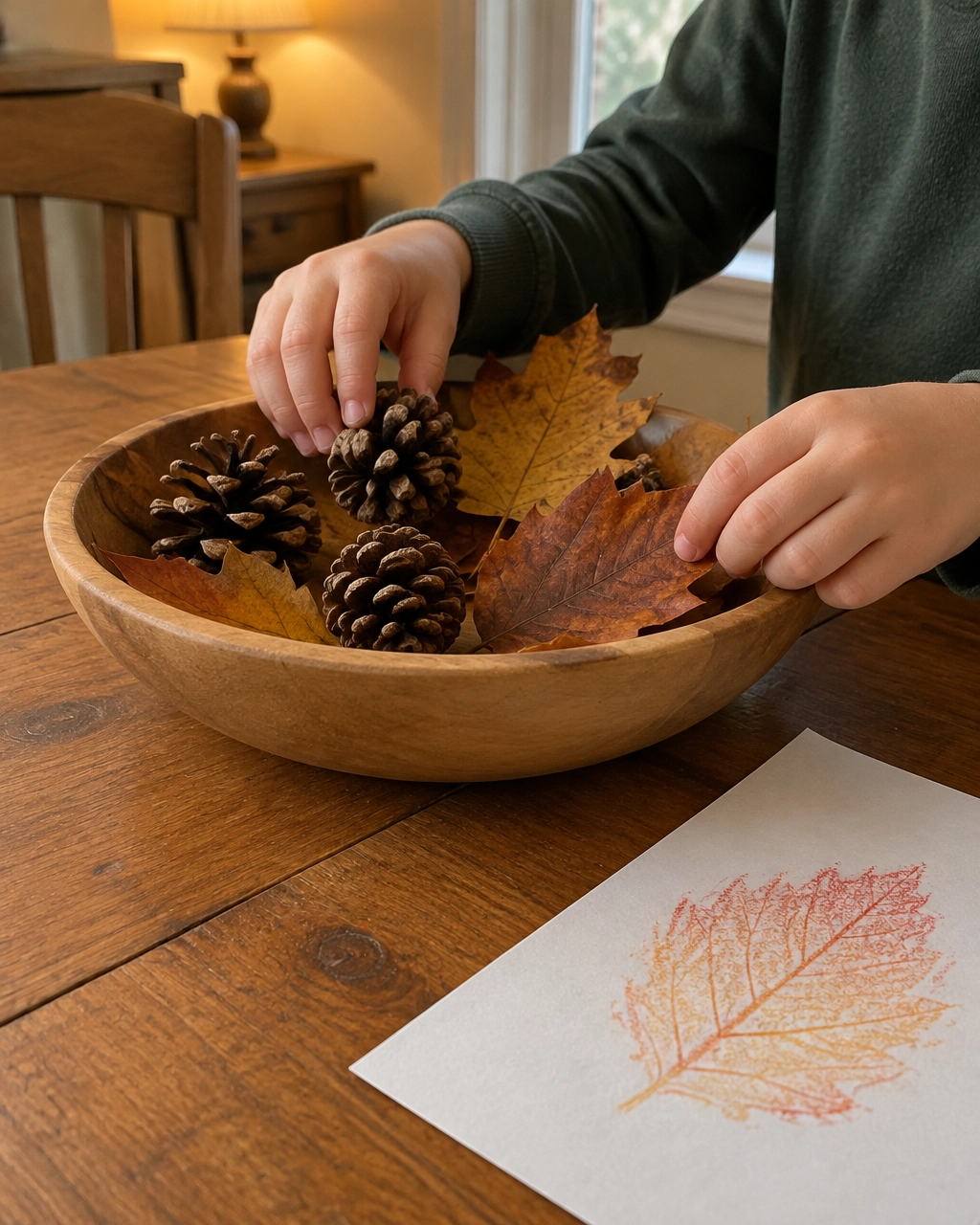
Provide a tray, shallow bowl, or basket, and invite your child to create an arrangement. Try to resist the temptation to rearrange things afterward. The goal isn’t a perfect centerpiece, but an opportunity for your child to make thoughtful decisions and feel the satisfaction of creating something on their own.

A simple arrangement takes shape, one child-chosen piece at a time.
- Make personal place cards.
Children who are learning to write can prepare a card for each guest. Younger children can draw pictures or decorate cards with leaf rubbings, made by placing a leaf under the paper and gently rubbing over it with the side of a crayon. An older child might practice careful handwriting or add a short personal message for each guest. A child with steady hands may also enjoy tying a small sprig of evergreen around a folded napkin, one of those small touches that makes a table feel cared for. - Prepare the table together.
Invite your child to help place the centerpiece, set the table, and put out the place cards. When guests arrive, let your child tell them about what they created, if they would like to.

A sprig tied to a napkin is a personal touch a child can manage alone.
Adapting the Activity to Your Child’s Age
- Ages 3 to 5: Focus on collecting, sorting, carrying, and arranging a few objects. Young children love real work, and carrying a basket or placing each item on the tray is meaningful to them.
- Ages 6 to 9: Children this age may enjoy designing the entire centerpiece, identifying plants, and making all the place cards.
- Ages 10 and up: Older children and adolescents can take on the challenge of designing the whole table setting, thinking about color, proportion, the space available, and the practical needs of guests, such as leaving room for serving dishes and keeping the centerpiece low enough for people to see one another across the table.
The Montessori Connection
In Montessori education, we believe children develop independence and confidence through meaningful activity. Preparing a holiday table brings together several important experiences: close observation of nature, creative expression, coordination, planning, and care for the environment.
Most importantly, your child is contributing to something that matters to the family. This is not simply a craft project to keep children busy while the adults prepare for company. It is real participation in family life, and children feel the difference.
Try It Again
This activity can easily become a family tradition throughout the year, because each season offers something new to discover. In winter, children might use evergreen branches and pinecones. In spring, they might arrange flowers or flowering branches, and in summer, herbs and blossoms from the garden. Over time, each arrangement becomes a reflection of your child’s growing abilities and appreciation for beauty.
If your child wants to keep going, the same materials lend themselves to a few other things: a nature wreath for the front door, or a few pressed leaves and flowers saved for handmade cards and gift tags later in the season.

A few gathered natural materials make a place for children at the family table.
The most beautiful holiday table is not necessarily the most elaborate. Sometimes it is the one that tells the story of the hands that helped create it