Related Posts

Understanding what infants and toddlers need to thrive, how parents can nurture independence at home, and the value of a Montessori environment in the earliest years
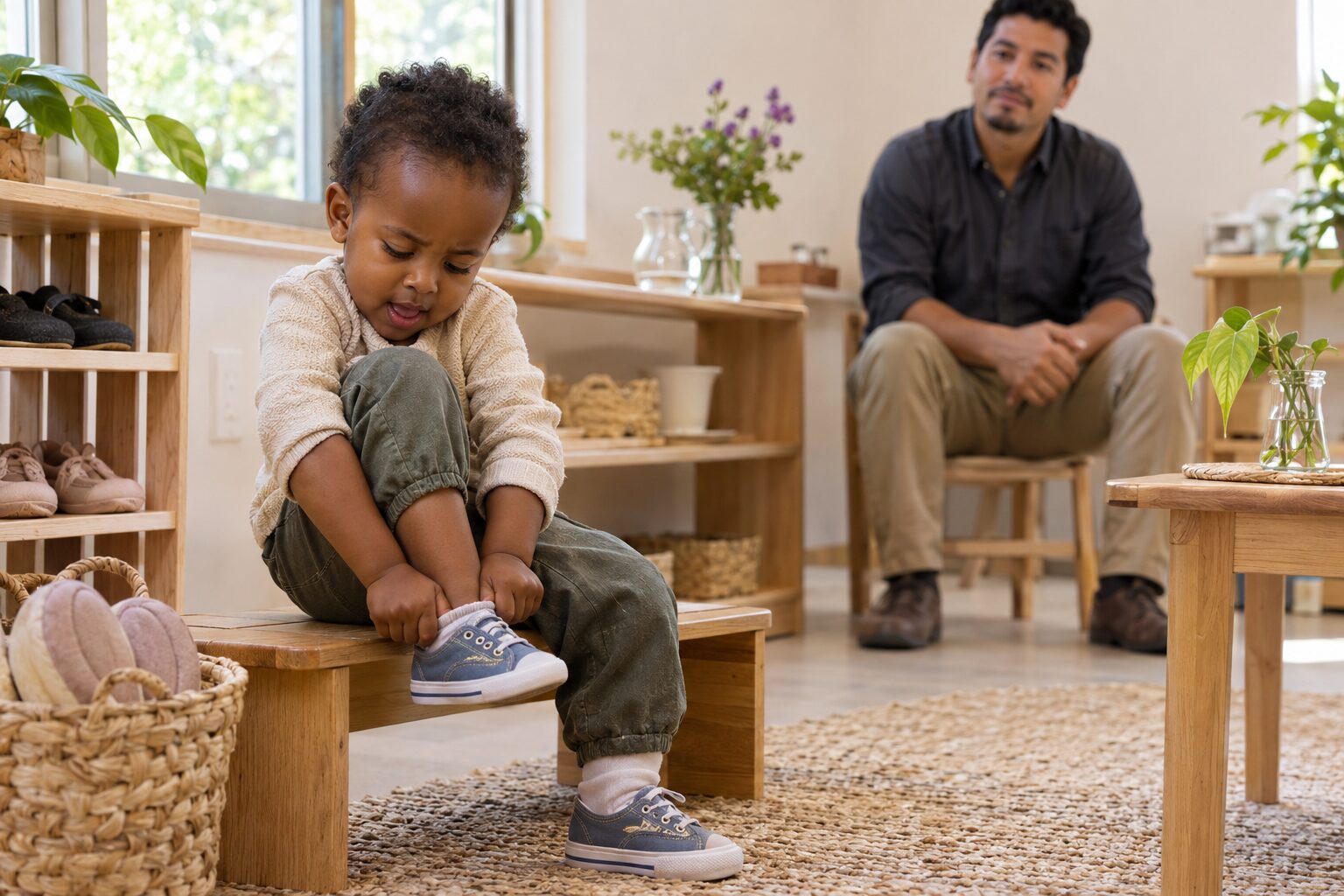
The shoe story: It would take only a moment to help, but waiting gives this little girl the chance to succeed on her own.
Snapshot
Montessori education doesn’t begin when a child walks into a classroom at age 3. It begins at birth, when babies are already learning by watching our faces, listening to our voices, moving their bodies, and taking part in everyday routines. You don’t need special materials to support this growth at home. Independence grows out of a secure, loving relationship with the adults who care for a child. A high-quality Montessori infant–toddler program can offer families loving care in an environment designed around the needs of very young children, but providing it well takes real investment, which is why many Montessori schools begin at age 3.
A Small Moment That Matters
Picture a 2-year-old sitting on a little bench, trying to put on her shoe. She gets her toes inside, but her heel keeps catching, so she pulls the shoe off and tries again. An adult sits nearby, watching. It would be so easy to slip the shoe onto her foot and move on with the day, but instead, the adult gives her a little more time.
After several tries, the shoe finally slips on. The little girl looks down, smiles, and stands up, clearly pleased with herself. In those few minutes, she has practiced coordination, patience, concentration, and problem-solving. More importantly, she has discovered that she can do something for herself.
Moments like these remind us that Montessori education doesn’t begin when a child walks into a classroom at age 3. It begins much earlier.
Education Begins Long Before Preschool
For many parents, their first introduction to Montessori comes when they begin looking for a preschool. But Maria Montessori recognized that the first 3 years of life are among the most important in a child’s development. She described the young child as having an “absorbent mind,” taking in an extraordinary amount simply by living in and interacting with the world.
Think about how much a child learns between birth and their third birthday. A newborn who cannot yet hold up their head becomes a toddler who runs, climbs, carries objects, and insists on doing things independently. A baby who communicates through cries and facial expressions gradually begins to understand language, form words, and share thoughts and feelings. All of this happens without formal lessons or worksheets.

The absorbent mind: From the earliest weeks, babies absorb language, expressions, and connection from the faces and voices of the people who love them.
Babies learn by watching our faces, listening to our voices, moving their bodies, and taking part in everyday routines. Montessori understood that our role as adults is not to rush this development, but to create the conditions that allow it to unfold.
The Importance of Doing Things for Yourself
If you’ve spent much time with toddlers, you’ve probably heard the words “Me do it!”, often at the least convenient moment, like when you’re trying to get everyone out the door in the morning.
As adults, we naturally want to help, and sometimes children truly need it. But Montessori encourages us to recognize when stepping back might be more valuable than stepping in. A toddler learning to wash her hands, carry a small glass of water, or wipe up a spill is doing much more than completing a task. She’s developing coordination, learning how things work, and discovering that she has a meaningful role in her family.
We don’t need to invent elaborate activities to make this happen. Sometimes all it takes is a small pitcher, a low hook for a jacket, or a little extra time. And yes, there will be spills and mistakes. That’s part of learning, too.

Pouring water: A small glass pitcher sized for little hands turns an ordinary task into deep concentration, and an occasional spill is part of learning.
Preparing an Environment for the Youngest Children
Montessori infant and toddler environments look a little different from classrooms for older children, because the needs of very young children are different. For infants, the focus is on freedom of movement, exploration, and secure relationships with familiar adults. A thoughtfully prepared infant space might include a comfortable area on the floor, a low mirror, and a few simple objects that encourage reaching, grasping, and rolling. Instead of spending long periods in seats, swings, or other equipment that limits movement, babies are given safe opportunities to discover what their bodies can do.

Infant movement: Open floor space, a low mirror, and a simple object to reach for invite a baby to move, explore, and discover what their body can do.
As children begin walking, the environment changes with them. A toddler room might have low shelves with a few activities, small tables and chairs, opportunities to work with water, plants to care for, and snacks to prepare. The goal isn’t a picture-perfect classroom. It’s an environment that is understandable, welcoming, and accessible to the children who use it.

The toddler room: A Montessori toddler environment is calm and orderly, with a few carefully chosen activities, real plants, and furniture that fits the children who use it.
Just as important is the adult. A Montessori infant–toddler guide learns to observe closely, respect each child’s pace, and respond with warmth and patience. Sometimes that means demonstrating a skill. Other times it means sitting quietly nearby while a child works through a challenge. The goal is not to push children to develop faster or to introduce academics early. It’s to give them a strong foundation for all the learning that lies ahead.
Can You Practice Montessori at Home?
Absolutely, and you don’t need a house full of Montessori materials to do it. Your home is your child’s first learning environment. Talking with your baby while changing a diaper, allowing time to move freely on the floor, or inviting a toddler to help prepare a snack are all simple ways to support development.
One of the most helpful changes parents can make is to look at everyday routines from their child’s perspective. Instead of always thinking about the quickest way to get something done, we can occasionally ask ourselves, “Is there a part of this my child could do?” Perhaps your toddler could carry napkins to the table or place dirty clothes in the laundry basket.

Washing hands: A sink at the right height, a towel within reach, and time to do it herself help a toddler take care of her own needs.
Of course, not every part of the day needs to become a learning experience. Families are busy, and there will always be mornings when it’s simply easier to help a child put on their shoes. That’s perfectly fine.

Helping in the kitchen: Slicing a banana for the family’s snack gives a young child the real satisfaction of contributing to home life.
In fact, one of the most important things we can offer infants and toddlers is a secure, loving relationship. Young children need to know that the adults in their lives will comfort them and respond to their needs. Independence doesn’t mean expecting a young child to manage without us. It means offering opportunities to grow while providing the reassurance and support they still need.
What Can an Excellent Montessori Infant–Toddler Program Offer?
If so much Montessori learning can happen at home, you may wonder what an infant or toddler program adds. For many families, the first consideration is practical: Parents need dependable child care while they work, and they want to know their children are safe, loved, and well cared for. A high-quality Montessori program offers all of that, along with an environment designed around the needs of very young children and adults specially prepared to understand early development.
One of the things I especially appreciate about Montessori programs for this age group is the understanding that care routines matter. Feeding, diapering, dressing, and comforting aren’t simply tasks to complete before moving on to something more educational. Think about the difference between quickly changing a baby’s diaper while talking to another adult and taking a few moments to speak directly to the baby, explain what’s happening, and invite participation. Interactions like these help children develop trust, language, and cooperation, and they strengthen the relationships that make young children feel secure.

Care routines: Dressing is more than a routine. Unhurried and respectful, it becomes a moment of cooperation, language, and trust.
When visiting a program, look beyond the attractive shelves and beautiful materials. Pay attention to how the adults speak to children. Are they warm and responsive? Do they seem to know each child well? The Montessori name alone doesn’t guarantee quality. What matters most is the experience children have with the adults and environment around them.
Why Don’t More Montessori Schools Offer Infant Programs?
Parents often ask this question when they discover that their Montessori school begins at age 3. The answer usually comes down to the practical realities of providing excellent care for babies and toddlers.
Infants need a great deal of individual attention. Programs must meet licensing requirements, maintain appropriate staffing, and provide spaces designed for feeding, diapering, sleeping, and safe movement. Teachers need specialized training in infant and toddler development. All of this makes infant care expensive to provide well. A Montessori school can’t simply add a few cribs to an existing classroom and call it an infant program. For some schools, these challenges make it difficult to offer infant care, even when they strongly believe in Montessori education from birth.

Comfort and security: Independence grows out of security. Young children need adults who notice their feelings and comfort them when they are upset.
The Beginning of a Much Longer Journey
Whether a young child spends their earliest years at home, with grandparents, in a child care setting, or in a Montessori infant community, their basic needs are much the same. They need loving, dependable relationships, opportunities to move and explore, and routines that help them feel secure. Most of all, they need adults who recognize how much learning is taking place during these early years.
I often think about that little girl trying to put on her shoe. She isn’t thinking about independence as an educational goal. She simply wants to put on her own shoe. And when the adult beside her gives her the time and encouragement to do it, she learns something important about herself: I can try. I can figure things out. I can do hard things.

Success: “I did it myself.” Small victories like this one build the confidence that will carry a child into everything that follows.
Those experiences may seem small, but they add up. By the time a child enters the Montessori Children’s House, so much of the foundation has already been laid. And perhaps that’s one of the most meaningful things Montessori teaches us about the earliest years of life: We don’t have to rush children toward independence. We simply need to make room for it.