Related Posts


Why Montessori education through adolescence can offer young people academic challenge, independence, meaningful relationships, and the confidence to shape their own futures
Snapshot
Choosing a high school is one of the most important decisions you will make with your teenager. A Montessori high school offers rigorous academics combined with intellectual freedom, close relationships with teachers who know your child well, and real responsibility for learning and life. Montessori graduates apply to college through the same admissions systems as everyone else. I believe the most important question is not only where your child will go to college, but who your child will be when they walk out the door for the last time.
A Different Kind of Promise
Imagine a high school student who can explain what she is learning, why it matters, and what she hopes to accomplish. She is comfortable asking questions, challenging ideas respectfully, and working with others. She can organize a complicated project, recognize when she needs help, and take responsibility when something goes wrong.
She certainly has academic ambitions. But she is also developing something harder to measure: a sense of who she is and what she might contribute to the world. I believe this is the larger promise of Montessori education during the high school years.
If you have watched your child grow through Montessori elementary and middle school, the decision about high school can be especially difficult. A larger school may offer extensive athletics, advanced courses, and a wider social community. A Montessori high school offers an education in which young people are known as individuals and given real responsibility for their learning and their lives. So the question is not simply which school will help your child get into college. It is which environment will help your child become a capable, thoughtful, confident adult.
Beyond the Race for Credentials
High school can easily become an intense competition over grades, class rank, advanced courses, test scores, and college admissions. Academic achievement matters, and your child deserves a rigorous education. But when education becomes mainly a race for credentials, something important can be lost. Students may choose courses for how they will look on an application rather than for what they genuinely want to understand, and avoid intellectual risks because a mistake could hurt their grades.

A seminar: In a Montessori high school seminar, students learn to analyze ideas, build arguments, and challenge one another respectfully.
Montessori high schools seek a different balance. Students are expected to master essential knowledge and skills, and they are also encouraged to pursue their own questions, take on substantial projects, and develop their own intellectual interests. The goal is not to make school easier. It is to make serious learning more meaningful.
Academic Rigor With Intellectual Freedom
A strong Montessori high school should offer challenging work in literature, writing, mathematics, science, history, world languages, and the arts. Students need to learn to analyze complex texts, build arguments, weigh evidence, and communicate clearly.
Imagine students investigating climate change in their own region. They might study atmospheric science, analyze historical weather data, and interview community members whose livelihoods are affected. Then they present their findings to a real audience. This kind of work demands solid academic knowledge, and it also asks students to collaborate, think critically, and defend their conclusions.

Climate fieldwork: Investigating real questions in their own region, students bring together science, data analysis, economics, and public policy.
When you visit, I encourage you to ask one essential question: Are students developing both a strong academic foundation and the ability to use what they know?

The lab: Rigorous academic work remains at the heart of a strong Montessori high school.
Becoming the Author of Your Own Life
As young people approach adulthood, independence takes on a new meaning. Maria Montessori saw the years from 12 to 18 as one continuous stage of development, the time when a young person begins building an adult identity. For a 3-year-old, independence may mean learning to dress without help. For a high school student, it increasingly means making decisions with long-term consequences. How should I spend my time? What do I believe? What kind of work matters to me? How do I respond when I fail?
I believe a Montessori high school should give your teenager chances to practice answering these questions while supportive adults are still close by. Students may help set their academic goals, take part in internships, or take on leadership roles. Along the way, they learn that freedom brings responsibility. A missed deadline affects other people, and a disagreement calls for communication and compromise.

An internship: Internships give teenagers a chance to test their interests in the adult world while supportive mentors are close by.
These experiences build the judgment and self-discipline young people will need when adults are no longer organizing their days.

Student leadership: When students plan and lead real projects, they learn that freedom comes with responsibility.
A Community Where Young People Are Known
One of the strongest potential advantages of a small Montessori high school is the quality of its relationships. Your teenager may develop close connections with teachers who know their interests, strengths, struggles, and hopes. In a supportive community, young people often feel more comfortable asking hard questions, admitting uncertainty, or trying something unfamiliar, which matters a great deal at an age when fear of embarrassment can keep students from taking risks.

Mentorship: In a small community, teachers know students well enough to help with more than coursework.
But I want to be honest that small communities have limitations. Some students want a much larger circle of peers, or are passionate about competitive athletics, orchestra, theater, or specialized programs a small school may not be able to offer. The best school is not necessarily the one with the most programs, nor is it automatically the smallest and most personal. It is the one that offers the right combination of challenge, opportunity, belonging, and support for your particular child.

Mentoring younger students: Older students often mentor younger ones, building leadership and confidence along the way.
What About College?
Montessori high schools prepare students for college, and many are accredited by recognized educational organizations. Their graduates apply through the same admissions systems as graduates of any other school.

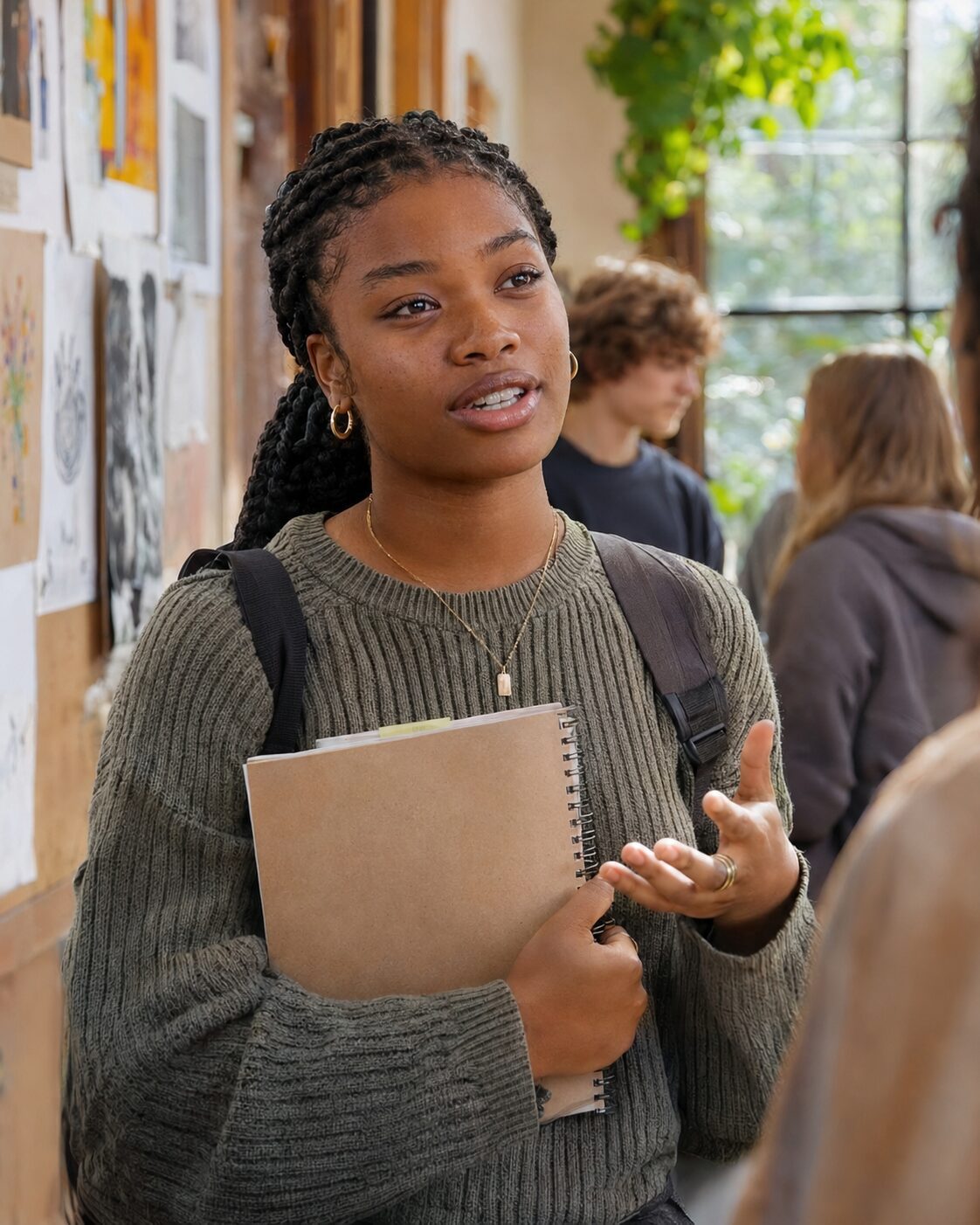
The college conversation: Montessori graduates apply to college through the same admissions systems as everyone else, often well prepared to thrive once they arrive.
What distinguishes a strong Montessori high school is not whether its graduates can get into college, but the preparation they bring with them. Ideally, students leave with a solid academic foundation, experience managing substantial independent work, and the maturity to take charge of their own education.
You should still look closely at any particular school's academic program, accreditation, graduation requirements, and record of preparing students for the paths they choose. But choosing Montessori through high school does not have to mean choosing between academic preparation and personal growth. The goal is not simply to help your child get into college. It is to help them thrive once they arrive, and throughout the life that follows.
Education for a Changing World
None of us knows exactly what the world will look like when today's teenagers reach middle age. Our children will certainly need knowledge. But they will also need the ability to keep learning, evaluate unfamiliar information, work with people whose experiences differ from their own, and adapt when circumstances change. These capacities cannot be built simply by memorizing information for exams. They grow through experience: making decisions, investigating difficult questions, working with others, and accepting responsibility. At its best, Montessori high school education makes these experiences part of everyday learning.
The Person Who Walks Out the Door
When you choose a high school, it is natural to focus on courses, grades, and college. But I would ask you to consider another question as well: Who will this young person be when they walk out the door for the last time? Will they be curious, comfortable thinking for themselves, able to respond to setbacks, and ready to contribute to something larger than themselves?

Walking out the door: The journey that began with a toddler's first shoe has always been about becoming fully human.
These are ambitious hopes, and no school can guarantee them. But they are worthy goals for education. Montessori's vision has always been larger than preparing children for the next grade. It is about helping human beings develop the knowledge, independence, character, and sense of purpose they need to live meaningful lives.
The child who once struggled to put on a shoe, who learned to care for a classroom, who explored the universe through Cosmic Education, and who discovered the value of meaningful work as a young adolescent is now preparing to enter the adult world. The journey has never been simply about school. It has been about becoming fully human.