Related Posts
Walk into a Montessori classroom for young children and you may see something that seems a little surprising.
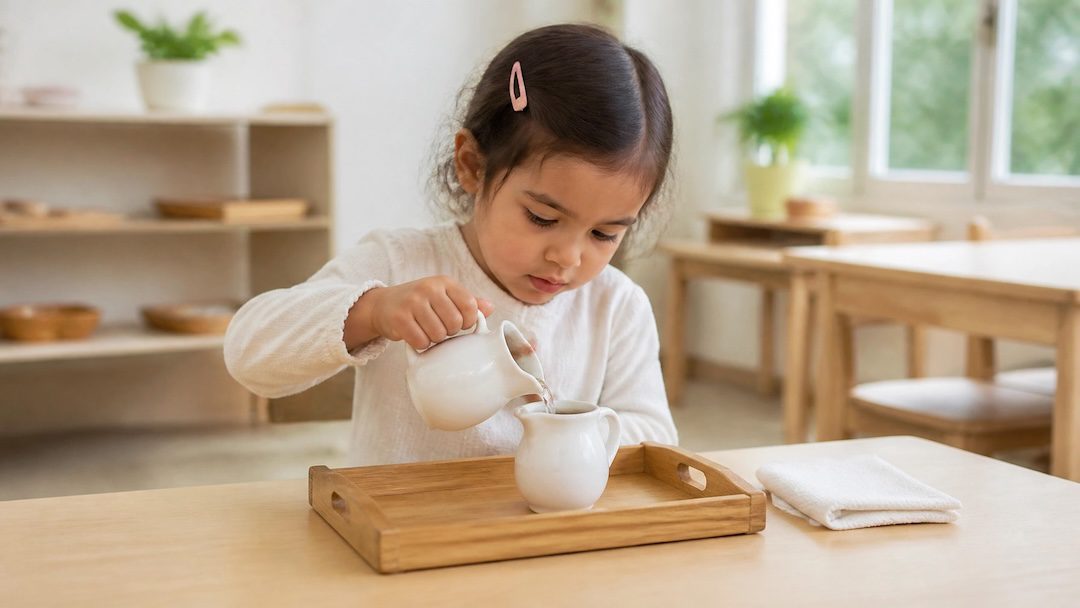
A young child carefully pours water between two small pitchers on a simple tray.
A child may be carefully pouring water from one small pitcher into another. Another may be washing a table. Someone else may be polishing a mirror, arranging flowers, preparing a snack, sweeping the floor, or fastening buttons.

Children engage in purposeful Practical Life activities, including washing a table and arranging flowers.
At first glance, a parent might reasonably wonder: is this really school?
It certainly is. These seemingly simple activities are part of one of the most important areas of the Montessori curriculum: Practical Life.
Children Want to Participate in the Real World
Young children are fascinated by the things adults do. They want to carry things, pour things, wash things, cut things, open and close things, put things away, help prepare food, take care of animals and plants.
How often have you heard a young child say, “I can do it myself”?
Montessori took this desire seriously. Rather than continually telling children “you’re too little,” “don’t touch,” or “let me do that for you,” Montessori environments give children opportunities to participate meaningfully in everyday life. The equipment is sized for their bodies. The activity is broken into manageable steps. The teacher demonstrates slowly and carefully. Then the child has an opportunity to try.

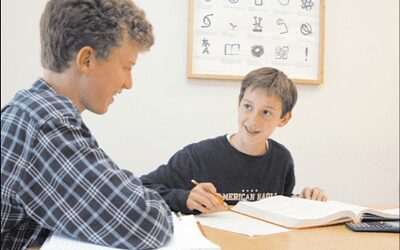
A guide demonstrates a Practical Life activity slowly while a child watches and prepares to try.
But Is Pouring Water Really Academic?
Not in the conventional sense, and that’s precisely the point.
Before children can become successful readers, writers, mathematicians, scientists, and thinkers, they need to develop some very fundamental human capacities. They need to be able to concentrate. They need to coordinate their movements. They need to remember and follow a sequence. They need to notice when something has gone wrong and figure out what to do about it. They need to persist when something doesn’t work the first time. And, gradually, they need to become less dependent on adults.
Practical Life provides an extraordinary laboratory for developing all of these abilities.
Think about something as simple as pouring water. The child must pick up the pitcher correctly, judge its weight, position the spout, control the movement of the wrist, watch the rising water level, know when to stop, and return the pitcher to its place.

A child works carefully with buttons, developing coordination, concentration, and independence.
If some water spills, that isn’t a disaster. The child knows where the cloth is and can clean it up. There is an enormous difference between an adult saying “be careful, don’t spill that” and a child discovering “if I spill something, I know what to do.” The second experience builds competence.

A child cleans up a small spill independently, treating it as an ordinary part of learning.
Practical Life Builds Concentration
One of the most important things Montessori teachers watch for is concentration. You may see a three-year-old completely absorbed in washing a table, repeating the activity again and again. To an adult, repetition can seem unnecessary — the table is already clean.

A child repeats the purposeful movement of washing a table with deep concentration.
But cleaning the table may no longer be the child’s real purpose. The child is constructing something within himself or herself: coordination, order, concentration, independence, and control of movement.
This is one reason Montessori teachers generally don’t interrupt a child who is deeply engaged simply because it seems like time to move on to something “more educational.” The concentration itself is educational.
Independence Is More Than Doing Things Alone
Montessori education places great emphasis on independence, but independence does not mean that children should never need anyone. It means helping children develop the reasonable ability to take care of themselves, their belongings, their environment, and eventually one another.

Children take responsibility for themselves and their shared environment through ordinary, meaningful actions.
A child who learns to put on a coat, prepare a snack, clean a spill, carry a plate carefully, or return materials to their proper place is receiving an important message: you are capable, you belong here, you can contribute. That sense of competence affects much more than the particular task.
Practical Life Is Also Social
Some Practical Life activities involve caring for oneself. Others involve caring for the environment. Still others involve what Montessori called Grace and Courtesy.
Children learn how to greet someone, wait without interrupting, offer help, carry something safely around another person, speak respectfully, welcome a visitor, resolve everyday conflicts, and move through a shared community with consideration for others. These are not incidental lessons. They are part of learning how to live with other human beings.

Children learn that Grace and Courtesy is part of living thoughtfully with other people.

Children practice Grace and Courtesy through respectful greetings, waiting, and shared movement.
What Can We Do at Home?
You do not need to purchase Montessori materials or turn your kitchen into a classroom. Instead, look at ordinary family life and ask a simple question: what am I routinely doing for my child that my child could begin learning to do?
A young child might carry a small backpack, put dirty clothing in a hamper, set napkins on the table, feed a pet, water a plant, help prepare a snack, wipe up a spill, sort laundry, and put shoes where they belong.

A parent invites a child to participate in ordinary family life by setting napkins and a plate.
An older child can take on increasingly meaningful responsibilities.

A child waters a plant with a small household tool as part of family life.
The goal is not to create chores simply for the sake of keeping children busy. It is to allow children to become genuine participants in family life.
It will often take longer. It may not be done exactly the way you would do it. There may even be a little more water on the floor. That’s all right. We sometimes become so efficient at caring for children that we accidentally take away the experiences through which they learn to care for themselves.
The next time your child says “I can do it,” resist the temptation to automatically step in. Watch. Wait. And when it is reasonable and safe, give your child the opportunity to try.

A child contributes confidently to family life by carrying a plate carefully to the table.
Because the ultimate goal of Practical Life is much larger than pouring water, buttoning a shirt, or washing a table. It is helping a child gradually come to the deeply satisfying realization: I can do things for myself. I can solve problems. I can care for the world around me. And I have something meaningful to contribute.