Related Posts
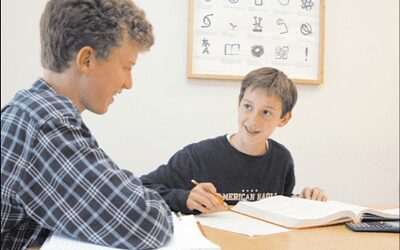

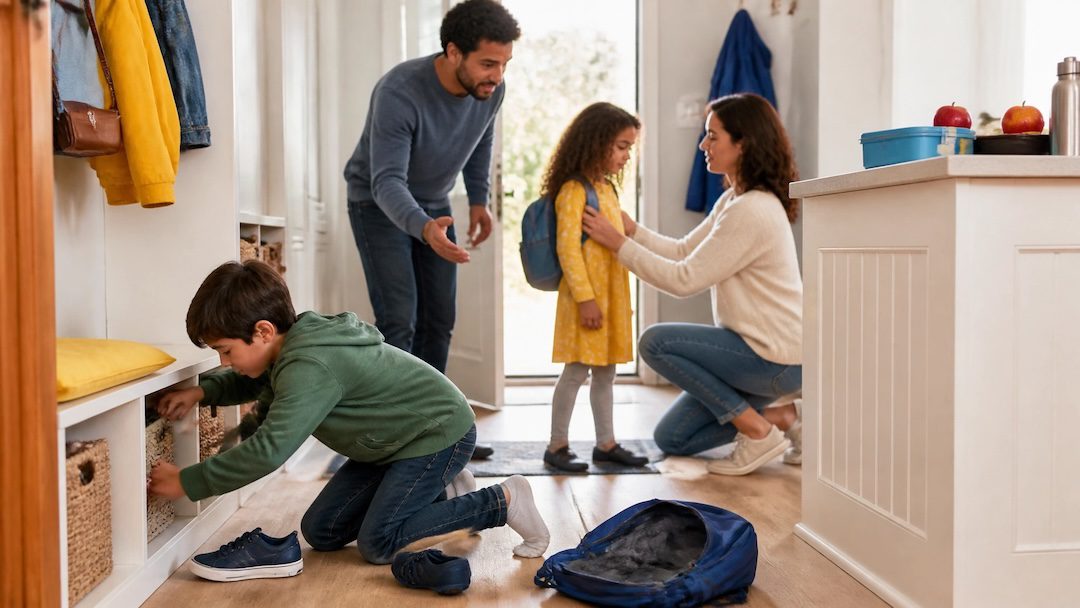
Even a difficult morning can become an opportunity to notice what children are ready to do for themselves.
It’s 7:42 in the morning.
Someone can’t find a shoe. The lunch isn’t packed. Your child suddenly remembers something that absolutely must go to school today. You have asked three times for teeth to be brushed. And now the child who was perfectly happy ten minutes ago has decided that the shirt they are wearing is completely unacceptable.
“We’re late!”

Preparing clothes and school belongings the night before can make morning independence more realistic.
If this sounds familiar, you are not alone.
Family mornings can be difficult. But a Montessori approach can help — not by creating a rigid military schedule, but by preparing the environment so children can gradually take more responsibility for getting themselves ready.
A Peaceful Morning Often Begins the Night Before
One of the simplest Montessori principles is preparation. If mornings are consistently frantic, don’t begin by blaming the child. Look at the environment and the routine instead.
What could happen the night before? Clothes can be selected. The backpack can be checked. Forms can be signed. Shoes can have a regular place. Items that need to go to school can be placed beside the door.
Much of what looks like a morning problem is actually a preparation problem.

Limited, accessible choices help children participate in preparing for the next day.
Give Children Enough Time
Adults know how long it takes them to get dressed. Children are another matter. They become distracted. They discover something fascinating under the bed. A sock feels wrong. They decide that this is the perfect moment to tell you an elaborate story.
If we give children exactly enough time to get ready assuming everything goes perfectly, we have created the conditions for stress. Building in additional time allows children to do more for themselves, and that matters. We cannot reasonably say “I want you to become independent” and then say every morning, “you’re taking too long, let me do it.”
Prepare the Environment for Independence
Look at your home from your child’s perspective. Can your child reach appropriate clothing? Is there a place for shoes? Can your child reach a hairbrush? Can breakfast dishes be reached safely? Does the backpack have a regular home? Can your child see what needs to happen next?

A simple visual sequence can help a young child remember what comes next without relying on repeated adult instructions.
For younger children, a simple picture sequence can help: get dressed, eat breakfast, brush teeth, put on shoes, and get backpack.
The goal is to reduce the number of instructions you need to give. Instead of becoming the family’s human alarm system — get dressed, eat, brush your teeth, shoes, backpack — the environment and routine begin carrying some of that responsibility.
Let Breakfast Become Practical Life
Breakfast provides wonderful opportunities for independence. Depending on age and ability, a child might pour cereal, peel a banana, spread something on toast, pour a small glass of milk, carry a dish to the table, or clean up afterward. Younger children will need more preparation and assistance. Older children can assume considerably more responsibility.

Everyday breakfast tasks can become meaningful practical life experiences when children have the time and support to participate.
Again, efficiency isn’t the only goal. If the adult does everything, breakfast may be faster. If the child participates, breakfast becomes part of education.

Cleaning up after breakfast helps children experience themselves as capable contributors to family life.
Choices Help, Too Many Choices Don’t
“Get dressed” can become an enormous decision for a young child facing a drawer full of possibilities. Offer manageable choices instead: “would you like this shirt or that one?”

Two reasonable choices can support cooperation without overwhelming a child at the busiest part of the morning.
Better still, an older child can choose clothes the night before, when there isn’t a deadline approaching. Freedom works best within reasonable limits.
Protect the Relationship
One of the saddest things about chaotic mornings is that everyone may leave the house upset. The child begins school having already experienced a series of conflicts. The parent drives away feeling guilty or frustrated.
There will always be difficult mornings — families are human. But when every morning becomes a battle, something in the system probably needs to change. Rather than simply demanding that everyone try harder tomorrow, ask: where are we getting stuck? What could be prepared in advance? What can the child reasonably do independently? Where does the child still genuinely need help? Are we allowing enough time?

Repairing the relationship after a difficult morning matters as much as improving the routine.
Punctuality Is Part of Community
Arriving at school on time isn’t simply an administrative preference. The beginning of the Montessori day matters. Children enter, greet one another, settle in, choose work, receive lessons, and establish the rhythm of the morning.

Arriving calmly gives children time to enter the classroom community and begin the day with purpose.
Regularly arriving late can make that transition more difficult for the child and can disturb a classroom whose work cycle is already underway. Being on time is also one of the ways families show consideration for the larger community.

The calm beginning of the Montessori work cycle depends on children having time to settle, connect, and choose their work.
The Goal Isn’t a Perfect Morning
Some mornings will still go sideways. Someone will lose a shoe. Someone will spill the milk. Someone will wake up grumpy.
Montessori isn’t about creating perfect children or perfect families. It is about creating conditions that allow children to develop increasing competence.

Independence develops gradually as children take responsibility for familiar steps in the morning routine.
A successful Montessori morning isn’t one in which the parent efficiently gets everyone ready. It is one in which, little by little, the children learn to get themselves ready.
And perhaps the best measure of progress is that, over time, you find yourself saying fewer words. The child already knows what comes next.