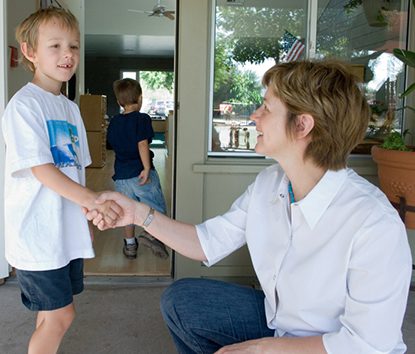
How Do You Know When You Have Entered a Montessori School?
To continue reading, you will need to choose a subscription plan.
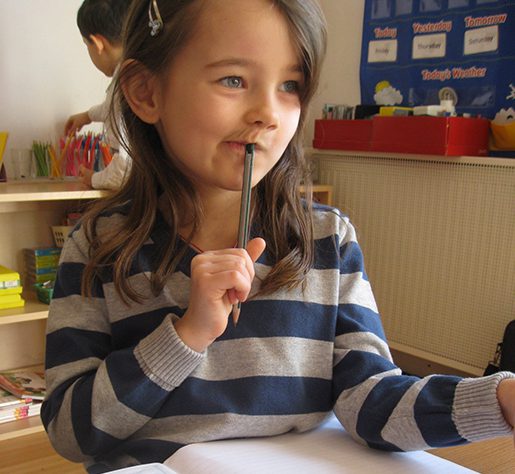
Dear Cathie: Montessori For The Kindergarten Year
To continue reading, you will need to choose a subscription plan.
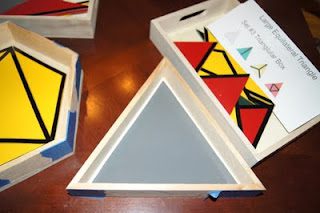
Sacred Geometry
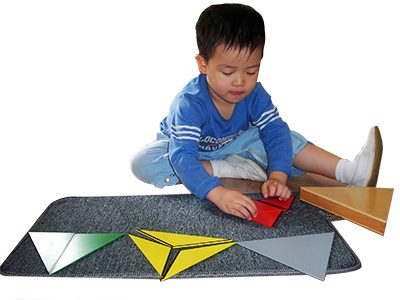
It was Plato who said,
Geometry is the experience of the eternally existent. The study of the ‘One’ is among those that lead the mind on and turn it to the vision of reality.”
This is the basis of the sacred work of geometry. It is the study of the universe, the world we live within, and our interconnected relationship with it. It is called ‘sacred’ not because it adheres to a specific religious or spiritual ideology but, rather, because it offers the practitioner a way to appreciate the world with wonder and to explore life’s most fundamental questions. This is done through physical means, through the practice of geometry. Maria Montessori shared in this vision of geometry in speaking of, “the reciprocal relationship between man and the objects of the environment.”
It is this geometric exploration into the interconnectedness of the universe and themselves that truly speaks to the child. Children look upon the world to explore, discover, and reveal who they are: psychologically, emotionally, physically, and spiritually. This happens through their interactions with, and observations of, this relative, physical world. It is in this pursuit that sacred geometry entices the child. It offers the child a spiritual exploration through physical means, that guides and leads the child to the mystical wholeness they find within their own hearts and minds. In the child, Sacred Geometry fosters wonder, keen observation and a holistic understanding of the universe and the environment where they live.
It begins with the study of the ‘One,’ as Plato suggests. This is shown through the circle.
Children will find delight in using the compass to form all sorts and sizes of circles. The circle manifests as the image of oneness and is well represented in the art and architecture of the world’s great spiritual traditions, as in the “O of Giotto,” the Zen “Enso,” or in the stained glass of the famous Chartres Cathedral in Paris, France. Through the meditative practice of creating the circle, and reflecting on it, the image of wholeness is reflected back as the child’s own completeness.
The child then discovers how the ‘One’ becomes two. This is represented through creating an exact emanation of the original circle, formed on the circumference of the original. This precise emanation creates the birthplace of geometric shapes, the coming of duality and the construction of the world as we experience it.
This space, within the intersecting points of the two circumferences sharing the same radius is called the “Vesica Piscis,” or “Bladder of the Fish.” The “Vesica Piscis” holds the pure creative potentiality of the universe. It is at this point that children’s creative energy will flow freely and their minds are “turned to the vision of reality” as they discover the many shapes, images and artwork that arises within the “Vesica Piscis” and, ultimately, from the original circle or oneness.
They discover a line and its division, the constructive triangle, the manifest square, rectangle, and the many polygon constructions. Children’s sensitive periods for imagination are stimulated and come to life as they construct and observe each shape and experience the structures of the world. The child finds familiarity in these shapes through observing their environment and within themselves.
As children continue creating polygons within the original, with more and more sides through the bisection of the constructive triangles, they find something quite extraordinary: the many has returned to the “One.” How is this possible?
We experience it in geometry as the polygon slowly becomes the circle again, as more and more sides are added to it. The child might even say, “Look, it’s becoming the circle again!” But how does the “eternally existent” manifest in our own lives? This is the real question of Sacred Geometry and one for each of us to discover through our own practice, as the child does quite naturally through concentrated work. (Please note that this is a very brief introduction and overview of this topic and process, and is in no way meant to be taken as an exhaustive account.)
Each step along this geometric journey affords the child the opportunity to realize something about themselves and the environment in which they live. This ultimately manifests in beautiful artwork and mandalas that the children create from the spark in their heart/mind. Not just artwork on paper but the beautiful artwork of their being.
It is important that children are able to discover of their own accord and not be told what they might find or experience through this work. While this description is quite abstract, the child’s experience is real and actual and devoid of such unneeded intellectualizing. Any such explanation would only serve to diminish the child’s interest and wonder.
The study is also one that will take time and patience. No specific timeline should be set, it will come when it is ready. Some guidance on the process is all that is needed; a direction into the use of the compass and straight-edge and how to create the basic constructions is helpful. This is truly a journey of self-exploration and it is through the child’s self-discovery that Maria Montessori’s vision of peace in the world becomes a reality of humankind’s future.
Now, for the Montessori guide, the practice of Sacred Geometry leads us into our own inquiry. It offers us a medium for the internal work and preparation necessary to follow and guide the child with fresh eyes; within our classrooms and in the world. Working with the compass and straight-edge, we find a meditation on the building blocks of our life. Like the child, we begin with the circle and move step-by-step. We encounter our edges as we bump up against our own challenges. We must learn and practice patience and focus as we come to the work each time.
It gives us insight into the child’s challenges as well, as we realize our own limitations. Perhaps we notice our own insecurities in our ability to create the work as we would like. Or, we struggle with our desire for perfection, and with our comparisons to others. Ultimately, through practice, we come to see the shapes as complete as they are and realize that we, too, are complete as we are.
As we gaze upon these shapes and observe our world, we see that geometry is everywhere; it is this life itself and in and through each and every one of us. It is nature and the whole of the universe. Like the child, we discover things about ourselves that helps us appreciate our children and the wonder they experience in the world.
I encourage each and every one us to join in this exploration of the fascinating and awe-inspiring practice of Sacred Geometry. Learn and guide your children in how to utilize the geometer’s tools, the compass and straight-edge, to create inspiring geometric works, and take a personal journey of self-discovery, as we explore the structures and building blocks of the world in which we live.
Tomorrow’s Child / Sept 2016 / p 9
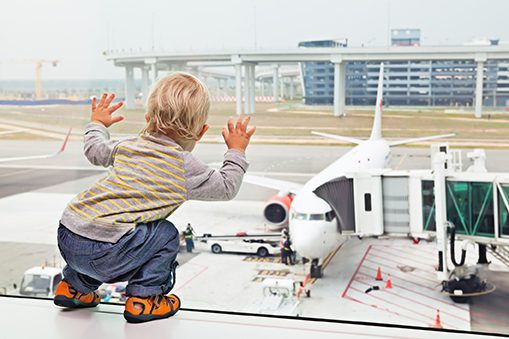
Traveling with Young Children
Yay! It’s time to visit friends and relatives for the holidays!
The thing is, though, that you’ve got young children, and a plane flight looms on the horizon. The only thing worse than sitting in front of a fussy child on a plane is the parent who is trying so hard not to have THAT child! No matter how well behaved your child might be in other situations, all bets are off when it comes to air travel.
While we all dread having THAT child, it’s worth remembering that most of your fellow passengers have probably had the same experience at some time in their life with their own children. Young children are excited and cranky and too tired to sleep. While there’s no sure-fire fix to eliminate the stress of plane travel with young children, there are some ways to make it easier.
Before we talk about fun, let’s remember some basic ‘housekeeping’ issues.
Bathroom/Diapers: Use the restroom facilities in the airport before boarding the plane. Even when your newly diaper-free child says a bathroom break is not necessary, now is the time to learn one of the basic life lessons: Never turn down a free lunch or a chance to go to the bathroom! If you have ever tried to change a messy diaper in an airplane bathroom or had to stand in line with a crying toddler grabbing his pants as you wait for someone to exit the lavatory, you know the importance of this step.
Wipes: Bring wipes of all kinds: diaper wipes, face wipes, hand wipes, disinfectant wipes (for the plane tray and basically everything your child is going to touch… or has touched), and glass wipes if you wear glasses, because they will probably get smeared with something.
Popping Ears: All children (and adults) feel pressure in their ears as the plane gains altitude. For children, it is more painful. If you’re traveling with a baby, now is the time for breast, bottle, or ‘binkie.’ Many adults chew gum for the same reason. For toddlers, this might be the time to treat them to a lollipop (sugar free preferably). Swallowing is the key!
Now that you’ve attained lift-off, here are some other suggestions that won’t break the bank or waste valuable carry-on space, plus you will find them useful for occupying children in restaurants while on vacation and when you return home.
PAPER & CRAYONS
Cut some small pieces of colorful paper and allow the children to make their own little book. Crayons are better than markers. You don’t need all 500 colors; a small pack of basics will do! Let children create a story about their trip or anything else that interests them. If they want to dictate a story to go along with pictures, be a scribe. If you are really organized, make all the pages of equal size, punch two holes along the sides of the paper and bring a strand of yarn to bind the ‘book’ when it is finished. Let your child ‘read’ the book to grandparents or friends upon arrival.
PLAY DOUGH™
Maybe you have never allowed your children to play with this stuff at home. If so, this will be an absolute revelation! (Silly Putty™ is another choice). There are plenty of great recipes online if you want to make your own, or just buy some small containers of Play Doh™. Small containers are really inexpensive (about $1 each). Allow your child to remove the dough, smell it, feel the texture, and dig in. You can show your child how to make snakes and bowls and all the dough art you made when you were a child. Just don’t let them eat it. It does smell delicious! When you are done, be sure to wipe down the tray for the next passenger.
BLOCKS
A small Lego™ set can occupy a young builder for … minutes? It’s also a good opportunity to teach or engage children in identifying the block colors. Tegu™ blocks are another fun possibility. Tegu’s Pocket Pouch includes 8 magnetic wooden blocks and is packaged in a felt pouch. Tegu has reinvented the wooden block, and, by safely embedding magnets into each piece, these blocks are “curiously
attractive” for both kids and adults. The pouch sells for about $25.
ETCH A SKETCH™
This old favorite is making a comeback in a small, portable model. The Pocket Etch a Sketch™ should not cost more than $10 and is pretty entertaining for busy hands.
STOCKING STUFFERS/ GRAB BAG
Little presents that can be doled out on an hourly basis give bored children something to look forward to and represent passage of time if done on an hourly basis. Wrap each ‘present’ to prolong the experience. Little inexpensive items are all you need.
STICKY NOTES
Buy a multi-colored pack of Post-It Notes™ and let your child decorate his tray, seat, window. Be sure to retrieve them upon landing so that they can be used later.
SNACKS
Be sure to bring an assortment of snacks. The Cheerio Play Book allows your child to combine snacking with reading. On every page, there are pictures that need to be completed by adding Cheerios™ to just the right places. Pages are recessed to help children successfully place their own dry cereal pieces within the scenes. The book costs about $8. Remember to bring a sandwich bag full of Cheerios™!
In addition to your child’s favorites, we’ve got some snack suggestions in the box on the next page.
PEZ™ DISPENSER
Yes, it is candy, but it is very small and might be something your children haven’t experienced. This product has been around since the 1920s and now apparently comes in many theme-oriented dispensers. Popping the top is actually more fun than eating the treat. Just watch your children to make sure they eat the candies properly. If you can’t find these items in your local stores, just go online!
TABLETS [Editor’s Note: This is not an endorsement of tablets, computer, or phones; however, when used sparingly at home, this is a great way to make a travel experience a whole lot easier!]
When all else fails, loading books and movies onto an iPad may be your best bet. Remember to bring kid-friendly earphones. The whole plane doesn’t necessarily want to hear the soundtrack from Frozen over and over and over. Kidz Gear™ has headphones in a variety of fun colors. The cost is about $20 and well worth it! Many wonderful children’s books are also available on Kindle™.
Healthy Travel Snacks
HIGH-FIBER/LOW-SUGAR GRANOLA BARS
Low-sugar, high-fiber granola bars are a great way to boost your kids’ nutrient intake. Plus, they’re a lot easier to eat than regular granola.
Yogurt with Toppings Crumble™ granola bars into a yogurt cup for a smooth and crunchy snack. Travel with pre-packaged, store-bought bars and yogurt cups to combine together while on the go or pack already-crumbled granola in a resealable plastic bag and portion yogurt in a travel-size container.
Granola trail mix makes a sweet and salty trail mix by breaking apart one or two granola bars into a bowl and combining with 1 tablespoon of raisins and 1/3 cup of small pretzels. Toss together and store in a re-sealable plastic bag.
HIGH-FIBER/LOW-SUGAR CEREAL
Think outside the box by taking a favorite breakfast food to the next level.
O-Cereal Necklaces String any “O”-shaped cereal onto a piece of yarn, 12 to 18 inches, depending on the size of your child’s head; tie the ends to make a necklace. This is a fun activity to do ahead of time, and kids will have a blast munching rings from their neck.
Sweet and Salty Trail Mixes Combine ½ cup of cereal with ¼ cup of yogurt-covered raisins and ¼ cup chopped walnuts. Mix well and store in an airtight container or a resealable plastic bag.
Cereal Truffles Mix together ½ cup almond butter (or any nut butter), ½ cup honey, ½ teaspoon cinnamon, 2 cups brown rice cereal (or Rice Krispies™), and ½ cup unsweetened coconut. Shape into 1-inch balls and roll in ¾ cup chopped sunflower seeds. Place the truffles on a baking sheet lined with wax paper and freeze until firm. Pop truffles into an airtight container and allow them to thaw while traveling.
ALMOND BUTTER (OR ANY NUT BUTTER)*
Nut butters are a super way to add protein to snack time, and you can make portability a breeze by purchasing the single-serving packages.
Ants on a Log Cut small sticks of celery (the log) and fill the indentations with almond butter. Place some raisins or dried cranberries (the ants) on top of the butter in a straight line. Store in an airtight container.
Kids always get a kick out of this classic snack and it’s a perfect fruit, veggie, and protein combo.
Almond Butter, Honey, and Banana Sandwich Spread some almond butter on two slices of whole-grain bread. Top with a few slices of banana and drizzle on honey. Cut the sandwiches in half, and store in a re-sealable plastic bag.
*Do not serve to children with nut allergies!
MINI PANCAKES OR WAFFLES
Frozen versions are the perfect size for little hands; they also make the best toasted ‘bread’ for small sandwiches.
PB&J Pancake ‘Sammies’ Defrost mini pancakes in the microwave. Spread half the pancakes with a layer of peanut butter (or favorite nut butter) and the other half with a layer of grape jelly (or another fruit jelly). Put the halves together and pack in resealable plastic bags.
WHOLE-WHEAT WRAPS
These handheld treats travel well and are filling and finger-friendly.
Cream Cheese and Jelly Pinwheels Spread a wrap with layers of cream cheese and your favorite jelly, roll up, and cut into one-inch pieces that look like pinwheels from the side. Pack inside an airtight container.
Spinach and Feta Quesadillas Melt some feta cheese and chopped spinach between two wraps in a pan heated with oil. Then cut into wedges. Store in an airtight container with a small cup of mild salsa for dipping.
STRING CHEESE
Fun to eat while keeping kids busy, a single serving provides 10 to 20 percent of the daily calcium recommended by the USDA.
Ham and Cheese Roll-Ups No bread is needed for this tasty alternative to a pig-in-a-blanket snack. Simply roll thinly sliced deli turkey or ham around a half or a full stick of string cheese. Securing with a toothpick would be dangerous for little ones; instead, store the roll-ups seam side down in an airtight container to keep fresh.
Cheesy Pizza Rolls Cut up a whole stick into little pieces and arrange them on a whole-wheat wrap. Cover the cheese with two tablespoons of marinara sauce. Roll up the wrap and microwave for 30 seconds until the cheese is slightly melted. For short trips, keep warm in a piece of aluminum foil or store in an airtight container.
FRESH FRUIT
Sweet fruit makes for a refreshing and healthy snack that’s full of fiber and vitamins.
Mini Fruit-and-Cheese Plate Peel and dice fruit (like apples and pears) into ½-inch chunks and serve along with cubes of your child’s favorite cheese and wedges of whole-wheat pita. Everything can be stored easily in airtight containers.
Frozen Banana Bonbons Cut banana into 1-inch rounds, dip in a favorite flavor of yogurt, and roll in crushed graham crackers. Place the slices in an airtight container and store it in the freezer until you’re ready to travel. These bonbons are best served on car trips because they defrost pretty quickly.
Minty Sweet Salad Cut watermelon, cantaloupe, and honeydew into 1-inch cubes (you should have 2 cups total). In a small bowl, whisk together the juice of 1 lime, 2 tablespoons honey, and ¼ cup finely chopped mint. Toss ½ cup of grapes into the melon mixture, pour over the dressing, and toss. Pack in an airtight container and put in the fridge to maintain freshness.
APPLESAUCE CUPS
Mashed, cooked apples give kids a serving of fruit while satisfying a craving for something sweet.
Apple Dip Pack individual snack cups alongside resealable bags filled with carrot sticks or baby carrots and celery sticks for easy dipping. Or, instead of cups, portion out applesauce into airtight containers.
Apple “Pie” Cups Crush pieces of graham crackers over a cup of applesauce to create a tasty and super healthy mock apple pie. For maximum crunch, store the crackers in an airtight container and then crumble pieces into a cup of applesauce before eating; otherwise, the crackers will get soggy.
FROZEN EDAMAME
Veggies aren’t always an easy sell, but edamame is a smart on-the-go munchie that’s packed with iron, omega-3 fatty acids, and protein.
Edamame Poppers Steam up a batch of frozen edamame in pods and store in an airtight container in the fridge for up to three days. Before you hit the road, sprinkle them with a touch of salt and watch the kids have a blast popping them from the shells right into their mouths.
Edamame Hummus In a food processor, puree 1 cup of frozen edamame (steamed and shelled) with 1 small clove of garlic, 2 tablespoons of olive oil, ¼ teaspoon salt, and juice of ½ lemon. Process until smooth and serve with cut veggies or pita chips. Store everything in an airtight container. Edamame hummus is full of fiber and a terrific alternative to high calorie packaged dips.
HUMMUS
Loaded with vitamin B6, folate, and iron, creamy hummus is no ordinary dip. Plus, its thick consistency means less chance of messy spills.
Super Dip Pack hummus inside a small airtight container along with some pita chips, baby carrots, red pepper slices, and celery sticks for dipping.
Pita Pocket Stuff small whole-wheat pitas with hummus and thinly sliced cucumbers (or another sliced vegetable) for a pocket sandwich packed with protein and fiber. Store in an airtight container or resealable plastic bag to keep fresh.
Tomorrow’s Child / November 2014 / p 37
Featured
-
 Montessori Family Alliance School Group Membership (Print & Digital 2026 1/2 year pricing)
Original price was: $30.00.$15.00Current price is: $15.00.
Montessori Family Alliance School Group Membership (Print & Digital 2026 1/2 year pricing)
Original price was: $30.00.$15.00Current price is: $15.00.
-
The Montessori Way, Revised and Expanded: An Education for Life; A Comprehensive Guide for Parents and Teachers
$25.00
-
The Montessori Child: A Parent's Guide to Raising Capable Children with Creative Minds and Compassionate Hearts (The Parents' Guide to Montessori)
$20.00
-
The Montessori Toddler: A Parent's Guide to Raising a Curious and Responsible Human Being (The Parents' Guide to Montessori)
$20.00
-
Montessori in Action: Building Resilient Montessori Schools 1st Edition
$29.95