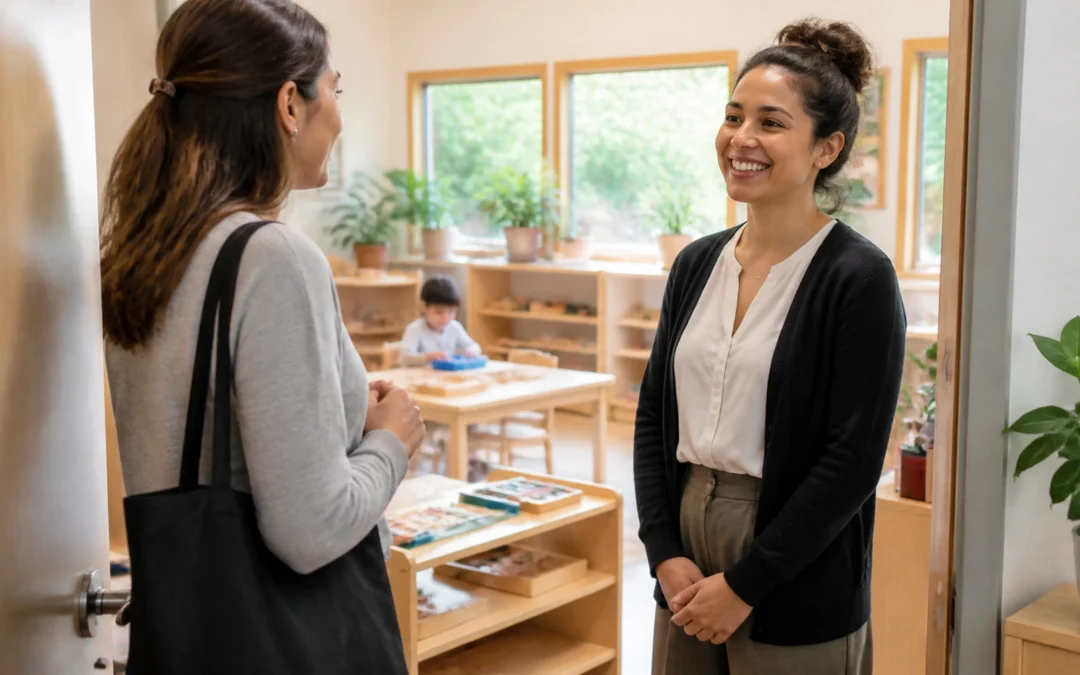
If your child’s teacher could sit down with you for an unhurried hour, there are a few things she would probably want you to hear.
Your Child Doesn’t Have to Love Every Day
Adults do not love every day at work either.
Children do not have to love every day; tiredness, frustration, and missing home are all part of growing up.
Some mornings, children wake up tired, miss you, have a disagreement with a classmate, or find a new lesson challenging.
Those experiences are not signs that school is failing. They are part of growing up.
Learning to navigate disappointment, frustration, and success with caring adults nearby is one of the most valuable parts of childhood.
Tears at Drop-Off Don’t Necessarily Mean Something Is Wrong
Few experiences are harder for a parent than walking away from a crying child.
Tears at drop-off do not necessarily mean something is wrong; many children settle quickly into purposeful work once their parent has left.
Experienced Montessori teachers, however, know something reassuring: many children who cry when a parent leaves are happily engaged in meaningful work just minutes later.
Children often express their greatest emotions with the people they trust most.
If your teacher tells you that your child settled quickly, believe them.
Independence Takes Time
It is often faster to zip the coat, tie the shoes, and carry everything to the car yourself.
Independence takes time, and each attempt to zip a coat, tie a shoe, or manage a personal belonging quietly builds confidence.
But every time children do something for themselves, they quietly build confidence.
Give your child opportunities to practice at home, even when it takes longer. The investment pays lifelong dividends.
We Notice Far More Than Academics
Parents often ask how their child is progressing in reading or whether they are ready for mathematics.
Of course, those things matter.
Montessori teachers notice far more than academics as they observe a child’s confidence, curiosity, concentration, and willingness to engage.
But we are also watching whether your child is becoming more confident, more curious, more willing to help others, better able to solve problems, and more considerate toward classmates.
These qualities often become the strongest predictors of future success—not only in school, but in life.
Please Tell Us What Is Happening at Home
Please let us know about changes such as a new baby, a family illness, a move, a death in the family, or a parent traveling.
When parents tell teachers what is happening at home, the adults around the child can respond with greater understanding and care.
Even happy changes can affect a child’s emotions and behavior.
The more we understand what your child is experiencing outside school, the better we can support them inside the classroom.
Trust That We See the Child You Love
Every teacher hopes parents understand one simple truth: we do not see a collection of test scores. We see your child.
We notice the excitement when they master a difficult skill, the quiet pride after helping a younger classmate, the determination to keep trying after a mistake, and the delight of discovering something new.
Teachers notice the quiet pride that appears when a child helps a younger classmate and contributes to the life of the community.
The delight of mastering a difficult skill is one of the moments that reminds teachers why they became teachers.
These are the moments that remind us why we became teachers.
We Are Partners
The most successful Montessori experience does not happen because parents or teachers do everything perfectly.
It happens because parents and teachers trust one another.
Children notice that trust.
When parents and teachers speak warmly about school and work together with trust, children feel more secure and supported.
When children hear their parents speak positively about school, they feel more secure. When teachers know that parents are listening with curiosity rather than suspicion, communication becomes more open and honest.
When everyone works together, children flourish.
That is what Montessori has always been about: not simply educating children, but surrounding them with a community of adults who believe in their potential.
We did a screen-free weekend out of pure desperation.
If you are a parent living in the modern digital age, you probably know the exact brand of exhaustion I am talking about. It is that glazed-over, zombie-eyed trance where your child looks like they are absorbing blue light directly into their bloodstream. By Sunday evening, our household had reached peak tech fatigue, and my partner and I locked eyes across the living room and silently agreed: Enough.
We braced ourselves for the inevitable apocalypse. We expected a full-scale, wall-rattling meltdown by hour two. We imagined weeping, gnashing of teeth, and demands to watch algorithms feed our toddler brightly colored plastic eggs opening on YouTube.
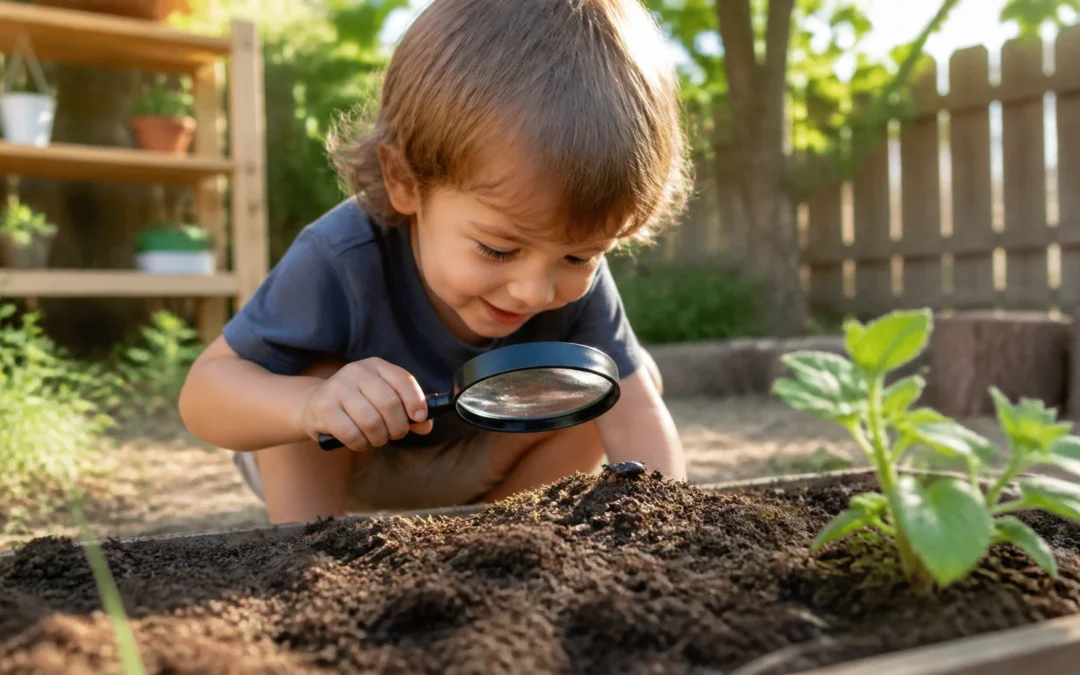
Instead, my daughter walked out to the back patio, found a dusty brown beetle in the yard, named him Gerald, and proceeded to give him a guided tour of her sandbox for forty minutes.
No screens. No battery charger. Just Gerald.
The Montessori Philosophy: Why Gerald Beats the iPad
In traditional parenting circles, outdoor time is often viewed as a recess, a way to burn off steam before getting back to “real” learning. But in the world of authentic Montessori education, the outdoors is not a break from learning; it is the ultimate extension of the classroom.
Dr. Maria Montessori recognized that children in their early years possess what she called the absorbent mind. They soak up every detail of their environment without conscious effort. When we trap children behind glass screens, we starve that brilliant absorbent mind of multi-sensory truth. A screen gives flat pixels and canned audio; a backyard gives texture, temperature, scent, shifting light, and actual living organisms.
When my daughter met Gerald, she wasn’t undergoing a structured “nature lesson.” There was zero worksheet energy. There was no teacher standing over her saying, “Now, class, observe the carapace of the Coleoptera.” There was just a child and a beetle, engaging in an authentic, self-directed encounter with the natural world.
If you are looking to dive deeper into how these foundational concepts translate into daily life, exploring foundational resources like Montessori for Every Family can completely shift how you view your child’s daily rhythms. It is not about turning your living room into an austere, museum-like schoolhouse; it is about embracing montessori basics that honor your child’s innate curiosity.
The Building Blocks of Outdoor Learning
Let’s talk about the blocks of early childhood development, not the plastic ones scattered across your floor that you inevitably step on in the dark, but the foundational building blocks of outdoor learning and unstructured play.
Modern child development research backs up what Montessori guides have known for over a century: unstructured outdoor play builds cognitive focus, risk assessment, and genuine independence in ways that curated, indoor structured activities simply cannot replicate.
When children navigate uneven terrain, hoist themselves over a rotting log, or figure out how to transport water in a leaky plastic bucket, they are constructing crucial neural pathways. They are learning physics, geometry, and resilience through raw experience.
Traditional Indoor Screen Time
Montessori Outdoor Play
Passive consumption of pre-made content
Active creation and direct manipulation of reality
Instant digital gratification and dopamine spikes
Delayed gratification through sustained exploration
Deepened concentration and focus (like watching Gerald for 40 minutes)
When we remove the screens, we clear away the mental static. That space is immediately filled by deep concentration. As parents exploring montessori philosophy, we often worry we aren’t doing enough. We buy flashcards and sign up for toddler enrichment classes in Mandarin-violin fusion. But as it turns out, sometimes the most profound educational intervention you can make is to step out of the way and let your child examine a six-legged neighbor named Gerald.
Montessori Basics at Home: Low-Effort Ways to Welcome the Outdoors
You do not need a sprawling acreage or an immaculate organic garden to cultivate this environment. In fact, Montessori is all about simplicity and respect for what is already there. The prepared environment can start in the smallest patch of earth.
Here are a few remarkably low-effort ways to start bringing these principles into your weekend routine:
A patch of “wild” yard: Designate a small corner of your yard, or even a large planter box on a balcony, where your child is allowed to dig, turn over rocks, and move dirt with zero rules. No manicured lawn perfection allowed here. This is their laboratory.
The investigator’s toolkit: A simple bug jar with a breathable lid and a sturdy magnifying glass. That’s the entire kit. You don’t need battery-operated microscope gizmos; let the simplicity of the lens focus their attention on the intricate details of a leaf or an ant trail.
Embrace the sacred pause of boredom: The magic often happens right when you feel most uncomfortable. When your child whines, “I’m bored,” resist the urge to hand over a tablet or orchestrate an activity. Let boredom happen before you intervene. That awkward, empty space is usually where Gerald shows up.
Montessori Discipline and the Calm Mind
One unexpected side effect of our screen-free weekend was a dramatic shift in household dynamics. We often stress endlessly over montessori discipline, wondering how to set compassionate, firm boundaries without resorting to shouting or sticker charts.
It turns out that raw, outdoor sensory play is one of the best regulators of children’s nervous systems ever invented. When children spend forty minutes squatting in the dirt tracking an insect, their cortisol levels drop. Their erratic energy finds a natural anchor.
When we brought her inside that evening, the usual bedtime battles evaporated. There was no frantic dopamine withdrawal from turning off a tablet; there was a tired, satisfied child who calmly washed her muddy hands at the sink, climbed into bed, and chattered happily about Gerald’s architectural choices in the sandbox.
By trusting the child’s natural inclination toward order and purposeful activity, we unlocked a level of peace we hadn’t experienced in months.
Finding Community Through the Montessori Family Alliance
Implementing these shifts at home is wonderfully liberating, but it helps to know you are not charting this course alone. That is precisely why communities like the Montessori Family Alliance exist.
Whether you are navigating tantrums, setting up your first home-prepared environment, or trying to explain to well-meaning relatives why your child is eating breakfast outside with a handful of earthworms, having a supportive network of fellow parents and experienced guides makes all the difference. At The Montessori Foundation, we work every day to bridge the gap between timeless educational philosophy and the messy, beautiful reality of modern family life.
We publish practical parenting guides, host family-centered workshops, and offer resources designed to bring authentic Montessori principles right into your living room, kitchen, and backyard. Because raising independent, curious, grounded children isn’t about perfection, it’s about creating the space for discovery.
Conclusion: Long Live Gerald
We haven’t seen Gerald in a few days. We suspect he moved on to greener pastures, or perhaps a neighbor’s tomato patch. We assume he is living his absolute best life out there in the wild.
And honestly? So is my kid.
The screens are still in our house, of course, but their reign of terror has ended. They are tools now, used sparingly and with intention, rather than digital pacifiers holding our family hostage. Next time the afternoon slump hits and the household energy starts to fray, we won’t panic. We’ll hand over the magnifying glass, step out the back door, and see who comes out to say hello.
Are you looking for more ways to bring authentic Montessori principles into your home and family life? Explore our parent resources, articles, and community programs through the Montessori Family Alliance today, and discover how small, deliberate shifts can transform your family’s daily rhythm.
Montessori is great for little children but that’s it!
Montessori is warm and fuzzy. Children enjoy it, but the real world isn’t warm and fuzzy. They have to grow up sometime.
I’m worried that Montessori shelters my child from life.
Your children are still in Montessori. You should be thinking about their future. You do want them to go to college, don’t you?
As a Montessori parent, you’ve probably heard many statements like those above, and you can probably add a few of your own. These remarks often are expressed by parents to other parents. Sometimes they come from well-meaning relatives, co-workers, neighbors, and just about anybody who knows you have a child in a Montessori school. When it comes to Montessori, it seems that everyone has an opinion.
When my children first started Montessori many years ago, I heard the statement “It takes courage to be a Montessori parent.” I used to believe that it took courage because Montessori was an experimental program to which I was offering the use of my children as guinea pigs. As I became better informed, I quickly discovered this was not the case. Montessori has actually been around for over one hundred years and has been proven successful in many different educational environments throughout the world.
So what does it mean “It takes courage?” Maybe it’s because Montessori tends to encourage children to think for themselves and articulate their own opinions. This is all wonderful, but as a parent, there are moments when it would be a whole lot easier to deal with a six-year-old who blindly and obediently accepts your explanation for why you don’t want to create a recycling center right in the middle of your kitchen or a four-year-old who announces that she knows where hamburger really comes from and she’s never going to eat it or any other animal ever again, period!
That must be it, I thought. It takes courage to live with these self-actualized, intelligent little creatures that have been encouraged by Montessori to think logically and express their opinions. I stuck with this understanding of the “courage” statement for a number of years. As a parent of two children who grew up in a Montessori school for ten years, I’ve got a million examples of a Montessori mother’s courage in action, but that’s the subject of another article.
As my children got older, I came to understand the courage statement in a whole different light. About the time that my children hit kindergarten, I found myself constantly defending my choice to keep my children in Montessori through the elementary years. The opinions of relatives were the most difficult and the hardest to discount because they came from people who were legitimately concerned about their grandchildren, or nieces and nephews. A case in point. My husband went to a New England boarding school, followed by Yale, followed by medical school at Columbia. He later topped it off by obtaining a law degree. Observing his grandson working with little beads while lying flat on his belly during a visit to the school, it was clear from the bemused expression on my father-in-law’s face that Grampa Dan not only had doubts about Montessori, he also had doubts about us as parents.
The pressure can be enormous. There were many times when we were very tempted to walk away from Montessori and put our children into the capable hands of a more traditional school. After all, we turned out all right. Or did we?
Speaking only from my own personal experience, I question how we as a society have come to define “success.” Is a child who grows up to become a doctor or a lawyer any more successful than a carpenter or a musician or a teacher or a homemaker? Do well-intended parents unconsciously push their children into status careers that send out all the right messages that we as a society have come to accept as the true measure of success.
Does it matter to us that our child grows up to be happy with her choice in careers, that she has a sense of fulfillment every day that she goes to work, that she approaches each day of her adult life with the same enthusiasm and eagerness to grow that she experienced as a child in the Montessori classroom, that she is able to accept the challenges that life has to offer and has the ability to adapt to new ideas and technology, that she understands that whatever gifts of intelligence and ability she possesses they are truly gifts and that others have other abilities and gifts that are different from her own? If we as parents can answer yes to these questions, then I believe our children are well placed in a Montessori environment for as long as we are able to keep them there.
In designing the cover, we tried to find a provocative, and indeed a shocking way, to visually portray the question: Does Montessori prepare children for the real world? The cover has a great deal of personal significance to me for three reasons. First, the boy in the picture is my son. I can assure you he does not look like that in real life (see insert). Second, it is the first and possibly only time I have ever succeeded in getting him into a tie and jacket long enough to have a picture taken (my mother will be so happy). Third, and most importantly, as a young adult, I chose a career in law for all the wrong reasons.
I believed that becoming a lawyer would give me prestige and wealth. What it gave me that I hadn’t counted on was an ulcer and the nagging feeling that I should be doing something else with my life. Please don’t get me wrong. I don’t dislike lawyers (or tasseled loafers) — even trial lawyers are ok with me as long as I don’t have to join them in the courtroom. There is nothing wrong with the law, medicine, teaching, carpentry, or anything else as long as it is what is right for the individual.
If the answer to the question of whether or not Montessori prepares children for the real world is to be judged by whether or not great percentages of Montessori students will go on to a professional career, then the answer is maybe. If the answer to the question is to be judged by whether or not Montessori prepares children for life, the answer is an unequivocal yes.
As a parent, I have very high expectations for my children from Montessori. I expect them to be well prepared academically so that they will be able to follow their dreams wherever that may take them, but I hope that they will be able to continue making the responsible choices I see them make every day in their classrooms, I hope that they will be able to retain the love of learning and creativity that hasn’t been driven out of them by a system that is so intent upon conformity that it places individuality at grave risk.
I care about academics, but I know that my children will get them from any good school, Montessori or otherwise. For me, the true value of Montessori goes beyond academics. When I look at my own children, I see behavior patterns that are different from my own at their age. I feel very comfortable that Montessori prepares children for the real world. In an interview, David Kahn once remarked, “Montessori is the real world. It’s the dichotomy that’s false.” When you think about it, there’s a lot of sense behind that statement.
I often wish I could have had a Montessori experience as a child. Things might have turned out differently. For one thing, I could have saved all that money on law school, but then I really do believe that all learning experiences have value. Maybe a bit of Montessori did rub off on me after all. At the age of 35, I quit the practice of law and I’m now doing something I find much more fulfilling, something I probably should have done in the beginning if I had not tried so hard to jam my round-pegged personality into a square professional hole.
When I announced that I wasn’t going to practice law anymore, the initial overwhelming response was, “What do you mean you’re not going to practice law anymore. How do you think you’re going to survive in the real world without a profession?” Sound familiar?
More than anything, I hope that we as parents will have the courage to recognize and continue to support the human values and life lessons that our children are learning in their Montessori classrooms every day. As for my children growing up to pursue some kind of yuppie career, that’s ok as long as it’s right for them. Our world could probably use a lot more Montessori lawyers, politicians, and doctors who understand that there’s more to life than being book smart. Above all, though, I think that as parents and educators we must never accept the premise that our objective must be to teach children to survive life. Better we should help them learn to celebrate it!
It’s a sunny morning at Oakwood Montessori School, and inside the brightly lit classrooms, a quiet buzz fills the air. In one corner, Maya (a fourth-grader) is constructing a model of a Roman arch, while Jacob (a fifth-grader) is busy calculating irregular shapes’ areas with Montessori geometry materials. Both are focused and seem to be motivated by inner curiosity.
Maya and Jacob have been in Montessori since they were toddlers, and most days are filled with moments of discovery. Today, for Maya, it’s exploring history through building this scale model of a Roman arch that holds together without mortar. For Jacob, it’s the satisfying moment when a challenging math problem clicks into place. They are, however, quietly developing something more enduring: self-reliance, critical thinking, and resilience; these are characteristics that will serve them well when they eventually shift to more traditional middle or high schools.
The elementary Montessori learning environment is clearly different from the traditional classrooms students may experience later. The area feels more like a studio or workshop than a typical classroom. Students move around and choose their activities, working alone or with a few others. This is a hallmark of the Montessori approach. It allows students like Maya and Jacob to explore their interests while still meeting set learning goals.
Claire, the Upper Elementary Montessori guide, observed, “They’re not just working because they have to. They’re engaged in work that they choose, which develops a much deeper connection to knowing.”
Jacob enjoys challenging math problems. He says that he has been spending as much time as he can on geometry for weeks. “He’s able to dive deep into subjects that interest him,” Claire describes. “And he’s establishing the discipline to keep going even when things get difficult.”
Maya’s experience with hands-on learning is typical in Montessori education. Through tasks like constructing a Roman aqueduct, she’s not simply discovering ancient civilizations; she’s learning more about engineering, team effort, and the value of water systems in society. She may not recognize it, but the flexibility to explore principles in such an experiential way is laying the groundwork for how she’ll approach finding out for the rest of her life.
What’s not obvious to the casual observer is that both Maya and Jacob are likewise sharpening skills that will reduce their ultimate shift to more conventional school settings. They are finding out how to handle their time, set objectives, and evaluate their progress with increasing self-reliance and very little assistance from trainers.
Navigating Freedom and Responsibility
In Montessori, children like Maya and Jacob have a substantial quantity of autonomy. Each day, they choose the work on which they want to concentrate, stabilizing their interests with the academic requirements. Although this technique might seem disorganized, it promotes a strong sense of obligation and self-motivation.
families invest an evening in the class for the students to share their work and projects.”
This capability to self-manage makes Montessori students especially well-prepared for the next steps in their education. In a traditional middle or high school, where deadlines are strict and schedules are set, this self-discipline will help them thrive.
Tanya, Maya’s mom, is confident that Maya will be ready for life after Montessori. “She currently has the skills to manage her work effectively. She has ownership of her education.”
Montessori Elementary education is not just about letting children explore; it’s about preparing them for the realities of the world beyond.
As they progress through the program, students like Maya and Jacob develop essential skills that will serve them well in conventional schools: critical thinking; problem-solving, and social intelligence. These abilities are not just for educational success but for life beyond academics, helping them navigate the complexities of the modern world.
Jacob’s mom, Laura, states, “He’s discovered how to plan his day. It’s not like he’s simply doing whatever he desires. Jacob knows what he needs to accomplish, and he has to figure out how to make it happen. Yes, he has a weekly work plan, but he also keeps a journal of what he’s done and puts together portfolios of his finest work. Like the majority of kids, Jacob doesn’t constantly tell us about what he’s performed in school unless it is something very amazing. However, he has so much to say at conference time or when
In Montessori classrooms, children of different ages interact, fostering a collaborative environment where older trainees coach more youthful ones. This mixed-age grouping helps children like Maya and Jacob establish social maturity and leadership abilities. It’s an experience that’s hard to replicate in standard schools but one that offers Montessori trainees an edge when it pertains to browsing new social environments.
“It’s incredible to observe how they handle group work,” their Montessori instructor, Claire, says. “They’re not simply trying to get things done rapidly; they’re focused on finding out together. That collaboration constructs a lot of emotional intelligence.”
Jacob, who will probably transition to a standard middle school after sixth grade, is currently revealing indications of being ready for the modification. His self-confidence in handling his time and overcoming problems without fear of failure will be crucial as he moves into a more traditional environment.
Montessori Graduates in High School
Many Montessori parents question how their children will adapt from the Montessori approach to a more structured standard class setting. The experiences of former Montessori students, who efficiently transitioned from Montessori to conventional high schools, demonstrate the value of Montessori education in equipping trainees for the needs of standard academic environments.
Sophie, who is now a junior at a competitive private high school, recalls how her Montessori background offered her an unanticipated advantage when she started ninth grade. “At first, I fretted about all the tests and deadlines,” she states. “But honestly, it wasn’t as hard as I thought it would be. I was currently used to handling my own time.”
Sophie gained valuable time management abilities in Montessori, which enabled her to organize her everyday jobs and schoolwork separately. This capability served her well when she started high school, as she adapted to the more strenuous schedule without feeling overwhelmed.
Unlike many of her brand-new schoolmates, Sophie felt confident in staying up to date with her work, attributing her success to the skills she obtained in Montessori.
Sophie’s mother, Jen, who initially stressed over the shift to high school, now feels the strong foundation Montessori offered. She appreciates Sophie’s resilience, capability to express concerns, and desire to take risks in her educational journey.
Daniel, a sophomore at a public high school, tells a comparable story. “In Montessori, you’re taught to think for yourself, not simply follow guidelines,” he stated. “That actually assisted me when I got to high school. I wasn’t scared to speak out in class or deal with jobs.”
Throughout his time at Montessori, Daniel participated in all sorts of creative activities that improved his ability to think critically and resolve problems. These qualities served him well in his new school’s more structured environment. “I believe Montessori made me more positive,” he says. “It taught me how to figure things out on my own, which is something I see some of my friends fight with.”
His mom, Lisa, concurs. “He’s not just going through the movements,” she says. “Montessori gave him the tools to really engage with what he’s learning, which’s carried over into high school.”
The Long-Term Impact of Montessori
Maya and Jacob’s years in elementary Montessori are setting them up for success. They are learning to think deeply, work independently, solve problems, and make friends.
For graduates like Sophie and Daniel, the shift to traditional schools has been less of a hurdle and more of an opportunity to apply the skills they’ve spent years developing.
As Sophie prepares for college, she’s optimistic that her Montessori background will continue to serve her well. “I don’t just remember stuff for tests,” she says. “I know how to study and learn. That’s what Montessori offered me.”
For parents like Jen and Lisa, the question of whether Montessori prepares children for traditional schools is clear. “Montessori isn’t just preparing them for the next grade,” Lisa states. “It’s not just about getting them ready for the next level. It’s about providing the abilities and values they require to be successful in life.”
The same can be said for Maya, Jacob, Sophie, and Daniel. Whether they are building Roman aqueducts, computing the area of an intricate shape, or tackling the difficulties of high school, Montessori has actually provided a structure that goes far beyond academics — it’s provided the ability to navigate whatever comes next.
Joyce St. Giermaine is the Executive Director of the Montessori Foundation. Her background includes a lifetime of work in association management, law, banking, and institutional advancement. A lifelong learner, she is an accomplished photographer, editor, and graphic designer. Joyce is a former Montessori parent and grandparent.
“Mommy, why are there no more dinosaurs in the world today?” “Where do potatoes come from?” “Why is the sky blue?” If you’re a parent, such questions are a daily dose of wonder, but have you ever really considered how these everyday questions are connected to an expansive concept of the world?
Montessori education prompts children to connect the dots. You might have heard of ‘Cosmic Education’ during parent-teacher meetings or casual Montessori chitchats. Sounds a bit odd, doesn’t it?
At its heart, cosmic education is all about emphasizing the interconnectedness of everything. Dr. Montessori saw science and history as two lenses to view the captivating tale of our universe’s continuous unfolding.
It’s not just a fancy term or a subject in the Montessori curriculum. It’s a holistic approach that blends subjects like astronomy, chemistry, and biology. The aim? To stoke the embers of curiosity in our children and show them the magnificent web of life, where everything has its unique place.
From Potatoes to the Universe: It’s All Connected!
Mario Montessori wrote about his grandmother (Maria Montessori) and the concept of Cosmic Education in his book, Education for Human Development. He reflected on how his grandmother could effortlessly tie present moments to distant past events. Picture this: She’s peeling potatoes and, out of the blue, starts pondering about humankind’s journey of discovering the potato. A simple veggie makes her wonder about ancient civilizations and their agricultural practices!
Her unique gift was to make such connections, laying the groundwork for Cosmic Education. This allowed for merging the past with the present, making everyday activities feel like epic tales.
Think about how peeling potatoes could lead to tales of the potato’s journey from the New World to European dining tables. That’s the Montessori magic!
Swimming with the Salmon: Every Story Has a Lesson
Maria Montessori prompts us to ponder the salmon’s life cycle. These fish are born in freshwater, venture into the vast ocean, and, against all odds, find their way back home. It’s a biology lesson and a narrative of nature’s balance and magic.
Cosmic Education gives such stories context, teaching children the beauty and complexity of our world. Everything has a story and purpose, whether a humble potato or a migrating salmon.
Humans: The Cosmic Contributors
While salmon follow nature’s script, we humans can write our own. We can reach for the stars or recklessly consume our planet’s resources. Montessori’s Cosmic Education emphasizes our unique cosmic task: to cherish and protect our home.
More than Just School Lessons
Montessori’s Cosmic Education is more than just school lessons; it’s a philosophy. It’s about seeing the bigger picture, understanding our role in the universe, and acting responsibly. Children are not passive vessels to be filled with knowledge; they are young explorers hungry to understand their place in the cosmos.
Traditional education often starts with details, moving from basic concepts to the big picture. But Montessori flips this. Why? Because children are naturally curious about the universe, the stars, and the history of the world.
Once they see the grand tapestry, they’re eager to explore each thread.
For instance, instead of merely teaching kids about plants, Montessori education might start with the story of how the world began. Rather than giving them the right answers, a Montessori teacher will ask students to think about how they imagine our universe might have come to be. Some children may know the story from Genesis. Others may express a simple version of the concept of the Big Bang. Other ideas may include the concept of an oscillating universe that contracts and expands.
Montessori teachers tend to inspire a sense of wonder and nurture children’s curiosity and imagination.
For example, many years ago, we visited Wilmington Montessori School in Delaware to take photos for Tomorrow’s Child magazine. While there, we came across a wonderful lesson presented by one of their Elementary teachers. In a dark room, lit by the repeating flash of a strobe light, he popped a large black weather balloon filled with confetti and glitter, as he told the story of what scientists believe happened with the Big Bang at the beginning of the universe. The expression on the children’s faces, eyes wide and mouths open in surprise, they got a lesson that I am sure they remember to this day.
They were fascinated as their teacher described the concepts of all the atoms rapidly expanding away from the initial point of the Big Bang and swirling out into the distance, gradually forming stars, galaxies, planets, and the universe we know today.
My husband, Tim, is a Montessori educator. He often says that Montessori teachers ask children the right questions rather than give them the right answers.
I know that my children’s teachers offered them lots of information. But I also remember that the teachers didn’t tell them that there was one right answer. Their teachers encouraged them to question and look for alternative possible explanations but to always go to the best sources.
Montessori teachers tend to inspire a sense of wonder and nurture children’s curiosity and imagination.
So, in addition to learning how to read and write, clean a table, fold a napkin, sweep, and use a mop, they come away with some sense of the earth, the dance of the sun and the rain, and how it nurtures life. Once kids see this grand narrative, they’re naturally curious about the details: photosynthesis, the role of roots, and more.
Why Should You Care?
We often lose sight of the bigger picture in today’s fast-paced world, but our children need to grow up with a broader vision, understanding how things work and why they matter. They need to realize that every action, no matter how small, has consequences in this interconnected world.
I’ll never forget the day my four-year-old daughter announced that she had figured out where hamburger came from and refused to ever eat it again. For many years, she was a strict vegetarian, and, forty years later, she still won’t eat meat. A few years later, she was writing the president of the United States and the government of Japan, pleading with them to work together to stop fishing boats from hunting whales. She knew whales were beautiful, intelligent creatures and couldn’t understand how anyone could deliberately kill them. She was an activist then and still is today in her career as a forensic psychologist.
As parents, we aim to prepare our children for tests, careers, and life. We want them to be responsible adults, aware of their impact, and driven by purpose. Montessori’s Cosmic Education lays the foundation for this holistic growth.
So, dive into the story the next time your child asks about potatoes, stars, or the buzzing bee. Connect the dots. The universe is a grand, beautiful tapestry, and every thread, including your child, has a role to play. Montessori’s Cosmic Education is the compass that can guide them through it.
Joyce St. Giermaine is the Executive Director of the Montessori Foundation. Her background includes a lifetime of work in association management, law, Banking, and institutional advancement. A lifelong learner, she is an accomplished photographer, editor, and graphic designer. Joyce is a former Montessori parent and grandparent.
Montessori is great for little children but that’s it!
Montessori is warm and fuzzy. Children enjoy it, but the real world isn’t warm and fuzzy. They have to grow up sometime.
I’m worried that Montessori shelters my child from life.
Your children are still in Montessori. You should be thinking about their future. You do want them to go to college, don’t you?
As a Montessori parent, you’ve probably heard many statements like those above, and you can probably add a few of your own. These remarks often are expressed by parents to other parents. Sometimes they come from well-meaning relatives, co-workers, neighbors, and just about anybody who knows you have a child in a Montessori school. When it comes to Montessori, it seems that everyone has an opinion.
When my children first started Montessori many years ago, I heard the statement “It takes courage to be a Montessori parent.” I used to believe that it took courage because Montessori was an experimental program to which I was offering the use of my children as guinea pigs. As I became better informed, I quickly discovered this was not the case. Montessori has actually been around for over one hundred years and has been proven successful in many different educational environments throughout the world.
So what does it mean “It takes courage?” Maybe it’s because Montessori tends to encourage children to think for themselves and articulate their own opinions. This is all wonderful, but as a parent, there are moments when it would be a whole lot easier to deal with a six-year-old who blindly and obediently accepts your explanation for why you don’t want to create a recycling center right in the middle of your kitchen or a four-year-old who announces that she knows where hamburger really comes from and she’s never going to eat it or any other animal ever again, period!
That must be it, I thought. It takes courage to live with these self-actualized, intelligent little creatures that have been encouraged by Montessori to think logically and express their opinions. I stuck with this understanding of the “courage” statement for a number of years. As a parent of two children who grew up in a Montessori school for ten years, I’ve got a million examples of a Montessori mother’s courage in action, but that’s the subject of another article.
As my children got older, I came to understand the courage statement in a whole different light. About the time that my children hit kindergarten, I found myself constantly defending my choice to keep my children in Montessori through the elementary years. The opinions of relatives were the most difficult and the hardest to discount because they came from people who were legitimately concerned about their grandchildren, or nieces and nephews. A case in point. My husband went to a New England boarding school, followed by Yale, followed by medical school at Columbia. He later topped it off by obtaining a law degree. Observing his grandson working with little beads while lying flat on his belly during a visit to the school, it was clear from the bemused expression on my father-in-law’s face that Grampa Dan not only had doubts about Montessori, he also had doubts about us as parents.
The pressure can be enormous. There were many times when we were very tempted to walk away from Montessori and put our children into the capable hands of a more traditional school. After all, we turned out all right. Or did we?
Speaking only from my own personal experience, I question how we as a society have come to define “success.” Is a child who grows up to become a doctor or a lawyer any more successful than a carpenter or a musician or a teacher or a homemaker? Do well-intended parents unconsciously push their children into status careers that send out all the right messages that we as a society have come to accept as the true measure of success.
Does it matter to us that our child grows up to be happy with her choice in careers, that she has a sense of fulfillment every day that she goes to work, that she approaches each day of her adult life with the same enthusiasm and eagerness to grow that she experienced as a child in the Montessori classroom, that she is able to accept the challenges that life has to offer and has the ability to adapt to new ideas and technology, that she understands that whatever gifts of intelligence and ability she possesses they are truly gifts and that others have other abilities and gifts that are different from her own? If we as parents can answer yes to these questions, then I believe our children are well placed in a Montessori environment for as long as we are able to keep them there.
In designing the cover, we tried to find a provocative, and indeed a shocking way, to visually portray the question: Does Montessori prepare children for the real world? The cover has a great deal of personal significance to me for three reasons. First, the boy in the picture is my son. I can assure you he does not look like that in real life (see insert). Second, it is the first and possibly only time I have ever succeeded in getting him into a tie and jacket long enough to have a picture taken (my mother will be so happy). Third, and most importantly, as a young adult, I chose a career in law for all the wrong reasons.
I believed that becoming a lawyer would give me prestige and wealth. What it gave me that I hadn’t counted on was an ulcer and the nagging feeling that I should be doing something else with my life. Please don’t get me wrong. I don’t dislike lawyers (or tasseled loafers) — even trial lawyers are ok with me as long as I don’t have to join them in the courtroom. There is nothing wrong with the law, medicine, teaching, carpentry, or anything else as long as it is what is right for the individual.
If the answer to the question of whether or not Montessori prepares children for the real world is to be judged by whether or not great percentages of Montessori students will go on to a professional career, then the answer is maybe. If the answer to the question is to be judged by whether or not Montessori prepares children for life, the answer is an unequivocal yes.
As a parent, I have very high expectations for my children from Montessori. I expect them to be well prepared academically so that they will be able to follow their dreams wherever that may take them, but I hope that they will be able to continue making the responsible choices I see them make every day in their classrooms, I hope that they will be able to retain the love of learning and creativity that hasn’t been driven out of them by a system that is so intent upon conformity that it places individuality at grave risk.
I care about academics, but I know that my children will get them from any good school, Montessori or otherwise. For me, the true value of Montessori goes beyond academics. When I look at my own children, I see behavior patterns that are different from my own at their age. I feel very comfortable that Montessori prepares children for the real world. In an interview, David Kahn once remarked, “Montessori is the real world. It’s the dichotomy that’s false.” When you think about it, there’s a lot of sense behind that statement.
I often wish I could have had a Montessori experience as a child. Things might have turned out differently. For one thing, I could have saved all that money on law school, but then I really do believe that all learning experiences have value. Maybe a bit of Montessori did rub off on me after all. At the age of 35, I quit the practice of law and I’m now doing something I find much more fulfilling, something I probably should have done in the beginning if I had not tried so hard to jam my round-pegged personality into a square professional hole.
When I announced that I wasn’t going to practice law anymore, the initial overwhelming response was, “What do you mean you’re not going to practice law anymore. How do you think you’re going to survive in the real world without a profession?” Sound familiar?
More than anything, I hope that we as parents will have the courage to recognize and continue to support the human values and life lessons that our children are learning in their Montessori classrooms every day. As for my children growing up to pursue some kind of yuppie career, that’s ok as long as it’s right for them. Our world could probably use a lot more Montessori lawyers, politicians, and doctors who understand that there’s more to life than being book smart. Above all, though, I think that as parents and educators we must never accept the premise that our objective must be to teach children to survive life. Better we should help them learn to celebrate it!
Membership in The Montessori Family Alliance means direct access to Montessori experts and other friends and parents of Montessori. Now, you have a one-stop resource for all of your Montessori needs. Brought to you by The Montessori Foundation.