

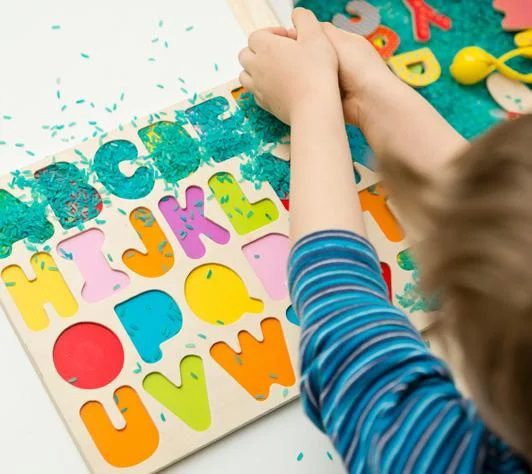
The Progression of Left to Right in Montessori Language Development
The Montessori Method, developed by Dr. Maria Montessori, is renowned for its child-centered approach to education. Within the Montessori classroom, language development plays a crucial role in nurturing a child’s ability to communicate effectively. While the Montessori Method itself is adaptable to various writing systems and cultural contexts, it often incorporates a left-to-right progression in language activities and materials. This article explores the reasons behind the left-to-right progression in Montessori language development, provides examples of materials used in the classroom, and highlights research insights on this topic.
The Importance of Left-to-Right Progression: The left-to-right progression is a convention followed in many languages for reading and writing. Introducing children to language and literacy skills in a manner that aligns with this convention can facilitate their understanding of written texts and prepare them for independent reading and writing. By incorporating left-to-right progression in language activities, Montessori educators create an environment that not only supports language development but also prepares children for successful literacy experiences beyond the classroom. The consistent use of this convention helps children build essential cognitive and linguistic skills, fostering their ability to read, write, and engage with written language effectively.
Examples of Materials and Activities in Montessori Language Development
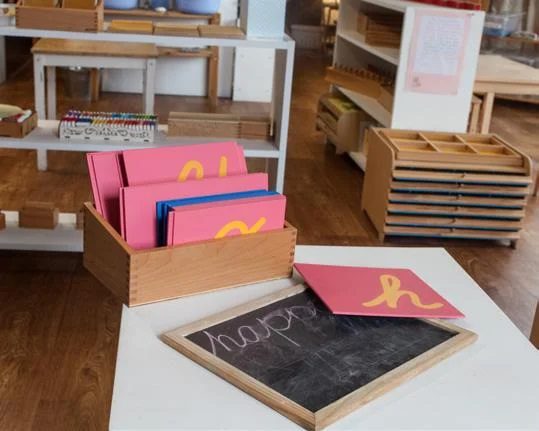
Sandpaper Letters: Sandpaper Letters are tactile materials with textured letters mounted on wooden boards. Children trace the shape of each letter with their fingers while simultaneously associating the sound with the symbol. These letters are typically arranged from left to right, reinforcing the directionality of writing.
Moveable Alphabet: The Moveable Alphabet is a set of individual letters, often made of wood or plastic, that children can manipulate to form words. Children choose letters and arrange them from left to right to represent the sounds they hear in words. This activity aligns with the left-to-right progression of writing in many languages.
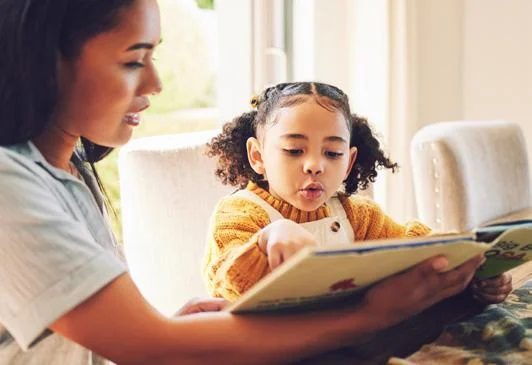
Reading Books: Montessori classrooms include a variety of books at different reading levels. As children progress in their reading abilities, they are encouraged to read from left to right, following the conventional reading direction. Teachers provide guidance and support as children navigate the pages and sentences.
Research Insights: While specific research articles linking Montessori materials with left-to-right progression in language development are limited, studies have highlighted the effectiveness of the Montessori method in enhancing early literacy skills. Research by Lillard and Else-Quest (2006) found that children in Montessori programs showed higher levels of phonological awareness, letter recognition, and early reading skills compared to non-Montessori peers. Furthermore, studies by Rathunde and Csikszentmihalyi (2005) and Dohrmann et al. (2007) indicated that Montessori education fosters independent reading and writing skills, with children developing a sense of confidence and engagement in their language abilities. Introducing children to language and literacy skills in a manner that reflects this convention has several important benefits: alignment with reading and writing conventions; cognitive organization; structure preparation for independent reading; and writing consistency and familiarity.
Conclusion: While the Montessori Method itself is adaptable to different writing systems and languages, it often incorporates a left-to-right progression in language development activities and materials. The use of materials, such as Sandpaper Letters, Moveable Alphabets, and reading books, supports the natural progression of reading and writing skills in many cultures. While further research specifically linking Montessori materials to left-to-right progression is limited (as mentioned earlier in this article), existing studies demonstrate the effectiveness of the Montessori Method in promoting early literacy skills and independent language exploration in children.
Overall, the left-to-right progression in Montessori language development aligns with the conventions followed in many languages, providing children with a solid foundation for future reading and writing skills. By understanding and practicing this natural flow of language, children are equipped with the tools to navigate and comprehend the written world around them.
References
Lillard, A. S., & Else-Quest, N. (2006). Evaluating Montessori Education. Science, 313(5795), 1893-1894. Rathunde, K., & Csikszentmihalyi, M. (2005). Middle school students’ motivation and quality of experience: A comparison of Montessori and traditional school environments. American Journal of Education, 111(3), 341-371. Dohrmann, K. R., Nishida, T. K., Gartner, A., Lipsky, D. K., Grimm, K. J., & Bugental, D. B. (2007). High school outcomes for students in a public Montessori program. Journal of Research in Childhood Education, 22(2), 205-217.
Aradhna Dhawan is a certified Montessori Educator 3-6. Eager to expand her knowledge, refine her skills, and create a prepared environment that fosters independence, critical thinking, and a love for learning. Through this pursuit, Aradhnah is currently pursuing AMI Elementary Diploma 6-12 and AMI School Leadership Certificate.
Motivated to Grow: The Child’s Passion for Work
Independent work begins with choice, and choice is a necessary work element for self-development.
Look in a Montessori classroom with twenty or more very busy children between the ages of almost three and six, and you will see children who are passionate about their work. They are focused, self-directed, and persistent. Three-year-old John cuts an apple and then shares apple slices with his friends. Four-year-old Peter traces metal shapes with colored pencils. Five-year-old Sara counts colored wooden squares and then writes numerals on a math paper. When children work with passion, they are curious, creative, inquisitive, imaginative, constructive, thoughtful, orderly, and more. Children love to work. This is how they grow.
Children’s “work” has many meanings.
In a Montessori setting, the word “work” conveys several meanings. Work identifies a learning activity. For example, a food preparation work, a writing work, or a math work. When a child uses a learning activity, he may say, “This is my work.”
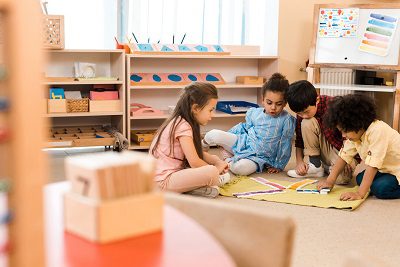
Work activities occur during the “work period.” The classroom schedule may include a 2 ½ to 3 hour morning work period. The schedule may also include a shorter afternoon work period. During the work period, children may choose work that is for one child; other works may be used by two or more children. Some works are designed to be used on a table. Other work is used on a floor. Before bringing it to the floor, children will unroll a work rug. The work rug assists the young child with keeping the learning objects together on the rug. The work rug also announces to the other children, “Please walk around my work.”
“Work” also describes a child’s responsibilities for taking care of the work materials. It can happen that a child finishes her work, and then she may decide to go to the shelf and choose another work, another learning activity. The teacher will offer the child a gentle reminder, “Please put your work away before you choose another work.”
Children’s work has both practical and developmental purpose.
“Work” refers to the practical purpose found in each learning activity. For example, a child works with the subtraction strip board and learns a subtraction process. Another child works with the bow-tying dressing frame and learns a bow-tying process. Work has yet another meaning. The child’s process of self-development is also called work. For this reason, we do not interrupt children when they work. They are developing their potential within themselves. The work of the child is to become an adult.
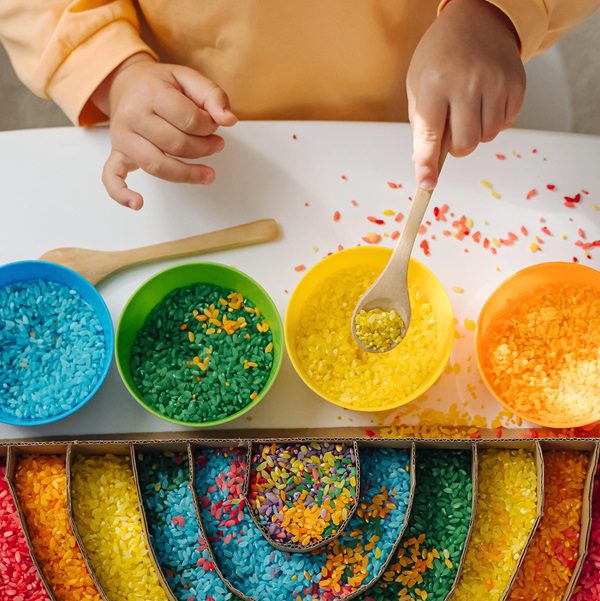
For example, three-year-old Martha transfers dried beans from one bowl to a second with a wooden tong. The practical purpose for this work is to learn to use tongs. The developmental purpose is to learn to concentrate and strengthen and develop hand coordination, a necessary preparation for learning to write when she is older.
Children’s work has several more characteristics.
Several more characteristics describe children engaged in purposeful, self-development work. Children will work independently from others. They become absorbed and concentrate for long periods of time. Children will use learning activities with tremendous repetition; they complete a work task, and then they do it all over again. And they are not concerned about making mistakes; mistakes are children’s recipes for learning.
Children make independent choices when they work.
Remarkably, young children are compelled to engage in activities by themselves. They are not directed by teachers. In the Montessori classroom, a teacher will not do anything for children if they are ready for us to show them how to do it themselves.
Independent work begins with choice, and choice is a necessary work element for self-development. When children make independent choices, they learn to become self-directed and self-disciplined. Children choose their own work. Each child will also choose how to use it and how long to use it. When children choose their own work, they are choosing what they need for their growth and development. They choose what they need to develop their unique potential. Consequently, no two children learn at the same time or in the same way, and each child will only learn when she is ready.
Children who are independent can choose their own work and work with concentration. They can persist, overcome challenges, and self-correct. They have developed habits of learning.
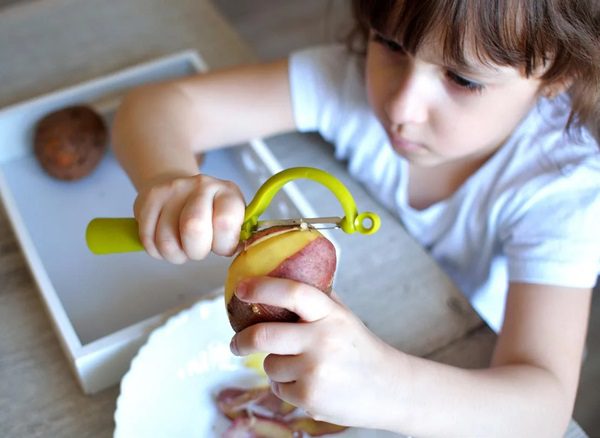
Children develop understanding when they work.
Work with the Montessori materials assists children with developing conceptual understanding. For example, size is an abstract concept. If young children could reason and learn solely with language, we could tell them the meaning of size, and they would understand. Instead, young children are perceptual learners. Young children learn with their senses (sight, sound, touch, taste, and smell) and from what they can do with objects.
Perceptual learners “think” with objects. They understand concepts by arranging and comparing objects. Something is rough because it is not smooth. Something is sweet because it is not sour.
For example, four-year-old Martin arranges a set of ten wooden rods. A practical purpose for this material is to understand length. Each rod is painted in the same red color. The shortest red rod is 10 cm. long; the next is 20 cm. long; and the next rods progress in length by ten more centimeters to the longest red rod which is 100 cm. or 1 meter long. Martin places the red rods randomly on his work rug. He then places two rods side-by-side, compares their lengths, and in this way arranges all ten rods from shortest to longest. Martin now mixes the rods and sorts them by length again. Martin repeats his work with the red rods six times.
Children prefer the process of work and not results.
Children are not result oriented. They are, instead, process oriented, and they are compelled to work with repetition. Children may prefer process because they are not interested in perfection. Perfection is a final state; there is no further growth after becoming perfect. The child’s purpose is to develop his or her unlimited potential, and repetition is how they do this.
For example, two-year-old Beth has been working with an apron for about ten minutes. She puts it on over her head, and then she takes it off. She looks at the apron, turns it sideways, and then puts it on over her head. And then takes it off, and then puts it back on. At any moment an adult could help Beth, but Beth does not ask for help. Apparently, she is not interested in wearing the apron. Beth’s choice is developmental. She is purposefully practicing putting it on and taking it off.
Three-year-old Tommy picks up a pitcher containing red-colored water. Tommy places a funnel into an empty jar, he pours the colored water into the funnel and watches the water drain into the jar. Now he places the funnel into a second jar, pours water into the funnel, and again watches the water drain. Some water spills onto the table. He places the pitcher on the table, picks up a small sponge, wipes the water spill, and squeezes the sponge into the pitcher. He now pours the jar water back into the pitcher. Then he does it all over again, and then again. Tommy busies himself for some 25 minutes with this activity. Sometimes he pours slowly, sometimes quickly, sometimes with the funnel, and sometimes without. The practical purpose of this work is to learn to pour liquids through a funnel and to decide to stop pouring when the jars are filled. The developmental purpose is to develop coordination, concentrate, and make judgments.
Children develop both practical skills and satisfy developmental purposes from repetition and practice. They develop their abilities to concentrate, observe, compare, make decisions, innovate, and more. For example, four-year-old Michelle has been sorting and building with 27 colored blocks already for 15 minutes. The colored blocks make up ten different combinations of sizes and colors. When put together, the blocks form a trinomial cube. Michelle is absorbed. She sorts the blocks by sizes and colors, builds the cube, and then takes it apart. Then she builds the cube all over again, each time beginning with a different block. Perhaps she is fascinated with the size and color patterns; perhaps she is fascinated with how these blocks always come together and form a cube.
Children’s work includes making many mistakes.
Children are mistake oriented; they are not afraid to make many, many mistakes. We should celebrate the necessity of making mistakes because this is how children learn. Their work process is to explore, investigate, make mistakes, discover, and then do It again. For example, learning to pour requires developing eye and hand coordination that prevents spilling. Learning to spell requires developing writing coordination and knowledge of English phonemes that prevent writing pear as pair or writing see as sea.
The Montessori learning materials are designed to guide children to learn to recognize and then self-correct their mistakes. For example, Tammy works with the Knobbed Cylinder Block. The purpose of this material is to learn about size and to develop the ability to reason and make judgments. There are ten cylinders in the block. The ten cylinders are the same length, and they differ in diameter. Each cylinder fits exactly into one hole in the block. Tammy takes out each cylinder and then puts them back into the block. Sometimes she puts cylinders in the wrong places — the cylinders do not fit into the wrong places. Once the cylinders are properly returned, she repeats and does it all over again. Some children will repeat this work process 15, 20, or more times.
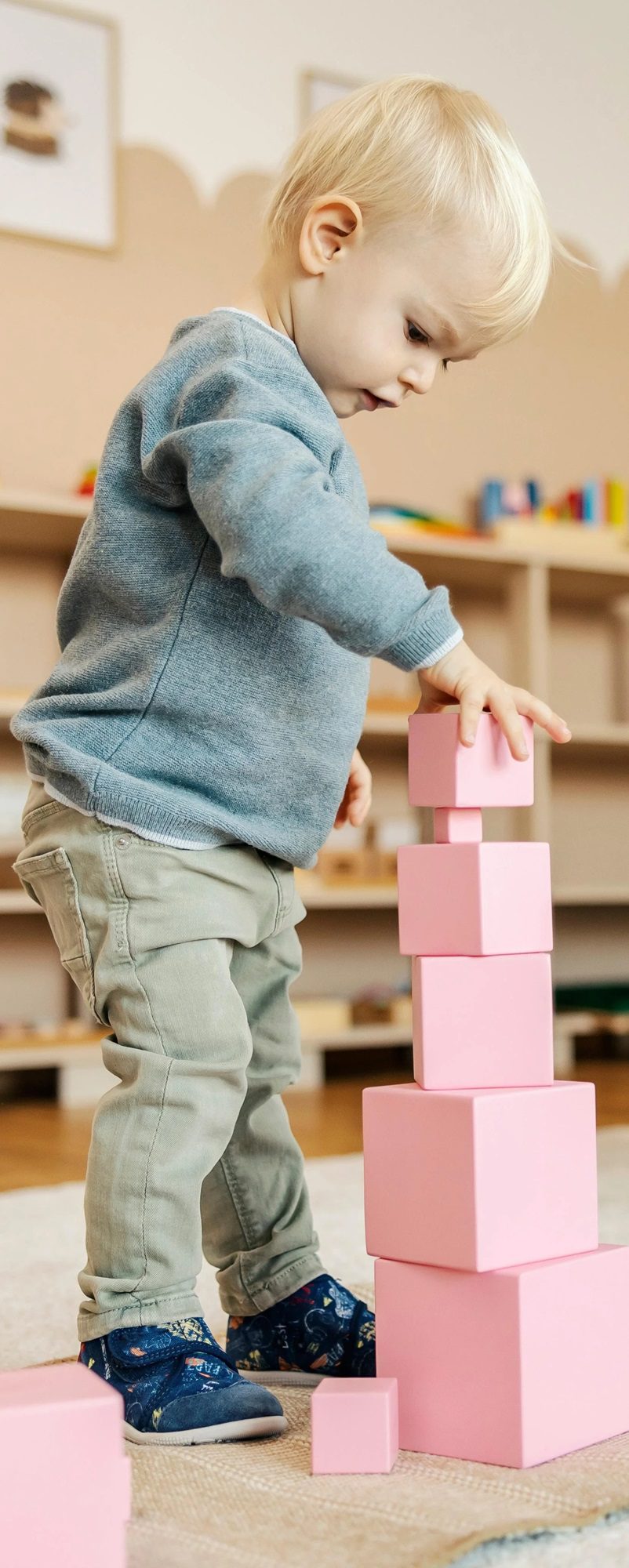
Erin builds a block tower, and the tower falls. She tries again, and she stacks the blocks in a different way. The tower falls again. From these building mistakes, Erin gains valuable experiential knowledge about cause and effect, balance, creative problem solving, and the value of learning from trial and error. This work is called the Pink Tower. This is a set of ten cubes, and the cubes are painted in an identical pink color. The cubes are not the same size. They are graded in size from 1 cm3 to 10 cm3. The purpose of this work is for the child to develop an understanding of size. Children develop this understanding with their senses. They hold and see each cube, compare the sizes and weights of each cube, and arrange the cubes in order from largest to smallest or from smallest to largest.
When children work, their repetition guides them to learn how to self-correct. Although the cubes differ in size, the child may place some of the cubes in the wrong size order. Should this happen, the teacher will merely observe and patiently wait and see what the child will do next. Will the child notice the sequence of cubes is not in a size order? Will the child self-correct and rearrange the cubes?
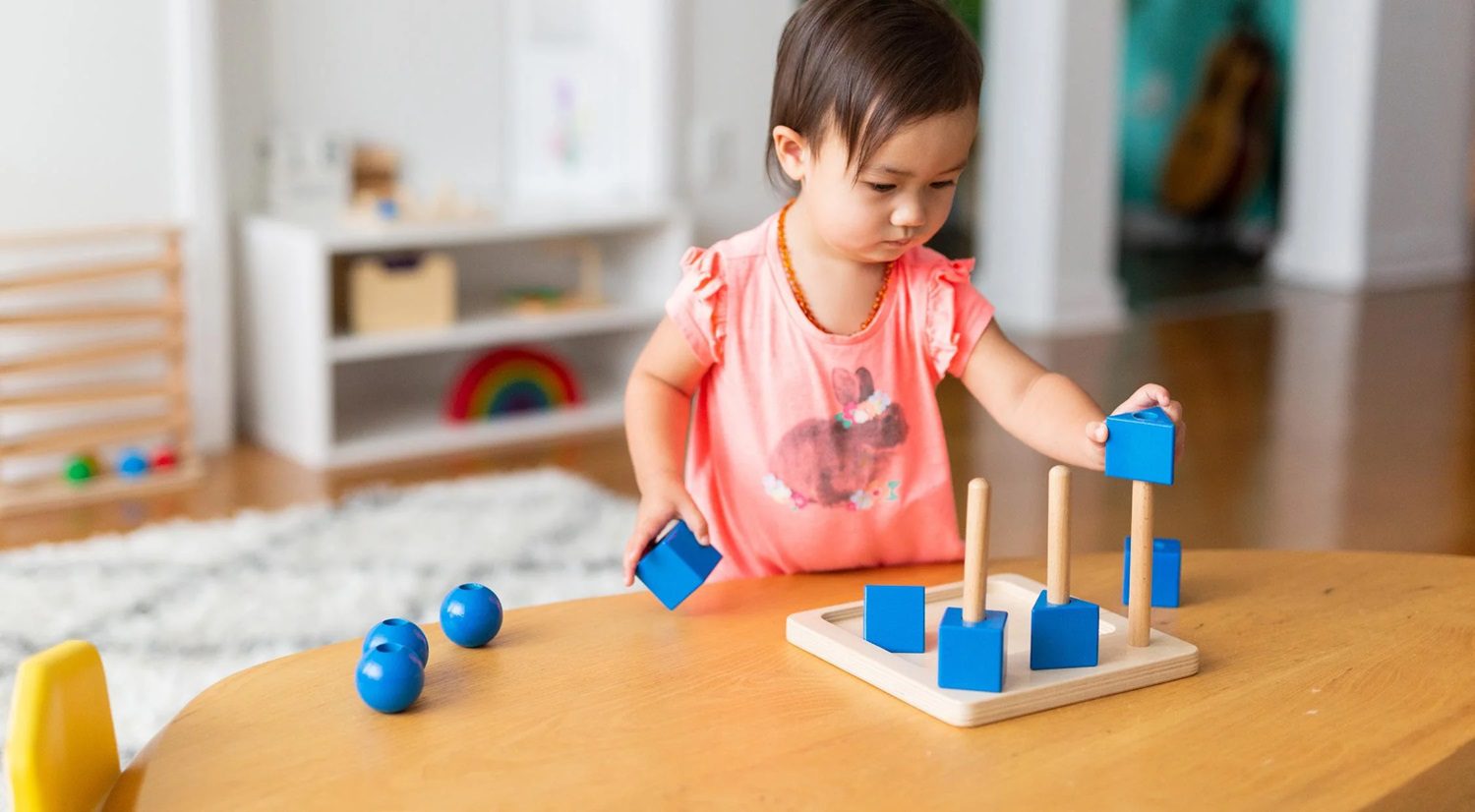
Children’s work differs from adults’ work.
Remarkably, work does not tire children. Instead, they become energized from engaging in work they have chosen. Adults, of course, also work, and we also develop ourselves from our work. For example, we go to the gym and “workout.” We can work to master some knowledge and skills and better ourselves. We also work to produce results. We often work efficiently and effectively to produce the most results we can, in the least amount of time, and with the least amount of effort. We love results, and we feel satisfied when we check it off the list. We adults are motivated to work for intrinsic and extrinsic rewards. We work out at the gym for the benefit of health and strength. And we may work at work for the benefit of a salary.
Children work for the benefit of growing up and becoming adults, and they do this without a contract or promise of salary in exchange for their time and the value they produce. When young children finish an activity, they do not check it off a list. Instead, they may do their work all over again. Children’s work often lacks efficiency and effectiveness. They may make unpredictable movements, and they may make many messes. Unlike an adult, young children do not work with minimal effort. They are “all in!” They love to work! Dr. Maria Montessori described a child’s work process:
[The] child has a personality which he is seeking to expand; he has initiative, he chooses his own work, persists in it, changes it according to his inner needs; he does not shirk effort, he rather goes in search of it, and with great joy overcomes obstacles within his capacity. (Dr. Montessori’s Own Handbook, pp.77- 78.)
For children, work is a continuous process of self-development, and children must work to develop everything: their personalities and walking, running, climbing; understanding and speaking language; socializing and expressing emotions; reasoning and creating; overcoming obstacles and persisting; solving problems, being creative, and more.
Children passionately engage in work because they are passionate to grow and become themselves. When they work, they are scientists, filled with wonder and curiosity. They are intent on investigating the world and developing themselves. They are not afraid to experiment and see what will happen when they try this and then that. For children, it’s all in a day’s work.

Paul Epstein is the educational director of Designs for Lifelong Learning. He has worked in education as an administrator, university professor, teacher trainer, classroom teacher, researcher, consultant, and author.
Paul brings transformative learning experiences to educators and parents throughout the world. He is the author of numerous articles and books including An Observer’s Notebook: Learning from Children with the Observation C.O.R.E. He is also the co-author of The 60-Day Montessori Observation Workbook and The Montessori Way, a definitive work on the Montessori experience.
His administrative experiences include working as a head of Montessori schools, and he brought the International Baccalaureate Middle Years Program to one of the schools. Paul also works as a director and instructor of Montessori teacher education programs. He has been a Montessori classroom teacher in Montessori early childhood, middle, and high school programs.
Paul holds Montessori teacher certification in early childhood and secondary levels one and two from the American Montessori Society and his doctorate is in Cultural Anthropology.

Part I: Your Rookie Year as a Montessori Family (0-6 Years Old)
To continue reading, you will need to choose a subscription plan.
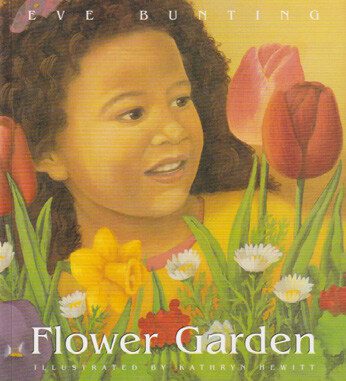
Book Review – Flower Garden

Flower Garden
Written by Eve Bunting Illustrated by Kathryn Hewitt
Another book by Eve Bunting! This talented woman has written many books for children from two years old to teenagers, in all different settings, and in varied real-life situations. She doesn’t try to hide the truth or to tip toe around uncomfortable topics. Her stories have heart and sometimes raw emotion. The illustrations in her books are usually quite realistic and enhance her words beautifully. Her books raise her readers’ social consciousness – sometimes subtly and sometimes flat out!
Flower Garden is the story of a dad and his daughter putting together a beautiful surprise for his wife and her mother’s birthday. It’s set in a city where they live several stories up in an apartment building. They ride public transportation to and from the grocery store, where they buy plants, a window box, and cake and ice cream.
Mom isn’t home, so they can quickly plant the flowers in the window box before she arrives. She is surprised and happy when she gets home!
In this book the words rhyme. Young children love rhyming! In this book, the reader may not be aware that they are learning about people of different races, or they may recognize themselves in the characters. It is a beautiful book that young children will enjoy over and over again at home or in school.
Reviewed by Lorna McGrath
Book Review – Hold This!

Hold This!
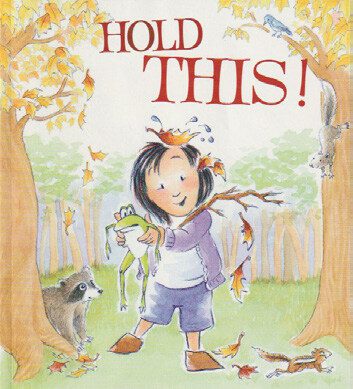
As a dad and his young daughter, Mika, take a walk through the woods, Mika finds so many treasures that she wants to keep and take home. She finds a stick and a frog and some water and leaves and a sparkling stone and more. Mika wants her dad to put these items in his backpack or pockets, but he reminds her several times that she is a “big girl” and can carry her own treasures. At the end, Mika asks once more, “I know I’m a big girl, but…will you hold this?” as she reaches her hand up to him.
Written by Carolyn Cory Scoppettone Illustrated by Priscilla Alpaugh
Children love to collect things in nature. We often encourage them to leave them there or to carry the treasures themselves. Really, the very best part of a walk-in nature is the time spent together. Children two to six years old will enjoy this book.
Reviewed by Lorna McGrath

Book Review – The Vegetarian Cookbook: More Than 50 Recipes for Young Cooks

The Vegetarian Cookbook: More than 50 Recipes for Young Cooks
Written by DK publishers
My son and his family are vegetarians. I wondered if there were any vegetarian cookbooks for children. So I went searching and, lo and behold, there were quite a few!
I found one that looked good to me (on the internet), it was the right age grouping for my grandson, and the description seemed like it was laid out in a way that was easy to use and simple enough for a young child. I bought it. Well, much to my chagrin, this book was not child friendly or, in my case, adult friendly. All the measurements were in grams, the photos showing the steps were too small (about 16 on an 8×10 page), and the photos had no instructions. At any rate it was totally unsuitable for me (master’s degree in Home ‘Ec’ and a Montessori 3-6 credentialed teacher) or for my grandson (5 years old, loves to eat and cook, and goes to a Montessori school). What a disappointment!
Today, I looked again and found a beautiful book by DK publishers with beautiful photos, an introductory section with kitchen rules, equipment, and healthy eating with food groups. Once the child is prepared, we get into the recipes that include breakfasts, snacks, lunches, drinks, entrées, and sweets. There are easy-to-follow steps with one photo and brief written instructions for each step. Everything looks delicious, as DK is masterful with their photographic illustrations. I can’t wait to cook with my grandson next time he comes over. The recipes would work for 4–8-year-olds and their parents or some other adults who love to eat and cook! It can be found on amazon.com

10 Ways to Prepare for Summer

10 Ways to Prepare for Summer
by Cheryl Allen & Lorna McGrath
1. Maintain a routine–getting up at a similar time each day, eating at regular times, keeping enough routine to keep your child comfortable. This is important for all ages. It gives them a sense of stability. It is especially important in early childhood, as these children are especially sensitive to order and consistency.
2. Keep up your family meeting schedule. Remember that family meetings provide opportunities for everyone to have a voice, be a leader, and take part in shaping the summer. If you have visitors, invite them to join your meeting.
3. Create and discuss family expectations for behavior at home, out on the town, and when traveling. These are great topics for family meetings as you prepare for summer.
4. Find out what each family member is hoping for from the summer and see if you can meet each family member’s goal. This is another topic for a family meeting. Remember to break down preparation topics into manageable pieces so that you don’t feel as if everything has to be covered in one meeting.
5. If possible, schedule only one or two activities or camps in the summer to provide consistency. Also, if these activities or camps can be chosen with your family values about respectful interactions among participants and adults in mind, the experience will probably be more enjoyable and productive for your child.
6. Let your child know about plans for the day and what may be required ahead of time so your child can plan. Even though you will share with each other at your family meetings what’s up for the week, it is important to look at each day in more detail as the day begins.
7. Allow for relaxation time each day, especially if you are traveling or have visitors. As always, we suggest that consciously planning for downtime is as important as planning for activities.
8. Encourage time for practical life activities–gardening, cooking, and cleaning. Practical life activities bring us back to our family community, interacting together, doing meaningful work, and learning to use math and science in our everyday lives.
9. If you don’t already have this, develop a quieting space for each family member. Creating “quieting spaces” for each family member involves multiple family meetings, so start planning them now. As school comes to an end, consider quieting spaces for summer travels.
10. Plan your schedule so that you’re home in time to prepare for the new school year. We always think that summer will last forever, but before we know it, it’s time to go back to school. It’s helpful to the whole family to get back into a home routine at least a week before school starts. •
Cheryl Allen is the Associate Coordinator of the MontessoriFamily Alliance and is also a parenting educator and a Montessori consultant with the MontessoriFoundation. Cheryl attended Montessori school as a child. After some time as a traditional Secondary teacher, she worked in Montessori classrooms, 3-6, 6-9, and 9-12, earning certifications from both AMS (3-6and 6-9) and IMC (6-12). She is a teacher educator, workshop presenter, and member of IMC accreditation teams. Cheryl’s two children attended Montessori from age two through high school graduation.
Lorna McGrath, MEd, is Director of IMC School Accreditation, Program Director of the MontessoriFamily Alliance, and Senior Consultant of The Montessori Foundation. Lorna has 41 years of experience in the field of education, teaching children from 18 months through 6 years old and from 12 through 18 years old in both public schools and independent Montessori schools. Lorna is a Montessori teacher educator, conference presenter, and school consultant. She can be reached at lornamcgrath@montessori.org
A Montessori Approach to Clean-Up Time
A Montessori Approach to Clean-Up Time
by Carine Robin
We know that Montessori is all about order.
We know that children have a sense of order. The Montessori classroom is an orderly environment where every activity has its place.
Montessori teachers encourage children to use one activity at a time and to tidy up each activity after they have finished with it.
As parents, we expect that the Montessori philosophy will help our children to be tidy! In my experience as a teacher, it’s easier for children to tidy up in the classroom. The Montessori school is designed for children and leads naturally to order. There are clear rules and expectations, and children are more willing to clean up after themselves in the classroom.
What if I tell you that, despite being a Montessori teacher, my children’s bedrooms are not orderly? They don’t tidy up spontaneously. There are several reasons for that, and I have learned over the years what helps children to tidy up and to stay organized.
Three reasons why children don’t tidy up?
1. You might have heard of the sense of order? This is one of the ‘’sensitive periods’ observed by Maria Montessori. It is now described more as a tendency that all human beings must make sense of their environment. It’s not so much about “tidying up after themselves” or keeping their bedroom clean” as about routine, rhythm, and knowing what comes next.
They will express that sense of order about what matters for them. For example: sorting their little people; being obsessed about their collection of pebbles; sleeping with their special teddy is all about that sense of order!
“It seems to him, at this stage, a particularly vital matter that everything in his environment should be kept in its accustomed place; and that the actions of the day should be carried out in their accustomed routine.” – E.M. Standing, Maria Montessori: Her Life and Work, p. 123
Sense of order doesn’t equal being tidy!
2. Are you a tidy person? I’m very honest on this blog and on my social media about the fact that I am not a naturally tidy person. I used to have lots of clutter in my life.
I did a big work on myself to understand my hoarding tendencies and to learn to be more organized. So, if like 50 percent of the parents I work with, you tend to be “messy and disorganized,” you cannot expect that your children will be able to tidy up spontaneously. Children need role models. The more you clean and tidy in front of them, the more they will see it as being part of the routine.
3. They don’t see you cleaning and tidying! I have said it already but even the tidiest parent tends to “clean” when the children are not around. Have you ever sent your co-parent to the park with the children, to allow you to do a good clean-up session?
Do you tend to do everything when they nap? Or do you tend to tidy up all their toys at the end of the day when they are in bed? Stop now and do as much as you can in front of them. Montessori is about teaching life skills and independence, so taking care of the environment is something that I would advise you to focus on. Teach your child to fold the laundry, to do the dishes, empty the dishwasher, setting up the table, and cleaning the windows!
How to help children to tidy up?
• Work on yourself: if you are not naturally tidy, start with you! Do a big decluttering session, and try to understand why it’s hard for you to be orderly. Seek support if needed. Your children will thank you!
• Equally, if you are a very tidy person, lower your expectations; having a spotless house when we have children is just not possible. Review your definition of what is a tidy home.
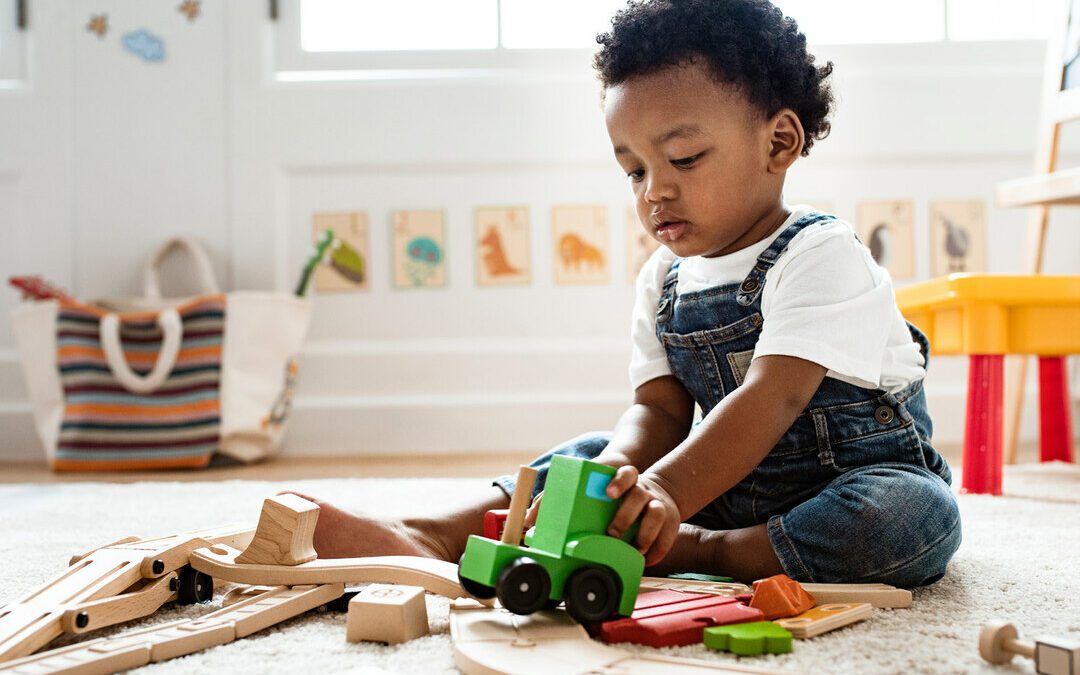
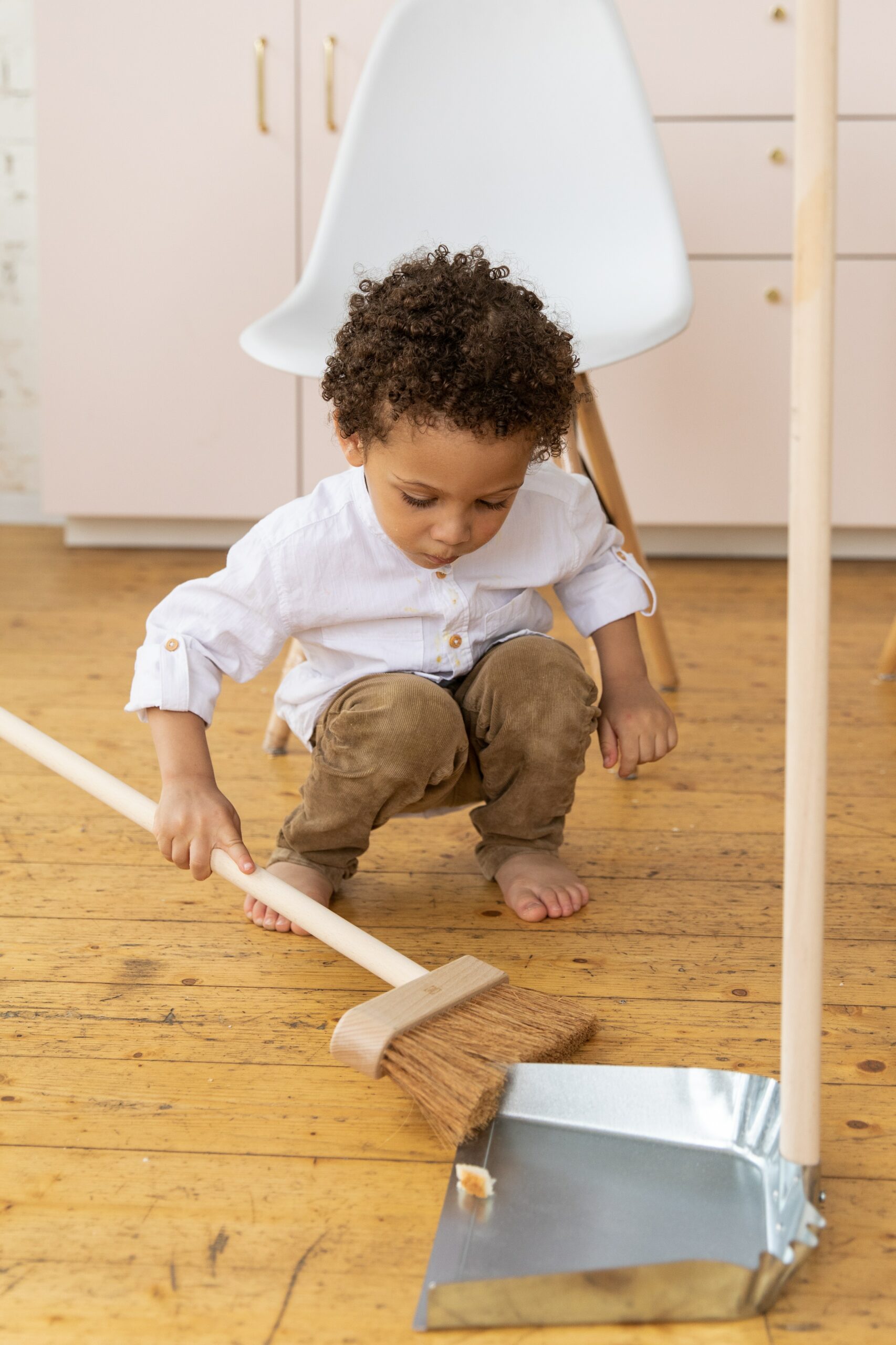
• Be a role model: clean in front of your children. Even if you have a cleaner, try to do a task with them as a way to teach them. Involve them in the cleaning tasks: young toddlers, generally, love to clean! Give them child-size tools and don’t expect a brilliant result. Let them enjoy the process.
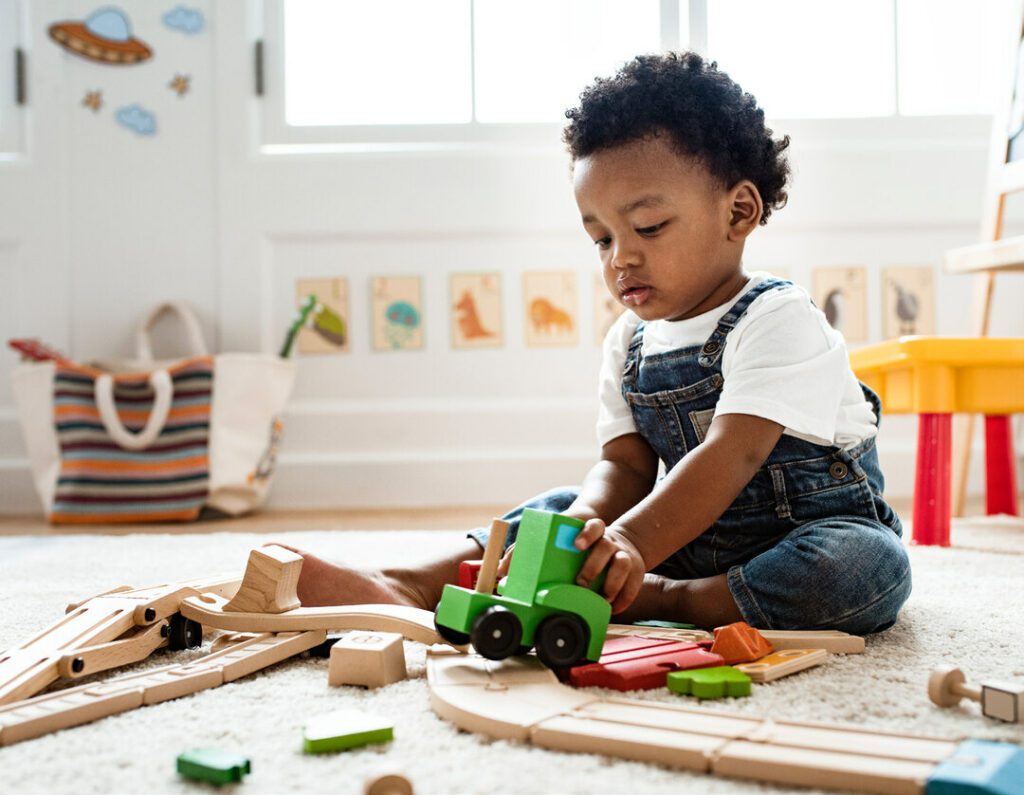
• Have fewer activities and toys available. The less there is to tidy, the easier it will be. Halve the amount of Legos™, blocks, train parts… Those sets tend to be difficult to tidy, and children get discouraged and stop cleaning up after themselves if they are overwhelmed by the task.
• Have a place for everything. Make sure you know the spot for each toy/activity. At the beginning of your Montessori journey, you might still move things around but try to limit a big overhaul, as it disturbs their sense of order and will prevent them from putting back what they have used.
• Make it playful: have a tidy-up song! or a silly dance. Have the animals go back to their basket, making sounds. Find what works for your child.
• Wait for when they are ready. When children are in a flow, playing intensely, it’s hard to know when it’s time to tidy up. It might be dinner time, but they might not be ready to stop playing. Wait for the moment they naturally seem to move onto a new activity to encourage them to put the previous one back on the shelf.
• Help them! It’s a skill, don’t expect them to do it consistently even if they have done it a few times. Like us, they are allowed cheat days.
What about older children?
Children in the second plane of development are messier than younger children. They are less interested in organizing the environment. They are less interested in practical life. They tend to spread out when they explore a topic. It’s because it’s an age when they make connections between concepts.
Their play area and toys might be in their bedroom. Their bedroom is their private area, and you might be less around when they play. Children in the second plane have access to toys that have small parts (Legos™ beads, …).
You can still rotate toys for that age group. You can have a rule that the Legos™ are stored in the living room, or the crafts are only accessible at the dining table. I recommend that you limit what they have access to in their bedroom. Make it part of the daily routine to tidy up for half an hour before dinner.
The bottom line: Mess is part of life but being tidier, as a family, will help everyone.
Having said that, let’s close with this quote: “Excuse the mess, the children are making memories!” •
Carine Robin has a master’s degree in psychology, specializing in child psychology. She worked for various social services in her home country of Belgium, before moving to Ireland in 2006.
It was there that she started working in a nursery and discovered Montessori education. After having her first child, her passion for the philosophy grew. She qualified as a Montessori teacher and managed a Montessori preschool.
Carine has been running Montessori-based parents and toddler groups and coaching families for 9 years. She now also runs an online group for over 20,000 parents, sharing her knowledge and passion with people from around the world.
In 2018, Carine realized families needed more support and launched her popular online parenting courses and monthly subscription boxes, full of personally designed Montessori materials.
Carine has also trained with Sarah Ockwell-Smith in BabyCalm and Toddler Calm, with Dr. Laura Markham on Peaceful Parenting, and most recently, at the prestigious Maria Montessori school in London, as an AMI Elementary and 0-3 assistant. She writes on a popular blog “the Montessori Family”. www.themontessorifamily.com Instagram: @montessorifamilyuk
Beyond Bribes, Rewards, and Punishments

A Montessori Approach to Clean…
Beyond Rewards, Bribes, & Punishment
A Montessori Approach to Building Intrinsic Motivation
42 ways that the Montessori approach builds intrinsic discipline in our children.
by Simone Davies
In my last article on a Montessori approach to discipline, I mentioned that we don’t use rewards, bribes, or punishment in a Montessori classroom. And there is not a teacher at the front telling everyone what they need to do. Yet, if you observe in a Montessori classroom, there is a gentle hum of conversation and movement and a lot of concentrated children who are motivated to work.
So, not surprisingly, I received many questions about a Montessori approach to building intrinsic motivation in the child. Intrinsic motivation is doing something because you have the inner drive to do it, not because of some external reason like a reward or threat.
I love a good list so here are 42 ways that the Montessori approach builds intrinsic discipline in our children.
Note: It’s a holistic approach where each part is intrinsically linked. So, while it may seem overwhelming to do all these things, rest assured they also naturally build on one another.
42 Ways to Build Intrinsic Motivation
1. Build an environment where they can have success; knowing where they can find things and having things at their level.
2. Create opportunities for them to build independence – they see themselves as capable.
3. Cultivate opportunities to work together, cooperate and care for others – they see their input matters; a 0-3 child is observing and beginning their social development in their family. With a care giver, and/or nursery; the 3-6 child is part of their family and their class; and the 6-12 child wants to work and be a part of a group.
4. Value process over product; there is more learning in the doing than in the result.
5. Use encouragement rather than praise. When they hear, “You worked hard to get your shirt on all by yourself ” rather than “good job,” they learn to look to themselves to understand what worked, rather than looking to us for praise.
6. Give them freedom to work on things they are interested in – rather than what the teacher/adult tells them – or a timeline.
7. Provide safe limits. Offer security and show that someone cares about them.
8. Allow them the freedom to choose what, where, and with whom they’d like to work.
9. Provide a clear rhythm to their day so that they know what to expect.
10. Help them learn respect for themselves, each other, and the environment – they feel truly accepted and learn to accept others.
11. Encourage those agreements are made together – they feel like a valued member of the community.
12. Let them know that it’s a safe place to practice boundaries – we can support them with words if needed, “I’d like to work by myself right now. It will be available soon.”
13. Honor who they are; each member is unique and valued – builds their sense of self.
14. Help them learn to look after themselves, others, and the environment – it’s empowering to be able to do this for themselves.
15. Show trust in them – by removing external rewards and punishments.
16. Help them to make amends when needed – they know that when they get it wrong, they will take responsibility and learn from the experience.
17. Value curiosity – learning is about finding out rather than memorizing facts
18. Allow them to have choices – they have ‘agency’ in their days
19. Provide honest, instructive feedback – we see what’s going well and how they can do better; give them gentle guidance to keep improving.
20. Offer different ways to learn; we all learn in different ways and on different days; the materials appeal to kinesthetic, visual, and aural learners, and they can choose how they’d like to present their work, from a booklet to a survey to a poster etc.
21. Be their guide – not their boss or servant
22. Help children build ‘scaffold skills’ – where each activity builds on the next to allow mastery.
23. Support them to develop their own routines/ rhythms, such as taking an activity to a table or mat and returning it when it’s done.
24. Help children develop their thinking skills – they are learning to learn through hands-on learning and making discoveries for themselves; they help younger children and consolidate their own learning; they reflect on what they have learned.
25. Keep it real; children are not learning just for the sake of learning. They are learning how it applies in the real world giving meaning to their work.
26. The absence of tests or punishments allows a natural love of learning, while maintaining their creativity and interest in learning
27. Model intrinsic motivation ourselves as adults; our actions are more powerful than our words.
28. Provide control-of-error activities, which will allow children to discover their errors and try again.
29. Offer challenges at the appropriate level. Children do not feel unmotivated, because they know that they can do hard things, and they do not want to give up.
30. Encourage service in the community. This allows children to see and appreciate the impact of their work.
31. Children can have a healthy relationship with failure: the guide and classmates are supportive; children are able to stay with something until they master it and are ready to move onto the next activity; and they learn to ask for help if needed.
32. Remove competition for sticker charts or praise; children do not need rewards from others. Help them look to themselves instead of someone else.
33. Allow time to help children build skills, e.g., planning skills, learning to dress themselves, how to make a report, etc.
34. Children are in charge of their own learning: they learn uniquely, have their unique interests; and are on their own unique timeline.
35. Adults can trust the Montessori process, without forcing their own agenda.
36. Help children support themselves as they become members of their society.
37. Be patient; learning happens at its own pace and isn’t forced.
38. Plant seeds of curiosity, enough to get them interested, and not too much to allow them to discover the rest for themselves.
39. Encourage the possibility for big work and big ideas that looks at the interdisciplinary nature of the universe.
40. Allow space for all voices; we want everyone in our community to feel valued, accepted, and safe.
41. Avoid criticism or correction; instead, observe where children are in their process, and offer another opportunity to teach it again.
42. Learn from others. We can see others learning and be inspired to learn that too.
It’s never too late to start applying these principles. We can even scaffold the skills with a child in Upper Elementary (9-12 years), first helping them plan, then letting them take over more and more steps themselves. •
Simone Davies is the author of The Montessori Toddler and co-author of The MontessoriBaby, comprehensive guides to raising toddlers and infants in a Montessori way. The books are based on her 15+ years’ experience working as an AMI Montessori teacher in Sydney and in Amsterdam. She also has a popular blog, Instagram, and podcast “The Montessori Notebook”.She is also mother to two young adults.Simone currently runs parent-childMontessori classes in Amsterdam at her school, Jacaranda Tree Montessori, and is working on another book with Junnifa Uzodike, The Montessori Child for children from 3-12 years.
With hundreds of practical ideas for every aspect of living with a toddler, here are five principles for feeding your child’s natural curiosity, from “Trust in the child” to “Fostering a sense of wonder.” Step-by step ways to cultivate daily routines with ease, like brushing teeth, toilet-training, and dealing with siblings

The Dump Truck Story
The Dump Truck Story
What happens when we normalize ‘disaster’ thinking and accept the mess
by Alicia Diaz-David
When my son was two years old, he scribbled on his dump truck with a brown marker and announced that he would wash it right there in the middle of our living room floor. My first reaction was to gasp when I noticed the brown scribbles. My second reaction was to see where his plan of action would take him.
So, I watched as he used the foaming soap dispenser to lather his hands and then rub the foam on the dump truck that was still on the living room floor. And I watched as he headed to the bathroom to fill his large bath-time cup with water to rinse off the foamy soap.
And that’s when I jumped in. Not stopping him but offering him another line of thinking by asking what would happen if he poured the water on the truck right there where it was. Thankfully, he responded that it would spill. I suggested we bring the dump truck outside to our front steps, where a giant water spill would not matter as much.
And the rest happened as you might imagine. My son happily poured water over the soapy brown marker and watched as it splashed on the cement pavers, instead of the living room floor. He went back inside the house to get a towel, which he smoothed over the water droplets on his beloved dump truck. And he smiled proudly at all that he had done.
If you are familiar with the principles of Montessori and the practice of following the child, this story may seem reasonable enough. It may seem as nothing more than a toddler exploring and experimenting with his dump truck and a mom observing and conscientiously guiding the learning moment that would unfold. However, when I submitted this story for a recent publication, it was changed. The edited version included the words, “This is going to be a disaster,” and I admit it stopped me in my tracks when I read it.
Not only was I impacted by the fact that a piece of original writing would be so altered, but also by the idea that our current thinking about children exploring and experimenting is so readily equated to things turning into a disaster.
The truth is, there is a great deal of learning in the so-called disaster. The mindful parent recognizes the learning potential when a child is following her own reasoning. The prepared adult is ever-present, jumping in to help only with the hard parts. That is the true meaning of Montessori parenting, as I’ve read in countless books, learned in Montessori training, and experienced personally with my own children at home.
So, I write today to challenge this thinking and normalize what we would otherwise consider a ‘disaster.’ When we let our children explore their ideas, when we observe this process, we realize that we are truly being given the gift of watching a genius at play.
Our job as adults is not to limit or edit this experience but to let it unfold and only redirect it when necessary. What I learned from my two-year-old son that day—what I witnessed—was a young toddler exhibiting complex executive-function skills, a little boy filled with resolute determination, a confident multi-cultural child ready and willing to solve problems in the world.
I hope that in the future, we don’t edit stories like this. These are moments to cherish for what they are … the awakening of life itself. •
Alicia Diaz-David is a parent and educator with over 15 years’ experience in education. She has followed the Montessori approach at home since her children were born and is a certified Montessori guide for ages 3-6. She is also the founder of TeachLearnMontessori.org, which is dedicated to helping parents better understand the Montessori philosophy and simplify the approach. You can learn more about supporting children’s growth and development using Montessori via the real-life stories she shares on Instagram @MontessoriwithAlicia or on her blog at TeachLearnMontessori.org.

50 Ways to Celebrate Summer Learning
50 Ways to Celebrate Summer Learning
by Cheryl Allen
Summer is a time of more daylight, warmer temperatures, and more time outdoors. We may think that, for children who are out of school in the summer, it is not a time of learning. Yet, it can be an incredible time of learning. Here are fifty ways to help your child learn and grow while not in school.
Explore
1. Let your child plan an activity for the day or some activities for the summer. They can use maps, stick to a budget, and do the research.
2. Go on a searching hike, in nature or an urban setting; look for objects in the shapes of the letters in your name, or in sets of your favorite number, or particular colors.
3. Learn about the plants and animals that are near you. What are those birds by your home? What are the names of the plants you see every day?
4. Walk at your child’s pace. Notice the smells of different plants, admire the bugs, follow your child’s lead.
5. Play board games.
6. Learn card or magic tricks.
7. Learn jokes and present a comedy show.
8. Play unplugged games, such as Hangman, your own version of Pictionary, I Spy, or other paper-and-pencil games.
9. Think of free or inexpensive ways you could help neighbors and act on them.
10. Create a scavenger hunt and follow the clues.
11. Try out new playgrounds nearby.
12. Go to a grocery store you do not usually go to, especially if it has a focus on an ethnicity different than your usual cooking.
13. Allow time for daydreaming.
14. Try outdoor science experiments.
15. Plan a dream vacation.
16. Find some art to admire, outside or in a museum. Discuss what each person likes about it.
17. Explore distances and make a map. How far are you from family members, favorite types of animals, friends, or any other thing that can be mapped?
Communicate
18. Make time for reading every day, or nearly every day.
19. Visit the library and allow your child to make choices of reading material on their own.
20. Encourage your child to tell a friend or a family member about a book they read; retelling helps develop understanding.
21. Write letters to friends and family.
22. Address the envelope for that letter. Writing the address correctly on an envelope takes practice.
23. Keep a summer journal or a travel journal. Write in it regularly and include printed photos, pressed flowers, or leaves, ticket stubs, maps, or any reasonably flat items that remind them of the events written about.
24. Have your child create lists for things to do, grocery lists, books read or books to read, movies to watch, anything that can be listed.
25. Write a letter to their future self and store it or use a site that will email you in a certain amount of time.
26. Create a kindness list; how many acts of kindness can be performed this summer?
27. Count cars, bikes, dogs, flowers, anything you see regularly in your travels.
28. Find letters of the alphabet or make up a silly sentence using letters or words on items in the grocery store. Only one word or letter per item!
Create
29. Build a design of your child’s own creation or follow the directions from a set, with Legos™, blocks, or other building materials.
30. Learn to build card houses.
31. Plan and build a birdhouse.
32. Make your own playdough and sculpt with it.
33. Water down paint, place paper outside, and use squirt guns filled with the watery paint for a creation.
34. Set up objects outside and trace their shadows onto paper.
35. Put on a show–write it, practice it, design costumes and props, and perform for others. Record the show to share it with family that cannot attend in person.
36. Use chalk to draw outside, then use water and a scrub brush to erase it.
37. Plan dinner for a night and help make it.
38. Make a salad. Make dressing to go with it for an extra skill-building opportunity.
39. Grow vegetables and harvest them for dinner.
40. Find a recipe and cook with a new-to-you food.
41. Shuck corn, peel potatoes, wash, and spin lettuce dry, participate in cooking preparation.
42. For older children, set a cooking challenge to use ingredients and make a meal.
43. Sketch or paint flowers at your home or a nearby location.
44. Draw self-portraits directly on the mirror using window markers.
45. Clean the mirror after drawing on it.
46. Wash windows (an adult may need to wash the top).
47. Water the garden or potted plants.
48. Organize an area of your home together, especially one that your child uses regularly.
49. Explore with cash, count coins, save for an item, buy something with cash and check the change received.
50. Make leaf or bark rubbings and label them with the type of tree or bush they came from. •
Cheryl Allen is the Associate Coordinator of the Montessori Family Alliance and is also a parenting educator and a Montessori consultant with the Montessori Foundation. Cheryl attended Montessori school as a child. After some time as a traditional Secondary teacher, she worked in Montessori classrooms, 3-6, 6-9, and 9-12, earning certifications from both AMS (3-6 and 6-9) and IMC (6-12). She is a teacher educator, workshop presenter, and member of IMC accreditation teams. Cheryl’s two children attended Montessori from age two through high school graduation.
The Power of Hands-on Learning
The Power of Hands-on Learning
by Mary Ellen Maunz
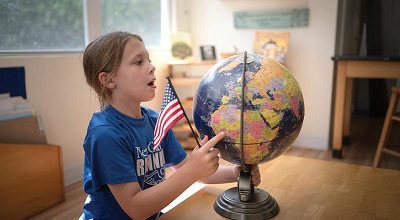
“What the hand does, the mind remembers.” – Dr. Maria Montessori
If a child is able to use their hands to discover, their discoveries become more meaningful to them. The concepts they learn are much more rooted than any rote memorization could be, because in using their hands, they experience their learning. They are an active participant.
Active Education
If you picture a traditional classroom, you would likely see a teacher standing at the front of the room near a black- or whiteboard, speaking to children who are lined up in desks, memorizing facts, or attentively looking at and listening to their instructor.
In recent years, concepts such as “table groups” and “flexible seating,” where children can sit in small groups, or choose where they sit, have allowed for some redesign throughout the classroom.
In addition to the arrangement of the environment itself, many teachers and administrators have also looked to hands-on or non-traditional classroom experiences like “project-based learning,” “design thinking,” “the maker movement,” and “the flipped classroom,” for ways to engage children in their learning.
These shifts in education are a reminder that schooling isn’t one-size-fits-all. Individual needs can be addressed when we take the time to step back, assess what we are doing, and make the decision to move forward with purpose. Need some guidance for change? Read on!
Making Changes
If you are unsure where to start, let me give you one powerful idea.
Start with the child’s hands. Sure. Easy. The child’s hands. What? Let me explain.
If you can make a change in learning, begin with just one simple step. Try this: begin by watching hands. Hands are smart. Really smart. Just like our heads. Often, however, this seems to be forgotten.
If you ever have the opportunity to observe someone learning a new skill, I would challenge you to watch their hands. It is through touching and manipulating that information is taken in through the hands and delivered to the brain.
Use Your Hands!
Adults seem to think that it is okay for younger children to work with their hands when they are learning. Think about it: sandboxes, water tables, Play-doh™! But somewhere along the way, these manipulatives got a bad rap for being “childish.” Why?
If you’ve ever seen someone participate in an activity they love, you’ve very likely seen them using their hands! You’ve likely witnessed someone building with tools, fixing up a vehicle, or playing an instrument. How about someone turning the page of a book, digging in the dirt while gardening, or making food?
Why should learning through math, science, history, or languages be any different? Utilize an abacus for addition, measure velocity when launching a marshmallow with a spoon, tea-dye a map, or handle pairs of objects that rhyme. Whether formal or informal education, using your hands helps!
In the Montessori Classroom
Dr. Maria Montessori was a scientist who spent time observing children. In doing so, she realized that children wanted real-world, hands-on application for learning. Not only did they want it, but they also experienced joy in using their hands.
Through experimentation and careful calculation, Montessori developed materials for children to use. These lessons intentionally foster self-discovery and serve learning goals. Over one hundred years later, the observations she made then still hold true. Regardless of subject matter, children enjoy, and benefit from, using their hands to learn.
In a Montessori classroom you will see hands-on learning EVERYWHERE! A child washing a table is learning care of their environment, while also preparing their hand muscles for similar movements in writing. Placing cubes on top of one another for the Pink Tower allows children to learn precision of movement, while also allowing their body to experience, physically, the difference in 1 cubic centimeter ten times over! Not only this, but it is also teaching the basics of the mathematics base ten system. Rarely is a lesson in a Montessori classroom taught for one purpose only, and usually, with time, the hands-on learning leads to multiple objectives.
A Personalized Journey
Learning is not a race with a finish line. It’s a constant stroll through a variety of experiences that all necessitate different paths and use different materials.
Whether Montessori is your muse, you want to improve learning for your students, or you just personally like to get your hands dirty, don’t wait! The world is waiting for you. Explore! Dig in! •
Mary Ellen Maunz is the Founder and Program Director of Age of Montessori. She has more than 50 years of experience inMontessori education for both teachers and parents. She collaborated for two decades with Dr. Elisabeth Caspari, student and personal friend of Maria Montessori. She is an international authority on Early Childhood and Elementary education and has lectured and taught students in seven countries on five continents. Internationally-renowned author and lecturer, Maunz is on a lifelong mission to help parents understand the underlying needs of the developing child. Find our blogs, webinars, professional development and MACTE certified teacher education courses at: ageofmontessori.org
Are We Really All Friends?
ARE WE REALLY ALL FRIENDS?
by Betsy Merena
In this article, we will discuss the appropriateness of the long-standing tradition of using the term “friends” as an all-encompassing definition of peer relationships in the early childhood classroom environment. Through a personal anecdote that spurred self-reflection and a pivot in my own teaching practices, we will discover informed alternatives that ease the pressure created by expectations of universal friendship.
“But what is a social life if not the solving of social problems, behaving properly, and pursing aims acceptable to all?”
Ubiquitous in almost all preschool classrooms across the country, both Montessori and mainstream, is the idea that we’re all friends. But are we really?
Receiving lessons in, and creating an environment rich in, Grace and Courtesy is a hallmark of a good Montessori education. But is universal friendship an equally essential ideal? As guides in the Montessori toddler and primary environments and beyond, we want pleasant interactions among our students. We want cooperative work and play efforts. We want classrooms full of children who enjoy being there and being together. And we guide, teach, and prepare the environment, with those goals in mind.
But do we need to enforce the idea that we’re all friends?
It wasn’t until I became the parent of a primary-aged Montessori student that I came face-to-face with the pitfalls of this concept. All my previous years of experience in the world of early childhood education were full of songs and encouragements, championing the same basic message: we’re all friends.
But what if that’s not true?
Here’s what happened to jumpstart this shift in my thinking. My daughter, four years old at the time and a second-year primary student, was having trouble with a boy in her class. As the toddlers’ guide in the same school, I had the benefit of hearing the teachers discuss various students and how to handle the challenging situations that crop up in any given year. Plus, we share a playground and recess time. So, I was able to observe my daughter and her class daily. I knew that this boy, new to the school, was having a harder time than most acclimating to the classroom environment and was targeting a few specific children with some of the worst of his behaviors. My daughter was one of them.
As parents, my husband and I fielded her frustrations and complaints at home with the standard responses: Talk to him and tell him “No.” Your friends should make you feel good pretty much all the time; if they’re not, and if they’re not respecting your body, then you don’t have to be friends with them.
It was at that point that my daughter broke down into crocodile-sized tears and said, “But my teacher says we’re all friends.”
It felt like the air was knocked from my lungs. In that moment, it felt like the entirety of my teaching career flashed before my eyes. How many times had I said those same exact words to my students? We’ve sung those words and sentiments at our morning circle countless times. Full of the best intentions, I’ve said them over and over to children who were struggling to get along.
But what if that phrase, that sentiment, is doing more harm than good?
What if it’s giving young children, and their developing social skills and social understandings, a skewed idea of what friendship is and what it means to exist in a cooperative environment with our peers?
As adults, we live and work in a society with each other. We navigate relationships of all kinds in many ways. But no one ever expects us to be friends with everyone with whom we regularly interact. Why do we ask that of children?
Instead of saying we’re all friends, let’s try, “We are a community” instead. In communities, people are expected to act with grace and courtesy toward each other, but they are not expected to be friends with everyone. We can set healthy boundaries and still be kind. We can recognize how other people make us feel and choose who we honor with the title of ‘friend’.
In a community, we can all work towards the same goals; we can share experiences. We can learn and grow together. We can do all these classroom basics without the pressure of being friends with every single person.
After I caught my breath, I looked my daughter in her tear-rimmed eyes and said, “You do not have to be friends with anyone who makes you feel this badly. You are classmates and part of the same community. You need to be kind to each other, but you do not have to be friends.”
The relief that realization had on my daughter was immediate and profound. And its magnitude hit me in the same way. Children, even young children, can be classmates without the pressure or expectation of being friends.
As guides, and as parents, we know that some children’s personalities are like oil and water. It is so much more empowering to say to them honestly, “You don’t have to be friends, but you must be respectful, kind, and courteous to each other.”
Perhaps then, as these children grow, they’ll have a healthier view of friendship. We can hope that they will have a more robust emotional and social tool kit for existing cooperatively with people who they just don’t click with well.
And, what a poignant lesson this could be for us as an American community right now. We might not all be friends, we might disagree, but we must be respectful, kind, and courteous to each other.
“The social rights of children must be recognized so that a world suited to their needs may be constructed for them.” – Maria Montessori
REFERENCES:
Montessori, M. (1967) The Absorbent Mind, p225
Montessori, M. (1966) The Secret of Childhood, p225
Betsy Merena is an AMS certified toddler guide at The Montessori School of Westminster inWestminster, Maryland with over a decade of teaching experience in early childhood classrooms. Along with her husband and daughter, now in her first year of lower elementary at the same school,Betsy loves to explore the world through travel and cooking. She also volunteers asa Girl Scout troop leader for her daughter’s troop and enjoys spending time camping.
The Importance of the Kindergarten Year

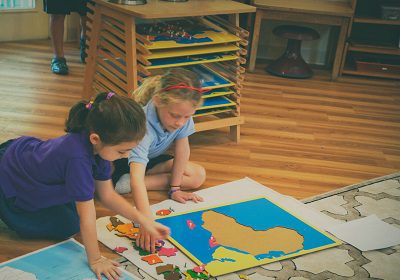
Every year in January, one of us will write an article about the importance of children who are turning five completing the three-year cycle of the Montessori Early Childhood program. We do this because this is a decision that is truly important for any child who has grown up, thus far, in a Montessori program.
We understand how tempting it is, for parents who have their children enrolled in a non-public Montessori school, to make the switch at Kindergarten to avoid another year of tuition. However, having invested in Montessori thus far, the long-term benefits of staying, at least through the third year, if not beyond, cannot be stressed often enough.
The third-year is critical in the Early Childhood Montessori program. This is the year when children’s earlier experiences are normally internalized and reinforced and when children begin to take the first steps of moving from very concrete learning to learning that is more abstract. When children leave Montessori for traditional Kindergarten, much of what they have been learning fades away because they have not yet made the passage to abstract understanding.
The advantages of using the local schools often seem obvious, while those for staying in Montessori are often not at all clear. When you can use the local schools for free, why would anyone want to invest thousands of dollars in another year’s tuition?
It’s a fair question, and it deserves a careful answer. Obviously, there is no one right answer for every child. Often the decision depends on where each family places its priorities and how strongly parents sense that one school or another more closely fits in with their hopes and dreams for their children.
Naturally, to some degree, the answer is also often connected to the question of family income as well; although, we are amazed at how often families with very modest means, but who place a high enough priority on their children’s education, will scrape together the tuition needed to keep them in Montessori.

Most five-year-olds have been waiting for the longest time to be one of the ‘big kids.’ The experience of playing the leadership role does wonders to reinforce the five-year-olds’s sense of autonomy and self-confidence.
So here are a few answers to some of the questions parents often ask about Montessori for the Kindergarten-age child.
In a nut shell, what would be the most important short-term disadvantage of sending my five-year-old to the local schools?
When a child transfers from Montessori to a new Kindergarten, she spends the first few months adjusting to a new class, a new teacher, and a whole new system with different expectations. This, along with the fact that most Kindergartens have a much lower set of expectations for five-year-olds than most Montessori programs, severely cuts into the learning that could occur during this crucial year of their lives.
As children begin their third year in Montessori, their understanding of the decimal system, place value, mathematical operations, and similar information is usually very sound. With reinforcement, as they grow older, these concepts become internalized and a permanent part of who they are. When they leave Montessori before they have had the time to internalize these early concrete experiences, their early learning often evaporates because it is neither reinforced nor commonly understood.
What would be the most important advantages of keeping my five-year-old in Montessori?
Montessori is an approach to working with children that is carefully based on what we’ve learned about children’s cognitive, neurological, and emotional development from more than one hundred years of research. Although sometimes misunderstood, the Montessori approach has been acclaimed as one of the most developmentally appropriate models by America’s top experts on early childhood and elementary education.
One important difference between what Montessori offers the five-year-old and what is offered by many of today’s Kindergarten programs has to do with how it helps the young child learn how to learn.
Educational research has increasingly shown that students in many schools don’t really understand most of what they are being taught. As Howard Gardner, leading educational psychologist and advocate of school reform, wrote: “Many schools have fallen into a pattern of giving kids exercises and drills that result in getting answers on tests that look like they understand.
Most students, from as young as those in Kindergarten to students in some of the finest colleges in America, do not understand what they’ve studied, in the most basic sense of the term. They lack the capacity to take knowledge learned in one setting and apply it appropriately in a different setting.”
Montessori is focused on teaching for understanding.
In an Early Childhood Montessori classroom, three- and four-year-olds receive the benefit of two years of sensorial preparation for academic skills by working with the concrete Montessori learning materials. This concrete sensorial experience gradually allows the child to form a mental picture of concepts, such as: How big is a thousand? How many hundreds make up a thousand? and What is really going on when we borrow or carry numbers in mathematical operations?
The value of the sensorial experiences that the younger children have had in Montessori has often been underestimated by parents and educators. Research is very clear that young children learn by observing and manipulating their environment, not through textbooks and workbook exercises. The Montessori materials give the child concrete sensorial impressions of abstract concepts, such as long division, that become the foundation for a lifetime of understanding.
But won’t my five-year-old spend her Kindergarten year taking care of younger children instead of doing her own work?
No, not at all! When older children work with younger students, they tend to learn more from the experience than their ‘students.’
Experiences that facilitate development of a child’s independence are often very limited in traditional schools.
Five-year-olds are normally the leaders and role models in the Primary Montessori classroom. They help to set the tone and serve as an example of appropriate behavior for the class. They often help younger children with their work, actually teaching lessons or correcting errors.
Most five-year-olds have been waiting for the longest time to be one of the ‘big kids.’ The experience of playing the leadership role does wonders to reinforce the five-year-olds’s sense of autonomy and self-confidence.
Five-year-olds are beginning to reflect upon the world. They pay closer attention, notice more details, ask more questions, and begin to explain the world in their own terms. The Kindergarten year is a time when the child begins to integrate everything she learned in the first few years.
Academic progress is not our ultimate goal. Our real hope is that they will feel good about themselves and enjoy learning. Mastering basic skills is a side goal.
The key concept is readiness. If a child is developmentally not ready to go on, he or she is neither left behind nor made to feel like a failure. Our goal is not ensuring that children develop at a predetermined rate, but to ensure that whatever they do, they do well and feel good about themselves as learners. •

Raising Helpers
by Theresa of Montessoriinreallife.com
One of the most wonderful things about toddlers is how they so inherently want to help. They are eager to be involved, be near us, and participate in our day-to-day activities. What we deem “chores,” toddlers see as what they are: meaningful contributions to our family or community.
After toddlerhood, we often notice a shift. Children seem less intrinsically motivated to help and view helping more as a chore. This is a natural part of development: they are more independent and focused on their own work and play. They are discovering who they are and where their own interests lie, which is a beautiful thing. It also doesn’t mean it’s the end of helping!
How do we continue to foster this motivation and raise helpers beyond the toddler years? Here are a few tips that I’ve been keeping in mind in our own home lately. These can be incorporated in toddlerhood and well beyond!

Help Our Children
Our children learn how to help through us helping them. When we respond to their requests for help, they are more likely to do so in return. Helping doesn’t mean doing a task for them, but rather offering just enough help to get them through a tough spot.
Model It
Not only should we think about how we are offering help to our children, but how can we offer help to our partner, a friend, or our community? The more our children see us being helpers, the more likely they will want to be a helper too.
Talk About It
“In our family, we help each other.” This is a phrase that we repeat often at home. The more we say and hear this, the more ingrained it becomes and the more natural it feels to be a helper in the family. Importantly, this phrase is said in a gentle way, not as a command.
Make It Part Of The Routine
When we make helping a part of our daily rhythm, it becomes natural. In our family, certain tasks are the kids’ responsibility every day: putting shoes and coats away, setting the table, feeding the dog, wiping up spills, tidying toys, etc. These tasks aren’t rewarded but rather just part of the routine.
Don’t Force It
Inviting doesn’t guarantee our children will help. Even when these tasks are part of the daily (or weekly) routine, everyone has off days. We can offer grace and let it go. Often, the next day, or at a different time, they are ready to help again.
Offer Opportunities
Sometimes we move so quickly through our own chores, we forget that we could involve our children. As much as possible, I try to do chores in front of the children so that they have the opportunity to join in and help. Often, what we consider mundane tasks are satisfying for our children. Having cleaning tools that are appropriately sized for our children makes them feel especially capable.
Accept It As Is
When our children do help, we may find that they’re ‘help’ doesn’t lead to the outcome we desire. The dishes might not be as clean, or the laundry might not be folded in a neat stack. When this happens, we can thank them for helping and appreciate the effort that went into it. Rather than correct them at the moment, we can model again another time, and try to be patient, as every skill takes time.
How can your child help today? •

Theresa is a mom to two, a former Montessori guide, and the founder of the blog Montessori in Real Life(www.montessoriinreallife.com). Prior to momming and blogging, she went to graduate school for developmental psychology and earned her Montessori infant/toddler guide certification. Since transitioning from teaching to motherhood, Theresa found a new passion sharing her love of Montessori with parents,while continuing to implement the Montessori philosophy in her own home.
Faces of Normalization
Normalization is a term that Montessori teachers exhaust at the beginning of each school year.
“The children are normalizing.”
“Normalization is a delicate process.”
“We’re almost normalized.”
But what is normalization?
Dr. Montessori described normalization in this way: “And in these qualities of the child, she sees man as he ought to be: the worker who never tires, because what drives him on is perennial enthusiasm. She sees one who seeks out the greatest efforts because his constant aspiration is to make himself superior to difficulties; he is a person who really tries to help the weak, because in his heart there is the true charity which knows what is meant by respect for others, and that respect for a person’s spiritual efforts is the water that nourishes the roots of his soul. In the possession of these characteristics, she will recognize the true child, who is father of the true man.” (p. 257).
These are some of the faces of ‘normalization.’ The children are demonstrating independence, perseverance, repetition, and concentration to the exclusion of all the sights, sounds, sensations, and activity around them, because they have a greater task at hand. The children are constructing their own learning; they are shaping their own personalities; and they are building the adults that they are yet to become.

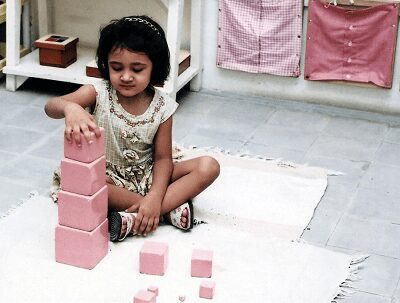
Anika places a large pink cube atop a small pink cube and the cubes fall. She removes the large cube and chooses another somewhat smaller cube. This cube also falls. She removes the small cube and replaces it with a larger cube. She places the smaller cube atop and, later, the smallest cube at the top of the tower. She sits back, observes her balanced tower, and her eyes sparkle as she smiles. one who seeks out the greatest efforts because his constant aspiration is to make himself superior to difficulties; he is a person who really tries to help the weak, because in his heart there is the true charity which knows what is meant by respect for others, and that respect for a person’s spiritual
To the onlooker, it appears that the children are cleaning, building, and working on skills. They appear to be manipulating letters, numbers, and tablets of color. They carry long red rods, stack pink cubes, and lug heavy brown pieces of wood to awaiting throw rugs. These observations are accurate; however, the process of normalization involves a great many skills, some that are visible and some that are less obvious. These children (and others like them) are learning, growing, and developing in a specially prepared environment that fosters the love of activity, concentration, self-discipline, and sociability. This process is facilitated by a sensitive adult, who has prepared the environment with order, consistency, warmth, and the removal of obstacles that could prevent this development.

Martin enters his classroom, says hello to a few friends, and walks directly to the shelf that contains the materials necessary for the parts of the tree puzzle. First he retrieves and unrolls his rug with attention to its position and smoothness. Then he gathers his puzzle and places it on the rug. He builds, disassembles and rebuilds his puzzle without fatigue, but with joyful energy.
Dr. Montessori’s discovery of the “secret of the child,” i.e., their hidden potential, had yet to be revealed and understood by adults. Dr. Montessori’s skills in observation and the circumstances that placed her in the company of children in need of a place to call their own (the slums of San Lorenzo, Rome) found a fertile place for the revelation to occur. She shared with her adult students at the second Indian Montessori training course, that the children came “undernourished, dirty, and uneducated.” “And these very small children, from three to six, did wonderful things. They had wonderful revelations. All these revelations of how to learn to write and to read by themselves at such a young age (and in the midst of joy) resulted in a transformation of their character.”

Liam is building the triangles with deep concentration. Somewhere in the room a tray falls, a child coughs, and an adult walks past. Outdoors a horn sounds and a truck rumbles past. Meanwhile, he continues the assembly of the triangles, the triangles that he has constructed many times before, without interruption.
Then and today, children enter Montessori settings with capabilities that suit them for the work and activity they will encounter. They bring bodies designed for purposeful movement, coordination, grace, and stamina. Their hands and senses serve them by allowing them to interact with and come to experience their environments. They are equipped with a mind that absorbs impressions from all around them; a mind that organizes, problem solves, adapts, remembers, is curious, is capable of long periods of attention and concentrates with little effort and without fatigue. When the body and the mind are satisfied, the true character of children is disclosed. They are peaceful, joyful, sociable, helpful, self-disciplined, satisfied, and their inquisitive and loving souls are made evident. ¢
REFERENCES
Association Montessori Internationale USA. (n.d.). “The first Casa dei Bambini: Montessori 150.” Retrieved December 2, 2021, from https:// montessori150.org/news/ first-casa-dei-bambini.
Montessori, M. and Claremont, C. A. (2019). The Absorbent Mind. Montessori-Pierson Publishing Company.
Dorothy Harman is an AMS Early Childhood credentialed Montessori guide. She holds a BA in Early Childhood Education and a M. Ed in Curriculum and Instruction with an Emphasis in Creative Arts. Dorothy Harman serves as a Montessori consultant and Adjunct Lecturer at the University of Nebraska- Kearney. She serves as a Field Consultant for the Center for Guided Montessori Studies and was a 2018 recipient of an AMS Peace Seed Grant. She is the author of Intentional Connections: A Practical Guide to Parent Engagement in Early Childhood and Lower Elementary Classrooms, published through Parent Child Press.

Less Talk – More Respect
Do you feel like you talk too much about your child’s behavior? Are you constantly repeating your requests and explaining things your children already understand? Joe Newman, the author of “Raising Lions” will talk about how replacing our explanations and lectures with action boundaries, will get better behavior from our kids and will raise those kids into adults who are both confident about themselves and connected to other’s feelings and needs.
Featured
-
 The Montessori Way, Revised and Expanded: An Education for Life; A Comprehensive Guide for Parents and Teachers
$25.00
The Montessori Way, Revised and Expanded: An Education for Life; A Comprehensive Guide for Parents and Teachers
$25.00
-
The Montessori Child: A Parent's Guide to Raising Capable Children with Creative Minds and Compassionate Hearts (The Parents' Guide to Montessori)
$20.00
-
The Montessori Toddler: A Parent's Guide to Raising a Curious and Responsible Human Being (The Parents' Guide to Montessori)
$20.00
-
Montessori in Action: Building Resilient Montessori Schools 1st Edition
$29.95
-
Bulk Order, 30 Copies of Montessori for Every Family: A Practical Parenting Guide To Living, Loving, And Learning
Original price was: $600.00.$510.00Current price is: $510.00.



Products
-
The Montessori Way, Revised and Expanded: An Education for Life; A Comprehensive Guide for Parents and Teachers
$25.00
-
The Montessori Child: A Parent's Guide to Raising Capable Children with Creative Minds and Compassionate Hearts (The Parents' Guide to Montessori)
$20.00
-
The Montessori Toddler: A Parent's Guide to Raising a Curious and Responsible Human Being (The Parents' Guide to Montessori)
$20.00
-
Montessori in Action: Building Resilient Montessori Schools 1st Edition
$29.95
-
Bulk Order, 30 Copies of Montessori for Every Family: A Practical Parenting Guide To Living, Loving, And Learning
Original price was: $600.00.$510.00Current price is: $510.00.