Related Posts



Your three-year-old insists on having the same cup at breakfast every morning. Your five-year-old becomes upset when you take a different route to school. Your eight-year-old asks repeatedly whether Grandma is still picking them up this afternoon.
Why do children sometimes care so much about things that seem unimportant to adults?
Part of the answer is that children are still learning how the world works. Familiar routines help them make sense of their days. They give children something dependable to count on as they encounter new experiences, face challenges, and gradually learn to manage their own lives.
Maria Montessori understood that children need both order and freedom. At first, that may sound contradictory. But the two actually work together.
When children feel secure in their surroundings and understand the basic rhythms of daily life, they are often more willing to explore, make choices, and try new things.
Why Order Matters So Much to Young Children
Montessori observed that young children often have a particularly strong need for order. She described a sensitive period for order during the early years, when children may be especially attentive to where things belong and how familiar activities unfold.
Think about a toddler who becomes distressed when someone moves a favorite chair or a preschooler who insists that bedtime stories happen in a particular order.
Adults may see these reactions as stubbornness. But young children are still developing their understanding of the world. Familiar arrangements and repeated experiences can help them feel oriented and secure.
Imagine entering a room where everything changes location every day. You never know where to find your shoes, your toothbrush, or your favorite book. Even simple tasks would require extra effort.
For young children, whose experience and understanding are still developing, consistency can be especially reassuring.
This doesn’t mean that every child needs identical routines or that every objection to change reflects a developmental need for order. Children differ in temperament, maturity, and their ability to handle transitions. But recognizing the value of predictability can help us respond with greater understanding.
What Montessori Classrooms Teach Us About Routine
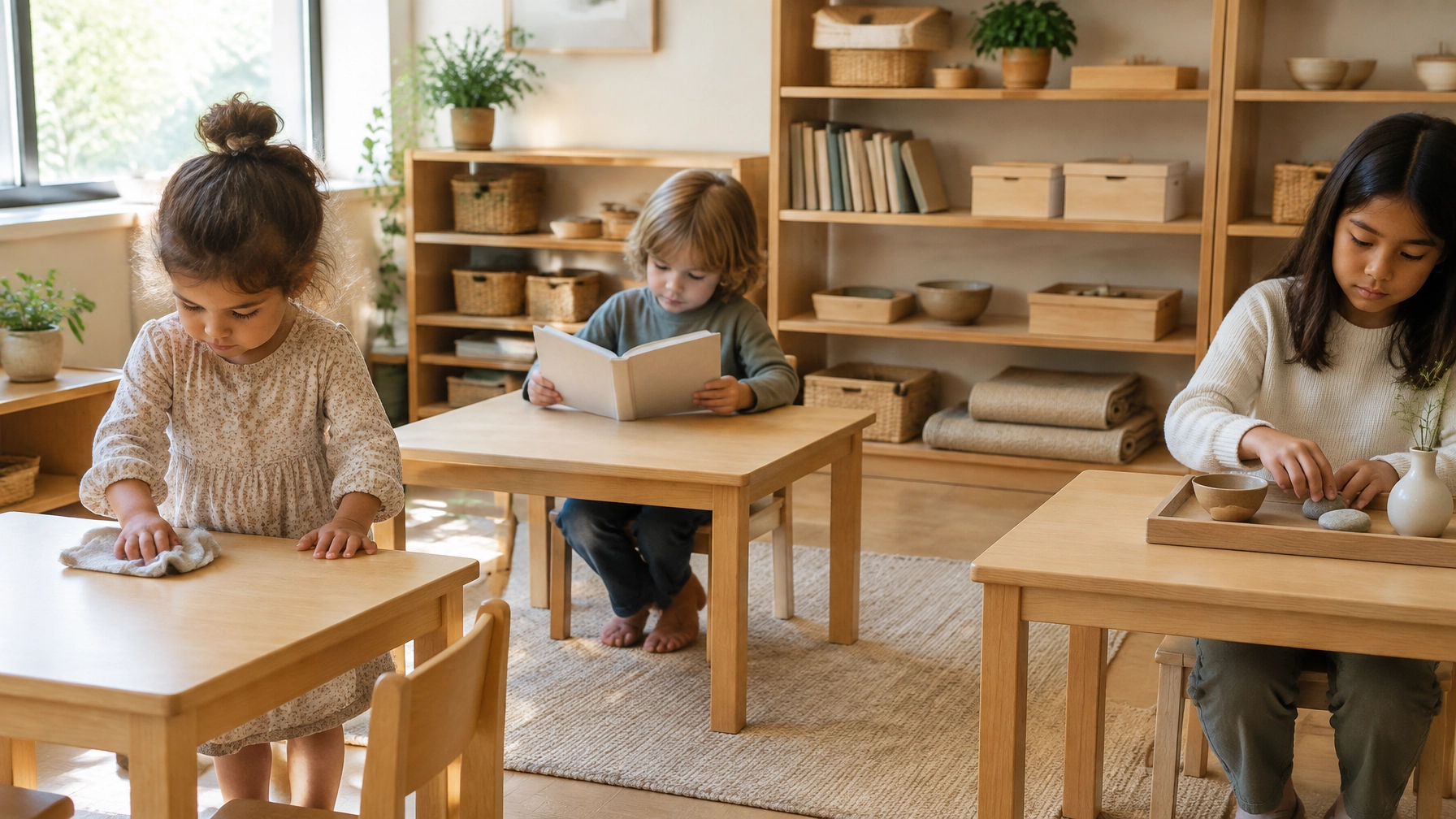
Walk into a well-prepared Montessori classroom, and you may notice something interesting.
Children are moving freely. Some are working alone, others with friends. One child may be carefully washing a table while another builds words with the Moveable Alphabet. Older children may be working together on a research project.

A familiar classroom rhythm gives children room to choose and work.
There may be no adult standing at the front telling everyone what to do next.
Yet beneath all this activity is a remarkable degree of order.
Materials have familiar places on the shelves. Children know how to select work, use it carefully, and return it for someone else. They understand the expectations for moving around the room, caring for their environment, and respecting one another’s concentration.
The daily work period follows a familiar rhythm, but children have considerable freedom within it.
This is one of Montessori’s most important insights: Freedom becomes more meaningful when children have a dependable environment in which to exercise it.
Because children understand how their classroom works, they don’t need to wait constantly for adult instructions. They can make decisions, solve problems, and gradually take responsibility for themselves. This balance of structure and flexibility is also important in personalized learning, where students are encouraged to take ownership of their education.
The same principle can make family life more peaceful.
Creating a Sense of Order at Home
A predictable home doesn’t have to be a perfectly organized home. Nor does every minute of the day need to be scheduled.
What matters most is establishing familiar patterns that children can understand and eventually manage for themselves.
Here are some practical ways to begin.
Make mornings more predictable. Young children often do better when the basic sequence of getting ready stays reasonably consistent: getting dressed, eating breakfast, brushing teeth, collecting belongings, and leaving for school.
A simple picture chart can help a younger child remember the steps. Older children may enjoy making their own checklist.
Give important belongings a home. A low hook for a coat, a basket for shoes, and a consistent place for a backpack can eliminate many daily struggles.

Simple places for everyday belongings support growing independence.
When children know where things belong and can reach them independently, they don’t need an adult to organize every step.
Protect familiar family rituals. Reading together before bed, preparing breakfast on Saturday mornings, or sharing something about the day at dinner can become reassuring points of connection.

Small, familiar rituals can offer a reassuring point of connection.
These small traditions often matter more to children than we realize.
Leave room for uninterrupted activity. Children benefit from having time to become absorbed in play, reading, building, creating, or pursuing their interests without unnecessary interruptions.
Not every afternoon needs to be filled with scheduled activities.
Invite children to participate. Rather than designing every routine for your child, involve them in deciding how things might work.
A four-year-old might choose whether to put on pajamas before or after brushing their teeth. A nine-year-old might help establish a homework routine that leaves time for outdoor play.
The goal is not simply to make children comply with a schedule. It is to help them become capable of managing their own lives.
What Happens When Plans Change?
Of course, life doesn’t always cooperate.
A parent gets stuck in traffic. A favorite teacher is absent. A birthday party is canceled because someone is sick. A family trip takes longer than expected.
These moments can be especially difficult for children who rely heavily on familiar routines.
Our task is not to protect children from every disappointment or unexpected change. It is to help them develop the confidence and flexibility to handle those experiences.
One helpful approach is to explain three things:
What’s changing? “Grandma won’t be able to pick you up today.”
What’s staying the same? “You’ll still come home after school, and we’ll have our usual dinner together.”
What happens next? “I’ll be picking you up instead, and we’ll call Grandma when we get home.”
These explanations may seem simple, but they give children something concrete to understand.
It is also important to acknowledge their feelings.
“I know you were looking forward to seeing Grandma. It’s disappointing when plans change.”
We don’t have to eliminate disappointment to help children manage it.
As children mature, we can invite them to participate in finding alternatives. “The park is closed because of the rain. What else might we enjoy doing this afternoon?”
Over time, these experiences can help children discover that an unexpected change may be frustrating without being overwhelming.
When a Child Seems Suddenly Anxious or Unsettled
Sometimes children tell us directly that they are worried. At other times, their behavior offers the first clue.
A child who normally gets ready independently suddenly needs repeated reminders. Another asks the same question over and over. A child who usually enjoys school becomes reluctant to leave home.
There can be many reasons for these changes, including tiredness, illness, friendship difficulties, family stress, or developmental changes.
Before assuming that a child is being difficult, consider whether something in their world has become less predictable.
Has the family schedule changed? Is a parent traveling? Has there been a change in the classroom? Is the child facing responsibilities that suddenly feel too complicated?
Sometimes a calm conversation and a little additional support are enough to help.
Other times, a familiar routine, a manageable first step, or extra time with a trusted adult may make a difference.
Persistent or significant anxiety deserves careful attention and may call for guidance from a qualified professional. Routines can provide reassurance, but they are not a treatment for an anxiety disorder.
The Difference Between Security and Rigidity
There is one important caution.
Predictability should help children feel secure, not teach them that everything must always happen exactly as expected.
If we become too rigid about schedules and routines, children may become more distressed when something inevitably changes.
A healthy family rhythm has both consistency and flexibility.
Perhaps bedtime usually includes a bath, a story, and a goodnight hug. But one evening, after a late family gathering, there may only be time for a quick wash and a shorter story.
We can explain the change without making it a crisis.
Similarly, a child who is deeply engaged in building something wonderful may occasionally benefit from a few extra minutes before dinner rather than being interrupted simply because the clock says it’s time.
As children grow, they should have increasing opportunities to help manage their own time and responsibilities.
A toddler may need an adult to guide each step of the morning routine. A six-year-old may manage much of it independently. An adolescent can gradually take responsibility for planning schoolwork, activities, and personal commitments.
The structure remains, but the adult’s role changes.
We move from doing things for children to helping them learn to do things for themselves.
A Secure Foundation for Growing Independence
One of the beautiful things about childhood is watching children gradually become more capable.
The toddler who once needed help finding their shoes eventually gets ready independently. The child who became upset when plans changed learns to suggest alternatives. The adolescent who once needed reminders begins organizing their own responsibilities.
These changes don’t happen overnight.
They grow through countless ordinary experiences in which children discover that the world is understandable, that the adults in their lives can be trusted, and that they themselves are increasingly capable.
Familiar routines are one way we help create that foundation.
Our goal is not to raise children who need everything to happen according to plan.
It is to raise children who feel secure enough to explore the unfamiliar, confident enough to take responsibility, and resilient enough to handle life’s inevitable surprises.
About the Author
Betty Norton is Chief Academic Officer of Xceed Preparatory Academy, a Cognia-accredited network of private and virtual schools serving grades 6–12. She has nearly 30 years of experience in curriculum development, school improvement, and educational leadership, with a particular interest in student-centered and inclusive learning.