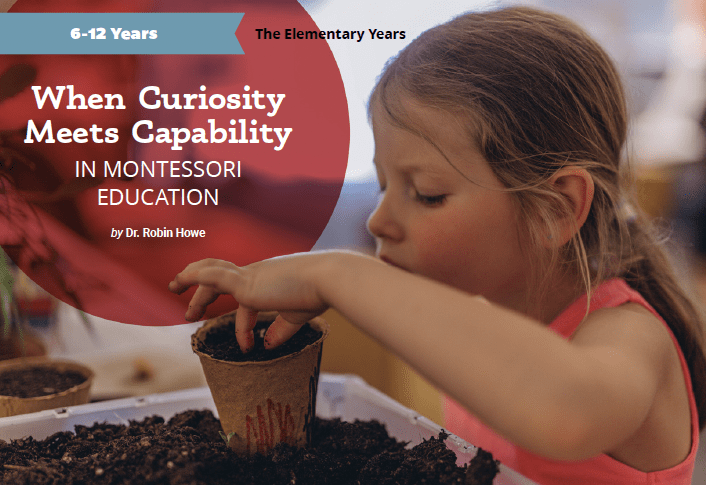
When Curiosity Meets Capability In montessori Education

When Curiosity Meets Capability In montessori Education

curiousity

A New Kind of Questioning

Children between the ages of six and twelve are in one of the most remarkable periods of development. It is during these years that their brains can imagine times, places, and people beyond their immediate experiences and the physical world. They arrive at school brimming with questions that stretch a brain that is hungry to imagine and understand. Why do leaves change color? How did the first language begin? Did humans create fire or discover it? What makes thunder? Who invented money? Their minds no longer settle for quick answers. They want to know how things connect, why events happen, and where humanity fits in the grand story of life.

This is what Maria Montessori referred to as the Second Plane of Development. It’s a time of enormous change. Children grow in confidence, abstract reasoning, and moral awareness. Their social lives expand, and their curiosity deepens. For Montessori educators, this is the moment when curiosity meets capability—and the Elementary program is uniquely designed to meet it.


The Psychology of the Elementary Child

Children in this stage are dramatically different from their younger peers. Their world expands from the self to the group, and there is a new hunger for shared experiences.  They thrive in collaboration. You’ll often find them gathered around large tables, sprawled on the floor with maps, or debating over how to divide tasks for a project. Their friendships evolve in complexity, and they start to challenge the rules of fairness, justice, and loyalty. This is a period when their own personalities and group members begin to take shape. Moral reasoning starts to bloom. A child who once followed rules simply because “that’s what you do” now questions whether those rules are fair. They want to talk about justice and responsibility, weighing what’s right and wrong in ways that mirror adult conversations. At the same time, their ability to think abstractly begins to expand. While they still love to work with their hands, they are also eager to grasp big concepts, such as civilizations rising and falling, the laws of physics, and the evolution of life. They are drawn to heroes—both real and imagined— who embody courage, resilience, and human greatness.

Did you know?

Developmental psychologists note that, between ages 6 and 12, children experience what Jean Piaget called the “concrete operational stage.” They are increasingly able to reason logically, understand cause and effect, and imagine perspectives beyond their own. Montessori’s approach aligns beautifully with these cognitive leaps. Furthermore, other developmental psychologists, such as Erik Erikson, described these years as ones where students have the psychosocial task of developing industry through work, versus the sense of inferiority, leading to the lifelong “virtue” of competency that will lead them into the early stages of adolescence, young adulthood, and eventual full adulthood.

The Montessori Elementary Approach

To meet the needs of these growing minds, the Montessori Elementary curriculum provides a learning experience that is both structured and expansive. At its heart are the Five Great Lessons, sweeping stories that serve as a unifying framework for everything that follows.

• The Story of the Universe introduces the origins of stars, planets, and the conditions for life.

• The Coming of Life traces the evolutionary journey of living organisms across billions of years.

• The Arrival of Humans explores what makes our species unique—our ability to imagine, communicate, and create culture.

• The Story of Communication in Signs follows the birth of language and writing.

• The Story of Numbers reveals humanity’s inventive ways of measuring, recording, and understanding the world.

These stories don’t just deliver facts. They are intended to be impressionistic. They ignite wonder. They provide a framework for children to see how science, history, math, and language are interconnected. Instead of isolated subjects, children experience knowledge as a web—alive, connected, and ever-expanding. Perhaps more important than what is mentioned above is the sense of appreciation that these lessons are intended to instill.

The late Montessorian Dr. Michael Dorer, author of The Deep Well of Time, among other great Montessori books, often mentioned that the Great Lessons (in addition to providing a framework for the Elementary years) give context and relevance to the curriculum. This helps children develop a deep sense of appreciation for everything that came before them, affecting almost all aspects of our lives, including digital technology and electronics.

One Parent’s Story: Wonder in Action

Jacob, age seven, listened to the Story of the Universe and went home buzzing with questions. That weekend, he built a three-dimensional solar system out of clay, complete with asteroid belts and moons. His parents were astonished by how deeply he absorbed the story. “It wasn’t homework,” his father, Scott, said. “It was joy. He wanted to know everything.”

Beyond the Classroom Walls

Montessori Elementary education doesn’t stop at the school doors. Students design and implement “going out” experiences: student-led trips to libraries, museums, businesses, and nature preserves. Unlike traditional field trips, these outings begin with a child’s question: What was daily life like in Ancient Egypt? How does a printing press work? What kinds of birds live in our county? The children often play a significant role in planning their trip, helping to set an agenda, and learning to navigate real-world logistics, such as writing letters, making calls, managing money, and practicing courtesy with adults in the broader community. These experiences cultivate independence and give them a sense that the whole world is their classroom.

Going Out: The concept of “going out” originates from Maria Montessori, who believed that the prepared environment for older children extended beyond the classroom to encompass the entire community.

Supporting Abstract Thinking

As children grow, their thinking shifts toward more abstract concepts. Montessori materials evolve alongside them, offering bridges from hands-on experiences to symbolic reasoning. As students progress through Elementary and into Montessori Secondary programs, the prepared learning environment becomes less based on materials and physical learning “tools” and more about the prepared opportunity for learning through research, discussion, or experience.

The following materials and curricular areas illustrate how the Elementary Montessori curriculum supports students’ cognitive abilities and interests during this second plane.

The Timeline of Life stretches across the classroom floor, making billions of years of evolutionary history tangible.

Mathematical materials shift from beads and cubes to algebraic formulas, preparing children for higher-level reasoning and problem solving. In the Elementary Montessori curriculum, Dr. Montessori considered geometry and arithmetic as related but separate curricular areas, where students learn the characteristics of shapes and then add the ability to quantify value, such as area and volume, through their discovery of the relationship of quantity and size.

Language studies expand to etymology, grammar, and literature, helping children appreciate the richness of communication.

Cultural charts illuminate the rise of civilizations, trade, and human innovation.

A Montessori classroom at this level is alive with research. Children write reports, create models, stage debates, and prepare presentations for peers. Instead of memorizing information for tests, they engage with knowledge in ways that make it meaningful and lasting.

A Collaborative Environment

Elementary Montessori classrooms are designed to encourage collaborative learning. Elementary classrooms often have large tables that invite group work, while open floor space allows for projects that sprawl. Children divide tasks, solve disagreements, and learn to appreciate diverse perspectives. Peer teaching thrives. Older students guide younger ones, reinforcing their knowledge while modeling leadership. A 12-year-old explaining fractions to an 8-year-old doesn’t just strengthen math skills; it builds patience, empathy, and confidence.

One Parent’s Story: A Different Kind of Classroom

A mother visiting her daughter’s classroom was startled to see a group of nine-year-olds leading a lesson on the American Revolution. “I thought, where’s the teacher? Then I realized that the teacher was guiding from the side, and the students were taking ownership of the learning. It was inspiring.”

Academic Rigor with Meaning

Parents sometimes wonder whether Montessori Elementary prepares children academically. The answer is an emphatic yes. Mathematics progresses from concrete exploration to geometry, pre-algebra, and, in some cases, early calculus concepts. Language studies move from writing simple stories to analyzing grammar, writing essays, and engaging with literature. Science includes classification, chemistry, biology, and physics. History and geography encompass ancient civilizations, cultural development, and the interconnectedness of societies.

Unlike conventional schools, Montessori does not teach these subjects in isolation. They are always connected to a larger story and a greater purpose. This integration ensures that children understand not only what to learn but also why it matters and how it is relevant to their lives and their experience as human beings.

Did You Know? Studies comparing Montessori and conventional students have found that Montessori graduates demonstrate stronger critical thinking, greater creativity, and equal or higher achievement in math and literacy by adolescence (Lillard, A.S., et al., Frontiers in Psychology, 2017).

Outcomes that Last

The benefits of Montessori Elementary extend beyond test scores. Children leave these years with exceptional research and critical thinking skills, the ability to collaborate and lead, strong communication abilities, and the confidence to tackle new challenges. Most importantly, they come away with a genuine love of learning. Elementary Montessori education provides socioemotional opportunities for children to develop the skills they need as they progress to a new level of emotional awareness. As these students enter adolescence, a challenging period in most cases, Montessori Elementary environments aim to prepare them as effectively as possible to understand, accept, and self-regulate their emotions.

One Parent’s Story: Independence Blossoms

One of my parents described her son’s ‘shift’ during the Elementary years: “He started asking questions we couldn’t answer. Instead of waiting for us, he grabbed books, searched online, interviewed neighbors, and even wrote letters to a local historian. Montessori taught him that curiosity isn’t the end of learning—it’s the beginning.” Possibly more important than his desire to learn was his ability to take action on his own to address his own needs, a skill that is possibly more important than any academic accomplishment.

Supporting Your Child’s Montessori Journey

For parents, raising an Elementary-aged Montessori child means embracing their boundless curiosity and growing independence.

Engage with their questions. Instead of rushing to give answers, ask, “What do you think?” or, “Where could we look that up?”

Offering enriching experiences includes museum visits, nature hikes, and cultural festivals—all of which feed the classroom curriculum. Give space for independence.

Allow them to plan family projects, cook meals, or resolve conflicts with siblings.

Respect their social world. Friendships are central at this age, and learning to navigate them is an integral part of the developmental process.

Supporting your child doesn’t mean doing everything for them—it means giving them the room and resources to grow into capable, thoughtful young people.

The Elementary Years as a Foundation

The Elementary years are a time of profound intellectual and social growth.

With Montessori’s unique approach, curiosity and capability come together in powerful ways. Children emerge as independent thinkers, problem solvers, and lifelong learners. At the end of the Elementary years, Montessori children don’t just know facts and figures. They know how to think, collaborate, and maintain their curiosity. That’s a foundation not just for school but for life.

In closing, choosing to have your children continue in Montessori through the Elementary years is a great and BRAVE decision. Elementary Montessori education inspires and encourages questioning, challenging, and advocating. While some might consider these three characteristics as adversarial, many of us believe that these are what evolve into leadership, confidence, and support, possibly exactly what the world needs. It takes brave people to raise Montessori children!


 Dr. Robin Howe began his Montessori education at the age of 2 at the Barrie School in Silver Spring, MD, where he attended through eighth grade. Graduating from Dickinson College with two majors (Spanish and Religion), he went on to earn a Master’s Degree in Bioethics from the University of South Florida. After a successful career in restaurant management, Robin decided to return to his Montessori roots. He earned his Primary certification from Palm Harbor Montessori School (AMS) and then attended St. Catherine’s University to earn his Lower and Upper Elementary Certification (AMS). He also participated NAMTA’s Orientation to Adolescent Studies (AMI). Robin holds a Doctorate in Educational Leadership from Argosy University and serves as a Senior Montessori School Consultant at The Montessori Foundation.




An Online Montessori School for Teens

An Online Montessori School for Teens

In the fall of 2020, the leadership of the Center for Guided Montessori Studies asked the question, “What would an authentic Montessori middle school look like if it were online?” This question was especially pertinent at the time, because we were all adjusting to “forced” online learning resulting from the COVID pandemic. The question that we asked ourselves was, “Can we build an adolescent Montessori program and community online?”

That winter, we decided to plan for a soft launch of what became the Bridgemont International School. We began with just one class of seventh- and eighth-grade students, all living within the time zones of the continental United States, led by certified and experienced Montessori Adolescent Guides.

Our plan is to add one grade a year, extending through high school over the next four years. We also plan to open additional cohorts in North America and other parts of the world as interest grows. As we have from the start, our goal is not to grow quickly, but rather with slow, careful steps to ensure that we establish programs that are excellent and sustainable.

The first question that we reexamined was, “What makes a Montessori adolescent (middle and high school) program authentically Montessori?” Even though we have been involved with Montessori programs at this level for years, there is (at this point) no one model for adolescent programs. Dr. Montessori died before she was able to define the “model” of what a secondary program looks like. Rather, there are a series of lectures and discussions that other Montessori educators have interpreted, leading to vastly different models of Secondary education.

Many are familiar with the farm-school model of Montessori Adolescent Education (Erdkinder), while others may be familiar with the curricular outlines of other Montessori Secondary training programs. While there are many different models, there are key components of Montessori for the student in the third plane.

Curriculum: Students need to learn! They should be culturally literate and develop the academic skills they will need if they decide to pursue post-secondary education. Even within this component, there are different definitions of what that means. I would suggest that students need to know basic information. What makes Montessori distinct at this level is the balance between helping students through the challenges of adolescence, while covering an excellent course of study. For us, a particular focus is helping teens to discover that what they learn in school is real, relevant, and interesting. We want to encourage their interests, help them to see the big picture, and think critically about what they study and how it relates to their own lives.

The core of our academic program is the Montessori educational syllabus, which consists of ‘integrated academic components’ in three overarching areas: self-expression; emotional development; and preparation for adult life.

Within these areas, Bridgemont offers rigorous coursework in a variety of academic subjects, experiential learning, and in-the-field experiences; a range of seminars and collaborative learning projects; training in organization and personal responsibility.

Even though our curriculum is highly integrated, courses have titles that are familiar to colleges and other schools including math, language arts, sciences, humanities, Spanish, health, arts, and electives.

Here is an example of a simple 7th- and 8thgrade science experiment that we did recently.

Is “earth-friendly” laundry detergent actually safe for the environment?

For this experiment, we planted radish seeds in potting soil. In Dish #1, we watered the seeds with a mixture of water and regular detergent. In Dish #2, we watered the seeds with a mixture of water and earth-friendly detergent. In Dish #3, we simply used regular tap water.

After 10 days, only one dish had germinated seeds. Can you guess which one???

The dish that used regular tap water was able to grow radish seeds. The other two dishes? Nothing.

In Dish #1, the regular detergent solution left a heavy film over the soil and seeds.

In Dish #2, the earth-friendly detergent solution did not leave as heavy a film; however, no seeds germinated.

Conclusion: “Earth-friendly” may not be all it is advertised to be; however, it certainly is “friendlier” in appearance.

Valorization: This is such a wonderful term that Dr. Montessori gave us. It is the key challenge of adolescence: the formation of a clear sense of identity, a moral compass, and feeling validated and valued for their contribution as an individual. As children transition from childhood through the teenage years, and then into the adult world, they need to feel a sense of responsibility and worth that leads them to confidence and independence. This can be accomplished in many ways; however, it is probably the single most important component of Montessori at this level.

Community: Community is, directly and indirectly, related to curriculum and valorization. Part of the work of adolescents is to discover their own strengths, style, and role in the community. This is done through deliberate and unexpected avenues. A most basic statement is that adolescents desire to be part of a community.

So, back to the question at hand; how does one create this from an online platform?

How can we deliver a rich curriculum that is more than mere memorization, create opportunities for students to feel valued and value in their work, and create a sense of community, when most of them have never actually met in person?

The students at Bridgemont spend approximately four hours a day in real-time engagement in a variety of activities, including (but not limited to) direct instruction, Socratic dialogue, independent and small-group work with peers, presentations, guest lecturers, working out, doing art, and the occasional Harry-Potter-themed “butter beer” parties.

So, can Montessori at this level be done from an online platform? YES!

A prepared environment at the Secondary level is much more about experiences rather than the materials and physical environments of the Early Childhood and Elementary levels. Can the Montessori guides create opportunities for authentic interaction, sharing, and developing a real sense of caring about one another? Can this be done while also helping students become culturally literate and explore their open passions? Again, YES!

Online learning gives students the space to comfortably participate and voice their opinions, which can ultimately help build confidence and positively reinforce their self-esteem.

At the half-year point, the discussion among the students and Montessori guides turned to gratitude. To our delight, what the students were most grateful for was the sense of community, greater than they had felt in their brick-and-mortar schools. What was our greatest concern, had become our greatest strength.

Community, in the case of the Bridgemont students, guides, and administrators, means kind, empathetic, interested young adults that are not just saying that they care, but honestly care about each other and are interested in the world in which they exist. While doing so, they are also being held to a high level of academic expectations that support each student’s progress and independence.

SOME ADDITIONAL INFORMATION:

Is Bridgemont accredited?

As Bridgemont International School is licensed in the state of Florida, it adheres to the graduation requirements of the State of Florida. (We teach the same courses; however, they are taught very differently.) The school plans to pursue accreditation by the International Montessori Council (IMC) and Cognia.

How does Bridgmeont address service learning, Erdkinder, etc.?

At Bridgemont, we recognize the importance of the “Montessori experience.” We intend to include each of these experiences; however, they will be different in that the students will have more responsibility in designing their experiences with the support of our Montessori guides. Rather than being provided with experiences, students will be actively involved in the design of the experiences that satisfy their requirements in their own communities.

Is it all online?

A goal for the near future is to have two live in-person experiences a year. The school year would start with a whole-school orientation, which would change from year to year and is meant to be a team-building and orientation program. The second experience is meant to be student-designed and will look different from year to year. This will be budgeted, designed, planned, and based on student feedback and student work. (COVID-19 has made this difficult, but it is a goal for the 2022-2023 school year, if possible).

How are time zones addressed?

Our courses and schedules are deliberately designed to meet the needs of students in the continental United States. With WIN (What I Need) hours scheduled on both sides of the “Core” curriculum, students from all parts of the United States can work together at times that are convenient and in line with best practices in adolescent psychology.

As the school grows, there will be timezone-specific cohorts. These will be times that are more specific to time zones and regions; however, there will be shared times with all available time zones to include students from other countries, continents, etc.

In summary, Bridgemont International School is an authentic Montessori School, where students from all over the United States and around the world have the opportunity to become what they are meant to be and have the fortitude, confidence, and support to go after it. •

If you are interested in learning more, please visit our website at www.bridgemontschool.com.


Robin Howe, Ed.D. is a Montessori kid, a Montessori certified teacher (at all levels except infants), and a Senior Consultant for the Montessori Foundation.

Where Have All The Teachers Gone?

Where Have All The Teachers Gone?

Jobs, need school teachers

In Elka Torpey’s (2018) article “ Projections for teachers: How many are leaving the occupation?” According to the US Bureau of Labor Statistics, between the years of 2016 and 2026, more than 270,000 teachers will be leaving the profession each year. Whether it is retirement, career changes, burn-out, there are a lot of open teaching positions. That was before the onset of the COVID-19 factor, which has impacted each of our lives in so many different ways.


As described in the Madeline Fox (2021) article, “Teacher retirements were up in 2020 and more are expected in 2021,” the Covid pandemic has caused many teachers to evaluate their retirement plans and, in many cases, make the decision to retire early. According to the Fox (2021) article, there are various factors that are causing teachers to make this decision, including but not limited to: health fears; burnout; feelings of not being able to manage; etc.


Whether teachers are retiring because they are reaching the age of retirement or making the decision to retire early for any reason, we are in the midst of teacher shortage and are losing mentoring teachers who have been relied upon to usher in the new waves of teachers. All of this is leading to the reality that there are going to be a lot of new teachers in our classrooms. While training Montessori teachers may have a slight advantage in that many Montessori teacher education programs require a year of supervised practicum, the reality is that teaching is hard work and mentorship and support is incredibly important, especially in the early years of a teacher’s teaching career.


The first question then becomes: Where are we finding the teachers? In a publicly acknowledged underpaid career field that is increasingly becoming more about parent management rather than inspiring students, we need to find teachers and nurture and guide them to become the types of teachers needed to replace the expanding sinkhole of seasoned educators.


Now, assuming young adults entering university make the decision to enter the education field, whether it is to work in a kindergarten or a high school (private or public), Montessori, traditional, and any of the other flavors of education out there, what are our expectations of these teachers?


This is the first generation of young adults that have grown up with their entire lives memorialized on social media. Essentially, these young professionals entering the workplace have a history, good or bad, and it is there for us to see, criticize, judge, and ultimately use to make decisions regarding character.


So, to reference a 2021 article published in the Washington Post, “The Right to be Forgotten: Should teens’ social media pages disappear as they age?” Davis (2021) shares stories of the impact of older social media posts on careers, and we are all aware of stories that have impacted college scholarships, public perceptions, etc. Davis, (2021) writes, “Some question whether what children post online (and what others post about children) should follow them into adulthood, potentially affecting their academic and vocational careers.”


Most schools follow a similar hiring practice that includes local and national background checks. These checks generally report infractions, ranging from simple misdemeanors to more serious felonies. What is not included on these federal or law enforcement background checks, is whether Suzy (as a young adult) posted a picture smoking a joint back in college or whether Jack (also as a young adult) allegedly made a sexually provocative response to a classmate and used inappropriate language.


Whether these youthful indiscretions may not be relevant to the present, be assured that inquisitive parents and students will find that post from ten years ago. While there may not have been any laws broken, is that comment or photo more damning because someone was photographed smoking marijuana (which is now legal in 18 states and Washington, DC) at a friend’s house?


My response is, “YES!”


Going back to the Davis (2021) article, “Should Teens’ Social Media Pages Disappear as they Age?”


As there is an increasing need for teachers, a hole that will have to be filled with these young men and women entering the workforce, as we read through their CVs and discuss their interest in the positions, should we also look into their Facebook and Instagram pages? Google is public, so it is certainly not illegal to do a basic search. Even if we don’t look into it, a parent or our students certainly will.


What happens when we find something we don’t like? Furthermore, an expectation of teachers, and even more so, Montessori teachers, is that we need to be able to stand behind what we teach children. More explicitly, how can we talk about modeling behaviors and responsible use of social media when we have a teacher with a less than stellar digital record?


Summarizing the points suggested above: there is an increasing shortage of teachers that need to be filled by young men and women, many of whom have less than perfect social media records that are publicly available for judgment.


While the reality is that many of the applicants will not have any skeletons in their closet waiting to be discovered, the question still remains as to how we value and or judge someone based on decisions or judgments made before the frontal lobes of the brain were able to comprehend future consequences. Davis (2021) asks this question differently: “When should a person’s ‘permanent digital record’ start recording, if ever? To what extent should social media be a space for trial-and/or-error exploration around identity and social behavior?”


If we are to judge others based on the higher than average expectations of Montessori teachers, are we not only limiting the potential eligible candidate needed to fill the Montessori teacher shortage, but are we also denying the fundamental principles we teach of learning from mistakes. If we are to measure young adults based on decisions made years earlier, are we encouraging children to not self-express? Are we warning against risk? This is non-synonymous with being careless with our words and actions but acknowledging the biological and neurological transformation that takes place in the third and fourth planes of development.


Citing Dr. Maria Montessori, Camillo Grazzini describes the third plane of development (ages 12-18), stating, “This is the time, says Montessori, ‘when the social man is created but has not reached full development; this is the time ‘the sensitive period when they should develop the most noble characteristics that would prepare a man to be social, that is to say, a sense of justice and personal dignity.”


Describing adolescence, Dr. Montessori wrote, “The period of life in which maturity is attained is a delicate and difficult time, because of the rapid development and change which the organism must go through.” Again, describing adolescence, Montessori wrote: “From the physiological point of view this is also a critical age. There are doubts and hesitations, violent emotions, discouragement, and an unexpected decrease in intellectual capacity.”


Collectively, we (the grown-ups in the room) are facing questions about how to evaluate a young person’s character when they are making decisions for which they may not be able to adequately comprehend the consequences. This is not to suggest that students or adults should be immune to bad decisions, lack of judgment, or impulsive and emotional responses.


This is simply a plea, from an imperfect Montessori educator, in a time of scarcity and heightened emotional tension, to focus on the person, the development of responsible men and women, and focus on awareness and education rather than judgment.


Dr. Daniel Robinson (Robin) Howe began his Montessori career at the age of two at the Barrie School in Silver Spring, MD, which he attended through the eighth grade. Graduating from Dickinson College with two majors (Spanish and Religion), he went on to earn a Master’s Degree in Bioethics from University of South Florida. After successfully pursuing a career in the restaurant industry, Robin decided to return to certification from Palm Harbor Montessori School (AMS) then attended St. Catherine’s University to earn his Lower and Upper Elementary Certification (AMS). He also attended NAMTA’s Orientation to Adolescent Studies (AMI). Robin holds a Doctorate in Educational Leadership from Argosy University and worked with The Montessori Foundation’s management team at NewGate (the Foundation’s lab school), serving as Associate Head of School and as a Senior Montessori Foundation School Consultant. In his spare time, Robin lives with two Elf cats and has set a personal goal to run marathons in all fifty states.

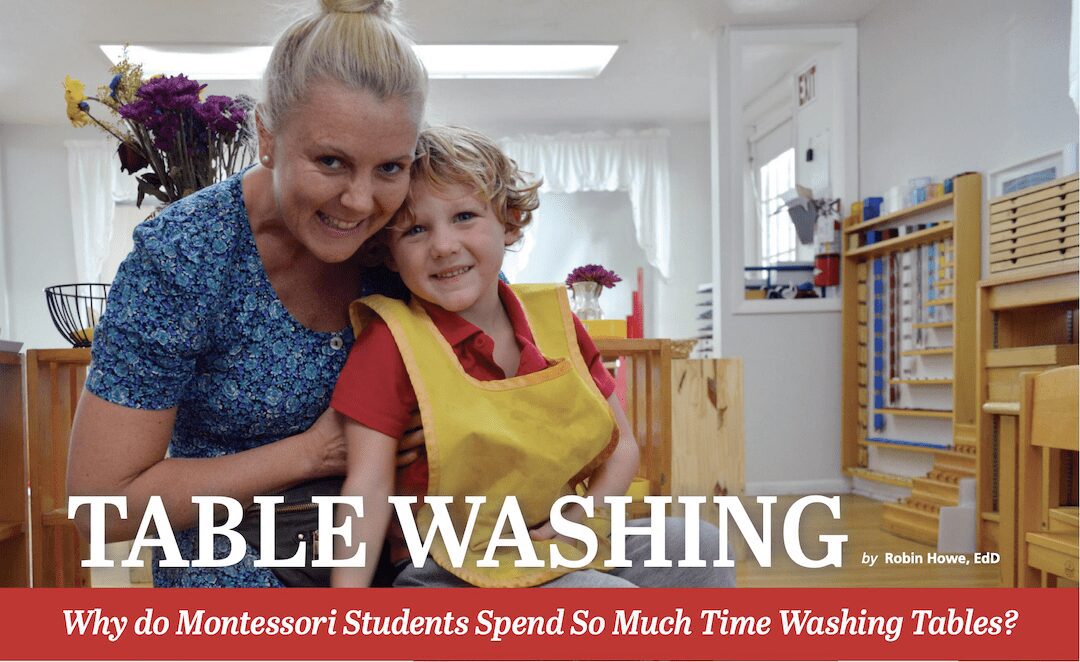
Table Washing: Why Do Montessori Students Spend So Much Time Washing Tables?

Table Washing: Why Do Montessori Students Spend So Much Time Washing Tables?

Table washing

by Robin Howe, EdD

Editor’s Note: If we had a dollar for every time a skeptical parent has questioned the amount of time their young Montessori child spends washing tables …

ANATOMY OF A LESSON

Ironically, I missed the session of my Montessori teacher training when we were given the lesson on how to wash tables. I remember doing it as a Montessori child. How hard could it be? I was just getting out of my first career in the restaurant business, and someone was going to teach me how to wash a table? I had washed and set tables for the rich and famous. I had cleaned more tables than everyone in that class combined. I was, in fact, relieved to miss that day of instruction. The summer training session ended, with my teacher trainer reminding me that I still needed to have a lesson on table washing.

A month later, about three weeks into the school year, where I was doing my internship, my lead teacher, a wonderful, experienced Montessorian, invited me to join her while she gave a review lesson to one of the returning students on table washing. Great, I thought! This was my opportunity to receive the lesson, seemingly without missing a beat. About twenty minutes later, I found myself sitting there observing a four-year-old finish up his work, while I, the ‘non-lesson-needing ‘expert’ watched dumbfounded.

I once thought that table washing was one of the most remedial tasks that a Montessori student would ever have to learn. As a result of watching this lesson, and essentially being humbled by a four-year-old (also an experience that has since occurred on many occasions), I have come to realize how important and difficult this work is for children.

I have now learned how to give this lesson, and it never ceases to amaze me that it is so complicated. More amazing is the way that my students seem to pick it up so quickly and how I still, after many lessons, have to focus in order to perform it correctly. For these reasons, I would like to share the lesson, as well as some observations, on how children respond to this exercise. It is my hope that others will gain a better appreciation for the complexity of this lesson and will, as a result, appreciate its importance and contribution as a part of the Montessori curriculum.

When working with any water exercise, the first step is to have the child put on an apron. Students are already familiar with where aprons are kept in the classroom, as well as how to put one on. Next, the teacher asks the student to go together to where the table-washing kit is located on the shelf. The child is either shown or asked to identify the table-washing kit and is then asked to take it to the side of the table that will be washed, placing the kit on the floor next to the table. Included in the table-washing kit are the following: soap in the soap dish; a soap brush; a pitcher for gathering the water; a bucket for dirty water; a basin (or bowl); a sponge; a drying cloth; and a hand towel that will serve as a mat for the materials. Generally, the materials are kept in the basin that will be used for the water. With the hand towel in place on the floor, the materials are arranged along the top of the hand towel in this order: sponge, soap, brush, drying towel (from left to right), and the water pitcher. And basin along the bottom. Note: This lesson may vary depending on the classroom and teacher.

After all the materials are placed on the towel, water is brought to the table using the water pitcher. Children have to fetch the water, which exercises body control as they navigate through the classroom, returning carefully with a pitcher filled with water (about two-thirds full). Then, the water is poured from the pitcher to the basin. The pouring of water from a pitcher is an extension of work that the student has already mastered in earlier Practical Life lessons.

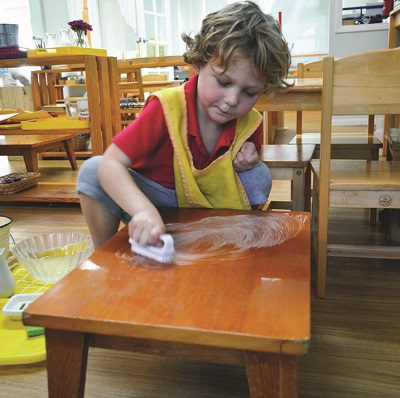
Next, the brush is wet and run across the soap until it is foamy. Using the wet, soapy brush, the table is methodically scrubbed in a circular motion. There should be small, but visible, suds on the surface of the table.

The brush is then rinsed and returned to its place on the mat. The dirty water is poured from the basin to the bucket, and the child carefully walks the dirty water to the sink to empty it. He will return it to the mat and fetch the pitcher so that he may again fill it with clean water to pour into the basin.

Now, the child wets the sponge and wrings out the excess water. Both the wetting of the sponge, as well as the squeezing of the sponge, are skills the child already possesses as a result of previous lessons in Practical Life. Starting at the bottom of the table, moving in horizontal motions, the child begins to rinse the soap from the table.

The sponge is wet once again. As an extension of this Practical Life exercise, the student might be asked to count how many compresses the sponge gets and then count the number of squeezes in order to expel excess water.

The child rinses the sponge, and picks up the towel to begin carefully drying the table top. After the surface is completely clear, the child checks the edge for suds and wipes it accordingly.

Step 1: Apron

Step 1: Apron

Step 2: Collecting Materials for the Lesson

Step 3: Preparing the Materials

Step 4: Getting Water

Step 5: Pouring Water

Step 6: Wet the Brush

Step 7: Soap the brush

Step 8: Scrub the Table

Step 9: Dump the Dirty Water

Step 10: Fill the Pitcher with More Clean Water

Step 11: Pour the Clean Water into the Bowl

Step 12: Wet and Wring the Sponge

Step 13: Wipe the Table with the Sponge

Step 14: Dry Table with Cloth

Step 15: Dump Dirty Water into Bucket

Step 16: Dump Dirty Water

Step 17: Clean Up Any Spills

Step 18: Roll Up a Clean Towel

Step 19: Fold the Mat

Step 20: Return the Materials to the Tray

At this point, the table is now clean and dry, and the basin is filled with soapy water. The student then pours the water in the basin into the bucket and disposes of the soapy water. The process of disposing of the water is also a very important part of the lesson. The child, again, has to navigate through the classroom, focusing on his movement and the balance of the bucket so as to not spill the water. This is great practice for walking slowly and being patient.

Once the water is dumped, the child uses the towel to make sure the work area is clean and dry. The dirty towel is placed in the laundry hamper, and a fresh towel is carefully rolled, and placed in the pitcher. Next, the mat is carefully folded and all materials are returned to the tray as they were found.

This lesson is important for many reasons. As mentioned during the lesson description, the child has to practice patience, while exercising fine-motor skills and balance. The student’s ability to sequence is challenged, as the proper completion of the work is dependent upon the ability to follow the proper steps. Another important aspect of this lesson, perhaps overlooked much of the time, is the time that the student spends working with the teacher. This is one of the longest lessons and can often take up to fifteen minutes.

During this process, children must listen carefully and ask questions, which helps them develop important language skills.

I hope that my description of this exercise offers some insight into the Montessori classroom and instills a sense of respect and feeling of awe for the children. Similar to the mistake I made, many people assume that these lessons with simple names must be simple, causing us to wonder how they could be so important. Indeed, I have come to realize that they are important, not only as a part of children’s Montessori academic curriculum but also their development as people. •

Daniel Robinson (Robin) Howe, III was a Montessori student from age two through the eighth grade. He worked his way through multiple levels of certification, spent many years in the classroom, managed a number of Montessori schools, and then earned his EdD. Formerly, co-head of the NewGate School, Robin is a senior consultant with the Montessori Foundation.

TOMORROW’S CHILD © • NOVEMBER 2019 • WWW.MONTESSORI.ORG