Related Posts


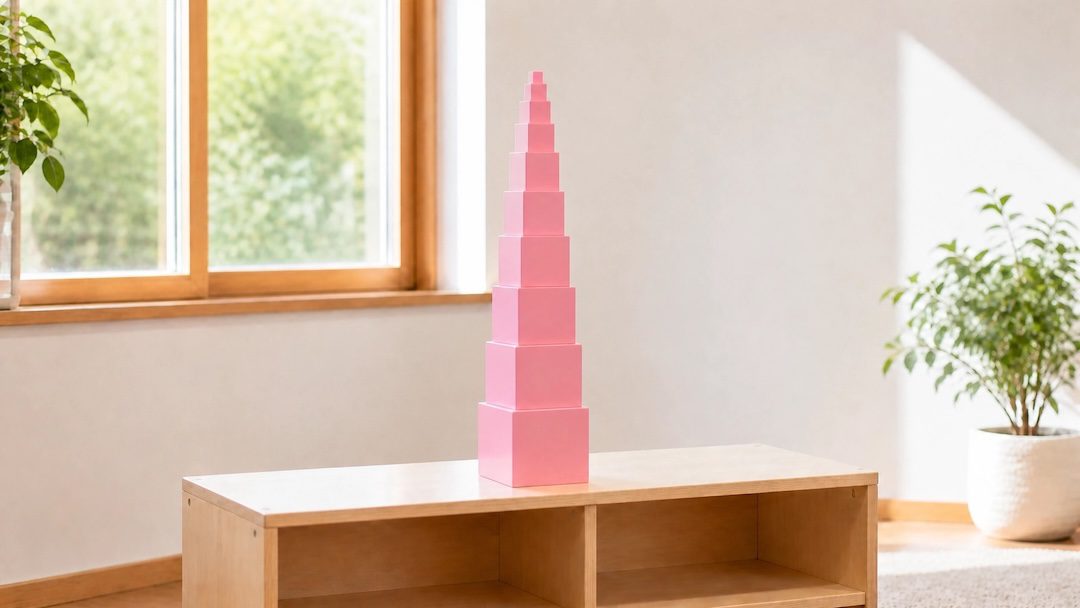
The Pink Tower is arranged from the largest cube at the bottom to the smallest cube at the top on a low wooden shelf.
If you’ve visited a Montessori classroom for young children, you’ve probably seen it: ten pink cubes, ranging from quite large to very small, sitting neatly on a low shelf.
It is called the Pink Tower, and it is one of the most recognizable Montessori materials in the world. It is also deceptively simple.
A child builds a tower. Big cube on the bottom. Smaller cubes follow until the tiniest cube sits at the top. That’s it?
Not quite.
Why Is Everything Pink?
This is actually an important part of Montessori’s design. The Pink Tower is not ten different colors. It doesn’t have numbers printed on it. It doesn’t light up, make sounds, or congratulate the child when the tower is completed.
Montessori materials tend to remove distractions rather than add them. The cubes are identical in shape, texture, and color. What changes is their size. That allows the child’s attention to focus on one particular quality: dimension. Montessori educators call this the isolation of difficulty — rather than asking a young child to process several changing qualities at once, the material essentially says: for now, pay attention to this.

A child carries one solid pink cube from the low shelf while the remaining Pink Tower cubes are arranged by size.
What Does the Child Actually Do?
The child carries the cubes, usually one at a time, to a work area. That is already part of the lesson: the largest cube is relatively easy to grasp, while the smallest requires a very different movement of the hand and fingers.
The child then begins constructing the tower, judging each cube in relation to the others. Which is larger? Which comes next? Does this look right?

A child carefully places a smaller cube on top of the progressively sized Pink Tower.
The teacher does not need to stand over the child saying, “no, that’s the wrong one, try this one.” The material itself provides information. Put a cube dramatically out of sequence and the tower looks wrong — the child can often see the discrepancy and make the correction. This principle, allowing children to discover and correct their own errors, is found throughout Montessori education.
The Mind Is Learning Through the Hands
Adults sometimes assume that thinking happens in the head while the hands simply carry out instructions. For young children, the relationship is much more intimate. They learn through movement, touch, vision, repetition, and manipulation of the physical world.

A child’s hands hold two solid pink cubes of different sizes beside the remaining cubes arranged on a work rug.
With the Pink Tower, the child is making increasingly precise visual judgments while coordinating increasingly precise physical movements: large, small, larger, smaller, largest, smallest, and all the subtle differences in between. The child is developing a visual understanding of dimensional relationships long before anyone introduces an abstract formula.
There Is Mathematics Hidden in the Tower
The dimensions of the cubes increase systematically. They are not simply ten randomly sized blocks.
The child does not need to know the mathematics behind the material — at three or four years old, that would miss the point entirely. Instead, the child handles mathematical relationships physically. Later, when Montessori mathematics becomes increasingly abstract, this kind of sensorial experience provides part of the foundation upon which mathematical thinking can develop.
This is a recurring Montessori principle: give the child a concrete experience before asking for an abstraction. Before mathematics exists only as numbers and symbols on paper, children have experienced quantity, dimension, sequence, comparison, pattern, and relationship with their own hands.

A child reaches toward a cube that is out of sequence while working with the Pink Tower on a rug.
Why Does the Child Keep Building It?
Parents sometimes wonder why a Montessori child repeats an activity already mastered. An adult tends to be product-oriented: we built the tower, mission accomplished, what’s next? Young children are often process-oriented. They may build it again, and again, and again.

A child works with the Pink Tower while arranging the cubes from smallest to largest on a work rug.
Through repetition, movements become more precise, perceptions become more refined, and concentration deepens. Eventually the child may be finished with the material — not because an adult decided it was time to move on, but because the developmental purpose that drew the child to that work has largely been satisfied.
It Is Not Really About Building a Tower
What you see a child doing and what is actually developing inside the child are not necessarily the same thing.
You see a child stacking pink cubes. The Montessori teacher sees visual discrimination, coordination, ordered thinking, concentration, persistence, independence, preparation for mathematics, and an increasingly refined ability to perceive relationships.

A Montessori guide observes from nearby while a child works independently with the completed Pink Tower.
That is why Montessori classrooms can sometimes seem mysterious to parents. The materials are simple on the surface, but remarkably intentional underneath.

A child sits beside a completed Pink Tower and looks closely at the orderly arrangement of the cubes.
So the next time you walk past a Pink Tower, look at those ten little cubes differently. They aren’t there simply because children enjoy building towers. They are an invitation to look carefully, compare, judge, move precisely, discover mistakes, try again, and gradually bring order to what the child sees.

A child’s hands carefully place the smallest cube on top of the Pink Tower.
The child builds much more than the material in front of them. The child is building themselves.

A child observes the completed Pink Tower in a calm, uncluttered Montessori classroom.