Related Posts



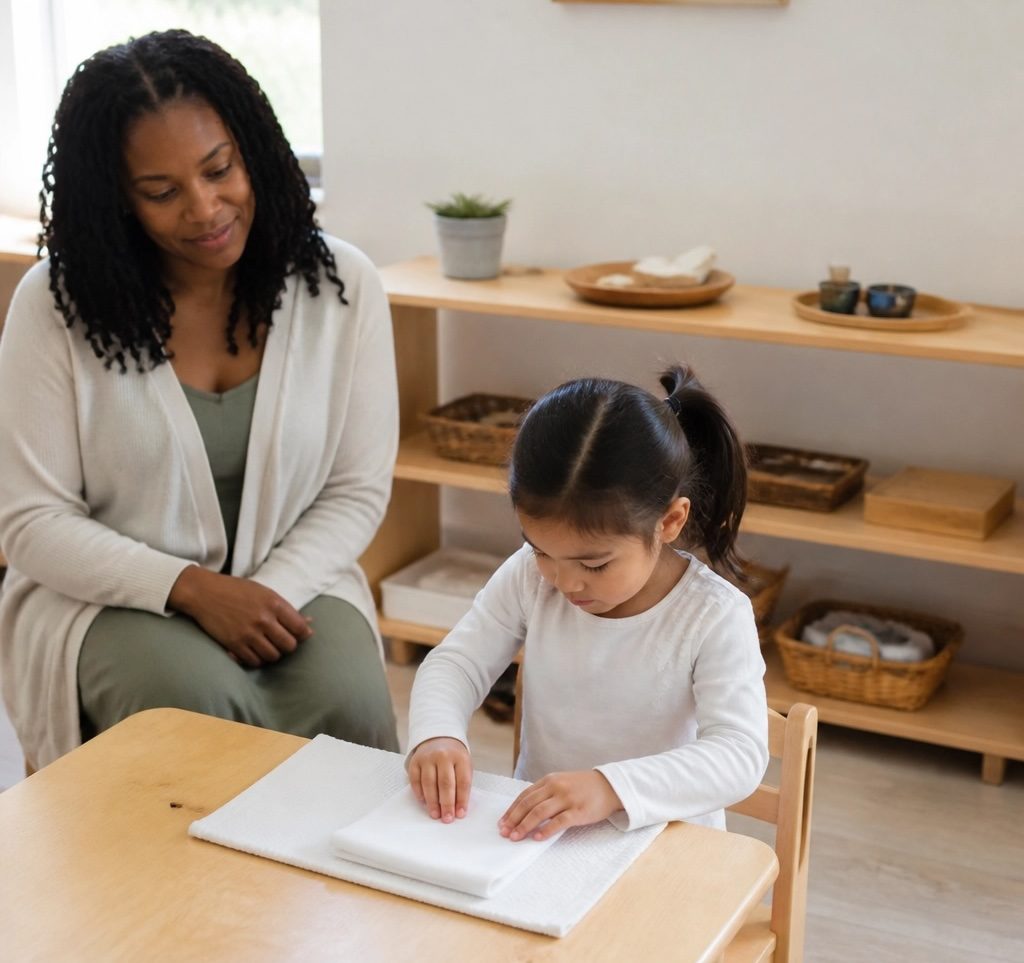
Observation begins with giving a child respectful space to concentrate.
“Follow the child” may be one of the most frequently repeated phrases in Montessori education, and one of the most easily misunderstood.
To someone hearing it for the first time, it can sound as though Montessori believed children should be allowed to do whatever they want. If a child wants to paint all morning, let them paint. If they don’t want to learn mathematics, don’t make them. If they would rather wander around talking with friends, that’s their choice.

The prepared environment offers children meaningful choices within a thoughtfully designed space.
But that isn’t what Montessori meant at all.
Following the child is not passive parenting or passive teaching. It requires adults to pay extraordinarily close attention to children so that we can understand what they need, what they are ready for, and how best to help them take the next step.
We Follow the Child by Observing
Observation is fundamental to Montessori education. Rather than beginning with the assumption that every five-year-old should be doing exactly the same thing on Tuesday morning, the Montessori teacher watches each child carefully.
What attracts this child? What has the child mastered? Where is the child struggling? Can the child concentrate? Is the work too easy, or too difficult? Is the child ready for the next lesson? Is something happening socially or emotionally that is interfering with learning?

Respectful movement allows children to exercise freedom while protecting the concentration of others.
Montessori teachers use what they observe to decide when to introduce new lessons, when to step in, and, just as importantly, when to stand back. Following the child begins with knowing the child.
Freedom Exists Within Limits
Children in a Montessori classroom have a great deal of freedom, but it is not unlimited freedom. They generally have freedom to move about the classroom, choose among work they have been shown and are ready to use, repeat an activity, work alone or sometimes with others, and decide how long to concentrate on meaningful work. But they do not have the freedom to hurt someone, misuse materials, continually disrupt other people’s concentration, or treat the classroom carelessly.

A mixed-age environment gives children opportunities to work independently while participating in a shared community.
This is sometimes described as freedom within limits. The limits protect the child, the other children, and the learning environment. Within those limits, children have genuine opportunities to make decisions and gradually learn to manage freedom responsibly.
The Prepared Environment Matters
“Follow the child” would mean something very different in an empty room.
A Montessori classroom is carefully prepared. The materials have been selected for developmental purposes and organized in a logical sequence. The furniture fits the children. There are opportunities for movement, language, mathematics, sensorial exploration, practical activity, science, geography, art, music, and social interaction.
The environment itself provides direction. A child is not choosing among every possible thing that could be done. The child is choosing within an environment thoughtfully designed by adults who understand child development. That is an important distinction.
Readiness Matters More Than the Calendar
Children don’t all develop according to exactly the same timetable. One child may become fascinated with letters while another is absorbed in building coordination and concentration through Practical Life. One child may suddenly become captivated by numbers, while another is ready for increasingly sophisticated language work.

A carefully presented lesson responds to the child while leaving room for observation and discovery.
A Montessori teacher watches for these moments of readiness. When a child’s interest and developmental readiness come together, learning can move very quickly.
This does not mean children never encounter things they initially find difficult or less appealing. Part of the teacher’s role is to awaken interest, offer lessons, establish expectations, and sometimes redirect a child who is avoiding an important area of development. Following the child does not mean waiting indefinitely for the child to request every lesson.

Repetition gives children time to refine movement, deepen concentration, and develop confidence.
The Adult Still Leads
This may sound paradoxical, but following the child requires skilled adult leadership. The teacher prepares the environment, establishes the culture of the classroom, presents lessons, protects concentration, sets limits, models respectful behavior, redirects when necessary, and keeps track of each child’s development.

Clear boundaries help protect safety, concentration, and respect for the shared environment.
Parents do much the same thing at home. A four-year-old does not decide whether brushing teeth is necessary. A seven-year-old does not decide whether the family leaves for school on time. Children need adults to establish reasonable expectations and boundaries.
Within those boundaries, however, we can offer meaningful choices and increasing responsibility. “Would you like the blue shirt or the green one?” is a genuine choice. “Would you like to go to school today?” probably isn’t.

At home, a limited choice can give a child real agency while the adult remains responsible for the larger boundary.
Following Is Not the Same as Indulging
Perhaps the easiest way to understand the idea is this: following the child means responding to development rather than simply responding to desire.
Children’s wishes matter, but what a child wants at a particular moment is not always what the child needs. The Montessori adult observes carefully enough to begin seeing the difference.

Sometimes following the child means remaining nearby, attentive, and quiet while the child works through a challenge.
Sometimes we offer help. Sometimes we set a limit. Sometimes we introduce something new. And sometimes the wisest thing we can do is remain quiet and allow the child to struggle, concentrate, repeat, discover, and succeed without our interference.

Following the child is a relationship built through attention, respect, and thoughtful adult guidance.
That is the art of following the child. It isn’t stepping away from our responsibility as adults. It is learning to exercise that responsibility with greater attention, restraint, and respect.