Related Posts


We’ve all done it. Perhaps our child is building with blocks, drawing, digging in the garden, or trying again and again to fasten a stubborn button.
We mean to help and say something encouraging.
“That’s wonderful!”
And just like that, the concentration is gone. Our child looks up and the moment has been broken.
We meant to cheer her on, but sometimes our encouragement interrupts the very thing we hoped to support. This helps explain something that can seem puzzling about Montessori classrooms at first: teachers are remarkably protective of children’s concentration. They will let a long silence sit. They will resist the urge to jump in. To a visiting parent, this can look like indifference. It is actually one of the most deliberate things happening in the room.
Concentration Is Something Children Build
We often talk about attention as though a child either has it or does not. “He has a short attention span.” “She cannot concentrate.” But concentration is not a fixed trait a child is born with. It is a capacity that develops, the same way balance or vocabulary develops.
Young children gradually learn to direct their own attention, resist distraction, push through difficulty, and stay engaged long enough to actually finish something. Dr. Maria Montessori considered this capacity enormously important, more important in some ways than any single skill it produces. A child who can concentrate can learn almost anything. A child who has not yet built this capacity may struggle even when perfectly capable of understanding the material in front of them.
So Montessori classrooms are built, quite deliberately, to give concentration room to grow.
From infancy onward, children are drawn toward purposeful engagement. An infant may spend several quiet minutes watching movement, reaching for an object, or repeating an effort to bring a hand or foot under control. In a carefully prepared environment, the adult does not rush to entertain or redirect the child. We make space for sustained discovery.
That developmental thread continues through early childhood and elementary school, when children become absorbed in language, mathematics, geography, practical life, science, and cultural studies. Later, during adolescence, concentration takes a more social and purposeful form through research, collaboration, community work, and responsibility for meaningful projects. The activity changes. The developmental need remains.
This Is Why the Work Period Is Not Interrupted
In a Montessori classroom, the morning is not chopped into short blocks with an adult announcing every twenty minutes that it is time to stop and switch. Instead, children get an extended, uninterrupted stretch of time to choose meaningful work, receive lessons, repeat activities as many times as they need to, and gradually sink into deeper concentration.
At first, a young child may flit from one thing to another, barely settling anywhere. That is normal, and it is not a sign of a problem. Over time, something shifts. The child finds a piece of work that genuinely captures attention. Five minutes becomes fifteen. Fifteen becomes thirty. Eventually you may see a child so absorbed that the rest of the classroom seems to disappear around them.
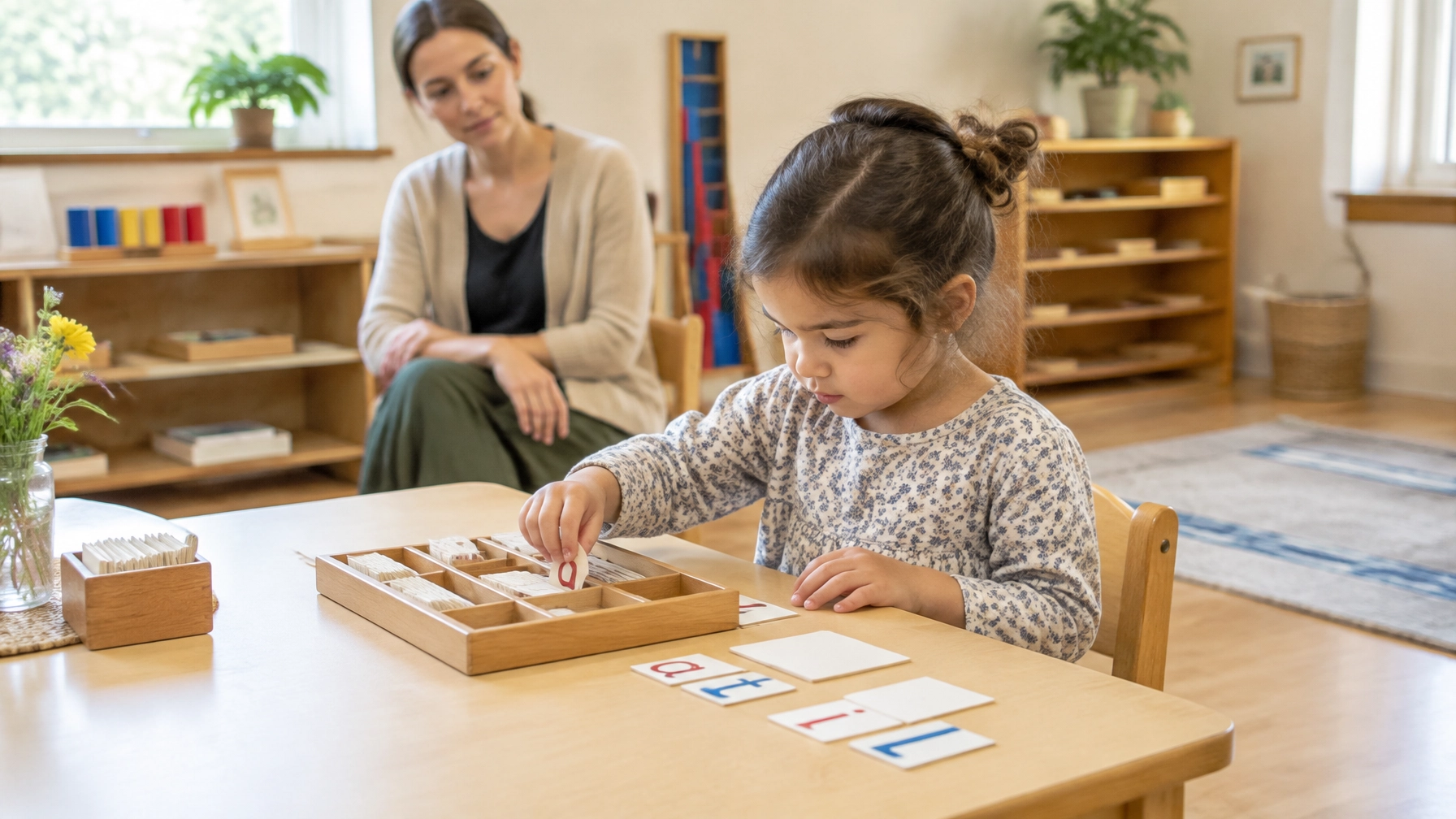
Montessori teachers watch for these moments and guard them fiercely, because they know how rare and how valuable they are. A long uninterrupted work period gives children the chance to begin, struggle, repeat, correct, and finish without being hurried along by an adult-designed schedule.

Caption: Concentration grows when children can repeat purposeful language work without unnecessary interruption.
In early childhood, this may be a child tracing a sandpaper letter, matching objects by sound, preparing a snack, or carefully carrying water from one place to another. In elementary school, it may be a mathematics investigation, a geography study, or a research project that unfolds over several days.
At the adolescent level, sustained concentration may involve planning a small enterprise, studying an ecological question, preparing a presentation, or working with others to meet a genuine community need. Adolescents need uninterrupted time, too: not merely to complete assignments, but to experience themselves as capable contributors.
Why Does the Teacher Not Just Praise the Child?
Picture a child who has struggled for ten minutes to get something right. Finally, it works. The child sits back and looks at it quietly.
An eager adult might rush over: “Fantastic! You are so smart! Great job!” It comes from love. But think about what it quietly teaches. Whose judgment just became the important one? Not the child’s. The adult’s.
If a child learns to look up after every success to check whether the adult approved, satisfaction becomes something that has to be granted from outside, rather than something the child can generate for themselves.
This is why Montessori teachers tend to use more restrained responses. The goal is for the child to walk away thinking, I did it, not The adult says I did it well. Those are two very different sentences, and they build two very different relationships to effort.
None of this means Montessori teachers are cold or withhold encouragement. They do not. But there is a real difference between sharing in a child’s satisfaction and becoming the reason the child did the work in the first place.
Montessori educators observe closely. They notice whether a child is ready for a new lesson, whether the work is too easy or too difficult, and whether an interruption would help or simply break the child’s train of thought. The adult’s restraint is not passivity. It is informed attention.
Try It at Home
When your child is deeply engaged in something, experiment with saying nothing at all. Just watch.
If your child brings you the finished result, resist the automatic “Good job!” and try describing what you actually noticed instead.
“You worked on that for a long time.”
“You kept trying even when it got hard.”
“You used a lot of different colors there.”
“You figured out how those pieces fit together.”
Or simply: “You did it.”
Often the child’s own smile tells you that nothing more needs to be said.
At home, we can also prepare for concentration by making a few purposeful activities accessible and orderly. A child might have a small basket with drawing materials, a place for building, or a low shelf with carefully selected books and practical-life activities. We do not need to recreate a Montessori classroom. We can ask what kind of environment makes it easier for our child to start something independently and stick with it.

Caption: Hands-on mathematics can hold a child’s attention while connecting concrete experience with abstract understanding.
Boredom Is Not Always an Emergency
Protecting concentration also means resisting the modern urge to entertain children continuously. Children today grow up inside a world engineered for nonstop stimulation. Screens change every few seconds. Toys light up and chirp. Adults fill every open hour with an activity. The moment nothing is happening, someone usually steps in to fix that.
But real creativity and concentration often grow out of exactly the space that opens up after “I am bored.” A child wanders. Looks around. Tries something. Gives up on it. Tries something else. Eventually lands on something worth doing, something nobody assigned.
That search matters. It is how children learn to generate their own ideas instead of waiting for the next one to be handed to them.
If we rush to fill every quiet moment, we are not sparing children discomfort so much as taking away their chance to discover what can hold their own attention. A little boredom at home is not a gap in parenting. It is often the on-ramp to the next thing your child gets absorbed in.
This does not mean that every child should be left alone with unlimited free time or expected to invent meaningful activity without support. We still establish reasonable limits around screens, sleep, safety, and family responsibilities. We offer suggestions when a child is genuinely stuck. We introduce children to books, tools, materials, nature, music, and practical work.
Then we step back.
Concentration Changes the Child
Montessori noticed something remarkable in her observations: after a period of deep, freely chosen concentration, children often seemed calmer, more satisfied, and more connected to the people around them. The activity had not merely kept them busy. Something had happened inside them.
This is why Montessori educators take concentration so seriously. When you see a child quietly absorbed in meaningful work, whether it is numbers, letters, pouring water, drawing, studying a map, or tending a garden, you may be watching something much bigger than that particular skill. You may be watching a child learn to direct their own mind.

Caption: Concentration can be both independent and collaborative as children pursue questions about the wider world.
As children grow, this capacity supports more than academic achievement. It helps them listen carefully, manage frustration, make thoughtful decisions, and contribute to a group. An elementary child who can concentrate on a question about geography or human history is building habits that will support increasingly complex work. An adolescent who can sustain attention through research, planning, and collaboration is preparing to participate responsibly in the wider community.
The developmental path is gradual. An infant’s quiet engagement, a young child’s repeated practical work, an elementary student’s intellectual exploration, and an adolescent’s purposeful study are not isolated accomplishments. They are connected expressions of a growing human capacity.
That Is Worth Protecting
The next time you see your child completely absorbed in something, pause before speaking.
Ask yourself: does my child need help, or does my child need time?
Sometimes safety requires us to intervene. Sometimes a child truly needs a lesson, a boundary, or a hand nearby. But when the child is working safely and meaningfully, silence may be the most respectful response we can offer.
We can watch. We can protect the space. We can allow the work to unfold.
And when the child finally looks up, we can be there to share the satisfaction : without taking it away.
To learn more about observing children and preparing environments that support independence and concentration, explore the Montessori Foundation’s observation checklist and the Montessori Family Alliance. Their guidance can help us notice not only what children are doing, but who they are becoming through the work.
That is the deeper gift of concentration.
A child is not merely learning to finish a task. The child is discovering, through repeated, meaningful experience: “I can direct my attention. I can stay with difficulty. I can learn something I do not yet understand.”
That is worth protecting.