Related Posts
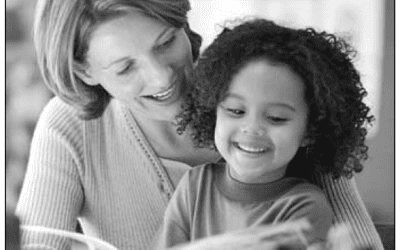
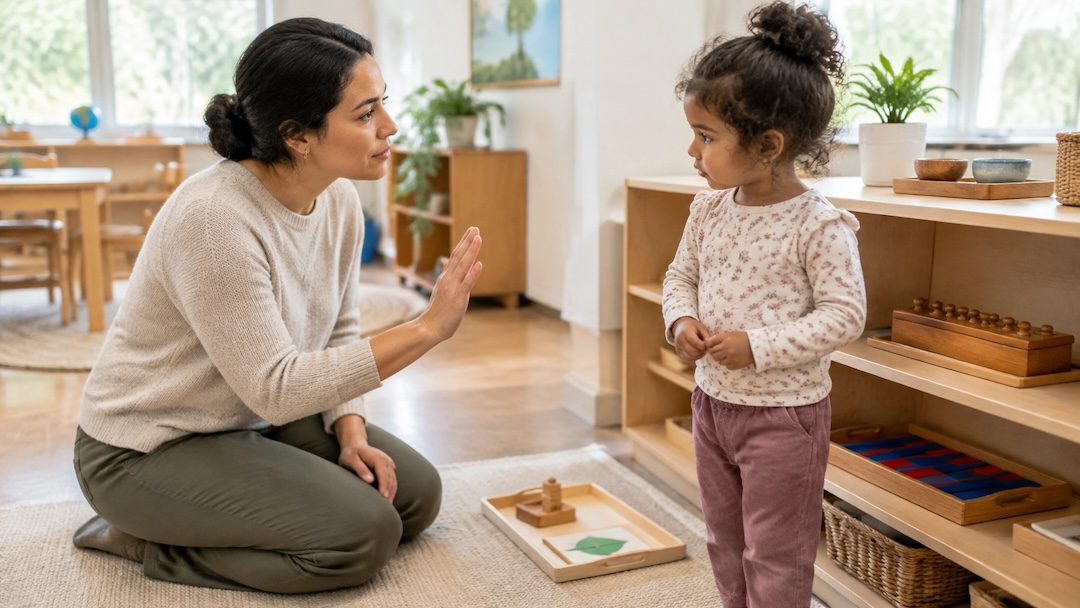
A Montessori guide calmly sets a clear limit while preserving the child’s dignity and freedom to choose purposeful work.
Montessori classrooms give children a remarkable amount of freedom. Children move around the room. They choose their own work. They decide where to sit. They may work alone or team up with a friend. Nobody is sitting in a chair waiting for an adult to announce what happens next.
For a parent walking in for the first time, this raises an obvious question: who’s actually in charge here?
The answer is straightforward. The adults are. What’s different is how a good Montessori adult uses that authority, in a way that looks nothing like either the strict, do-it-because-I-said-so classroom or the anything-goes free-for-all some people picture when they hear the word “freedom.”
Freedom Is Not the Absence of Limits
A child is free to choose meaningful work. A child is not free to throw it across the room.
A child is free to move around the classroom. A child is not free to run through the middle of someone else’s careful work.
A child is free to talk with friends. A child is not free to constantly break other people’s concentration.
A child is allowed to feel furious. A child is not allowed to hurt someone because of it.
This is what Montessorians mean by freedom within limits, and it’s worth sitting with that phrase, because the two halves aren’t in tension. The limits are what make the freedom real in the first place.
The limits look different at different ages. An infant needs an adult to provide almost all of the external structure. A young child gradually practises choosing, moving carefully, waiting, and restoring order. An elementary student takes on responsibility for work and community. An adolescent must learn to exercise judgment, accept accountability, and participate in governing the life of the group.
The adult remains responsible throughout. What changes is how much of that responsibility the child can gradually carry.
Limits Are What Make Freedom Possible
Picture roads with no agreed-upon rules. No one stops at red lights. Everyone picks whichever side of the road looks convenient in the moment. That isn’t freedom. It’s a pile-up waiting to happen. The rules of the road are exactly what let you drive anywhere you want, at whatever speed feels comfortable, without constantly bracing for a collision.
Children need the identical thing on a smaller scale. A boundary they can count on isn’t a cage. It’s the thing that lets them relax enough to actually explore everything inside it.
For infants and toddlers, that boundary begins with the prepared environment. The adult arranges a safe, orderly space where the child can move, reach, explore, and practise emerging independence without being asked to manage dangers they cannot yet understand. A low shelf, a stable place to sit, a predictable routine, and a small number of appropriate choices give the child real freedom without pretending that a very young child can regulate everything alone.
At this stage, adults provide substantial regulation. We stop the hand reaching toward danger. We prevent one child from hurting another. We hold a tired toddler close when the child cannot yet recover from strong emotion independently. This is not a failure of freedom. It is the secure external structure from which self-regulation eventually grows.

A child repairs a small spill through a direct consequence, with an adult available nearby but not hovering.
Calm Does Not Mean Weak
Montessori discipline gets misread sometimes because the adults tend to speak quietly and skip public punishment entirely, no scolding in front of the class, no raised voice, no theater. That quiet can look, to an outside observer, like there’s no discipline happening at all. In fact, respectful discipline can be extremely firm. It just doesn’t need volume to back it up.
A Montessori teacher might say: “I won’t let you hit.” “The material needs to be used carefully.” “You’re welcome to talk with your friend outside. People in here are concentrating.” “You’re having a hard time managing your body right now. Stay near me for a bit.”
None of that requires anger. The limit doesn’t get louder to be enforced. It’s simply the limit, stated plainly, and held.
With young children, adults also give concrete lessons in grace and courtesy. We show how to interrupt without grabbing, how to carry a chair, how to wait for a turn, how to offer help, and how to repair a relationship after conflict. The child is not expected to know these things automatically. We teach them, practise them, and repeat them with patience.
By the elementary years, children can participate more actively in shaping the life of the classroom. They may help plan projects, care for plants or animals, manage shared materials, and consider how their decisions affect the group. Their freedom expands because their responsibility expands with it.
What About Consequences?
Montessori generally favors consequences that connect directly to what happened, rather than ones that are just handed down as punishment. Spill something, and you help clean it up. Misuse a material, and it may need to go back on the shelf for now. Hurt someone, and that needs to be addressed directly with the person you hurt. If a child clearly isn’t ready to manage a particular freedom responsibly yet, an adult may step in with more structure for a while, not as a penalty, but as scaffolding until the child is ready to try again.
The goal was never to make a child suffer enough that the lesson sticks through discomfort alone. The goal is self-control, built through direct, logical experience of cause and effect.
This applies at home as well. We can invite a toddler to help wipe up spilled water. We can help a young child restore a work area. We can guide siblings through repairing the impact of hurtful behavior instead of simply declaring one child “bad.” Observation-based language helps us stay focused on what happened and what needs to happen next: “The blocks were thrown. They need to be put back before we choose another activity.”

Children choose purposeful work, move respectfully, and collaborate within the clear limits of a prepared environment.
The Long-Term Goal Is Self-Discipline
Very young children rely heavily on an adult for regulation. They need someone else’s calm, external structure because they haven’t built their own yet. Gradually, that changes. The adult who once had to repeat “Walk,” “Wait,” “Put that away,” and “Please don’t interrupt” all day finds they need to say it less and less. The expectations move inside the child.
That’s discipline in the fullest Montessori sense of the word, and it’s a genuinely different thing from mere compliance. It isn’t “I behave because someone’s watching.” It’s “I understand how what I do affects the people around me, and I can manage myself accordingly.” One of those requires constant supervision to hold up. The other one doesn’t.
In the elementary years, self-discipline becomes responsibility. Children are no longer concerned only with controlling their own bodies and handling materials carefully. They are learning whether others can depend on them. Can they complete a shared task? Can they keep a commitment? Can they listen to another person’s ideas, resolve a disagreement, and contribute to a community that is larger than themselves?

Elementary students practise responsibility by planning, organizing materials, and contributing to a shared community project.
The adolescent years bring another important shift. In Montessori adolescent programs, freedom is connected to contribution and self-government. Older students may take part in meaningful work, community projects, service activities, school enterprises, and decisions that affect the group. Adults remain present as mentors and guides, but adolescents need opportunities to make genuine choices, experience genuine consequences, and reflect on the effects of their decisions.
What makes this different from simply letting teenagers do whatever they want? The answer is accountability. Mature freedom asks a young person to consider other people, follow through on commitments, repair harm, and help create the conditions in which everyone can work and live with dignity.

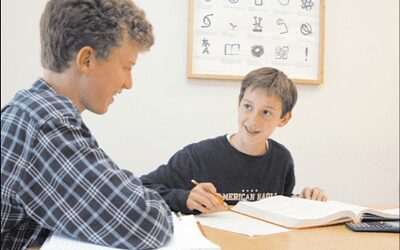
Adolescents exercise judgment and accountability as they plan meaningful work with guidance from a mentor.
The Same Principle Works at Home
Parents don’t have to put every single limit up for negotiation. Bedtime can simply be bedtime. Seat belts aren’t a topic for debate. We don’t hurt people, full stop. But inside those non-negotiable boundaries, there’s real room for a child to exercise genuine choice.
“You need to get dressed. Do you want to pick your clothes, or should I?”
“Teeth need to get brushed. Before your story or after?”
“You’re angry at your brother right now. I’m not going to let you hit him.”
As children mature, the choices can become more substantial. A preschool child might choose between two shirts. An elementary child might help decide when to complete a project and how to organize the necessary materials. An adolescent might take responsibility for part of a family meal, plan a journey, manage an agreed budget, or help review a family agreement.
The boundary remains clear, but the child’s participation grows.
Kindness and firmness aren’t opposites, whatever the parenting debates online might suggest. Children need both at once, held by the same person, often in the same sentence.
If you are considering a Montessori school, observe carefully. The Montessori observation checklist can help you look beyond whether a classroom appears quiet or busy. Notice how adults respond when a child struggles. Are limits clear? Are children treated with dignity? Do they have meaningful freedom, or are they simply being left without guidance? You can also explore the Montessori curriculum scope and sequence to see how independence and responsibility develop over time.
Montessori doesn’t ask a parent or teacher to give up authority. It asks us to use that authority with a specific long-term aim in mind: that bit by bit, the child in front of us learns to govern themselves, so that eventually, our voice isn’t the thing holding the limit in place. Theirs is.
For more guidance on bringing Montessori principles into family life, visit the Montessori Family Alliance. To learn more about finding and evaluating a Montessori school, visit the Montessori school directory and explore the questions that matter most to your family.