Related Posts
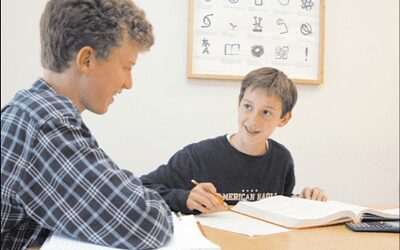
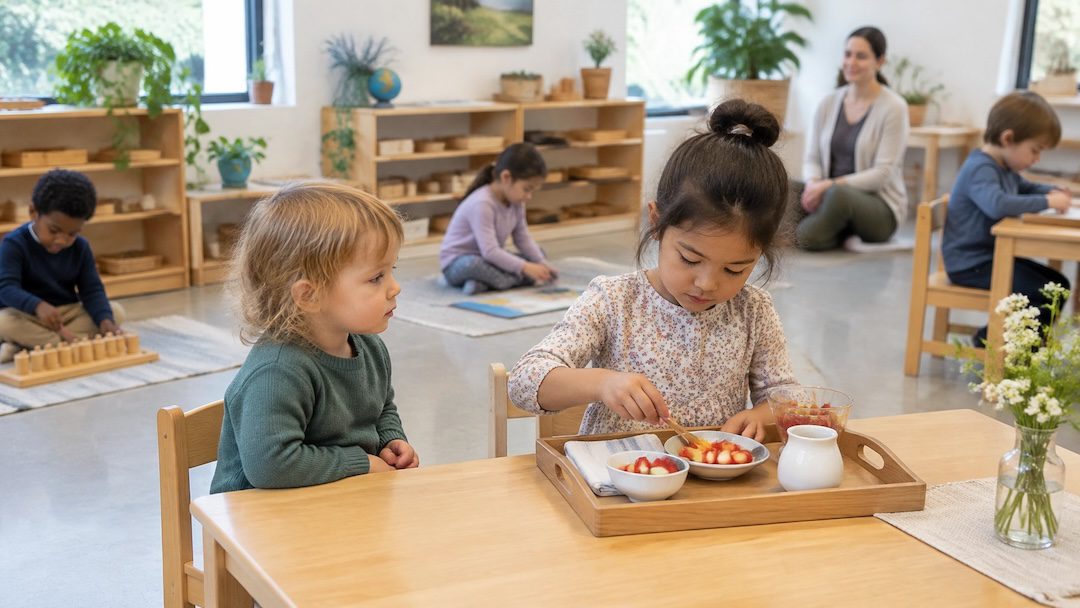
A younger child observes an older classmate working independently in a calm, mixed-age Montessori prepared environment.
The first time parents encounter a Montessori mixed-age classroom, it can raise real questions. Wouldn’t a three-year-old be better off with a room full of other three-year-olds? Won’t the older kids get held back waiting for everyone else to catch up? How does one teacher possibly meet the needs of children spread across such different developmental stages at once?
Fair questions. But the mixed-age classroom isn’t a scheduling shortcut or a budget-driven compromise. It’s one of the deliberate, load-bearing pieces of Montessori education, not an accident of how the room happened to fill up.
Real Communities Have Always Been Mixed-Age
For most of human history, children simply grew up around people of every age. Families span decades. Neighborhoods span decades. A younger child watched an older one and tried to copy them. An older child looked out for a younger one without being told to. That’s just how human groups have organized themselves for most of history.
The modern habit of sorting children into rooms where everyone was born within roughly the same twelve months is a comparatively recent institutional invention, built for industrial-era efficiency, not for how children actually develop. Montessori classrooms deliberately step back from that arrangement and recreate something closer to a small, real community, one that spans several years on purpose.
In a typical Montessori Children’s House, children from approximately three to six share a prepared environment. They remain together for several years, while the adults observe each child closely and offer lessons, materials, and challenges that match the child’s developmental readiness.
That last point matters. Mixed ages do not mean identical expectations. The three-year-old is not expected to complete the work of a five-year-old, and the five-year-old is not asked to wait academically for the youngest children. Each child is viewed as a universe of one, participating in a larger community while progressing at an individual pace.
Younger Children Get to See Their Own Future
Picture being three years old and watching a five-year-old read fluently across the room. Or watching an older classmate carefully prepare a snack, work confidently with large numbers, write out a whole story, or solve a problem completely on their own.
No adult has to give a pep talk about what’s possible. The younger child just sees it happen, right there, done by someone not so different from them. The message lands on its own: children like me can do that. Older classmates make the next stage of growth visible and real, in a way no amount of adult explanation could match.
This is one reason Montessori places so much emphasis on observation. A child may watch another child carry a tray, unroll a work rug, pour water, return a material to the shelf, or ask politely to join a group. The younger child is absorbing far more than the isolated skill. They are seeing how a capable member of the community moves, concentrates, communicates, and contributes.

A younger child watches an older classmate work with care while other children pursue their own purposeful activities.
Older Children Discover They’re Capable of More Than They Knew
Fast-forward two years, and that same three-year-old is suddenly one of the experienced members of the room. A younger child comes up, unsure. “Where does this go?” “How do I carry this without spilling it?” “Can you show me how?”
Being the one who’s asked, rather than the one asking, changes something in how a child sees themselves. I know things. I can help someone else. I belong here, not just as a participant, but as someone others rely on. Leadership doesn’t need to be taught as a separate lesson. It grows naturally out of simply being needed.
This does not mean that older children become substitute teachers. A five-year-old is still a young child with their own need for concentration, challenge, play, rest, and adult guidance. In a healthy classroom, helping another child is one part of community life, not the older child’s full-time responsibility.
The opportunity is often small and ordinary. An older child may show a younger classmate where a work belongs, demonstrate how to carry a basket, or answer a simple question before returning to their own activity. The guide remains responsible for the classroom and for each child’s progress.
Teaching Someone Else Deepens Your Own Understanding
Anyone who has ever tried to explain an idea to someone else knows this firsthand: teaching exposes exactly how well you actually understand something. The gaps show up the moment you try to put it into words for someone who doesn’t already know it.
Montessori classrooms are full of small, informal chances for children to help and teach each other this way. This doesn’t replace the teacher’s role. It adds a whole layer of social and intellectual life to the room that a same-age classroom simply doesn’t generate in the same way.
A child who has worked repeatedly with a material may eventually be ready to show it to someone younger. In this sense, mastery is not merely demonstrated through a worksheet or an adult’s question. It can also be seen in the child’s ability to use the skill confidently, explain it clearly, and return to it with purpose.
The Montessori Foundation’s Curriculum Scope and Sequence reflects this broader view of development. Montessori does not introduce a concept once and then move on simply because a calendar says it is time. Children revisit skills over several years, deepening understanding as their abilities change.
What About the Older Child’s Own Progress?
A reasonable worry: will older children end up spending the whole day helping little ones instead of moving forward academically themselves? They shouldn’t, and in a well-run Montessori classroom, they don’t. The curriculum is carefully sequenced to keep challenging older children at their own level, work that has nothing to do with the younger children in the room. Helping and mentoring is something added on top of that, not a substitute for it.
And being one of the oldest, most experienced members of a small community offers something a same-age classroom can’t easily replicate: the direct, lived experience of becoming genuinely capable and looked-up-to, rather than just being the biggest kid in a room of equals.
The adults make this possible through careful observation and planning. They notice when a child is ready for a new lesson, when a familiar activity has become too easy, and when a child needs more time or a different kind of support. Freedom and choice exist within a carefully prepared environment, not outside of adult responsibility.
Parents can often see this balance during a classroom observation. One child may be working alone with a language activity. Another may be preparing food. Two children may be collaborating on a project. A guide may be giving a lesson to one child while keeping a watchful awareness of the entire room.
For questions about what to look for during a school visit, the Montessori Foundation’s Choosing a Montessori School resource can help families think about the fit between a particular school, its classroom practices, and their child’s needs.
Mixed Ages Make Differences Feel Ordinary, Not Alarming
A mixed-age room also quietly changes how children think about ability itself. The youngest child in the room never expects to be doing exactly what the oldest child is doing, so there’s no built-in comparison trap. Over several years in the same community, children watch classmates develop at wildly different rates in different areas, and it stops seeming strange.
One child is far ahead in math and still needs help making friends. Another reads beautifully and can’t keep track of their own belongings. Development starts to look like what it actually is: uneven and individual, not a race with a single finish line.
This can be especially valuable for families who are accustomed to age-based milestones being treated as fixed deadlines. Montessori guides still hold clear developmental and academic expectations, but they use observation to understand when and how a child is ready to move forward.
A mixed-age community also gives children repeated experience with difference. They learn that people do not all work at the same speed, communicate in the same way, or need the same kind of assistance. They practice patience and assertiveness. They learn to ask for help, offer help, wait, negotiate, and return to their own work.
Then the Cycle Starts Over
Eventually the oldest children in a class move on to the next level, and there they become the youngest again. They observe. They learn the ropes. They grow. And eventually, once again, they lead.
This rhythm continues through the Montessori journey. Infants and toddlers begin with environments carefully prepared for movement, exploration, language, attachment, and growing independence. In the three-to-six community, children build concentration, coordination, practical-life skills, language, mathematics, and social confidence within a stable family group.
In elementary, the mixed-age structure commonly continues through three-year groupings such as ages six to nine and nine to twelve. The questions become larger. Children collaborate on research, pursue interests, discuss ideas, plan projects, and develop responsibility for their classroom community. Younger elementary students observe what is possible, while older students deepen their understanding by coordinating, contributing, and working with others.

In elementary, mixed-age collaboration grows into shared research, discussion, and responsibility while children continue their own individual work.
In adolescence, the community expands again. Montessori adolescents are prepared not only to study, but to contribute. They may participate in practical work, community projects, enterprise, environmental stewardship, and shared decision-making. The older students’ role is no longer simply to be the most experienced children in the room. They are growing toward meaningful participation in the wider world.

Adolescent collaboration extends the Montessori tradition of responsibility, contribution, and purposeful work.
There’s something deeply, almost old-fashioned human about that rhythm. Montessori was never just about moving individual children efficiently through a curriculum. It’s about building a real community where children learn from the adults in the room, from the environment around them, and just as much from each other.
Some mornings, the most important thing a five-year-old learns comes straight from the teacher. Other mornings, the three-year-old’s most inspiring teacher is simply the five-year-old working quietly across the room, showing them, without a single word, what’s coming next.
For families who want to deepen their understanding of Montessori at home and strengthen their partnership with their child’s school, the Montessori Family Alliance offers parent education, observation guidance, and resources grounded in the work of The Montessori Foundation.
The mixed-age classroom is not asking your three-year-old to grow up too quickly. It is giving them a real community in which to grow : first as the youngest, then as an increasingly capable participant, and eventually as someone who has something meaningful to offer.