

The Absorbent Mind & Sensitive Periods
To continue reading, you will need to choose a subscription plan.

Finding Identity & Purpose in Montessori Middle & High Schools
To continue reading, you will need to choose a subscription plan.

What the Brain Reveals About Montessori
To continue reading, you will need to choose a subscription plan.

Why Child Care IS SO Expensive – and why it is worth the investment
Recently, we read an opinion piece by Jordan McGillis in The Washington Post (August 18, 2025), titled “Why child care costs so much — and how to fix it.” It raised important points about America’s rising child-care costs and prompted us to reflect on this issue from a Montessori perspective. Why All Child Care Is Expensive
High-quality care is costly everywhere because caring for babies, toddlers, and young children is labor-intensive. There are no shortcuts. Children need attentive adults who respond with warmth, patience, and skill. Economists call this the Baumol effect.
In most industries, technology boosts productivity—factories produce more with fewer workers. But child care is different. It still takes one set of loving arms to rock one baby. A teacher cannot safely guide 20 toddlers at once. The adult-to-child ratio must stay low, which keeps labor costs high.
Meanwhile, fewer Americans are entering Early Childhood education. The pay is modest compared with other professions, despite the extensive training, stamina, and emotional intelligence required. A shortage of qualified caregivers drives up wages further, adding pressure on program budgets.
The Hidden Overhead of Montessori and Other Private Schools
Most Montessori schools in the U.S. are private and tuition- driven. They face the same challenges as other childcare centers—plus additional costs unique to their model.
Teacher Education and Salaries
Montessori teachers complete specialized training that can take a year or more and often comes with significant tuition debt. Schools must offer competitive salaries to attract and retain top talent, especially since many public schools provide higher pay and benefits.
Classroom Materials
Montessori classrooms are filled with hands-on learning materials—Golden Beads for math, Sandpaper Letters for literacy, Puzzle Maps, timelines, and science tools. These are durable and beautiful, but also expensive. Equipping one classroom can cost between $20,000 and $40,000.
Facilities and Support Staff
Private schools carry mortgage or lease payments, insurance, utilities, and maintenance without government funding to offset costs. They also need administrators, assistants, and specialists to maintain operations. Payroll, benefits, and retirement contributions add up quickly.
Safety and Compliance
Meeting state licensing standards requires investments in security systems, playground equipment, fire alarms, and frequent inspections. In regions prone to hurricanes, wildfires, or earthquakes, insurance premiums can be staggering.
Where Tuition Goes: A Montessori Cost Breakdown
Every school is different, but surveys of Montessori and other independent schools show a fairly consistent breakdown of tuition spending:
• 65% to Staffing (teachers, assistants, administrators): The majority of tuition goes directly to salaries and benefits. Low student-to-teacher ratios, especially in infant and toddler programs, make staffing the most significant expense.
• 20% to Facilities (mortgage, rent, utilities, insurance, maintenance): Maintaining a safe, child-friendly environment comes with high ongoing costs.
• 5% to Educational Materials and Curriculum: Montessori materials are carefully crafted, long-lasting, and often imported.
• 5% to Professional Development: Training Montessori teachers is a continual investment through refresher courses, conferences, and coaching.
• 5% to Other (licensing fees, technology, supplies): From playground upkeep to accreditation to liability coverage, “hidden” expenses add up quickly.
Tuition isn’t padded with excess—it reflects the real costs of providing safe, nurturing, high-quality care.
The Limits of Subsidies
As McGillis noted, subsidies help families manage tuition but don’t reduce the actual cost of care; they shift the expense to taxpayers. Subsidy programs also come with strict regulations: mandated curricula, credential requirements, and extensive reporting. While these rules aim to ensure safety and accountability, they can inadvertently reduce schools’ flexibility.
For Montessori programs, heavy regulation can conflict with values, such as individualized learning, freedom within limits, and respect for each child’s natural development.
Ideas That Could Help
The Washington Post article offered several ideas worth considering:
• Expand visa programs. The U.S. could welcome more qualified caregivers from abroad, many of whom are eager to work with children. Montessori schools, in particular, can recruit teachers from Europe, Asia, and Latin America, where training programs are strong.
• Rethink credential barriers. While training is essential, rigid rules can deter passionate caregivers and drive up costs.
• Give families more choice. Not every family wants the same model of care. Greater flexibility, while maintaining safety, would allow Montessori and other approaches to flourish.
Why the Investment Pays Off
The high cost of childcare, particularly for Montessori programs, can be a significant financial burden. Yet these are the years when a child’s foundation for life is built. Neuroscientists confirm that 85 percent of brain growth occurs before age six. Focus, self-regulation, empathy, and problem-solving all emerge from early experiences. When children spend those years in nurturing, well-prepared environments, the long-term benefits ripple outward for decades.
Montessori offers settings where independence, concentration, and curiosity are cultivated daily. A three-year-old carefully pouring water or a five-year-old teaching a younger child how to trace a letter are building confidence, competence, and belonging.
The Bigger Picture
Yes, childcare is expensive. Yes, Montessori tuition can feel daunting. But these costs reflect what it truly takes to offer children high-quality early experiences: skilled teachers, rich materials, safe facilities, and environments designed for growth. For parents, tuition can be seen not only as a bill to be paid, but as an investment—an investment in a child’s lifelong love of learning, resilience, and emotional growth.
As McGillis and others suggest, the challenge lies in expanding the pool of caregivers and reducing barriers that keep good people out of the field. If society can do that, more families will have access to early education options— including Montessori—that honor children’s needs and prepare them for a future full of promise.
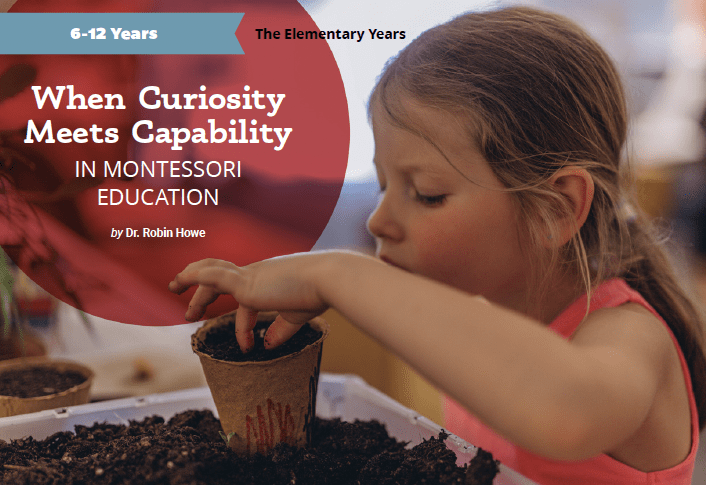
When Curiosity Meets Capability In montessori Education
A New Kind of Questioning
Children between the ages of six and twelve are in one of the most remarkable periods of development. It is during these years that their brains can imagine times, places, and people beyond their immediate experiences and the physical world. They arrive at school brimming with questions that stretch a brain that is hungry to imagine and understand. Why do leaves change color? How did the first language begin? Did humans create fire or discover it? What makes thunder? Who invented money? Their minds no longer settle for quick answers. They want to know how things connect, why events happen, and where humanity fits in the grand story of life.
This is what Maria Montessori referred to as the Second Plane of Development. It’s a time of enormous change. Children grow in confidence, abstract reasoning, and moral awareness. Their social lives expand, and their curiosity deepens. For Montessori educators, this is the moment when curiosity meets capability—and the Elementary program is uniquely designed to meet it.
The Psychology of the Elementary Child
Children in this stage are dramatically different from their younger peers. Their world expands from the self to the group, and there is a new hunger for shared experiences. They thrive in collaboration. You’ll often find them gathered around large tables, sprawled on the floor with maps, or debating over how to divide tasks for a project. Their friendships evolve in complexity, and they start to challenge the rules of fairness, justice, and loyalty. This is a period when their own personalities and group members begin to take shape. Moral reasoning starts to bloom. A child who once followed rules simply because “that’s what you do” now questions whether those rules are fair. They want to talk about justice and responsibility, weighing what’s right and wrong in ways that mirror adult conversations. At the same time, their ability to think abstractly begins to expand. While they still love to work with their hands, they are also eager to grasp big concepts, such as civilizations rising and falling, the laws of physics, and the evolution of life. They are drawn to heroes—both real and imagined— who embody courage, resilience, and human greatness.
Did you know?
Developmental psychologists note that, between ages 6 and 12, children experience what Jean Piaget called the “concrete operational stage.” They are increasingly able to reason logically, understand cause and effect, and imagine perspectives beyond their own. Montessori’s approach aligns beautifully with these cognitive leaps. Furthermore, other developmental psychologists, such as Erik Erikson, described these years as ones where students have the psychosocial task of developing industry through work, versus the sense of inferiority, leading to the lifelong “virtue” of competency that will lead them into the early stages of adolescence, young adulthood, and eventual full adulthood.
The Montessori Elementary Approach
To meet the needs of these growing minds, the Montessori Elementary curriculum provides a learning experience that is both structured and expansive. At its heart are the Five Great Lessons, sweeping stories that serve as a unifying framework for everything that follows.
• The Story of the Universe introduces the origins of stars, planets, and the conditions for life.
• The Coming of Life traces the evolutionary journey of living organisms across billions of years.
• The Arrival of Humans explores what makes our species unique—our ability to imagine, communicate, and create culture.
• The Story of Communication in Signs follows the birth of language and writing.
• The Story of Numbers reveals humanity’s inventive ways of measuring, recording, and understanding the world.
These stories don’t just deliver facts. They are intended to be impressionistic. They ignite wonder. They provide a framework for children to see how science, history, math, and language are interconnected. Instead of isolated subjects, children experience knowledge as a web—alive, connected, and ever-expanding. Perhaps more important than what is mentioned above is the sense of appreciation that these lessons are intended to instill.
The late Montessorian Dr. Michael Dorer, author of The Deep Well of Time, among other great Montessori books, often mentioned that the Great Lessons (in addition to providing a framework for the Elementary years) give context and relevance to the curriculum. This helps children develop a deep sense of appreciation for everything that came before them, affecting almost all aspects of our lives, including digital technology and electronics.
One Parent’s Story: Wonder in Action
Jacob, age seven, listened to the Story of the Universe and went home buzzing with questions. That weekend, he built a three-dimensional solar system out of clay, complete with asteroid belts and moons. His parents were astonished by how deeply he absorbed the story. “It wasn’t homework,” his father, Scott, said. “It was joy. He wanted to know everything.”
Beyond the Classroom Walls
Montessori Elementary education doesn’t stop at the school doors. Students design and implement “going out” experiences: student-led trips to libraries, museums, businesses, and nature preserves. Unlike traditional field trips, these outings begin with a child’s question: What was daily life like in Ancient Egypt? How does a printing press work? What kinds of birds live in our county? The children often play a significant role in planning their trip, helping to set an agenda, and learning to navigate real-world logistics, such as writing letters, making calls, managing money, and practicing courtesy with adults in the broader community. These experiences cultivate independence and give them a sense that the whole world is their classroom.
Going Out: The concept of “going out” originates from Maria Montessori, who believed that the prepared environment for older children extended beyond the classroom to encompass the entire community.
Supporting Abstract Thinking
As children grow, their thinking shifts toward more abstract concepts. Montessori materials evolve alongside them, offering bridges from hands-on experiences to symbolic reasoning. As students progress through Elementary and into Montessori Secondary programs, the prepared learning environment becomes less based on materials and physical learning “tools” and more about the prepared opportunity for learning through research, discussion, or experience.
The following materials and curricular areas illustrate how the Elementary Montessori curriculum supports students’ cognitive abilities and interests during this second plane.
The Timeline of Life stretches across the classroom floor, making billions of years of evolutionary history tangible.
Mathematical materials shift from beads and cubes to algebraic formulas, preparing children for higher-level reasoning and problem solving. In the Elementary Montessori curriculum, Dr. Montessori considered geometry and arithmetic as related but separate curricular areas, where students learn the characteristics of shapes and then add the ability to quantify value, such as area and volume, through their discovery of the relationship of quantity and size.
Language studies expand to etymology, grammar, and literature, helping children appreciate the richness of communication.
Cultural charts illuminate the rise of civilizations, trade, and human innovation.
A Montessori classroom at this level is alive with research. Children write reports, create models, stage debates, and prepare presentations for peers. Instead of memorizing information for tests, they engage with knowledge in ways that make it meaningful and lasting.
A Collaborative Environment
Elementary Montessori classrooms are designed to encourage collaborative learning. Elementary classrooms often have large tables that invite group work, while open floor space allows for projects that sprawl. Children divide tasks, solve disagreements, and learn to appreciate diverse perspectives. Peer teaching thrives. Older students guide younger ones, reinforcing their knowledge while modeling leadership. A 12-year-old explaining fractions to an 8-year-old doesn’t just strengthen math skills; it builds patience, empathy, and confidence.
One Parent’s Story: A Different Kind of Classroom
A mother visiting her daughter’s classroom was startled to see a group of nine-year-olds leading a lesson on the American Revolution. “I thought, where’s the teacher? Then I realized that the teacher was guiding from the side, and the students were taking ownership of the learning. It was inspiring.”
Academic Rigor with Meaning
Parents sometimes wonder whether Montessori Elementary prepares children academically. The answer is an emphatic yes. Mathematics progresses from concrete exploration to geometry, pre-algebra, and, in some cases, early calculus concepts. Language studies move from writing simple stories to analyzing grammar, writing essays, and engaging with literature. Science includes classification, chemistry, biology, and physics. History and geography encompass ancient civilizations, cultural development, and the interconnectedness of societies.
Unlike conventional schools, Montessori does not teach these subjects in isolation. They are always connected to a larger story and a greater purpose. This integration ensures that children understand not only what to learn but also why it matters and how it is relevant to their lives and their experience as human beings.
Did You Know? Studies comparing Montessori and conventional students have found that Montessori graduates demonstrate stronger critical thinking, greater creativity, and equal or higher achievement in math and literacy by adolescence (Lillard, A.S., et al., Frontiers in Psychology, 2017).
Outcomes that Last
The benefits of Montessori Elementary extend beyond test scores. Children leave these years with exceptional research and critical thinking skills, the ability to collaborate and lead, strong communication abilities, and the confidence to tackle new challenges. Most importantly, they come away with a genuine love of learning. Elementary Montessori education provides socioemotional opportunities for children to develop the skills they need as they progress to a new level of emotional awareness. As these students enter adolescence, a challenging period in most cases, Montessori Elementary environments aim to prepare them as effectively as possible to understand, accept, and self-regulate their emotions.
One Parent’s Story: Independence Blossoms
One of my parents described her son’s ‘shift’ during the Elementary years: “He started asking questions we couldn’t answer. Instead of waiting for us, he grabbed books, searched online, interviewed neighbors, and even wrote letters to a local historian. Montessori taught him that curiosity isn’t the end of learning—it’s the beginning.” Possibly more important than his desire to learn was his ability to take action on his own to address his own needs, a skill that is possibly more important than any academic accomplishment.
Supporting Your Child’s Montessori Journey
For parents, raising an Elementary-aged Montessori child means embracing their boundless curiosity and growing independence.
Engage with their questions. Instead of rushing to give answers, ask, “What do you think?” or, “Where could we look that up?”
Offering enriching experiences includes museum visits, nature hikes, and cultural festivals—all of which feed the classroom curriculum. Give space for independence.
Allow them to plan family projects, cook meals, or resolve conflicts with siblings.
Respect their social world. Friendships are central at this age, and learning to navigate them is an integral part of the developmental process.
Supporting your child doesn’t mean doing everything for them—it means giving them the room and resources to grow into capable, thoughtful young people.
The Elementary Years as a Foundation
The Elementary years are a time of profound intellectual and social growth.
With Montessori’s unique approach, curiosity and capability come together in powerful ways. Children emerge as independent thinkers, problem solvers, and lifelong learners. At the end of the Elementary years, Montessori children don’t just know facts and figures. They know how to think, collaborate, and maintain their curiosity. That’s a foundation not just for school but for life.
In closing, choosing to have your children continue in Montessori through the Elementary years is a great and BRAVE decision. Elementary Montessori education inspires and encourages questioning, challenging, and advocating. While some might consider these three characteristics as adversarial, many of us believe that these are what evolve into leadership, confidence, and support, possibly exactly what the world needs. It takes brave people to raise Montessori children!
Dr. Robin Howe began his Montessori education at the age of 2 at the Barrie School in Silver Spring, MD, where he attended through eighth grade. Graduating from Dickinson College with two majors (Spanish and Religion), he went on to earn a Master’s Degree in Bioethics from the University of South Florida. After a successful career in restaurant management, Robin decided to return to his Montessori roots. He earned his Primary certification from Palm Harbor Montessori School (AMS) and then attended St. Catherine’s University to earn his Lower and Upper Elementary Certification (AMS). He also participated NAMTA’s Orientation to Adolescent Studies (AMI). Robin holds a Doctorate in Educational Leadership from Argosy University and serves as a Senior Montessori School Consultant at The Montessori Foundation.

Tomorrow’s Child – December 2025 Digital Issue
Tomorrow’s Child | Welcome | November – December 2025
Tomorrow’s Child – September 2025 Digital Issue

The Role of Wonder: Keeping the Flame Alive
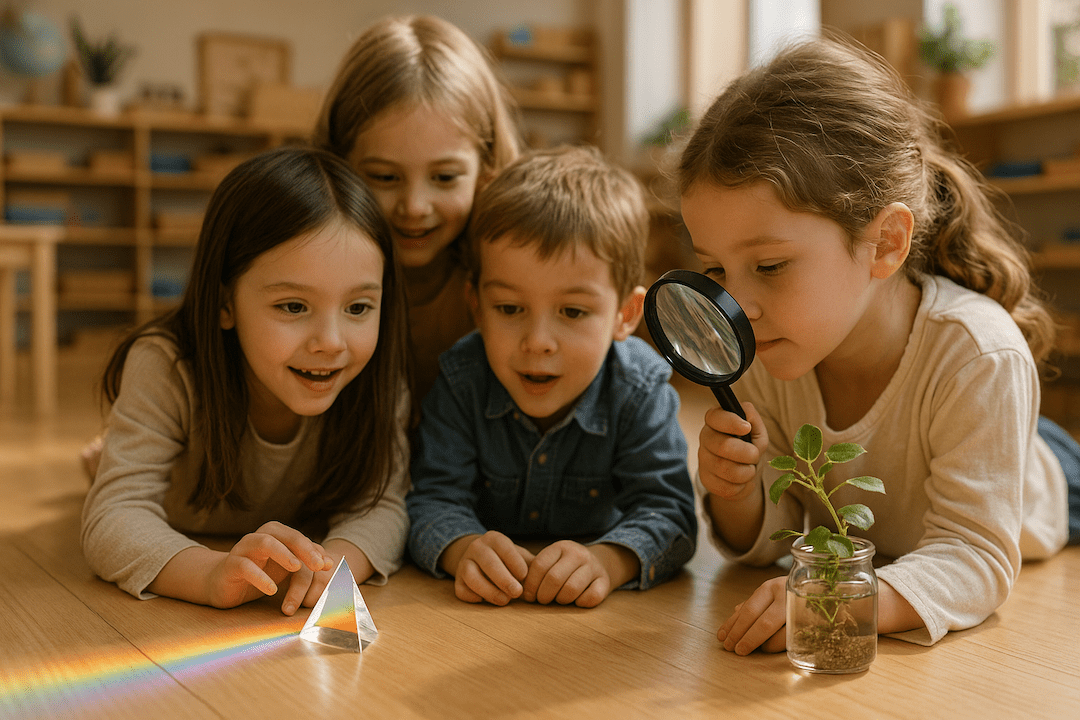
If there is one quality that defines the spirit of Montessori education, it is wonder — that deep, joyful curiosity that makes learning feel alive. Long before a child can read or write, before they know the names of the continents or the rules of grammar, they are born with a natural desire to explore. They reach for the world with all their senses, asking silently, “What is this?” How does it work? What happens if I try? That is where true education begins — not in lessons or tests, but in the awakening of wonder.
In many ways, it is through these simple, sensory experiences that children start to make sense of the world around them. By allowing them to explore without constant direction, even mundane experiences can become opportunities for discovery. Activities that promote this type of hands-on, self-directed learning can be important tools for keeping this type of natural curiosity alive, especially when they promote engagement with the world at large and not just simply passive input
Maria Montessori often wrote that “the child is both a hope and a promise for mankind.” She believed that wonder — the capacity to see the extraordinary in the ordinary — is not a passing stage of childhood, but a sacred force that renews human life. It is what fuels creativity, discovery, and moral awareness. The tragedy is that modern education, in its well-meaning quest for measurable results, often drains that energy away. When schools become dominated by testing, schedules, and scripted curricula, children learn to perform rather than to inquire. They begin to believe that learning is something done to them instead of something they do.
The challenge for educators today is how to protect that spark — not just in the children, but in ourselves. Wonder thrives in an atmosphere of calm and curiosity. It cannot be rushed. Montessori classrooms are designed to make space for this: long, uninterrupted work cycles; materials that invite exploration; and guides who step back rather than constantly direct. When children are free to follow their questions, they find joy in discovery. They learn to concentrate deeply, and from that concentration grows confidence, imagination, and awe.
The teacher’s task is to prepare an environment that whispers, Come and see. A shell on a tray, a prism scattering light, a map that unfolds into stories of people and places — these are invitations to wonder. The teacher introduces lessons with just enough information to spark curiosity, then steps back, leaving space for the child to investigate further. That moment of quiet engagement — the look of fascination on a child’s face — is more valuable than any test score. It means the mind is awake.
I remember one six-year-old girl who spent nearly an hour one morning with a small glass vase, a flower, and three jars of colored water. She had been shown how water moves through a stem — capillary action — and wanted to test it for herself. Every few minutes, she leaned close, whispering to a friend, “Look, it’s turning blue!” When the petals finally showed the faintest tint of color, her joy was pure discovery — not because someone told her what would happen, but because she saw it unfold with her own eyes.
In another classroom, a group of upper elementary students had been studying astronomy. One evening, their teacher invited families to gather in a nearby field to look through a telescope. The children were bundled in blankets, their breath visible in the cool air. When the first child peered through the lens and saw the rings of Saturn, he stepped back, speechless. “It’s real,” he finally whispered. That small moment — the collision of science and awe — was more powerful than any lecture on the solar system. It was learning as wonder.
But protecting wonder also means protecting teachers. In a profession increasingly burdened by paperwork, data tracking, and performance metrics, adults, too, can lose their sense of joy. A teacher who has no time to breathe cannot model curiosity. That is why Montessori emphasized the prepared adult as much as the prepared environment. Teachers must nurture their own spirits through reflection, connection, and continued learning. Reading great literature, spending time in nature, engaging in art, travel, and community — these are not luxuries; they are fuel for the inner life of an educator. We cannot kindle wonder in others unless we keep the flame alive in ourselves.
There is also an important balance to strike. Montessori education values precision, accuracy, and mastery — but never at the expense of curiosity. The materials are scientifically designed to guide children from concrete experience to abstraction, while also inviting imagination. When a child traces the map of Africa or constructs a bead chain that represents a thousand, they are not just learning geography or math — they are experiencing scale, pattern, and mystery. In this way, Montessori blends intellect and emotion, reason and reverence.
In an age where technology can answer any question instantly, it is easy to mistake access to information for understanding. Our goal should be not to fill children’s heads with facts, but to help them fall in love with asking questions. Wonder is what keeps learning alive long after the test is over. When we protect that, we give children not only knowledge but also wisdom — the ability to see the world with open eyes and an open heart.
One of the most powerful ways to restore wonder is simply to slow down. Let children watch a caterpillar metamorphose, listen to the rhythm of the rain, or take apart a broken clock to see how it works. These experiences do more to form the mind and spirit than hours of instruction. They teach patience, observation, and appreciation — qualities that no standardized test can measure, but which define a thoughtful, creative human being.
For educators, reclaiming wonder also means returning to why we entered this work in the first place. Every teacher remembers that moment when a child’s eyes lit up with understanding — when something invisible became visible. That moment is what keeps us going. It is why we endure long hours and limited resources. The joy of teaching is the joy of witnessing transformation.
In the end, wonder is not something we teach; it is something we protect. It is fragile, like a small flame that can be easily extinguished by hurry, fear, or cynicism. But when we surround it with patience, beauty, and love, it grows stronger — and it lights the way forward.
If we want children to grow into curious, compassionate adults who can imagine a better world, we must give them time to wonder. And if we want to remain the kind of teachers who inspire them, we must keep wondering, too.

Featured
-
 Montessori Family Alliance School Group Membership (Print & Digital 2026 1/2 year pricing)
Original price was: $30.00.$15.00Current price is: $15.00.
Montessori Family Alliance School Group Membership (Print & Digital 2026 1/2 year pricing)
Original price was: $30.00.$15.00Current price is: $15.00.
-
The Montessori Way, Revised and Expanded: An Education for Life; A Comprehensive Guide for Parents and Teachers
$25.00
-
The Montessori Child: A Parent's Guide to Raising Capable Children with Creative Minds and Compassionate Hearts (The Parents' Guide to Montessori)
$20.00
-
The Montessori Toddler: A Parent's Guide to Raising a Curious and Responsible Human Being (The Parents' Guide to Montessori)
$20.00
-
Montessori in Action: Building Resilient Montessori Schools 1st Edition
$29.95