Related Posts
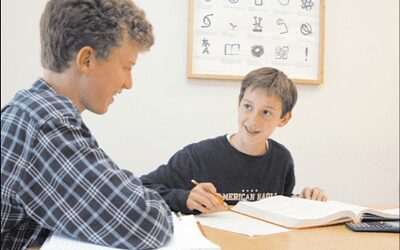
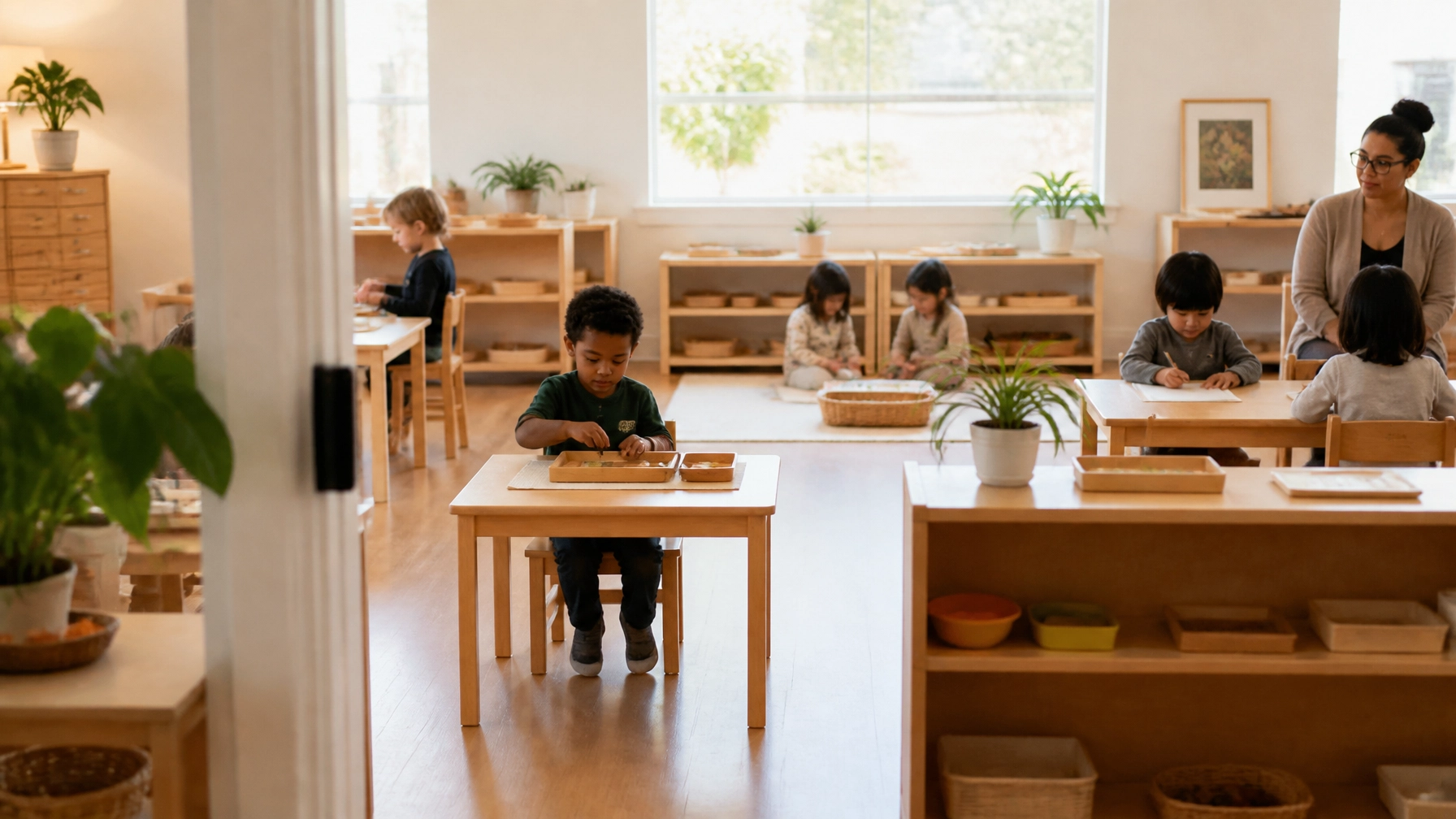
Walk into a well-established Montessori classroom during the morning work period and you may be struck by how it looks.

An established Montessori classroom may look simple at first glance, while purposeful activity unfolds throughout the prepared environment.
One child is arranging objects on a rug. Another is writing. A small group is working with a teacher. Someone is washing a table. Two children are discussing something quietly. Another child is sitting alone, completely absorbed in a piece of work.
It may look peaceful and surprisingly simple.
But much of the most important work taking place in that room is invisible.
You See a Child Pouring Water
You may see a young child slowly pouring water from one pitcher into another.

A carefully controlled pouring activity engages coordination, concentration, sequencing, and attention to detail.
What you don’t necessarily see is the enormous amount of coordination involved. The child must control the hand and wrist, judge distance, monitor the water level, stop at the appropriate moment, notice a spill, and remember what to do next.
The child is also practicing something increasingly important in modern discussions of child development: executive function. Plan. Remember the sequence. Control an impulse. Monitor what is happening. Correct a mistake. Complete the task.
You See a Child Repeating the Same Activity
Why is she doing it again? She already knows how.

Through repetition, a child refines movement and sustains attention because the work itself is meaningful.
Adults tend to value completion. Children often need repetition. Through repetition, movement becomes coordinated, understanding becomes secure, and concentration becomes deeper.
A child who chooses to repeat meaningful work is also beginning to experience something extraordinarily important: the ability to sustain attention because the activity itself is satisfying.
You See a Teacher Who Isn’t Constantly Teaching
This can initially puzzle parents. Shouldn’t the teacher be in front of the room? Shouldn’t she be talking more?

The Montessori teacher observes carefully, offering lessons and support while protecting children’s concentration.
Montessori teachers certainly give lessons, but they also spend a great deal of time observing. They are watching who is concentrating, who needs a new challenge, who is avoiding something, who needs help socially, who is ready for the next lesson, and who needs to be left completely alone because something important is happening.
A Montessori teacher learns that intervention is not automatically helpful. Sometimes the most skillful teaching is knowing when not to interrupt.
You See Children Making Choices
What you may not see is the development of judgment. What should I do? Where should I work? What materials will I need? Can I work with a friend and still concentrate? Am I finished? What do I do next?

Accessible shelves and orderly work spaces help children practice choice, planning, and responsibility.
Making appropriate choices is a skill. It develops through practice. The goal isn’t simply to give children choices. It is to help them gradually become people capable of making good ones.
You See Someone Cleaning Up a Spill
Perhaps nobody rushes over to rescue the child. That’s intentional.

When a cloth is accessible, a small spill becomes an opportunity for the child to respond independently.
The cloth is accessible. The child knows where it belongs and what to do with it. A small accident becomes a small problem to solve.
Repeated experiences like these gradually shape a child’s response to difficulty: something went wrong, and I can do something about it. That is a very different internal message from: something went wrong, and I need an adult to fix it.
You See Children Living Together
A Montessori classroom is a social environment. Children wait, negotiate, watch one another, ask for help, offer help, occasionally become annoyed with each other, make mistakes, resolve disagreements, and learn when they may join an activity and when another person’s concentration needs to be respected.

Grace and Courtesy comes alive as children learn to share space, offer help, and protect one another’s concentration.
This is where Grace and Courtesy becomes real. Social development isn’t confined to a lesson about being kind. It happens all day long as children learn how to live as members of a community.
You See Independence Developing
Independence is one of the most visible characteristics of Montessori education, but its deeper significance is easily missed.

Ordinary moments of carrying, choosing, returning, and organizing gradually build functional independence.
A child gets out materials without asking an adult, finds a missing pencil, puts work away, gets a drink, chooses another activity, asks a classmate a question, realizes something is difficult and tries again. None of these moments seems particularly dramatic. But collectively they change the child’s relationship with the world.
The question gradually shifts from who will do this for me, to how can I do this.

Persistence develops as children experience difficulty, make adjustments, and discover that they can continue.
The Child Is Constructing Himself or Herself
Maria Montessori described childhood as a process of self-construction. Children are not simply accumulating information. Through their experiences, they are gradually developing the capacities and characteristics that will become part of who they are: concentration, self-control, persistence, coordination, judgment, confidence, empathy, independence, and the ability to live and work with other people.

Within the Montessori community, the child gradually develops concentration, confidence, persistence, and belonging.
These qualities don’t appear because an adult gives a lesson called “how to become independent.” They develop through thousands of ordinary experiences.

The visible calm of a Montessori classroom rests on countless opportunities for purposeful movement, responsibility, and connection.
That is why a Montessori classroom can be difficult to understand from a quick tour or photograph. We naturally notice the beautiful materials. We notice children working independently. We notice the relative calm.
But the most important curriculum may be the part we cannot see. Beneath all that ordinary activity, the child is gradually constructing the person they will become.