Related Posts
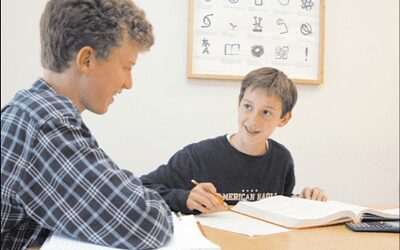


A mixed-age Montessori classroom allows children to follow individual paths through a carefully prepared environment.
Visit a conventional classroom and you’ll likely see most children working on the same subject at roughly the same time. Visit a Montessori classroom and the picture looks very different. One child is working with multiplication. Another is reading. Someone is painting. A small group is studying geography. Another child is washing a table. Two children are working with language materials.
It raises an understandable question: how can the teacher possibly teach everyone if everyone is doing something different? The answer gets to the heart of Montessori education.
Children don’t develop on an assembly line
Two children of the same age can be remarkably different. One may be reading fluently while another is just becoming fascinated by sounds and letters. One may grasp mathematical relationships almost instantly; another may need to handle concrete materials repeatedly before the idea becomes secure. Traditional age-based instruction asks, “What should a six-year-old be doing?” Montessori teachers ask instead, “What is this particular six-year-old ready to learn next?”
Dr. Maria Montessori understood that children do not unfold according to a single timetable. Development has patterns, but each child moves through those patterns with an individual rhythm. One child may be ready for a new challenge while another needs more time to consolidate an earlier discovery.
This is one reason Montessori education places such value on observation. The guide watches not only what a child can do, but also how the child approaches work, where concentration deepens, which movements are becoming coordinated, and which ideas are beginning to connect. That observation helps the guide decide what to offer next.
For families, this can be reassuring. A child does not need to be compared with every other child of the same age to know whether meaningful learning is taking place. The more useful question is whether the child is becoming increasingly capable, engaged, independent, and confident.
Lessons are often given to individuals or small groups
Montessori teachers do teach : quite a lot. But many lessons go to one child or a small group rather than the whole class, which lets the teacher tailor the lesson to readiness. A child who understands quickly can move forward. A child who needs repetition gets it, and can revisit the same lesson tomorrow or next week. The result is a classroom that looks less synchronized but is often far more individually responsive.

A Montessori guide gives a child a focused lesson while the rest of the classroom continues its work.
The teacher may introduce a mathematical concept to one child, offer a language presentation to another, and gather a small group for a geography lesson. These lessons are not random or improvised. They are part of a carefully sequenced curriculum, presented when the guide believes a particular child or group is ready.
The classroom may appear quiet and varied, but there is considerable planning behind it. Montessori guides keep records, observe patterns, follow each child’s progress, and prepare the environment so that children can continue working after a lesson has ended. The teacher’s attention moves purposefully through the room.
This differs from a classroom in which one explanation must serve every child at precisely the same moment. Individual lessons make it possible to respond to differences without labeling one child as ahead and another as behind.
Mixed ages make this more visible
Montessori classrooms typically span several ages, deliberately. The younger child sees where the work eventually leads. The older child develops confidence and leadership. Children encounter a broader range of ability without being ranked against everyone born within the same twelve months. In a three-to-six classroom, it’s normal : even expected : for children to be doing very different things.
A three-year-old may watch an older child read, calculate, or care for the classroom community. The younger child does not need to master that work immediately. Simply seeing what is possible can create interest and orientation. Over time, the child begins to recognize the sequence of activities and imagine taking the next step.
Older children benefit as well. They become more experienced members of the community, and they may help younger classmates in respectful, authentic ways. Explaining an idea or demonstrating a process often strengthens the older child’s own understanding. Leadership grows through responsibility, not merely through being told to lead.

In a mixed-age Montessori environment, older children may support younger classmates while deepening their own understanding.
Mixed-age grouping also changes the social atmosphere. Children are not constantly measuring themselves against a narrow band of peers who are all expected to complete the same work at the same time. Instead, they belong to a community in which everyone is learning, contributing, practicing, and growing.
Repetition is part of the curriculum
A child may return to a familiar material many times without being stuck. Repetition can refine movement, deepen understanding, strengthen memory, and build confidence. Adults tend to want visible advancement : yesterday this, today something harder : but children’s development is often less linear. Work that looks familiar may be laying the foundation for the next leap.
A child who repeatedly builds a familiar design, reads the same kind of book, or practices a mathematical operation may be doing important developmental work. Repetition allows the child to move from effortful action toward fluency. It can also reveal new layers of understanding that were not visible the first time.
In Montessori, we often speak of mastery rather than simple exposure. A child may have been shown a material once, but that does not mean the concept has become secure. Returning to the work gives the child time to coordinate the hands, organize the mind, notice relationships, and experience the satisfaction of doing something with increasing independence.
Parents sometimes wonder whether a child is progressing when they see familiar work at home. Before assuming that the child needs something more difficult, we can ask: Is the child becoming more precise? More concentrated? More independent? Is the work taking on a new level of complexity? Progress does not always announce itself through a visibly different activity.
Choice doesn’t mean anything goes
Montessori children have meaningful choice, but they aren’t simply wandering around doing whatever they feel like. Teachers keep records, observe closely, notice which areas children are choosing and which they’re avoiding, present new lessons, and redirect children who are drifting. A child who spends every day on one comfortable activity will eventually hear, “I have something new I’d like to show you.” Individualization doesn’t mean an absence of expectations.

Children make meaningful choices within the limits of a prepared Montessori environment.
Freedom in Montessori is always connected to responsibility. Children choose from activities that have been prepared and presented. They learn to use materials carefully, respect another child’s concentration, complete a work cycle, and return materials to their places. These boundaries protect the community and make meaningful independence possible.
At home, families can offer a similar balance. We might arrange a small number of accessible activities, invite a child to participate in practical daily tasks, and allow enough uninterrupted time for concentration. We do not need to recreate a classroom. We can simply ask whether the environment supports purposeful activity and growing independence.
“What is the class working on?” may be the wrong question
Parents often ask teachers, “What is the class working on in math?” In Montessori, the honest answer may be: which child? Different children work on different mathematical concepts because they’re at different points in the sequence. A better set of questions: What is my child working on right now? What comes next? What are you noticing? Where is my child becoming more confident? Those questions are much closer to how the Montessori teacher actually sees the classroom.
Families can also ask how a child responds to challenge, whether the child chooses to repeat work, and how the child participates in the classroom community. These questions offer a fuller picture than a list of completed pages or a comparison with classmates.
The Montessori Family Alliance offers parents practical guidance for bringing Montessori principles into family life. You can explore resources and parent education at familyalliance.montessori.org. The Montessori Foundation also provides an overview of Montessori education and the principles that shape the prepared environment.
The goal is not to keep everyone together
There’s a certain comfort in knowing everyone is on page 42. But children aren’t pages in a book. The Montessori goal isn’t to make sure every child crosses every academic milestone on the same Tuesday : it’s to understand development well enough to offer each child the right challenge at the right time. That takes a carefully prepared environment, excellent observation, good recordkeeping, and teachers who know the curriculum deeply enough to see where each lesson leads.
This approach requires patience from adults. We may not always see immediate results, and we may need to trust a process that unfolds gradually. There will be moments when a child needs more direct support, a new presentation, or a thoughtful conversation between home and school. Individualization is not a promise that every challenge disappears. It is a commitment to meeting the child honestly and deliberately.
So the next time you look into a Montessori classroom and see children doing ten different things, don’t assume learning is fragmented. You may be seeing something highly organized: many children, each following an individual path through a carefully sequenced curriculum, inside one shared community.
That is the quiet strength of Montessori. Children learn to move at a pace that respects their development while remaining connected to the life of the group. They learn that their work matters, that other people’s work matters, and that there is more than one right time to take the next step.