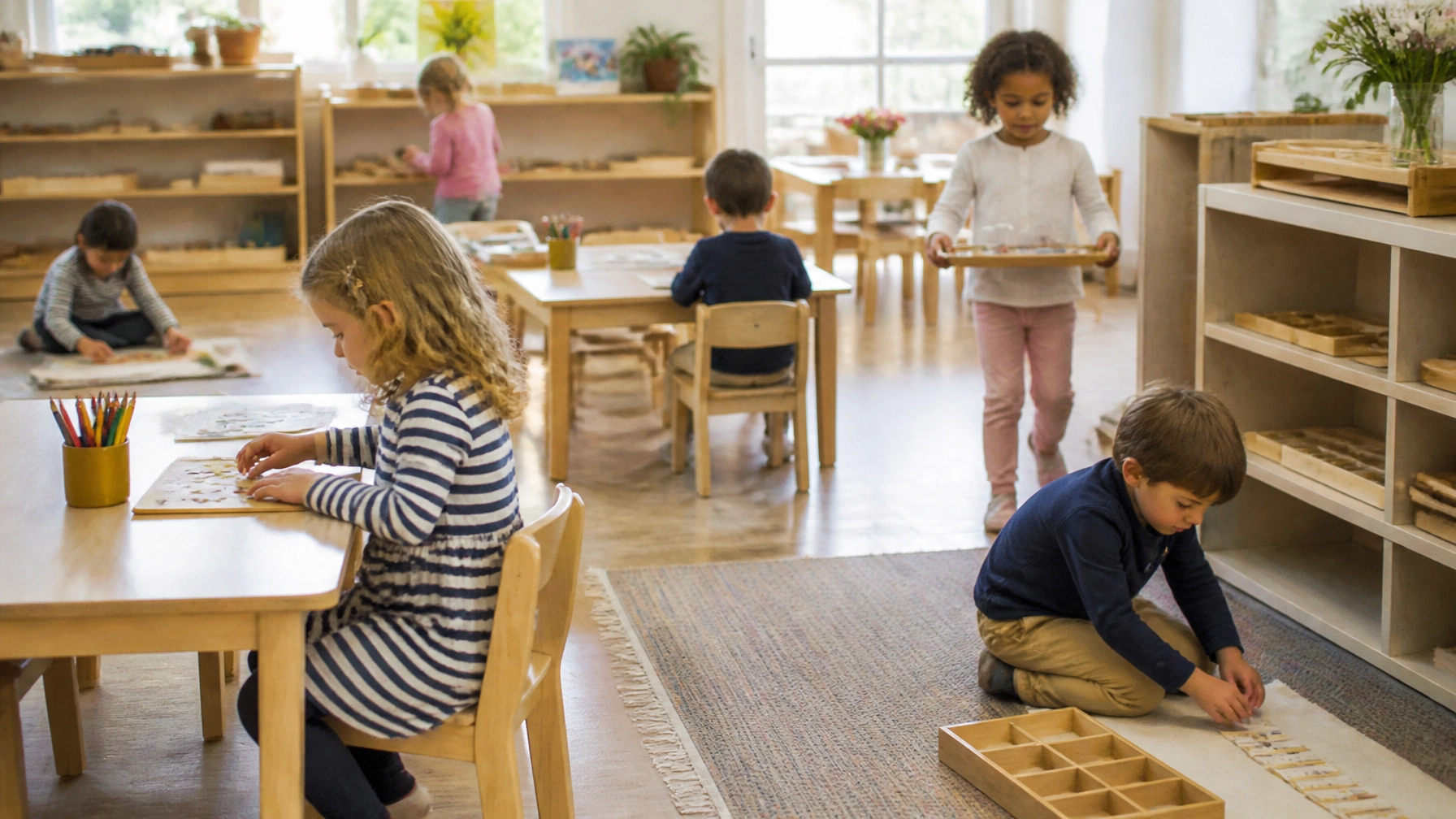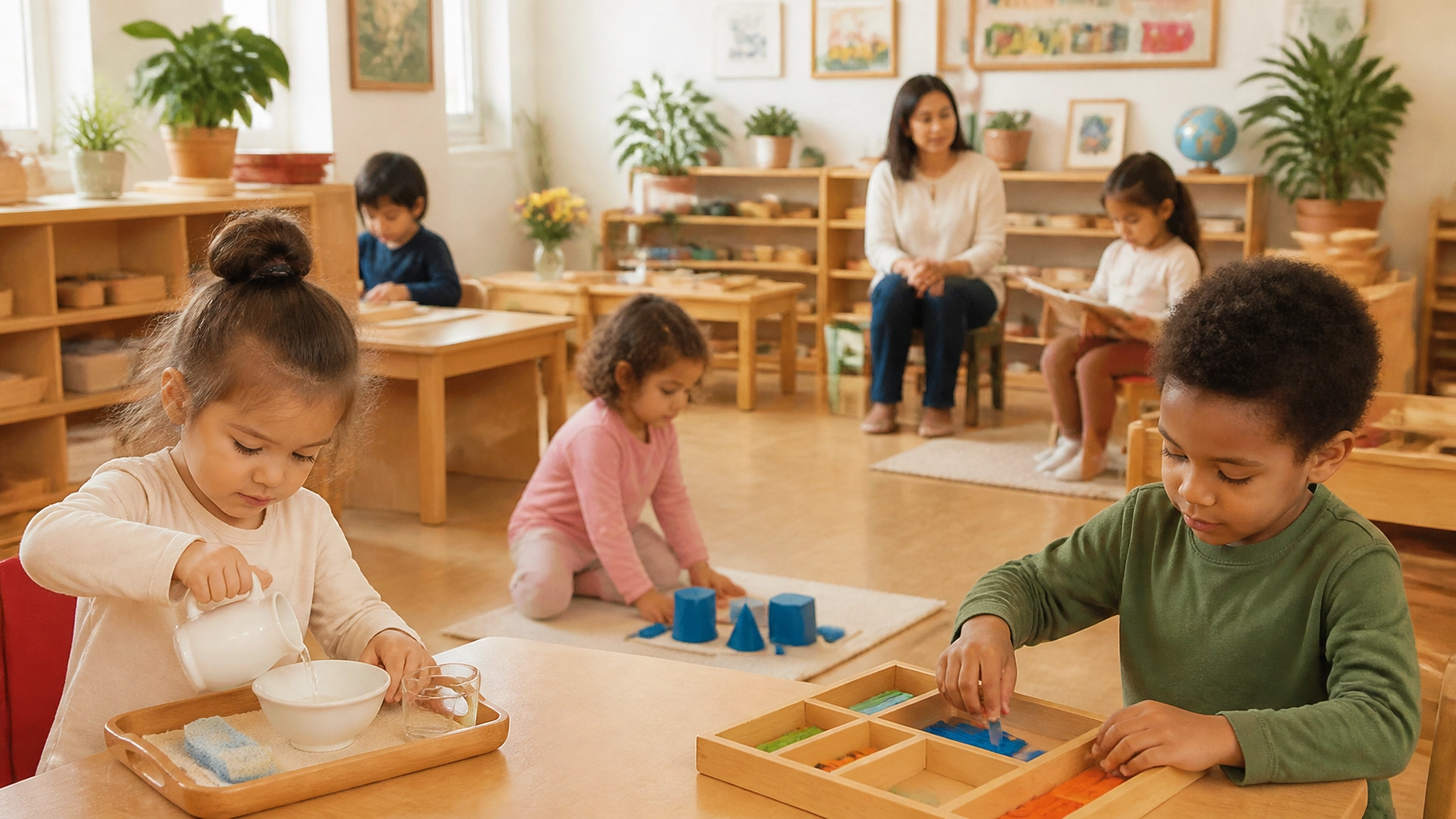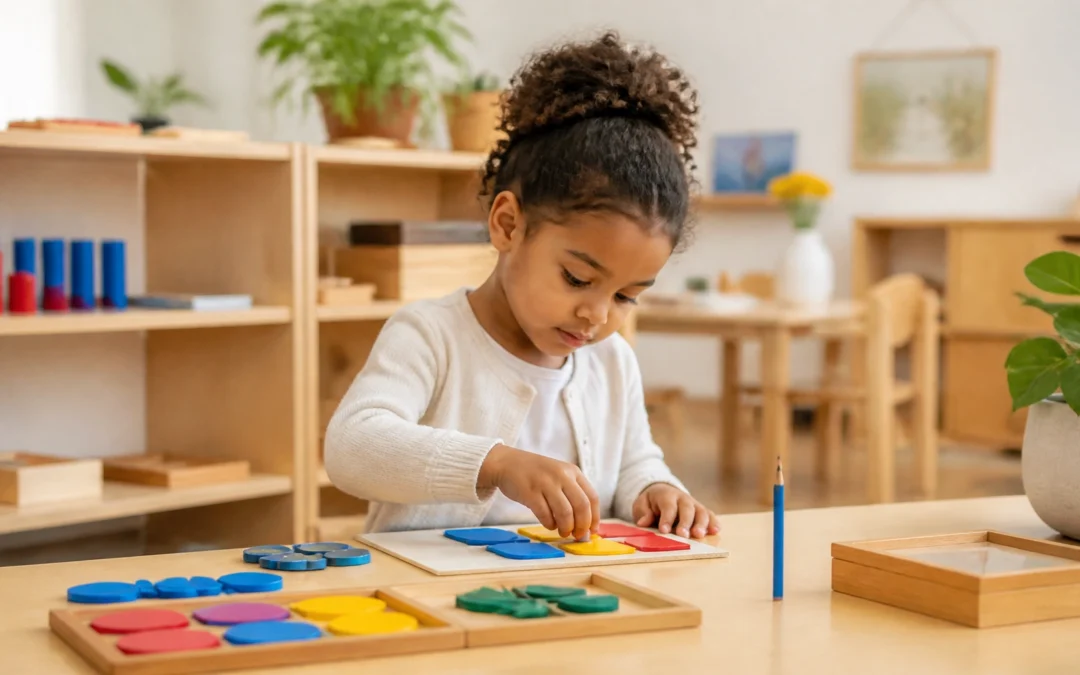

The Montessori Journey Begins

The Montessori Journey Begins

toddler cooking

By Amanda Riccetti

A Gentle Welcome to Independence, Discovery, and Avery’s First Day

You’ve enrolled your child in a Montessori school. Perhaps a trusted friend recommended it. Maybe you were a Montessori child yourself. Or perhaps the calm beauty of the classroom simply spoke to you during your visit, resonating on a level you couldn’t quite name.

Whatever path led you here, your child is about to begin a new chapter of growth—and you’ll be walking alongside them into something extraordinary: the Montessori Primary years, spanning ages three to six.

This isn’t preschool or kindergarten in the traditional sense. It’s what Montessori calls a Three-Year Journey—a formative period of development where your child learns by doing, observing, and discovering at their own pace, guided by an intentionally prepared and beautiful environment.

As this journey begins, it’s natural to feel a mix of wonder and uncertainty. Your child will be stepping into a space designed for them—a classroom that nurtures independence while offering structure, beauty, and purpose. And while the materials are thoughtfully arranged and the guides warmly prepared, your presence—the emotional grounding you offer at home—remains an essential part of the experience. Together, we can help your child feel safe, curious, and ready to begin.

Supporting Your Child’s Transition

Entering a Montessori classroom is like embarking on a beautiful adventure. Here’s how you can support this transition:

  • Speak Positively: Frame the start of school with enthusiasm and curiosity.
  • Visit if Possible: Help your child picture the space and meet familiar faces.
  • Respect the Process: Allow time for nesting—a valid stage where children observe, breathe, and acclimate before choosing work.
  • Trust the Journey: Know that even quiet observers are learning and preparing to engage.

Once your child walks through the door, they’ll step into an environment prepared just for them. The Montessori classroom isn’t just a room full of materials—it’s a living, breathing space designed to meet children where they are developmentally, emotionally, and socially. Understanding what your child will encounter inside helps you support their journey even more deeply. So what will they see when they arrive?

Inside the Montessori Classroom

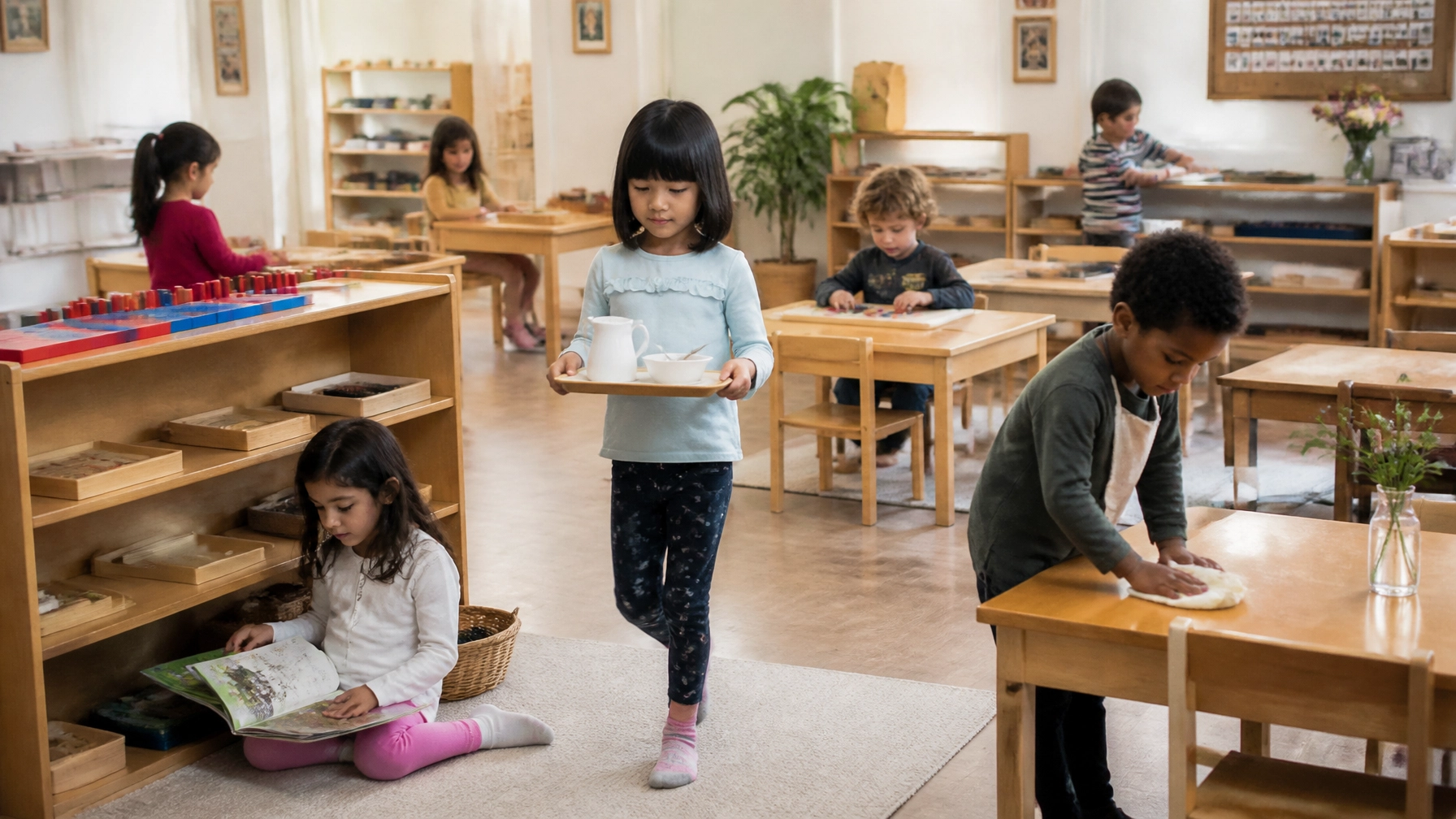
Practical Life: Learning Through Living

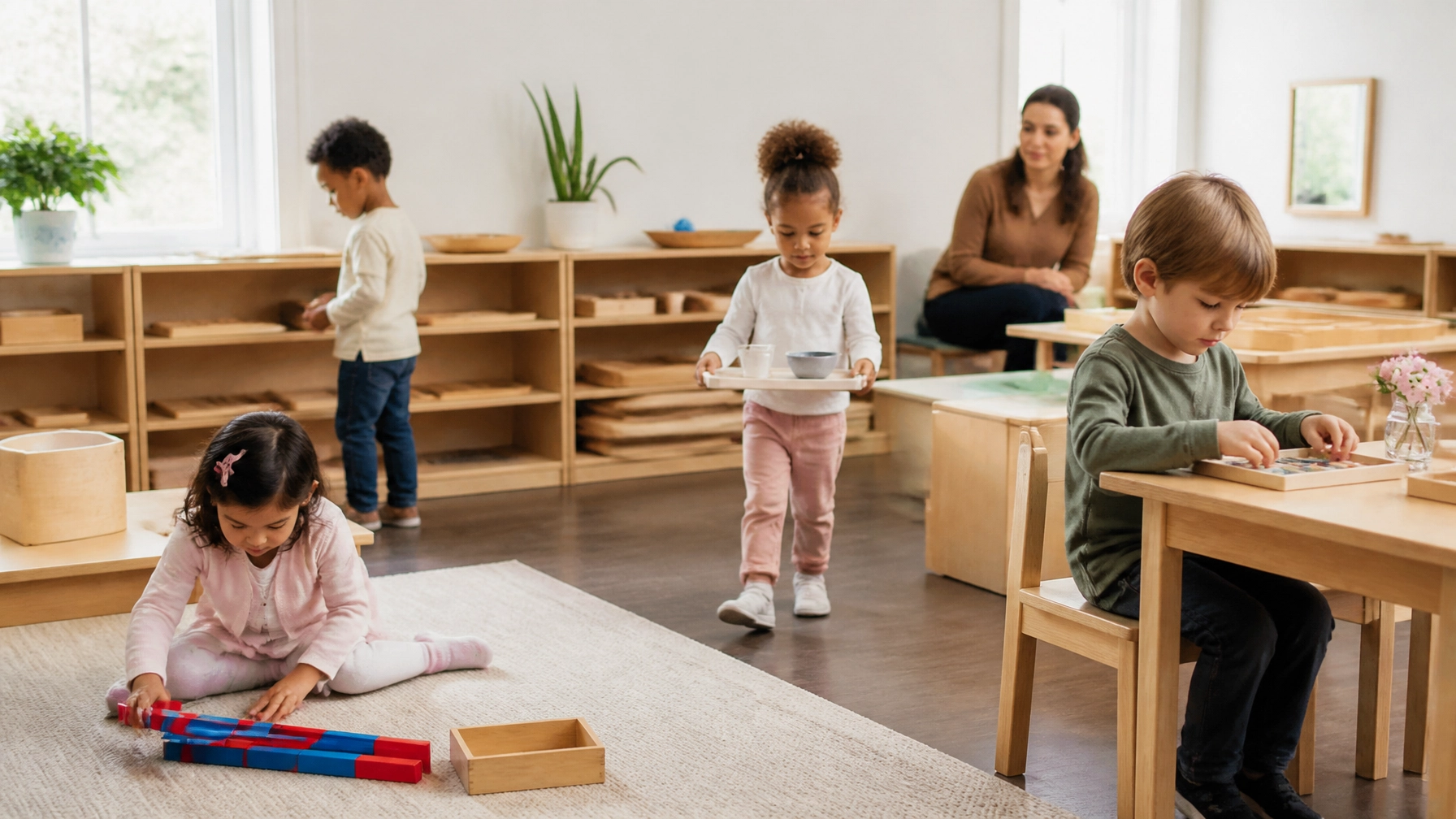
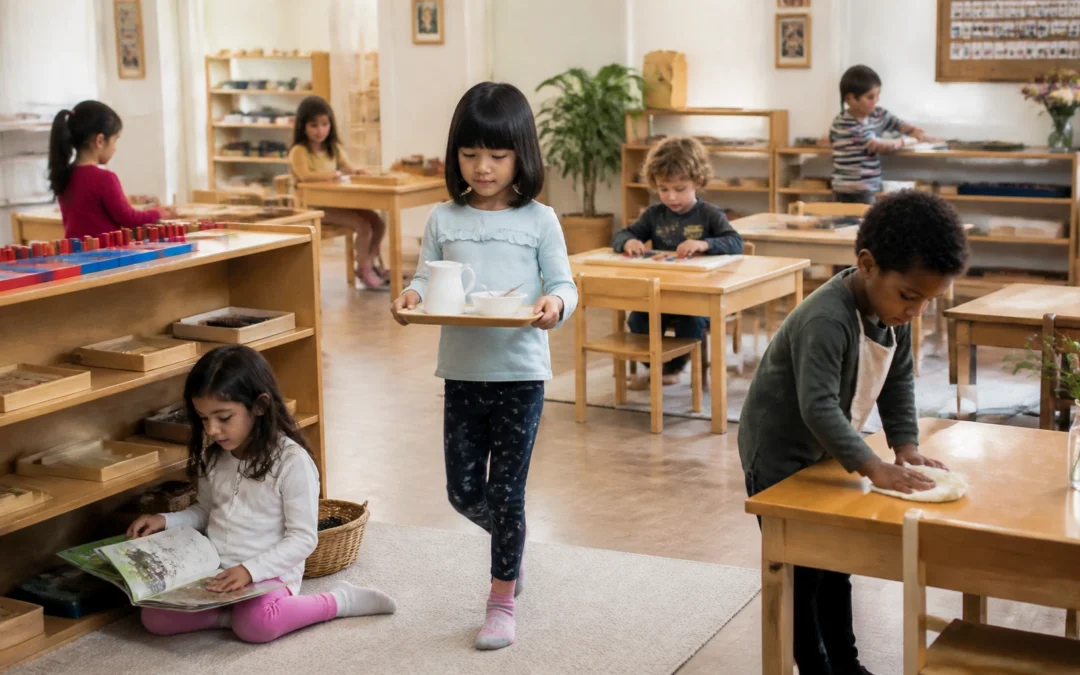
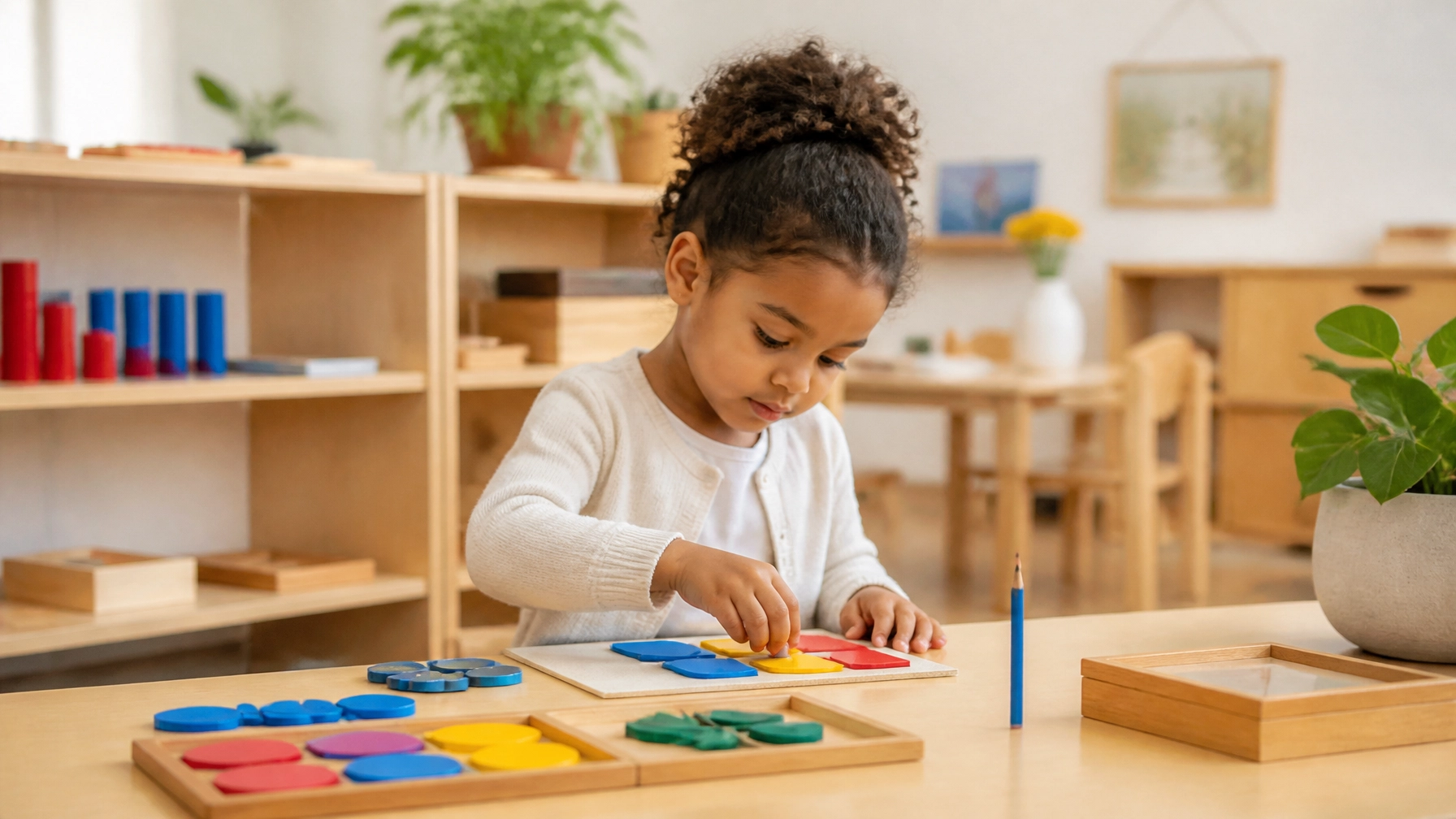
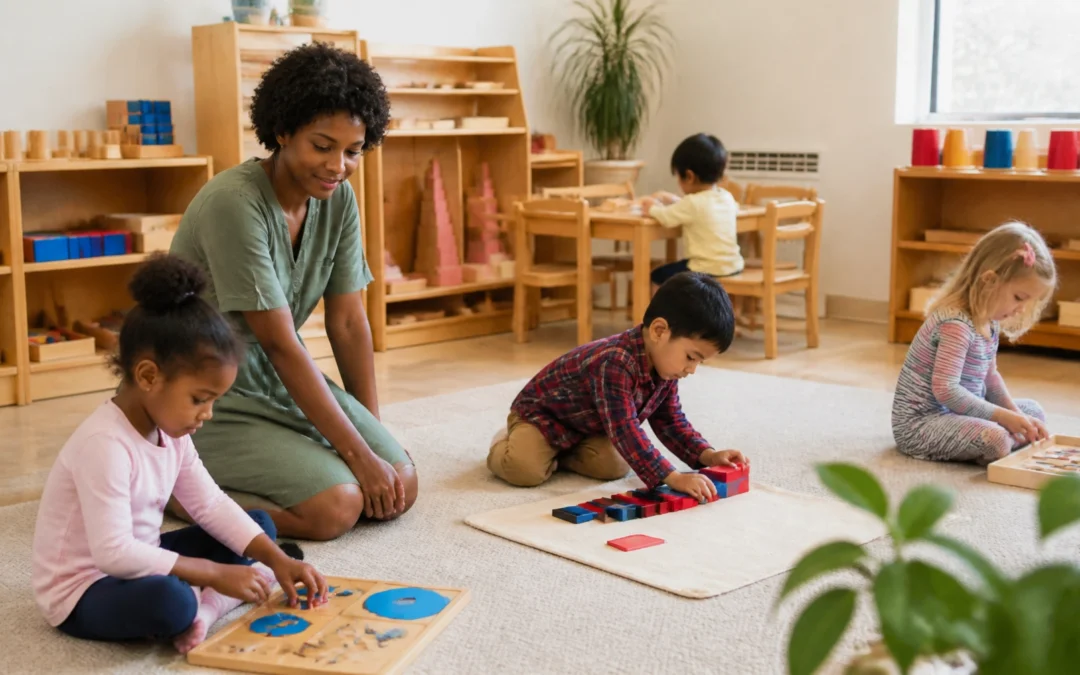
Practical Life is the heart of the Montessori classroom. Activities like pouring, sponging, sweeping, and table-washing build both gross and fine motor skills while teaching grace, order, and courtesy.

These exercises fall into four core categories:

  • Care of Self
  • Care of the Environment
  • Grace and Courtesy
  • Control of Movement

Children experience the rhythm of each task—beginning, middle, and end—developing sequencing skills, independence, and real-world competence in a peaceful, purposeful way.

Sensorial: Refining the Senses, Awakening the Mind

Sensorial materials are uniquely Montessori—crafted to engage the five senses and refine perception. Children classify objects by shape, color, sound, and texture, learning vocabulary such as rough/smooth, short/tall, and even geometric expressions like triangular prism and quatrefoil.

This work builds the cognitive architecture for literacy and math by nurturing observation, comparison, and joyful repetition.

Cultural: Exploring the Wonders of Our World

Dr. Montessori believed a cultured person understands the natural world and human expression. In this area, children explore:

  • Geography
  • Botany & Zoology
  • Science
  • Music & Art

These activities foster wonder, broaden perspective, and help children see themselves as part of a respectful, interconnected world.

Language & Math: The Power of Words and Numbers

Language begins with phonetic awareness—children learn how words are constructed from sounds, then joyfully decode and read at their own pace. Vocabulary flourishes through conversation and work, while writing emerges organically through the use of drawing with metal insets and storytelling.

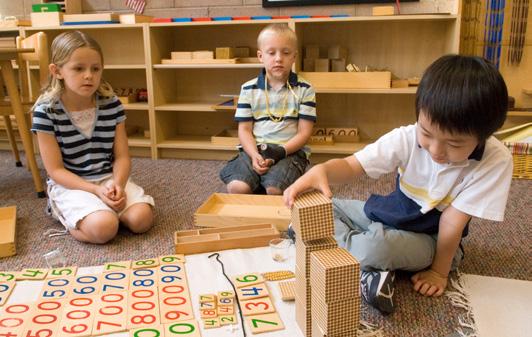
Math is introduced through tactile materials—golden beads, number rods, and precise tools that turn abstract concepts into something concrete. Children discover that math is a language they already speak.

The Montessori Environment: A World Prepared for the Child

The classroom is designed to meet children’s developmental needs with beauty and clarity. Materials are arranged on low shelves for easy access. Each item teaches a lesson and is self-correcting, so children explore and learn independently.

Montessori classrooms are intentionally multi-age, typically ranging from 2½ to 6 years. This structure offers children authentic opportunities for peer learning and leadership. Older children gain confidence and reinforce their own learning through mentoring, while younger children learn by observing, imitating, and engaging with guidance.

Social development blossoms naturally. Respectful interactions and collaborative rituals help children practice empathy, inclusion, and real-world citizenship.

In this prepared environment, the classroom becomes a community—one where every child is invited to grow with confidence, joy, and purpose. As children settle into this prepared environment—filled with choice, beauty, and meaningful work—they begin to find their rhythm. But even in the most thoughtfully designed classrooms, the first days can bring big emotions. Separation, new routines, and unfamiliar faces can feel overwhelming at first. And for families, this transition is just as profound. That’s why emotional readiness, reassurance, and storytelling have such an essential place in the Montessori journey.

Readiness and Reassurance

As children settle into this prepared environment—filled with choice, beauty, and meaningful work—they begin to find their rhythm. However, even in the most thoughtfully designed classrooms, the first days can evoke strong emotions. Separation, new routines, and unfamiliar faces can feel overwhelming at first. And for families, this transition is just as profound. That’s why emotional readiness, reassurance, and storytelling have such an essential place in the Montessori journey.

Remember that readiness doesn’t always arrive with bounding energy and bold declarations. Sometimes it comes quietly—through watchfulness, observation, and inner preparation. Montessori honors all paths to readiness. This transition isn’t a single leap—it’s a gentle unfolding.

Often, parents carry the deeper emotional weight, balancing excitement with uncertainty. Your calm, trusting presence becomes your child’s anchor. Through daily rituals, shared conversations, and gentle transitions, you send a clear message: school is a safe, beautiful place, and you believe in them.

 A Quick Goodbye, A Confident Start

The way each morning begins sets the tone for your child’s day. We recommend a short and consistent goodbye to support a smooth transition.

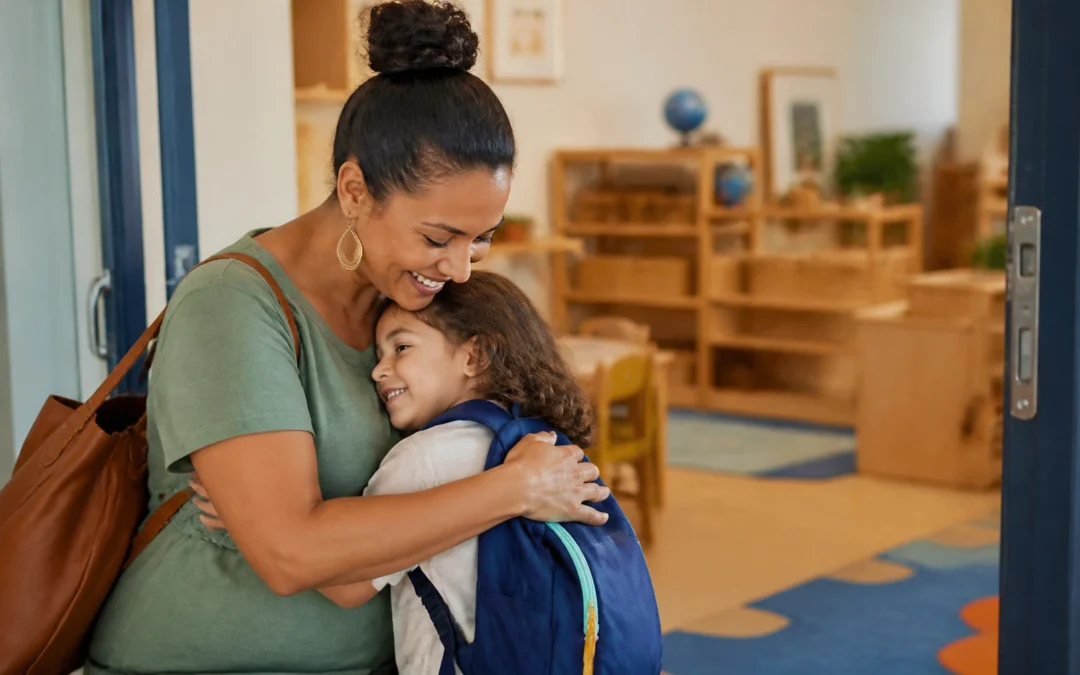
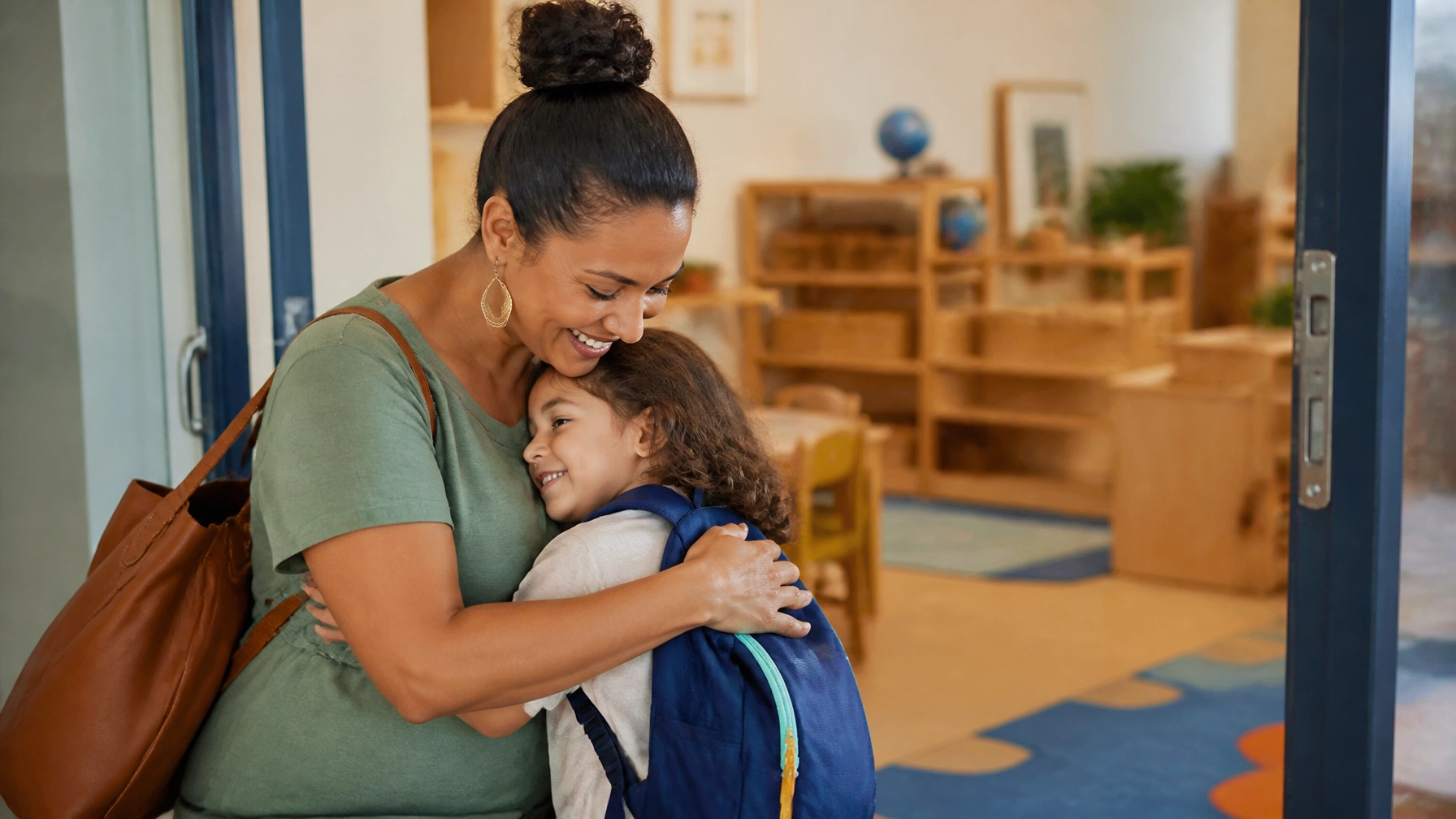
When you arrive, a teacher will warmly greet your child and help them with their cubby. This is the moment to say goodbye, gently, and with confidence. Children thrive on routine, and a quick departure sends a powerful message: “School is a safe place. You’ve got this.”

Lingering too long or hesitating can unintentionally give your child false hope that you’ll stay, which may lead to confusion or emotional stress. Saying goodbye promptly helps your child shift into classroom life with clarity, autonomy, and ease.

You’re not abandoning them—you’re affirming their strength. This daily ritual becomes a trusted rhythm, empowering both child and parent to embrace the day ahead with courage and grace.

You’ll feel confident because your child is well prepared, grounded by routine, greeted with warmth, and guided with consistency. And once this emotional foundation is set, another beautiful way to reinforce your child’s readiness is through storytelling.

Storytelling: A Gentle Bridge to Confidence

In the Montessori environment, stories aren’t just entertaining—they’re purposeful. Whether it’s a tale about resilience, kindness, or curiosity, storytelling offers children a gentle bridge from emotional connection to cognitive growth. Through narrative, they build language, imagination, and the inner tools needed to approach the day with clarity and self-assurance.

Across cultures and generations, stories have helped children understand and embrace change. They offer continuity, language for emotions, and images to visualize what’s ahead. Picture books especially give children a quiet path to prepare themselves, rehearsing new experiences in ways that feel safe and imaginative.

Throughout my decades as a Montessori guide, I sought a story that would gently introduce children to this unique approach to education—child-led, emotionally rich, and inclusive of all family structures. I found glimpses of similar themes in other books, such as Llama Llama Back to School, but nothing fully aligned with the Montessori values I hold dear.

So, I wrote one.

Avery’s First Montessori Day:

Avery’s First Montessori Day is told entirely through Avery’s voice, giving children language to name feelings, visualize their classroom, and see their experience affirmed. Each page features gentle narration and a thought bubble from Avery, reflecting the inner moments of hesitation, joy, and curiosity that Montessori children often reveal.

Notably, the story uses the word “parent” sparingly and never describes adults in detail, allowing families of all kinds to feel welcome. Whether your child has two moms, two dads, one parent, grandparents, is in foster care, or has a chosen family, the book makes space for their reality without needing to explain it.

Avery doesn’t tiptoe into his Montessori world—he dives in. With wonder as his guide and quiet courage blooming in small ways, he embraces his first day as an adventure that belongs to him alone.

This updated edition builds on the 2013 original, now more inclusive and more deeply aligned with Montessori principles. I’ve seen its impact firsthand: families say their children settle more easily, cry less, and enjoy their experience with more confidence and less trauma.

You can purchase a copy from Amazon at

https://www.amazon.com/Averys-First-Montessori-Amanda-Riccetti/dp/B0FHWV6DML

If you choose to share Avery’s First Montessori Day with your child, I hope it becomes more than a book—I hope it becomes a companion. A bridge between home and school. A hug that says: “You belong here. You’re ready.”

About the Author

Amanda Riccetti has welcomed children into Montessori classrooms with joy and purpose since 1980. As Director and Head Teacher at Big City Montessori School, she leads with warmth, wisdom, and a deep respect for every child’s unfolding journey.

Amanda is the author of Reading with Miss Amanda, a hands-on reading series rooted in phonics, storytelling, and child-centered learning. Her songs, storybooks, and curriculum materials reflect decades of observation, empathy, and innovation.

Now a proud mother and grandmother, Amanda continues shaping education as Big City Montessori becomes a second-generation family-run school. She writes not to teach at children, but to walk with them—ensuring every story, song, and lesson is a tool for connection, not just content.

Her work is a legacy of care, inclusion, and quiet brilliance. Avery’s First Montessori Day is one more reflection of that vision: a child’s voice, honored from the very first moment.

Below is the article description

The Montessori Journey Starts. Montessori educator Amanda Riccetti shares a gentle roadmap for families entering the Primary years, highlighting emotional readiness, self-led learning, and the story behind her new book, Avery’s First Montessori Day.

Screens and Stillness_ A Call to Screentime Stewardship

Screens and Stillness_ A Call to Screentime Stewardship

Teacher training


By Jennifer Iamele Savage  

“Breaking up with your phone means giving yourself the space, freedom, and tools necessary to create a new, long-term relationship with it, one that keeps what you love about your phone and gets rid of what you don’t.” Catherine Price, How to Break Up with Your Phone, Revised Edition: The 30-Day Digital Detox Plan

Over the past month I have been exploring the concept of screentime stewardship as a social change initiative, and the journey has been eye-opening. Like most of us, I have had a complicated relationship with screens throughout the years. As a member of Generation Y, I remember a time without the internet, technology, screens, and the like, and yet at this moment, I cannot imagine them not being a part of our daily lives. I have ridden all the waves of technology including getting excited about the potential and possibility of these advancements to getting disgusted by the statistics of the time being wasted and those who profit from our distractions.  I have quit social media for extended periods of time and done digital detoxes. My mindset was always “disconnect to reconnect”.  In recent years, however, I feel like completely disconnecting is no longer an option–and with the growing popularity of AI and other technological advances, that option will only become less available, in my opinion. Therefore, I am turning my attention to a different way of interacting with technology which I refer to as Screen Time Stewardship. 

What is Screen Time Stewardship? 

“Screen time stewardship” is a thoughtful, values-based approach to managing digital device use—especially in homes, schools, and communities. Rather than simply limiting screen time, stewardship emphasizes intentionality, balance, and responsibility in how we engage with screens.

It’s about asking:

  • What purpose does this screen time serve?
  • Is it enriching, connecting, or numbing?
  • How does it align with our values, goals, and well-being?
  • How does cultivating this practice apply to other technologies as well? 

In practice, screen time stewardship might look like:

  • Co-creating family or classroom media plans that prioritize quality over quantity.
  • Modeling mindful tech use—pausing to reflect before picking up a device.
  • Encouraging digital citizenship and critical thinking about online content.
  • Making space for offline experiences that nurture creativity, movement, and connection.

How do I Build my own Capacity for Screen time Stewardship? 

As part of this exploration, I have been running a screen time stewardship pilot program and have heard feedback from participants such as “it [technology use] feels like a familiar pattern with clear signals: craving, dopamine hit, let down, renewed craving” and “I would like to model responsible phone behavior and use my phone as a tool not as a mindless addiction”.  Participants reflect on their screen time use and set goals regarding what they hope to get out of the study. Based on participant feedback and personal reflection, I have identified a pathway with practical steps for cultivating digital stewardship. 

Awareness 

Audit your current screen time use. Reflect and notice when you use your devices and what needs you are trying to fill. Consider your goals. Become conscious of the statistics and their implications for yourself and those you care about. Consider the things that you do not have time to do that you want to spend more time doing. 

Staggering Statistics:

U.S. adults spend an average of 7 hours and 3 minutes per day on internet-connected devices.  (Backlinko, 2025)

47.5% of children aged 2–5 exceed 2 hours of recreational screen time on weekdays; this jumps to 65.5%for ages 6–11. (CDC, 2020)

50.4% of teens aged 12–17 report 4+ hours of daily screen time, excluding schoolwork. (NHIS–Teen, 2024)

Action

 After you audit the time that you spend online, consider how you could reduce the wasted time and replace that time with things that you want to prioritize.In reducing your time, try different actions (adapted from Catherine Price’s 30 Day Break Up Plan) that could help you break your addiction and make those mindful changes. 

Accountability

Find an accountability tool or person to support you in your goals. Maybe it’s setting screen time limits. Maybe it’s joining an accountability group or finding an accountability partner to check in with regarding your screen time usage. 

Engage Family

Part of Screen Time Stewardship involves acting as a role model for your families and/or future generations. Try building your own family commitments based off of Andy Crouch’s work in Tech-Wise Family. Build a family contract. Play Family Wellness Bingo

Application to Other Technologies

Stewardship doesn’t stop at screens: it extends to emerging technologies like AI, which are rapidly changing our lives before our eyes.  At this moment I am inviting people to consider how they want to interact with AI. I recently read an article that said “You’re not going to lose your job to an A.I., but you’re going to lose your job to someone who uses A.I.” Jensen Huang, CEO of Nvidia and that truly encapsulated the mindset that I believe we need to adopt.  AI is here to stay so we need to apply some of the same principles that we are applying to other technologies and screens to AI. We must find a way to stay in integrity with our intellectual capital while utilizing this technology and maintaining an awareness of the environmental implications–which are all parts of stewardship. Stewardship also includes understanding the unseen costs of technology use, specifically its environmental footprint.

A single ChatGPT request uses about 10 times more electricity than a standard Google search.

Data centers powering AI models consumed 4.4% of all U.S. electricity in 2023, and that figure is projected to rise to 6.7–12% by 2028.

Some AI prompts can generate up to 50 times more CO₂ emissions than others, depending on complexity and model size. (Shan, 2025). 

Consider Power Dynamics Behind the Screen

Part of this is in the awareness category and yet I believe that this deserves its own space for big picture, structural consideration. There are cultural currents shaping our attention and part of being a good steward is taking the intentional time that is necessary to understand if being complicit in these systems is serving us and our society. 

For example, Bo Burnham, an American comedian, musician, filmmaker, and former YouTube sensation, has been outspoken about the psychological toll of social media, describing it as a form of attention colonization.” In interviews and panels, he’s warned that tech companies are no longer just selling products—they’re coming for every second of your life,” monetizing human attention and shaping behavior through algorithmic design.  

More Perfect Union,an Emmy-winning nonprofit media organization focused on building power for the working class, blends investigative journalism with advocacy, spotlighting corporate abuses and amplifying the voices of everyday Americans. While on a recent road trip, I saw some of their billboards, got interested, and did some research. Recently, the group launched a billboard campaign targeting Big Tech, calling out companies like Meta and TikTok for exploiting user attention and contributing to mental health crises. These billboards are part of a broader push to hold tech giants accountable for their role in digital overconsumption, especially among youth. 

What Other Resources are Available to Support this Social Change? 

There are resources and movements like The Anxious Generation by Jonathan Haidt, the Screenagers documentary series, and campaigns like Wait Til 8th that advocate for limiting screen use for children and teenagers. In Tech Wise Parenting by Andy and Amy Crouch, the authors offer 10 tech-wise commitments and Catherine Price in How to Break Up with Your Phone offers a 30 day break up plan. All of these resources can be invaluable in creating your own screen time stewardship plan. However, the key to creating this successful balance and personalized pathway depends on the individual and is ultimately a personalized journey. In my work I have created a visual companion to assist myself and others who are on this quest to a more intentional relationship with current and emerging technologies that can be found below.

Conclusion

Regardless of the tools that you use to get there, Screen Time Stewardship is a social change effort that I believe should be on our minds and hearts before it is too late. There is no right way to do this and vilifying technology is not the goal–cultivating a responsible and intentional relationship and finding the balance and harmony that exists at the center of this movement is instead what I believe will sustain us in the future. Screens are not going away and if anything, there will be increasing opportunities to engage with them sooner than we may even realize, so the question is not if we want to engage with digital platforms but instead how–and I believe that if we do not set these parameters others who do not have our best interests at heart will. 

References

Backlinko Team. (2025, January 30). Revealing average screen time statistics for 2025. https://backlinko.com/screen-time-statistics

Huang, J. (2025, May 28). You’re not going to lose your job to an A.I., but you’re going to lose your job to someone who uses A.I. CNBC. https://www.cnbc.com/2025/05/28/nvidia-ceo-jensen-huang-youll-lose-your-job-to-somebody-who-uses-ai.html

Mic. (2022, November 10). Bo Burnham warned us about social media, now everyone is listening. https://www.mic.com/life/bo-burnham-social-media-twitter-elon-musk

Shah, S. (2025, June 18). The climate impact of different AI prompts. Time. https://time.com/7295844/climate-emissions-impact-ai-prompts/

Yahoo News. (2025, July 15). Big Tech billionaire backlash protest puts 50 billboards in Augusta and beyond. https://www.yahoo.com/news/big-tech-billionaire-backlash-protest-154155511.html

Zablotsky, B., Arockiaraj, B., Haile, G., & Ng, A. E. (2024, October). Daily screen time among teenagers: United States, July 2021–December 2023 (NCHS Data Brief No. 513). National Center for Health Statistics, Centers for Disease Control and Prevention. https://www.cdc.gov/nchs/products/databriefs/db513.htm

Biography

Jen Iamele Savage is a writer, educator, and empowerment coach whose work bridges the worlds of teaching, motherhood, and personal transformation. Her path has been shaped by a deep commitment to authentic living and a calling to help others—particularly women and mothers—reclaim their voice, worth, and purpose.

Jen began her professional journey as a high school English teacher, has worked in a variety of educational capacities, and is currently pursuing a doctorate in Montessori studies, deepening her commitment to whole-child, whole-person education. Her classroom has always been more than a place of academic learning; it’s where she nurtures reflection, voice, and connection. Drawing from her Montessori foundation and trauma-informed teaching background, she approaches education with compassion and curiosity, encouraging students to ask big questions about identity, purpose, and the world around them.

Jen’s writing, featured on platforms like Her View From Home. Motherly, and Charleston Moms, explores motherhood with both tenderness and fierce honesty. In her books—The Language of Mom Rage: From Injustice to Transformation and The Language of Transformation—she unpacks the emotional undercurrents of modern womanhood, offering readers language and frameworks to make sense of their inner experiences.

Whether she’s speaking to fellow educators about supporting the whole child or guiding a group of mothers through personal transformation, Jen’s work is rooted in a single truth: our hardest moments can become our greatest invitations. Her story is one of surrender, reclamation, and the radical idea that healing can start right where we are—in the classroom, in the kitchen, in the middle of a tantrum or a heartbreak.

Now living in Charleston, South Carolina, Jen is raising two children, continuing to teach, write, and lead with integrity and intention. Through every role she inhabits, she models what it means to be a mindful, purposeful woman in a world that often demands we disconnect from our inner voice.

“Breaking up with your phone means giving yourself the space, freedom, and tools necessary to create a new, long-term relationship with it, one that keeps what you love about your phone and gets rid of what you don’t.” Catherine Price, How to Break Up with Your Phone, Revised Edition: The 30-Day Digital Detox Plan

Over the past month I have been exploring the concept of screentime stewardship as a social change initiative, and the journey has been eye-opening. Like most of us, I have had a complicated relationship with screens throughout the years. As a member of Generation Y, I remember a time without the internet, technology, screens, and the like, and yet at this moment, I cannot imagine them not being a part of our daily lives. I have ridden all the waves of technology including getting excited about the potential and possibility of these advancements to getting disgusted by the statistics of the time being wasted and those who profit from our distractions.  I have quit social media for extended periods of time and done digital detoxes. My mindset was always “disconnect to reconnect”.  In recent years, however, I feel like completely disconnecting is no longer an option–and with the growing popularity of AI and other technological advances, that option will only become less available, in my opinion. Therefore, I am turning my attention to a different way of interacting with technology which I refer to as Screen Time Stewardship. 

What is Screen Time Stewardship? 

“Screen time stewardship” is a thoughtful, values-based approach to managing digital device use—especially in homes, schools, and communities. Rather than simply limiting screen time, stewardship emphasizes intentionality, balance, and responsibility in how we engage with screens.

It’s about asking:

  • What purpose does this screen time serve?
  • Is it enriching, connecting, or numbing?
  • How does it align with our values, goals, and well-being?
  • How does cultivating this practice apply to other technologies as well? 

In practice, screen time stewardship might look like:

  • Co-creating family or classroom media plans that prioritize quality over quantity.
  • Modeling mindful tech use—pausing to reflect before picking up a device.
  • Encouraging digital citizenship and critical thinking about online content.
  • Making space for offline experiences that nurture creativity, movement, and connection.

How do I Build my own Capacity for Screen time Stewardship? 

As part of this exploration, I have been running a screen time stewardship pilot program and have heard feedback from participants such as “it [technology use] feels like a familiar pattern with clear signals: craving, dopamine hit, let down, renewed craving” and “I would like to model responsible phone behavior and use my phone as a tool not as a mindless addiction”.  Participants reflect on their screen time use and set goals regarding what they hope to get out of the study. Based on participant feedback and personal reflection, I have identified a pathway with practical steps for cultivating digital stewardship. 

Awareness 

Audit your current screen time use. Reflect and notice when you use your devices and what needs you are trying to fill. Consider your goals. Become conscious of the statistics and their implications for yourself and those you care about. Consider the things that you do not have time to do that you want to spend more time doing. 

Staggering Statistics:

U.S. adults spend an average of 7 hours and 3 minutes per day on internet-connected devices.  (Backlinko, 2025)

47.5% of children aged 2–5 exceed 2 hours of recreational screen time on weekdays; this jumps to 65.5%for ages 6–11. (CDC, 2020)

50.4% of teens aged 12–17 report 4+ hours of daily screen time, excluding schoolwork. (NHIS–Teen, 2024)

Action

 After you audit the time that you spend online, consider how you could reduce the wasted time and replace that time with things that you want to prioritize.In reducing your time, try different actions (adapted from Catherine Price’s 30 Day Break Up Plan) that could help you break your addiction and make those mindful changes. 

Accountability

Find an accountability tool or person to support you in your goals. Maybe it’s setting screen time limits. Maybe it’s joining an accountability group or finding an accountability partner to check in with regarding your screen time usage. 

Engage Family

Part of Screen Time Stewardship involves acting as a role model for your families and/or future generations. Try building your own family commitments based off of Andy Crouch’s work in Tech-Wise Family. Build a family contract. Play Family Wellness Bingo

Application to Other Technologies

Stewardship doesn’t stop at screens: it extends to emerging technologies like AI, which are rapidly changing our lives before our eyes.  At this moment I am inviting people to consider how they want to interact with AI. I recently read an article that said “You’re not going to lose your job to an A.I., but you’re going to lose your job to someone who uses A.I.” Jensen Huang, CEO of Nvidia and that truly encapsulated the mindset that I believe we need to adopt.  AI is here to stay so we need to apply some of the same principles that we are applying to other technologies and screens to AI. We must find a way to stay in integrity with our intellectual capital while utilizing this technology and maintaining an awareness of the environmental implications–which are all parts of stewardship. Stewardship also includes understanding the unseen costs of technology use, specifically its environmental footprint.

A single ChatGPT request uses about 10 times more electricity than a standard Google search.

Data centers powering AI models consumed 4.4% of all U.S. electricity in 2023, and that figure is projected to rise to 6.7–12% by 2028.

Some AI prompts can generate up to 50 times more CO₂ emissions than others, depending on complexity and model size. (Shan, 2025). 

Consider Power Dynamics Behind the Screen

Part of this is in the awareness category and yet I believe that this deserves its own space for big picture, structural consideration. There are cultural currents shaping our attention and part of being a good steward is taking the intentional time that is necessary to understand if being complicit in these systems is serving us and our society. 

For example, Bo Burnham, an American comedian, musician, filmmaker, and former YouTube sensation, has been outspoken about the psychological toll of social media, describing it as a form of attention colonization.” In interviews and panels, he’s warned that tech companies are no longer just selling products—they’re coming for every second of your life,” monetizing human attention and shaping behavior through algorithmic design.  

More Perfect Union,an Emmy-winning nonprofit media organization focused on building power for the working class, blends investigative journalism with advocacy, spotlighting corporate abuses and amplifying the voices of everyday Americans. While on a recent road trip, I saw some of their billboards, got interested, and did some research. Recently, the group launched a billboard campaign targeting Big Tech, calling out companies like Meta and TikTok for exploiting user attention and contributing to mental health crises. These billboards are part of a broader push to hold tech giants accountable for their role in digital overconsumption, especially among youth. 

What Other Resources are Available to Support this Social Change? 

There are resources and movements like The Anxious Generation by Jonathan Haidt, the Screenagers documentary series, and campaigns like Wait Til 8th that advocate for limiting screen use for children and teenagers. In Tech Wise Parenting by Andy and Amy Crouch, the authors offer 10 tech-wise commitments and Catherine Price in How to Break Up with Your Phone offers a 30 day break up plan. All of these resources can be invaluable in creating your own screen time stewardship plan. However, the key to creating this successful balance and personalized pathway depends on the individual and is ultimately a personalized journey. In my work I have created a visual companion to assist myself and others who are on this quest to a more intentional relationship with current and emerging technologies that can be found below.

Conclusion

Regardless of the tools that you use to get there, Screen Time Stewardship is a social change effort that I believe should be on our minds and hearts before it is too late. There is no right way to do this and vilifying technology is not the goal–cultivating a responsible and intentional relationship and finding the balance and harmony that exists at the center of this movement is instead what I believe will sustain us in the future. Screens are not going away and if anything, there will be increasing opportunities to engage with them sooner than we may even realize, so the question is not if we want to engage with digital platforms but instead how–and I believe that if we do not set these parameters others who do not have our best interests at heart will. 

References

Backlinko Team. (2025, January 30). Revealing average screen time statistics for 2025. https://backlinko.com/screen-time-statistics

Huang, J. (2025, May 28). You’re not going to lose your job to an A.I., but you’re going to lose your job to someone who uses A.I. CNBC. https://www.cnbc.com/2025/05/28/nvidia-ceo-jensen-huang-youll-lose-your-job-to-somebody-who-uses-ai.html

Mic. (2022, November 10). Bo Burnham warned us about social media, now everyone is listening. https://www.mic.com/life/bo-burnham-social-media-twitter-elon-musk

Shah, S. (2025, June 18). The climate impact of different AI prompts. Time. https://time.com/7295844/climate-emissions-impact-ai-prompts/

Yahoo News. (2025, July 15). Big Tech billionaire backlash protest puts 50 billboards in Augusta and beyond. https://www.yahoo.com/news/big-tech-billionaire-backlash-protest-154155511.html

Zablotsky, B., Arockiaraj, B., Haile, G., & Ng, A. E. (2024, October). Daily screen time among teenagers: United States, July 2021–December 2023 (NCHS Data Brief No. 513). National Center for Health Statistics, Centers for Disease Control and Prevention. https://www.cdc.gov/nchs/products/databriefs/db513.htm

Biography

Jen Iamele Savage is a writer, educator, and empowerment coach whose work bridges the worlds of teaching, motherhood, and personal transformation. Her path has been shaped by a deep commitment to authentic living and a calling to help others—particularly women and mothers—reclaim their voice, worth, and purpose.

Jen began her professional journey as a high school English teacher, has worked in a variety of educational capacities, and is currently pursuing a doctorate in Montessori studies, deepening her commitment to whole-child, whole-person education. Her classroom has always been more than a place of academic learning; it’s where she nurtures reflection, voice, and connection. Drawing from her Montessori foundation and trauma-informed teaching background, she approaches education with compassion and curiosity, encouraging students to ask big questions about identity, purpose, and the world around them.

Jen’s writing, featured on platforms like Her View From Home. Motherly, and Charleston Moms, explores motherhood with both tenderness and fierce honesty. In her books—The Language of Mom Rage: From Injustice to Transformation and The Language of Transformation—she unpacks the emotional undercurrents of modern womanhood, offering readers language and frameworks to make sense of their inner experiences.

Whether she’s speaking to fellow educators about supporting the whole child or guiding a group of mothers through personal transformation, Jen’s work is rooted in a single truth: our hardest moments can become our greatest invitations. Her story is one of surrender, reclamation, and the radical idea that healing can start right where we are—in the classroom, in the kitchen, in the middle of a tantrum or a heartbreak.

Now living in Charleston, South Carolina, Jen is raising two children, continuing to teach, write, and lead with integrity and intention. Through every role she inhabits, she models what it means to be a mindful, purposeful woman in a world that often demands we disconnect from our inner voice.

Taking Time to Recommit: How YOUR School Can Reconnect with YOUR Heart and Culture

Taking Time to Recommit: How YOUR School Can Reconnect with YOUR Heart and Culture

Teacher training

“I usually dread workshops… but this was engaging and fun. I got so much out of it.”

That comment, offered by one of the thirty staff members at Ghent Montessori School in Norfolk, Virginia, meant the world to me. Workshops can easily become another item on the back-to-school checklist—another day in a packed week of CPR training, classroom setup, and policy reviews. But when a day of professional development leaves people feeling reenergized, seen, and more connected to the values that brought them into Montessori education in the first place, it’s something worth sharing.

Why This Workshop Mattered

Ruland Gagné, the school’s Head of School, reached out to me earlier in the summer. Like many leaders, she felt a need to bring her team together—not just physically, but emotionally and philosophically. The school had experienced remarkable growth since COVID. Their programs were strong. The parent community was loyal. Yet under the surface, they were feeling some of the all-too-common challenges: communication issues among staff, negativity seeping into team dynamics, and moments where tone or language strayed from the ideals of Montessori. They wanted a reset. Not a lecture. A reset.

The result was a full-day, on-site workshop I led on behalf of the Montessori Foundation. It wasn’t about adding more rules or fixing people. It was about rediscovering what it means to be a Montessori school—not just in curriculum, but in culture.

The Structure of the Day

Earlier in the week, the Ghent team opened their work week with a quote from The Bear

“It’s the people they remember.”

It set the tone. Our materials and routines matter—but what stays with children and families is how we make them feel. That’s the heart of Montessori.

The Decalogue as a Mirror

We moved into a conversation around Montessori’s Decalogue—a beautifully simple yet powerful list of ten commitments for adults in Montessori environments. We explored each one through practical examples: How do we treat mistakes? How do we correct a child’s behavior without shame? What does it really mean to wait to be invited?

The Decalogue served as a mirror. It reminded us what Montessori called us to do—not just in theory, but in the way we show up every day.

Naming Our Beliefs, Values, and Behaviors

Next, we engaged in small-group work using a framework I adapted from another organization’s social norms document. We explored three questions:

  • What do we believe about children, learning, and each other?

  • What do we value as a school community?

  • What behaviors show those values in action?

Each group shared their thoughts, and the insights were powerful. It gave the team a language to name the culture they wanted to cultivate, and to gently acknowledge where they may have drifted off course.

The School Covenant

In the afternoon, we co-created a Ghent Montessori School Covenant—a short, clear statement of shared professional commitments. Things like:

  • We speak about children, families, and one another with respect.

  • We offer guidance privately, not publicly.

  • We listen first, assume best intentions, and support each other’s growth.

This wasn’t a top-down document. It was built together. And when we concluded the day, every staff member had the opportunity to sign it.

Real Talk: Case Studies from the Field

We also worked through case studies drawn from real scenarios: What do we do when a colleague speaks negatively about students? How do we respond when someone shares a personal diagnosis that feels outside our role? These conversations were honest, respectful, and solution-focused.

Why You Might Want to Do This at Your School

You don’t need a major crisis or a new program to make this kind of day worthwhile. In fact, the best time to run a workshop like this is any time you’re ready to take a fresh look at who you are as a school and recommit to your core values.

Whether it’s before the school year begins, mid-year when fatigue creeps in, or after a leadership transition, this kind of reflective day can do more than “train staff”—it can reawaken your community.

You can run something like this yourself. We are happy to share the structure, handouts, and prompts. We would also be honored to work with your school directly. The Montessori Foundation offers tailored workshops like this one—whether on-site or virtual—designed to fit your unique team, challenges, and aspirations.

Final Thought

Montessori is more than a curriculum. It’s a commitment to who we are and how we treat one another. A single day, thoughtfully planned, can remind your team why they chose this path and help them walk it together—with grace, humility, and renewed joy.

If you’d like to bring a workshop like this to your school, reach out. There’s no bad time to hit pause, look inward, and start fresh.

What Makes Montessori lesson planning different?

What Makes Montessori lesson planning different?

Montessori Growth Suite

1907-2025 Welcome to the 119th Montessori School Year!


Montessori planning is not about racing through a checklist. It’s about understanding where each child is on their unique learning journey and preparing lessons that truly meet them where they are. Montessori Compass 2.0 gives you the tools to do this with precision and flexibility.

Responsive
In Montessori, planning begins with observation. What did you notice today? Is a child showing new interest in number work, or struggling to complete a Practical Life activity? With Montessori Compass, you can log these observations immediately, then plan lessons that respond to the child’s needs—rather than following a fixed schedule that may not fit.

Individualized
No two children progress at the same pace or in the same way. Montessori Compass allows you to create and track lesson plans tailored to each child’s development, interests, and readiness. You can assign lessons to individuals or small groups and see at a glance where each child is in their learning sequence.

Flexible
Even the best plans need room to breathe. Children may be absent, disinterested, or ready for something more challenging than expected. Montessori Compass lets you adjust on the fly—moving lessons forward, postponing them, or swapping them out without losing track of your original plan.

Reflective
Good planning doesn’t just look ahead; it also looks back. Montessori Compass makes it easy to review what has been presented, practiced, or mastered. This history helps you spot patterns, celebrate growth, and decide what’s next. You’re not just planning for tomorrow—you’re learning from yesterday.

With these four principles—Responsive, Individualized, Flexible, and Reflective—you can create a dynamic, child-centered lesson plan that grows and changes with your students, supported every step of the way by Montessori Compass 2.0.

Creating a Lesson Plan in Montessori Compass

In Montessori, lesson planning is both an art and a science. It blends your knowledge of the curriculum with your observations of each child’s unique progress and interests. Montessori Compass 2.0 makes this process intuitive, so you can spend less time wrestling with logistics and more time focusing on what matters—guiding your students.

Step 1: Choose the Curriculum Area
Begin by selecting the appropriate area—Practical Life, Sensorial, Language, Math, or Cultural. If your school has customized curriculum strands, you can navigate those as well. This keeps lessons organized and makes them easier to find later.

Step 2: Select a Child or Group
You can assign a lesson to an individual or to a small group. For efficiency, consider creating custom groupings in Compass, such as “Early Readers” or “Golden Beads Explorers.” These groupings make it faster to plan for multiple children who are working at a similar stage.

Step 3: Set the Lesson Title and Date
Add the name of the lesson and the date you plan to present it. If the lesson is part of a series or a sequence, Compass will help you keep track of what has already been presented and what’s coming next.

Step 4: Add Notes
Use the notes field to capture your objectives, focus points, or any special considerations. For example, “Emphasize place value” or “Encourage peer teaching if interest is high.” These notes will help you stay intentional and provide valuable context for future reflection.

Step 5: Tag Learning Goals or Sensitive Periods
By tagging each lesson with relevant learning goals—or noting if it’s connected to a sensitive period—you’ll be able to pull reports later that show progress in specific skill areas. This tagging system also helps ensure you’re meeting developmental needs across the whole curriculum.

Tip:
You can create groupings such as “Early Readers” or “Golden Beads Explorers” to simplify weekly planning. This is especially useful for multi-age classrooms where several children may be working on the same concept at different times.

When you plan lessons in Compass with this step-by-step approach, you create a clear roadmap for the week that is flexible enough to adapt when children surprise you—which they always will.

Why We Recommend Montessori Compass 2.0

Among other assets, Montessori Compass contains the most robust and carefully designed Montessori curriculum scope and sequence.

Over the years, we’ve seen some Montessori schools drift away from Montessori Compass — often trying other platforms or piecing together multiple tools. Many later tell us they miss the way Compass was explicitly designed for Montessori. Now is the perfect time to take another look.

Montessori Compass 2.0 is not just an update — it’s a complete rebuild from the ground up, informed by over a decade of feedback from Montessori schools worldwide.

Why Montessori Compass 2.0 Is a Game Changer

  • Faster, cleaner, and easier to use — redesigned interfaces for both web and mobile make lesson planning, observation, and parent communication far more intuitive.

  • Teacher and parent apps — purpose-built for each audience, keeping daily records and updates quick for staff and crystal-clear for families.

  • Deep Montessori scope and sequence — developed with the Montessori Foundation to ensure complete coverage of both Montessori materials and the developmental expectations of your country or region.

  • Smarter recordkeeping — track progress with clarity, see who needs follow-up lessons, and plan your week with fewer clicks.

  • Better parent communication — share photos, notes, and progress updates that help parents truly understand the learning happening in your classrooms.

Montessori Compass 2.0 makes it practical for teachers to plan, record, and report in real time — not at home in the evening or in a rush before conferences.

Enter the Montessori Growth Suite

For schools ready to connect classroom work with the rest of their operations, Montessori Compass 2.0 is now available as part of the Montessori Growth Suite — a partnership between Montessori Compass, AiMS, and the Montessori Foundation.

Growth Suite adds:

  • Admissions management — inquiries, tours, and applications in one streamlined system.

  • Digital contracts & online tuition — send, sign, and bill without paper or multiple logins.

  • AI-powered marketing — manage Google, Facebook, and Instagram ads plus all your social media from one place.

  • Multi-channel communication — newsletters, email, and text messaging, all integrated with your parent database.

Why We Recommend It

If you’ve been juggling separate tools for recordkeeping, admissions, billing, and marketing — or if you left Montessori Compass years ago — this is the moment to take another look. Montessori Compass 2.0 delivers the Montessori-specific classroom and parent communication experience you need. Growth Suite takes it further, bringing your entire school into one integrated system.

The Montessori Foundation is here to help your team not only master the technology, but also use it thoughtfully — so these tools strengthen your Montessori practice and help your school thrive.

https://www.montessoricompass.com/growth-suite/

Montessori Compass 2.0 + Growth Suite: A Smart SOLUTION for Montessori Schools

Montessori Compass 2.0 + Growth Suite: A Smart SOLUTION for Montessori Schools

Montessori Growth Suite

1907-2025 Welcome to the 119th Montessori School Year!


Over the years, we’ve seen some Montessori schools drift away from Montessori Compass — often trying other platforms or piecing together multiple tools. Many later tell us they miss the way Compass was explicitly designed for Montessori. Now is the perfect time to take another look.

Montessori Compass 2.0 is not just an update — it’s a complete rebuild from the ground up, informed by over a decade of feedback from Montessori schools worldwide.

Why Montessori Compass 2.0 Is a Game Changer

  • Faster, cleaner, and easier to use — redesigned interfaces for both web and mobile make lesson planning, observation, and parent communication far more intuitive.

  • Teacher and parent apps — purpose-built for each audience, keeping daily records and updates quick for staff and crystal-clear for families.

  • Deep Montessori scope and sequence — developed with the Montessori Foundation to ensure complete coverage of both Montessori materials and the developmental expectations of your country or region.

  • Smarter recordkeeping — track progress with clarity, see who needs follow-up lessons, and plan your week with fewer clicks.

  • Better parent communication — share photos, notes, and progress updates that help parents truly understand the learning happening in your classrooms.

Montessori Compass 2.0 makes it practical for teachers to plan, record, and report in real time — not at home in the evening or in a rush before conferences.

Enter the Montessori Growth Suite

For schools ready to connect classroom work with the rest of their operations, Montessori Compass 2.0 is now available as part of the Montessori Growth Suite — a partnership between Montessori Compass, AiMS, and the Montessori Foundation.

Growth Suite adds:

  • Admissions management — inquiries, tours, and applications in one streamlined system.

  • Digital contracts & online tuition — send, sign, and bill without paper or multiple logins.

  • AI-powered marketing — manage Google, Facebook, and Instagram ads plus all your social media from one place.

  • Multi-channel communication — newsletters, email, and text messaging, all integrated with your parent database.

Why We Recommend It

If you’ve been juggling separate tools for recordkeeping, admissions, billing, and marketing — or if you left Montessori Compass years ago — this is the moment to take another look. Montessori Compass 2.0 delivers the Montessori-specific classroom and parent communication experience you need. Growth Suite takes it further, bringing your entire school into one integrated system.

The Montessori Foundation is here to help your team not only master the technology, but also use it thoughtfully — so these tools strengthen your Montessori practice and help your school thrive.

https://www.montessoricompass.com/growth-suite/

 The Montessori Way – 50 Little Things That Mean a Lot to Kids

 The Montessori Way – 50 Little Things That Mean a Lot to Kids

50 little things

1907-2025 Welcome to the 119th Montessori School Year!


In Montessori education, every interaction is an opportunity to model respect, independence, and joy in learning. At home, it’s the little things—small, consistent gestures—that let your child know they are valued and loved.

Building Connection Through Everyday Gestures

Begin the day with a warm greeting – Make your first words and expressions calm and welcoming.

Make real eye contact – Get on their level and truly listen when they speak.

Leave a kind note – A short message in a lunchbox or by their work mat is a tangible reminder you care.

Acknowledge effort, not just results – Praise persistence and creative thinking.

Invite their opinion – Give them real choices and value their perspective.

Share an inside joke – Humor builds intimacy.

Tell stories from your own childhood – Connect through shared humanity.

Say “I love you” often – Make it a natural part of conversation.

Welcome their friends – Show respect for their social world.

Create small family rituals – Predictable traditions help children feel grounded.


Fostering Independence and Responsibility

Let them contribute to real work – Cooking, gardening, or folding laundry builds skills and pride.

Use their name with kindness – Your tone can invite cooperation.Sit quietly near them while they work – Show you value their concentration.

Encourage them to solve problems themselves – Offer guidance, not quick fixes.

Let them set up their own workspace – Ownership of space encourages order.

Give them age-appropriate tools – Child-sized brooms, pitchers, or rakes say, I trust you to help.

Teach them how to care for their belongings – Part of the Montessori respect for the environment.

Let them prepare their own snack – Builds confidence in daily life skills.

Encourage them to greet people politely – A grace and courtesy lesson in action.

Invite them to help plan a meal – Practical life meets family bonding.


Nurturing Emotional Security

Laugh together often – Joy builds resilience.

Tuck them in with care – A peaceful end to the day signals safety.

Keep your promises – Trust is built in small follow-throughs.

Learn about their passions – Follow the child into their interests.

Let them overhear you speak proudly of them – Authentic affirmation is powerful.

Offer hugs for no reason – Love without conditions.

Listen to their music or stories – Respect their tastes.

Ask about the best part of their day – Encourages reflection.

Say you’re proud—specifically – “I’m proud of how gently you treated the kitten.”

Remember details they’ve shared – Shows they matter to you.


Encouraging Curiosity and Wonder

Share moments of natural beauty – Rainbows, moonlight, birdsong.

Look things up together – Model how to find answers.

Invite them to teach you something – Reverses the roles and builds mastery.

Explore your neighborhood on foot – Observation is a Montessori core skill.

Visit new places together – Museums, libraries, gardens.

Include them in planning trips – Gives them a sense of agency.

Try new recipes side by side – Sensory learning at home.

Collect treasures from nature – Shells, leaves, pinecones for display.

Share your own wonder – “Look at those clouds! What do you see?”

Make time for open-ended play – Follow their lead in pretend or construction play.


Modeling Respect and Kindness

Apologize when you’re wrong – Teaches humility and repair.

Thank them sincerely – Gratitude works both ways.

Use polite language with them – Please and thank you aren’t just for adults.

Speak to them as you would to a respected adult – Montessori dignity at home.

Avoid interrupting their concentration – Respect their flow of work.

Ask permission before borrowing their things – Models respect for property.

Be patient when they’re learning – Mistakes are part of mastery.

Include them in family decisions that affect them – Builds ownership and trust.

Speak calmly even when you’re frustrated – Emotional regulation is learned through example.

Celebrate who they are today – Affirm their worth in this moment, not just their potential.


Starting Strong: How to Prepare Your Child (and Yourself) for the New Montessori School Year

Starting Strong: How to Prepare Your Child (and Yourself) for the New Montessori School Year

new school year

1907-2025 Welcome to the 119th Montessori School Year!

The end of summer brings its familiar rhythm: back-to-school shopping, earlier bedtimes, and the gentle hum of anticipation—or, for some families, a little nervousness. Whether your child is stepping into a Montessori classroom for the first time or returning for another year, transitions can bring big emotions for both children and parents.

The good news is that with a bit of preparation, you can help your child—and yourself—start the school year feeling calm, confident, and excited. Here are practical tips rooted in Montessori wisdom to ease the transition and set the stage for a joyful year ahead.

1. Reset Routines Early

Summer often brings looser schedules, later bedtimes, and spontaneous adventures. About two weeks before school begins, it helps to gradually reintroduce school-year routines:

  • Bedtime and Wake-Up: Shift sleep and wake times earlier in 15-minute increments until you’re back on track.
  • Morning Practice: Do a few trial runs of morning routines—getting dressed, brushing teeth, having breakfast—to help your child feel capable and confident.
  • Predictable Evenings: Calm, predictable bedtime routines help your child wind down and get the rest they need to handle the busy school days ahead.

2. Talk About What to Expect

Children feel more secure when they know what’s coming. Talk about the new school year with excitement and reassurance:

  • Describe what a typical school day might look like: morning work, time with friends, lunch, outdoor play, and storytime.
  • If your child is starting at a new school or moving up to a new classroom, describe the new environment or visit the school together if possible.
  • Share stories about when you started something new and how you handled those first-day feelings.

3. Encourage Independence

Montessori education emphasizes independence—and you can start nurturing that at home:

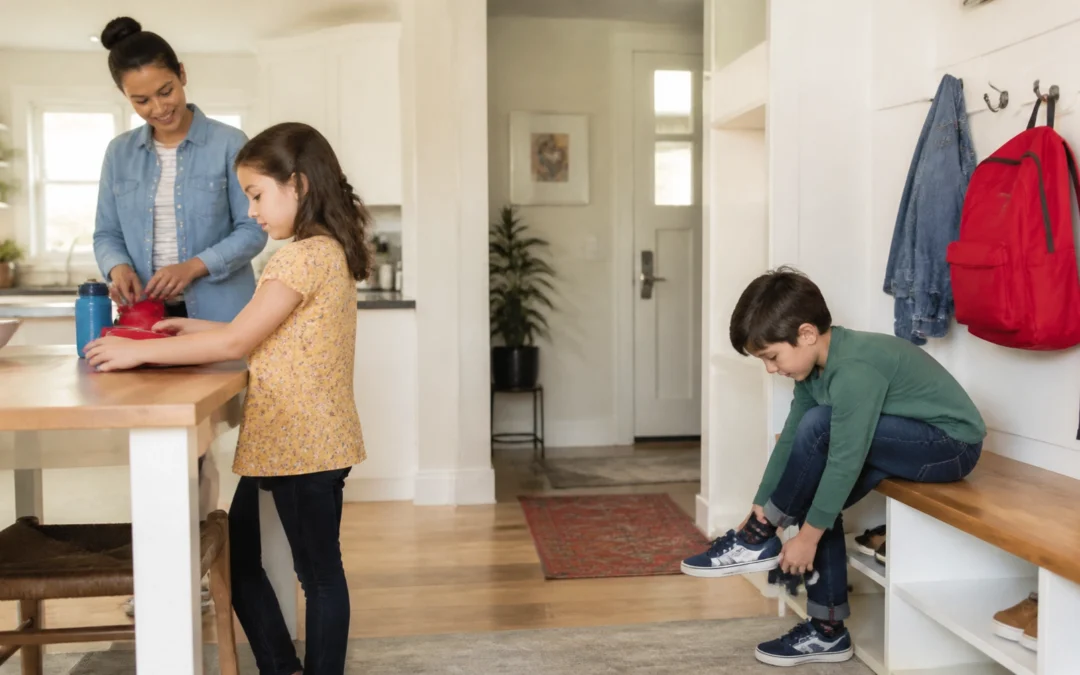
  • Let your child practice self-care tasks like dressing, putting on shoes, or packing their backpack.
  • Set up a small station at home where your child can keep school essentials (like their lunchbox or water bottle) within easy reach.
  • Invite your child to help prepare snacks or lunch, giving them ownership over part of their school day.

4. Manage Your Own Emotions

Children are attuned to their parents’ feelings. If you’re anxious about the transition, your child will sense it. Take time to reflect on your own worries or hopes for the year ahead. It’s perfectly natural to have mixed emotions—especially if your child is entering school for the first time.
Share your confidence in your child’s abilities, and model curiosity and positivity about the year to come.

5. Reconnect with the School Community

If your school hosts back-to-school events, meet-the-teacher days, or classroom orientations—attend if you can. Seeing familiar faces and spaces helps your child feel part of a larger community.

Even if your school doesn’t have formal events, you might:

  • Schedule a playdate with classmates
  • Review any welcome materials or classroom newsletters
  • Refresh your understanding of Montessori methods, so you can speak the same language your child will hear at school

6. Prepare Practical Needs in Advance

Take time to ensure your child has everything they need to start comfortably:

  • A weather-appropriate wardrobe that allows freedom of movement
  • A comfortable, easy-to-use backpack
  • A reusable water bottle
  • A simple lunchbox they can open independently, if applicable

Label belongings to avoid mix-ups and teach your child how to recognize their things.

7. Normalize First-Day Feelings

Even seasoned students can have jitters on the first day. Normalize those feelings by saying things like:

“It’s okay to feel a little nervous when we start something new. I feel that way sometimes too! Let’s think about what you’re excited to do this year.”

Remind your child that teachers are there to help and that feeling unsure at first is a normal part of learning.

8. Trust the Process

Finally, remember that Montessori education is a journey. The first few days and weeks are often a period of adjustment as children reorient to the classroom and reconnect with their community.

Be patient with your child—and with yourself. Trust that the gentle rhythms of the Montessori environment will help them settle in, find their footing, and flourish.

A Year of Growth Awaits

Starting strong doesn’t mean everything must be perfect from day one. It means creating a foundation of confidence, routines, and connection that supports your child’s growth—not just academically, but socially and emotionally too.

By preparing with care and intention, you’re giving your child the tools to step into the school year with excitement and assurance—and that’s a gift that lasts well beyond the first day.


Back to School Readiness Checklist

Prepare Your Child—and Yourself—for a Great Start to the Montessori Year

1. Reestablish Routines

☐ Adjust bedtime and wake-up times 1-2 weeks before school starts
☐ Practice morning and evening routines
☐ Reintroduce limits on screen time for calmer evenings

2. Prepare Practical Skills

☐ Practice getting dressed independently
☐ Practice opening lunch containers, snack bags, and water bottles
☐ Encourage self-care tasks like brushing teeth and hair

3. Organize for Independence

☐ Set up a child-friendly station for school essentials (backpack, shoes, lunchbox)
☐ Label personal items with your child’s name
☐ Organize a spot for your child to prepare or pack their lunch with your help

4. Emotional Preparation

☐ Talk positively about the upcoming school year and classroom community
☐ Share what the daily routine will look like
☐ Read books about starting school or returning after a break

5. Reconnect with the School

☐ Attend any back-to-school events or orientations
☐ Refresh your understanding of Montessori principles
☐ Review any materials or updates sent by the school

6. Home Environment Refresh

☐ Declutter play spaces to encourage focus and order
☐ Rotate toys and materials to keep interest fresh
☐ Create quiet spaces for reading or independent play

7. Mindset for Parents

☐ Reflect on your own feelings about the new school year
☐ Prepare to support your child with patience during transitions
☐ Plan to check in with your child’s guide if you have questions or concerns

Bonus Tip:
Create a “First Day of School” tradition—like a special breakfast or a family photo—to start the year with joy and celebration.


Why Sleep Matters in Early Childhood Development: What Parents Should Know

Why Sleep Matters in Early Childhood Development: What Parents Should Know

parent and teacher

This is a brief summary of “The Brain Architects” podcast by The Center on the Developing Child at Harvard University. This particular episode was titled “Why Sleep Matters in Early Childhood Development: A Discussion on the Main Ways Sleep Affects Early Childhood Health and Well-being.” It was published July 28, 2025


Sleep isn’t just a daily necessity—it’s a fundamental part of how young children grow, think, feel, and learn. In a recent episode of The Brain Architects podcast, produced by the Center on the Developing Child at Harvard University, host Emilia Johnson sat down with two leading researchers in the science of sleep: Dr. Lindsay Burkhart, the Center’s Chief Science Officer, and Dr. Rebecca Spencer, a professor of cognitive neuroscience at the University of Massachusetts Amherst.

Their conversation revealed just how critical sleep is in shaping early brain development and highlighted practical takeaways for parents, caregivers, educators, and policymakers. Below is a synthesis of their discussion, filled with insights that every parent should know.


Why Sleep is So Powerful

Dr. Spencer began by explaining that sleep occupies about a third of our lives—an indicator that it must serve essential functions beyond just rest. While awake, our brains multitask constantly. But during sleep, the brain gets a unique chance to process and consolidate information in a protected, distraction-free environment. Sleep allows for:

  • Faster memory consolidation: Tasks that take seconds while awake happen 10 times faster during sleep.

  • Emotional regulation: Processing experiences and emotions while sleeping leads to calmer, more resilient behavior during the day.

  • Physical growth and immune function: Especially in young children, sleep supports growth hormones and helps build strong immune systems.

Sleep is not one single uniform state. It includes multiple stages—like deep (slow wave) sleep and REM (rapid eye movement)—each of which supports different brain functions. Dr. Spencer emphasized that these varied stages together create an “exponential capacity” for the brain to heal, grow, and learn.

Sleep in Infancy: More Than Just a Nap

Infants can sleep up to 20 hours a day, and there’s good reason for that. Dr. Spencer explained that everything is new to a baby—sights, sounds, feelings, and sensations. Babies don’t just absorb experiences; they build the very scaffolding of understanding on which all future learning will rest. Sleep is when that scaffolding is reinforced.

Importantly, sleep also helps prune synapses—streamlining the brain’s networks for efficiency. This is a “smart” process, selecting which connections to keep and which to let go. And much of that decision-making seems to happen during sleep.


Sleep Starts Before Birth

Dr. Spencer highlighted important research—such as studies led by Dr. Caroline Hriniak at Washington University—showing that maternal sleep during pregnancy can directly affect a baby’s sleep and even their social-emotional development. Mothers who experience “circadian disruption” (like shift workers with irregular sleep patterns) are more likely to have infants with sleep disturbances and mood regulation challenges.

Still, Dr. Spencer reassured listeners that not all is lost if circumstances aren’t perfect. Protective factors—like adequate nutrition, rest when possible, and emotional support—can buffer the impact. And postnatal sleep environments and routines remain powerful influences.


Naps Are Not Optional for Young Children

One of the most striking takeaways from the episode is just how essential naps are for toddlers and preschoolers. Dr. Spencer’s research shows that naps do more than rest the body—they protect memories and emotional health.

Here’s why:

  • Memory protection: Habitual nappers (typically toddlers and younger preschoolers) suffer measurable memory loss if deprived of their nap. The brain simply can’t hold onto new information without offloading some of it during daytime sleep.

  • Emotional reset: Children who nap are less emotionally reactive. That “clean slate” effect after a nap helps them handle peer conflict, frustration, or overstimulation with greater self-control.

  • Cognitive processing: Naps help children generalize what they learn—like understanding that “dog” means more than just the family beagle, but all dogs.

As Dr. Spencer put it, a young child’s brain is like a small bucket—it fills quickly and spills over unless emptied (or rather, sorteLO. Some children may need naps again temporarily during developmental leaps.


Sleep Disruption and Its Impact

Whether due to illness, inconsistent routines, or overstimulation, disrupted sleep can pause or even regress a child’s learning temporarily. The good news: once good sleep resumes, children often catch up. That said, chronic disruption—especially in sensitive windows of development—can have longer-lasting effects.

Dr. Spencer pointed to an intriguing nonprofit initiative called Bedtime Math, which encourages children to practice simple math problems before bed. This kind of cognitive “priming” takes advantage of the brain’s natural memory processing during sleep, showing that we can also harness sleep to boost learning—not just avoid setbacks.


Light, Screens, and Bedtime Routines

A recurring theme throughout the discussion was light sensitivity, especially in early childhood. Research by Dr. Lauren Hartstein (Arizona State University) shows that children are significantly more sensitive to light than adults. Even small amounts of light before bed can interfere with the natural release of melatonin—the hormone that cues the body to fall asleep.

Tips for parents:

  • Dim lights 45 minutes before bedtime: Create a low-light environment to encourage melatonin production.

  • Avoid screens: Tablets and smartphones not only emit disruptive blue light, but they are also overstimulating—offering novelty and excitement when children need calming and routine.

  • Choose familiar bedtime stories: Repetition helps cue the brain for sleep. Save new books or exciting content for daytime.


What About Melatonin Supplements?

Dr. Spencer was emphatic on this point: don’t give children over-the-counter melatonin. Here’s why:

  • It is not regulated by the FDA, meaning dosage and ingredients can be inaccurate or contaminated.

  • It is easily misused. Melatonin isn’t a sleeping pill—it’s a clock setter. It must be taken at the same time every day to have any effect on circadian rhythms.

  • Too much melatonin is not better. High doses can disrupt natural melatonin production and cause additional sleep problems.

Prescription melatonin may be appropriate in certain cases (e.g., for children with autism or sensory processing disorders), but only under pediatric supervision.


Temperature and Sleep

Another overlooked factor is temperature regulation. To fall into deep sleep, the body needs to lower its internal temperature. If a child’s sleep environment is too warm—whether due to external heat, too many layers, or over-swaddling—they may struggle to reach restorative sleep stages.

Recommendations include:

  • Keep bedrooms cool—ideally between 64 and 68°F.

  • Avoid over-swaddling or heavy pajamas in warm rooms.

  • Layer lightly so children can regulate their own temperature (e.g., by kicking off a blanket).

Advocating for Sleep in Schools and Policy

As the conversation turned toward childcare and early education settings, Dr. Spencer raised a critical issue: naps are often undervalued in preschool and pre-K environments, especially in state-funded universal pre-K programs.

Some states don’t even require nap opportunities in their curriculum. Yet if naps protect memory, support emotional regulation, and boost cognitive function, then skipping them undermines the very educational goals those programs aim to achieve.

Dr. Spencer called for:

  • Quieter, more sleep-conducive nap environments in childcare centers.

  • Training for staff to understand that naps are educational, not just logistical.

  • Policy changes that include sleep as a developmental and educational priority, not an optional break.

What Parents Can Do

Based on the insights shared by Dr. Spencer and Dr. Burkhart, here’s what parents can do to support healthy sleep in their children:

Respect nap needs, even if inconsistent. Let children nap if they show signs of fatigue—even if they skipped it the day before.
Create a consistent bedtime routine that includes 45 minutes of dim light.
Avoid screens before bed—use calming, familiar books instead.
Keep bedrooms cool, quiet, and dark.
Avoid over-the-counter melatonin, unless prescribed by a pediatrician.
Advocate for nap time in childcare settings and schools.

Sleep is not just rest—it’s an active, essential part of your child’s development. Supporting healthy sleep from pregnancy through early childhood can lay a foundation for learning, emotional resilience, and well-being that lasts a lifetime.


To Learn More
Visit the Center on the Developing Child at Harvard University (https://developingchild.harvard.edu/) and explore The Brain Architects podcast for more conversations on how science can shape better futures for all children.


Starting the Year Right: Building Parent Confidence, Trust, and Engagement

Starting the Year Right: Building Parent Confidence, Trust, and Engagement

parent and teacher

When a new school year begins, every interaction with a parent is an opportunity to build—or erode—trust. For families, this trust is not just about whether their child will learn but whether their child will be truly seen. They want to know that their child’s teacher notices the sparkle in their eyes, the way they carefully line up their crayons, or how they worry about trying something new.

Trust grows in moments, not just meetings.

As teachers, we shape the emotional environment of our classrooms. But we also shape the emotional connection with our families. And when parents feel confident in us, they become our greatest allies. They offer grace when something goes wrong. They speak positively about the school. They stick with us. And they advocate for us in the wider community.

Here are some ways to set that foundation—before school starts, during the first days, and throughout the year.


Before the School Year Begins: Planting Seeds of Connection


Even before you meet a child, you can build a bridge to their family. A warm welcome email, a video greeting, or a quick call tells parents: “I’m thinking about your child already.” It sets the tone that this relationship will be personal, thoughtful, and kind.


Before-School Connection Checklist

  • Send a warm welcome letter or video to each family
  • Invite families to a “Meet the Teacher” session or classroom preview
  • Ask each family:
    Did anything happen over the summer that I should know?
    Are there any concerns you’d like me to keep an eye on?
    What are your hopes or goals for your child this year?

Schedule short welcome calls with returning families

Send a class-wide email introducing routines, materials, and key dates

Tip: You don’t need to wait for parents to initiate communication. Be the one who reaches out first, and you’ll make it easier for them to come to you when it matters most.


First Days of School: Creating Emotional Safety

Drop-off is full of emotions—joy, worry, pride, and sometimes tears (from both children and parents). These moments are when your calm presence is most powerful. Greet each child by name. Make eye contact with their parent. Smile. These small rituals become touchstones of trust.

By the end of the first day or two, share something—anything—personal with parents. A brief note, such as “Emma spent 15 minutes carefully washing the classroom leaves this morning,” is more effective than a lengthy newsletter.

First Week Checklist
Personally greet each family upon arrival.
Send a short note or email after Day 1 or 2
Share a photo of each child engaged in purposeful work
Highlight one moment of effort, joy, or curiosity for each child

Parents are wondering:

Is my child happy?
Is my child seen?
Does this teacher understand them?

We can answer “yes” with every interaction.


The First Month: Build Habits That Strengthen the Bridge

It’s easy to get swept up in classroom life and forget to communicate with families until there’s a problem. But by creating habits early—like sharing good news weekly or reaching out personally to a few families—you avoid that disconnect.

Even a simple note that says, “Saw Maya peacefully reading for 10 minutes today,” can deepen a parent’s confidence tenfold.

First Month Communication Checklist

Send your first monthly class newsletter with photos and stories
Personally reach out to 5 families per week
Track communication so all families are included over time
Begin logging short “good news” moments for each child

 Tip: Keep a “sunshine folder” on your desk. When you notice something joyful, write it down right away. These are the stories that parents treasure—and the ones they’ll remember when hard conversations arise later.


Everyday Magic: Personal Notes, Good News, and Shared Joy

Monthly newsletters are expected. But it’s the unexpected note on a Monday morning or the candid photo of a child’s quiet focus that creates magic. Parents are not in the classroom—but through you, they can glimpse its beauty.

Don’t overthink it. A sticky note. A quick text. A one-line email. These all say: “Your child is known.”

Ongoing Connection Checklist

Send one personal message per child each month (email, phone, note)
Capture 1–2 candid photos weekly and save them to share
Use a secure platform for sharing media with families
Send monthly group emails with photos, stories, and upcoming activities
Keep notes on communication in your planner or digital log

Sample Notes to Parents:

“Saw Elijah helping a friend clean up today—so gentle and kind.”
“Sofia independently rolled up her work rug and put it away perfectly!”
“Rohan told me all about his trip to the mountains. He was beaming.”


Weekly Family Communication Plan

To make all of this sustainable, structure your week. Here’s a sample plan to help you pace your efforts and ensure no family is left behind:

Personal note/email to 1 parent ✓ ✓ ✓ ✓ ✓
Observe and log “good news” moments ✓ ✓ ✓
Take 1–2 candid photos of classroom work ✓ ✓ ✓
Log contacts in your communication tracker ✓ ✓

Adapt this to your own schedule—but keep it consistent. Small weekly actions add up to deep trust.


Why It Matters

When parents feel seen and heard:

They are more patient and collaborative
They trust your judgment and classroom decisions
They’re less anxious and more engaged
They’re more likely to stay with your school

Even more important: when parents feel their child is known and loved, they relax. That ease ripples out into the home. It fosters consistency, emotional security, and mutual respect between school and family.


Lead with Heart, Follow with Habit

This isn’t about being perfect. It’s about being present.

You don’t need to write daily essays or send weekly photo albums. You just need to keep showing up with curiosity, empathy, and intention. What you do in August and September lays the foundation for the rest of the year.

And that foundation isn’t built on policies or procedures. It’s built on trust, communication, and the quiet message you send every day:

“I see your child. And I care.”

What the Brain Reveals About Montessori

What the Brain Reveals About Montessori

leader with list

A Conversation with Dr. Ann Epstein on Creativity, Thinking, and Memory

By Tim Seldin

I recently had the pleasure of speaking with Dr. Ann Epstein of the University of Wisconsin, a longtime researcher and advocate for high-quality early education. Our conversation turned to some fascinating new studies coming out of Europe and the U.S. that shed light on how different educational approaches actually shape the developing brain. What’s emerging, thanks to researchers like Dr. Solange Denervaud and her colleagues in Switzerland and at Penn State, is compelling scientific evidence for what Montessori educators have observed for over a century: the Montessori approach does more than help children learn well—it appears to support deep, lasting brain development tied to memory, creativity, and flexible thinking.

Dr. Epstein shared two recent studies with me, and I want to pass along what I learned from her. These findings offer new insights—not just affirming what we already know about Montessori education, but potentially helping us understand why it works so well.

Creativity and the Developing Brain: What the Science Shows

The first study Dr. Epstein pointed me to was Creative Thinking and Brain Network Development in Schoolchildren, published in Developmental Science (Duval, Denervaud, et al., 2023). The researchers used both behavioral assessments and fMRI brain scans to compare 75 children aged 4 to 18 from Montessori and traditional schools. The results confirmed what previous research has suggested: Montessori students tend to score higher on measures of creative thinking. But what’s truly remarkable is what was happening in their brains.

Children in Montessori classrooms showed more balanced and flexible activation across three key brain networks involved in creativity:

  • The Default Mode Network (DMN), which supports internal thought, imagination, and self-reflection. 
  • The Executive Control Network (ECN), which supports working memory and decision-making. 
  • The Salience Network (SN), which helps the brain decide what to pay attention to. 

Children from traditional school environments, by contrast, tended to spend more time in a static or introspective mode (high intra-DMN activity), suggesting less flexibility in switching between idea generation and evaluation. Montessori students, meanwhile, moved more fluidly between networks—exactly the kind of dynamic thinking that supports creativity, problem-solving, and adaptability.

This isn’t just academic. As Dr. Epstein reminded me, creative thinking is essential—not just for artists or inventors, but for anyone navigating a complex and ever-changing world. And these findings suggest that Montessori schools may be doing something unique to nurture it.

Memory: Learning by Heart or With Heart?

The second study Dr. Epstein shared was Learning by Heart or With Heart: Brain Asymmetry Reflects Pedagogical Practices, published in Brain Sciences (Schetter, Denervaud, et al., 2023). This paper looked at another important dimension: how children remember and organize what they learn.

Using structural MRI scans, the researchers measured differences in the parahippocampal cortex (PHC), a brain region involved in memory and learning. Children in Montessori classrooms showed a developmental trend toward left-hemisphere asymmetry in the PHC—associated with semantic memory (understanding concepts, generalizing ideas). In contrast, children from traditional schools showed right-hemisphere asymmetry—linked to episodic memory (recalling specific events or rote sequences).

What does that mean? According to Dr. Epstein, the data suggest that Montessori children are more likely to encode meaning, while children in traditional classrooms are more likely to recall isolated facts or events. It’s a difference between knowing and understanding—and it shows up in the structure of the brain.

Montessori students also tend to perform better on recognition tasks and show more interconnected and flexible semantic networks, according to earlier research by Denervaud and colleagues. That flexibility—how easily children link ideas together and transfer learning from one context to another—is at the heart of real-world problem-solving.

Why Might Montessori Make a Difference?

As Dr. Epstein and I discussed, the studies don’t claim that Montessori is the only path to healthy brain development. But they do suggest that some key features of Montessori classrooms may be contributing to these positive outcomes:

  • Multi-age classrooms and peer collaboration, which support social-emotional development and flexible thinking. 
  • Uninterrupted work periods, which promote sustained attention and deeper engagement. 
  • Freedom of movement and choice, which align with how the brain learns best: through agency and active exploration. 
  • Respectful adult-child relationships, where teachers serve as guides rather than lecturers—a factor Angeline Lillard highlights in The Montessori Handbook (Bloomsbury, 2021). 
  • Calm, well-ordered environments, which reduce behavioral disruptions and allow children to focus, regulate, and retain more of what they learn. 

From Dr. Epstein’s perspective, one of the most interesting questions ahead is why these differences arise. Is it the materials? The mixed-age grouping? The training of the teacher? Likely, it’s the synergy of all of the above. Montessori isn’t just a set of techniques—it’s a whole system designed around how children actually grow and learn.

A Word of Caution—and of Encouragement

It’s important to note, as Dr. Epstein emphasized, that this research is still developing. We need longitudinal studies to follow children into adulthood and determine how these early neural patterns play out over time. But even now, these findings offer a rare window into the deeper “how” behind Montessori’s effectiveness.

For parents, it’s an opportunity to see that the choice of school is about more than academics or test scores. Montessori may help your child build a brain that’s not just smarter—but more creative, more adaptable, and more capable of seeing the bigger picture.

And for teachers, these findings can be affirming. What you do each day—the grace with which you guide, the calm you maintain in your classroom, the respect you offer to each child—is quite literally helping shape the architecture of a developing mind.

We’ve always known that Montessori education works. We’ve seen it in the confidence, curiosity, and calm focus of our students. Now, thanks to researchers like Dr. Denervaud and advocates like Dr. Epstein, we’re starting to see why.

And the answer, it seems, is written not just in observation notes or test scores—but in the very folds and rhythms of the growing brain.


If you’re curious to learn more about these studies, I encourage you to watch the video summary from Dr. Denervaud’s team on creativity and the brain: https://www.youtube.com/watch?v=xWV_5o8wB5g. Or, better yet, talk with your child’s Montessori teacher. They’re your partner in this extraordinary journey.


When Children Seem Indifferent: A Montessori Response to the Telegraph’s Article on Early Signs of Psychopathy

When Children Seem Indifferent: A Montessori Response to the Telegraph’s Article on Early Signs of Psychopathy

defiant child


By Tim Seldin


I wrote this in response to an article in The Telegraph discussing early signs that a very young child may be showing signs of psychopathy. As the research suggests, such behavioral patterns suggest the possibility that a disorder might develop, and invite us to provide positive experiences that may lead to more positive social development. Most of us come across children who seem to be aggressive and/or uncaring. As Montessori educators, we work hard to encourage self-esteem, self-regulation, and nonviolent/pro-social behavior and attitudes.


Snapshot: Psychopathy is a personality disorder characterized by a constellation of traits including impaired empathy, lack of remorse, antisocial behavior, and manipulative tendencies. It’s often associated with reduced emotional responses and poor behavioral controls, which can lead to criminal behavior. While not a formal clinical diagnosis in the DSM-5, it’s closely related to Antisocial Personality Disorder (ASPD) and is often used to describe a severe subtype of ASPD.


On July 27, 2025, The Telegraph published a provocative article by Eleanor Steafel titled “The Signs That Three-Year-Olds Might Be on the Path to Becoming Psychopaths.” The piece summarizes research led by Professor Essi Viding, a developmental psychopathologist at University College London, whose work focuses on identifying early markers of antisocial behavior— particularly what are known as callous-unemotional (CU) traits in children as young as three or four.

For those of us in Montessori education, such headlines naturally raise questions. Is this kind of labeling helpful? What does the science actually say? And how can we, as Montessori educators, respond thoughtfully when a child in our care seems indifferent to others’ feelings or exhibits challenging behavior?

Let’s take a closer look at what the research shows—and how our understanding of child development in Montessori settings offers both reassurance and guidance.

What Are Callous-Unemotional Traits?

CU traits are a specific cluster of behaviors linked to low empathy, reduced sensitivity to others’ distress, and a limited emotional response. Professor Viding and her colleagues have explored these patterns extensively through twin studies and neurobiological research. While they are careful not to label children as “psychopaths”—a term that applies only to adults—their findings suggest that some children show early behavioral and emotional tendencies that, without support, may increase their risk of persistent conduct problems.

In particular, children with high CU traits may:

  • Appear less emotionally responsive to others’ sadness or fear


  • Struggle to regulate their own frustration


  • Engage in aggressive or harmful behavior without seeming remorseful


  • Seem unmotivated by pleasing adults or doing kind things for others


Professor Viding’s research, published in journals such as The Journal of Child Psychology and Psychiatry and Development and Psychopathology, indicates that these traits may have a strong genetic component. However, she emphasizes that no one is born a psychopath and that both biology and environment interact in complex ways to shape a child’s development.

What This Doesn’t Mean

The Telegraph article touches on a parental fear many readers likely share: What if my difficult or unempathetic child is on the path to something darker?

It’s important to distinguish between developmentally typical behavior and signs of concern. Three-year-olds frequently hit, grab toys, cry when they don’t get their way, or struggle to apologize. These are not signs of psychopathy—they’re signs of being three.

Montessori educators understand that early childhood is a period of tremendous emotional and social development. The ability to take another’s perspective, regulate impulses, and respond with empathy emerges gradually and unevenly, especially in the first plane of development (birth to age six). Some children need more time, modeling, and support than others.

A Montessori Lens: Behavior as Communication

In Montessori classrooms, we don’t see behavior as good or bad—we see it as a window into the child’s needs, struggles, and developmental progress. When a child hits another, laughs when someone is hurt, or refuses to share, we don’t leap to judgment. We observe. We ask: What is this child trying to communicate? What tools are they missing? What might they need from us?

Children exhibiting early signs of emotional disconnection may:

  • Feel overwhelmed in group settings


  • Have difficulty interpreting social cues


  • Lack a sense of security or attachment


  • Be mirroring behaviors seen in their environment


Rather than attempting to diagnose or label, we respond by preparing a calm, consistent, emotionally supportive environment where trust and connection can grow. We offer Grace and Courtesy lessons to help children practice prosocial behavior. We model empathy, invite reflection, and support self-regulation through hands-on work and individualized guidance.


What the Research Does Support: The Power of Warm Relationships

One of the most hopeful takeaways from Professor Viding’s work is that intervention matters—especially early and especially when grounded in warm, emotionally attuned relationships. Several studies have shown that children at genetic risk for CU traits are far less likely to develop severe antisocial behaviors if raised in nurturing, responsive caregiving environments.

In other words, relationships protect. Children who may struggle to feel what others feel can still learn to understand social dynamics, experience belonging, and adopt compassionate behaviors—particularly when they feel safe and seen by the adults around them.

This is where Montessori schools can shine. We are uniquely positioned to offer children a consistent, respectful, emotionally attuned environment that values connection, responsibility, and self-awareness. Our approach doesn’t rely on rewards or punishments. Instead, we guide behavior through deep observation, empathy, and purposeful activity.

Instead of asking, “What’s wrong with this child?” we should be asking, “What does this child need from me right now?” That shift changes everything. A child who seems disconnected may not lack empathy. They may be overwhelmed, dysregulated, or struggling to feel safe in their body or environment. What may look like defiance or indifference is often a call for connection. In Montessori, we don’t rush to fix or label. We prepare ourselves, prepare the environment, and meet the child with curiosity, not judgment.


As Dr. Bruce Perry reminds us, “The more healthy relationships a child has, the more likely he will be to recover from trauma and thrive. Relationships are the agents of change, and the most powerful therapy is human love.” His work on developmental trauma reinforces what Montessorians know to be true: it is the environment and especially the attuned adults within it that shape a child’s development and emotional resilience.


Supporting Children with More Complex Needs

That said, we will sometimes encounter children whose behavior goes beyond what we’d expect developmentally. They may be persistently aggressive, seem disconnected from the emotions of others, or show a pattern of behavior that doesn’t improve with typical Montessori guidance.

In those cases, it’s appropriate to:

  • Document what you observe clearly and factually


  • Meet with the child’s family early, with compassion and partnership


  • Recommend professional consultation when needed (e.g., pediatrician, psychologist, developmental specialist)


  • Continue offering a consistent, calm, and inclusive classroom experience


Even when a child is receiving outside support, our role remains essential. A stable school environment, grounded in trust and respect, can be a critical protective factor.

At the same time, we must acknowledge a very real and often complex tension: the need to support the child who is struggling, while also protecting the physical and emotional well-being of the other children in the community. Montessori classrooms are built on trust, and when one child’s behavior becomes consistently aggressive, disruptive, or unpredictable, it can create fear and anxiety for others. Our responsibility is not only to the individual child, but to the group as a whole. This requires careful observation, close collaboration with the family, and often the addition of extra support—whether through shadowing, shortened days, or consultation with specialists. We work to create a plan that prioritizes safety and security for everyone, without isolating or shaming the child in question. When successful, this approach allows the child to remain in the community, while gradually learning new strategies for managing their emotions and impulses—surrounded by adults and peers who continue to believe in their capacity for growth.

Replace Fear with Understanding

The Telegraph’s article might alarm some readers. But from a Montessori perspective, it invites a more profound reflection: How do we respond when a child seems disconnected? How do we hold compassion when a child’s behavior pushes our buttons? And how do we protect the dignity of every child, even those who are struggling the most?

The answer lies not in labels, but in relationships. Not in fear, but in understanding. Not in punishment, but in preparation—of the environment, the adult, and the heart.

No child is beyond help. And every child deserves to be seen, supported, and believed in.


References and Sources

  • Steafel, Eleanor. The Signs That Three-Year-Olds Might Be on the Path to Becoming Psychopaths. The Telegraph, July 27, 2025.


  • Viding, E., Blair, R.J.R., Moffitt, T.E., & Plomin, R. (2005). Evidence for substantial genetic risk for psychopathy in 7-year-olds. Journal of Child Psychology and Psychiatry, 46(6), 592–597.


  • Viding, E., & McCrory, E.J. (2019). Towards understanding atypical social affiliation in psychopathy. The Lancet Psychiatry, 6(5), 437–444.


  • Hyde, L.W., Waller, R., & Trentacosta, C.J. (2016). Trajectories of callous-unemotional traits in early childhood: Predictors and outcomes. Journal of Child Psychology and Psychiatry, 57(2), 203–210.


Managing Difficult Conversations with Clarity and Compassion

Managing Difficult Conversations with Clarity and Compassion

leader with list

By Tim Seldin

Snapshot: Difficult conversations with parents are inevitable in school leadership, but they don’t have to damage relationships. This brief essay provides private school leaders with a proven framework for transforming challenging discussions into partnership opportunities through thorough preparation, empathetic listening, and collaborative problem-solving that preserves trust while addressing concerns effectively.

Every private school leader knows the feeling—that knot in your stomach before a challenging conversation with parents about their child’s struggles. These moments test not only our communication skills but our ability to preserve the trust families place in us when they choose our school.

The difference between conversations that strengthen partnerships and those that fracture them often lies not in what we say, but in how we approach them. When we shift from viewing these discussions as problems to solve to opportunities for deeper collaboration, everything changes.

Prepare YOurself

Managing difficult conversations effectively begins long before parents enter your office. Proper preparation goes beyond gathering facts—it requires understanding the whole child and examining your own readiness to lead with empathy.

Gather comprehensive insights. Consult with teachers, counselors, and specialists who work with the child. Observe the student directly in various settings. Look for patterns, strengths, and contextual factors that might influence their behavior or academic performance.

Examine your internal state. Maria Montessori spoke of the “spiritual preparation” of the adult—a practice more relevant than ever. Before difficult conversations, honestly assess your own mindset. Are you carrying frustration, judgment, or preconceived notions? These internal states inevitably surface in conversation, often derailing dialogue before it begins.

Document objectively. Prepare specific, observable examples rather than general impressions. “Sarah often appears withdrawn during group discussions and has missed several assignment deadlines” is more helpful than “Sarah seems unmotivated.”

Creating the Right Environment

The physical and emotional environment shapes every conversation. A hurried hallway encounter or interruption-filled meeting sends the wrong message about priorities and respect.

Choose your setting deliberately. Meet in a private, comfortable space where all parties can sit at the same level. Ensure adequate time—rushed conversations rarely resolve anything and often create more problems.

Leverage your relationship foundation. The most difficult conversations become manageable when built on a foundation of trust. Regular positive interactions with families—what some call “emotional bank deposits”—make challenging discussions possible.

The Opening: Affirmation and Shared Purpose

How you begin sets the tone for everything that follows. Lead with appreciation and establish collaborative intent from the first words.

Start with genuine appreciation: “Thank you for taking time to meet with us. We’re grateful for your partnership and want to begin by sharing how much we value having Emma as part of our school community. Today, I’m hoping we can work together to explore some observations we’d like to discuss.”

Establish shared purpose: Make it clear you’re not there to criticize or blame, but to collaborate in service of their child’s growth and happiness.

The Heart of Dialogue: Deep Listening First

One of the most potent tools for challenging conversations costs nothing but transforms everything: genuine listening.

Invite their perspective first. Ask parents what they’ve observed at home, how they’re feeling about their child’s experience, and what concerns they might have. Often, parents are already aware of struggles and may even feel relieved to discuss them openly.

Listen for emotions, not just facts. Pay attention to underlying feelings—fear, frustration, disappointment, or confusion. Acknowledging these emotions validates parents’ experience and builds connection.

Resist the urge to problem-solve immediately. Create space for parents to fully express their thoughts before offering your observations or suggestions.

Sharing Your Perspective: Observations, Not Judgments

When it’s time to share your concerns, how you frame them determines whether parents become defensive partners or collaborative allies.

Use specific, observable language: Instead of “Alex is disruptive,” try “During yesterday’s math lesson, Alex called out answers without raising his hand three times, and when redirected, he put his head down on his desk.”

Avoid diagnostic language: Unless you’re a qualified professional making an official assessment, stick to behavioral observations rather than clinical terms or labels.

Frame concerns as puzzles to solve together: “We’re noticing some patterns that we’d love to understand better, and we’re hoping your insights might help us piece together what’s happening.”

When Defensiveness Arises: Responding with Empathy

Even with the best approach, some parents will become defensive. This is natural—you’re discussing their most precious relationship. Respond with understanding, not resistance.

Use the “Feel, Felt, Found” approach:

  • Feel: “I can understand how concerning this must be to hear.”
  • Felt: “Many parents I’ve worked with have shared similar feelings when we’ve discussed their child’s challenges.”
  • Found: “What we’ve consistently found is that when families and schools work together, we see remarkable progress.”

Validate without agreeing: You can acknowledge their emotions without accepting blame or criticism. “I hear how frustrated you are, and I want to understand better what’s contributing to that feeling.”

The Art of Collaborative Problem-Solving

The most effective solutions emerge from genuine collaboration, not expert prescription.

Explore rather than conclude: Instead of “Here’s what needs to happen,” try “Let’s explore some possibilities together. What approaches have worked well for Emma at home?”

Build on family strengths: Ask about successful strategies parents have used, then consider how to adapt them for the school environment.

Create shared ownership: Develop action plans that include specific roles for both school and family, with clear timelines and check-in points.

When Conversations Stall: The Power of the Pause

Sometimes, despite your best efforts, conversations become unproductive. Knowing when and how to pause protects relationships while creating space for a reset.

Recognize the signs: Rising voices, repeated arguments, or withdrawal often signal the need for a break.

Pause gracefully: “I can see we’re both deeply invested in Sarah’s success, and right now we’re struggling to find our way forward together. I’d like to pause here and schedule another meeting when we can approach this with a fresh perspective.”

Preserve dignity: Never make parents feel dismissed or defeated. Frame the pause as caring for the relationship, not giving up on solutions.

Closing with Clarity and Commitment

How you end difficult conversations matters as much as how you begin them.

Summarize clearly: Review key points discussed, agreements reached, and any different perspectives that emerged.

Define next steps specifically: Who will do what, by when, and how will you measure progress? Vague agreements lead to future frustration.

Reaffirm partnership: Close by restating your commitment to their child’s success and your appreciation for their collaboration.

Follow-up in writing: Send a brief summary email within 24 hours to ensure shared understanding and accountability.

The Deeper Purpose: Partnership No Matter What

Beyond any single conversation lies a more fundamental commitment—to remain steadfast partners in service of every child, especially when the path becomes challenging.

As Montessori reminded us, we must “purify our hearts and render them burning with charity.” This isn’t mere sentiment but practical wisdom. When parents feel our genuine care and commitment to their child, even difficult conversations become opportunities for deeper trust.

Making It Sustainable: Building Systems for Success

Individual conversations matter, but sustainable change requires systems that support consistent, compassionate communication:

  • Train all staff in empathetic communication techniques
  • Create templates and protocols that ensure consistency while preserving authenticity
  • Schedule regular relationship-building touchpoints with families before problems arise
  • Debrief difficult conversations with colleagues to improve approaches continually

The Long View: Transforming School Culture

When private school leaders consistently approach difficult conversations with preparation, empathy, and genuine partnership, something remarkable happens. The school culture itself begins to shift. Parents feel safer bringing concerns forward earlier. Teachers develop stronger communication skills. Students sense the collaborative spirit between their most important adults.

These conversations, handled well, don’t just solve immediate problems—they model the kind of thoughtful, compassionate communication we hope to nurture in our students. In this way, every difficult conversation becomes an opportunity to live our educational values, not just teach them.

Remember: the goal isn’t to avoid difficult conversations but to approach them as sacred opportunities to deepen understanding, strengthen partnerships, and ultimately serve the children we’re all committed to nurturing.

A Matter of Choice: Why Families Search for the Right School

A Matter of Choice: Why Families Search for the Right School

leader with list

By Tim Seldin

The American school system is at a crossroads.

At the center of the debate is a question that feels both intensely personal and profoundly political: Where should my child go to school?

For some families, the answer is obvious — the neighborhood public school down the street. For others, the path winds through charter programs, magnet schools, scholarships, or private schools with distinct missions and philosophies. And for still others, the answer requires sacrifices most people never see — second jobs, forgone vacations, small apartments in expensive zip codes — all for the sake of what they believe is a better fit for their child.

So what’s really going on behind these choices? Why do some families stick with public schools, despite mounting frustrations, while others scrape and sacrifice to seek out something different? Why is there so much judgment — and misunderstanding — on all sides?

Let’s talk about it.

“We Wanted Something More”

Anna and Luis, parents of two boys in a quiet Florida suburb, never thought they’d consider private school.

“I went to public school. My husband did. We believe in public education,” Anna says. “But when our oldest started kindergarten, he came home every day saying school was ‘too loud’ and that he was scared at recess. There were 27 kids in the class. The teacher was kind, but overwhelmed. We tried to give it time. But he started withdrawing.”

They toured a nearby Montessori school out of curiosity. “It was quiet. The children were focused, working independently. The teacher knew every child. It was night and day.”

They couldn’t afford the tuition — not really — but they adjusted their budget, gave up cable, downsized a car, and qualified for a state scholarship. “It’s still a stretch,” Anna admits. “But he’s thriving. That makes it worth it.”

Their story is far from unique.

The Truth About the Educational Marketplace

Whether we like it or not, we live in an educational marketplace. Parents are consumers of schooling, not just passive recipients. They talk, tour, read, and research. They compare. They seek referrals. They chase waitlists and openings like people used to chase concert tickets.

However, what’s often misunderstood is that most families are not seeking prestige or social status. They’re looking for fit. For a place where their child is known and safe. Where learning is joyful. Where values align.

Yes, some private schools cater to the elite — with centuries-old traditions, blazers and boat races, and price tags that would make your head spin. But most private schools in America are small, mission-driven, and often founded by people who were simply trying to do school differently. They serve working families. They offer scholarships. They rely on fundraising. They aren’t out of reach — unless we assume they are.

“We Felt Judged”

Still, families who opt out of public school often feel the heat. “It’s like people think we’re traitors,” says Rayna, a single mom who sends her daughter to a Waldorf-inspired school through a state voucher program. “I’ve been called ‘elitist’ — me, a woman who works nights and qualifies for subsidized lunch. It’s frustrating. I just wanted a place where my daughter wouldn’t be rushed, where her creativity was valued. That doesn’t make me disloyal to public education. It makes me loyal to my child.”

This resentment is real — and so is the pain it causes. Parents of public school students sometimes feel abandoned or judged. Some worry that school choice drains resources from the system. Others believe private school families don’t care about equity, or that they’re buying their way out of the problems the rest of society must face together.

But we must be careful not to confuse choice with elitism. Parents who choose private schools aren’t saying public schools are bad — they’re saying their child needed something different. In fact, many are deeply committed to the public education system. They just couldn’t wait for it to work for their family.

What About Vouchers and Scholarships?

The debate surrounding vouchers and scholarship programs is passionate—and complicated.

Critics argue that these programs siphon money away from public schools, weakening the fabric of a shared democratic education. And in some cases, concerns about oversight and transparency are valid. But what’s often missing from this conversation are the voices of the families who benefit.

These programs have opened the door to educational options that would have been unthinkable for many low-income families, children with special learning needs, and military families who move frequently. In many states, these scholarships do not financially harm public schools; they often alleviate overcrowding and provide parents with a meaningful role in their child’s education.

If we truly believe education should be equitable, why wouldn’t we support efforts that give more families access to the same choices wealthier families already enjoy?

The Heart of the Matter: What Do Parents Really Want?

Ultimately, this isn’t a battle between public and private — it’s a conversation about what families value most.

Some want academic rigor. Others want creativity and emotional growth. Some prioritize religious instruction. Others want diversity, inclusion, and progressive values. Many are simply looking for a school where their child feels safe, seen, and excited to learn.

I once asked a group of parents, “What would it take for you to say, ‘This school was the right place for my child’?” Their answers weren’t about test scores or college acceptances. They talked about confidence. Joy. Curiosity. Friends. Kindness. A sense of belonging.

That’s what school choice is really about. Not escaping public school. Not climbing social ladders. But finding the right place — where children grow into who they are meant to become.

A Freedom Worth Protecting

School choice is one of the quiet freedoms woven into American life — a freedom that should be nurtured, not resented. We don’t all drive the same car or live in the same house. We shouldn’t all have to send our children to the same kind of school.

When families have the power to choose — not just in theory, but in practice — education improves. Schools become more accountable. Innovation thrives. And most importantly, children benefit.

The goal isn’t to tear down public education. It’s to lift up all education. To make it possible for every family — regardless of income or zip code — to find the place where their child will shine.

Because in the end, school isn’t just about buildings and budgets. It’s about childhood. It’s about futures. And it’s about the simple, powerful idea that parents know their children best — and should be trusted to choose what’s right for them.

100 Things School Leaders can do before school reopens

100 Things School Leaders can do before school reopens

leader with list

As the final weeks of summer fly by, independent school leaders find themselves in that familiar sprint toward the first day of school—a blend of excitement, urgency, and opportunity. There’s a remarkable amount of groundwork to be laid to ensure a strong and joyful start. Whether your school is already thriving or recovering from a tough year, this is your golden window to set the tone for everything to come.

Here’s a list of 100 things you and your team might focus on in these last few weeks. Some are quick wins; others require thoughtful planning and teamwork. All of them make a difference.

I. Strengthen Your School Culture & Community

1. Review your mission, vision, and values with your leadership team.
2. Revisit last year’s parent and staff feedback—what worked, what didn’t?
3. Meet with board or advisory members to align on priorities for the year.
4. Identify a theme or focus word for the year that reinforces community goals.
5. Plan a “State of the School” message to kick off the year with clarity and inspiration.
6. Schedule one-on-one meetings with returning faculty and staff.
7. Personally call or write to new families to welcome them.
8. Organize a Back-to-School picnic, breakfast, or coffee social to build connections.
9. Prepare staff talking points to ensure everyone is aligned in messaging to parents.
10. Invite your PTO or parent volunteers to help set a warm tone for new families.

II. Fine-Tune Internal Communication & Leadership Systems

11. Review and update your internal calendar—school-wide, by division, and by program.
12. Assign team leaders or grade-level chairs to manage communication flow.
13. Schedule weekly admin meetings and biweekly faculty check-ins for the year.
14. Establish how urgent decisions will be made when you’re not available.
15. Audit your school’s internal communication tools—is everyone using the same system?
16. Prepare emergency and inclement weather protocols and communications.
17. Update your school-wide contact list and distribute it to key staff.
18. Create a flowchart of “who handles what” and post it in the staff lounge.
19. Clarify faculty expectations for email and text message response times.
20. Review your grievance and feedback procedures—ensure clarity and fairness.

III. Onboard & Support New Faculty and Staff

21. Finalize contracts and HR documents for all new employees.
22. Host a welcome lunch for new staff.
23. Pair each new teacher with a mentor for ongoing support.
24. Offer a walkthrough of classroom setup for new teachers.
25. Orient new staff to your culture, curriculum, and community values.
26. Give new staff a “cheat sheet” of parent personalities and student histories.
27. Provide training in classroom management, school technology, and communication expectations.
28. Review child safety, emergency drills, and supervision policies.
29. Help new staff get to know returning families before school begins.
30. Invite new team members to share their stories at the opening staff meeting.

IV. Plan a Meaningful Staff Orientation Week

31. Create an agenda that balances training, team-building, and inspiration.
32. Include sessions on social-emotional learning and DEIB priorities.
33. Plan quiet time for teachers to prepare their rooms.
34. Invite a guest speaker or coach to uplift and energize your team.
35. Review student learning data and trends—what needs focus this year?
36. Schedule time for cross-program or inter-level collaboration.
37. Give teachers time to walk through new procedures or routines.
38. Host a welcome back breakfast on the first day.
39. Provide printed or digital copies of the updated staff handbook.
40. Include a segment to reflect on your “why”—why we teach, why this matters.

V. Prepare the Physical Campus

41. Walk every inch of the campus with a “parent’s eyes”—what needs repair or cleaning?
42. Replace burnt-out lights, chipped paint, faded signage, or torn posters.
43. Ensure bathrooms and communal spaces are spotless and stocked.
44. Check the safety and functionality of playgrounds and outdoor spaces.
45. Hang welcome banners or inspiring messages at entrances.
46. Post updated faculty and classroom directories in public spaces.
47. Confirm HVAC systems are functioning properly for every classroom.
48. Check all fire alarms, security systems, and safety gear.
49. Place maps, directional signs, and parking instructions where needed.
50. Prep your reception area to feel friendly, efficient, and calm.

VI. Organize Student Files & Parent Communications

51. Confirm all student paperwork is complete—health forms, waivers, emergency contacts.
52. Follow up with families who haven’t submitted required documents.
53. Send welcome packets or digital newsletters to all families.
54. Share calendar highlights and parent engagement opportunities.
55. Ensure new parents have access to your parent portal or communication app.
56. Clarify who to contact for questions about tuition, lunch, aftercare, or curriculum.
57. Update student rosters and emergency binders for every classroom.
58. Prepare allergy lists and health alerts for staff and food service.
59. Review drop-off and pick-up procedures with parents—clear signage helps!
60. Share teacher bios or welcome notes to introduce classroom guides.

VII. Get Classrooms Ready for Children

61. Schedule a full clean and restocking of each classroom.
62. Check materials for completeness, safety, and order.
63. Create inviting welcome areas for children—flowers, art, books.
64. Reorganize shelves to reflect the developmental level and readiness of students.
65. Prepare welcome activities for the first day or week—make it gentle and joyful.
66. Review individualized learning plans or notes from last year.
67. Assign cubbies, mailboxes, or lockers and label them with care.
68. Place family photos in younger children’s classrooms to ease transitions.
69. Create classroom norms or agreements with returning staff in advance.
70. Set up peace corners, calm-down spaces, or cozy reading nooks.

VIII. Lead 11th-Hour Marketing and Enrollment Pushes

71. Review which classes still have openings—be precise.
72. Run a targeted social media campaign for those age groups.
73. Reach out to leads from spring tours or inquiries.
74. Ask current families to share your school with friends.
75. Offer an open house or pop-up tour before school starts.
76. Update your website with current tuition, faculty, and program descriptions.
77. Make sure your Google listing is accurate and includes parent reviews.
78. Publish a back-to-school blog or video to spotlight your values and community.
79. Host a coffee event for prospective parents during orientation week.
80. Ensure your admissions coordinator is fully prepped for follow-up.

IX. Review Financials and Fundraising Plans

81. Double-check your budget against current enrollment numbers.
82. Meet with your business manager to confirm payroll, tuition, and vendor schedules.
83. Review tuition accounts—who’s paid, who needs reminders?
84. Plan your first finance committee meeting for the fall.
85. Finalize fundraising goals and messaging for the year.
86. Create or revise your annual fund theme.
87. Map out dates for donor cultivation and community events.
88. Ensure you’re tracking donations and pledges in your system.
89. Draft grant applications or proposals for fall deadlines.
90. Set a date for your first development or advancement committee meeting.

X. Build Relationships Early and Intentionally

91. Send personalized emails or notes to every new family.
92. Schedule time to greet parents at arrival and dismissal the first week.
93. Set up coffee chats, class potlucks, or parent mixers by division.
94. Invite parent volunteers to help decorate or prep classrooms.
95. Assign a buddy family to each new family.
96. Review plans for room parents or class representatives.
97. Confirm how teachers will stay in touch—weekly emails, apps, notes?
98. Set goals for teacher-parent communication in the first month.
99. Encourage teachers to learn parents’ names before the first day.
100. Make sure every child and parent feels seen, welcomed, and excited.

These final weeks before school begins are precious. What you do now reverberates across the whole year. Every checklist item, every thoughtful gesture, every system you set in place builds the foundation for a school year filled with trust, collaboration, and joy.

Don’t try to do it all yourself. Delegate. Empower your team. And remember—what matters most is how people feel walking through your doors.

If your school feels like a place where people belong, you’re already ahead.

How to Lead Your School Through a Crisis

How to Lead Your School Through a Crisis

leader in aftermath


Snapshot: This article provides private school leaders with essential strategies for navigating institutional crises, covering the preparation, rapid response, and recovery phases. It emphasizes that effective crisis leadership requires transparent communication, values-based decision-making, and community stewardship that extends beyond logistics management. Key focus areas include building preparedness systems, maintaining trust through honest communication during emergencies, making difficult decisions under pressure while preserving institutional values, and leveraging crisis experiences to strengthen community bonds and build long-term resilience.


Crisis is an inevitable part of institutional leadership, and private schools are not immune to the unexpected challenges that can shake a community to its core. Whether facing a global pandemic, natural disaster, financial emergency, safety threat, or reputational crisis, how school leaders respond in those critical first hours and days often determines not just immediate outcomes, but the long-term health and resilience of their institution.

The most effective crisis leaders understand that their role extends far beyond managing logistics. They must serve as steady anchors for their communities while navigating unprecedented uncertainty, making difficult decisions with incomplete information, and maintaining the trust that forms the foundation of their school’s culture.

The Foundation: Preparation Before the Storm

Effective crisis leadership begins long before any crisis emerges. The strongest school leaders invest in building systems, relationships, and cultural foundations that become invaluable when testing times arrive.

Develop Your Crisis Management Infrastructure

Every private school needs a comprehensive crisis management plan that goes beyond basic emergency procedures. This includes clear communication protocols, defined decision-making hierarchies, financial contingency planning, and identified external resources. Regularly review and update these plans with your senior leadership team, board, and key stakeholders.

Establish relationships with local emergency services, mental health professionals, legal counsel, and public relations experts before you need them. These connections become lifelines during actual emergencies when time is critical and emotions run high.

Build Trust Through Transparency

The currency of crisis leadership is trust, and trust is earned through consistent transparency and authentic communication during normal times. School leaders who regularly share both successes and challenges with their communities, who admit mistakes and show vulnerability when appropriate, and who demonstrate genuine care for all stakeholders create reservoirs of goodwill that sustain them through difficult periods.

Cultivate Your Leadership Team

Surround yourself with team members who complement your strengths and can handle significant responsibility under pressure. Cross-train multiple people in critical functions so that your school never depends on a single individual for essential operations. During a crisis, you need people who can think independently, communicate effectively, and maintain composure when the stakes are high.

Leading in the Eye of the Storm

When crisis strikes, effective school leaders shift into a distinct mode of operation that prioritizes rapid assessment, clear communication, and decisive action while maintaining the values and culture that define their institution.

Assess, Prioritize, and Act Swiftly

The first 24 to 48 hours of any crisis are crucial. Begin with a rapid but thorough assessment of the situation. What are the immediate safety concerns? What are the potential impacts on students, families, and staff? What resources do you have available, and what additional support might you need?

Resist the temptation to delay action while gathering perfect information. In crisis situations, waiting for complete clarity often means losing valuable time when swift action could prevent escalation. Make the best decisions you can with available information, while remaining flexible enough to adjust course as situations evolve.


Communicate Early, Often, and Honestly

During a crisis, an information vacuum creates anxiety and speculation. Even when you don’t have all the answers, communicate what you do know, what you’re doing to address the situation, and when you expect to provide updates. Your community needs to hear from you directly and frequently.

Tailor your messaging to different stakeholder groups while maintaining consistency in core messages. Parents need different information than students, staff require different details than board members, but everyone deserves honesty about the gravity of situations and your school’s response.

Be prepared to acknowledge uncertainty. Phrases like “We don’t yet know everything, but here’s what we’re doing to find out” or “This situation is evolving, and we’re monitoring it closely” demonstrate both honesty and active leadership.

Maintain Your School’s Mission and Values

Crisis can tempt leaders to abandon their institution’s core principles in favor of expedient solutions. The strongest school leaders use their mission and values as guideposts for decision-making, even when those principles make responses more complex or costly.

If your school values community engagement, continue soliciting input from stakeholders even when faster unilateral decisions might be easier. If transparency is a core value, resist the urge to withhold information that might generate difficult conversations. Your response to a crisis should reflect who you are as an institution, not just what’s most convenient.

Support Your People

Remember that everyone in your community is experiencing stress and uncertainty. Students may struggle with anxiety about changes to their routines or academic programs. Parents might worry about their children’s safety or educational progress. Faculty and staff face professional uncertainty while often dealing with personal challenges.

Make mental health resources readily available and actively encourage their use. Check in personally with key team members and vulnerable community members. Consider how policy decisions impact different constituencies, particularly those who may be most vulnerable.

Communication Strategies That Build Confidence

Effective crisis communication requires both strategic thinking and emotional intelligence. Your words and tone shape how your entire community processes and responds to challenging circumstances.


Choose Your Channels Wisely

Different situations call for different communication approaches. Emergency safety issues require immediate, direct communication through multiple channels, including email, text alerts, and website updates. Complex policy changes might benefit from video messages that allow for more nuanced explanation and demonstrate your personal engagement.

Social media requires particular care during crisis situations. While these platforms can provide rapid updates to broad audiences, they also invite public commentary that can spiral beyond your control. Use social media strategically, but don’t rely on it as your primary means of communication for serious issues.

Master the Art of Difficult Conversations

Crisis leadership inevitably involves delivering unwelcome news, whether about program changes, financial challenges, safety concerns, or policy modifications. Approach these conversations with empathy while maintaining clear authority.

Begin with context that helps people understand the broader situation before diving into specific impacts. Acknowledge the difficulty of changes while explaining the reasoning behind decisions. Provide specific information about next steps and support resources.

When facing angry or frightened community members, listen actively to their concerns while maintaining boundaries around respectful discourse. You cannot solve every individual problem, but you can ensure that everyone feels heard and treated with dignity.

Handle Media and External Pressure

Private schools often find themselves under public scrutiny during crisis situations, particularly when issues involve student safety, financial management, or controversial policies. Prepare for media attention by identifying a single spokesperson, typically the head of school, and developing key messages that accurately represent your school’s position and response.

Work with communications professionals when facing significant media attention. They can help craft messages that serve your community’s needs while protecting your institution’s reputation and legal interests.

Making Difficult Decisions Under Pressure

Crisis leadership demands rapid decision-making with incomplete information and significant consequences. The most effective leaders develop frameworks that help them navigate these challenging situations while maintaining their integrity and their community’s trust.

Establish Clear Decision-Making Processes

Before a crisis strikes, clarify who makes what decisions under different circumstances. During emergencies, traditional consensus-building processes may be too slow, but you still need input from key stakeholders and experts. Identify which decisions require board approval, which can be made by senior leadership, and which fall to individual departments or divisions.

Create systems for rapid consultation with key stakeholders while avoiding decision paralysis. This may involve establishing emergency committees, developing rapid consultation protocols, or delegating specific types of decisions to trusted team members.

Balance Competing Priorities

Crisis situations often force leaders to choose between competing values or stakeholder interests. Safety measures might conflict with educational goals. Financial constraints might limit ideal responses. Transparency might compete with privacy concerns.

When facing these dilemmas, return to your school’s mission and values as a guide for decision-making. Consider both short-term and long-term consequences of different approaches. Seek input from diverse perspectives, including those who might be most affected by different options.

Learn to Manage Risk, Not Eliminate It

Perfect solutions rarely exist in crisis situations. Effective leaders focus on managing and mitigating risk rather than pursuing impossible perfect outcomes. This requires honest assessment of different options’ potential consequences and clear communication about trade-offs involved in different approaches.

Document your decision-making process, including the information available at the time, the stakeholders consulted, and the reasoning behind chosen approaches. This documentation serves both accountability and learning purposes.

Building Long-Term Resilience

The strongest school leaders use crisis experiences to build institutional resilience that serves their communities well beyond immediate challenging circumstances.

Invest in Systems and Redundancies

Every crisis reveals weaknesses in existing systems and processes. Use these discoveries as opportunities to build stronger, more resilient operations. This may involve diversifying revenue streams, cross-training staff in essential functions, upgrading technology infrastructure, or strengthening partnerships with other institutions.

Consider which aspects of crisis response revealed unexpected strengths or innovations that should be maintained even after normal operations resume. Many schools discovered new capabilities in remote learning, family communication, or flexible programming that enhanced their long-term offerings.

Strengthen Community Bonds

Crisis can either fracture school communities or forge stronger connections among stakeholders. Leaders who prioritize relationship-building during challenging times often find that their communities emerge stronger and more resilient.

Create opportunities for people to contribute to solutions, whether through volunteer efforts, fundraising campaigns, policy input, or emotional support for others. People who feel actively engaged in addressing challenges develop stronger ownership and investment in their school’s success.

Develop Your Next Generation of Leaders

Use crisis experiences as leadership development opportunities for emerging leaders throughout your organization. Include senior students in appropriate aspects of problem-solving. Give department heads and middle managers opportunities to take on additional responsibilities. Invite promising board members to participate in strategic planning processes.

The leaders who emerge from crisis experiences with expanded capabilities become invaluable assets for future challenges and ongoing institutional strength.

Learning and Growing from Crisis

The most successful crisis leaders view challenging experiences as opportunities for institutional learning and growth rather than simply problems to be endured and forgotten.

Conduct Thorough Post-Crisis Analysis

After immediate crisis pressures subside, conduct comprehensive reviews of your response with all key stakeholders. What worked well? What could have been handled differently? Which systems held up under pressure, and which revealed weaknesses?

Engage external perspectives in this analysis when appropriate. Sometimes board members, consultants, or peer school leaders can offer valuable insights that internal stakeholders might miss.

Document and Share Lessons Learned

Create detailed records of crisis experiences, including decision-making processes, communication strategies, stakeholder responses, and outcome assessments. This documentation becomes invaluable for future crisis preparation and can benefit other school leaders facing similar challenges.

Consider sharing appropriate lessons learned with peer institutions through professional organizations or informal networks. The private school community benefits when leaders share wisdom gained through difficult experiences.

Update and Improve Your Preparedness

Use crisis experiences to refine your emergency planning, communication protocols, decision-making processes, and stakeholder engagement strategies. Test new approaches during smaller challenges before major crises arise.

Regular scenario planning exercises with your leadership team can help maintain crisis readiness while incorporating lessons learned from actual experiences.

Conclusion

Leading through crisis represents one of the ultimate tests of educational leadership. It demands technical competence, emotional intelligence, moral courage, and unwavering commitment to the communities we serve. While no leader can predict or prevent every crisis, those who invest in preparation, maintain their values under pressure, communicate with transparency and empathy, and use challenges as opportunities for growth position their institutions for both immediate success and long-term resilience.

The measure of crisis leadership lies not just in how well schools weather immediate storms, but in how much stronger and more unified their communities become as a result of the experience. The leaders who achieve this transformation understand that their role extends far beyond managing logistics or solving problems. They serve as stewards of their school’s mission, guardians of their community’s values, and architects of institutional resilience that will serve future generations of students, families, and educators.

In an era of increasing complexity and uncertainty, these leadership capabilities become not just valuable assets but essential requirements for sustainable educational excellence. The schools that thrive in the coming decades will be those led by individuals who embrace both the challenges and opportunities that crisis leadership presents.

Resources

Private School Crisis Management Plan Template  Download

Crisis Management Communications Plan Checklist  Download

Post-Crisis Review Template  Download

Building Faculty and Family School Partnerships

Building Faculty and Family School Partnerships

mom and son

I want to acknowledge my colleague, Renee Duchany-Farkas, whose own work is also reflected in my presentations on school cultures of partnership.


A school is far more than bricks and mortar, playgrounds and projectors, or even a well-managed budget. At its heart, a school is a living, breathing community made up of people—students, families, teachers and staff, administrators, and the board. A great school doesn’t simply educate; it unites. It brings people together around shared values, common goals, and a collective commitment to the success and well-being of every child.

At the core of this unity is partnership—partnership at every level. Today’s schools must prioritize authentic collaboration between families and faculty, built on trust, respect, and mutual support. This is not a new idea, but it is more urgent than ever. Life has changed dramatically for many families over the past several years. Between economic uncertainty, increased mental health concerns, and the fast-paced demands of modern parenting, families are under pressure. As school leaders, we have a powerful opportunity to reimagine the relationship between school and home—not just as a necessary part of student success, but as the very foundation of a thriving school culture.


The Need for Partnership

The phrase “it takes a village” has never been more relevant. Families today are seeking more than academic excellence—they are looking for community, guidance, and connection. They want their children to be safe, supported, and known. Increasingly, they are also looking for help. Many parents feel overwhelmed, anxious, and isolated. In 2024, the U.S. Surgeon General’s report spotlighted the mounting pressures families face, citing concerns around safety, time constraints, health, stress, and loneliness. For many parents, raising children feels like essential work—but work they are expected to do with little support.

Parents come to us with deep hopes and dreams for their children. They want to be the best parents they can be, but many are anxious and unsure. They hope to build positive relationships with their children’s teachers and feel like valued members of the school community. They want to belong. They want to contribute. And they want to know that their voice matters.

This is why a meaningful partnership between schools and families is so critical. It is not about ceding control or catering to every demand. Instead, it is about establishing a culture of shared responsibility. Schools and families each bring unique and complementary perspectives to a child’s development. When we work together—when we create space for honest communication and mutual respect—everyone benefits: the student, the parent, the teacher, and the school as a whole.

Rethinking the Parent Experience

To lead effectively in this area, we must shift our mindset. Too often, schools focus exclusively on the student experience while treating parents as bystanders or occasional visitors. However, the truth is that every parent has a dual experience with our schools. One part is tied to their child’s journey—how their child is treated, what they’re learning, how they are growing. The other part is personal—how the parent feels when they walk onto campus, how staff communicate with them, how welcomed and respected they feel.

In today’s world, we must take seriously the concept of “the parent experience.” Every touchpoint—emails, conferences, drop-off routines, social events—shapes how families perceive the school’s culture and values. Do they feel heard? Informed? Valued? Empowered? Or do they feel overlooked, confused, or left out?

This is not just a philosophical question—it’s a strategic one. A positive parent experience drives retention, engagement, and word-of-mouth referrals. It builds a culture of trust. And it directly impacts how children feel about school.

Customizing the Experience

One powerful idea for schools to embrace is the concept of a “Red Carpet Experience” for parents. In other industries, the customer experience is meticulously curated. Why shouldn’t schools take the same care? Parents see us daily. They remember how they were greeted. They notice whether communication feels rushed or thoughtful. They sense when teachers are present versus when they are burned out.

Great schools make every effort to personalize the experience. They offer proactive check-ins with new families. They schedule informal gatherings like “Coffee and Conversations.” They send welcome emails before school begins and follow up afterward. They create opportunities for parents to ask questions and offer feedback. And they don’t relegate parent engagement to the admissions office—it’s everyone’s responsibility.

Building pride, trust, and loyalty starts with understanding our families and making them feel seen.


Communication: The Foundation of Partnership

Of course, communication is at the heart of any strong partnership. Yet too often, communication between schools and families is reactive or inconsistent. To truly serve our communities, we must be intentional. That means:

  • Creating clear guidelines about who communicates what, when, and how.
  • Making time for regular updates from teachers to parents—and vice versa.
  • Offering multiple channels and formats to meet the needs of diverse caregivers.
  • Using technology strategically—but never in place of human connection.

Strong communication systems prevent misunderstandings, reduce stress, and foster a sense of transparency and alignment.

Supporting Teachers

Partnerships with families thrive when teachers feel confident and supported. But we must acknowledge that working with parents is not always easy. Many teachers feel more comfortable focusing on their students. They may worry about difficult conversations or feel unprepared for conflicts that arise.

That’s where school leaders come in. We can:

  • Offer professional development on communication, boundary-setting, and conflict resolution.
  • Provide role-play opportunities and scripts for challenging conversations.
  • Design consistent formats for parent-teacher conferences.
  • Sit in on meetings when needed.
  • Model positive family interactions.

When teachers feel prepared, their confidence grows—and so does the quality of the school-family relationship.

Making It a Whole-School Priority

True transformation requires a school-wide commitment. This begins with leadership. Framing the parent experience as a core strategic priority—not a sideline issue—is the first step. From there, we can:

  • Form leadership task forces focused on improving family partnerships.
  • Share stories of success at staff meetings.
  • Embed family partnership goals into strategic plans and staff evaluations.
  • Solicit feedback regularly through surveys, forums, or parent councils.

Everyone in the school—from the front desk to the classroom—needs to see themselves as a key part of the parent experience.

Building a Partnership Strategy

A strong parent partnership strategy includes three essential components:

  1. Listening to Parents:
    Gather input through focus groups, surveys, informal chats. Create space for parents to express their hopes, concerns, and ideas.
  2. Equipping Teachers and Parents:
    Offer workshops for parents on school philosophy, child development, and how to support learning at home. Train teachers in relationship-building skills and cultural competence.
  3. Creating Meaningful Engagement Opportunities:
    Host speaker series, organize discussion groups, celebrate cultural diversity, and plan community events that bring families together. Invite parents to volunteer, lead initiatives, or simply be present.

These steps create a virtuous cycle: trust builds engagement, and engagement builds trust.

Conclusion

At its best, a school is not just a place where children learn—it’s a place where families grow, where teachers thrive, and where communities come together. Building strong partnerships with families isn’t a luxury. It’s a necessity. It requires thoughtful leadership, school-wide alignment, and an unwavering belief in the power of community.

As school leaders, we are uniquely positioned to unlock this potential. When we nurture faculty and family partnerships, we do more than improve school culture. We transform lives.

At Home: Building Confidence Without a Classroom

At Home: Building Confidence Without a Classroom

mom and son

You don’t need shelves of wooden materials to raise an independent, self-assured child. Confidence isn’t born from curriculum or credentials. It grows steadily and quietly in the everyday moments that shape a child’s sense of self. Montessori understood this deeply. Her insights weren’t just for classrooms. They were rooted in a vision of the child as a capable, worthy person who grows best when given space to try, to fail, to repeat, and to master.

At home, confidence develops through rhythm, through rituals, and most of all, through trust. When we create an environment where children know what to expect, where they are included in meaningful ways, and where their efforts are respected, they begin to carry themselves differently. Their eyes light up when they pour their own water, button their own coat, or carry a grocery bag that’s just the right size for them.

For families with young children—especially those between one and a half and four—this is a golden time to lay the foundation. Parents considering Montessori school or already enrolled often ask what they can do at home to support their child’s confidence. The answer doesn’t lie in flashcards or academic drills. It’s far more personal, grounded in the way we live day-to-day with our children.

Imagine a three-year-old waking up to a calm, predictable morning. They know where to find their clothes, because the drawer is organized just for them. They get dressed themselves—not perfectly, but with pride. They sit at a small table and help pour their cereal. Later, they help sweep up a few crumbs from the floor. No one hovers or corrects. Their parents smile, say thank you, and move on with the day. These aren’t just chores. These are moments of identity-building.

Later in the day, the same child helps her father wash apples for a snack. She uses a small sponge and carefully scrubs them one by one. He doesn’t interrupt. He watches. She finishes and lines them up neatly on a towel to dry. It may take longer than if he had done it himself, but that isn’t the point. The child is learning that her work has value—that she can be trusted to contribute.

In another home, a child helps prepare for guests. Her mother shows her how to fold napkins and arrange small vases of flowers. The child feels important, not just entertained. She isn’t sent away to play while the adults prepare—she’s included. Her small hands may not fold the napkins perfectly, but the pride in her eyes says it all. She has done real work. She has been part of something meaningful.

Montessori emphasizes “freedom within limits.” At home, that can look like giving your child choices within a structured rhythm. You might invite them to help decide what vegetables to buy for dinner. They may choose between two outfits or decide which book to read at bedtime. But the boundaries remain clear and calm. Lunch is at noon. Toys are put away before bed. Trust and consistency become the backdrop against which a child can take risks and grow.

What we’re offering isn’t just independence—it’s responsibility. And responsibility is what makes independence meaningful. When a child waters the plants, helps feed the dog, or puts away clean silverware, they’re not just learning skills. They’re participating in the real life of the family. They see their actions make a difference. That deepens their connection to the people around them and strengthens their sense of purpose.

Confidence also blooms when we let our children struggle a little. It’s tempting to zip their coat or pour their juice when they fumble. But every time we rush in, we rob them of a chance to discover their own competence. Montessori adults observe, wait, and only help when needed. At home, this can feel countercultural. But when we pause—just for a few seconds longer—we often find that our children can do more than we imagined.

In a home where confidence is nurtured, you’ll hear phrases like “Would you like to try?” and “Show me how you do it.” You’ll see toddlers carrying their own backpacks, putting away their own shoes, and slicing bananas with a child-safe knife. Not because someone forced them to, but because they’ve been invited to contribute from an early age. These acts, repeated day after day, build the kind of quiet confidence that lasts a lifetime.

For parents already in Montessori schools, extending this approach into home life reinforces what children experience during the day. It helps create a seamless sense of identity. At school, they are trusted. At home, they are too. At school, they contribute. At home, they are invited to do the same.

For those just beginning their Montessori journey, it’s encouraging to know that you can begin now. No special training, no special materials—just a shift in perspective. Trust your child. Invite them in. Give them space and time. Let them pour, sweep, dress, water, stir, scrub, fold, and carry. Let them feel the dignity of work and the pride of persistence.

In this, confidence doesn’t arrive all at once. It builds over time, through dozens of small acts. And eventually, you’ll see it in the way your child stands taller, walks with purpose, and meets the world with open, eager eyes—not because someone told them they were capable, but because they discovered it for themselves.

You Don’t Have to Be a Teacher to Bring Montessori Home

You Don’t Have to Be a Teacher to Bring Montessori Home

parents at home

A common worry I hear from parents is: “I love Montessori, but I’m not a trained teacher.” It’s a real concern, especially for parents of toddlers and young preschoolers just discovering the Montessori approach. But let me be clear—you don’t need a credential to bring Montessori into your home. What you need is a curious spirit, a respectful relationship with your child, and a willingness to slow down and be present.

Montessori at home doesn’t require you to recreate a classroom. You don’t need specialized training or a room full of wooden materials. The real magic happens in the everyday moments—in the rhythm of daily life, where your child learns by doing, by observing you, and by participating in the meaningful work of your home.

Picture a mixed-race couple in their bright kitchen, sunlight pouring in through the windows. Their three-year-old daughter stands on a wooden learning tower, stirring batter in a bowl while her father holds it steady. Her mother is nearby, placing muffin tins on the counter and chatting gently about what they’re baking. This is Montessori at home. It’s not about lesson plans. It’s about inviting your child to be part of your world, to do real things with real tools, and to feel capable and trusted.

Children between the ages of one and a half and four are in a powerful stage of development. They crave participation and purpose. In Montessori, we honor this by including them in the real work of daily life. Helping with breakfast, watering plants, sorting socks, brushing the dog, or cleaning up a spill—these are all learning opportunities. They build fine motor skills, coordination, and—most importantly—confidence. Children begin to feel that they matter. That they can do things for themselves. That they are not just observers in the family—they are participants.

We often underestimate what young children are capable of. But if you slow down and invite them in, they will surprise you. A toddler can carry their own plate to the sink. A three-year-old can help fold napkins or dust a shelf. It may take longer, and it may not be perfect, but that’s not the point. What matters is that the child begins to see themselves as competent.

Montessori also teaches children to follow a process. When we give them time and space to work through a task—whether it’s slicing a banana or cleaning up spilled water—they develop executive function skills that will serve them for life. They learn to plan, to concentrate, to finish what they start. These early experiences lay the foundation for attention, memory, and self-control.

And beyond skills, there’s something even deeper being nurtured: the child’s sense of self. When a child contributes to their home—not because they are told to, but because they want to—they feel dignity. They feel belonging. And they begin to understand what it means to be part of a community.

That’s the real work of Montessori at home. It’s not about educational outcomes or hitting milestones. It’s about building strong relationships within the family and giving your child a sense of purpose and pride. When your child is invited to help wash vegetables for dinner, or put on their own shoes, or carry a basket of clean laundry, they are learning responsibility, independence, and grace.

We want to encourage parents to let go of busywork and worksheets and instead embrace the richness of real life. A worksheet may keep a child occupied, but it doesn’t nurture their spirit. It doesn’t build connection. It doesn’t say, “You belong here.” The daily tasks of the home do. And that’s the heart of Montessori.

You don’t have to do it all at once. You don’t need to be perfect. You just need to begin. Start by slowing down. Watch what your child is drawn to. Invite them into your world. Let them mix the pancake batter, match socks, and scrub potatoes. Be patient. Be present. And trust that these small acts—done together with love—are building something powerful.
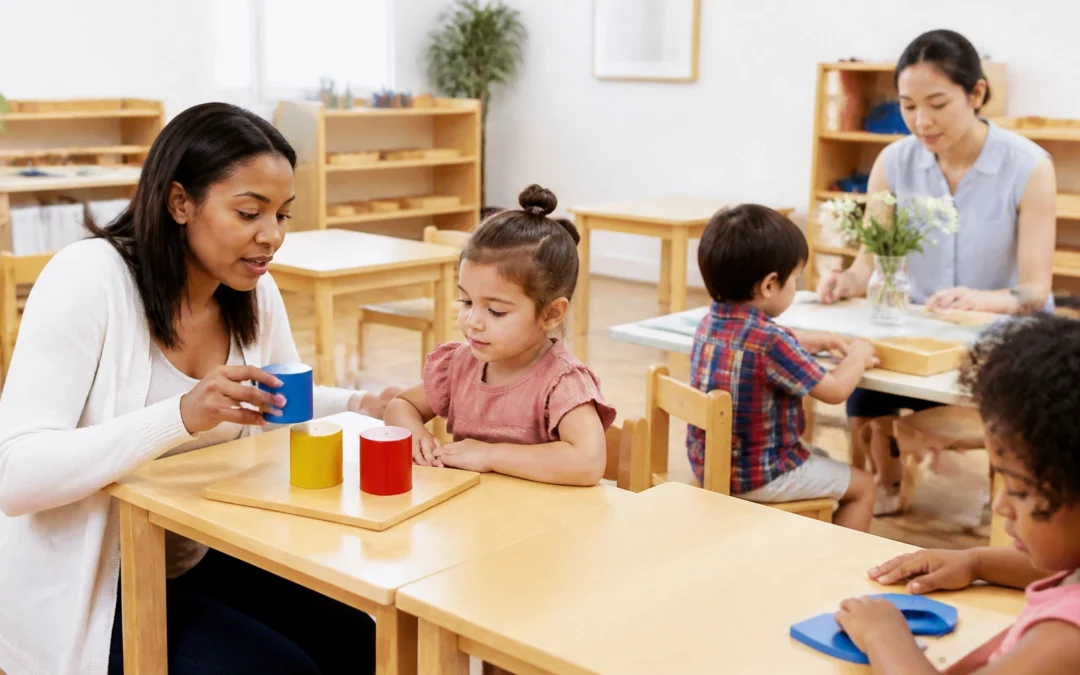
No, you don’t have to be a teacher to bring Montessori home. You just have to be a parent who believes in your child and values the time you spend together. And when you do, your home becomes more than just a place of shelter. It becomes a place of learning, of growth, of joyful connection—and a space where independence, grace, and belonging quietly take root.