Not Every Wound Is A Trauma

Not Every Wound Is A Trauma


By Tim Seldin

My original intention was not to become a teacher. It was to go into counseling psychology. I was fascinated by a single question: how does a human being find their way back to light out of darkness? Over time, though, I began to understand something that changed the direction of my life. Prevention is far more powerful than cure. A child raised with the right foundations rarely needs to be rescued later. That realization led me back to Montessori, which had shaped my mother’s work at the Barrie School and, through her, shaped me from childhood. I came to see that Montessori, alongside thinkers like Alfred Adler, Erik Erikson, and Anna Freud, was offering something more ambitious than a teaching method. It was offering a pathway for helping children become their best and highest selves, before the darkness I had once hoped to treat ever had the chance to take hold.

That is the lens through which I have always understood Montessori education. Not simply as an academic method, a clever way to teach reading or mathematics, but as something closer to mental health built directly into the architecture of childhood. I have never believed children become strong by being protected from every difficulty. I have believed, and Montessori demonstrated, that they become strong by being trusted with difficulty in doses their development can absorb, and by discovering, through their own effort, that they are capable. That is not a pedagogical footnote. It may be one of the most important preventive mental health interventions ever built into an educational system, and almost no one describes it that way.

Which brings me to the phrase that gives this essay its title, and that stops most people the first time they hear it.

Spiritual preparation. It sounds like something borrowed from a monastery, not a training manual for early childhood teachers. Many new guides hear it and quietly set it aside, filing it under Montessori’s personal religious sensibility, interesting perhaps, but not essential. I understand the instinct. I felt it myself. It took years, and a good many mistakes in front of children, before I understood that this was not a devotional aside. It was the whole foundation. Skip it, and you can master every material in the classroom and still fail the child in front of you, because the instrument you actually teach with is yourself, and you have left it unprepared.

Montessori placed this preparation before the real work of teaching, not alongside it:

“The real preparation for education is a study of one’s self. The training of the teacher who is to help life is something far more than the learning of ideas. It includes the training of character, it is a preparation of the spirit.”
: Maria Montessori, The Absorbent Mind (1949; English translation by Claude A. Claremont, 1967)

She meant this literally. Most adults arrive in a classroom without patience, humility, and self-command fully formed, not because they are deficient people, but because ordinary life rarely demands these qualities with any consistency. A room full of young children demands them constantly, and without mercy.

To see why she placed such weight on it, it helps to go back to where her own understanding began. Not with a theory of the adult. With a discovery about the child.

Maria Montessori did not begin with the adult. She began with the child.

In that first Casa dei Bambini in Rome, she discovered something that had been hidden in the child all along, a capacity for concentration, order, self-discipline, and joy that no one had thought to look for because no one believed it was there. She had expected to manage a room of unruly children. Instead she watched a small girl work with a set of cylinders in complete absorption, undisturbed by the noise around her, and rise from that work calm and changed. That moment reordered everything she thought she knew, and her understanding of the adult’s task was born from that discovery, not from any theory of teaching.

If the child already carried within them this drive toward growth and self-construction, what was left for the adult to do? Her answer unsettled the educators of her time and still unsettles many today. She measured success by a strange and demanding standard:

“The greatest sign of success for a teacher… is to be able to say, ‘The children are now working as if I did not exist.'”
Maria Montessori, The Absorbent Mind, chapter 27, p. 283 (1949)

That sentence has unsettled ambitious, well-meaning adults for over a century, because it asks them to measure their success by their own disappearance.

A Montessori guide observing children quietly and attentively in a prepared environment

Start with humility, because Montessori’s discovery demanded it first. That trust has to be earned, through the adult’s own inner work. Here I think of Viktor Frankl, whose Man’s Search for Meaning has stayed with me since my student days in psychology. Frankl survived the Nazi concentration camps and emerged believing that one freedom cannot be taken from a person even in the worst circumstances:

“Everything can be taken from a man but one thing: the last of the human freedoms : to choose one’s attitude in any given set of circumstances, to choose one’s own way.”
Viktor E. Frankl, Man’s Search for Meaning (1946; English translation 1959)

A guide preparing themselves spiritually is engaged in exactly this kind of choosing, meeting the friction of classroom life, the interruption, the mess, the child testing every boundary, not as an injury to resent but as the material of their own growth.

Montessori named the necessary inner work through a borrowed image, taken directly from the Sermon on the Mount, and she was specific and unflinching about what the obstacle usually consists of:

“He must rid his heart of pride and anger. He must learn how to humble himself and be clothed with charity. Anger is the principle defect, but it is cloaked by pride, which lends it a certain dignity that can even demand respect.”
Maria Montessori, The Secret of Childhood, pp. 151–153 (1936; English translation 1966)

Pride is the quiet conviction that our own pace and sense of order are simply correct, and the child’s task is to conform to them. Anger, in her broader sense, is the low-grade irritability that surfaces whenever a child’s normal behavior, their slowness, their repetition, their need to do things again, gets in the adult’s way. Neither registers to the adult as a fault. It registers as being right. The adult who snaps at a slow child does not feel they are behaving badly. They feel the child is being difficult. Elsewhere in the same book she made the discipline explicit:

“We insist on the fact that a teacher must prepare himself interiorly by systematically studying himself so that he can tear out his most deeply rooted defects, those in fact which impede his relations with children.”
Maria Montessori, The Secret of Childhood (1936)

Remove that obstacle, and most of what looked like a problem in the child turns out not to have been the child’s problem at all.

Alfred Adler adds another layer to this. He used a word, Gemeinschaftsgefühl, usually translated as social interest or community feeling, to describe a genuine, active orientation toward the wellbeing of others rather than a preoccupation with the self. He developed the concept across his writings and lectures beginning in 1918, and gave it fullest popular expression in his 1931 book What Life Could Mean to You. A guide’s spiritual preparation is social interest turned into a vocation. They are not curing a private wound. They are extending themselves toward a room full of children who need something steadier than most adults offer by default.

Erik Erikson points at the same target from another angle. He coined the term generativity and defined it precisely:

“The concern in establishing and guiding the next generation.”
Erik H. Erikson, Childhood and Society, p. 267 (1950; 2nd edition 1963)

He named this one of adulthood’s central developmental tasks, with stagnation as its opposite.

And Anna Freud, whose work on child development I read closely during my years studying psychology, contributed something I think Montessori would have recognized instantly. Anna Freud spent much of her career distinguishing normal development from pathology in childhood, developing what she called developmental lines, the idea that a child’s growth toward independence, self-regulation, and relationship with others unfolds gradually and unevenly, and that most of what looks alarming in a child is simply a normal step along one of those lines, not a symptom to be treated. She laid this out most fully in her 1965 book Normality and Pathology in Childhood. It is, in different language, the same case Montessori was making decades earlier: that development is not injury, and that the adult’s task is to recognize the difference.

I say all of this as someone who has never found it easy to live out, and I do not think anyone genuinely has. This is the part of spiritual preparation that rarely gets said plainly, so I will say it plainly here. We are not finished people asking unfinished children to grow. We are unfinished people too, still working out our own fears, our own old wounds, our own need for control, at the very same time we are asked to hold space for someone else’s becoming. Montessori’s preparation does not ask us to resolve our own journey before we begin. It asks us to become conscious of it, so that our own unmet needs do not quietly become the child’s problem to manage. This is a form of separation, learning to tell the difference between what is actually happening in the child in front of us and what is simply our own unresolved emotional life, arriving in disguise. That separation is not achieved once. It is practiced, imperfectly, for as long as we do this work.

It is also why I have come to believe spiritual preparation cannot be reduced to a single quality like patience or calm. Montessori asked the adult to prepare themselves to support a child’s full development, physically, through movement and the disciplined use of the hand; socially, through the slow work of living alongside other children in a shared community; intellectually, through concentrated engagement with real problems and real materials; emotionally, through the growing capacity to meet frustration and joy without being overwhelmed by either; and spiritually, in the sense of a dawning understanding of one’s own place in the universe and one’s relationship to the whole of humanity. An adult who has not begun to reckon with these same dimensions in their own life will find it very difficult to recognize and protect them in a child. You largely see in a child what you have learned to see, and been willing to see, in yourself.

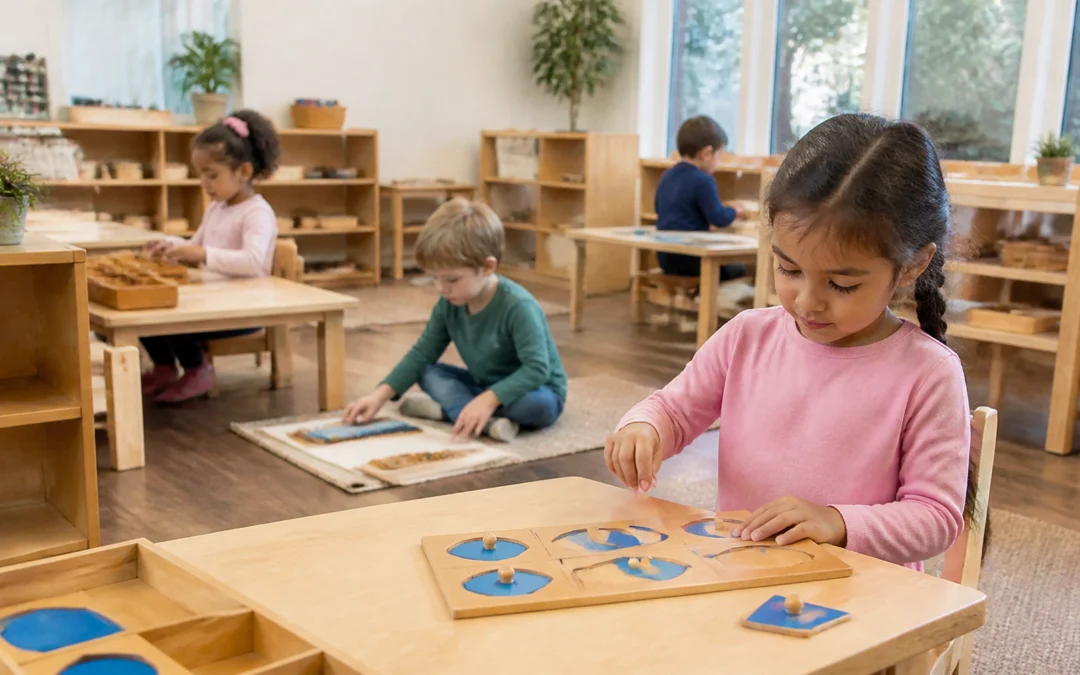
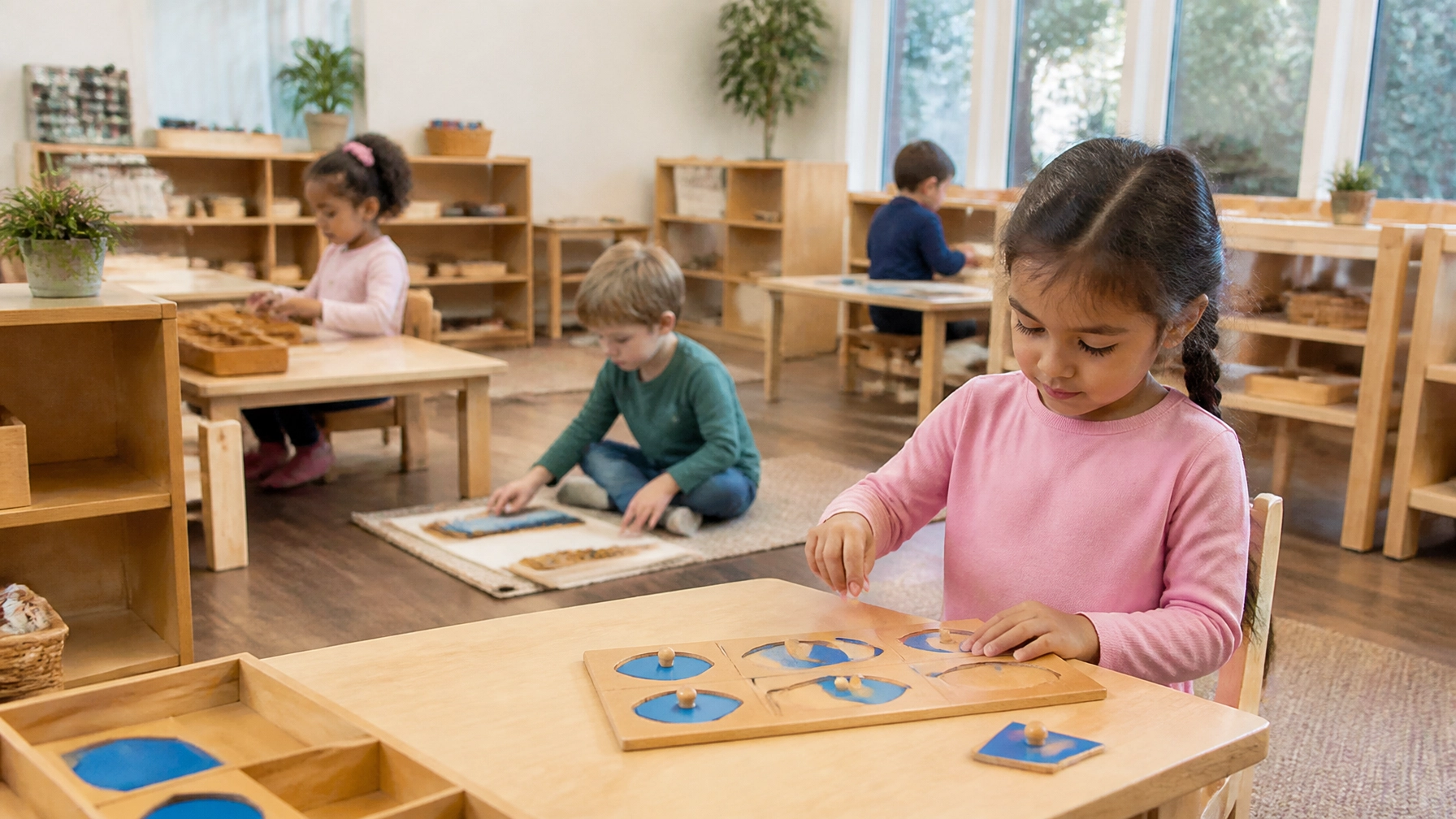
Hands-on Montessori materials on a wooden table, serene and focused atmosphere

This is where the two threads of my thinking meet most fully. Recovery from grief, anxiety, or despair rarely comes through endless self-examination. It comes through purposeful, embodied work: service, which pulls attention outward; exercise, which returns a person to their own body; gardening, which teaches patience and rewards it with something alive; time outdoors, which reminds us we belong to something larger than our own circumstances; work with the hands, in a workshop, a kitchen, a studio. Montessori would have recognized every item on that list, because the same principle she found in the child holds for the adult. She described the discipline itself as closer to physical training than intellectual study:

“The teacher must fashion herself, she must learn how to observe, how to be calm, patient, and humble, how to restrain her own impulses, and how to carry out her eminently practical tasks with the required delicacy. She too has greater need of a gymnasium for her soul than of a book for her intellect.”
: Maria Montessori, The Secret of Childhood, p. 151 (1936)

Spiritual preparation is not one insight, arrived at once. It is renewed daily, the way strength or a skilled craft is built through repetition, not declared into existence.

None of this makes the guide flawless, and Montessori never asked for perfection. She asked for ongoing effort, daily observation of the self alongside daily observation of the child, a willingness to notice one’s own impatience and keep setting it down. This is slow work. It rarely announces itself with breakthroughs. Most days it looks like choosing to watch a little longer before stepping in, breathing once more before responding, trusting a child’s struggle a little further than instinct prefers, and trusting your own struggle the same way.

I have known guides who mastered every material and every presentation and still failed to reach children, because the inner work had been skipped. I have known guides with far less formal training whose classrooms felt like sanctuaries, because they had done the quieter work Montessori considered primary. The difference was rarely knowledge. It was almost always preparation of the self, undertaken honestly, by someone who never stopped being, in their own right, a person still growing.

Montessori discovered the child, and in that discovery found the adult’s true task waiting for her. I have come to believe the same about the transformation of a life. Neither happens all at once. Neither happens through analysis alone. Both happen through the same patient, unglamorous work: showing up, again and again, ready to meet what is real in the child and honest about what is still unfinished in ourselves, trusting that the meeting itself will change us both.


Sources

  • Montessori, Maria. The Absorbent Mind. Translated by Claude A. Claremont. New York: Holt, Rinehart and Winston, 1967 (originally published 1949).
  • Montessori, Maria. The Secret of Childhood. Translated by M. Joseph Costelloe. Bombay: Orient Longman, 1966 (originally published 1936).
  • Frankl, Viktor E. Man’s Search for Meaning. Boston: Beacon Press, 1959 (originally published in German, 1946).
  • Erikson, Erik H. Childhood and Society. 2nd ed. New York: W. W. Norton, 1963 (originally published 1950).
  • Adler, Alfred. What Life Could Mean to You. Oxford: Oneworld Publications, 1998 (originally published 1931); the concept of Gemeinschaftsgefühl was developed across Adler’s lectures and writings beginning in 1918.
  • Freud, Anna. Normality and Pathology in Childhood: Assessments of Development. New York: International Universities Press, 1965.
The Spiritual Preparation of the Adult: On Becoming a Montessori Guide

The Spiritual Preparation of the Adult: On Becoming a Montessori Guide

A peaceful, welcoming Montessori teacher training classroom setting with natural wooden shelves and soft warm light

By Tim Seldin

My original intention was not to become a teacher. It was to go into counseling psychology. I was fascinated by a single question: how does a human being find their way back to light out of darkness? Over time, though, I began to understand something that changed the direction of my life. Prevention is far more powerful than cure. A child raised with the right foundations rarely needs to be rescued later. That realization led me back to Montessori, which had shaped my mother’s work at the Barrie School and, through her, shaped me from childhood. I came to see that Montessori, alongside thinkers like Alfred Adler, Erik Erikson, and Anna Freud, was offering something more ambitious than a teaching method. It was offering a pathway for helping children become their best and highest selves, before the darkness I had once hoped to treat ever had the chance to take hold.

That is the lens through which I have always understood Montessori education. Not simply as an academic method, a clever way to teach reading or mathematics, but as something closer to mental health built directly into the architecture of childhood. I have never believed children become strong by being protected from every difficulty. I have believed, and Montessori demonstrated, that they become strong by being trusted with difficulty in doses their development can absorb, and by discovering, through their own effort, that they are capable. That is not a pedagogical footnote. It may be one of the most important preventive mental health interventions ever built into an educational system, and almost no one describes it that way.

Which brings me to the phrase that gives this essay its title, and that stops most people the first time they hear it.

Spiritual preparation. It sounds like something borrowed from a monastery, not a training manual for early childhood teachers. Many new guides hear it and quietly set it aside, filing it under Montessori’s personal religious sensibility, interesting perhaps, but not essential. I understand the instinct. I felt it myself. It took years, and a good many mistakes in front of children, before I understood that this was not a devotional aside. It was the whole foundation. Skip it, and you can master every material in the classroom and still fail the child in front of you, because the instrument you actually teach with is yourself, and you have left it unprepared.

Montessori placed this preparation before the real work of teaching, not alongside it:

“The real preparation for education is a study of one’s self. The training of the teacher who is to help life is something far more than the learning of ideas. It includes the training of character, it is a preparation of the spirit.”
: Maria Montessori, The Absorbent Mind (1949; English translation by Claude A. Claremont, 1967)

She meant this literally. Most adults arrive in a classroom without patience, humility, and self-command fully formed, not because they are deficient people, but because ordinary life rarely demands these qualities with any consistency. A room full of young children demands them constantly, and without mercy.

To see why she placed such weight on it, it helps to go back to where her own understanding began. Not with a theory of the adult. With a discovery about the child.

Maria Montessori did not begin with the adult. She began with the child.

In that first Casa dei Bambini in Rome, she discovered something that had been hidden in the child all along, a capacity for concentration, order, self-discipline, and joy that no one had thought to look for because no one believed it was there. She had expected to manage a room of unruly children. Instead she watched a small girl work with a set of cylinders in complete absorption, undisturbed by the noise around her, and rise from that work calm and changed. That moment reordered everything she thought she knew, and her understanding of the adult’s task was born from that discovery, not from any theory of teaching.

If the child already carried within them this drive toward growth and self-construction, what was left for the adult to do? Her answer unsettled the educators of her time and still unsettles many today. She measured success by a strange and demanding standard:

“The greatest sign of success for a teacher… is to be able to say, ‘The children are now working as if I did not exist.'”
Maria Montessori, The Absorbent Mind, chapter 27, p. 283 (1949)

That sentence has unsettled ambitious, well-meaning adults for over a century, because it asks them to measure their success by their own disappearance.

A Montessori guide observing children quietly and attentively in a prepared environment

Start with humility, because Montessori’s discovery demanded it first. That trust has to be earned, through the adult’s own inner work. Here I think of Viktor Frankl, whose Man’s Search for Meaning has stayed with me since my student days in psychology. Frankl survived the Nazi concentration camps and emerged believing that one freedom cannot be taken from a person even in the worst circumstances:

“Everything can be taken from a man but one thing: the last of the human freedoms : to choose one’s attitude in any given set of circumstances, to choose one’s own way.”
Viktor E. Frankl, Man’s Search for Meaning (1946; English translation 1959)

A guide preparing themselves spiritually is engaged in exactly this kind of choosing, meeting the friction of classroom life, the interruption, the mess, the child testing every boundary, not as an injury to resent but as the material of their own growth.

Montessori named the necessary inner work through a borrowed image, taken directly from the Sermon on the Mount, and she was specific and unflinching about what the obstacle usually consists of:

“He must rid his heart of pride and anger. He must learn how to humble himself and be clothed with charity. Anger is the principle defect, but it is cloaked by pride, which lends it a certain dignity that can even demand respect.”
Maria Montessori, The Secret of Childhood, pp. 151–153 (1936; English translation 1966)

Pride is the quiet conviction that our own pace and sense of order are simply correct, and the child’s task is to conform to them. Anger, in her broader sense, is the low-grade irritability that surfaces whenever a child’s normal behavior, their slowness, their repetition, their need to do things again, gets in the adult’s way. Neither registers to the adult as a fault. It registers as being right. The adult who snaps at a slow child does not feel they are behaving badly. They feel the child is being difficult. Elsewhere in the same book she made the discipline explicit:

“We insist on the fact that a teacher must prepare himself interiorly by systematically studying himself so that he can tear out his most deeply rooted defects, those in fact which impede his relations with children.”
Maria Montessori, The Secret of Childhood (1936)

Remove that obstacle, and most of what looked like a problem in the child turns out not to have been the child’s problem at all.

Alfred Adler adds another layer to this. He used a word, Gemeinschaftsgefühl, usually translated as social interest or community feeling, to describe a genuine, active orientation toward the wellbeing of others rather than a preoccupation with the self. He developed the concept across his writings and lectures beginning in 1918, and gave it fullest popular expression in his 1931 book What Life Could Mean to You. A guide’s spiritual preparation is social interest turned into a vocation. They are not curing a private wound. They are extending themselves toward a room full of children who need something steadier than most adults offer by default.

Erik Erikson points at the same target from another angle. He coined the term generativity and defined it precisely:

“The concern in establishing and guiding the next generation.”
Erik H. Erikson, Childhood and Society, p. 267 (1950; 2nd edition 1963)

He named this one of adulthood’s central developmental tasks, with stagnation as its opposite.

And Anna Freud, whose work on child development I read closely during my years studying psychology, contributed something I think Montessori would have recognized instantly. Anna Freud spent much of her career distinguishing normal development from pathology in childhood, developing what she called developmental lines, the idea that a child’s growth toward independence, self-regulation, and relationship with others unfolds gradually and unevenly, and that most of what looks alarming in a child is simply a normal step along one of those lines, not a symptom to be treated. She laid this out most fully in her 1965 book Normality and Pathology in Childhood. It is, in different language, the same case Montessori was making decades earlier: that development is not injury, and that the adult’s task is to recognize the difference.

I say all of this as someone who has never found it easy to live out, and I do not think anyone genuinely has. This is the part of spiritual preparation that rarely gets said plainly, so I will say it plainly here. We are not finished people asking unfinished children to grow. We are unfinished people too, still working out our own fears, our own old wounds, our own need for control, at the very same time we are asked to hold space for someone else’s becoming. Montessori’s preparation does not ask us to resolve our own journey before we begin. It asks us to become conscious of it, so that our own unmet needs do not quietly become the child’s problem to manage. This is a form of separation, learning to tell the difference between what is actually happening in the child in front of us and what is simply our own unresolved emotional life, arriving in disguise. That separation is not achieved once. It is practiced, imperfectly, for as long as we do this work.

It is also why I have come to believe spiritual preparation cannot be reduced to a single quality like patience or calm. Montessori asked the adult to prepare themselves to support a child’s full development, physically, through movement and the disciplined use of the hand; socially, through the slow work of living alongside other children in a shared community; intellectually, through concentrated engagement with real problems and real materials; emotionally, through the growing capacity to meet frustration and joy without being overwhelmed by either; and spiritually, in the sense of a dawning understanding of one’s own place in the universe and one’s relationship to the whole of humanity. An adult who has not begun to reckon with these same dimensions in their own life will find it very difficult to recognize and protect them in a child. You largely see in a child what you have learned to see, and been willing to see, in yourself.

Hands-on Montessori materials on a wooden table, serene and focused atmosphere

This is where the two threads of my thinking meet most fully. Recovery from grief, anxiety, or despair rarely comes through endless self-examination. It comes through purposeful, embodied work: service, which pulls attention outward; exercise, which returns a person to their own body; gardening, which teaches patience and rewards it with something alive; time outdoors, which reminds us we belong to something larger than our own circumstances; work with the hands, in a workshop, a kitchen, a studio. Montessori would have recognized every item on that list, because the same principle she found in the child holds for the adult. She described the discipline itself as closer to physical training than intellectual study:

“The teacher must fashion herself, she must learn how to observe, how to be calm, patient, and humble, how to restrain her own impulses, and how to carry out her eminently practical tasks with the required delicacy. She too has greater need of a gymnasium for her soul than of a book for her intellect.”
: Maria Montessori, The Secret of Childhood, p. 151 (1936)

Spiritual preparation is not one insight, arrived at once. It is renewed daily, the way strength or a skilled craft is built through repetition, not declared into existence.

None of this makes the guide flawless, and Montessori never asked for perfection. She asked for ongoing effort, daily observation of the self alongside daily observation of the child, a willingness to notice one’s own impatience and keep setting it down. This is slow work. It rarely announces itself with breakthroughs. Most days it looks like choosing to watch a little longer before stepping in, breathing once more before responding, trusting a child’s struggle a little further than instinct prefers, and trusting your own struggle the same way.

I have known guides who mastered every material and every presentation and still failed to reach children, because the inner work had been skipped. I have known guides with far less formal training whose classrooms felt like sanctuaries, because they had done the quieter work Montessori considered primary. The difference was rarely knowledge. It was almost always preparation of the self, undertaken honestly, by someone who never stopped being, in their own right, a person still growing.

Montessori discovered the child, and in that discovery found the adult’s true task waiting for her. I have come to believe the same about the transformation of a life. Neither happens all at once. Neither happens through analysis alone. Both happen through the same patient, unglamorous work: showing up, again and again, ready to meet what is real in the child and honest about what is still unfinished in ourselves, trusting that the meeting itself will change us both.


Sources

  • Montessori, Maria. The Absorbent Mind. Translated by Claude A. Claremont. New York: Holt, Rinehart and Winston, 1967 (originally published 1949).
  • Montessori, Maria. The Secret of Childhood. Translated by M. Joseph Costelloe. Bombay: Orient Longman, 1966 (originally published 1936).
  • Frankl, Viktor E. Man’s Search for Meaning. Boston: Beacon Press, 1959 (originally published in German, 1946).
  • Erikson, Erik H. Childhood and Society. 2nd ed. New York: W. W. Norton, 1963 (originally published 1950).
  • Adler, Alfred. What Life Could Mean to You. Oxford: Oneworld Publications, 1998 (originally published 1931); the concept of Gemeinschaftsgefühl was developed across Adler’s lectures and writings beginning in 1918.
  • Freud, Anna. Normality and Pathology in Childhood: Assessments of Development. New York: International Universities Press, 1965.
So Your Child Is about to Start or Return to Montessori School: A Survival Guide

So Your Child Is about to Start or Return to Montessori School: A Survival Guide

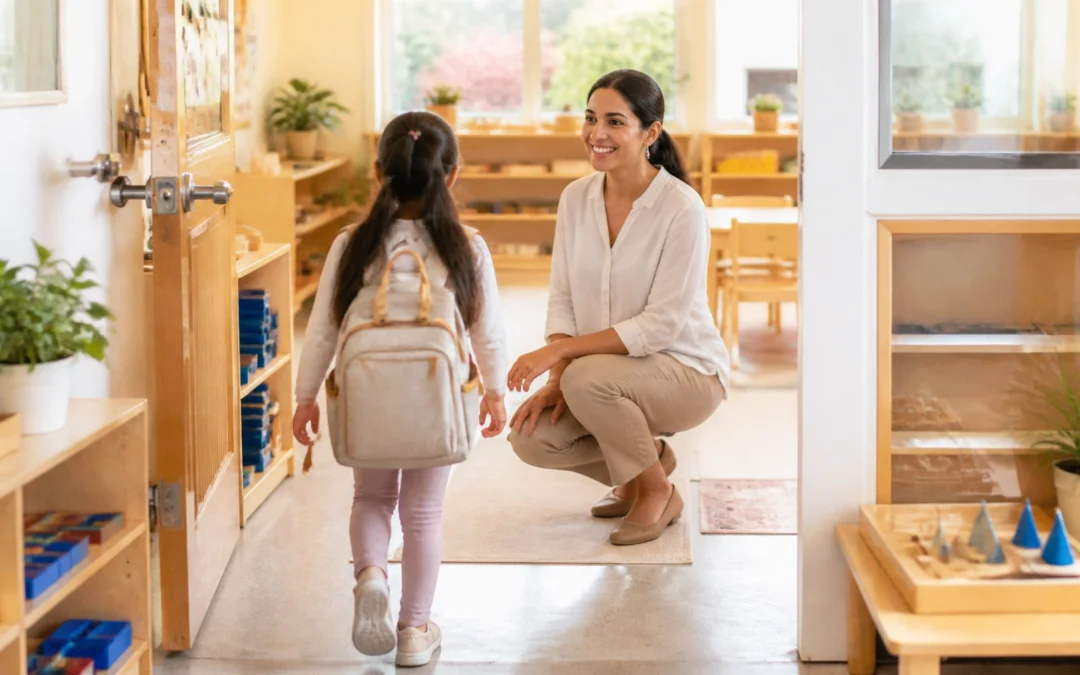
A joyful child and parent approaching a welcoming Montessori school entrance

Somewhere between buying the (non-negotiable, apparently) labeled water bottle and frantically googling "is my 4-year-old emotionally ready for anything," it hits you with the subtlety of a falling brick: school is starting.

Whether your child is walking into their very first primary cycle or returning for another year of independent discovery, the end-of-summer transition can stir up a whirlwind of emotions. For parents, it is a delicate mix of excitement, relief, and low-key terror that you have forgotten a crucial immunization form.

At The Montessori Foundation, we talk to thousands of families every year who are navigating this exact rite of passage. Through our work with the Montessori Family Alliance, we know that preparing for the school year isn't about buying matching pastel stationery or turning your home into a rigid institution. It’s about building a bridge between home and the classroom , minus the panic.

Here is how to actually prepare your family for the Montessori school year, rooted in authentic montessori philosophy, foundational montessori basics, and a healthy dose of parental grace.


The Building Blocks of a Smooth Transition

In traditional education, preparation often means flashcards, workbook drills, and cramming academic milestones into the final weeks of August. But in authentic Montessori education, development happens from the inside out. Dr. Maria Montessori observed that children are naturally driven to master their world through action, repetition, and purposeful movement.

When we talk about the building blocks of a successful school transition, we aren't talking about long division or sight words. We are talking about the foundational life skills that foster true independence, emotional resilience, and confidence.

Let's break down how to set the stage for a thriving school year without losing your mind (or your coffee mug).


Step 1: Stop Trying to "Teach Them Everything" First

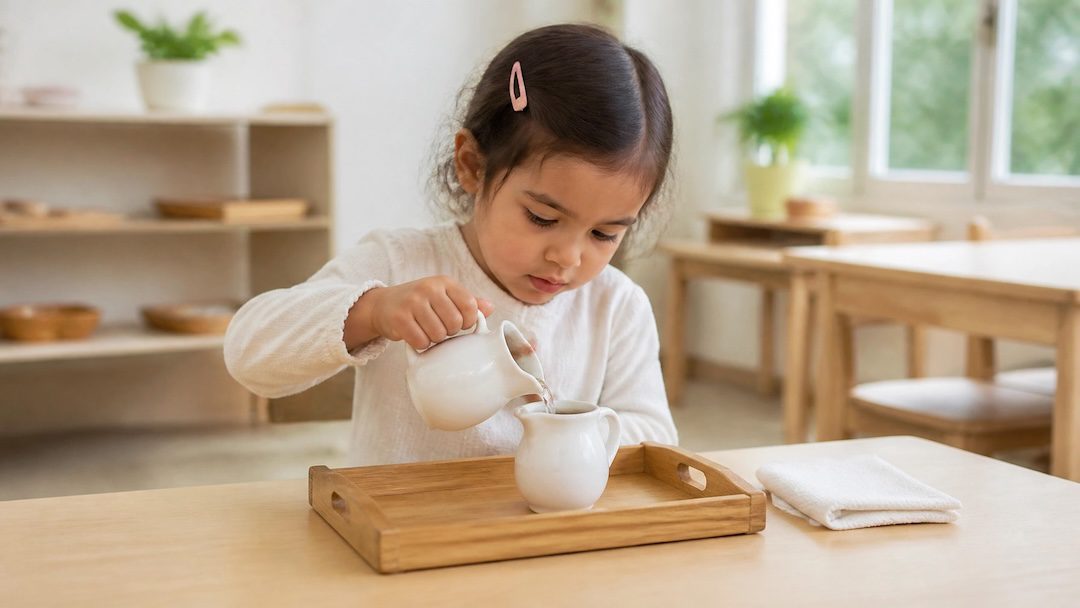
A toddler practicing practical life pouring skills on a wooden tray

Every August, some well-meaning relative asks if your child knows their letters yet, or whether they can count to fifty in two languages.

Our advice? Ignore them entirely.

Montessori isn't about cramming academics into a reluctant four-year-old before day one. It’s about whether your kid can hang up a jacket without narrating a three-act tragedy about the injustice of gravity.

Instead of flashcards, practice the delightfully boring stuff now:

  • Zipping and buttoning: The unsung heroes of classroom autonomy.
  • Pouring water: Perfecting the art of pouring a glass without flooding the counter.
  • Shoe management: Putting shoes on the correct feet (optional for toddlers, but a nice touch).

These are the actual, tangible practical life skills that make classroom mornings smooth and joyful. Nobody’s toddler has ever had an existential meltdown over long division. Plenty, however, have staged a full protest over a stuck coat zipper. Mastering these basics gives children the inner calm and confidence they need when entering their prepared environment.


Step 2: Practice "Independent Snack Time" at Home Like It's the Olympics

Montessori classrooms expect children to take charge of their own nourishment. Kids are taught to open their own containers, unwrap their own cloth napkins, pour their own water, and gently wipe up their own crumbs when snack time arrives.

If your child currently requires a specialized team of adults to open a single granola bar, you have some fun training ahead of you this week.

Give them a lunch container with a slightly-annoying-but-not-impossible lid. Hand it over, sit on your hands, and let them struggle for a minute before swooping in to rescue them. Yes, this will test your patience. Yes, you will want to take over when you see the dramatic sighs.

But remember: you are not raising a child who needs rescuing. You are raising a capable human being who Googles nothing and just gets the job done.

For more tips on fostering this kind of self-reliance at the dinner table and beyond, explore our guides at the Montessori Family Alliance.


Step 3: Talk About What Happens, Not How Fun It'll Be

Parent and child prepping a simple snack box together in a sunlit kitchen

When parents get nervous, we tend to overcompensate with aggressive cheerfulness. "You're going to have SO much fun!! Every single second is going to be magical!"

It sounds lovely in theory, but it often backfires spectacularly. Why? Because now your child has built up an internal expectation of a bounce house, a petting zoo, and an endless supply of stickers : only to arrive and discover a quiet, orderly classroom with wooden bead chains and silence rules.

Nervous systems love predictability way more than hype.

Instead of selling school like a theme park, try narrating the actual, grounded sequence of events:

"Tomorrow, you'll walk into your classroom, hang your bag on your designated hook, choose a work to start your morning, and later you'll have your independent snack and outdoor playtime."

Boring? To an adult, perhaps. Extremely comforting and grounding to a young child? Absolutely.


Step 4: Do a Trial Run of the Morning Chaos

A week before the big bell rings, do a full dress rehearsal. Set the alarm, wake up at the ungodly hour you'll need all year, make breakfast, get dressed, put on shoes, and walk out the front door.

You will likely discover, with mounting horror, that this entire sequence takes 45 minutes longer than your optimistic brain calculated. It is infinitely better to discover this flaw in your logistics on a Tuesday morning practice run than at 7:52 AM on the actual first day of school, while everyone in the household is crying : including, quite possibly, you.

At the same time, shift your child’s bedtime earlier gradually : pulling it back by 15 minutes each night : rather than yanking the schedule back all at once. Sudden bedtime shifts turn delightful children into small, furious raccoons. Protect everyone's sleep!


Step 5: Let Them Pick One Thing

Children thrive when they experience genuine autonomy. Because so much of a child's day is dictated by adults (when to sleep, what to eat, where to sit), starting school can feel like an avalanche of external control.

Give them one real, non-negotiable decision to make for themselves:

  • The lunch box color or pattern.
  • The first-day outfit (even if it clashes in ways that defy human comprehension).
  • Which special stuffed animal gets to stay home and "guard" their bedroom while they are conquering the world at school.

Small amounts of sincere control go a remarkably long way toward inspiring big cooperation when it's time to head out the door.


Step 6: Lower Your Own Expectations for Day One

A joyful child walking hand-in-hand with a parent toward a warm Montessori school entrance

Let’s be entirely honest with one another: day one is rarely a cinematic masterpiece.

Some children will walk through those doors like they own the entire building, never looking back. Others will cry, cling to your kneecaps like a barnacle, or announce to the lead guide that they are officially "done with education" by 9:15 AM.

Both reactions are entirely normal. Neither one is a verdict on how the rest of the school year will unfold.

Bring tissues : but keep them for yourself, not your child. They will likely settle in and start exploring within five minutes of your departure. You, on the other hand, will be sitting alone in your parked car, eating a granola bar that you 100% could not open independently either. And that is okay.


Preparing Together: A Journey Worth Taking

Finding an authentic Montessori school and setting your child up for success is a collaborative journey. It requires patience, observation, and a willingness to step back so your child can step forward.

Remember, preparation isn’t about achieving a mythical state of perfection where nothing goes wrong. It’s about raising a child who has a rough idea of what to expect, supported by a parent who has mentally rehearsed the goodbye enough times to keep a brave face until they reach the carpool line.

To explore more resources on parenting the Montessori way, understanding child development stages, and connecting with a community of like-minded families, we invite you to visit the Montessori Family Alliance and discover how we can support your family's educational adventure every step of the way.


Your Toddler Is Not a Small Adult: They’re a Tiny Scientist Who Hates Your Rules

Your Toddler Is Not a Small Adult: They’re a Tiny Scientist Who Hates Your Rules

A toddler happily pouring dried lentils into wooden bowls on a low wooden table in a sunlit Montessori prepared environment

Your two-year-old just dumped an entire bin of dried beans onto the kitchen floor, stared you dead in the eye, and reached for more. Congratulations: you are witnessing the scientific method in its rawest, most unadulterated form.

In the heat of the moment, when you are standing ankle-deep in legumes while dinner burns on the stove, it is entirely normal to feel like your house has been invaded by a tiny, unreasonable dictator whose sole mission is to test your blood pressure. But here is the liberating truth that forms the bedrock of montessori philosophy: your toddler isn't trying to ruin your day. They are trying to understand gravity.

The Mystery of the Absorbent Mind

To understand why your living room rug currently resembles a dry goods warehouse, we have to look through the developmental lens Dr. Maria Montessori gave us over a century ago. Young children possess what she termed the absorbent mind and operate within intense sensitive periods: evolutionary windows of time where their brains are neurologically wired to obsess over one specific skill.

Whether it is pouring, sorting, climbing, or saying an emphatic "NO!" to every single request you make, your child is driven by an internal developmental imperative. Fighting this relentless drive is a bit like yelling at a plant for photosynthesizing. It is not a behavioral defect; it is biology at work.

When a toddler repeats an action twenty-five times in a row: dropping a spoon, opening and closing a cabinet door, or dumping beans: they are building the neural pathways of concentration and cause-and-effect. They are the chief researchers of their own universe, and your kitchen floor is their laboratory.

A toddler's hands carefully sorting colored wooden shapes on a low wooden tray in a Montessori environment

Shifting from Punishment to Respectful Redirection

Traditional parenting advice often frames these moments as battles of will: Who is going to win? But authentic montessori discipline shifts the question entirely: How can we honor the child's underlying need while maintaining safety and order in our shared environment?

When we attempt to stop a toddler through sheer force of will or arbitrary punishment ("Stop that right now!"), we trigger frustration, tears, and escalating power struggles. The child's developmental impulse hasn't vanished; it has simply been blocked.

Instead of shouting "Stop dumping the beans!", the Montessori approach invites us to redirect the urge: "Let's pour the beans into these two bowls."

Notice what happens here. You haven't suppressed the scientific inquiry. You have simply provided a boundary that protects your sanity and your kitchen floor. The impulse remains satisfied, but the context changes from chaotic mess to purposeful work.

The Building Blocks of Redirection and Daily Life

Mastering montessori basics at home doesn't require a master's degree in early childhood education or a house full of expensive specialized materials. It starts with recognizing the fundamental "blocks" of behavior and channeling them constructively. Here are three powerful phrases to put in your parenting toolkit this week:

  • "You can pour it there, on the tray." (Redirect, don't reject. Honor the motor skill while setting a clear spatial boundary.)
  • "I won't let you throw that, but you can throw this soft ball." (Establish a firm limit while offering an acceptable alternative that satisfies the physical urge.)
  • "You're working really hard on that." (Praise effort and concentration rather than tidiness or compliance, fostering intrinsic motivation.)

A happy parent and toddler sitting together on a soft rug in a sunlit living room looking at a picture book

You Don’t Have to Figure It Out Alone

Navigating the spirited toddler years can feel wonderfully magical one minute and utterly exhausting the next. That is precisely why we created the Montessori Family Alliance.

As part of The Montessori Foundation, the Family Alliance is dedicated to helping parents bring authentic Montessori principles out of the classroom and directly into home and family life. Through practical guides, expert webinars, and community support: including invaluable resources like The Parenting Puzzle and Montessori for Every Family: we walk alongside you as you set up a prepared environment, decode your child's behavior, and cultivate joyful independence from infancy onward.

A bright, cozy Montessori children's room with low wooden shelving and baskets of toys

Let Them Explore

The next time your little scientist launches a bowl of cereal across the kitchen or insists on wearing winter boots in July, take a deep breath. Acknowledge the intense developmental drive behind the madness.

Set your loving, respectful boundaries, provide a safe alternative for their curiosity, and remember that these messy, beautiful experiments are how great minds are built. Your tiny scientist isn't trying to break your spirit. They're just figuring out how the world works. And honestly? They're doing a fantastic job.


We Took the Screens Away and Now My Kid Talks to Bugs

We Took the Screens Away and Now My Kid Talks to Bugs

A young child joyfully exploring soil in a sunny backyard with a magnifying glass, looking at a small insect

We did a screen-free weekend out of pure desperation.

If you are a parent living in the modern digital age, you probably know the exact brand of exhaustion I am talking about. It is that glazed-over, zombie-eyed trance where your child looks like they are absorbing blue light directly into their bloodstream. By Sunday evening, our household had reached peak tech fatigue, and my partner and I locked eyes across the living room and silently agreed: Enough.

We braced ourselves for the inevitable apocalypse. We expected a full-scale, wall-rattling meltdown by hour two. We imagined weeping, gnashing of teeth, and demands to watch algorithms feed our toddler brightly colored plastic eggs opening on YouTube.

Instead, my daughter walked out to the back patio, found a dusty brown beetle in the yard, named him Gerald, and proceeded to give him a guided tour of her sandbox for forty minutes.

No screens. No battery charger. Just Gerald.

The Montessori Philosophy: Why Gerald Beats the iPad

In traditional parenting circles, outdoor time is often viewed as a recess, a way to burn off steam before getting back to “real” learning. But in the world of authentic Montessori education, the outdoors is not a break from learning; it is the ultimate extension of the classroom.

Dr. Maria Montessori recognized that children in their early years possess what she called the absorbent mind. They soak up every detail of their environment without conscious effort. When we trap children behind glass screens, we starve that brilliant absorbent mind of multi-sensory truth. A screen gives flat pixels and canned audio; a backyard gives texture, temperature, scent, shifting light, and actual living organisms.

A child carefully holding a bug jar with a magnifying glass in a vibrant green garden

When my daughter met Gerald, she wasn’t undergoing a structured “nature lesson.” There was zero worksheet energy. There was no teacher standing over her saying, “Now, class, observe the carapace of the Coleoptera.” There was just a child and a beetle, engaging in an authentic, self-directed encounter with the natural world.

If you are looking to dive deeper into how these foundational concepts translate into daily life, exploring foundational resources like Montessori for Every Family can completely shift how you view your child’s daily rhythms. It is not about turning your living room into an austere, museum-like schoolhouse; it is about embracing montessori basics that honor your child’s innate curiosity.

The Building Blocks of Outdoor Learning

Let’s talk about the blocks of early childhood development, not the plastic ones scattered across your floor that you inevitably step on in the dark, but the foundational building blocks of outdoor learning and unstructured play.

Modern child development research backs up what Montessori guides have known for over a century: unstructured outdoor play builds cognitive focus, risk assessment, and genuine independence in ways that curated, indoor structured activities simply cannot replicate.

When children navigate uneven terrain, hoist themselves over a rotting log, or figure out how to transport water in a leaky plastic bucket, they are constructing crucial neural pathways. They are learning physics, geometry, and resilience through raw experience.

Traditional Indoor Screen Time Montessori Outdoor Play
Passive consumption of pre-made content Active creation and direct manipulation of reality
Instant digital gratification and dopamine spikes Delayed gratification through sustained exploration
Artificial visual stimuli and flat pixels Multi-sensory immersion (dirt, texture, temperature, sound)
Fragmented attention span Deepened concentration and focus (like watching Gerald for 40 minutes)

When we remove the screens, we clear away the mental static. That space is immediately filled by deep concentration. As parents exploring montessori philosophy, we often worry we aren’t doing enough. We buy flashcards and sign up for toddler enrichment classes in Mandarin-violin fusion. But as it turns out, sometimes the most profound educational intervention you can make is to step out of the way and let your child examine a six-legged neighbor named Gerald.

Montessori Basics at Home: Low-Effort Ways to Welcome the Outdoors

You do not need a sprawling acreage or an immaculate organic garden to cultivate this environment. In fact, Montessori is all about simplicity and respect for what is already there. The prepared environment can start in the smallest patch of earth.

Here are a few remarkably low-effort ways to start bringing these principles into your weekend routine:

  • A patch of “wild” yard: Designate a small corner of your yard, or even a large planter box on a balcony, where your child is allowed to dig, turn over rocks, and move dirt with zero rules. No manicured lawn perfection allowed here. This is their laboratory.
  • The investigator’s toolkit: A simple bug jar with a breathable lid and a sturdy magnifying glass. That’s the entire kit. You don’t need battery-operated microscope gizmos; let the simplicity of the lens focus their attention on the intricate details of a leaf or an ant trail.
  • Embrace the sacred pause of boredom: The magic often happens right when you feel most uncomfortable. When your child whines, “I’m bored,” resist the urge to hand over a tablet or orchestrate an activity. Let boredom happen before you intervene. That awkward, empty space is usually where Gerald shows up.

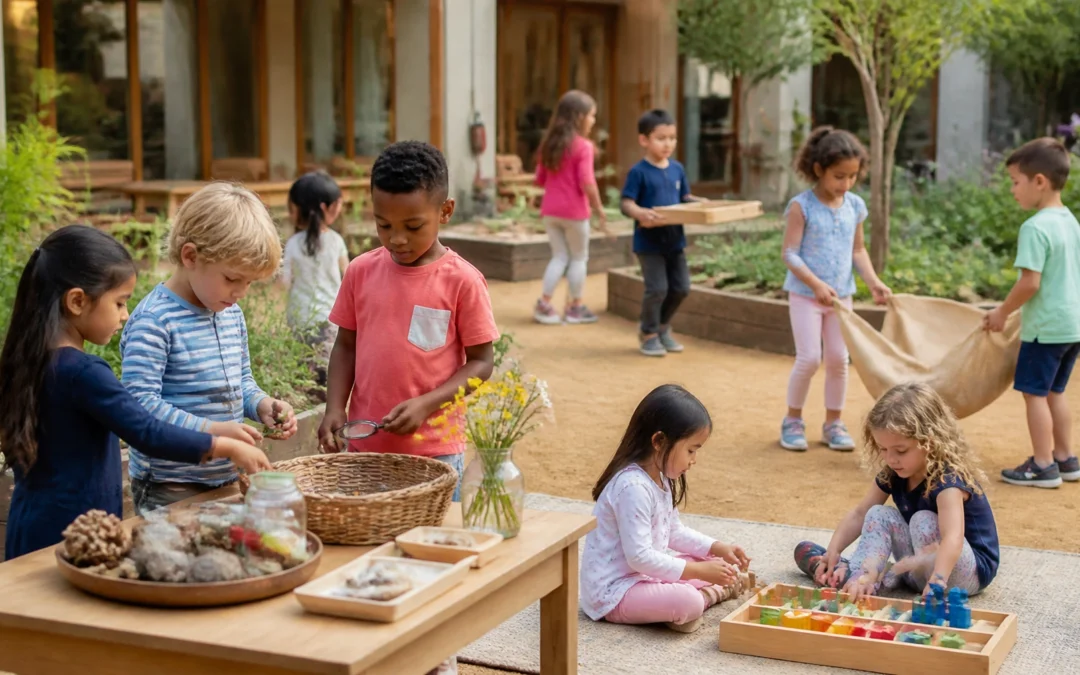
A child playing with natural materials like stones, sticks, and dirt in a sunny outdoor play space

Montessori Discipline and the Calm Mind

One unexpected side effect of our screen-free weekend was a dramatic shift in household dynamics. We often stress endlessly over montessori discipline, wondering how to set compassionate, firm boundaries without resorting to shouting or sticker charts.

It turns out that raw, outdoor sensory play is one of the best regulators of children’s nervous systems ever invented. When children spend forty minutes squatting in the dirt tracking an insect, their cortisol levels drop. Their erratic energy finds a natural anchor.

When we brought her inside that evening, the usual bedtime battles evaporated. There was no frantic dopamine withdrawal from turning off a tablet; there was a tired, satisfied child who calmly washed her muddy hands at the sink, climbed into bed, and chattered happily about Gerald’s architectural choices in the sandbox.

By trusting the child’s natural inclination toward order and purposeful activity, we unlocked a level of peace we hadn’t experienced in months.

Finding Community Through the Montessori Family Alliance

Implementing these shifts at home is wonderfully liberating, but it helps to know you are not charting this course alone. That is precisely why communities like the Montessori Family Alliance exist.

A toddler digging in a patch of wild garden with a small child-sized shovel, muddy hands

Whether you are navigating tantrums, setting up your first home-prepared environment, or trying to explain to well-meaning relatives why your child is eating breakfast outside with a handful of earthworms, having a supportive network of fellow parents and experienced guides makes all the difference. At The Montessori Foundation, we work every day to bridge the gap between timeless educational philosophy and the messy, beautiful reality of modern family life.

We publish practical parenting guides, host family-centered workshops, and offer resources designed to bring authentic Montessori principles right into your living room, kitchen, and backyard. Because raising independent, curious, grounded children isn’t about perfection, it’s about creating the space for discovery.

Conclusion: Long Live Gerald

We haven’t seen Gerald in a few days. We suspect he moved on to greener pastures, or perhaps a neighbor’s tomato patch. We assume he is living his absolute best life out there in the wild.

And honestly? So is my kid.

A quiet backyard garden corner with lush green plants, sunbeams filtering through leaves, peaceful sit spot

The screens are still in our house, of course, but their reign of terror has ended. They are tools now, used sparingly and with intention, rather than digital pacifiers holding our family hostage. Next time the afternoon slump hits and the household energy starts to fray, we won’t panic. We’ll hand over the magnifying glass, step out the back door, and see who comes out to say hello.


Are you looking for more ways to bring authentic Montessori principles into your home and family life? Explore our parent resources, articles, and community programs through the Montessori Family Alliance today, and discover how small, deliberate shifts can transform your family’s daily rhythm.

I Decluttered My Kid’s Toy Shelf and Found the Meaning of Life

I Decluttered My Kid’s Toy Shelf and Found the Meaning of Life

A clean, bright Montessori-style toy shelf with a few thoughtfully placed items and dinosaurs.

I own, at minimum, 47 plastic dinosaurs. I know this because I counted them at 11:00 PM on a Tuesday while questioning my life choices, my storage solutions, and my sanity.

We’ve all been there, haven’t we? Standing in the middle of a living room that looks like a prehistoric disaster zone, wondering how one small human managed to accumulate enough plastic to choke a landfill. It starts with one friendly Stegosaurus, and before you know it, you’re knee-deep in “dino debris,” contemplating if you should just move to a house with larger closets or perhaps a bunker.

But here is the Montessori secret that nobody tells you until you’re literally buried: kids don’t actually need more toys. In fact, the more toys they have, the less they actually play. They don’t need a mountain of stuff; they need fewer, better-chosen items, rotated on a schedule that you control.

At The Montessori Foundation, we call this the “Prepared Environment.” It’s one of the core Montessori basics, and honestly? It might just save your life (or at least your shins).

The Psychology of the “Dino Pile”

Why does a box of 60 toys lead to a child screaming, “I’m bored!” while throwing a T-Rex at the wall?

It comes down to a concept Dr. Montessori called the Sensitive Period for Order. From birth to age six, children have an internal, almost biological drive to organize their world. They are trying to make sense of how things fit together. When we present them with a chaotic toy box, a literal jumble of unrelated parts, we aren’t giving them “choices.” We are giving them a sensory overload that their developing brains can’t process.

Imagine walking into a library where the books are just piled in the middle of the floor in a giant heap. You wouldn’t think, “Oh, look at all these wonderful choices!” You would walk right back out and find a Netflix show to watch. That’s what our kids do. They “flit” from one toy to another, never settling, never focusing.

A young child deeply focused on playing with a single plastic dinosaur in a minimalist room.

The Great Dinosaur Culling

So, I did it. I performed the “Great Dinosaur Culling.”

I put 40 dinosaurs in an opaque bin in the back of the closet. I left exactly seven on the shelf. I didn’t just toss them there; I spaced them out. I gave them “room to breathe.”

To our delight, something magical happened. My son didn’t ask where the other 40 went. Instead, he walked up to the shelf, picked up a lone Triceratops, and spent twenty minutes: twenty actual minutes!: investigating its horns and making it “walk” across the rug. He began treating them like precious artifacts instead of floor hazards.

By following the Montessori philosophy of simplicity, we transitioned from “clutter management” to “meaningful engagement.”

The “Blocks” of a Prepared Environment

When we talk about the building blocks of a home environment, we aren’t just talking about literal wooden blocks (though those are great). We are talking about the structural elements that make a home feel like a sanctuary rather than a schoolroom or a warehouse.

In the Montessori Family Alliance, we often guide parents through the process of setting up these spaces. If you’re looking for a comprehensive guide, I highly recommend checking out our resources like “Montessori 101” or the classic book “How to Raise an Amazing Child” by our president, Tim Seldin. They offer a deep dive into how simplicity fosters independence.

How to Try It: Your 3-Step Plan

If you’re ready to find the meaning of life (or just your floor), here is how to implement a basic Montessori materials list through rotation:

  1. The “Job” Rule: Pick 5–8 toys per shelf. Every item must have a clear “job.” One for building (blocks), one for sorting (a tray of shells), one for fine motor skills (a puzzle), and one for pretend play (those 7 lucky dinosaurs). If it doesn’t have a job, it goes in the bin.
  2. The “Breathe” Rule: Use low, open shelves. Place each toy or activity in its own basket or tray. Leave visible space between them. This visual “quiet” is what allows a child to choose with intention.
  3. The Rotation Strategy: Store the extras out of sight: not out of the house (yet!). Every 2–3 weeks, observe your child. Are they ignoring the puzzle? Swap it for a new one from the closet. It feels like Christmas morning every time, and it costs exactly zero dollars.

A parent's hands organizing a Montessori shelf, emphasizing order and the 'building blocks' of the environment.

Why This Matters for the Long Haul

You might be thinking, “It’s just dinosaurs, Penny. Is it really that deep?”

Yes. It is.

By creating an orderly environment, we are teaching our children how to focus, how to value their possessions, and how to find peace in their surroundings. We are moving away from the “more is better” consumerist mindset and toward a life of intentionality. This is the heart of what we teach in the Montessori Family Alliance. We want to help you solve the “Parenting Puzzle”: which, as it turns out, is a lot easier to solve when there aren’t 47 plastic dinosaurs missing their tails under the sofa.

Frequently Asked Questions

Q: What if my child asks for a specific toy that I’ve hidden in the closet?
A: If they ask for it by name, give it to them! That shows they have a strong mental image and a real desire for that item. Swap it out for something currently on the shelf. The “rotation” isn’t a prison; it’s a menu.

Q: My house is small. I don’t have room for “open shelves” and “breathing space.”
A: We hear you. In small spaces, the principle of simplicity is even more important. Use vertical space, or even just designate one single shelf as the “Montessori Shelf.” You don’t need a palace; you just need a plan. For more small-space tips, check out “Montessori for Every Family.”

Q: How do I know which toys are “better-chosen”?
A: Look for “passive” toys that require an “active” child. Simple wooden blocks, realistic animals, and practical life tools (like a small pouring set) are better than toys that light up and talk. When the toy does the work, the child’s mind turns off. When the toy is simple, the child’s imagination turns on.

The Takeaway

The meaning of life, it turns out, is a slightly emptier shelf.

When we clear away the literal and metaphorical “dino debris,” we make room for what actually matters: concentration, joy, and the quiet hum of a child at work. We move from being “toy managers” to being “guides.”

If you’re feeling overwhelmed by the clutter, I invite you to join us. The Montessori Family Alliance is a community of parents just like you: parents who are tired of stepping on T-Rexes and are ready to bring a little more “authentic Montessori” peace into their homes.

Start small. Pick one shelf. Pick 7 dinosaurs. And then, take a deep breath. You’ve got this.

A cozy, organized Montessori corner in a family home, showing simplicity and invitation.


Want to dive deeper? Explore our full library of parenting guides, including “The Parenting Puzzle” and “Montessori 101,” at montessori.org.

Montessori Discipline Without Punishment: 7 Practical Steps to Replace Time-Outs with Connection

Montessori Discipline Without Punishment: 7 Practical Steps to Replace Time-Outs with Connection

A calm mother and child connecting at eye level in a bright, minimalist room.

If you have ever found yourself standing over a crying toddler or a defiant preschooler, wondering if a “time-out” is really the best you can do, you aren’t alone. We have all been there. In those moments of heat and frustration, it feels like we need a tool to “stop” the behavior immediately. But in the Montessori tradition, we look at these moments differently. We don’t see a child who needs to be punished; we see a child who is struggling to master a skill.

At The Montessori Foundation, we believe that discipline is not something we do to a child. It is something we develop within them. The word discipline itself comes from the Latin disciplina, meaning “instruction” or “knowledge.” It shares its root with disciple, a learner.

So, can Montessori discipline be done effectively at home without traditional punishments? YES!

By shifting our perspective from “controlling behavior” to “building blocks of connection,” we can help our children develop true inner self-discipline. This is the heart of the Montessori Family Alliance mission: bringing the peace and intentionality of the Montessori classroom into the beautiful, messy reality of home life.

Let’s explore seven practical, actionable steps you can start using today to replace time-outs with meaningful connection.


1. Prepare the Environment (The “Secret” Step)

In Montessori, we often say the “Prepared Environment” is the third teacher. If your child is constantly climbing on the counters, is the problem their “disobedience,” or is it that they need a safe way to reach the sink?

Many behavioral “problems” are actually the result of a mismatch between the child’s developmental needs and the physical space. When the environment is set up for success, “misbehavior” naturally decreases.

A bright, minimalist Montessori-inspired child's room with low wooden shelves.

Try this today:

  • Low Shelves: Keep toys on low, open shelves in beautiful baskets. Too many toys lead to overwhelm and “dumping” behavior.
  • Accessibility: Provide a sturdy stool so they can wash their own hands or a low hook for their coat.
  • Defined Spaces: Use small rugs to define “work areas.” This helps a child understand where their body and their activities belong.

When we prepare the home, we remove the constant “no” and replace it with “yes, you can do this yourself.”

2. Regulate Yourself First

This is perhaps the hardest step for any parent. Dr. Maria Montessori reminded us that the adult is a vital part of the child’s environment. If the “environment” is shouting or frantic, the child will reflect that energy.

Children learn self-control by watching ours. If we lose our temper because they lost theirs, we are modeling the very behavior we are trying to stop.

I would suggest a “Pause” for the parent. Before you react to the spilled juice or the hit sibling, take one deep breath. Drop your shoulders. Lower your voice. When we speak in a calm, whisper-quiet tone, children often lean in to listen. It breaks the cycle of escalating volume.

3. Use the Power of Positive Phrasing

Can you guess which instruction is easier for a child’s brain to process?

  1. “Don’t run!”
  2. “Use walking feet.”

The second one wins every time. A young child’s brain has to work twice as hard to process a “don’t” command. They first imagine the forbidden action (running) and then have to try to “delete” that image and find an alternative.

A father and son sitting in a cozy 'calm corner' reading a book together.

Practical examples for your home:

  • Instead of “Don’t hit,” try “Hands on your own body” or “Use gentle hands.”
  • Instead of “Stop shouting,” try “Use your indoor voice.”
  • Instead of “Don’t throw the blocks,” try “Blocks stay on the floor for building.”

Tell them what to do, rather than what not to do. It provides a clear roadmap for successful behavior.

4. Connection Before Correction

This is a core principle we advocate for in the Montessori Family Alliance. A child who is “acting out” is usually a child who feels “out of connection.” Their “emotional cup” is empty.

Before you address the behavior, address the child. Get down on their level. Make eye contact. Use a light touch on their shoulder if they are open to it.

The Montessori Script:
“You look really frustrated that the tower fell. It’s hard when things don’t go the way we want. I’m here. Let’s take a breath together.”

By validating their feelings first (“You are mad”), you lower their physiological stress. Only once the child is calm, and their “upstairs brain” is back online, can they actually learn the lesson you want to teach.

5. Embrace Natural and Logical Consequences

In the Montessori philosophy, we replace arbitrary punishments (like losing iPad time because you threw a toy) with consequences that are related to the action.

Natural Consequences happen without any adult interference. If a child refuses to wear a coat, they will feel cold. (Obviously, we ensure safety first!)

Logical Consequences are adult-facilitated but directly related to the “misstep.”

A toddler using a child-sized broom to sweep a mess while a parent watches.

How it looks in practice:

  • The Spill: If a child spills milk, the consequence isn’t a time-out. The consequence is cleaning it up. We say, “The milk spilled. Here is a cloth; let’s wipe it up together.”
  • The Misused Toy: If a child is throwing a wooden truck, we say, “I see you are having a hard time using the truck safely. I’m going to put it on the high shelf for now. We can try again tomorrow.”

This teaches the child that their actions have a direct impact on the world around them. It isn’t about “making them pay”; it’s about “making it right.”

6. Introduce the “Peace Table” and Grace and Courtesy

In our classrooms, we don’t just hope children will be polite; we give formal lessons in Grace and Courtesy. We can do this at home, too! During a calm time (not in the middle of a fight), role-play how to ask for a turn or how to say “excuse me.”

For conflict resolution, we highly recommend setting up a Peace Table or a Peace Corner.

A close-up of a Peace Table with a single rose in a vase and two chairs.

The Peace Table is a neutral ground. It might have a “Peace Rose” or a “Peace Stone.” Whoever is holding the rose gets to speak, while the other person listens.

  • “I didn’t like it when you took my block.”
  • “I wanted to build, too.”
  • “Next time, please ask me.”

This gives children the literal tools (and vocabulary) to handle their own disputes without needing an adult to act as a judge and jury.

7. Set Consistent Limits with Empathy

Montessori is not “permissive” parenting. Authentic Montessori requires very firm, very clear boundaries. The difference is how we hold those boundaries.

We can be a “Firm Guide” rather than a “Harsh Dictator.”

If it is time to leave the park and your child is protesting, you don’t need to threaten them. You can say: “I hear you; you aren’t ready to leave. You love the swings! And, it is time to go to the car now. Do you want to hop like a bunny to the car or walk like a giant?”

The boundary is non-negotiable, but the child’s feelings about that boundary are respected.


Building the Foundation Together

Transitioning away from time-outs takes practice: mostly for us adults! It requires us to move away from the “quick fix” of punishment and toward the long-term goal of character development.

To our delight, when parents embrace these steps, they find that the “battle of wills” begins to dissolve. In its place grows a relationship built on mutual respect and understanding.

If you are looking for more deep dives into these concepts, we invite you to explore our resources:

  • Read Montessori 101 for a primer on the philosophy.
  • Join the Montessori Family Alliance for weekly support and community.
  • Pick up a copy of “How to Raise an Amazing Child” by our President, Tim Seldin, or “The Parenting Puzzle” for step-by-step guidance.

Discipline is a journey, not a destination. By choosing connection over punishment, you aren’t just managing a behavior: you are raising a human being who is capable, confident, and kind.

What is one “positive phrase” you’re going to try today? Let us know in the comments below!


When a Family Wants to Be Released from an Enrollment Agreement

When a Family Wants to Be Released from an Enrollment Agreement

child and mom in nature

This article is not legal advice. It offers school leaders thought-provoking information based on experience, general knowledge of business contracts, and the practical realities of running an independent school. Contract law, consumer-protection law, court procedure, and collection law vary considerably from state to state. Every school should have its enrollment agreement and collection practices reviewed by an attorney licensed in the state where it operates.

Every school leader eventually receives the call.

“We’ve decided not to enroll after all.” “We’re moving.” “My husband lost his job.” “Our child was accepted somewhere else.” “We didn’t get enough financial aid.” “The school isn’t working for our child.” “We simply can’t afford the tuition.”

Sometimes the family calls months before the school year opens. Sometimes the call comes in August, after teachers have been hired, classrooms set up, budgets approved, and other applicants turned away. Sometimes the child has already attended for several months.

The parents may see this as canceling a service they no longer need. The school sees something very different: a binding financial commitment it has already relied on.

What should the school do?

The legal answer starts with the enrollment agreement and the law of the state where the school operates. But the wisest answer also weighs fairness, compassion, consistency, collectability, community relationships, and public perception. A school may have a legal right to collect an entire year’s tuition and still decide that exercising it would be unwise. Another school may feel genuine sympathy for a family and still conclude that releasing them without consequence would be unfair to every family that honored the same commitment.

There is often no easy answer.

An enrollment agreement is a real contract

Parents don’t always think of an enrollment agreement the way they think about a mortgage, a car lease, or a business contract. Enrollment forms are often completed online alongside health forms, emergency contacts, permission slips, and requests for records. Parents click through quickly, assuming they’re handling routine paperwork.

But an enrollment agreement is ordinarily meant to be binding. The family promises to pay tuition; in return, the school accepts the child, reserves a place, and makes financial and operational commitments in reliance on that promise. A child never actually attending doesn’t necessarily void the contract. A family may still owe tuition if it withdrew after the cancellation deadline, even if the school never taught the child a single day.

That can surprise parents, but the school’s obligations don’t begin on the first day of class. Long before children arrive, the school has hired teachers, signed employment agreements, awarded financial aid, purchased materials, set up classrooms, and decided how many additional applicants it can accept — all based on the enrollment commitments already in hand. If three children withdraw from a classroom in August, the school can’t simply cut the teacher’s salary by three-twentieths. It may have turned away qualified applicants months earlier, applicants who have since enrolled elsewhere and are no longer available to fill the vacancy.

This is why independent-school enrollment agreements commonly set a date after which the family becomes responsible for all, or a substantial share, of the year’s tuition.

What the Barrie School case actually decided

There’s an important Maryland case involving the Barrie School, the Montessori school my mother founded in 1932 and that I later led for many years.

In Barrie School v. Patch, a family signed a re-enrollment agreement for the 2004–2005 school year. The agreement let the parents cancel before May 31 and lose only their deposit; withdrawing after that date made them responsible for the full year’s tuition. The parents notified Barrie of their withdrawal on July 14 — 44 days after the deadline. Their daughter never attended, and the family refused to pay the remaining balance.

Barrie sued. What happened next is more complicated, and more instructive, than simply saying the school won.

The District Court found the enrollment agreement valid and the full-year tuition provision a legitimate liquidated-damages clause rather than an unlawful penalty. Even so, it ruled against Barrie because the school hadn’t tried to mitigate its damages by finding another student. The Circuit Court affirmed, noting that Barrie’s overall enrollment had met or exceeded its budget projections — from the lower courts’ view, the school hadn’t shown a loss equal to the tuition it was demanding.

Maryland’s highest court reversed. The Court of Appeals — now the Supreme Court of Maryland — held that when an agreement contains a valid liquidated-damages clause, the non-breaching party has no separate duty to mitigate. The whole point of agreeing to liquidated damages in advance is to avoid litigating the precise financial effect of a breach after the fact. Barrie didn’t have to prove it tried to fill that specific place or calculate its exact loss.

The decision wasn’t unanimous. Chief Judge Robert Bell dissented, pointing to Barrie’s enrollment having met or exceeded projections. In his view, there was no persuasive evidence the withdrawal cost Barrie a full year’s tuition, and requiring the family to pay it risked handing the school a windfall rather than compensating an actual loss.

The school won, and the ruling established an important Maryland rule: a valid liquidated-damages clause can eliminate the ordinary duty to mitigate. But the lower-court reasoning and the dissent shouldn’t be dismissed. They capture a concern many parents, judges, and school leaders share — should a school collect a second full tuition payment once it has already replaced the student or otherwise met its enrollment and revenue goals?

The legal answer in Maryland, under this particular agreement, favored the school. Other states may apply different rules, and a different agreement could produce a different outcome. The full decision is available through Justia’s case law archive.

The Sandy Spring Friends School case

A more recent Maryland dispute shows the other side of this issue.

A mother applied to Sandy Spring Friends School for her preschool-aged daughter, expecting she would need financial assistance for her child to attend. The child was accepted, and the mother signed the enrollment agreement electronically. According to reporting on the case, she never received the assistance she believed she needed, her child never attended, and she hadn’t paid the enrollment deposit. She apparently believed enrollment was incomplete, or that she could withdraw because she couldn’t afford tuition without aid.

The school took a different position: the electronically signed agreement was binding, and the mother had missed the contractual withdrawal deadline. It sought roughly $21,300 in tuition and fees; with interest and attorney’s fees, the total approached $27,000.

The trial judge agreed with the school. The child never attending didn’t, by itself, release the mother from the agreement, and the court entered judgment on the signed contract.

That’s legally significant, but worth being precise about — a trial-court judgment isn’t a binding precedent for other courts. What it does show is that a court may enforce an enrollment agreement even when the child never attends and the parent says she couldn’t proceed without aid.

The legal win didn’t end the matter. After the Washington Post reported on the case, the school’s new head waived the debt, apologized to the mother, and said the school would review its admissions-contract procedures and business-office practices, describing the prior approach as inconsistent with the school’s values.

Two very different outcomes from one dispute: the school prevailed in court, then chose not to collect once the case became a public and institutional-values issue. The Post’s account offers a detailed look at this case and similar tuition disputes.

The lessons worth taking from both cases:

  • A signed enrollment agreement may be enforceable even if the child never attends.

  • A parent’s expectation of financial aid may not create a legal contingency unless the agreement or related communications say so clearly.

  • An unpaid deposit may not invalidate an otherwise binding electronic agreement.

  • Winning a judgment doesn’t eliminate a school’s reputational, relational, or ethical concerns.

  • A trial-court win resolves one dispute; it doesn’t set a rule for the next one.

The Sandy Spring case is a reminder that “can we collect?” is only one of several questions a school needs to ask.

Begin by finding out what happened

When a family asks to be released, I wouldn’t start with a collection notice or the harshest paragraph in the agreement. I’d start with a conversation.

Why is the family withdrawing? When did they first know their plans might change? What did they understand when they signed? Did someone at the school say something that isn’t reflected in the written agreement? Is this an unavoidable hardship, a misunderstanding, or simply a change of preference?

There’s a real difference between a military family with unexpected transfer orders and a family that signed agreements with several schools while it postponed a decision. A difference between the death of a parent and a decision to attend a competing school. A difference between a child who developed a serious medical condition and a family that found a cheaper alternative. And a difference between a child who never set foot in the building and a child who occupied a place for six months while the family ran up an unpaid balance.

These distinctions may or may not change the family’s strict legal liability. They should shape how the school evaluates the request.

Establish a review process

Every school should handle release requests through a consistent internal process, including:

  • A written request from the family explaining the circumstances and the relief sought.

  • A review of the signed agreement, payment history, financial-aid award, admissions correspondence, withdrawal date, and other relevant records.

  • Confirmation of what the family was actually told before signing.

  • An honest look at whether the school met its own obligations.

  • A calculation of the amount contractually due.

  • A realistic assessment of the school’s actual financial loss.

  • Consideration of whether the place can still be filled.

  • A written decision from the person or committee authorized to make exceptions.

The head of school shouldn’t make one decision because a family is influential, another because a parent is threatening, and a third because the business manager happens to feel sympathetic. And the collection agency or attorney shouldn’t be the one setting policy — they can advise and carry out instructions, but the school’s leadership has to decide what’s consistent with its contract, its finances, its values, and its own past practice.

Create an exceptions policy before the crisis

A strong enrollment agreement doesn’t prevent a school from exercising compassion. It gives the school a secure legal footing from which to exercise judgment.

A full or substantial release may be appropriate when:

  • The school can’t provide the program or placement it promised.

  • Enrollment was expressly contingent on a specified amount of financial assistance that wasn’t awarded.

  • The school determines, before attendance begins, that it can’t appropriately serve the child.

  • The school made a material misrepresentation that influenced the family’s decision to enroll.

A partial release or negotiated settlement may be appropriate when:

  • The family must relocate beyond a reasonable commuting distance.

  • A parent dies, becomes seriously ill, or faces an unexpected financial catastrophe.

  • The child develops a medical or psychological condition that makes continued attendance impracticable.

  • The place is filled by another full-tuition student.

  • The family gives reasonable notice, even though the contractual deadline has passed.

More rigorous enforcement may be appropriate when:

  • The family simply prefers another school.

  • The parents knowingly missed a clearly disclosed deadline.

  • The school turned away other applicants in reliance on the enrollment.

  • The child attended for part of the year and the account is delinquent.

  • The family concealed material information during admission.

  • The family used the agreement to hold a place while waiting on another school’s decision.

These aren’t universal legal rules — they’re examples of the distinctions a thoughtful school might weigh.

Tuition refund insurance: what it does and doesn’t cover

One tool that sits upstream of most of these disputes is tuition refund insurance — sometimes called tuition protection or a tuition refund plan. Rather than fighting over whether a withdrawal was sympathetic enough to warrant a discretionary exception, the school and family both rely on a third-party insurer to make that determination against fixed, pre-agreed criteria.

The best-known program in independent education is the Dewar Tuition Refund Plan, offered by A.W.G. Dewar, Inc., a firm that has provided this kind of coverage since 1930 and is used by well over a thousand schools and colleges across North America. Other insurers offer comparable products, and a school evaluating this option should get quotes from more than one carrier, but Dewar’s plan is a useful model for understanding how the category works generally.

The basic mechanics are fairly consistent across providers:

  • Coverage must be purchased before the covered period begins — typically before the first day of class or the start of the term. A family cannot buy the policy after a withdrawal is already likely, which prevents the coverage from being used as a last-minute escape hatch.

  • The policy insures a defined dollar amount of tuition and, often, certain required fees, for a defined period. It does not automatically cover every charge the family pays the school — room, board, and discretionary fees are frequently excluded unless specifically added.

  • Claims are almost always tied to a covered reason, not a change of mind. The core triggering event is a withdrawal compelled by illness, injury, or a mental health condition, certified by a licensed physician or other qualified professional, that makes it impossible for the student to continue attending for the balance of the covered term.

  • Refunds are typically partial, not full replacement of the tuition obligation, and the percentage varies by the plan the school or family selects — commonly in the range of 60 to 100 percent of the insured tuition, prorated or fixed depending on the policy, and reduced by whatever refund or credit the school itself already provides under its own withdrawal schedule.

  • There is usually a claims window. Providers commonly require that a claim be reported within a set number of days of the qualifying event — often around 30 days — with supporting medical documentation.

  • Reasons families most often assume are covered, but usually are not, include: a change of school preference, academic dismissal, disciplinary dismissal, general financial hardship, dissatisfaction with the program, or a parent’s decision that the fit isn’t right. These are precisely the categories that generate the enrollment disputes discussed earlier in this article, and tuition refund insurance is not designed to resolve them.

Because of that gap, tuition refund insurance is best understood as a tool for one specific category of hardship — medical and psychological withdrawal — not as a general release valve for every family that wants out of a contract. It can still be extremely valuable within that category. It gives the school a neutral third party to point to, takes some of the burden of playing insurer off the business office, and gives anxious families real reassurance before they sign.

Some practical points for a school considering it:

  • Decide whether the school pays the premium as a standard part of enrollment, whether it is passed through to families as an optional add-on, or whether it is required for families on certain payment plans. Some schools require it for any family using an extended monthly payment plan, since the school is effectively extending credit over the year.

  • Understand exactly what the plan insures — the full contracted tuition, or only the balance still outstanding at the time of withdrawal. These produce very different outcomes.

  • Read the exclusions closely, particularly around pre-existing conditions, and understand how the insurer treats withdrawals that occur very early versus very late in the term.

  • Make sure the enrollment agreement and the insurance program tell a consistent story. If the enrollment agreement says the family owes full tuition regardless of circumstances, but the marketing for the tuition refund plan implies broad protection, families will reasonably feel misled when a claim is denied.

  • Recognize that insurance addresses risk to the family’s payment obligation to the school; it does not change whether the school itself has any duty to refund tuition it has already collected. Those are two different financial relationships that happen to intersect at the same event.

Self-insuring against withdrawal risk

Some schools, particularly larger or well-endowed ones, ask whether they should skip third-party insurance altogether and self-insure — setting aside their own reserve fund to absorb the financial impact of withdrawals, rather than paying annual premiums to a carrier like Dewar.

This can work, but it is a real financial commitment, not simply a decision to do nothing.

The case for self-insuring:

  • The school keeps the premium dollars that would otherwise go to a third-party insurer, and over a run of years with few claims, that can be meaningfully cheaper than buying coverage.

  • The school sets its own criteria for granting a partial or full release, rather than being bound by an insurer’s list of covered reasons. This lets the school extend compassion in situations — such as a job loss, a difficult divorce, or a family in genuine distress — that commercial tuition refund insurance would never cover.

  • There is no claims-adjustment process or waiting period. The school’s own leadership decides.

  • Reserve funds not used in a given year remain the school’s asset, rather than being paid out as a premium, regardless of whether any claim occurs.

The case against it:

  • A single school, even a large one, is a very small risk pool. An insurance company spreads the cost of unlucky years across thousands of policyholders; a school self-insuring is exposed to its own bad luck in full. A cluster of medical withdrawals in one year, or an economic downturn that triggers several hardship requests at once, can hit a reserve fund hard in exactly the year the school can least afford it.

  • Building an adequate reserve takes years of discipline. A school that starts self-insuring without first accumulating a meaningful reserve is not actually self-insuring — it is simply absorbing losses out of current operating funds, which is a different and riskier thing.

  • The reserve needs real governance: a target funding level based on some reasonable estimate of expected claims, a policy for when and how it can be drawn down, and board-level oversight, or it tends to quietly disappear into general operations during a tight budget year.

  • Without a named third-party insurer, the school itself becomes the entity making case-by-case medical and financial judgment calls about families in crisis. That can strain relationships and staff time, and it removes the useful distance a commercial insurer provides between the school’s admissions relationship with a family and a claims decision that might disappoint them.

  • Self-insurance does not come with the marketing value of being able to tell prospective families, up front, that a recognized tuition protection plan is available — which some families specifically look for when comparing schools, particularly at higher tuition levels.

In practice, many schools land on a hybrid: they offer or require a commercial tuition refund plan to cover the medically driven withdrawals it is built for, while separately maintaining a modest discretionary reserve, governed by the exceptions policy described earlier in this article, to handle the harder, more subjective cases that no insurance policy was ever going to cover. That combination lets the school point families to objective, third-party-administered coverage for the most sympathetic and predictable category of loss, while preserving its own judgment and resources for the situations that call for genuine discretion.

What does the school actually want?

When disputes arise, schools sometimes move toward litigation before deciding what outcome they actually want. The full balance? A reasonable contribution toward the loss? A quick settlement? An orderly payment plan? A clean, confidential end to the relationship?

The answer matters, and there’s usually room to negotiate:

  • Retention of the enrollment deposit.

  • Payment of one, two, or three months’ tuition.

  • Tuition until the place is filled.

  • A percentage of the remaining balance.

  • A reduced lump-sum payment.

  • A longer payment plan.

  • Release based on documented hardship.

  • Payment of the school’s actual, unrecoverable costs.

A negotiated settlement isn’t an admission that the agreement was invalid — it’s a business decision that acknowledges the uncertainty, expense, and emotional cost of enforcement. Any settlement should be in writing, reviewed by counsel, and clear about the amount owed, the payment schedule, the withdrawal date, and the claims being released. It should also state plainly that this is a negotiated exception, not a change to the school’s general enrollment policy.

Small-claims court and civil litigation

If negotiation fails, litigation may be the next step. Small-claims court can work well when the amount falls within the state’s jurisdictional limit and the facts are straightforward. The school will generally need to present the signed agreement, evidence the student was accepted, the applicable tuition and fees, the cancellation deadline, the family’s withdrawal notice, a payment history, an accurate balance calculation, and evidence the school fulfilled its own obligations. Procedures and dollar limits vary by state, and many annual tuition balances exceed small-claims limits entirely.

Even a win isn’t a check. The family may lack collectible assets, and enforcing a judgment can require further proceedings involving wages, bank accounts, or property. The school should weigh filing fees, attorney’s fees, staff time, possible counterclaims, and the real odds of recovering the money — and remember that litigation becomes part of the public record, so allegations that were once private can end up in court filings, news coverage, and social media.

Collection agencies and attorneys

A school may hand the account to an attorney or collection agency rather than handling it internally. Choose carefully. Tuition collection touches families, children, former students, and the wider school community — an agency built for aggressive commercial debt collection can do real damage to a school’s reputation.

Third-party collectors are subject to the federal Fair Debt Collection Practices Act and related state and federal rules; some states extend protections further or regulate creditors collecting their own debts. The Consumer Financial Protection Bureau offers a useful general overview of what’s permitted.

The school should insist on:

  • Professional, respectful communications.

  • Accurate account information.

  • No contact with unrelated parents or community members.

  • No threats the collector isn’t legally entitled or prepared to carry out.

  • School approval before any litigation.

  • Prompt referral back to the school if the family raises a credible dispute.

  • Full compliance with federal and state requirements.

The school remains responsible for the decision to pursue a family, even when someone else is making the calls.

Winning in court and losing in the community

Barrie and Sandy Spring illustrate two different kinds of risk. Barrie lost twice before prevailing in Maryland’s highest court — a path that took time, expense, and persistence through the appellate process. Sandy Spring won at trial, then waived the judgment once the case drew public attention.

Before pursuing enforcement, a school should ask:

  • How strong is the agreement under our state’s law?

  • Was the cancellation deadline displayed clearly?

  • Did the family understand the obligation covered the full year?

  • Did the school say anything inconsistent with the written agreement?

  • Was enrollment contingent on aid, testing, placement, or another event?

  • Did the school accept the student and reserve a genuine place?

  • Has the school met its own responsibilities?

  • Has the student’s place already been filled?

  • Is the school seeking a reasonable estimate of its loss, or a windfall?

  • Is the amount realistically collectible?

  • Have comparable families been treated the same way?

  • How would the facts look if reported accurately in the local paper?

  • Can the school explain its decision without violating the family’s privacy?

A parent’s threat of bad publicity shouldn’t dictate school policy. But no school should ignore how its actions will look to reasonable people, either. A court decides whether the school has a legal right. It doesn’t decide whether exercising that right is the wisest institutional choice.

What belongs in a modern enrollment agreement

An older agreement — even one built on solid traditional protections like a full-year commitment, a withdrawal deadline, joint financial responsibility, collection costs, and incorporation of the parent handbook — shouldn’t be reused without real revision by qualified local counsel. A modern agreement should address the following clearly.

Identify the parties. Use the school’s exact legal name. Name the student and everyone agreeing to be financially responsible. If both parents are meant to be liable, both should sign — don’t assume a parent who didn’t sign can be held responsible later.

Define the enrollment period. Spell out the school year, program, campus, grade or classroom level, tuition, required fees, deposit, and payment plan.

State when the agreement becomes binding. Is it binding when the parent signs? When the school accepts? When the deposit is paid? Only when all three happen? The agreement, enrollment portal, acceptance letter, and confirmation emails need to give the same answer — the Sandy Spring dispute shows exactly how much damage ambiguity here can cause.

Make the cancellation deadline unmistakable. Don’t bury it in dense legal language. Display it prominently, and consider requiring parents to initial both the deadline and its financial consequence.

Explain the full-year obligation. Say plainly why the family may remain responsible after withdrawal — that the school commits to staffing, aid, budgets, and classroom composition in reliance on enrollment, and may not be able to find a replacement after the deadline passes.

Use the correct legal theory. State clearly whether the remaining tuition is an unconditional payment obligation, liquidated damages, or another remedy — these aren’t interchangeable, and the wording should match the law of the school’s state. If relying on liquidated damages, the amount should reflect a reasonable estimate of loss anticipated at signing, not a punishment for leaving.

Address financial aid explicitly. If enrollment is binding regardless of the aid award, say so before the family signs. If it’s contingent on a specific amount of assistance, name that amount or build in a short withdrawal window after the award is communicated. No family should discover after signing that it expected a financial-aid contingency the school never intended to offer.

Address withdrawal and dismissal separately. Explain what happens when the family withdraws voluntarily, when the school determines it can’t serve the student, when a student is dismissed for misconduct, when the school asks a family to leave, or when health and safety concerns end attendance. A clause letting the school end services while automatically demanding all remaining tuition can be hard to defend, legally or publicly, especially if the school initiated the separation.

State the relationship between the enrollment agreement and any tuition refund plan. If the school offers or requires coverage such as the Dewar Tuition Refund Plan, or maintains its own self-insured reserve, say so, and be explicit that the insurance program governs claims for medically triggered withdrawals while the enrollment agreement itself governs the family’s baseline financial obligation. Don’t let the two documents imply different things about what a family can expect.

Use reasonable collection provisions. Interest, late fees, and attorney’s fees should comply with state law and bear a reasonable relationship to what the school actually incurs. An automatic 33 percent attorney’s fee, regardless of actual cost, deserves careful legal review.

Establish a dispute process. Identify who receives a release request, how notice may be delivered, the opportunity for internal review, governing law, where a proceeding must be filed, and whether mediation, arbitration, or court will be used. Arbitration isn’t automatically faster or cheaper — understand the tradeoffs before including it.

Be cautious about incorporating the handbook. Requiring compliance with the parent handbook is fine, but the school shouldn’t assume it can rewrite the financial contract by editing the handbook after the agreement is signed. Important financial terms belong in the agreement itself.

Permit reliable electronic notice. Requiring only certified mail is outdated. Allow notice via a designated email address or the enrollment portal to create a reliable delivery record.

Reconsider questionable remedies. Provisions claiming a lien on a student’s property or records deserve careful review — state law may regulate access to and transfer of school records, and using a child’s records as leverage in a financial dispute is rarely wise even where technically lawful. Language granting the school “sole and exclusive discretion” should be reconciled with applicable discrimination, disability, licensing, and consumer-protection law.

Preserve discretion without promising inconsistency. The agreement can authorize exceptions without requiring the same exception every time — but the school should still apply reasonably consistent standards and document why an exception was made.

A strong contract should prevent surprises

The goal isn’t the most intimidating agreement possible. It’s an agreement families can actually understand, that reflects how the school really operates, protects its legitimate financial interests, anticipates predictable disagreements, and can be defended legally, ethically, and publicly. The strongest agreement isn’t the one with the harshest language — it’s the one that produces the fewest legitimate surprises.

Before a parent signs, the school should be able to say plainly: “You’re reserving one of a limited number of places. After this date, we’ll make staffing and budget decisions in reliance on your commitment. If you later decide not to attend, you may still be responsible for the year’s tuition. Please don’t sign until you understand and accept that obligation.”

That conversation may protect the school better than another page of fine print.

When should the school stand firm?

There will be times when enforcement is justified. A school can’t build a responsible budget if enrollment commitments are treated as casual reservations — releasing every family that changes its mind shifts the burden onto the families who stayed, which can shrink resources for children, depress teacher pay, and threaten the school’s stability.

But standing firm doesn’t always mean demanding every possible dollar. Sometimes it means a reasonable contribution toward the loss created. Sometimes it means keeping the deposit. Sometimes it means collecting tuition until the place is filled. Sometimes it means enforcing the agreement in full. And sometimes the wisest move is releasing the family.

The decision shouldn’t come from anger, fear, favoritism, or a wish to make an example of someone. It should come from a careful look at the agreement, the circumstances, the school’s actual interests, its past decisions, and the likely consequences.

A school is both a mission-driven community and a financially responsible organization. Ignoring contracts is irresponsible. Treating every withdrawal as merely a collection opportunity is just as shortsighted. The real work is knowing when to enforce, when to negotiate, and when letting go genuinely serves the school best.

I’ll explore this issue in more depth — enrollment-agreement language, financial-aid contingencies, exceptions policies, tuition refund insurance, negotiated settlements, collections, small-claims court, and public-relations considerations — during our webinar on Thursday, July 23, at 1:00 p.m. Eastern Time.

A final note: none of the above is legal advice, and the description of tuition refund insurance programs above is general and illustrative rather than a summary of any specific policy. Every insurer’s terms differ, and every school’s situation is different. This is a framework for thinking through a hard problem, not a substitute for review by an attorney licensed in your state, and for insurance specifics, a conversation with a qualified insurance broker or the carrier directly.

The observant guide: How Montessori Teachers Learn to See the Child—and Find the Time to Record What They See

The observant guide: How Montessori Teachers Learn to See the Child—and Find the Time to Record What They See

child and mom in nature

It is nine-forty in the morning, and a six-year-old is sitting on the floor with the Golden Beads spread across a mat, not moving. Her hand rests on a stack of Ten Bars. A visitor glancing in might see a child who has stopped working. A teacher who has learned to watch sees something else: the child’s eyes are tracking back and forth between two piles, her lips are moving slightly, and she has been in exactly this position for four minutes. Something is being worked out. The teacher makes a note, not yet knowing what it means, and moves on.

four-minute pause is important. A Montessori teacher can know the albums thoroughly, present the materials beautifully, maintain an orderly classroom, and still miss the heart of the work because it is not visible from the doorway. We have to watch for it.

The essential question is not simply: What lessons have I taught? It is: What is happening within this child? What interests are emerging? What is the child trying to master? Which ideas have taken root, and which remain fragile? Is the child repeating an activity mechanically, or working with deep concentration?

Can the child apply an idea independently in a new situation? How does the child respond to difficulty? What role does the child assume in the social life of the class? Is the child becoming more capable, connected, self-directed, and engaged in purposeful work?

These questions cannot be answered by checking off lessons alone. They require sustained observation over time.

Observation is not an additional Montessori responsibility layered on top of teaching. It is the means by which Montessori teaching becomes responsive to the actual child rather than merely faithful to a predetermined sequence.

Maria Montessori’s educational method emerged from close observation of children. She asked adults to watch without rushing to intervene, to distinguish what they actually saw from what they assumed, and to allow patterns in children’s development to reveal themselves over time.

The preparation of the observer was not merely technical. It involved patience, restraint, humility, and a willingness to reconsider an initial interpretation.

This is much more demanding than it sounds.

Observation Is Not the Same as Watching

A new assistant once stood at the edge of a primary classroom during her first week and said, quietly, to the lead teacher: “That boy in the blue shirt never finishes anything.” The lead teacher didn’t answer right away. She watched with the assistant for the next few minutes. The boy chose the Cylinder Blocks, worked with them briefly, abandoned them, wandered to the shelf, touched three other materials without lifting them, and finally sat down near two older children who were building a chain with the Golden Beads. He watched them intently for the rest of the work cycle.

“He didn’t finish anything,” the lead teacher said afterward. “But look at what he did do. He’s not lost. He’s scouting. He’s trying to figure out where he belongs in this room.” That is the difference between watching and observing, and it is a difference most adults have to be taught to see.

Casual watching tends to be filtered through assumptions: She is advanced. He is not ready. She has trouble concentrating. He is a leader. She does not like mathematics.

These may eventually prove to be reasonable interpretations, but they are not observations. They are conclusions.

An observation describes what occurred:

“During the first twenty minutes of the work cycle, Maya selected three familiar activities. She completed each once, returned it to the shelf, and looked around the room before choosing another.”

“After receiving the Stamp Game multiplication lesson on Tuesday, Andre chose the material independently on Wednesday and Thursday. On Thursday, he completed three examples accurately without referring to the written sequence.”

“When another child declined to share the watercolor materials, Lena raised her voice, pulled the tray toward herself, and began to cry. After an adult acknowledged her frustration, she moved to the peace table. Ten minutes later, she returned and asked the other child when the materials would be available.”

The distinction matters. A judgment closes inquiry. An observation opens it.

“Maya cannot concentrate” gives the teacher little useful direction. A record of how Maya moves through the room, which activities hold her attention, who is nearby, what time of day the pattern occurs, and what happens immediately before she disengages gives the teacher something to study. Perhaps the work is too easy. Perhaps it is too difficult. Perhaps she is distracted by a social relationship. Perhaps she concentrates deeply in practical life but not yet in language. Perhaps the teacher has been offering too many lessons. Perhaps fatigue, hunger, sensory sensitivity, family circumstances, or a developmental transition are involved.

Observation prevents us from settling too quickly on a convenient explanation.

Seeing the Whole Child

Montessori observation is sometimes reduced to curriculum tracking: which materials have been presented, practiced, or mastered. That information is important, but it represents only one dimension of the child. A useful record gradually builds a portrait across several interrelated areas.

The child’s relationship with work What does this child choose? What does this one avoid? How long does engagement last? Do they repeat an activity? Do they work carefully, hurriedly, experimentally, or reluctantly? Can a child organize the materials, complete the activity, recognize errors, and restore the work? The quality of engagement often tells us more than the quantity of completed activities.

The child’s developing understanding A lesson presentation records an opportunity to learn, not evidence that learning occurred. A material can be performed perfectly by a child who has simply memorized the sequence of hand movements, the way a song can be sung correctly by someone who does not speak the language. The teacher must look past the performance and ask what is actually understood: can the child recall the procedure after time has passed, explain the idea, apply it in a different context, catch an error, or use the understanding in spontaneous, unprompted work? This is the difference between short-term performance and enduring learning.

The child’s executive functioning Observation reveals how children plan, initiate, persist, shift strategies, remember sequences, control impulses, organize materials, estimate time, and respond when something does not work. These capacities are not separate from academic learning. They shape the child’s ability to make productive use of freedom within the prepared environment.

The child’s social development: Whom does the child seek out? Who seeks out the child? How does the child enter a group? A teacher once watched a quiet eight-year-old circle a group of three children building a timeline three separate times over ten minutes before finally asking, “Can I hold the labels?” No adult intervention. No visible distress. Just a child working up the courage to ask, in her own time, on her own terms. A single glance into that classroom would have missed it entirely. It only became visible because someone was watching long enough for the pattern to unfold. One incident rarely tells us enough. Patterns over time do.

The child’s emotional development: How does the child express frustration, excitement, disappointment, uncertainty, embarrassment, or pride? What helps the child regain equilibrium? Does the child seek reassurance, withdraw, become disruptive, use language, return to familiar work, or turn to a friend? The goal is not to label children. It is to understand the conditions under which they function most successfully and the capacities they are gradually developing.

The child’s relationship with the environment. The prepared environment is also under observation. When several children misuse, avoid, or misunderstand the same activity, the problem may not lie with the children. The material may be incomplete, poorly placed, visually confusing, prematurely introduced, or disconnected from the interests of the class. Observation allows the teacher to ask not only “What is happening with this child?” but also “What might need to change in the environment or in my own practice?”

From Observation to Action

Observation has little value if it simply accumulates in notebooks or databases. Its purpose is to inform professional judgment. A useful observation may lead the teacher to:

  • offer a particular lesson
  • repeat a presentation in a different way
  • delay a lesson until the child is ready to receive
  • invite the child into a small group
  • introduce a more challenging extension
  • protect developing concentration from interruption
  • reconfigure part of the environment
  • pair children strategically
  • revisit a grace-and-courtesy lesson
  • confer with a colleague
  • compare school observations with the family’s experience
  • continue watching before reaching a conclusion
  • or seek specialized assessment or support

This is formative assessment in its most authentic form: gathering evidence as development and learning unfold, and using that evidence to determine what should happen next.

Presented Is Not Practiced, and Practiced Is Not Mastered

A parent once asked a teacher, with real frustration in her voice, “You told me he learned subtraction with borrowing in October. Why is he still struggling with it in March?” It was a fair question, and it exposed a quiet confusion that runs through a great deal of Montessori recordkeeping — the collapsing of four distinct events into one:

  1. A lesson was planned.
  2. A lesson was presented.
  3. The child practiced the activity.
  4. The child demonstrated understanding or mastery.

These are not interchangeable. A teacher may plan a lesson but postpone it because the child is absent, deeply engaged elsewhere, emotionally unsettled, or no longer appears ready. A child may receive a lesson politely but show no later interest in the work. A child may repeat an activity while reproducing only its visible movements without understanding its underlying purpose. A child may appear to have mastered a concept in October and be unable to retrieve or apply it in March — not because the earlier record was wrong, but because it recorded a presentation, not a mastery, and no one had gone back to check.

Good records preserve these distinctions. They make it possible to see learning as a process rather than as a series of completed transactions.

In some areas, mastery can be observed fairly directly. The child independently ties a bow, reads a phonetic word, accurately completes a dynamic addition problem, or names the parts of a flower.

In other areas, mastery is more complex. Has the child developed a durable understanding of place value? Can the child write a coherent paragraph without relying on a model? Does the child use respectful conflict resolution when emotionally activated? Can an elementary student organize a week of work with decreasing adult support? The teacher must look for multiple forms of evidence collected across different situations and over sufficient time.

The Montessori materials often provide immediate feedback through the control of error, but this does not eliminate the need for teacher observation. A child may complete an activity correctly without grasping its broader concept. Conversely, a child may understand the concept but make an error due to fatigue, inattention, motor difficulties, or a momentary lapse. Records should support interpretation rather than replace it.

Why Teachers Struggle to Do This Well

Picture the last twenty minutes of a work cycle in an early-childhood classroom. One child needs help zipping a jacket for outdoor time. Another has just burst into tears because a friend took the pink chair. A third is three words into reading her first phonetic sentence and glowing with it, and she needs someone to notice right now, not in an hour. The assistant is helping a child mop up a spill. A parent has appeared at the door fifteen minutes early for pickup. And somewhere in the middle of all of it, a boy who has been quietly threading beads for eleven straight minutes — the longest sustained concentration anyone has seen from him all month — finishes, smiles to himself, and puts the material away.

No one wrote that down. There was no interval in which anyone could have.

This is not a failure of commitment. It is cognitive overload, and it is the ordinary condition of a Montessori classroom, not the exception.

Infant and toddler educators face a particularly demanding version of this problem. Feeding, toileting, sleep, movement, attachment, language, transitions, physical safety, and emotional regulation are unfolding simultaneously. A significant developmental observation may last only a few seconds before the adult must turn to another child.

Early-childhood teachers may be giving individual lessons while simultaneously tracking emerging literacy, mathematical understanding, independence, concentration, practical-life competence, social development, and readiness for new experiences.

Elementary teachers are following a much broader curriculum while tracking individual and group projects, work plans, research, collaborative work, going-out activities, conferences, and the class’s changing social life.

Many teachers compensate by completing records after school, at night, or over the weekend, trying to reconstruct Tuesday from a Thursday-evening kitchen table using half-formed memory, a stray photograph, and a coffee-ringed sticky note. This practice is common, but it is neither reliable nor sustainable. Memory favors the dramatic, the difficult, and the recent. The boy who threaded beads quietly for eleven minutes has no tears, no incident, nothing dramatic to anchor the memory — and by Thursday, he may simply be gone from it. Repeated patterns blur together. Interpretation gradually replaces factual detail.

A teacher who must regularly reconstruct the week from memory is working within a flawed system.

The Clipboard Still Has a Place

Some of the most respected observers in Montessori classrooms carry nothing more sophisticated than a folded index card in an apron pocket. There is a kind of teacher who can walk past a shelf, glance at a child working, and jot three words on that card without breaking stride or breaking the child’s concentration — the pencil never quite stopping the conversation she is also having with the four-year-old beside her. That skill, low-tech as it looks, is not primitive. It is the product of years of learning exactly how much to write and how little to intrude.

A clipboard is immediate. It does not need to be charged, unlocked, updated, or connected to the internet. A paper grid can show an entire class at once, and teachers can develop shorthand to capture a lesson, a follow-up need, or a question in seconds. Paper is also less intrusive: a teacher writing on a clipboard may attract less attention than an adult repeatedly typing into a phone or tablet. For focused observation, a blank sheet may even work better than a predetermined digital form, because it does not tell the observer in advance what is important.

The limitations are equally clear. Handwritten notes may be scattered across pages, clipboards, calendars, and notebooks. They can be lost or left unsecured. Information about one child may be difficult to retrieve across several months. Paper does not automatically connect an observation to the curriculum, a future lesson, a colleague’s record, a conference report, or the child’s transition into another class.

The greatest inefficiency occurs when the teacher maintains both paper and digital records and enters the same information twice. A hybrid system works well when paper is used for rapid capture and when significant information is promptly transferred into a durable digital record. It fails when teachers accumulate a week of notes and spend Sunday afternoon trying to decipher and enter them — squinting at their own handwriting, trying to remember what “L – PT – conc? 3x” meant on Tuesday, when it is now Sunday night.

How Successful Teachers Make Observation Manageable

Successful observation does not mean writing a detailed narrative about every child every day. That is neither necessary nor possible.

Effective teachers tend to separate rapid capture from later reflection. During the work cycle, the teacher records only enough to preserve the event: a factual phrase, a time, a code, a lesson status, a question. Later, during protected planning time, the teacher decides what the observation may mean and what should happen next.

They also learn to observe with a question in mind:

  • What happens immediately before Noah leaves his work?
  • Can Leila complete exchange in subtraction without prompting?
  • How does Mateo enter peer play?
  • What restores this toddler’s sense of security after separation?
  • Which children have received very few individual lessons this week?
  • Is the difficulty with writing primarily motoric, linguistic, attentional, or motivational?

A question focuses attention without forcing an answer.

Strong teachers also rotate their attention. Without a deliberate system, highly verbal, socially prominent, charming, challenging, or frequently dependent children may receive most of the teacher’s observations. It is an easy trap: the loud child gets noticed by definition, and the quiet, self-sufficient child can go two or three weeks essentially unobserved simply by causing no trouble. A rotating schedule — sometimes as simple as three names taped inside a teacher’s planning book each morning — helps ensure that quieter and more independent children are not overlooked.

Teaching teams can develop shared codes for lessons planned, presented, practiced, independently repeated, emerging, or mastered. Codes save time only when the adults using them share a common understanding of what each term means.

Finally, successful schools protect short periods for reconciliation. Taking 10 or 15 minutes after a work cycle can prevent hours of reconstruction later. The teacher can clarify shorthand, update essential records, identify children who require closer observation, and set priorities for the following day. The school leader determines whether this time is genuinely protected or routinely consumed by dismissal, cleaning, telephone calls, staffing shortages, and meetings.

Observation as Institutional Memory

A teacher’s knowledge of a child should not disappear when the child moves to another classroom or when the teacher leaves the school. A new teacher inheriting a class in September is, in a very real sense, meeting twenty-five strangers — unless the adults who knew those children the year before left something behind besides a list of completed lessons.

The record should help the next adult understand:

  • the child’s strengths and sustained interests
  • concepts that remain uncertain
  • patterns of concentration and work choice
  • effective forms of support
  • significant social relationships
  • responses to difficulty and correction
  • developmental or learning concerns
  • interventions that have already been attempted
  • questions that remain open

This does not mean passing along fixed labels. “He is immature,” “She is manipulative,” or “The family is difficult” can prejudice the next teacher and trap the child inside another adult’s interpretation before the child has even walked through the door on the first day.

A sound transition record combines factual evidence, professional context, humility, and an acknowledgment that children change. Documentation is not merely the private memory of an individual teacher. It is part of the school’s professional memory.

The Record Is Not the Report

A father once sat down at a conference, opened the school’s parent portal on his phone, and said, “I can see she did the Pink Tower and the Moveable Alphabet. I don’t know what that means. I don’t know how she’s doing.” He wasn’t being difficult. He was being honest, and he was right.

One persistent problem with electronic recordkeeping is the assumption that giving parents access to the data is the same as communicating with them. It is not.

A parent may be able to see that the child received lessons on the Pink Tower, Moveable Alphabet, Stamp Game, Fundamental Needs of Human Beings, or Parts of a Flower. To a Montessori educator, these entries carry considerable meaning. To many parents, they are little more than unfamiliar titles. Even when software provides a description of each material, a list of lessons does not tell the family what the teacher has come to understand about the child.

Parents want to know:

  • Who is my child becoming?
  • What interests and strengths are emerging?
  • How does my child approach work?
  • Can my child concentrate and persist?
  • What can my child now do independently?
  • What does my child understand?
  • How does my child respond when something is difficult?
  • How does my child relate to classmates and adults?
  • Is my child developing confidence, self-control, responsibility, and compassion?
  • Where does my child need support?
  • What are the teachers planning to do next?

A lesson list is evidence. It is not yet a developmental narrative.

A strong narrative report interprets patterns across observations, presentations, repeated work, work samples, social interactions, and changes over time. It translates Montessori practice into language families can understand without reducing the report to generic praise or conventional grades.

A useful report should do five things:

Describe the child as a learner. How does the child enter the environment, choose work, sustain attention, organize activity, seek assistance, and respond to challenge?

Identify meaningful development. What has changed since the previous reporting period? Which capacities are emerging? What evidence supports the teacher’s conclusion?

Interpret curriculum progress. What ideas and skills is the child developing? What does the child understand rather than merely repeat? Is the learning becoming independent, transferable, and enduring?

Describe social and emotional growth. How does the child form relationships, participate in the community, communicate needs, manage frustration, negotiate disagreement, and contribute to the life of the class?

Identify the next horizon. What is the teacher continuing to observe? What lessons, experiences, responsibilities, environmental changes, or support are likely to be offered next?

A report might say:

Over the past several weeks, Lucas has begun to remain with challenging mathematics work rather than immediately asking an adult for help. He is now more likely to review the example, check the material, or consult a classmate before seeking assistance. We are continuing to help him distinguish between productive persistence and remaining stuck for too long.

That passage communicates academic behavior, executive function, social development, and the teacher’s next step. It is far more useful than a series of checked boxes or a statement that Lucas is “doing well.” It is also the kind of paragraph a parent reads twice — because it sounds like someone who actually knows their child.

Guiding Questions for Narrative Reports

The report-writing process can be strengthened by age-appropriate guiding questions. These should not become another exhaustive checklist. They are prompts that help the teacher identify the most important patterns in the child’s development.

Infant and toddler

  • How has the child’s sense of security and relationship with the adults developed?
  • How does the child respond during arrival, separation, reunion, and transitions?
  • What changes are visible in movement, balance, coordination, and bodily control?
  • How are receptive and expressive language developing?
  • How does the child communicate needs, preferences, discomfort, and interest?
  • What practical tasks is the child beginning to attempt independently?
  • How does the child participate in eating, dressing, toileting, resting, and care of the environment?
  • Which objects, sounds, movements, activities, or people repeatedly attract the child?
  • How long does the child remain engaged, and what conditions support engagement?
  • How does the child respond to limits, waiting, frustration, and the presence of other children?
  • What evidence do we see of imitation, memory, order, problem-solving, classification, or purposeful repetition?
  • What is the environment being prepared to support next?

Early childhood

  • How does the child separate, orient to the classroom, and begin the day?
  • How independently does the child choose, set up, complete, and restore work?
  • What kinds of work does the child choose spontaneously? What work does the child avoid?
  • How is concentration developing in length, depth, and frequency?
  • Does the child repeat work and return to it across several days?
  • How does the child respond when work is difficult or an error becomes apparent?
  • Which practical-life abilities have become secure?
  • What changes are evident in coordination, order, precision, and control of movement?
  • What evidence do we see of growth in spoken language, phonological awareness, writing, reading, vocabulary, and comprehension?
  • What mathematical ideas does the child understand, and how independently can they be applied?
  • How does the child engage with sensorial exploration, science, geography, nature, music, art, and cultural studies?
  • How does the child enter play or work with others?
  • How does the child communicate needs, wait, negotiate, share space, and repair conflict?
  • Which presentations have led to sustained independent work? Which have not yet taken root?
  • What will the teachers offer, protect, change, or observe next?

Elementary

  • What questions, stories, ideas, or areas of knowledge have awakened the child’s interest?
  • How does the child respond to the Great Lessons and the wider cultural curriculum?
  • Does the child pursue a subject beyond the original presentation?
  • Can the child formulate questions, locate information, evaluate sources, and communicate findings?
  • How is the child developing in reading, writing, mathematics, geometry, science, history, geography, and the arts?
  • Which underlying concepts are secure? Where might the child be relying on a procedure without fully understanding the concept?
  • Can the child retrieve and apply what they have learned after time has passed? Can the child transfer an idea to a new problem or context?
  • How does the child plan daily and weekly work? Does the child estimate time realistically, complete commitments, and revise plans?
  • How does the child respond to long-term projects?
  • When does the child persevere, and when does the child avoid, rush, or become dependent?
  • How does the child work with partners and groups? What roles does the child assume in the social community?
  • How does the child respond to fairness, responsibility, disagreement, and the needs of others?
  • What support is helping the child become more independent rather than more dependent on adults?
  • What are the next important intellectual and developmental challenges?

Using Artificial Intelligence to Assist with Narrative Reports

Artificial intelligence can be especially useful when the teacher has accumulated substantial evidence but needs to organize it into a coherent report.

The process should not begin with a request such as “Write a progress report for Maria.” The system has no legitimate basis to do that unless the teacher first provides accurate evidence.

A more responsible process is to:

  1. Review observations, lesson records, work samples, previous reports, and conference notes.
  2. Answer the relevant guiding questions in brief factual language.
  3. Identify two or three important developmental themes.
  4. Separate direct evidence from interpretation.
  5. Ask AI to organize the information without adding facts.
  6. Require the draft to include evidence, change over time, and reasonable next steps.
  7. Translate Montessori terminology into language parents can understand.
  8. Review the draft for accuracy, balance, confidentiality, bias, repetition, and tone.
  9. Compare the narrative with the underlying records.
  10. Ensure the teacher stands behind every conclusion.

A useful instruction for an AI tool might read:

“Using only the information provided, draft a clear narrative report for the child’s family. Organize it around the child’s approach to learning, developmental or academic progress, independence, social-emotional development, and likely next steps. Translate Montessori lesson names into language a parent can understand. Include specific evidence. Do not infer motives, diagnose the child, exaggerate progress, or introduce facts that do not appear in the notes. Where the evidence is incomplete, describe the issue as something the teachers are continuing to observe.”

AI can help structure and polish the report. It must not fabricate the substance.

What Can Montessori Software Actually Do?

The market for Montessori school software has expanded considerably. Some products began as classroom recordkeeping systems. Some have grown through partnerships with administrative platforms. Others were designed from the start as broader school- or childcare-management systems.

The important question is not which product has the longest feature list. It is whether the system helps teachers and leaders move effectively through the actual cycle of Montessori practice: observe, record, interpret, plan, act, reassess, communicate.

A serious comparison should consider:

  • the depth and usefulness of the Montessori curriculum
  • the ease with which teachers can capture observations and lesson activity
  • the quality of planning and progress tracking
  • the quality of narrative reporting and family communication
  • the extent of broader administrative functions
  • the degree to which the system reduces teacher workload
  • its data security and exportability
  • its capacity to grow with the school

Within that framework, Montessori Compass and Illumine deserve particularly close attention because they represent two substantially different and important approaches.

Montessori Compass 2.0: A Serious Montessori Curriculum and Recordkeeping System

Montessori Compass has served Montessori schools since 2012. What sets it apart is not primarily its interface, but the curriculum embedded in the platform.

The Montessori Foundation’s Scope and Sequence, which is part of Montessori Compass, includes nearly 3,000 lessons and learning elements extending from infancy through age twelve. It spans ten broad curriculum categories, pairs lessons with measurable learning objectives, and allows schools to edit lessons, add their own content, or import a custom curriculum within Montessori Compass.

This is substantially more than a catalog of Montessori material names. The curriculum is organized by area, subcategory, lesson or material, and specific learning element. The learning element identifies the behavior, understanding, or capacity the teacher is actually trying to observe.

Instead of recording only that a child worked with the Pink Tower, for example, the system can identify the specific learning outcome the child is demonstrating. This matters because lesson names are not always used consistently across Montessori training traditions. A teacher may check off a familiar material without clearly identifying what the child is expected to understand or be able to do. A clearly stated learning objective allows the teacher to ask, “What exactly am I looking for?”

The depth of the curriculum also protects against omission. Montessori educators naturally tend to be strongest in the areas emphasized by their training, experience, or personal interests. One teacher may be exceptionally strong in language and cultural studies but less systematic in geometry. Another may offer rich mathematics work but give less attention to science, art, music, movement, technology, or aspects of practical life. A sufficiently complete curriculum makes it harder for important skills and experiences to disappear simply because they are less familiar to the teacher.

This does not mean every child must receive every listed lesson, nor should the curriculum become a rigid pacing guide. It is a map. The teacher must still determine the path, timing, grouping, relevance, and depth appropriate for each child.

Some teachers find Montessori Compass demanding precisely because the curriculum is so detailed. They may prefer the terminology and sequence of their own training albums. That concern is legitimate: a comprehensive curriculum becomes counterproductive if teachers experience it as an obligation to check thousands of boxes. The ability to customize the curriculum is therefore important. Schools can preserve the terminology associated with their training while benefiting from the larger architecture of specific objectives and curricular completeness.

The larger point is that Montessori Compass represents an unusually serious effort to describe Montessori learning in language that Montessori educators, parents, researchers, accrediting teams, conventional educators, and public authorities can all understand.

Standards alignment

The Montessori Foundation Scope and Sequence is mapped to the United States Common Core State Standards for mathematics and English language arts from kindergarten through Grade 6. The valuable feature is the ability to look in both directions. A school can begin with the Montessori curriculum and see which external objectives are being addressed. It can also begin with the external standards and examine whether the children’s Montessori work provides evidence that those objectives are being met. This allows the school to speak two educational languages without maintaining two unrelated record systems.

Montessori Compass is not the only system that supports standards alignment; MRX and Transparent Classroom also offer standards-related features. What distinguishes it is the pairing of standards mapping with an unusually detailed built-in Montessori curriculum and specific learning elements.

Planning, observation, and reporting

Montessori Compass connects curriculum, lesson planning, classroom activities, observations, progress, standards, reporting, and family communication, and includes current plans for classroom management, school administration, parent communication, the Scope and Sequence, mobile apps, and migration support. The same record can help the teacher decide what to offer next, inform a colleague, contribute to a report, and provide evidence of curricular coverage. Its value is greatest when information is entered once and used appropriately in several ways.

Its risk, as with every detailed system, is that teachers may confuse recording completion with observing understanding. A sophisticated database does not eliminate the distinction between giving a lesson and determining whether learning has become enduring.

Montessori Compass and the Montessori Growth Suite

Montessori Compass can serve as a focused platform for classroom and family communication. It is also available through the Montessori Growth Suite, a collaboration among Montessori Compass, AiMS, and the Montessori Foundation. The suite combines Montessori Compass’s classroom management and parent communication functions with AiMS tools for admissions, marketing, CRM, automation, and analytics.

This changes how the platform should be evaluated. It would be inaccurate to describe Montessori Compass simply as a classroom program lacking broader administrative functions, without acknowledging that schools may encounter it as part of a larger operating ecosystem.

The Growth Suite is intended to connect several stages of the family relationship: discovering the school, making an inquiry, scheduling a tour, completing an application, enrolling, receiving communication, and following the child’s Montessori experience. This can be a meaningful advantage for a school trying to replace disconnected systems and create a more coherent journey for families.

Schools should still examine how seamlessly the components exchange data, how support responsibilities are divided, and whether staff or families must move between separate interfaces. A partner ecosystem may provide greater specialization; a system built from the outset around a single database may offer smoother native integration. The practical implementation matters more than the marketing language.

Illumine: Reducing the Distance Between Observation and Useful Documentation

Illumine takes a different approach. It was built as a comprehensive childcare and early childhood management platform, with functions including billing, enrollment, attendance, parent communication, learning and assessment, daily reporting, and multi-center management.

For some Montessori schools, that breadth may be unnecessary. For others, especially multi-campus organizations or schools seeking to replace several disconnected systems, it may be one of Illumine’s strongest advantages.

The real reason Illumine deserves close attention, however, is not simply that it manages many school functions. It is the way it connects administration, classroom observations, curriculum, family communication, and artificial intelligence.

Embedded artificial intelligence

Teachers can already use external AI tools to organize notes, draft reports, or translate communications. The limitation is that the teacher must move information from the school’s recordkeeping system into another application, protect identifying information, construct a prompt, evaluate the response, and return the revised material to the permanent record — a small chain of extra steps that, multiplied by twenty-five children and a full school year, becomes a real burden.

When AI is built into the system where observations, curriculum, photographs, assessments, and family communication already live, the workflow can become far more direct. Illumine currently describes AI writing assistance, automatically generated daily reports, translation into more than twenty languages, and AI-enhanced forms as integrated functions, and it also describes generating personalized activity updates from a photograph, voice note, or short piece of text.

A teacher might dictate:

Eli independently chose the Moveable Alphabet. He built six phonetic words. He needed help isolating the middle sound in “fish.” He returned after snack without invitation and built four additional words.

From that factual entry, an integrated system may help the teacher:

  • improve the wording without changing the meaning
  • connect the record to a curriculum objective
  • preserve it in the child’s learning journal
  • retrieve it for a later assessment
  • incorporate it into a narrative report
  • create a parent-friendly summary
  • or translate it into the family’s preferred language

The teacher must still review the result. The advantage lies in reducing how many times the same information must be rewritten.

Voice capture

Voice capture may be one of the most practical advances in early-childhood recordkeeping. Typing is often the least realistic method of documentation in an active infant, toddler, or early-childhood classroom — try composing a sentence on a screen while a two-year-old is climbing a shelf. A teacher may have only a few seconds between interactions with children, and dictating a short factual note into a phone can preserve an observation before it disappears from memory. Illumine publicly describes voice-note transcription as part of its AI-supported feature set.

Voice entry does not remove the need for professional discipline. The teacher must still distinguish fact from interpretation, protect confidentiality, and review the transcription. But it brings documentation much closer to the moment the observation actually occurred.

Translation and family communication

Illumine’s multilingual functions are also worth noting. Montessori schools increasingly serve families who do not all share the same first language, and Illumine currently advertises AI translation into more than twenty languages. This can help schools communicate more consistently and equitably — a father who reads a report in his own language for the first time is not a small thing. Translation should still be reviewed carefully, particularly when the message involves developmental concerns, health, behavior, or culturally sensitive language. Technology can help bridge a language difference. It cannot assume responsibility for the relationship.

Montessori and elementary depth

Illumine’s strongest history is in early childhood, and its Montessori and elementary capabilities are still developing. Schools considering it for elementary use should examine how complete its curriculum is, whether it distinguishes broad milestones from specific learning objectives, and how well it supports integrated cultural studies, long-term research, student work plans, and multi-year progress. That is not a criticism of the platform. It is a normal question whenever a system expands beyond the age range for which it was originally best known.

Illumine is especially compelling for a school that places high value on reducing teacher workload, connecting observations to reports, using voice entry, translating communication, and managing broader school operations in one environment.

Transparent Classroom: Flexible and Familiar to Many Montessori Schools

Transparent Classroom remains one of the most widely used Montessori-specific recordkeeping systems. The company reports use by approximately 2,950 Montessori schools, with principal functions that include visual curriculum tracking, standards alignment, lesson planning, observations, photographs, concentration tracking, work curves, daily care events, parent sharing, and customizable conference reports.

Its flexibility is likely the main reason many schools prefer it. Schools can adapt the curriculum to their own sequence and terminology rather than adopting a single, highly elaborated, built-in scope and sequence, which makes it attractive to schools whose faculty come from several training traditions or strongly prefer their own albums.

The distinction between Transparent Classroom and Montessori Compass should not be exaggerated. Both can support curriculum customization, observation, planning, reporting, standards alignment, and family communication. Montessori Compass places its unusually extensive built-in infant-through-elementary curriculum and measurable learning objectives near the center of the system. Transparent Classroom places greater emphasis on visual simplicity, flexibility, and the school’s ability to use its own preferred curriculum. Some schools will prefer the completeness and structure of Montessori Compass; others will prefer Transparent Classroom’s more open and adaptable approach.

Transparent Classroom also supports a realistic hybrid workflow. Teachers can print plans for a clipboard, enter results later, or record activity directly on a tablet, which is a genuine practical strength.

Transparent Classroom and OneSpot

Transparent Classroom is also offered together with OneSpot. The combined offering brings Transparent Classroom’s recordkeeping and progress-tracking functions into a broader, school-branded application that includes communication, billing, forms, group chats, and related administrative functions, making the combined product substantially broader than Transparent Classroom alone.

For families, the attraction is a central application through which they can receive communication, access records, complete forms, and make payments. For administrators, it may reduce reliance on scattered email systems, separate payment links, paper forms, and multiple family applications.

Schools should still examine the depth of the integration: whether data synchronizes automatically, where authoritative records are stored, and which provider is responsible when an integration fails. The OneSpot partnership gives Transparent Classroom a credible broader-school option, but it remains useful to distinguish the core recordkeeping platform from the added administrative layer.

Montessori Records Xpress: An Established Alternative

Montessori Records Xpress, generally known as MRX, is the longest-established of the major Montessori recordkeeping systems considered here. Its current platform emphasizes voice-supported recordkeeping, lesson planning, analysis, reports, standards alignment, and a library of more than 700 videos covering lesson demonstrations, assistant training, parent education, school management, and Montessori history.

Flexibility is its principal strength. Schools can choose or customize lesson sets, terminology, sequences, evaluations, and reports, which may appeal to teachers who want the software to closely align with the albums and language in which they were trained. The corresponding challenge is that curricular completeness depends heavily on the lesson set selected and the decisions the school makes. MRX does not appear to offer the same unified, deeply elaborated built-in curricular architecture that distinguishes Montessori Compass.

Its voice features, longevity, and Montessori resource library are worth noting, though its administrative capabilities appear more limited than those of Illumine or the Montessori Growth Suite. MRX remains a credible option for schools that prioritize customization and traditional classroom recordkeeping, but it occupies a narrower position than the two principal systems examined above.

Noorana: A Newer Montessori-Specific Entry

Noorana is a newer Montessori-focused platform founded in Albuquerque. It presents itself as an all-in-one Montessori management system that unites billing, administration, classroom operations, parent communication, forms, attendance, incident reporting, and school information.

This makes it an interesting entrant, particularly because it is being designed as a whole-school Montessori platform rather than as a general childcare system later adapted for Montessori use.

At this stage, however, Noorana should be considered emerging. The company was founded in 2024 and remains much smaller and less established than Montessori Compass, Transparent Classroom, MRX, or Illumine. Its claims regarding curriculum, administration, free access, and whole-school management are potentially attractive, but schools should examine:

  • the depth and authorship of its curriculum
  • the quality of implementation support
  • the durability of the business model
  • data-export options
  • integration with accounting or payment systems
  • performance in established multi-level schools

Noorana is worth watching. It is too new to be placed on the same evidentiary footing as the more established systems.

Other Platforms

Montessori schools may also encounter Montessori Workspace, Obserfy, Brightwheel, Procare, Famly, Lillio, and other regional or general early-childhood platforms. Some are strong in attendance, billing, staffing, licensing records, daily care reports, and parent messaging. Some are adding curriculum frameworks, assessments, and AI-assisted communication.

Their central limitation for an established Montessori school may not be operational capability but Montessori curricular depth. A generic childcare platform may allow a school to upload a list of Montessori lessons or track broad developmental milestones. That is not necessarily equivalent to a carefully sequenced Montessori curriculum with specific, observable learning objectives.

How Should a School Compare the Systems?

A polished demonstration can make almost any software look easy. The real test should involve ordinary classroom and administrative work.

Ask teachers to:

  • plan lessons for the coming week
  • record an individual and group presentation
  • dictate or enter an observation
  • distinguish presentation, practice, progress, and mastery
  • retrieve observations related to one concern
  • identify children who may have been overlooked
  • find curriculum areas receiving limited attention
  • prepare a narrative conference report
  • transfer a child’s record to another classroom
  • map Montessori work to an external standard
  • translate a parent communication
  • correct an AI-generated draft

Ask administrators to:

  • process an inquiry
  • schedule a tour
  • accept an application
  • produce an enrollment contract
  • issue an invoice
  • record a payment
  • send a schoolwide message
  • distribute a form
  • manage attendance
  • retrieve a child’s complete record
  • export the school’s data

Examine the curriculum itself. How complete is it? Who developed it? Which ages does it genuinely cover? Does it merely list materials, or does it identify observable learning objectives? Can it accommodate different Montessori training traditions? Can teachers modify terminology without losing the underlying sequence? Does it include practical life, social-emotional development, art, music, movement, science, history, geography, nature, and cosmic education? Does it support integrated and project-based elementary work?

Examine parent communication. Can the system produce a genuine narrative report or only lists and charts? Can teachers decide what is private and what is shared? Can reports explain Montessori development in family-accessible language? Can the school create age-level guiding questions, and can AI use those questions without inventing evidence? Can reports be translated and then reviewed? Can parents see growth over time rather than isolated daily activities?

Examine workload. How many taps or clicks does an ordinary observation require? Can information be captured by voice? Does the teacher enter the same information twice? Does the platform produce useful reports from ordinary daily records? Can assistants contribute appropriately? Does the system save teacher time, or merely shift the paperwork onto a screen?

Finally, examine data governance. Who owns the records, and how can they be exported? What happens if the school leaves the platform? Who can view sensitive notes, and what can parents see? Is AI-generated language identified? Is school data used to train outside models? What privacy commitments are contractual? Which provider is responsible when several connected systems are involved?

AI Must Not Become the Observer

A teacher once fed a single line — “Sam worked with two friends today” — into an AI chatbot and asked for a paragraph for a parent newsletter. What came back read beautifully. It described collaborative leadership, advanced communication skills, emotional intelligence, and a maturing capacity to resolve interpersonal conflict. The teacher read it twice, then deleted it. None of that had actually happened. Sam had built a tower with two other kids for six minutes. The sentence was fluent. It was also fiction wearing the clothing of an observation.

That is the danger in one small story: artificial intelligence can organize language. It cannot assume the teacher’s responsibility for understanding the child.

AI does not know whether the original observation was accurate. It cannot see what the teacher failed to notice. It may convert uncertainty into confident prose, infer motives that were never observed, exaggerate progress, or produce developmental interpretations unsupported by evidence.

AI produces plausible language. Plausibility is not evidence. The quality of AI-assisted documentation cannot exceed the quality of the observation on which it is based.

Schools should establish clear principles:

  1. The teacher remains the responsible professional and final author.
  2. AI-generated language is always reviewed and edited.
  3. Factual observation remains distinguishable from interpretation.
  4. AI does not diagnose children.
  5. Identifiable student information is entered only into school-approved systems.
  6. Parent communication reflects human judgment.
  7. AI should reduce clerical work rather than increase documentation expectations.
  8. Time saved should be returned to observation, reflection, collaboration, and direct work with children.
  9. Teachers should be able to connect an AI-generated conclusion to the evidence supporting it.
  10. Schools should audit reports for accuracy, bias, exaggeration, and generic language.

The School Leader’s Responsibility

It is easy for a school leader to tell teachers that observation and documentation are essential.

It is harder to create the conditions that make them possible.

It is one thing to say concentration and observation are sacred; it is another to build a schedule that actually protects fifteen minutes of quiet after the work cycle instead of quietly filling that gap, week after week, with one more staff meeting.

A school cannot reasonably expect timely and thoughtful records while scheduling teachers in continuous direct care, assigning extensive parent communication, holding frequent meetings, and providing no protected planning time.

Leaders should conduct a documentation audit. List every record teachers are expected to produce: lesson plans, presentation records, observations, work samples, photographs, daily family reports, assessments, conference reports, incident reports, health records, regulatory documentation, transition records, and internal communication. Then ask:

  • Which are legally required?
  • Which directly improves teaching?
  • Which duplicate information is recorded elsewhere?
  • Which are primarily performative?
  • Which can be generated from existing data?
  • How much time does the entire system require, and when are teachers expected to complete it?

Leaders should also distinguish between different kinds of records. A brief notation that a lesson was presented is not the same as a rich narrative observation. Both may be useful, but they should not be required at the same level of detail or frequency.

Most importantly, leaders should examine records for usefulness rather than volume. The question is not How much did the teacher write? It is Did the teacher’s observations deepen our understanding of the child and improve what we did next?

The Teacher Educator’s Responsibility

Observation cannot be taught in a single lecture or evaluated by a single assignment. It is closer to learning an instrument — a skill built through repetition, correction, and the slow accumulation of instinct, not through a single seminar. Adult learners need repeated opportunities to:

  • separate description from judgment
  • observe without intervening
  • notice movement, language, attention, repetition, social interaction, and emotional regulation
  • compare observations with classmates
  • recognize personal bias
  • connect evidence to developmental theory
  • plan a response without overinterpreting
  • return later to see whether the response had the intended effect

Teacher education programs should expose adult learners to several methods: narrative notes, timed observations, frequency counts, work curves, lesson grids, social maps, developmental continua, paper systems, digital platforms, and AI-assisted synthesis.

They should also help adult learners understand curriculum architecture. Can the emerging teacher connect a presentation to its direct and indirect aims? Can the teacher identify an observable learning objective? Can the teacher distinguish competent use of a material from conceptual understanding? Can the teacher map Montessori learning to an external standard without allowing the standard to drive the classroom?

Adult learners should also practice converting records into family communication: how to explain Montessori development without relying on jargon, how to write about concerns without labeling the child, how to support conclusions with evidence, and how to describe next steps without making promises the school cannot guarantee.

Technological fluency is now part of professional preparation. But no platform, however sophisticated, can compensate for weak powers of observation.

Toward a Humane System of Montessori Documentation

The best Montessori recordkeeping system is not the one that captures the most information. It is the one that helps the adult notice what matters, preserve enough evidence to recognize change over time, make thoughtful decisions, communicate responsibly, and return attention to the child.

A humane workflow might look like this.

During the work cycle, the teacher captures brief factual observations and lesson events with minimal interruption, using paper, a tablet, a phone, or voice entry. Immediately afterward, the teacher has protected time to clarify notes, update essential records, and identify next steps.

The teaching team regularly reviews selected children, checks that no one is being overlooked, and coordinates plans. The digital system connects observations, learning objectives, lesson planning, work samples, standards, and reports, ensuring information is entered once and used appropriately.

When it’s time to write progress reports, the teacher uses age-appropriate guiding questions to identify the child’s most important developmental patterns. AI may assist with organization, retrieval, translation, and drafting, but the teacher remains responsible for every conclusion. Periodically, the school reviews whether its documentation system is improving teaching or merely producing more records.

None of this will work unless the school makes time for it.

Go back to the beginning of this essay, to the girl sitting motionless over the Golden Beads. Nothing about that moment required software. It required an adult who had learned to wait, to notice, and to resist the urge to fill the silence with a question. Every tool described in these pages — paper, tablet, voice note, AI-assisted draft — exists to serve that one capacity, never to replace it.

Observation is often described as the heart of Montessori education. If that is true, time to observe and reflect cannot be treated as a private luxury that devoted teachers purchase with their evenings and weekends. It is part of the work.

Montessori Compass 2.0 offers an unusually comprehensive infant-through-elementary curriculum, specific learning objectives, and strong alignment with standards. Within the Montessori Growth Suite, it becomes part of a broader system for marketing, admissions, communication, and school growth.

Illumine offers the breadth of a true school-management platform and demonstrates how embedded AI, voice capture, multilingual communication, and connected reporting may reduce the distance between a brief observation and a useful educational record.

Transparent Classroom remains a respected and flexible Montessori recordkeeping system, particularly for schools that want to use their own curriculum and terminology.

Montessori Records Xpress offers a long-established, highly customizable alternative with useful voice and Montessori resource features.

Noorana represents an interesting emerging effort to create a Montessori-native whole-school platform, but it will need time and wider use before its long-term position becomes clear.

Each represents a different response to the same challenge. But the deepest work remains unchanged. The teacher must become still enough to see the child clearly, disciplined enough to record what actually happened, knowledgeable enough to interpret it carefully, humble enough to reconsider an initial conclusion, and responsive enough to change what happens next.

That is not clerical recordkeeping. It is the practice of scientific pedagogy, the foundation of individualized education, and one of the most demanding arts in the Montessori teacher’s work.

Disclosure

The Montessori Foundation contributed to the development of the Montessori Foundation Scope and Sequence used in Montessori Compass and participates in the Montessori Growth Suite. We also have a professional relationship with Illumine. Those relationships give us direct knowledge of the platforms and inform our interest in their development. They also make it important that competing systems be described accurately and that verified features be distinguished from our judgments.

Copyright 2026 The Montessori Foundation

The observant guide: How Montessori Teachers Learn to See the Child—and Find the Time to Record What They See

Being Together With Your Child in Nature

child and mom in nature

Montessori education places great importance on caring for and preserving our natural resources and the planet, and there is no better place to begin than in your own family life. In a Montessori-inspired home, spending time outside together is one of the simplest and most valuable things you can do. It strengthens your relationship with your child, and it helps him develop a real, lasting sense of connection to the natural world, one that may eventually grow into a genuine commitment to caring for it. Research consistently shows that children who spend regular time in nature tend to be calmer and more grounded than children who spend most of their time indoors with digital devices.

As a family, time outdoors is enjoyable, good for both physical and mental health, and often costs little or nothing at all. Most children love bringing home small treasures after a walk around the backyard, an afternoon at the local park, or a hike in the woods. If you have the space, consider setting up a nature area at home for displaying and collecting these finds. It can be as simple as a small table for photographs and objects, or as elaborate as an aquarium or terrarium for the bugs, beetles, frogs, and turtles your child brings home for a short visit before returning them to where they were found.

Every season brings something new to discover. If you live near a secluded beach, you and your child might find horseshoe crab eggs in the sand, and with a magnifying glass you can see the miniature crabs developing inside. Photographing the eggs each day until they hatch can become a wonderful shared project, and it teaches an important lesson about patience and care: not disturbing the process, and eventually letting the creatures go, the same way you would release a butterfly or a frog. Summer is an ideal time to gather and compare flowers, counting petals and stamens, or pressing flowers and leaves into a small scrapbook. Fall usually brings an abundance of fruits, nuts, and berries, and finding out which animals rely on them for food can become its own small adventure.

It helps to gather a few simple tools for your outings together: a magnifying glass, a bug box or jar, and a small field guide for identification. You might even sew or assemble your own collecting bag to carry them in.

As your child grows older, she may enjoy keeping a nature journal, whether written, photographic, or filled with drawings. A digital journal can even include short video clips tracking the passage of the weeks and months in your garden, from the day you plant your first basil seeds to the fully grown plant. Teaching your child to draw what she sees in nature is a wonderful, nearly lost skill worth reviving. People have long noticed that the act of drawing something forces us to notice small details we would otherwise miss. Encourage older children to write poems or short stories that capture their own sense of wonder, and to photograph everything from a sweeping landscape to a single leaf brought home for the nature shelf.

One simple way to build your child’s powers of observation is to go outside together, choose a single spot in your yard, and spend five quiet minutes really looking at it. Afterward, talk, write, or draw about what you noticed. Ask specific questions: What colors did you see in the grass? Did you spot any insects? What sounds did you hear?

If you have the room, a raised garden bed makes it much easier for a child to work comfortably alongside you, sitting on the ground or on a small stool while learning to plant and weed. We encourage families to try growing an organic garden, free of chemical fertilizers and pesticides, and perhaps to build or buy a small composting bin or even start a simple worm farm. Add a butterfly garden, and imagine the wonder on your child’s face, and the lift in everyone’s spirits, the first time real butterflies begin visiting your backyard. Add a few plants that attract hummingbirds, along with some bird and hummingbird feeders, and, once you have worked out how to keep the squirrels from raiding them, which is a small lesson in persistence all its own, you will have the quiet magic of songbirds, hummingbirds, and butterflies right outside your door.

Whether your family loves gardening, walking in the park, hiking in the woods, or simply observing the world up close in your own backyard, time spent together outdoors is good medicine for the soul.

Out and About: Infants, Toddlers, and Young Children (Birth to Age Five)

From birth to about eighteen months, infants need a great deal of hands-on care. They must be fed, carried or wheeled from place to place, dressed, and changed throughout the day. All of this can make leaving the house feel daunting, but with a little thoughtful planning, it becomes far more manageable.

Every baby is different. Some adapt easily to changes in routine, while others find any disruption difficult. Either way, there will be times parents simply need to take their infant along, whether for an essential doctor’s appointment, a trip to the grocery store, or just a change of scenery on a day when staying home has started to feel isolating.

In a Montessori-inspired home, parents try to show their child respect, empathy, and consideration from birth onward, in even the smallest daily decisions. Planning ahead before an outing is one simple way to put that respect into practice, making the experience as comfortable and pleasant as possible for everyone involved.

Before heading out with an infant, it can help to ask yourself a few questions. Why are you going out: is the trip necessary, or is it for pleasure? Whose needs will it meet, yours, your baby’s, or both?

If the outing is not essential, a few more questions are worth considering. Where will you go, and what will the weather be like? How long will it take to get there? How will you travel? What time will you arrive, and how does that line up with feeding and nap times? Will there be a place to feed and change your child once you arrive? What will you actually do while you’re there? Is this outing well suited to your child’s age? And how will you recognize the signs that your little one has had enough, whether that’s fussiness, or simply losing interest?

Once you’ve thought through these questions, you can prepare yourself and your child for whatever the outing calls for, whether it’s a short walk around the neighborhood or a longer trip to somewhere like the zoo.

Toddlers and young children up to age five often enjoy outings such as playdates at the park, time on a playground, picnics, or a morning at Sunday school or a parent-and-child class. This is often the age when children first begin to venture a little way from their parents, drawn to another child or a piece of play equipment. It’s important to keep a close eye on them for safety, while still allowing them the feeling of real independence. Most toddlers will wander a short distance and then circle back, just to make sure you’re still there. This is also the age when parents begin teaching the basics that will matter for years to come: staying within sight, holding hands to cross the street, and taking turns with other children.

A word about large amusement parks: a big, crowded park can be a genuinely difficult outing for an infant, toddler, or even a child between three and six. Little ones get hungry, thirsty, tired, or need the bathroom at the least convenient moments, and a day meant to be fun can quickly turn into a struggle for everyone. A smaller, closer option is often the better choice: a neighborhood park costs little or nothing, lets you head home the moment your child is ready, and usually offers exactly what a young family needs, whether that’s swings and slides or simply open space to run.

For younger children, a zoo, a petting farm, or a smaller, less overwhelming park can be entertaining without becoming overstimulating, and often offers a bit of learning along the way. A dinosaur-themed park, for example, with large models to explore, an area for digging up “bones,” and a shaded picnic spot, gives a young child a gentle, guided introduction to a new subject, built around movement, discovery, and rest in just the right proportions.

Reclaiming Attention: Helping Children Focus in a World of Constant Stimuli

Reclaiming Attention: Helping Children Focus in a World of Constant Stimuli

chlldrens focus


Many parents notice this behavior even when a child is doing something small. Perhaps they’re building with blocks. Maybe a story is being read aloud. Or they might be drawing or painting a picture on their own. For a couple of minutes or possibly longer, the room is silent. Then someone calls out from down the hall. One of their siblings walks past. A parent checks their cell phone. A toy near them suddenly plays music. The child stops whatever they’re engaged in and looks up. At some point, they’ll get back to what they were doing, but the minute has passed. There isn’t anything dramatically wrong; however, that thin thread of focus has been snapped. In too many families and schools today, this is happening multiple times a day. 

Not only are there more distractions than ever before, but we’ve never had a culture like ours where children are exposed to so many stimuli; there is little time to focus. Children are moving between activities at an incredibly rapid pace and don’t have nearly enough time to fully immerse themselves in any single activity.

Children’s ability to concentrate has been viewed as something inherent (children either are able to focus or they aren’t). We tell parents that their child “has trouble paying attention” or “just won’t sit still,” which makes it seem as if the ability to stay focused is simply a product of genetics. However, the field of developmental psychology shows us a far more optimistic view of concentration. Just like children learn new words every day, children develop their capacity for focus as well. But instead of forcing the process along, researchers believe that children develop their ability to focus when provided with an environment that supports deep engagement with their surroundings.


Developing Their Ability to Concentrate

Dr. Adele Diamond is a developmental psychologist whose work focuses on Executive Function. This includes all the skills that allow children to follow directions, refrain from acting impulsively, switch between ideas, and remain focused long enough to finish a job. Her research demonstrates that concentration is much more complex than simply sitting quietly. A child who stays with a puzzle even when one piece doesn’t fit is employing several executive functions at the same time: working memory, self-regulation, problem solving, and persistence. 

According to researchers at the Harvard Center on the Developing Child, these abilities act as the “air traffic control” of the developing brain because they help children keep track of many pieces of information, manage competing demands, and regulate their own behavior.

Montessori philosophy is especially relevant here. Maria Montessori realized that concentration is not only something that occurs in the classroom but also a foundation of healthy development. She saw that when children were fully immersed in meaningful tasks (or work), things began to change within them. They were less anxious, more independent, and better organized. And sometimes, remarkably happy afterward. In The Absorbent Mind, she writes that “the child who concentrates is infinitely happy.” 

At first glance, this quote appears simplistic until you’ve seen a young child lose track of time entirely while washing a table, constructing a tower, writing letters, or performing repetitive movements simply because they provide satisfaction. To Montessori, concentrating wasn’t compliance. Concentration indicated to her that a child had made meaningful connections with their world.


Constant Distractions Become the Backdrop

Distractions are not always obvious. They happen in subtle ways that eventually take children away from what they are doing. This can take the form of constant change of activities, adults who ask a lot of questions while children are occupied with something, noise, or a seemingly infinite number of options to choose from. 

On their own, these distractions may not seem very important, but together they make it difficult for children to remain engaged in a single meaningful activity long enough to concentrate. This is one of the reasons why prepared environments play a central role in the Montessori approach to teaching. 

While most people think about the concept as referring to beautifully organized classrooms, the reality is much deeper and more meaningful. The prepared environment in a Montessori setting is designed to support children’s concentration. Special care is taken when selecting materials, ensuring that a specific sequenced collection is available and that the child is allowed to use them freely. 


Rather than constantly encouraging children to move on to something new, a prepared environment quietly communicates to kids to stay with an activity, repeat it, and continue exploring it for as long as it remains meaningful.

Modern research echoes what Montessori educators have observed for generations. Researchers Cynthia DiCarlo of LSU (Louisiana State University) and Carrie Ota of WSU (Weber State University) demonstrated that the way adults provide choices and support directly affects children’s ability to sustain their attention. 

Younger children will often maintain a higher level of attention when provided only a few relevant choices; however, the older preschooler will continue to grow toward increasing levels of independence. It is common for parents to underestimate the degree to which too many choices can overwhelm a child. For instance, a room full of bins, shelves, toys that flash lights, art supplies, etc., although may seem like a wonderful space to an adult due to all its potential, can be perceived as quite chaotic from a child’s perspective. A child rapidly transitions from one activity to another not because they lack curiosity, but because the environment continues to ask them to make another decision. Reducing visual distractions in a space allows children to find a place where they can choose and then commit themselves to that task through focused engagement.


How Real World Experiences Develop Meaningful Concentration

Educational neuroscientist Dr. Tzipi Horowitz-Kraus has studied how children’s brains respond to reading, screens, and storytelling experiences. In discussions published by Children and Screens, she describes attention as involving both quick alerting systems and slower executive systems that support memory, self-control, and deeper thinking. Her work highlights an important distinction between passive stimulation and active engagement. A child may appear captivated by fast-moving images, yet that does not necessarily mean the brain networks responsible for language, imagination, and sustained attention are being strengthened in the same way. For example, shared reading illustrates this well. When a parent points out illustrations, asks “What do you think will happen next?” or relates a character’s experience back to their kid’s own experiences. A child is essentially predicting, remembering, imagining and integrating different pieces of information. This principle applies similarly to hands-on experiences such as building, pouring water, washing dishes, sorting objects, painting, gardening, kneading dough, and working with materials. Each of these experiences requires a child to observe closely, adjust their actions based upon that observation, and continue to attend to the task at hand because the environment itself will provide immediate feedback.


Similarly, environmental psychologist Dr. Frances Kuo studied the effects of nature on children’s ability to pay attention. Dr. Kuo’s research indicates that exposure to green spaces may help children who struggle to sustain their attention develop their ability to direct it. Green spaces present multiple sensory experiences with minimal demands for children to constantly react. Leaves rustle, birds sing, bugs fly around, clouds slowly move across the sky.


Engaging in physical movement is equally important. As stated earlier many adults view concentration as sitting still; however, most young children exhibit some of their most intense periods of concentration while their bodies are physically involved in an activity. Montessori principles recognize this. Practical life activities are not merely large versions of everyday household chores for children. Activities including pouring liquids into containers, cleaning surfaces with soap and water, rubbing wood polish onto furniture, and cooking meals require coordination, sequence of steps, observation and precise control of movement. These common daily activities are able to strengthen concentration in children as they inherently reward children for demonstrating patience, care and repetition in completing their assigned tasks.


Protecting Attention in Everyday Family Life

Perhaps one of the biggest challenges families face today is not poor parenting; it is finding the time to allow children to truly engage with something they value. Contemporary family life moves rapidly. Mornings are busy getting everyone ready for school or daycare. Afternoon hours are spent attending school events, extracurricular activities, running errands, doing homework, and caring for younger siblings. Given the pace of modern family life, it can become easy to distract your child again and again rather than allowing them time to reflect upon something that interests them. Protecting the quiet moments in your family routine when your child can practice sustained attention starts with acknowledging that your child doesn’t need a perfect environment. What your child needs is consistent time to explore something that holds their interest.


Once, I worked with a family who felt that their young daughter was unable to play independently. She would frequently get up to ask for assistance, transition rapidly from one activity to another, and become agitated if she was not assisted. I took a closer look at the array of materials she had available. The room contained approximately 40 toys and activities, each placed in a large bin. The only thing wrong was that there were far too many things vying for her attention. 

Working with the family, we removed nearly all of these items, leaving only a few select activities and a small table where she could go back and forth with her work during the day. Initially, she appeared somewhat perplexed. Then, relatively quickly, she went back to the same puzzle again and again, spent increasingly long periods of time drawing, and developed elaborate homes to house a handful of small stuffed animals. The amount of attention that existed within her did not change. What changed was the degree of competition the surrounding environment provided for it.

These kinds of experiences illustrate one of Montessori’s quieter observations. Children will often demonstrate extraordinary concentration when adults refrain from consistently directing their attention. We desire to encourage, praise, assist with challenges, and provide entertainment for our children. However, each unnecessary interruption forces children to move their attention away from what they discovered themselves. There are times when providing support means simply observing. If a parent observes a child’s efforts without intervening, concentration will grow by itself.

Guidance still matters. Children need encouragement, reassurance, and opportunities to develop knowledge while supported by caring adults. A parent who says, “I see you’re having difficulty getting this piece to fit,” and waits quietly provides the child with the opportunity to figure it out on their own. A parent who immediately assists the child in completing the puzzle removes the child’s concentration in favor of their own. While individual actions such as these may appear minor, when repeated hundreds of times, they have a significant impact on how children perceive challenge, perseverance, and their abilities to resolve problems on their own.


Creating Space for Attention to Flourish

The American Academy of Pediatrics has encouraged families to think less about counting minutes of media use and more about what digital experiences may be replacing. This way of thinking goes further than just looking at screens. Families should be considering whether children still have ample opportunity for engaging in conversations, movement, reading, exploring the outdoors, creative play, and being calm enough to have quiet moments that allow the mind to settle. Even parents find it challenging to maintain their focus under continuous exposure to stimuli. Given the immaturity of children’s self-regulatory skills, they tend to benefit even more from structured schedules that contain time for recovery after episodes of stimulation.


Montessori classrooms understand this concept by allowing children uninterrupted work cycles that gradually settle them into a state of concentration. Instead of expecting children to produce right away, they realize that children need time to observe, choose an option, tentatively initiate an activity, and return to the same activity before becoming deeply involved. Parents can offer similar alternatives at home by providing their children with a basket of carefully chosen books, a small table for drawing, or a shelf with a limited selection of activity options. One way parents can support their child’s concentration is by identifying what truly captures their child’s attention. Whether through pattern-making, movement, listening to a story, experiencing nature, building, listening to music, or performing practical tasks, when children are genuinely interested in something, they typically show the potential for continued involvement. As children experience the quiet satisfaction of maintaining a deep interest in meaningful pursuits, they will begin to demonstrate the ability to apply this concentration across various areas of learning and everyday life.


Additionally, there is a greater purpose behind safeguarding attention. By helping children learn to concentrate, they are teaching them to pay close attention, persevere through obstacles, make informed decisions, and derive pleasure from meaningful exertion. In today’s world, where children are repeatedly asked to look elsewhere, concentrating on a single, worthy pursuit becomes a form of independence. Reclaiming attention does not mean rejecting contemporary society entirely. It merely implies understanding that, regardless of whether children engage in modern forms of technology or traditional methods of communication, they still need the following: meaningful work; movement; stories; nature; periods of silence; and caring adults who appreciate the journey as much as the destination. Perhaps this is one of Maria Montessori’s most enduring gifts: the reminder that concentration is not something we force on children. It is something we patiently protect until it has the opportunity to flourish.

About the Author

Elena Maren is with Alphabet Trains, a company that produces research-backed educational materials to help children become curious, confident learners for life. Drawing on her knowledge of educational psychology and her experience in Montessori communities abroad, Elena shares her expertise on child development, attention, creativity, and prepared environments for successful growth, both at home and in schools.

The Children’s House – A Community of Connection and Self-Discovery

The Children’s House – A Community of Connection and Self-Discovery

By Tim Seldin

I recently read a thoughtful essay by my friend and colleague Tammy Oesting entitled What Have We Lost? In it, Tammy reflects on stories from the early Montessori movement and asks whether, somewhere along the way, we may have unintentionally left behind some of the most human aspects of Montessori education.

As I read her piece, I thought of my own childhood.

I grew up at the Barrie School, outside Washington, D.C., founded by my mother in 1932. When I think about my years there, I certainly remember classrooms and wonderful teachers. I remember learning to read. I remember mathematics, history, and science.

But those are not the memories that come rushing back first.

What I remember are the smells coming from the kitchen on cold winter mornings.

I remember stopping by before class to grab a piece of toast and some fruit. I remember Edith, the cook, standing over enormous pots preparing lunch for what seemed like half the world. As I grew older, I spent countless hours helping her. We peeled potatoes, washed vegetables, stirred soup, baked bread, and prepared meals for hundreds of children and adults.

At the time, I never thought of it as school.

It was simply life.

The same was true throughout the campus. There were horses to feed, chickens to care for, gardens to tend, sidewalks to sweep, visitors to greet, younger children to help, and endless jobs that needed doing. The school depended on all of us.

What strikes me now is that no one seemed particularly concerned with whether these activities were educational. Of course they were educational. But that wasn’t the point. They mattered because they were real. The horses needed feeding whether we felt like it or not. The gardens needed watering. Lunch had to be prepared. The community genuinely depended upon our contribution.

And perhaps that is what Tammy’s article brought back for me.

Children need opportunities to discover that they matter. Not because adults tell them they matter. Not because they receive awards, grades, or praise. They discover it because their actions make a difference in the lives of others.

To understand why this is so central to Montessori’s vision, it helps to remember who Maria Montessori actually was.

We tend to think of her as an educator. And she was. But she was first and foremost a physician and psychiatrist, a scientist who came to education through medicine and through her work with children whom the world had largely given up on. She was a contemporary of Sigmund Freud, developed her own framework for understanding mental life, and spent years working with children labeled as mentally defective — children she came to believe were not damaged, but simply unstimulated, unseen, and denied any real agency over their own lives. When she gave those children meaningful work, real choices, and genuine dignity, they flourished in ways that astonished the medical establishment.

That experience was the seed of everything that followed.

It is no accident that the figures most drawn to Montessori’s ideas in the early decades of the twentieth century were not only educators but psychologists and psychoanalysts — among them Anna Freud, Alfred Adler, Jean Piaget, and Erik Erikson. They recognized in her work something they were pursuing from a different direction: that the deepest human needs are not primarily academic. They are the needs for agency, for belonging, for the experience of genuine competence, for the freedom to discover who one is. Anna Freud understood this with particular clarity. She recognized that Montessori had been the first to see that a child’s engagement could only grow freely when it was not prescribed and controlled by adults — that the joy of succeeding at work one has chosen for oneself is a more powerful force than any external reward or requirement.

What Montessori built, in other words, was not primarily a system of instruction.

It was a framework for mental and emotional health.

She believed — and the evidence of her schools confirmed — that children who are trusted with real choices, given meaningful responsibilities, allowed to follow their own curiosity, and welcomed as genuine members of a community develop something that no curriculum can teach directly. They develop a stable sense of self. They grow into people who know they are capable, who trust their own judgment, and who understand that their presence in the world is not merely tolerated but genuinely needed.

Maria Montessori called her schools Casa dei Bambini. We translate that phrase as Children’s House, and in doing so, I think we lose something essential.

Dorothy Canfield Fisher noticed this problem as early as 1912, in her book A Montessori Mother, one of the first accounts written by an American who had actually visited Montessori’s schools in Rome. Fisher wrote that the phrase Casa dei Bambini was being translated everywhere by English-speaking people as The Children’s House, whereas its real meaning, both linguistic and spiritual, was The Children’s Home — or, as she put it, the Children’s Community. She insisted on this rendering because she felt it offered a far more accurate and complete insight into the character of what Montessori had actually created.

Fisher was right, and over a century later her observation still matters.

A house is a building. A home is something altogether different.

A home is a place where life happens. People prepare meals together. They celebrate and solve problems together. They care for one another, share responsibilities, and learn how to live together. When Montessori used the word casa, she was not describing a curriculum or a classroom arrangement. She was describing a community — a place where children genuinely belonged and where their presence and contribution actually mattered.

This is the dimension of Montessori education I believe we most urgently need to reclaim. Not as a philosophical nicety, but as a matter of children’s wellbeing.

We are living through a period of genuine crisis in the mental health of young people. Anxiety, disconnection, and a pervasive sense of purposelessness are increasingly common, even among children in early adolescence. The research on what protects children from these outcomes points consistently in one direction: children who have a sense of agency, who experience genuine belonging, who believe their actions matter, and who have had the opportunity to discover who they are through real work and real relationships are far more resilient than children who have been managed, praised, evaluated, and entertained but never truly needed.

Montessori understood this a hundred and twenty years ago.

Over the years, I sometimes wonder whether we have become so focused on the mechanics of Montessori education that we occasionally overlook its deeper purpose. We carefully protect the work cycle. We maintain beautiful materials. We document lessons and track progress. All of those things matter.

But children also need time to talk. Time to imagine. Time to create. Time to wander outdoors. Time to become absorbed in projects that no adult planned. Time to build friendships. Time to experience the ordinary rhythms of community life.

One of the passages in Tammy’s essay describes the midday meals remembered by Margot Waltuch. Children and adults sat together for long stretches of time, eating, talking, laughing, sharing stories. I found myself wondering how many schools today would view such a meal as an essential part of the curriculum. Yet when I think back to my own childhood, I realize that many of life’s most important lessons were learned around a table. Meals teach patience, conversation, listening, and courtesy. They teach children to become genuinely interested in other people. Meals build community.

The same can be said of gardening, caring for animals, preparing food, maintaining the environment, planning events, or resolving conflicts. These activities may not fit neatly into curriculum guides. Yet they teach children how to live.

As children grow older, these opportunities become even more important. Elementary children should help plan their own expeditions and outings. They should participate in solving the practical problems that arise within their community. They should learn how to navigate disagreements, repair damaged relationships, and make decisions together. Adolescents, especially, need meaningful work in the real world — opportunities to venture into the larger community, interview people, volunteer, organize projects, and discover that their efforts have value beyond the classroom walls.

Children are not merely preparing for life. They are already living it.

The same principle applies to the arts. I sometimes worry that we unintentionally place creativity into neat little boxes. Art from 10:00 to 10:45. Music on Thursdays. Drama during special events. Yet children are naturally creative beings who should have opportunities to paint when inspiration strikes, write stories that wander in unexpected directions, put on plays with minimal adult intervention, and create things that are entirely their own. Some of the most meaningful performances I have ever witnessed were not carefully choreographed by adults. They emerged from the imaginations of children working together. The process was often chaotic. It was also profoundly educational. When children negotiate roles, solve problems, build sets, and figure things out together, they are developing capacities that will serve them throughout their lives.

Children also belong outside. Not occasionally. Not simply for recess. Outside should be woven throughout the day. Children need mud on their boots, gardens, weather, birds, insects, streams, and open sky. They need to know the names of the trees around them. Most of all, they need to develop a relationship with the natural world. A child who falls in love with nature will spend a lifetime caring for it.

As I reflect on Tammy’s question, I find myself wondering whether we sometimes focus too heavily on documenting academic progress while overlooking the larger story of childhood. Parents certainly need to know what their children are learning. But perhaps they also deserve to know who their children are becoming. Imagine receiving not simply a list of lessons completed but a portrait of a year in the life of a child — photographs from expeditions, stories they have written, gardens they have planted, alongside the child’s own voice reflecting on what challenged them, what they are proud of, and what they hope to accomplish next. Those are the questions that help children become reflective human beings.

Tammy’s question does not ultimately lead us backward, toward nostalgia for 1907. It leads us toward a renewed appreciation for something that was always central to Montessori’s vision — something Dorothy Canfield Fisher understood clearly more than a hundred years ago, even as American educators were already beginning to translate it too narrowly.

Montessori education was never intended to be merely a method of instruction. The woman who created it was a psychiatrist before she was a teacher. She understood that what children need most is not a better curriculum. They need to know they are capable. They need to discover who they are. They need to belong to something larger than themselves and to feel, in a way that no amount of praise can manufacture, that their presence in the world makes a genuine difference.

That is what a casa is.

Not a building with beautiful materials on the shelves.

A community. A home. A place where children learn not only how to read, write, calculate, and reason, but also how to contribute, create, care, collaborate, and belong.

When children experience that kind of community, they leave school carrying something far more valuable than academic knowledge alone.

They leave with the understanding that they matter — and that they have something meaningful to contribute to the world around them.

Easy and Affordable Ways for Parents to Solve Family Chaos and Stay Organized

Easy and Affordable Ways for Parents to Solve Family Chaos and Stay Organized

MEFS

Busy parents juggling work, school, and home life often aren’t disorganized; they’re overloaded by family organization challenges that multiply quietly. The core tension is simple: every day demands fast decisions, but childcare scheduling changes, family document management piles up, and basic household time management keeps leaking minutes that never come back. When calendars don’t match, forms go missing, and routines rely on memory, family life starts feeling harder than it should. Clarity comes from identifying the specific stress points creating the chaos.

Quick Summary: What to Try First

  • Start by using simple family scheduling tools to keep everyone on the same page.
  • Start by decluttering household documents so important papers are easy to find.
  • Start by using meal planning strategies to reduce daily stress and last-minute decisions.
  • Start by setting up a children’s chore management system that fairly shares the workload.

Turn Paper Piles Into a Searchable Family Forms System

Once you’ve picked what to tackle first, paperwork is an easy win because it quietly steals time, money, and counter space. Instead of printing the same forms again and again, keep family paperwork digital and editable. A free, web-based PDF editor lets you open school forms, medical records, permission slips, and other important documents right in your browser — no software to install. You can fill in fields, make quick edits, add notes for yourself, and even sign documents electronically, so you’re not hunting for a pen, a printer, or the “latest” copy. If you want a different perspective on editing PDFs online, you can update and annotate documents without adding to the paper pile. The payoff is real: fewer lost forms, fewer last-minute print runs, and one accessible place where you can find and update what your family needs.

Steal These Budget-Friendly Organizing Wins for Real Life

You don’t need a fancy planner system or a weekend overhaul to calm the chaos. Try a few small, low-cost changes in the places that create the most daily friction, and let them stack up.

Create a “One Family Calendar” rule (and automate it)

Pick one shared digital calendar and make it the only place appointments count — if it’s not on the calendar, it’s not real. Set up two recurring events: a 10-minute “tomorrow check” each evening and a 15-minute “week preview” on the same day each week. Use default alerts like 24 hours and 2 hours, so you stop relying on memory (yours or the kids’).

Use a simple meal plan template with a “backup dinner” list

Plan 3 dinners you’ll cook, 2 fast dinners, and 2 leftover nights, then repeat the framework weekly. Keep a sticky note or note app list of five backup meals that use pantry/freezer staples (tacos, breakfast-for-dinner, sheet-pan sausage + veggies, rotisserie chicken + salad, pasta + frozen veg). This works because decision fatigue, not cooking skill, is usually what blows up weeknights.

Batch-prep one ingredient, not five full meals

Choose one 20–30-minute prep session to make “mix-and-match” building blocks: a pot of rice or pasta, a tray of roasted veggies, or a big bowl of chopped produce. Store them in clear containers at eye level so they get used. When life hits, you can assemble lunches, grain bowls, or quick sides without starting from zero.

Start a child chore chart with “micro-jobs” and a visible finish line

Assign 2–3 tiny tasks per child that take under 5 minutes (morning and after-school work best). A resource like HealthyChildren.org suggests age-appropriate chores — kids who can make their own beds make mornings smoother with almost no extra planning. Track chores with checkboxes on paper in a sleeve protector or a whiteboard, and reset it weekly.


Turn your digitized forms into a “launchpad” system

Build on your searchable family forms setup by creating two physical spots: an inbox tray for papers that still show up and a “to return” folder by the door. Once a day (or every other day), snap a photo or scan anything important, file it into your digital folders, and recycle the rest. This keeps paper from creeping back in while your digital system stays up to date.

Set up a budget home-office zone in a shoebox footprint

Claim one small surface (a corner of the table works) and keep only the essentials there: charger, pen cup, sticky notes, stapler, and one “in progress” folder. Restock cheaply at the dollar store so you’re not scavenging during homework help or work calls. End each workday with a 2-minute reset: clear the surface, plug in devices, and put papers back into the folder.

A Weekly Rhythm That Keeps Chaos Small

This weekly organizational workflow turns organization into routine maintenance rather than a periodic rescue mission. You will spend a few minutes planning, a few minutes coordinating, and a few minutes resetting so the basics stay handled even when the week gets loud.

Stage Action Goal
Choose anchors Pick two focus systems for the week Clear priorities, fewer half-started fixes
Weekly preview Check schedules, meals, and known deadlines Fewer surprises and late-night scrambles
Time-block essentials Block 2 to 3 short admin windows Paperwork and planning stop piling up
Daily sync Do a 10-minute tomorrow check Everyone knows what happens next
Reset spaces 5-minute tidy in launch areas Mornings start calmer and faster
Reflect and adjust Keep what worked, swap what did not The routine fits your real life

Each stage feeds the next: planning creates clarity, blocks protect follow-through, and quick resets prevent drift. The reflection step keeps you flexible, so the workflow gets easier over time instead of heavier. Start small, repeat weekly, and let consistency do the hard work.


Building Consistent Family Organization Habits for Calmer, Happier Weeks

Family life gets loud fast when schedules shift, papers pile up, and every day feels like catching up. The steady answer isn’t more effort — it’s a simple rhythm and a few consistent organizational habits that make planning automatic and long-term household management easier to sustain. With stress reduction through planning, mornings run more smoothly, decisions come faster, and parenting time efficiency improves because less energy goes into searching, redoing, and renegotiating. Small systems beat big cleanups every time. Choose one part of the weekly rhythm to repeat this week, and keep it light enough to do even on a tired day. Those small repeats build positive family outcomes over time — more stability, more connection, and a home that supports everyone’s best days.

Holding Two Truths: Montessori, Inclusion, and the Courage to Be Honest

Holding Two Truths: Montessori, Inclusion, and the Courage to Be Honest

1950s Hermes rocket typewriter

A 1950s-era Hermes Rocket portable typewriter similar to the one that I wrote with every day from age 5 through university.


The Promise — and Limits — of Montessori Inclusion: Following Every Child Honestly


A recent video by Montessori educator Brianna Rettig of Tiny Cabin Montessori prompted me to write about a question that has quietly troubled many Montessori educators for years. In her video, Brianna discusses her experience taking a course on learning differences through the Maria Montessori Institute in London and shares research by Montessori historian Professor Paola Trabalzini. Trabalzini argues that Dr. Maria Montessori’s work with children at the Orthophrenic School and her later work at the Casa dei Bambini were not simply the same educational model applied to different groups of children. Rather, Montessori adapted her approach to the unique developmental needs of each population she served.

That insight strikes me as deeply important — and somewhat uncomfortable — for Montessori schools today. We often say that Montessori is for every child, and in many respects, I believe that is true. During more than fifty years in Montessori education, I have seen remarkable success with children who have ADHD, autism, dyslexia, anxiety, sensory processing differences, executive functioning challenges, and many other learning profiles. Indeed, many families discover Montessori precisely because conventional classrooms have not met their child’s needs.

But there is another question that deserves honest discussion. While we all want to help as many children as possible — and while we should continue expanding our understanding of learning differences and strengthening our teachers’ ability to support them — have we reached the point where our expectations sometimes exceed what even an excellent Montessori guide can realistically provide? This is not a question about compassion. It is a question about professional responsibility, honesty with families, fairness to teachers, and our obligation to every child in the classroom. It is also a conversation that many Montessori school leaders are having privately, even if they are reluctant to discuss it publicly.

Montessori Has Always Been About Following the Child

One of the persistent misunderstandings of Montessori history is the belief that Dr. Montessori simply took what she learned working with children at the Orthophrenic School in Rome and applied it unchanged to typically developing children. That is not what happened. Maria Montessori was, above all, an observer who continually modified her methods in response to the developmental characteristics of the children before her. Her early work with children, then described as “deficient” or “phrenasthenic,” was medically informed and educationally radical. She drew from the work of Itard and Séguin and developed materials and approaches that helped children whom many people had dismissed as incapable of learning.

But when she opened the first Casa dei Bambini in San Lorenzo in 1907, she did not simply reproduce the Orthophrenic School. She created a different kind of prepared environment for a different population of children — one in which freedom, order, purposeful activity, movement, choice, concentration, independence, and social development gradually emerged in new ways. Montessori’s genius was not that she invented one classroom model and then insisted that every child fit into it. Her genius was that she observed children carefully and prepared environments that responded to their developmental needs. In other words, Montessori herself differentiated, and that may be one of the most important lessons we can recover today.

The Extraordinary Progress We Have Made

There is much to celebrate. When I began my career, many children with learning differences were misunderstood, underestimated, or simply excluded. Today, educators recognize neurodiversity in ways that would have been unimaginable only a generation or two ago, and Montessori educators have contributed significantly to that progress.

Many of the finest minds in our movement have shown us how Montessori education can be adapted thoughtfully and successfully for children with a wide range of developmental profiles. Educators such as Maria Eva Caffin, Christine Lowry, Joyce Pickering, Ann Epstein, and others have deepened our collective understanding of dyslexia, language processing differences, attention challenges, executive functioning, sensory processing, motor planning, and social-emotional development. Schools and programs such as the Shelton School in Dallas and Elizabeth Academy in Salt Lake City have demonstrated that Montessori principles can be woven together with specialized expertise to support children with learning differences and other exceptionalities. Their work reminds us that inclusion is not merely an aspiration. It is also a craft — one that requires knowledge, structure, humility, observation, patience, and professional judgment, and one that demands we recognize that good intentions, however sincere, are not enough.

There Is Much We Can — and Should — Do Better

Many of the most effective interventions for children with learning differences are not exotic clinical techniques. They are often simply good teaching made more explicit and more intentional. Clearer routines, more careful observation, thoughtful environmental adaptations, visual supports, and predictable daily schedules go a long way. So do grace-and-courtesy lessons taught with greater deliberateness, more explicit scaffolding for executive functioning, smaller steps between presentations, and more opportunities for meaningful repetition without shame. Better and earlier communication with families matters enormously, as does building referral pathways when concerns emerge and cultivating genuine partnerships with occupational therapists, speech-language pathologists, psychologists, developmental pediatricians, and reading specialists.

None of this diminishes Montessori. Done well, it strengthens and enriches it. Indeed, much of this is simply the fuller expression of Montessori’s own principle: observe the child, remove unnecessary obstacles, prepare the environment, and offer the next right help.

Sometimes One Accommodation Changes a Life

This discussion is not merely theoretical for me. It is deeply personal.

As a young child at the Barrie School in the early 1950s, I struggled with what today would almost certainly be recognized as dyspraxia, a developmental coordination disorder, though at the time no one had a name for it. I was awkward and clumsy, my fine motor skills were poor, and despite repeated attempts, I could never master riding a bicycle. My handwriting was dreadful — what my teachers might charitably have called “chicken scratch” — at a time when every child at our school was expected to develop a beautiful cursive hand. Curiously, I learned to ride horses at a very young age and became a capable rider. Like many children with developmental differences, my strengths and weaknesses did not follow a simple pattern.

Fortunately, my teachers did not conclude that I was lazy or incapable. Nor did they insist that I simply try harder until my handwriting somehow became beautiful. Instead, they observed me — and then they did something remarkably simple and remarkably wise. They encouraged my parents to buy me a lightweight, non-electric portable typewriter manufactured in Switzerland: a Hermes Rocket. That little machine changed my life. I learned to “write” by typing, and I carried that Hermes Rocket throughout elementary school, high school, and even at Georgetown University. While other students filled notebooks with handwritten essays, I produced mine on that little portable typewriter. When, in the early 1970s, I discovered computers and word processing, I thought I had died and gone to heaven.

Looking back, I realize how profoundly Montessori my teachers’ response really was. They did not lower expectations or excuse me from writing. They simply found another path that allowed me to accomplish the same intellectual work without requiring me to overcome a neurological challenge that had little to do with my ability to think. The accommodation did not fundamentally alter the classroom, demand extraordinary resources, or diminish the experience of the other children. It simply removed an unnecessary barrier between one child and his ability to express his ideas. I never felt broken. My teachers assumed I had ideas worth expressing and found another way for me to express them. Looking back all these years later, I understand what a gift they gave me: they accommodated my disability without defining me by it, and that distinction is at the heart of this entire conversation.

Good Montessori Is Good for Almost Every Child

One lesson continues to emerge from both developmental neuroscience and Montessori practice: children are designed to move, to work with their hands, to contribute, and to become increasingly capable through real responsibility. This is true whether a child is neurotypical or neurodivergent, and it points to something I have grown increasingly concerned about over many years.

Many Montessori schools — often with the best of intentions — have drifted toward quieter, more sedentary, more academically compressed programs. The irony is that the very children we most worry about may be precisely the ones who most need what we have allowed to shrink. 

Consider what becomes possible when children spend substantial portions of their day engaged in genuinely meaningful work — not pretend work or busy work, but real work that adults in their community actually need done. In a garden or on a farm, children plant, harvest, and care for animals. 

In a kitchen, they prepare food for the community, bake bread, and learn to cook for the younger children. In a workshop, they build furniture, repair fences, and master traditional crafts. On the school grounds, they maintain trails, plant trees, and work alongside adults who genuinely depend on their contributions. Through school enterprises, they operate student businesses, lead community service projects, and take on responsibilities that require sustained planning and follow-through.

These experiences are not merely enrichment, nor are they peripheral to Montessori’s vision. They are developmental experiences of the highest order, building executive function, persistence, judgment, self-confidence, coordination, social competence, and emotional regulation in ways that desk-based learning rarely can. 

Maria Montessori understood something that neuroscience is only beginning to explain fully: movement organizes the brain, purpose organizes behavior, and responsibility organizes character. Many children who struggle to remain engaged during prolonged periods of seatwork become remarkably calm and focused when given authentic responsibility. The child who finds it difficult to regulate his emotions in a chair may become an entirely different child while caring for animals, splitting kindling, harvesting vegetables, or repairing a broken gate.

None of this eliminates autism, cures ADHD, or erases dyslexia. But it often creates conditions in which children become more regulated, more successful, and more available for learning — and those benefits extend equally to children who carry no diagnosis whatsoever. Good Montessori works because it is profoundly developmental, and Practical Life was never intended merely as preparation for later academic work. It is life itself.

Teacher Preparation Must Continue to Evolve

Montessori teacher education has never stood still. Dr. Montessori herself continually revised her courses as new observations emerged, and we must do the same. Today’s Montessori guides need a considerably stronger foundation in neurodevelopment than previous generations received. Understanding executive functioning, sensory processing, working memory, processing speed, developmental language disorders, dyslexia, dysgraphia, dyspraxia, autism, ADHD, anxiety, and the effects of trauma is no longer the province of specialists alone. It belongs in every Montessori classroom — not because every guide should become a psychologist, but because deeper understanding produces sharper observation, and sharper observation is the foundation of everything Montessori does.

This also means building genuine comfort with the collaborative relationships that can extend a classroom’s reach: occupational therapists, speech-language pathologists, reading specialists, developmental pediatricians, psychologists, and behavioral consultants each bring expertise that no Montessori guide can reasonably be expected to replicate independently. 

We have much to learn from these professions, and they, increasingly, have much to learn from Montessori. The best Montessori schools I visit today are not abandoning their philosophy in the name of therapeutic intervention. They are enriching it while remaining faithful to the prepared environment, incorporating what neuroscience and developmental research have taught us over the past century. I believe that is what Maria Montessori would have done.

But We Must Also Be Honest

At this point, the conversation becomes more difficult.

Every experienced Montessori educator has encountered a child whose needs exceeded what the classroom could reasonably provide — not because the child was wrong for Montessori, but because the classroom lacked the support, staffing, or specialist resources that child genuinely needed. 

That need may be academic, social-emotional, behavioral, or some combination of all three. A child may be overwhelmed by sensory input, have extremely fragile emotional regulation, or have profoundly impaired communication. A child may require therapeutic interventions or one-on-one support that the current classroom is simply not equipped to provide, and safety may have become a recurring concern. Every one of those children deserves an education, deserves dignity, and deserves adults who refuse to give up on them. But acknowledging those truths does not eliminate another reality.

Montessori guides are human beings.

Imagine a Children’s House with twenty-four to thirty children whose developmental needs span a genuinely wide range. Several are managing significant anxiety or carrying the weight of trauma at home. Some have communication differences that require patient, adapted interaction throughout the day. Others need intensive, individualized support with executive functioning or emotional regulation. In some cases, the level of support a child genuinely requires — through no fault of the child — amounts to dedicated one-on-one adult presence for much of the day. Now picture one guide and perhaps one assistant, without specialist consultation, behavioral support, an occupational therapist, or an additional aide.

The mathematics becomes impossible. No matter how gifted the guide, attention is finite, and every minute devoted to one child is a minute unavailable to another. That is not a criticism of anyone — it is simply reality. The tragedy is that teachers often feel guilty for acknowledging it, and they should not. We would never ask one physician to care for many patients with dramatically different medical needs simultaneously while assuring every family that each would receive exactly what they require. Yet that is sometimes the expectation we place upon Montessori guides. No amount of professional development changes the arithmetic of human attention, and recognizing that limit is not a failure of commitment. It is an acknowledgment of reality.

Whose Rights Are We Protecting?

Perhaps the most difficult question of all is this: when we speak about inclusion, whose rights are we protecting?

For many years, the conversation has rightly focused on the rights of children with disabilities and learning differences, and with good reason. Historically, those rights were too often ignored — children were excluded, underestimated, or denied opportunities they deserved. The movement toward inclusion has corrected many of those injustices, and that is something we should celebrate. But in correcting one imbalance, we must be careful not to create another.

Every child in a Montessori classroom has rights, and among the most fundamental is the right to an environment genuinely prepared to meet their needs. 

The child with autism has a right to a setting where the adults are equipped and supported to truly understand and serve them. 

The child with ADHD has a right to a classroom prepared to work with their actual neurology, not simply to manage it. 

The child with dyslexia, the child coping with anxiety, the child recovering from trauma — each has a right to an educational environment organized around their genuine wellbeing. And every child in that classroom, without exception, has a right to a setting that is calm, purposeful, safe, and genuinely prepared to serve them — including the quiet child who finally found a place where she can concentrate, and the child who comes eagerly to school each morning because the classroom feels peaceful and welcoming. So does the teacher.

Montessori spoke often about freedom, but what we sometimes forget is that she almost always paired freedom with responsibility. Freedom was never absolute — it existed within a carefully prepared community in which everyone’s freedom mattered. The same principle applies here. The rights of one child cannot completely eclipse the rights of everyone else.

The Prepared Environment Is Also a Teacher

Montessori often described the prepared environment as if it were a living teacher, and she was right. The environment itself educates through its order, beauty, predictability, calm, opportunities for concentration, and open invitation to purposeful work. These are not decorative features. They are active ingredients in children’s development, and when the environment becomes chronically chaotic, it ceases to function as Montessori intended.

Every experienced Montessori teacher knows the difference between a classroom that occasionally experiences disruption because children are learning to become social human beings, and one in which disruption has become the defining characteristic of daily life. 

The first is normal, even healthy. The second changes the environment for everyone. 

Children who were developing concentration begin losing it. Teachers spend increasing amounts of time managing crises rather than observing learning. Presentations become shorter, interruptions become more frequent, and the community’s rhythm is fundamentally altered. The prepared environment slowly becomes something Montessori never intended — and that is not good for any child, including the child whose needs are greatest.

Sometimes the Kindest Answer Is More Help

One of the mistakes we sometimes make is assuming there are only two choices: either the child remains in the classroom exactly as things are, or the child is rejected. Montessori thinking should lead us to resist that false binary. Between those poles lies a wide range of possibilities — additional classroom support, a trained assistant, occupational therapy, speech therapy, behavioral consultation, psychological support, a modified schedule, smaller group instruction for part of the day, parent coaching, medical evaluation, or a more specialized Montessori setting. Sometimes these supports make all the difference. Sometimes, despite everyone’s best efforts, they do not. But the question we should always be asking is not how to preserve a particular placement. The question is how to help the child flourish, and those are not always the same thing.

Honesty Is an Act of Kindness and Respect

One of the hardest conversations a school leader ever has is telling loving parents that the school may no longer be the best setting for their child. No head of school wants to have that conversation, no teacher enjoys it, and no parent wants to hear it. Yet sometimes avoiding it causes greater harm than having it. Parents may continue believing that success is just around the corner. Teachers become increasingly exhausted. Other children become increasingly affected. The child himself often experiences repeated frustration because he is being asked to succeed in an environment that no longer matches his needs, and eventually everyone suffers.

There is another way. Schools can speak honestly — with kindness, with compassion, with humility — saying something like: “We love your child. We believe in your child. We have learned a great deal together. And we also believe your child now needs supports beyond what we can responsibly provide.” That is not abandonment. That is professional integrity, and it may be one of the greatest acts of love a school can offer.

The Difference Between Accommodation and Transformation

My own experience illustrates an important distinction. My teachers did not redesign the classroom because I struggled with handwriting. They found a tool that allowed me to participate fully in it. The classroom remained true to its culture, the expectations remained high, and the accommodation removed a barrier without transforming the nature of the environment.

Some accommodations do exactly that: they remove barriers while preserving and even strengthening the prepared environment. Visual schedules, additional movement opportunities, assistive technology, adjusted presentations, a slower pace, sensory supports, and genuine collaboration with specialists can each open the classroom to children it might otherwise have failed. When such supports are in place and working well, remarkable things become possible, and the prepared environment can serve children it could not have served a generation ago.

But when adequate supports are not in place — when a classroom is operating without the staffing, specialist collaboration, or resources a child genuinely requires — the situation changes. 

If one child requires continuous adult support throughout the day and no additional adult is present, if behavioral dysregulation has become a persistent safety concern without specialist consultation available, if the guide is spending most of each day preventing harm rather than guiding learning, these conditions are not reflections of any child’s worth or potential. They are indicators that the supports currently in place are insufficient — and that the most honest, loving response is to seek arrangements that can genuinely serve everyone. Recognizing that fact is not prejudice. It is observation, and observation is where Montessori always began.

We Must Also Protect Our Teachers

There is one more group whose needs we rarely discuss openly: our teachers.

Montessori teachers enter this profession because they love children, and they are among the most generous people I know. Many routinely sacrifice evenings, weekends, personal income, and family time for their schools. 

Many of us worry that we mistake generosity for unlimited capacity. Its no wonder that it has become increasingly challenging to find great Montessori teachers.

Today we ask Montessori guides to become fluent not only in child development and curriculum, but in parent education, trauma, executive functioning, neurodiversity, documentation, technology, marketing, admissions, conflict resolution, behavioral intervention, and social-emotional learning — and then we ask them to deploy all of it simultaneously while maintaining a beautiful, functional Montessori environment. 

It is an extraordinary and ever-expanding set of demands, and we should not be surprised that burnout has become one of the most pressing challenges facing our profession.

Supporting teachers is not separate from supporting children. It is one of the primary ways we support children. A burned-out teacher cannot offer the careful observation, calm presence, and thoughtful guidance that Montessori education depends on. If we truly value children, we must also value the adults who serve them — which means providing training, coaching, specialist partnerships, reasonable class sizes, and additional staffing when children’s needs genuinely require it. And it means giving teachers authentic permission to say, “We have reached the limits of what this classroom can responsibly provide.” That sentence should never be understood as a failure. Sometimes it is the beginning of finding the right answer.

Following the Child Requires Following the Truth

As I reflect on Brianna Rettig’s video and the historical work of Professor Paola Trabalzini, I keep returning to one simple realization: Maria Montessori never asked us to defend a method. She asked us to observe the children. Those are not the same thing, and the distance between them matters enormously.

When we become more committed to defending our philosophy than to understanding the child before us, we have already drifted away from Montessori. Likewise, when we assume that one educational environment should serve every child equally well, we may also be drifting away from her deepest insight. The prepared environment was never intended to be a one-size-fits-all solution. It was intended to be exactly what its name suggests — a prepared environment, prepared for these children, this stage of development, these adults, these resources, and these needs. As those needs change, the environment sometimes must change as well. That, too, is following the child.

We Need More Montessori, Not Less

If there is one conclusion I hope readers take from these reflections, it is not that Montessori schools should become less inclusive. Quite the opposite. I believe we should become even better at serving children with learning differences, and I believe the path forward is more genuine Montessori, not less.

Teacher preparation should include a far deeper understanding of neurodevelopment than was common a generation ago, and schools should build stronger, more collaborative relationships with occupational therapists, speech-language pathologists, psychologists, pediatricians, and reading specialists. 

Our classrooms should reclaim what has been quietly slipping away: more movement, more meaningful Practical Life, more time outdoors, more gardening, cooking, music, woodworking, and animal care, more real responsibility, and more opportunities for children to do work that genuinely matters to the community around them.

These experiences benefit virtually every child, and I sometimes wonder whether they are not the missing ingredient in many schools today. In our understandable desire to demonstrate academic excellence. To reassure families that Montessori children learn to read, write, calculate, and compete, we may have allowed authentic childhood to shrink. 

The irony is that the children struggling the most may be precisely the ones who most need what we have allowed to diminish. Perhaps the answer is not more worksheets, more testing, or more clinical intervention layered on top of an increasingly academic day. Perhaps the answer is more Montessori — the Montessori that trusted movement and genuine work, that trusted nature and meaningful responsibility to do what direct instruction cannot.

But We Also Need More Humility

At the same time, we should have the humility to recognize that no educational approach — not Montessori, not progressive education, not traditional education, not any philosophy — can be everything for every child. Every school has limits, every teacher has limits, and every classroom has limits. Recognizing those limits is not an admission of failure. It is the beginning of wisdom and the precondition for an honest partnership with families.

One of the most dangerous promises any school can make is “We can serve every child.” No school can honestly make that claim. The more honest promise sounds something like this: “We will do everything reasonably within our power to understand your child. We will continue learning. We will seek expert guidance when needed. We will partner closely with your family, make thoughtful accommodations whenever we responsibly can, and if we reach a point where another setting can better serve your child, we will tell you honestly, compassionately, and without judgment.” That is a promise I believe Montessori schools can keep, and it is, I would argue, a far more trustworthy promise than one that claims to serve everyone equally well.

The Greatest Gift We Can Offer

Looking back over my own life, I remain deeply grateful for the teachers who saw beyond my unreadable handwriting. They saw a little boy who had ideas, and instead of insisting that I express those ideas exactly as every other child did, they found another path. That little Hermes Rocket typewriter became one of the greatest educational gifts anyone has ever given me. They accommodated my disability without defining me by it, and that, I have come to understand, is what great educators do.

Accommodations are not acts of charity. They are acts of respect. They say to a child: “I see you. I understand what is difficult for you. And I also see what is possible.” There is enormous wisdom in that message, and it applies as much to the thinking of school leaders designing programs as it does to the work of a guide responding to a single child.

Holding Two Truths at Once

Perhaps the real challenge before Montessori education is learning to hold two truths at the same time. The first is that Montessori education is remarkably well suited for many children with learning differences — far more children can thrive in Montessori environments than many people once believed. The second is that some children require resources, expertise, staffing, therapeutic interventions, or educational settings beyond what a particular Montessori classroom can reasonably provide. These truths do not contradict one another. They complete one another.

Holding them together requires judgment rather than ideology, observation rather than assumption, and humility rather than certainty. Above all, it requires courage — the courage to keep learning, to expand our understanding, to ask for help, to support our teachers honestly, and to tell families the truth even when it is difficult. And it requires the courage to remember that every decision we make should begin where Maria Montessori always began: with careful observation of the child. Not the diagnosis. Not the philosophy. Not the politics.

The child.

If this article has raised more questions than it has answered, then perhaps it has served its purpose. These are not easy questions. They deserve thoughtful discussion, respectful disagreement, careful research, and above all, deep compassion for every person involved. 

Our goal should never be to prove that Montessori can serve every child. Our goal should be something both more modest and more profound: to ensure that every child finds the environment in which he or she can truly flourish. When we do that, we are not abandoning Montessori.

We are honoring her most fundamental insight.

We are following the child.

Author’s Note: I offer these reflections with enormous respect for the educators and specialists who have devoted their lives to expanding Montessori’s capacity to serve children with learning differences. If anything, I hope this article encourages even deeper collaboration between Montessori educators, families, therapists, and researchers. The goal is not to lower our aspirations, but to match them with honesty, wisdom, and the resources children and teachers truly need.


Measuring Child development in the Early Years: Three Tools

Measuring Child development in the Early Years: Three Tools

MEFS

Three Tools That Finally Match What Montessori Does

I rarely advocate for specific products in print. I have been around long enough to be skeptical of anything that presents itself as the answer to a problem our schools have been navigating for decades. But occasionally I encounter tools so genuinely aligned with what Montessori education values — and so useful in combination — that staying quiet feels like a disservice.

This is one of those times.

Over the past year, I have been looking closely at three assessment tools that I believe belong in far more Montessori schools than are currently using them.

The first is the MEFS App, a scientifically validated measure of executive function developed by researchers at the University of Minnesota.

The second is the developmental screening system from Chancey & Bruce Educational Resources, which I have written about separately and which I am increasingly convinced represents the best early childhood developmental assessment available to independent schools.

The third is the Developmental Environmental Rating Scale — the DERS — developed by the National Center for Montessori in the Public Sector, which assesses not the child but the classroom itself.

Used individually, each of these tools gives a school something valuable. Used together, they give a school something it has rarely had: a genuinely complete picture of how each child is developing, rigorous evidence of what the Montessori environment is actually producing, and a coherent framework for demonstrating all of it to the families and boards that need to understand it.

What We Know and What We Can Show

For as long as I have been in this work — and that is more than fifty years now — the strongest argument for Montessori education has been: come see for yourself. Visit our classrooms. Watch the children. You will understand.

That argument remains true. But it is no longer sufficient.

Public pre-K programs are expanding in state after state. Families are comparing options with a sophistication that was rare a generation ago. Boards and accrediting bodies want evidence of outcomes. And prospective parents — even those who are already drawn to Montessori — are asking harder questions than they used to. Philosophy matters to them, but so does proof.

The honest challenge is that Montessori builds things that conventional assessments do not measure well. Standardized tests tell us what a child already knows. They rarely tell us anything useful about how she manages herself, sustains effort, recovers from frustration, or brings flexible thinking to a problem she has not seen before. Those are the capacities that Montessori education develops with particular intentionality — and until recently, we had no reliable way to document that development systematically.

That is beginning to change.

Executive Function: The Heart of What We Build

Executive function is the umbrella term researchers use for the cognitive skills that govern how we manage ourselves and our thinking: working memory, cognitive flexibility, inhibitory control, and planning. These are not peripheral abilities. Study after study has confirmed that they are better predictors of long-term academic success than IQ — and that their influence extends well beyond school, shaping adult health, professional effectiveness, and the quality of relationships across a lifetime.

What strikes me every time I read this research is how precisely it describes what Montessori education is designed to develop. The three-hour uninterrupted work cycle is, among other things, a sustained daily exercise in working memory and inhibitory control. The freedom to choose work — real freedom, within a carefully prepared structure — builds cognitive flexibility and the capacity to initiate and sustain purposeful effort. The self-correcting materials shift the locus of evaluation from the teacher to the child, building internal monitoring and self-regulation. Maria Montessori did not use the language of neuroscience, but she was deliberately and systematically building executive function for decades before researchers gave it that name.

This means that a valid, reliable measure of executive function is not simply a useful research tool for Montessori schools. It is a direct measure of what we do and what we produce.

The MEFS App: Assessment That Fits Our Children

The MEFS — the Minnesota Executive Function Scale — was developed by Dr. Stephanie Carlson and Dr. Philip Zelazo, two of the leading researchers in executive function science. It is administered as a brief, game-like interaction on a tablet. Children as young as two can complete it without the experience feeling like a test, because for them, it genuinely does not. The assessment is appropriate across a wide age span, yields reliable and standardized results, and — importantly — measures executive function as something distinct from intelligence. It correlates strongly with other validated EF measures and shows low correlation with IQ. It is capturing something real and specific that most assessments entirely miss.

I know some Montessori educators will need a moment with this. We are cautious about standardized testing, and rightly so. We have seen what happens when the wrong tools are used to evaluate our children — when a child who has spent years developing concentration and self-direction is handed a timed worksheet and the result is presented as evidence of what she knows. The MEFS is not that. It is designed to observe developing cognitive capacities through an age-appropriate, engaging interaction. It is consistent with how we believe children should be assessed.

Used over time, MEFS data becomes a growth story. A school that tracks executive function from the toddler program through the primary years and into elementary can see not just where children are, but how they are developing — and whether the environments it is creating are doing what Montessori environments should do.

The DERS: Assessing the Environment, Not Just the Child

This brings me to the piece that makes the full framework coherent.

The MEFS tells us what is developing in the child. It does not, by itself, tell us why — or whether our classrooms are actually providing what Montessori classrooms should. That is what the Developmental Environmental Rating Scale addresses.

The DERS was developed by the National Center for Montessori in the Public Sector as a rigorous, Montessori-specific instrument for evaluating the quality of the prepared environment. Where generic classroom observation tools measure features that apply equally to any early childhood setting, the DERS is built around the specific conditions that define a well-functioning Montessori classroom: the integrity of the materials, the character and structure of the work cycle, the degree to which children exercise genuine self-direction, the quality of adult-child interactions, and the overall coherence of the prepared environment as a system.

The thesis underlying the DERS, and the reason I find it so compelling in combination with the MEFS, is direct and testable: classrooms that score high on the DERS should produce children who score high on the MEFS. A classroom that faithfully creates the conditions Montessori described — genuine freedom, a coherent prepared environment, sustained uninterrupted work, respectful adult presence — will be building executive function in the children who inhabit it. A classroom that has the right materials but lacks those conditions, or that interrupts the work cycle with transitions and teacher-directed activities, will be building something less than what Montessori intended. The DERS can tell you which situation you are in. The MEFS, tracked over time, can confirm it.

This matters practically for school leaders. A classroom observation tool tells you what to look for and gives you a framework for honest reflection and productive coaching. It identifies specifically where a classroom environment is strong and where it falls short — not in terms of generic quality metrics, but in terms of the Montessori-specific conditions that produce the outcomes we care about. And it creates accountability that is grounded in our own values rather than borrowed from a framework built for different purposes.

The National Center has developed a licensing program that allows schools to access both the DERS and the MEFS as an integrated annual subscription, which makes it practical for schools to use them systematically rather than as one-off exercises. The connection between the two tools is not incidental. It is the point: assess the environment, assess the children developing within it, and see whether the relationship between those two measures tells the story you hope it does.

Chancey & Bruce: The Developmental Foundation

Executive function matters enormously. It is not, however, the whole picture of a young child’s development.

A child may have strong self-regulation and genuine gaps in auditory memory. Another may be highly verbal but show fine motor development that is lagging behind what her work with Montessori materials will eventually demand. A third may have receptive language well ahead of his expressive language — a gap that an attentive teacher might sense without being able to name. Without a careful look at the full developmental landscape, we respond to what we can see and miss what lies beneath.

This is what Chancey & Bruce address.

I wrote at length about Chancey & Bruce recently, so I will not retrace that ground in full here. The short version: founded in the early 1980s, they have spent nearly fifty years developing and refining a developmental screening system that is now among the most thorough and trustworthy available to early childhood programs. Their one-on-one assessment — conducted by trained screeners and drawing on input from parents and teachers as well — profiles children across nine developmental pathways: fine motor, gross motor, visual discrimination, visual memory, auditory discrimination, auditory memory, receptive language, expressive language, comprehension, and social-emotional maturity.

If you have spent time in a Montessori classroom, these domains will feel like old friends. They are the neurological foundations — the architecture of learning rather than its surface products — that our environment is specifically designed to build. Chancey & Bruce is not measuring something foreign to us. They are looking carefully at the very capacities we spend years nurturing.

What the Three Together Can Tell You

Here is what I find most compelling about using these tools in combination.

The DERS establishes a foundation at the classroom level. It asks whether the environment a school has created is, in fact, a Montessori environment in any deep sense — one with the structural integrity and fidelity to principle that the research associates with strong developmental outcomes. It is the input measure. It gives school leaders an honest evaluation of the conditions they are providing before asking what those conditions are producing.

The MEFS then measures the most significant outcome — the development of executive function — in the children who have been living and working in that environment. If the DERS is asking whether we are doing what Montessori intended, the MEFS is asking whether it is working. The relationship between the two, tracked honestly over time, is one of the most meaningful things a Montessori school can know about itself.

The Chancey & Bruce screening widens the lens to ensure that no child falls through the gaps. It provides breadth — a careful developmental portrait of the whole child across all the foundational domains, with the nuance that comes from triangulating screener observation, teacher input, and parent perspective. A child who scores well on the MEFS but has unaddressed gaps in auditory processing may be working harder than she needs to in order to keep pace with the phonemic awareness work that comes naturally to her peers. A child whose executive function is growing beautifully may still need extra time and guidance in fine motor development before certain Montessori materials will be accessible to her in the ways they are intended to be. The Chancey & Bruce screening catches what the MEFS, by design, does not pursue.

Together, the three tools give a school what it has rarely had. The DERS tells you whether your environment is what you believe it to be. The MEFS tells you whether your children are developing the self-regulatory capacities that Montessori environments are specifically designed to build. Chancey & Bruce ensures that you see each child whole — not just the cognitive self-management capacities that aggregate data can reveal, but the full developmental picture that individualization requires.

For school leaders, the aggregate story matters as much as the individual one. A school that can show, over multiple cohorts, that high-fidelity Montessori environments — as measured by the DERS — produce children with measurably growing executive function — as measured by the MEFS — is doing something rare and significant. It is building an evidence base for what Montessori education actually does. That evidence answers questions that philosophy alone cannot answer, meets families where they are, and gives boards and accreditors the outcome data they are increasingly asking for.

This summer, we will be hosting a webcast that brings all three tools into direct conversation. We will look at how the DERS, the MEFS, and the Chancey & Bruce system can be used together as a coherent assessment strategy — how they relate to each other, what each one reveals that the others do not, and how school leaders can begin to build this kind of systematic evidence-gathering into the rhythms of their programs. I hope you will join us. Details on how to register will be forthcoming.

To Wrap Up

Montessori herself was a scientist. She measured things. She observed with precision. She was always in the service of understanding the child more deeply rather than confirming what she already believed. I do not think she would have been suspicious of tools like these. I think she would have been glad we finally have them.

The most important work still happens in the classroom. It always has, and no assessment changes that. But tools that look carefully at the very things we most care about — that see what we see through lenses we can trust — deserve a serious look from every Montessori school committed to knowing its children well and demonstrating that commitment to the world.

Copyright 2026 The Montessori Foundation

The Early Childhood transition Playbook: Big changes without the burnout

The Early Childhood transition Playbook: Big changes without the burnout

family with infant

Families navigating the early childhood years are juggling a stack of major life transitions all at once: a new baby, a new identity as parents, new care decisions, new housing needs, and new financial math. It can feel like you’re sprinting through a season that’s supposed to be sweet. The good news is that you don’t need a perfect plan—you need small, repeatable planning moves that lower stress and keep options open. It’s also normal to feel like you’re constantly reacting instead of choosing. Early childhood has a way of making even simple tasks (like running an errand) feel like a logistical operation. That doesn’t mean you’re doing it wrong; it means your life has more moving parts now.

What Helps Most

The early childhood years get easier when you treat change like a series of “mini-projects,” not one giant life overhaul. Pick the next transition on the horizon, name the emotional load and the practical tasks, then take one concrete step this week. Repeat. Confidence builds faster than overwhelm.

Transition Map You Can Actually Use

Below is a simple way to see what’s changing—and what to do without trying to solve your whole life in one weekend.

Transition Practical Pressure Points Emotional Pressure Points Money Pressure Points Small Planning Step (This Week)
Welcoming a new baby Sleep, feeding logistics, supplies, appointments Identity shift, anxiety, isolation Leave time, medical costs, gear creep Write a “help menu” (meals, laundry, errands) and share it
Adjusting to parenthood Dividing labor, routines, support Grief for old freedom, relationship strain Income changes, new recurring costs Hold a 20-minute “home ops” meeting with one agenda: what’s hardest right now
Choosing childcare/preschool Availability, hours, location Guilt, worry, “is this right?” Tuition, deposits, waitlists Make a shortlist and book 2 tours/calls
Settling into a family-friendly home Commute, space, safety, proximity Attachment to current place, fear of change Down payment, monthly payment, repairs List 3 non-negotiables and 3 “nice-to-haves”
Balancing dual careers Scheduling, sick days, burnout Resentment, mental load Opportunity costs, childcare tradeoffs Build a “coverage plan” for illness and closures
Planning for school years ahead Enrollment timelines, aftercare Letting go, comparison spirals Aftercare, activities, saving goals Put key enrollment dates on a shared calendar

A Home That Fits the Next Chapter

Sometimes the “right” home move isn’t about square footage—it’s about how your days work: space for strollers, a calmer bedtime setup, an easier commute, or being closer to trusted support and childcare. When families do decide to buy, the mortgage structure matters because early childhood expenses (childcare, preschool tuition, medical costs, constant replacements of tiny shoes) can be intense. A fixed-rate 30-year mortgage is often chosen because it spreads the cost over a longer term, which can help keep monthly payments more manageable while you’re also covering those ongoing kid-related costs.

Childcare Is a Decision, Not a Personality Test

When you’re touring programs, it’s easy to get swept up in branding or other parents’ certainty. Bring it back to fit: safety, warmth, reliability, and whether the environment matches your child’s temperament. If you’re in the Bay Area and looking for a place that many parents describe as a strong early foundation, Montessori School of San Francisco is positioned as a child care center serving infants, toddlers, and preschoolers in a fun, safe, and friendly environment. Their program blends traditional Montessori methods with preschool academics, they offer year-round programming, and they highlight a warm teaching staff that can feel like an extended family for longtime parents. For families who value independence, steady routines, and hands-on learning, it can be the kind of early start you’re glad you found early rather than later.

A Small How-To That Reduces Overwhelm Fast

  • Pick the week’s constraint: childcare coverage, sleep, meals, money, or work deadlines.
  • Name the one outcome you want: “Nobody panics when daycare closes,” or “We eat dinner without chaos for 3 nights.”
  • Do the one scheduling action: add dates, confirm coverage, request time off, or book a tour.
  • Do the one money action: set a small transfer, pay a deposit, cancel an unused subscription, or update a budget line.
  • Do the one relationship action: one appreciation + one request (“Thank you for bedtime; can you also handle Tuesday pickup?”).
  • Prepare one friction-saver: a grocery order, a packed daycare bag, a backup sitter text, or a meal prep shortcut.
  • Stop. Anything beyond this is optional.

One Resource Worth Bookmarking

For childcare decisions—especially when you’re comparing centers and trying not to second-guess everything—Child Care Aware of America has a practical Child Care Center Checklist you can take to tours and use to compare options side by side. It prompts you to look at health practices, staff communication, and quality indicators you might forget to ask about when you’re in the room. It’s also useful if you’re touring virtually, because it turns a fuzzy impression into concrete notes.

FAQ

How early should we start looking for childcare or preschool?

If you can, start earlier than you think—waitlists and enrollment cycles vary by city and program. Even a basic shortlist and a few calls can prevent a last-minute scramble.

How do we plan financially when costs keep changing?

Use ranges instead of exact predictions. Build a “known costs” list (tuition, diapers, insurance) plus a buffer line for the unknowns, and update monthly.

What if we disagree on the “right” choices (care, housing, work schedules)?

Treat it like a joint design problem: define non-negotiables, list tradeoffs, then test the least risky option first—a trial period, temporary schedule change, or revisiting the decision in 90 days.

How do we support our relationship when we’re exhausted?

Lower the bar and keep it consistent: a weekly 10-minute check-in and one small act of care goes further than rare “big” date nights.

Conclusion

Early childhood transitions are packed because so many systems change at once: routines, identity, money, space, and time. The path through isn’t heroic productivity—it’s steady, small planning steps that reduce decision load and protect your family’s energy. Pick one transition to focus on, make one move this week, and let momentum do the rest. You’re not behind—you’re building the next chapter in real time.


Charlene Roth is the founder of Safetykid.info, a resource dedicated to helping parents and caregivers create safe, engaging, and skill-building environments for children. With a focus on practical advice and family-friendly projects, Charlene is passionate about fostering creativity and teamwork within the home while ensuring the well-being of every child

How Montessori Builds Independence in Early Childhood

How Montessori Builds Independence in Early Childhood

Father and daughter

by V Narsimhan – Early Childhood Education Advocate and Marketer, Brixton House Montessori, Chennai, India


One of the most common phrases heard in homes with young children is: “Let me do it for you.”

Whether it is buttoning a shirt, pouring water, arranging toys, or carrying a school bag, parents often step in quickly — usually out of love, urgency, or the simple reality of a busy morning. It is one of the most natural impulses in parenting.

But what if these small, ordinary moments are actually opportunities for children to build confidence, responsibility, and independence? What if stepping back, just a little, is one of the most loving things a parent can do?

This is one of the core ideas behind the Montessori education approach at Brixtonhouse Montessori School in Purasawalkam, Chennai — and it begins much earlier than most parents expect.

Independence Begins Earlier Than We Think

Young children have a deep, almost urgent desire to do things on their own. You have probably heard it already: “I’ll do it.” “Let me try.” “I can do it myself.”

In Montessori philosophy, this is not stubbornness. It is a healthy and important developmental need — one that, when respected, helps children build self-confidence, problem-solving skills, focus, and emotional resilience. Most importantly, they begin to carry a quiet inner belief: “I am capable.”

What Makes Montessori Different?

In traditional settings, adults tend to instruct, correct, and guide children toward the right answer. Montessori classrooms work differently. Children are given child-sized furniture and tools, freedom within clear boundaries, and the time and space to repeat activities until they feel genuinely ready to move on.

The adult’s role shifts from “doing for the child” to “guiding the child.” This subtle difference has a powerful emotional impact.

How Independence Shapes Emotional Development

When children complete even small tasks on their own, they experience something adults often underestimate: genuine pride. Pouring water, folding clothes, cleaning up after play, or putting on shoes independently — these build a confidence that reaches far beyond the task itself.

Over time, children develop patience, coordination, decision-making, and a quiet sense of accountability. Gradually, they become less dependent on constant adult approval — not because they need adults less, but because they are learning to trust themselves.

5 Montessori-Inspired Ways Parents Can Encourage Independence at Home

  1. Slow Down and Allow Time

Children need extra time to complete tasks on their own, and rushing almost always leads adults to take over. The next time you feel the urge to step in, try replacing “You’re too slow” with “Take your time — you can do it.” That small shift in words makes a large shift in what the child believes about themselves.

  1. Create Child-Friendly Spaces

Place everyday items within your child’s reach: their water bottle, favourite books, clothes for the day, a few toys they can put away themselves. Accessibility quietly teaches responsibility. When children can manage their own things, they begin to feel ownership over their world.

  1. Involve Children in Real-Life Activities

Young children do not just want to play — they want to participate in real life. Allow them to water plants, wipe down a table, arrange cushions, or help prepare a simple snack. These activities build both skill and a sense of purpose that play alone cannot provide.

  1. Avoid Over-Correcting

Perfection is not the goal. The process matters far more than the outcome. A child pouring water imperfectly is still practicing coordination, patience, and independence — every small spill is part of the learning. When adults resist the urge to correct every mistake, children feel trusted, and that trust becomes confidence.

  1. Trust Your Child’s Capability

Children often rise to meet the expectations we hold for them. When a child feels that their parents genuinely believe in their ability, confidence grows in ways that no lesson or class can fully replicate. Something as simple as “I know you can do this” can stay with a child far longer than we realize.

The Bigger Lesson

Montessori is not just about materials or academic methods. At its heart, it is about respecting the child as a naturally capable individual.

Independence in early childhood does not mean children stop needing adults. It means they begin developing trust in themselves — and that is a foundation that supports everything else they will learn and become.

Perhaps that is one of the greatest gifts parents can offer during these early years: not just knowledge, but the quiet, steady belief that their child is capable of trying, learning, and growing.


V. Narsimhan is an Early Childhood Education Advocate and Marketing Strategist at Brixton House Montessori, Chennai. Passionate about Montessori education and child development, he writes on topics related to early learning, parenting, and nurturing children’s natural curiosity and potential.


Why Child Care Is So Expensive — and Why It’s Worth the Investment

Why Child Care Is So Expensive — and Why It’s Worth the Investment

Montessori Growth Suite

1907-2026 Welcome to the 120th Montessori School Year!


Last year, Jordan McGillis published an article in The Washington Post on August 18, 2025, titled “Why child care costs so much — and how to fix it”. It raised important points about the rising cost of child care in America and sparked me to reflect on this issue from a Montessori perspective.

Why All Child Care Is Expensive

High-quality child care is costly everywhere. Caring for young children is labor-intensive. There are no shortcuts when it comes to babies, toddlers, and very young children. A nurturing environment depends on adults who can give children their full attention.

Economists call this the “Baumol effect.” In most industries, productivity rises with technology—machines and software help people do more with less. But children still need the same love, guidance, and supervision they always have. That means labor costs remain high, and tuition rises as programs try to keep pace with wages in other fields.

Meanwhile, fewer Americans are pursuing careers in early childhood education. The pay is modest compared to other professions, even though the work is demanding and highly skilled. That shortage of willing caregivers further drives up costs.

The Limits of Subsidies

As McGillis pointed out in the Post, subsidies help parents but don’t reduce the underlying cost of child care. Instead, the cost shifts to taxpayers. Large-scale subsidies often come with heavy regulation: standardized curricula, rigid requirements, and compliance-driven oversight. While intended to ensure safety and accountability, these rules can make programs less flexible and less personal. They often don’t look much like Montessori, which thrives on individualized learning, freedom within limits, and respect for each child’s natural development.

Ideas That Could Help

The Washington Post opinion piece highlighted some ideas that are worth serious consideration:

  • Expand visa programs: The U.S. could allow more qualified caregivers from other countries—people who love working with children—to enter as au pairs, nannies, or early childhood teachers. This would expand the supply of caregivers and help families access more affordable options. Many Montessori schools already seek highly qualified teachers from Europe, Asia, and Latin America.
  • Rethink credential barriers: In some places, even those caring for toddlers must hold college degrees. Training matters, but overly rigid requirements drive good people away and unnecessarily raise costs.
  • Give families choices: Not every family wants or needs the same care model. Allowing flexibility in program design—while still protecting children’s safety—would make space for Montessori and other approaches parents value.

Why the Investment Pays Off

These discussions matter because the first six years of life shape everything that follows. A child’s ability to focus, regulate emotions, build relationships, and love learning develops in these early years. The quality of those experiences pays dividends for a lifetime.

Choosing a high-quality early childhood program may feel like a heavy financial burden. But it is not just another bill—it’s an investment in your child’s future. And as the Post article emphasized, finding creative ways to expand the pool of caregivers and make child care more affordable can make this investment possible for more families.