by V Narsimhan – Early Childhood Education Advocate and Marketer, Brixton House Montessori, Chennai, India
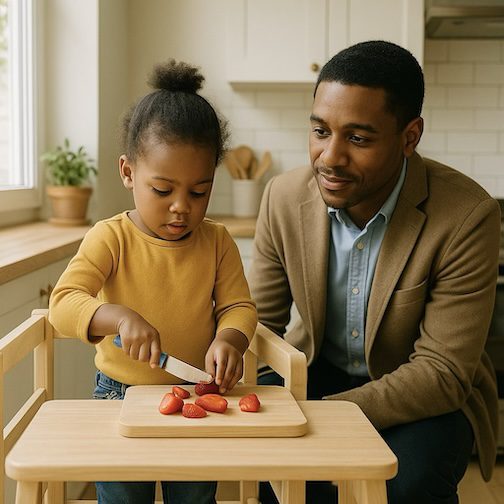
One of the most common phrases heard in homes with young children is: “Let me do it for you.”
Whether it is buttoning a shirt, pouring water, arranging toys, or carrying a school bag, parents often step in quickly — usually out of love, urgency, or the simple reality of a busy morning. It is one of the most natural impulses in parenting.
But what if these small, ordinary moments are actually opportunities for children to build confidence, responsibility, and independence? What if stepping back, just a little, is one of the most loving things a parent can do?
This is one of the core ideas behind the Montessori education approach at Brixtonhouse Montessori School in Purasawalkam, Chennai — and it begins much earlier than most parents expect.
Independence Begins Earlier Than We Think
Young children have a deep, almost urgent desire to do things on their own. You have probably heard it already: “I’ll do it.” “Let me try.” “I can do it myself.”
In Montessori philosophy, this is not stubbornness. It is a healthy and important developmental need — one that, when respected, helps children build self-confidence, problem-solving skills, focus, and emotional resilience. Most importantly, they begin to carry a quiet inner belief: “I am capable.”
What Makes Montessori Different?
In traditional settings, adults tend to instruct, correct, and guide children toward the right answer. Montessori classrooms work differently. Children are given child-sized furniture and tools, freedom within clear boundaries, and the time and space to repeat activities until they feel genuinely ready to move on.
The adult’s role shifts from “doing for the child” to “guiding the child.” This subtle difference has a powerful emotional impact.
How Independence Shapes Emotional Development
When children complete even small tasks on their own, they experience something adults often underestimate: genuine pride. Pouring water, folding clothes, cleaning up after play, or putting on shoes independently — these build a confidence that reaches far beyond the task itself.
Over time, children develop patience, coordination, decision-making, and a quiet sense of accountability. Gradually, they become less dependent on constant adult approval — not because they need adults less, but because they are learning to trust themselves.
5 Montessori-Inspired Ways Parents Can Encourage Independence at Home
Slow Down and Allow Time
Children need extra time to complete tasks on their own, and rushing almost always leads adults to take over. The next time you feel the urge to step in, try replacing “You’re too slow” with “Take your time — you can do it.” That small shift in words makes a large shift in what the child believes about themselves.
Create Child-Friendly Spaces
Place everyday items within your child’s reach: their water bottle, favourite books, clothes for the day, a few toys they can put away themselves. Accessibility quietly teaches responsibility. When children can manage their own things, they begin to feel ownership over their world.
Involve Children in Real-Life Activities
Young children do not just want to play — they want to participate in real life. Allow them to water plants, wipe down a table, arrange cushions, or help prepare a simple snack. These activities build both skill and a sense of purpose that play alone cannot provide.
Avoid Over-Correcting
Perfection is not the goal. The process matters far more than the outcome. A child pouring water imperfectly is still practicing coordination, patience, and independence — every small spill is part of the learning. When adults resist the urge to correct every mistake, children feel trusted, and that trust becomes confidence.
Trust Your Child’s Capability
Children often rise to meet the expectations we hold for them. When a child feels that their parents genuinely believe in their ability, confidence grows in ways that no lesson or class can fully replicate. Something as simple as “I know you can do this” can stay with a child far longer than we realize.
The Bigger Lesson
Montessori is not just about materials or academic methods. At its heart, it is about respecting the child as a naturally capable individual.
Independence in early childhood does not mean children stop needing adults. It means they begin developing trust in themselves — and that is a foundation that supports everything else they will learn and become.
Perhaps that is one of the greatest gifts parents can offer during these early years: not just knowledge, but the quiet, steady belief that their child is capable of trying, learning, and growing.
V. Narsimhan is an Early Childhood Education Advocate and Marketing Strategist at Brixton House Montessori, Chennai. Passionate about Montessori education and child development, he writes on topics related to early learning, parenting, and nurturing children’s natural curiosity and potential.
1907-2026 Welcome to the 120th Montessori School Year!
Last year, Jordan McGillis published an article in The Washington Post on August 18, 2025, titled “Why child care costs so much — and how to fix it”. It raised important points about the rising cost of child care in America and sparked me to reflect on this issue from a Montessori perspective.
Why All Child Care Is Expensive
High-quality child care is costly everywhere. Caring for young children is labor-intensive. There are no shortcuts when it comes to babies, toddlers, and very young children. A nurturing environment depends on adults who can give children their full attention.
Economists call this the “Baumol effect.” In most industries, productivity rises with technology—machines and software help people do more with less. But children still need the same love, guidance, and supervision they always have. That means labor costs remain high, and tuition rises as programs try to keep pace with wages in other fields.
Meanwhile, fewer Americans are pursuing careers in early childhood education. The pay is modest compared to other professions, even though the work is demanding and highly skilled. That shortage of willing caregivers further drives up costs.
The Limits of Subsidies
As McGillis pointed out in the Post, subsidies help parents but don’t reduce the underlying cost of child care. Instead, the cost shifts to taxpayers. Large-scale subsidies often come with heavy regulation: standardized curricula, rigid requirements, and compliance-driven oversight. While intended to ensure safety and accountability, these rules can make programs less flexible and less personal. They often don’t look much like Montessori, which thrives on individualized learning, freedom within limits, and respect for each child’s natural development.
Ideas That Could Help
The Washington Post opinion piece highlighted some ideas that are worth serious consideration:
Expand visa programs: The U.S. could allow more qualified caregivers from other countries—people who love working with children—to enter as au pairs, nannies, or early childhood teachers. This would expand the supply of caregivers and help families access more affordable options. Many Montessori schools already seek highly qualified teachers from Europe, Asia, and Latin America.
Rethink credential barriers: In some places, even those caring for toddlers must hold college degrees. Training matters, but overly rigid requirements drive good people away and unnecessarily raise costs.
Give families choices: Not every family wants or needs the same care model. Allowing flexibility in program design—while still protecting children’s safety—would make space for Montessori and other approaches parents value.
Why the Investment Pays Off
These discussions matter because the first six years of life shape everything that follows. A child’s ability to focus, regulate emotions, build relationships, and love learning develops in these early years. The quality of those experiences pays dividends for a lifetime.
Choosing a high-quality early childhood program may feel like a heavy financial burden. But it is not just another bill—it’s an investment in your child’s future. And as the Post article emphasized, finding creative ways to expand the pool of caregivers and make child care more affordable can make this investment possible for more families.
Why is it so hard to find a progressive school these days?
The Education We Know Is Possible
There is something both encouraging and slightly melancholy about sitting down with Alfie Kohn to discuss progressive education. Encouraging because his thinking remains as sharp and generative as ever, and because the people who gather around conversations like ours — the Independent School Leaders Forum — still burn with the same conviction that drove Dewey, drove Maria Montessori, drove my mother when she was up at Columbia in the nineteen-twenties absorbing ideas that seemed radical then and remain, somehow, radical still. Melancholy because so much of what we talked about has been talked about for a hundred years. The question Alfie turned back on us is the one we can never quite escape: if we know all of this, if we can articulate it so clearly and feel it so deeply, why are there still so few schools that actually live it?
That is where I want to begin, and I want to be honest with you about the answer, because I think school leaders sometimes look for an easier explanation than the truth provides.
What We Mean by Progressive
Alfie opened by doing something characteristically useful. He refused to let the word progressive do unchallenged work. Is a school not progressive because it charges $50,000 a year? Does a genuinely progressive lower school become something else when the students reach middle school and the culture shifts toward preparation and performance? What about the school that teaches interdisciplinary humanities with real depth and collaboration, but still hands out worksheets in math? And what about — this is the one that stings the most — the school that talks beautifully about progressivism in its political and cultural dimensions, that is genuinely concerned with justice and the environment and the full humanity of every child, but that still runs on a hidden grammar of obedience, graded performance, and adult control?
This last type is more common than we like to admit in our community. Alfie put it plainly: some schools are progressive in the contemporary political sense of that word but are not doing progressive education as any of us — Dewey, Montessori, Piaget — would define it. They teach about American imperialism and saving the planet, and they still give quizzes. The content has changed; the relationship between teacher, child, and knowledge has not.
What matters, Alfie insisted, is not the label but the substance. And the substance, drawing on the tradition that connects Dewey to Montessori to the best progressive thinkers of our own time, involves a commitment to the whole child, to supporting genuine autonomy, to authentic collaboration, to deep understanding rather than surface coverage, and to the fundamental proposition that the people involved in any educational enterprise — including the children themselves — ought to have a meaningful voice in shaping it. That last point is where most schools, including many that call themselves Montessori, fall short. I will return to it.
Why It Has Always Been Hard
One of the more clarifying things Alfie said is that progressive education has never been the majority practice in American schooling. Not in Dewey’s heyday in the nineteen-thirties, not in the open classroom movement of the sixties and seventies, not now. When we ask what happened to the progressive schools, we are asking, in part, the wrong question, because the right question is perhaps: how do any of them survive at all, given the undertow that is always pulling against them?
Alfie laid out the structural reasons with real precision. Progressive education is more demanding of everyone it touches. It is more demanding of children, who are asked to be co-creators of their learning rather than passive recipients. Thinking from the inside out, grappling with genuine questions, collaborating rather than competing — these require more of a child than memorizing facts and producing them on a quiz. Children can coast on a traditional education in a way they cannot coast in a genuinely progressive one, and that reality produces its own kind of resistance.
It is even more demanding of teachers. You cannot fake deep content knowledge in a classroom where children are constructing understanding, asking unpredictable questions, and following the logic of ideas wherever it leads. A teacher who lectures can get by on superficial familiarity; a teacher who is genuinely facilitating children’s thinking cannot. Beyond content knowledge, progressive teaching requires profound pedagogical skill — an understanding of how people actually learn, not just what they are supposed to be taught. And it requires what Alfie described memorably as the ability to function more like a jazz musician than a recitalist: to be genuinely at ease with uncertainty, to follow the emergent shape of a lesson rather than the predetermined one, to give up control over things that most teachers hold tightly.
And then there is the broader social environment. Progressive education tends to produce critical thinkers, and critical thinkers are, as Alfie said, inconvenient for people in power. A culture addicted to competition and to standardized test scores as the measure of educational success will always be in tension with schools that measure themselves by other standards. Parents, even those who deliberately chose our schools, often exert pressure — sometimes subtle, sometimes not — toward the familiar. They know what school looked like when they were children; they know what the path to college is supposed to look like; they are anxious, and anxiety tends to push people toward convention.
The Standardized Testing Trap
I want to linger here, because Alfie was particularly incisive about the way standardized testing functions not just as a policy problem but as an epistemological one. The moment a school agrees to be evaluated primarily by standardized test scores, it has already conceded the most important argument. Those tests, as Alfie said, measure what matters least intellectually. High scores are not merely meaningless in themselves — they can be a warning sign, because of what had to be sacrificed, what had to be drilled and narrowed and decontextualized, to produce them.
For those of us in Montessori and independent schools, this might seem like someone else’s problem. We do not, most of us, live and die by standardized test scores the way a public school principal does. But the logic of standardized accountability has a way of seeping in regardless. It seeps in through parents who ask how your graduates perform on the ERB, the SSAT, or the ACT. It seeps in through the implicit conversation about college placement. It seeps in through any moment when we begin to ask whether our children are keeping up rather than whether they are genuinely learning.
Alfie’s point is that test scores become the default measure of educational success in the absence of a genuine community conversation about what we are actually trying to accomplish. And that is where the responsibility falls on school leaders. If we do not lead that conversation, if we do not bring parents and teachers and, yes, students into a shared articulation of what we are for, then the default will fill the vacuum. The default is test scores, college placement, and the anxious mimicry of whatever the most prestigious schools appear to be doing.
The Lever of Long-Term Goals
Here is the most practically useful thing Alfie shared, and I have been thinking about how to put it to work ever since. When he speaks to groups of parents or educators, he almost always begins by asking the same question: How do you hope your children will turn out? What are your long-term goals for them as human beings?
And the answers are remarkably consistent across constituencies that would seem to disagree about almost everything. People say, “I want my child to be happy.” Ethical. Caring and compassionate. Curious. Self-motivated. Creative. A genuine thinker. The consensus, Alfie observes, is striking, and it spans the ideological spectrum.
Then comes the pivot. He says, essentially: you tell me you want this. So why are you doing that?
Because the practices of traditional schooling — the drilling, the grading on a curve, the extrinsic rewards, the narrowing of the curriculum to what can be measured, the insistence on compliance rather than genuine engagement — are not only failing to produce these outcomes; they are actively working against them. A child who has been taught primarily to perform for external rewards is not becoming self-motivated. A child who has spent twelve years learning that the point of school is to get the right answer and move on is not becoming curious or creative. A child who has been ranked against peers since kindergarten is not necessarily becoming compassionate.
Progressive education, by contrast, is oriented toward exactly the outcomes that most adults, when they stop and think about it, genuinely want for children. Alfie described this as a kind of lever, and I think that is exactly right. As school leaders, we are often trying to defend our approach to people who are skeptical or anxious, and we sometimes make the mistake of arguing on our opponents’ terms — defending our test scores, justifying our college placement rates, translating our philosophy into the language of measurable outcomes. What Alfie suggests is that we can instead shift the ground entirely, by helping parents articulate their own deepest intentions and then making visible the connection between those intentions and what we are doing in our schools.
The complement to this, which Alfie also offered, is to ask people to look backward into their own schooling. When were you most alive in a classroom? When did you not want the bell to ring? The answers almost always point toward the features of progressive education: collaboration rather than isolation, genuine choice about what to explore, and active engagement rather than passive reception. Nobody says the best moment of my education was sitting quietly, taking a multiple-choice test. Help people see that connection, and you have a powerful ally in their own experience.
Systems and the Montessori Advantage
This is where I want to bring my own perspective into the conversation, because it is something my mother helped me understand and something I have been thinking about for fifty years.
John Dewey was a philosopher before he was an educator, and the school he created at the University of Chicago was a remarkable place. But as my mother used to say, his great limitation was that he did not think in terms of systems. The emergent curriculum at the heart of Deweyan progressivism — the idea that the curriculum should arise from the genuine interests and questions of children and teachers together — is a beautiful idea that is also genuinely exhausting. It works brilliantly when you have an extraordinary teacher, someone who can hold that emergent space with skill, depth, and endless creative energy. But it does not scale. It does not sustain itself across decades and generations. Schools that depend primarily on the heroic creativity of individual teachers burn through those teachers and then lose the thread.
Maria Montessori, for all the ways she can be (and should be) criticized and read selectively rather than reverentially, gave us something Dewey did not: a system. A coherent, refined, replicable system for creating the conditions in which children can genuinely flourish — the prepared environment, the three-year cycle, the trained observation of the teacher, the materials themselves as the embodiment of a philosophy. When I transitioned the Barrie School to Montessori, one of the most immediate differences I felt as an administrator was that teachers had a framework in place. They did not have to reinvent their professional identity from scratch every September. The philosophy was built into the environment.
This is, I think, one of the most important things we can say to school leaders who are trying to understand what distinguishes Montessori from other progressive approaches. It is not that Montessori is the only way to honor the child, the only way to support genuine learning, the only pedagogy with wisdom to offer. Alfie is right that we should borrow selectively from the tradition rather than treating any founder as infallible. But the systematization matters. It is what allows the work to outlast any individual practitioner, to survive the turnover among teachers, heads, and boards that is the reality of every school.
The caveat I would add is that systems can also become prisons. When AMI orthodoxy treats Montessori’s every word as scripture and treats deviation as heresy, the system that was meant to serve the child ends up serving itself. The goal of the system is always the child’s flourishing. When we lose sight of that, we have made an idol of our methodology.
The Voice of Children
I raised a question during the webinar that I have been thinking about, and I don’t think we have fully addressed it in the Montessori world.
We talk beautifully about Casa dei Bambini — the house of the children. But whose house is it, really? We prepare the environment meticulously, with great care and professional intentionality. We design the curriculum, select the materials, and set the schedule. And then we invite the children in to choose from among the options we have prepared for them. That is nothing; it is genuinely better than what most children experience in most schools. But it is also not the same as what Alfie and Dewey were pointing toward when they talked about children as co-creators of their educational experience.
Alfie put the question beautifully: Is the environment prepared for the kids, or with the kids?
At Montessori conferences, when children are present at all, they are usually performing — part of a musical, a presentation, a demonstration. They are not sitting alongside adults as partners in imagining what Montessori education could be. At AMI and AMS conferences, you do not find children on the program committee, or presenting research alongside their teachers, or challenging adults on decisions that affect them. And yet, at AERO conferences, which have always been a little hippie, a little rough around the edges, and genuinely alive in a way that more polished events are not, children run the thing. Children are speakers. Children are organizers. That is, to my mind, what a Montessori event ought to aspire to.
The practical implications of this for school leaders are real and immediate. When you plan for the new school year, can you invite your children — even your three-, four and five-year-olds — to help set up the classrooms? There is something profound and formative about a child who has cleaned every material with Murphy’s oil soap and set it on the shelf with care. That child knows this is her room, her house, in a way no amount of telling can convey. In Japan, children come to school two weeks before classes begin to prepare the building for the year. The school is something they have made, not something they have been handed.
At the adolescent level, the stakes are even higher and the failures more visible. If we believe that the prepared environment is the cornerstone of Montessori practice, then we ought to be asking ourselves what the prepared environment looks like for a fourteen-year-old and for a seventeen-year-old. Not what we have inherited from an elementary tradition stretched upward, but what a genuine Montessori secondary environment would be, designed around the developmental realities of adolescence, with meaningful student voice built into its architecture from the ground up.
Structure Is Not the Same as Control
The last thing Alfie said before he signed off was also, perhaps, the most useful for school leaders to carry into their daily practice. He said: ” Structure is not the same as control.
This matters because the false dichotomy that most educational conversation gets stuck in is between the authoritarian classroom, where the adult controls everything, and the laissez-faire classroom, where the adult steps back and the children are nominally free. Both of these are failures, and both are failures because they misunderstand the role of the adult.
Alfie’s position — and it is Montessori’s position, and Dewey’s at his best — is that adults have a critical and irreplaceable role in the learning environment, but that role is working with children rather than doing things to them or standing back while they flounder. Adults bring content knowledge, pedagogical wisdom, the ability to introduce ideas and experiences and possibilities that children might not have stumbled upon on their own. None of that is authoritarian. None of it requires that children be passive or compliant. The question is whether the adult’s authority is being exercised in service of the child’s genuine growth, or in service of the adult’s need for control, convenience, or the appearance of rigor.
When Alfie speaks about needing courageous leaders, he also pushes back on that framing in an interesting way. He is suspicious of the idea that the solution to our challenges is finding more individuals with grit and resilience and the willingness to put on iron underwear and take the hits from all sides. Not because courage is unimportant, but because focusing on individual courage is, in his view, a somewhat conservative strategy: it accepts the hostile structures as given and tries to breed humans who can survive them. What he would rather do is change the structures, build systems of progressive education that do not require heroism to sustain, that support good teaching rather than merely tolerating it.
I hear that, and I mostly agree with it. But I also think school leaders live in the real world, and the real world requires both: the long work of structural change and the day-to-day courage to keep doing what you believe in even when it is hard. We need people who are building better systems AND people who are willing to stand up in a board meeting or a parent coffee and say, this is what we believe, this is why it matters, this is the education your children deserve.
The Moment We Are In
I would be dishonest if I wrote this essay without naming the political context in which we are all working. Alfie said it plainly: public education, which he rightly called a cornerstone of a democratic society, is under assault in a way that is unprecedented in modern American history. The dismantling of federal education infrastructure, the defunding of public schools through voucher programs, the attacks on teachers’ professional autonomy and on the very idea that schools should serve the public good rather than private preference — all of this is real, and all of it creates the conditions in which good progressive education becomes harder to do and easier to attack.
Alfie’s point, drawing directly on Dewey, is that progressive education and democratic society are not merely related — they are constitutive of each other. A society that is becoming more authoritarian will, inevitably, put pressure on schools that are trying to cultivate democratic habits of mind, critical thinking, and genuine autonomy. The connection flows both ways: the work we do in our schools is not separate from the larger project of maintaining and renewing a democratic culture. It is part of it.
This is not a reason for despair. It is, I think, a reason to clarify what we are doing and why. When we protect the child’s right to be genuinely curious, genuinely heard, genuinely a co-creator of her own education, we are doing something that matters beyond the walls of our schools. We are preparing people who know how to think, who know how to question, who know their voices matter. In this particular moment in history, that is not a small thing.
What We Owe the Next Generation of Leaders
Alfie closed the conversation with something that has been sitting with me. He said he looks forward to the day when the average age of a group like ours is half of what it is now, because that will mean there is another generation ready to carry this forward. He was being gentle, but the point is real. Many of us who have been in this work for decades are at the back half of our professional lives. The question of who comes next, and how we prepare them, and what we leave them to build on, is not abstract.
What I think we owe them is honesty about how hard this is. Not discouraging honesty — the kind that makes young educators feel that the deck is so stacked against them that there is no point. But clear-eyed honesty about the structural realities, the institutional inertia, the social pressures, the genuine difficulty of doing progressive education well. And alongside that honesty, the clearest possible articulation of why it matters. Not the institutional version of why it matters, not the version that talks about college placement and differentiated instruction and twenty-first century skills, but the real version: because children are whole human beings who deserve an education that treats them as such, because democracy depends on citizens who can think and question and collaborate, because the moment when a child discovers that her mind is capable of something she did not know it could do is one of the most consequential things that can happen in a human life.
We were not wrong about this. The people who built the Barrie School were not wrong. Maria Montessori was not wrong, even when she was imperfect. John Dewey was not wrong, even when he was hard to read, and his Chicago school didn’t always follow through. The work is still the work. The question that Alfie’s presence always revives for me is whether we are doing it with enough urgency, enough clarity, and enough genuine partnership with the children who are counting on us to get it right.
A Complete Guide from First Contact to Lasting Partnership
INTRODUCTION
Rethinking the Onboarding Journey
The ninety-day sequence at the heart of this playbook is among the most effective tools a school can deploy to welcome and retain new families. But the families who thrive most over time are often those who arrived at enrollment day already convinced, already connected, and already beginning to see themselves as Montessori parents. That level of readiness does not happen by accident. It is the result of a deliberate engagement process that begins long before a contract is signed, and in some cases, long before a family has even set foot on campus.
This expanded edition of the playbook addresses that larger arc. It introduces four additional frameworks that work alongside and before the ninety-day sequence: a program of pre-enrollment community building designed to reach families in the early stages of their decision-making; a waiting list nurture campaign that keeps families engaged and educated through what can be a lengthy period of anticipation; a set of strategies for the post-acceptance, pre-start window that bridges inquiry and enrollment into the classroom experience itself; and a full-year community programming model that sustains engagement, deepens understanding, and strengthens the emotional bond between families and school in ways that reduce attrition and build lasting partnership.
Together, these frameworks transform onboarding from a ninety-day communication sequence into a continuous, relationship-centered journey that begins the moment a family first encounters the school and deepens throughout their enrollment.
Understanding the Full Enrollment Journey
It is useful to think of a family’s relationship with a Montessori school as unfolding in five broad phases, each with its own emotional texture, information needs, and opportunities for connection.
Phase One: Awareness and Exploration
The period before a family has made any formal contact with the school. They may be researching options, attending community events, or simply becoming curious about Montessori. A family who has attended a film night, observed a classroom, or participated in an “Is Montessori Right for Your Family?” evening arrives at their first tour already philosophically prepared and emotionally inclined.
Phase Two: Inquiry and Waiting
Once a family has expressed interest or been placed on a waiting list, they enter a period that can last anywhere from a few weeks to several years. This is one of the most underserved phases in most schools’ enrollment programs. A thoughtful nurture campaign during this phase can transform a family’s fragile initial interest into deep loyalty.
Phase Three: Post-Acceptance Preparation
Once a family has been offered and accepted a place, there is a window of excitement and anticipation before the first day. Social events, classroom readiness experiences, and the introduction of the parent ambassador program can significantly deepen the foundation before Day One arrives.
Phase Four: The First Ninety Days
This is the core of the original playbook, and it remains the heart of the onboarding program. The additional frameworks in this edition ensure that families arrive at Day One better prepared, more philosophically aligned, and more personally connected than they would be otherwise.
Phase Five: Ongoing Partnership
After the formal onboarding period concludes, the school’s work is not finished. Retaining families through the full three-year classroom cycle requires sustained engagement, continued education, and a community that families actively want to belong to.
PART ONE
Before Enrollment
Pre-Enrollment Community Building and Awareness
Why This Phase Matters
The single most significant factor in Montessori enrollment retention is philosophical alignment. Families who genuinely understand and believe in the Montessori approach — not just as an educational method but as a way of seeing children — are dramatically less likely to leave. They are less rattled when their child has a difficult transition. They are less susceptible to the pull of a school that offers letter grades, homework packets, and a visible curriculum that looks more familiar. They are more likely to stay through the full three-year cycle, more likely to enroll siblings, and more likely to become the advocates and ambassadors who attract new families to the community.
That level of alignment cannot be built in a single tour, and it is difficult to fully establish in ninety days of onboarding emails. It is built over time, through repeated exposure to Montessori ideas, through witnessing the approach in action, and through meaningful conversation with other families who have made the journey ahead of them. The pre-enrollment phase is the school’s best opportunity to begin building that alignment long before any paperwork is signed.
There is also a practical recruitment dimension. Many families, particularly in communities where Montessori is not yet widely understood, are making their school choice largely on reputation and word of mouth. The school that creates welcoming, low-pressure community events for families in the exploration stage is planting seeds that will produce enrollment inquiries months or even years later. Every family who attends an open evening and leaves feeling informed and respected is a potential ambassador who will tell others.
Open Observation Opportunities
One of the most powerful pre-enrollment experiences a school can offer is the opportunity to observe a Montessori classroom in action. For most families, seeing the prepared environment, watching children choose and sustain their own work, and witnessing the calm and purposeful energy of the classroom is more persuasive than anything a brochure or website can convey. It is the difference between being told about Montessori and experiencing its reality firsthand.
Schools should consider scheduling regular observation opportunities that are open to prospective families, not just families who have already applied. The format matters. A family dropped into a classroom without context will often miss what they are seeing, or worse, misread it. Brief preparation before the observation — perhaps ten to fifteen minutes with an administrator or an experienced guide who orients the family to what they are about to witness — can transform the experience from a pleasant curiosity to a revelation. Equally important is the follow-up conversation afterward, giving families the chance to ask questions and share their reactions while the experience is still fresh.
Is Montessori Right for Your Family?
Borrowed in spirit from the Waldorf tradition, which has long offered community evenings explicitly oriented toward helping families decide whether the approach is right for them, the “Is Montessori Right for Your Family?” evening is a profoundly effective pre-enrollment event. The name itself signals something important: this is not a sales presentation. It is an honest, respectful, exploratory conversation designed to help families make a genuinely informed decision.
The format typically runs ninety minutes to two hours and might include a brief introduction to the foundational principles of Montessori education, an honest discussion of what Montessori asks of families, a panel or informal sharing from current families, and ample time for questions. The goal is not to convince every family that Montessori is right for their child. It is to give families the information and perspective they need to make a good decision, and to help them feel respected and trusted in the process. These evenings work best when offered at least twice a year and promoted well beyond the school’s existing network.
The Montessori Journey and Similar Experiential Programs
Some schools have developed more structured pre-enrollment experiences designed to give prospective families a direct encounter with Montessori learning. One of the most elegant of these is the Montessori Journey, developed by Barbara Gordon, an intensive orientation experience that guides families through key concepts and materials of the Montessori approach, often using the materials themselves. When a parent works with the golden bead materials, traces a sandpaper letter, or moves through a sensorial exercise, they understand from the inside what their child will be experiencing. Schools that offer this kind of immersive experience consistently report that families who go through it are better prepared, more confident, and more likely to stay through the full three-year cycle.
Film Nights and Documentary Screenings
Documentary film is one of the most accessible and effective tools available to schools trying to build pre-enrollment understanding. Films such as Raising Wild, The Beginning of Life, and Montessori: The Education Revolution offer beautifully produced, emotionally resonant introductions to concepts that are sometimes difficult to convey in words. A film night is low-effort to organize, naturally social in format, and accessible to families who might be intimidated by a more formal presentation. Schools should consider hosting two to three film nights per year and treating them as genuine community events, inviting current families alongside prospective ones, because the informal conversations that happen afterward are often more persuasive than anything an administrator can say.
Pre-Enrollment Follow-Up Emails
Each pre-enrollment event represents an opportunity to deepen a prospective family’s connection to the school. A warm, thoughtful follow-up email sent within twenty-four hours of a classroom observation or an evening event consolidates the impact of the experience and opens the door to continued relationship. The two templates below are designed for exactly this purpose.
Trigger: Sent within 24 hours after a prospective family observes in the classroom
Subject: Thank You for Visiting — A Few Things You May Have Noticed
Dear [Parent First Name],
Thank you for making time to visit our classroom yesterday. We hope the experience gave you a genuine sense of what a Montessori morning looks and feels like, and we are glad you could see it firsthand.
Classroom observations often raise as many questions as they answer, and that is exactly as it should be. You may have noticed the quiet, purposeful energy of the room, or the way children moved between materials without being directed. You may have wondered why the teacher was not at the front of the room, or what the younger children were doing while the older ones worked. You may have seen something that surprised or moved you, and you may have seen something that confused you.
We would love to hear your reflections. If you have questions about specific things you observed, [Name] is available for a conversation at your convenience. You can reach them at [email] or [phone], and they would genuinely enjoy talking through what you saw.
In the meantime, we have attached a brief guide called “What to Look For in a Montessori Classroom” that addresses many of the questions families ask after their first visit. We hope it adds another layer of understanding to what you experienced.
We look forward to continuing this conversation. Please do not hesitate to reach out.
Warmly, The [School Name] Team
Trigger: Sent within 24 hours after a prospective family attends an “Is Montessori Right for Your Family?” evening
Subject: Thank You for Being With Us Last Night
Dear [Parent First Name],
We are so glad you joined us last night. Evenings like that one are among our favorite events of the year — not because they are polished or formal, but because the conversations that happen in the room are honest, searching, and genuinely useful.
We hope you left with a clearer sense of what Montessori asks of families, what it offers children, and whether it feels like the right fit for your family right now. We believe the most important thing a prospective family can do is make a well-informed decision, and the best thing we can do is give you the information and perspective to do that. If last night raised more questions than it answered, that is entirely normal, and we welcome every one of them.
If you are interested in taking a next step, the most valuable one is an in-classroom observation. Watching the morning work period in action — even for thirty minutes — gives most families a level of clarity that no presentation can provide. You can schedule an observation by contacting [Name] at [email].
If you are not yet ready for that step, or if the evening confirmed that Montessori is not the right fit for your family right now, we appreciate your time and your openness. These evenings are richer because families like yours participate in the conversation.
Whatever you decide, we wish your family every good thing as you make this important choice.
Warmly, The [School Name] Team
The Waiting List Nurture Campaign
Why Waiting List Families Need Deliberate Engagement
In many Montessori schools, particularly those serving the toddler and primary levels, prospective families join a waiting list long before their child is of enrollment age. It is not uncommon for a family to express interest in a school while their child is still an infant, or in some cases, before the child is even born. The interval between joining the waiting list and the child’s actual start date may span two, three, or even four years.
This waiting period represents one of the most significant lost opportunities in Montessori enrollment management. Families who join a waiting list are highly motivated and genuinely interested. But that interest is fragile. In the months and years that follow, they will be approached by other schools, hear concerns from family members who question the Montessori approach, and watch their child grow while wondering whether their initial choice still makes sense. Without deliberate, consistent engagement from the school, a surprising number of waiting list families quietly abandon their interest before their child ever reaches enrollment age.
The solution is a thoughtful nurture campaign that treats waiting list families as the community members they are already becoming. The goal is not to inundate them with communications but to maintain a warm, low-frequency presence in their lives, to help them understand Montessori more deeply over time, to connect them to the community, and to ensure that when their child reaches enrollment age, they are more committed and better prepared than they would otherwise be.
The Waiting List Welcome
The first communication a family receives upon joining the waiting list should be warm, informative, and genuinely welcoming without being falsely reassuring about timelines. It should thank them for their interest, explain what they can expect in terms of communication, and invite them to take a first step toward deeper connection. Families who receive a thoughtful welcome begin their relationship with the school from a position of confidence and connection rather than uncertainty and passivity.
The Waiting List Email Sequence — At a Glance
The following table offers a summary of the complete six-email waiting list sequence. Full email templates follow the table.
ID
TIMING
SUBJECT LINE
PURPOSE
WL-1
Immediately
Welcome to Our Community
Warm welcome to the waiting list, what to expect, invitation to upcoming events, first curated Montessori resource.
WL-2
2–3 months
Your Child Right Now
Developmental stage overview tailored to the child’s current age, with Montessori’s sensitive periods framework as the lens.
WL-3
6 months
A Window Into the Classroom
Description of the prepared environment: materials areas, the work cycle, the guide’s role, what a typical morning looks like.
WL-4
9–12 months
Simple Ways to Support Your Child Now
Practical Montessori-at-home guidance for the child’s current stage. Builds loyalty by offering genuine value before enrollment.
WL-5
12–18 months
Questions We Hear Most Often
Addresses school readiness, grades, structure, and social concerns with honest, substantive answers.
WL-6
6 months before start
Your Family’s Time Is Coming
Shifts to relational tone. Acknowledges the wait, previews the enrollment process, invites personal connection.
The Waiting List Emails in Full
Trigger: Sent immediately upon a family joining the waiting list
Subject: Welcome to [School Name] — You’re Part of Our Community Now
Dear [Parent First Name],
We are so glad you found us. The fact that you have placed your child’s name on our waiting list tells us something meaningful: you are a parent who is thinking carefully about what kind of start you want to give your child. That kind of intentionality is exactly what Montessori families bring to this community, and we want to begin our relationship with you right now — not when your child’s start date finally arrives.
What does being on our waiting list mean? It means we will keep your child’s name in active consideration as spaces become available. We cannot make promises about timing — our program fills quickly and our spaces are limited — but we can promise to stay in touch, to keep you informed, and to give you advance notice when a space is likely to open for your child’s age group.
In the months ahead, you will hear from us periodically. We will share resources and reflections on the Montessori approach, offer invitations to school events and community gatherings, and occasionally check in to confirm that your family’s circumstances and interest have not changed. These communications are designed to be genuinely useful, not promotional. We want you to understand what your child would be stepping into, and we want you to feel connected to our community long before enrollment day arrives.
We invite you to attend our next [Open Evening / Community Film Night / Classroom Observation], taking place on [date]. There is no obligation and no pressure — only the opportunity to see our school in action and to begin meeting the people who make this community what it is. You can register at [link] or simply reply to this email.
Please feel free to reach out to [Name] at [email] with any questions at all. We are delighted you found us and we look forward to getting to know your family.
Warmly, The [School Name] Team
Trigger: 2–3 months after joining the waiting list
Subject: Your Child Right Now — What’s Happening Developmentally
Dear [Parent First Name],
Since you joined our waiting list, your child has been growing and changing every day. Whether they are currently a curious infant reaching for everything within grasp, a toddler who insists on doing everything themselves, or a three-year-old who asks “why?” approximately one hundred times before breakfast, they are doing exactly what they are meant to be doing. Maria Montessori spent decades observing children and came to a conclusion that still shapes everything we do: children are not empty vessels waiting to be filled. They are self-constructing human beings driven by a profound inner directive to grow.
To support that growth, Montessori identified what she called sensitive periods — windows of time when children are particularly receptive to certain kinds of learning. These windows are not permanent. When a child is in a sensitive period for language, for movement, for order, for the refinement of the senses, they are in a state of heightened readiness that will not last forever. The environment that meets them in that moment shapes who they become.
For infants and very young toddlers (under 18 months): Your child is absorbing the environment on a level that is almost impossible to fully comprehend. Language, movement, relationships, and the emotional texture of the people around them are being absorbed not intellectually but into their very bodies and nervous systems. The most important things you can offer right now are a calm, predictable environment, unlimited opportunities to move freely and safely, and the secure attachment that comes from responsive, unhurried care.
For toddlers (18 months to 3 years): Your child is in a sensitive period for order and for movement. They want things in their place, they want to do things themselves, and they are frustrated when the world does not cooperate. This is not stubbornness — it is intelligence. The insistence on “I do it myself” is the developmental precursor to genuine independence, and it deserves to be honored rather than managed.
For children approaching three: Your child is entering one of the most remarkable developmental periods of human life. The capacity for abstract thought, for language, for symbolic representation, for social sophistication — all of it is emerging simultaneously. The primary classroom they will eventually enter has been prepared precisely for this child, at precisely this moment in their development.
We look forward to welcoming your family when the time comes.
Warmly, The [School Name] Team
Trigger: 6 months after joining the waiting list
Subject: A Window Into the Montessori Classroom
Dear [Parent First Name],
If you have not yet had the chance to observe a Montessori classroom in action, we hope to change that soon. But in the meantime, we would like to take you inside — to describe what you would see, what you might not immediately understand, and what is actually happening beneath the surface.
The first thing most visitors notice is the quiet. Not the enforced silence of a classroom where children have been told to be still, but a purposeful, productive quiet that arises naturally when children are deeply engaged in work they have chosen. The second thing they notice is the movement — children moving between shelves and tables, carrying materials carefully with two hands, working on rugs spread on the floor, in ones, twos, and small groups that form and dissolve without direction.
The classroom is organized into areas that reflect the major domains of human knowledge and development. In a primary classroom, you would find the Practical Life area near the entrance — trays of pouring activities, frames for learning to button and zip, flower-arranging stations, and small brooms and mops that children use to care for their classroom. This area is not a warm-up exercise. It is the foundation of everything. The concentration, coordination, and independence built through practical life work underpins all academic development that follows.
The Sensorial area offers materials designed to refine the senses and introduce mathematical relationships through direct physical experience. The Language area moves from phonemic awareness through moveable alphabets and sandpaper letters into reading and writing. The Mathematics area introduces quantity, symbol, and operation through manipulable materials so concrete that a four-year-old can hold the concept of one thousand in their hands.
What you would not see is a teacher at the front of the room directing everyone’s attention. What you would see instead is a guide moving quietly and purposefully through the space, observing, occasionally kneeling beside a child to offer a brief lesson, sometimes simply watching. The guide’s primary role is not to deliver information but to connect each child with the work that is exactly right for them at exactly this moment in their development.
If you have not yet observed at [School Name], we warmly invite you to contact [Name] at [email] to arrange a visit. It is the single most persuasive thing we can offer.
Warmly, The [School Name] Team
Trigger: 9–12 months after joining the waiting list
Subject: Simple Ways to Support Your Child Right Now
Dear [Parent First Name],
One of the things Montessori parents discover most consistently is that the philosophy that shapes the classroom translates beautifully into everyday home life. You do not need to purchase special materials or redesign your house. The same principles that guide our classrooms — respect for the child’s developing independence, trust in their capacity, the offer of real responsibility — are entirely available to you at home, right now.
The single most powerful thing you can offer your child is the opportunity to do things themselves. This sounds simple, but it runs counter to almost everything our culture tells us efficient parenting looks like. It takes longer to let a child pour their own water than to pour it for them. It takes patience to watch them wrestle with a shoe buckle they are not yet quite coordinated enough to manage. It takes trust to step back when every instinct says to step in.
But the child who is regularly permitted to do real things — who sets their own place at the table, helps to prepare food, waters the plants, folds their own clothing, sweeps the floor after a spill — is building something far more valuable than a set of practical skills. They are building a conviction about who they are: someone capable, someone trusted, someone whose contributions to the household are real and meaningful.
A few practical starting points: Consider a low shelf or basket where your child can independently access a few carefully chosen activities that match their current level of development and interest. Consider a step stool at the kitchen or bathroom sink so they can participate in washing their hands and joining the real life of the household. Consider involving them in cooking tasks appropriate to their age — tearing lettuce, washing fruit, stirring batter, spreading butter.
These small acts of invitation build the same inner structure that the Montessori classroom is designed to develop. By the time your child arrives in our community, they will already have a meaningful head start.
Warmly, The [School Name] Team
Trigger: 12–18 months after joining the waiting list
Subject: The Questions We Hear Most Often — and Our Honest Answers
Dear [Parent First Name],
Over the years, we have heard thousands of questions from families considering Montessori education. Some come from genuine curiosity. Some come from concern. And some come from things a grandmother, a pediatrician, or a well-meaning friend has said that are worth addressing directly. We believe honest answers build better relationships than promotional ones. Here are the questions we hear most often.
Will my child be ready for kindergarten? Yes — and in most cases more than ready. Montessori graduates consistently demonstrate strong executive function, deep reading and mathematical foundations, advanced language skills, and the kind of self-regulation that research identifies as one of the strongest predictors of long-term academic success. Our graduates are sought after by independent elementary programs and by public schools alike, precisely because of the independence and intellectual confidence they bring.
There are no grades — how will I know how my child is doing? Your child’s guide observes and documents their progress continuously. Twice a year, you will receive a detailed written narrative assessment and have the opportunity for a substantive conference conversation about where your child is and where they are headed. In our experience, this kind of assessment gives parents a far richer and more accurate picture of their child’s development than a letter grade does.
Isn’t Montessori unstructured? The Montessori classroom is deeply structured — just not in ways that are immediately visible from the outside. The materials are sequenced from simple to complex, from concrete to abstract, in a precise progression designed to bring each child to mastery in their own time. The guide tracks each child’s path through that progression with great care. What children have is freedom of choice within that structure, not freedom from structure.
What if my child has trouble settling? Some children take time to find their rhythm in a Montessori classroom, and we expect that. A guide who has supported many children through this process will work closely with both the child and the family to understand what is needed and to find the right entry point. The transition is rarely as difficult as families fear in advance, and it is almost never as difficult as staying in an environment that does not fit.
Please reach out to [Name] at [email] with any question we have not addressed here. We are always glad to hear from you.
Warmly, The [School Name] Team
Trigger: Approximately 6 months before the child’s projected start date
Subject: Your Family’s Time Is Coming — What to Expect
Dear [Parent First Name],
You have been patient. It has been some time since you placed your child’s name on our waiting list, and in that time your child has grown in ways you could not have fully predicted when you first reached out to us. We have thought about your family, and we want you to know that the waiting will have been worth it.
Within the next [time frame], we expect to be in touch with specific information about availability for your child’s age group. When that happens, the enrollment process will move quickly, and we want you to be prepared for it.
Here is what to expect: You will receive a formal offer of enrollment by [communication method]. You will have [number of days] to confirm your acceptance and submit the enrollment agreement and deposit. Once confirmed, you will begin receiving communications designed to prepare your family for your child’s first day — the same carefully sequenced onboarding program that every new family at [School Name] goes through.
In the meantime, if you have not yet attended a New Family Orientation or arranged an in-classroom observation, we strongly encourage you to do so before the enrollment offer arrives. Families who arrive at their first day already familiar with our environment, our guides, and our community consistently have smoother, more confident transitions — for themselves and for their children.
Please also confirm that we have your current contact information by replying to this email or reaching out to [Name] at [email]. If your family’s circumstances have changed and Montessori is no longer the right fit for this season, please let us know with no embarrassment at all. We hold your space with genuine care and want to make sure it goes to a family who is ready.
We are looking forward to welcoming your child into this community. The wait has been long, and the journey ahead is very good.
Warmly, The [School Name] Team
Post-Acceptance and Pre-Start Engagement
The period between a family’s acceptance of their offer and their child’s first day of school is brief but rich with opportunity. These families are in a state of heightened openness. They have made their decision. They are excited. They want to connect. The existing playbook’s Phase One email sequence serves this window well, but several additional activities can significantly deepen the foundation before Day One arrives.
The New Family Orientation
A gathering specifically for families who have enrolled but not yet started is one of the most effective investments a school can make in the pre-start period. Organized as a warm, informal evening or weekend morning, the orientation brings new families together to meet the head of school, meet key guides, and begin to meet each other. It is not a logistics meeting, though logistics will naturally be addressed. It is a relationship-building event. Schools that hold new family orientations consistently report that families who attend arrive on the first day with significantly lower anxiety and a sense of belonging that transforms the drop-off experience.
Classroom Readiness Days
Some schools invite new and returning families to participate in classroom preparation days in the days before the school year begins. These are mornings or afternoons when families come to campus to help clean materials, restock shelves, tend the garden, or simply make the classroom environment beautiful and ready for the children. Families who have spent an afternoon preparing the environment arrive on the first day with a sense of ownership and connection that is difficult to create any other way. They have touched the materials their children will use. They have stood in the classroom and imagined their child working there. They understand, in a way that requires no words, that this is a community that prepares the environment together.
Pre-Start Social Gatherings
A family picnic, a new parent reception, or an informal gathering at a local park in the days before school begins gives new families the chance to meet each other in a low-pressure social setting. Children who have played together before the first day have an easier first morning. Parents who have shared that mixture of excitement and nerves over food and conversation arrive at drop-off with a sense of companionship that carries them through the transition. What matters is that these events happen, that they are actively promoted rather than passively announced, and that a parent ambassador personally follows up to make sure every new family knows they are genuinely expected and wanted.
Post-Acceptance Email Invitations
The three emails below accompany the events described above. They are designed to convey genuine warmth and personal invitation rather than logistical announcement. Each should feel like a letter from one person to another, not a mass communication.
Trigger: Sent 4–6 weeks before the child’s first day, shortly after enrollment is confirmed
Subject: You’re Invited — New Family Orientation at [School Name]
Dear [Parent First Name],
We are so glad your family has joined our community. Now that your enrollment is confirmed, we want to invite you to the first of several events designed to help you feel at home before your child’s first day.
Our New Family Orientation takes place on [date] at [time] at [location]. This is an evening — or morning, depending on when you are reading this — designed entirely for families who are new to [School Name]. You will meet [Head of School Name] and several of our guides. You will have a chance to walk through the classroom environment, ask the questions that have been building since you enrolled, and most importantly, begin to meet the other families who will be making this journey with you.
The evening is informal. There will be food. There will be children running around if you bring yours. There will be time to linger and talk. What it will not be is a slideshow presentation or a list of rules and policies. If you need that information, it is in your enrollment packet. This evening is about something different: it is about beginning to feel that this community is yours.
Please register at [link] or simply reply to this email so we can plan accordingly. If you cannot attend this session, reach out to [Name] at [email] and we will find another way to make sure you feel connected before the first day.
We look forward to seeing you there.
Warmly, [Head of School Name] and the [School Name] Team
Trigger: Sent 2–3 weeks before the school year begins
Subject: Come Help Us Prepare the Classroom — [Date]
Dear [Parent First Name],
One of the most meaningful Montessori traditions at [School Name] is the annual classroom preparation that takes place in the days before school begins. On [date] from [time] to [time], we are opening the classrooms for families who would like to help us make them ready for the children.
What does this actually look like? It looks like washing and polishing wooden materials, dusting shelves, arranging flowers, carrying chairs from storage, pulling weeds from the garden, and generally making the environment as beautiful and orderly as it can be. Children are welcome and have their own tasks. It is, in the best sense, a community work day.
There is no obligation to attend. But we have found, year after year, that families who come to a classroom preparation morning arrive on the first day of school with something different in their eyes: a sense of ownership, of investment, of having contributed to the space their child will inhabit. It is one of those experiences that is much more than it appears on the surface.
If you plan to come, please let [Name] know at [email] so we can have enough tasks ready. Wear clothes you are comfortable working in, and bring your child if you’d like. We will have light refreshments and we promise the work is genuinely satisfying.
We hope to see you there.
Warmly, The [School Name] Team
Trigger: Sent 10–12 days before the first day of school
Subject: Meet Your New School Community — [Event Name and Date]
Dear [Parent First Name],
School starts in less than two weeks, and we want to make sure you have had a chance to meet some of the families your child will be growing alongside.
We are gathering on [date] at [time] at [location — park, school grounds, etc.] for an informal [picnic / potluck / afternoon in the park]. New and returning families are all welcome. There will be food, and there will be children. The only agenda is to be together.
These pre-start gatherings have a way of taking some of the weight out of the first morning. Parents who have had a real conversation with another family, whose children have already played together, arrive at drop-off with a sense that they are not navigating something unfamiliar entirely alone. That feeling matters more than it might seem.
There is no registration required. Just come. If you have a question about what to bring or where exactly to gather, reach out to [Ambassador Name or Room Parent Name] at [contact], who is organizing the logistics.
We are looking forward to seeing you there, and even more to seeing you on the first day.
Warmly, The [School Name] Team
PART TWO
The First Ninety Days
Purpose of This Playbook
This playbook is designed to guide your school through a thoughtful, structured 90-day onboarding experience for every new family that enrolls. The goal is not simply to transfer information, but to build understanding, trust, and partnership between home and school.
Montessori education works best when families and schools share a common language, common expectations, and mutual respect for the developmental process. Many of the misunderstandings that arise in the first year of enrollment can be traced back to the onboarding period — specifically to gaps in communication, unclear expectations, or missed opportunities to build connection. This playbook addresses those gaps head-on with a phased approach that moves families from logistical readiness through philosophical understanding and into active partnership.
Who This Playbook Is For
This playbook is designed for school administrators, enrollment coordinators, and heads of school. It provides a complete, ready-to-implement onboarding system. If your school uses Montessori Growth Suite, this entire sequence can be imported as an automated workflow.
A Note on How to Use This Playbook
Everything in this playbook is a suggestion, not a prescription. The email templates, timeline, touchpoints, and resources are offered as a complete working model that schools can implement as-is or adapt to reflect their own voice, community, and circumstances. You know your families better than any template does.
The Onboarding Philosophy
In a Montessori classroom, the environment is carefully prepared before the child arrives. Materials are placed intentionally, the space is arranged to promote independence, and the guide has anticipated needs before they arise. New family onboarding should reflect the same principle.
When we prepare the environment for incoming families, we are doing several things simultaneously: reducing anxiety by providing clear information in manageable doses, building philosophical alignment so families understand why the school operates the way it does, establishing communication norms so families know what to expect and how to engage, and creating early touchpoints that build trust and connection with the school community. The 90-day framework is structured into three distinct phases, each with its own goals and emotional texture.
Phase 1: Welcome and Prepare (Enrollment to First Day)
This phase focuses on logistics, expectations, and excitement. Families need to feel organized, informed, and warmly received. They need to know what to bring, what to expect, and that they have made the right choice. Emails in this phase are warm, practical, and confidence-building.
Phase 2: Settle and Understand (Days 1–30)
This phase focuses on the adjustment period. Children are adapting to a new environment, and parents are often anxious, curious, or second-guessing. Emails in this phase normalize the transition, explain what the child is experiencing, and provide parents with specific language and tools to support the process at home.
Phase 3: Deepen and Partner (Days 30–90)
This phase shifts from support to education. Families are now settled enough to engage with deeper Montessori concepts. Emails in this phase introduce developmental philosophy, explain classroom practices, and invite families into the broader school community. The goal is to move families from passive consumers of a service to active partners in their child’s education.
Age-Level Considerations
While the core onboarding structure applies across all age levels, the specific content shared with families should be adapted. An infant/toddler family needs guidance on separation, sleep, and toileting awareness. A primary family needs help understanding the three-year cycle and the guide’s role. An elementary family needs context on the Great Lessons, the going-out program, and increasing independence.
90-Day Onboarding Timeline
The following timeline provides an overview of all touchpoints, emails, and actions across the full onboarding period.
TIMING
ACTION
OWNER
Day 0
Email 1: Welcome to the Family (sent on enrollment)
Automated
Day 2
Email 2: What to Expect on the First Day
Automated
Day 5
Email 3: Understanding the Montessori Classroom
Automated
Week 1
Personal phone call or video welcome from Head of School
Head of School
Pre-Start
Email 4: Preparing Your Child (and Yourself)
Automated
Day 1
First day of school — guide sends brief personal note
Lead Guide
Day 3
Email 5: The First Week — What You Might Notice
Automated
Day 7
Email 6: Why Montessori Looks Different (and Why That’s Good)
Automated
Day 14
Email 7: Building Independence at Home
Automated
Week 3
Parent observation opportunity (in-classroom)
Enrollment Coord.
Day 21
Email 8: Understanding Your Child’s Development
Automated
Day 30
Email 9: Your First Month — A Reflection
Automated
Day 45
Informal check-in from guide or admin
Lead Guide
Day 45
Email 11: Getting Involved — Your Place in the Community
Automated
Day 60
Email 10: Becoming a Montessori Family
Automated
Day 75
Email 12: Parent Education and Events This Year + personal invitation
Enrollment Coord.
Day 90
Formal welcome as full community member
Head of School
The Email Sequence
Below are twelve emails that form the backbone of the onboarding experience. Each email is written in full, ready to send or adapt. Subject lines, timing, and age-level variations are included. These are models, not mandates. Every school’s community is different, and you should feel free to rewrite any email in your own voice, adjust the timing to fit your calendar, or add and remove emails as your program requires.
Email 1: Welcome to the Family
Trigger: Sent immediately upon enrollment confirmation
Subject: Welcome to Willow Creek Montessori — We’re So Glad You’re Here
Dear [Parent First Name],
We are delighted to welcome your family to Willow Creek Montessori. Enrolling your child is one of the most meaningful decisions you can make as a parent, and we are honored that you have chosen to make this journey with us.
Over the next few weeks, we will be sending you a series of emails designed to help you and your child prepare for this new chapter. These are not overwhelming checklists or lengthy policy documents. They are thoughtful, manageable guides meant to build your confidence and help you feel at home.
In the next email, we will walk you through exactly what the first day looks like, including arrival, separation, and what your child will experience. After that, we will share insights into the Montessori classroom itself. And before the first day arrives, we will help you prepare both practically and emotionally.
In the meantime, please do not hesitate to reach out. Our enrollment coordinator, [Enrollment Coordinator Name], is available at [email] or [phone] and would love to hear from you.
Welcome to our community. We are so glad you are here.Warmly, The Willow Creek Montessori Team
Age-Level Variations
For infant/toddler families, add a line about the upcoming separation process. For elementary families, mention the exciting intellectual journey ahead and that the classroom community will welcome their child warmly.
Email 2: What to Expect on the First Day
Trigger: 2 days after Email 1
Subject: What the First Day Actually Looks Like
Dear [Parent First Name],
The first day at a new school can feel big for everyone involved, children and parents alike. We want to walk you through exactly what to expect so there are no surprises.
Arrival: School doors open at [time]. You will bring your child to the [location], where their guide, [Guide Name], will greet them personally. We recommend a warm, brief goodbye. Children take their cues from us, and a confident, loving send-off sets a positive tone.
The Morning: Your child will be gently introduced to the classroom environment. In Montessori, we do not expect children to sit and listen on day one. Instead, your child’s guide will offer them a few carefully chosen activities and allow them to begin exploring at their own pace. Some children dive right in; others prefer to observe first. Both are perfectly normal and perfectly welcome.
Pickup: At [pickup time], you will collect your child from [location]. Their guide or a member of our team will be available to share a brief update on how the day went.
What to Bring: Please send your child with a labeled water bottle, a change of clothes in a labeled bag, and [any age-specific items]. Please avoid sending toys, character clothing, or items that might distract from the work environment.
You are going to do great, and so is your child.Warmly, The Willow Creek Montessori Team
Email 3: Understanding the Montessori Classroom
Trigger: 5 days after enrollment
Subject: Inside the Montessori Classroom — What Makes It Different
Dear [Parent First Name],
If you have visited our classrooms, you may have noticed that they look quite different from what most of us experienced growing up. That is by design. A Montessori classroom is what we call a prepared environment. Every material, every piece of furniture, and every element of the daily routine has been thoughtfully arranged to support your child’s natural development.
Mixed ages: Your child will be in a classroom with children spanning a three-year age range. Younger children learn by observing older peers, and older children deepen their understanding by mentoring younger ones. It mirrors the way humans have always learned in families and communities.
Freedom within structure: Children choose their own work throughout much of the day. This is not a free-for-all. It is a carefully structured freedom, guided by the teacher (whom we call a guide), where children learn to make decisions, manage their time, and follow their curiosity.
Hands-on materials: Instead of worksheets and textbooks, children work with beautifully designed hands-on materials that make abstract concepts concrete. Your child will literally hold mathematical concepts in their hands before they ever write an equation.
Long, uninterrupted work periods: The morning work cycle typically runs for three uninterrupted hours. This allows children to enter states of deep concentration, which Maria Montessori identified as essential to healthy development.
In our next email, we will help you and your child prepare emotionally and practically for the first day.Warmly, The Willow Creek Montessori Team
Email 4: Preparing Your Child (and Yourself)
Trigger: 3–5 days before the child’s first day
Subject: Getting Ready — Practical Tips for the Days Ahead
Dear [Parent First Name],
Your child’s first day is almost here. Here are some simple, practical things you can do in the next few days to set everyone up for success.
For Your Child: Talk about school positively but matter-of-factly. Practice the goodbye routine — a short ritual, such as a special handshake, a kiss on the hand, or a simple “I love you and I’ll be back after lunch,” gives children something predictable to hold onto. Encourage independence at home by letting your child dress themselves, pour their own water, and carry their own bag.
For Yourself: It is completely normal to feel a mix of excitement and anxiety. Many parents find the first few days harder than their child does. Trust that your child is in a carefully prepared environment with trained, attentive guides who have supported hundreds of families through this transition.
Resist the urge to ask “What did you do today?” right at pickup. Children often need time to decompress. Instead, try specific, open-ended observations: “You look like you had a good day.” or “I noticed your hands are a little messy — it looks like you were working hard.”
We are ready for you, and we cannot wait to welcome your child.Warmly, The Willow Creek Montessori Team
Age-Level Variations
For families with children under 3, include additional guidance on the phase-in schedule: “Your child will attend for a shorter day during the first week as they build comfort with the environment. Your guide will communicate daily about readiness for extending the day.”
Email 5: The First Week — What You Might Notice
Trigger: 3 days after the child’s first day
Subject: The First Week — What’s Normal (and What to Expect at Home)
Dear [Parent First Name],
Now that your child has been at Willow Creek for a few days, you may be noticing some things at home. Here is what is completely normal during the first week and beyond.
Your child might be tired. A Montessori classroom engages children at a deep level — cognitively, physically, and socially. Even if your child “just played,” they have been working hard. Extra rest and earlier bedtimes are common during the transition.
Your child might not want to talk about school. This is perfectly normal and does not mean anything is wrong. Children process experiences differently than adults. Try sitting together quietly after school and letting them share on their own timeline.
Your child might test boundaries at home. When children experience a new environment with clear, consistent expectations, they sometimes push harder at home. This is a sign of healthy processing. Stay calm, stay consistent, and know that it passes.
Your child might talk about “work.” In Montessori, we use the word “work” rather than “play” to describe what children do in the classroom, because Montessori recognized that children’s self-chosen, purposeful activity deserves the dignity of being called what it is: meaningful work.
If anything concerns you, please reach out. We are here to support you through this transition, not just your child.Warmly, The Willow Creek Montessori Team
Email 6: Why Montessori Looks Different
Trigger: 7 days after first day
Subject: Why Montessori Looks Different (and Why That’s Good)
Dear [Parent First Name],
By now, you may have questions about some of the things you have observed or heard about. Let us explain a few things that often surprise new families.
There are no grades, sticker charts, or reward systems. Montessori education is built on the understanding that children are naturally motivated to learn. External rewards, while well-intentioned, can actually diminish a child’s intrinsic motivation. Instead, children experience the natural satisfaction of mastering a new skill or completing meaningful work.
The guide does not lecture. In a Montessori classroom, the guide gives brief, precise lessons to small groups or individual children and then steps back. The guide’s primary role is to observe, to connect each child with the right challenge at the right time, and to protect the working environment.
Children are not separated by ability. In the mixed-age classroom, children work at their own level, not at a grade level. A child who is ready for more advanced work moves forward. A child who needs more time with a concept gets that time without stigma.
It might feel slow at first. Some children take weeks or even a couple of months to fully settle into the rhythm of the classroom. This is expected and healthy. Trust the process. Your child’s guide is watching closely and will keep you informed.Warmly, The Willow Creek Montessori Team
Email 7: Building Independence at Home
Trigger: 14 days after first day
Subject: Simple Ways to Bring Montessori Home
Dear [Parent First Name],
One of the most common questions we hear from new families is: “How can I support what is happening in the classroom at home?” The good news is that Montessori principles translate beautifully to home life, and you do not need special materials or training.
Create a place for everything. Children thrive when they know where things belong. Low hooks for coats, a designated shelf for shoes, accessible shelves for books and activities. When everything has a place, children can participate in maintaining their environment.
Invite participation in real work. Children are deeply satisfied by contributing to the real work of the household. Depending on your child’s age, this might include setting the table, washing vegetables, folding towels, watering plants, or preparing simple snacks.
Slow down and allow time. It takes longer to let a child do things themselves. Buttoning a coat, pouring water, tying shoes — each attempt builds coordination, concentration, and confidence.
Limit screen time and protect boredom. Montessori children develop deep concentration through sustained, self-directed activity. Try to protect unstructured time at home where your child can simply be.
You are already doing more than you think. Every time you pause and let your child try, you are reinforcing the same message they receive at school: I trust you, I believe in you, and I know you are capable.Warmly, The Willow Creek Montessori Team
Email 8: Understanding Your Child’s Development
Trigger: 21 days after first day
Subject: What Your Child Is Really Learning Right Now
Dear [Parent First Name],
Three weeks in, your child is settling into the rhythm of the classroom. But what is actually happening beneath the surface? Maria Montessori identified sensitive periods — windows of intense readiness for specific kinds of learning. Every day in the classroom, your child is living inside one of these windows.
For children ages 0–3: Your child is in a period of incredible sensory and motor development. Everything they touch, taste, carry, pour, and stack is building neural pathways that form the foundation for all future learning.
For children ages 3–6: Your child is in the period of conscious absorption. They are building an understanding of order, language, mathematics, and their social world through hands-on, concrete experiences.
For children ages 6–12: Your child is entering the period of intellectual exploration. They are asking big questions about the universe, about fairness, about how things work and why. The Montessori elementary curriculum responds with the Great Lessons — sweeping, inspiring narratives that place your child’s learning in cosmic and human context.
Every day your child spends in the classroom, they are building the internal architecture for a lifetime of learning. The work is happening, even when it is not immediately visible from the outside.Warmly, The Willow Creek Montessori Team
Email 9: Your First Month — A Reflection
Trigger: 30 days after first day
Subject: One Month In — How Far You’ve Come
Dear [Parent First Name],
One month ago, you walked your child into Willow Creek for the first time. Take a moment to appreciate how much has happened since then.
Your child has begun to find their place in a carefully prepared community. They are building relationships with their guide and their classmates. They are developing daily rhythms and routines. They are learning to make choices, to concentrate, and to take care of themselves and their environment.
And you have been on your own journey. You have navigated drop-offs, resisted the urge to ask too many questions at pickup, and begun to trust a process that may feel very different from what you expected.
What have you noticed changing in your child since starting school? What has surprised you most about the Montessori approach? We would love to hear your reflections. We also encourage you to sign up for an in-classroom observation, which many parents find to be one of the most eye-opening experiences of their Montessori journey.
You are doing a wonderful job. Keep going.Warmly, The Willow Creek Montessori Team
Email 10: Becoming a Montessori Family
Trigger: 60 days after first day
Subject: You’re Not Just Enrolled — You’re Part of a Community
Dear [Parent First Name],
Two months ago, you were a new family. Today, you are part of the Willow Creek community. We want to invite you to deepen that connection.
Parent Education: Throughout the year, we offer parent education evenings, book discussions, and workshops on topics ranging from discipline and screen use to developmental milestones and Montessori philosophy.
Classroom Observations: If you have not yet observed in your child’s classroom, we strongly encourage it. Watching your child work in the prepared environment is something no email or article can replicate.
Community Involvement: Our school thrives because families contribute their time, skills, and presence. Whether it is helping with a classroom project, joining a committee, or simply attending school events, your involvement matters.
Continued Learning: We recommend exploring Montessori Navigator, a platform created by the Montessori Foundation that offers age-based guidance and practical tools for Montessori parenting.
Thank you for choosing Willow Creek. Thank you for trusting the process. And thank you for being part of what makes this community extraordinary.Warmly, The Willow Creek Montessori Team
Email 11: Getting Involved — Your Place in the Community
Note to Schools
Before sending, customize this email with your specific committees, events, contact people, and volunteer roles. The specificity is what makes this email feel genuine rather than generic.
Trigger: 45 days after first day
Subject: Getting Involved at [School Name] — There’s a Place for You Here
Dear [Parent First Name],
You are six weeks into your family’s Montessori journey. Your child is finding their rhythm. You are beginning to trust the process. And this is often the point at which families start wondering: what more can I do?
The most important thing to know first is this: every level of involvement is welcome. Whether you have an hour a month or an afternoon a week, whether you prefer behind-the-scenes support or visible community roles, there is a meaningful place for you here.
Volunteer in the Classroom or on Campus: From helping to prepare classroom materials to supporting special projects and field trips, parent volunteers are a valued part of our community. [Insert specific volunteer opportunities and contact for scheduling here.]
Join a Committee or Working Group: We have active parent committees working on [list your school’s committees]. These groups meet [frequency] and welcome new members throughout the year.
Attend School Events: Simply showing up matters. Community gatherings, student celebrations, work days, and social events are where the relationships that hold a school together are built. [List upcoming events with dates here.]
Share a Skill or Expertise: Do you have a profession, hobby, or area of knowledge that might enrich our students’ learning? If you have something to offer, we’d love to hear from you.
No question is too small. When in doubt, reach out. We are always glad to hear from you.Warmly, The Willow Creek Montessori Team
Email 12: Parent Education and Events This Year
Note to Schools
Before sending, replace placeholder descriptions with your actual calendar of events, including dates, topics, and registration information where applicable.
Trigger: 75 days after first day (or timed to coincide with an upcoming event)
Subject: Your Year as a Montessori Parent — Learning and Events Ahead
Dear [Parent First Name],
Your child is learning every day. So are you. One of the things we are most proud of at Willow Creek is that we take parent education as seriously as we take children’s education. The more you understand about what is happening in the classroom and why, the more your child benefits from the alignment between home and school.
Parent Education Evenings: Throughout the year, we host evening gatherings focused on topics that matter most to Montessori families. These are conversations where parents can ask questions, share observations, and deepen their understanding. This year’s topics include [insert topics and dates here].
Community Gatherings and Celebrations: Some of our favorite moments of the year happen when the whole community gathers simply to be together. [Insert your school’s community events here.] These events are informal, family-friendly, and open to everyone.
Classroom Presentations and Student Celebrations: These are among the most meaningful experiences of the Montessori year. Your guide will share specific dates and details as each event approaches.
A full calendar of events is available at [link or note]. Your journey as a Montessori parent is only beginning. We look forward to learning alongside you.Warmly, The Willow Creek Montessori Team
Recommended Resources by Phase
Each phase of onboarding is strengthened by pairing emails with educational content. Below are recommended articles, guides, and resources to share with families at each stage.
Phase 1: Welcome and Prepare
What Is Montessori? A Parent’s Guide (introductory overview)
The Role of the Montessori Guide (how the teacher role differs from conventional)
School Handbook or Family Agreement (your school’s specific document)
Montessori Navigator: School Decision Clarity tools
Phase 2: Settle and Understand
Why Your Child Says They “Worked” Today (explaining Montessori language)
The First Six Weeks: What to Expect (normalizing the transition period)
Understanding the Three-Year Cycle (why mixed ages and why staying matters)
Bringing Montessori Home (practical implementation guide)
Sensitive Periods of Development (understanding your child’s inner timeline)
Screens and Montessori: A Balanced Approach
Montessori Navigator: Home Implementation tools (environment guides, independence roadmaps)
School-Specific Touchpoints
Emails are only one part of onboarding. The most effective programs combine automated communication with personal, human connection. Below are the recommended personal touchpoints that should accompany the email sequence.
Personal Welcome Call
Within the first week of enrollment, the head of school or enrollment coordinator should make a personal phone call or send a brief video message to welcome the family. This is not a logistics call — it is a relationship-building call. Five minutes of genuine connection can set the tone for the entire enrollment.
Guide Introduction
Before or on the first day, the lead guide should send a brief, personal note to the family. The message should be warm, personal, and focused on the child: “I am looking forward to meeting [child name] and learning what excites them.”
In-Classroom Observation
Within the first three to four weeks, invite the family to observe in their child’s classroom. Provide a brief observation guide so parents know what to look for. Follow up with a conversation about what they saw. This is often the moment when philosophical understanding clicks for families.
30-Day Check-In
At the one-month mark, schedule a brief informal check-in with the family. Ask how they are feeling, what questions they have, and what has surprised them. Listen more than you talk.
90-Day Community Welcome
At the end of the onboarding period, formally acknowledge the family as a full member of the school community. This might be a mention at a school gathering, a small welcome gift, a note from the head of school, or an invitation to a special event. The key is to mark the transition from “new family” to “our family.”
PART THREE
Building Lasting Community
Parent Ambassadors and the Power of Personal Invitation
The Ambassador Program
Among all the tools available to a school for building engagement and reducing attrition, the parent ambassador program may be the most reliably effective and the most consistently underutilized. The concept is straightforward: identify a small number of experienced, enthusiastic, and socially connected current families and equip them to serve as personal guides and welcomers for new families joining the community.
The ambassador is not a salesperson and not a school spokesperson. They are a fellow parent who has navigated the Montessori transition themselves, who believes in the school, and who genuinely wants to help another family feel at home. That authenticity is precisely what makes the relationship so effective. A new parent who receives a personal call from another parent who says, “I remember how I felt during my first week here, and I wanted to make sure you have someone to call if you have questions,” experiences something that no institutional communication can replicate.
Effective ambassador programs typically match each new family with an ambassador family who has a child in the same classroom or at a similar level. The ambassador’s responsibilities are simple and should not be burdensome: a brief introductory call or text before the first day; an offer to meet for coffee or a walk; a check-in during the first week; a personal invitation to the next community event. Schools should recruit ambassadors from among the parents who are already most engaged, most enthusiastic, and most socially connected. Ambassadors who feel appreciated and trusted will continue to serve in that role year after year.
The Room Parent Role
Room parents serve as communication hubs and social connectors within a specific classroom community. They organize social gatherings, coordinate volunteer activities, help new families find their footing, and maintain the relational infrastructure that keeps a classroom community cohesive across the arc of the school year. The most effective room parents understand their role as relational rather than logistical. They notice which families seem disconnected, which new parents seem anxious or uncertain, and quietly reach out to create the conditions for connection.
Playdates and Informal Social Connections
Schools that facilitate early social connections between children, and by extension between families, create friendships that become powerful retention factors. Parents who have formed genuine friendships within the school community are far less likely to leave than families who are connected to the school institutionally but not personally. A school-organized gathering in a park in September, attended by a dozen families with children in the toddler or primary community, can seed friendships that will sustain the community for years.
Getting Events on People’s Calendars
One of the persistent frustrations of school event planning is poor attendance at carefully organized programs. The problem is almost never a lack of interest. It is almost always a failure of the invitation process. Email is increasingly unreliable as a primary invitation mechanism. Personal invitations — whether by phone, text, or direct conversation at pickup — are dramatically more effective than any broadcast communication. Getting events on families’ calendars in advance is equally important. The school that shares its full-year programming calendar in August and sends calendar invitations at the beginning of each month gives families the gift of time and the clear signal that these events matter enough to plan for.
A Full Year of Community: Programming for Engagement and Retention
The Goal of Year-Round Programming
Retention is relationship. Families leave schools for many reasons — cost, logistics, the availability of free public alternatives — but the deepest retention factor is nearly always the quality of the relationships a family has built with the school community. Families who feel genuinely known, genuinely valued, and genuinely connected are resilient in the face of competitive pressures, financial strain, and the inevitable moments of doubt that arise for every Montessori family.
Year-round programming serves three related purposes. It creates ongoing opportunities for families to deepen their understanding of Montessori education. It creates social occasions for community to develop organically. And it provides a structured rhythm of engagement that keeps the school present in families’ awareness and affections throughout the year, rather than concentrated only in the transition periods of September and June.
What Works and What Doesn’t
The traditional back-to-school evening, in which parents sit in rows while a teacher delivers a presentation about classroom procedures, is a format worth rethinking. It is passive in structure, uncomfortable in setting, and the information conveyed is often available in other forms. If retained, it should be redesigned: smaller groups, circular seating, genuine dialogue, a brief demonstration of classroom materials, and time for families to interact with each other and with the guide in a conversational way.
Online options have expanded significantly what is possible. A well-organized Zoom session can reach families who cannot arrange childcare or who have long commutes. Recording these sessions and making them available for on-demand viewing reaches families who could not attend at all. Daytime programming has its own audience among stay-at-home parents and remote workers whose schedules offer midweek flexibility.
A Year of Program Ideas
September is the ideal time for social gatherings that welcome new families and reconnect returning ones. A whole-school picnic or potluck in the first or second week costs nothing, requires minimal organization, and creates a warm occasion for families to encounter each other as whole people. The new parent reception, often held in September or early October, is a more targeted social event specifically for families in their first year — intimate, informal, and explicitly welcoming.
Student demonstration evenings are among the most powerful community events a Montessori school can offer. Unlike conventional open nights where families view displays of finished work, a Montessori demonstration evening invites children to guide their parents through the materials, to demonstrate exercises, and to experience the deep satisfaction of being their parents’ teacher. These evenings consistently produce the highest attendance of any school event.
The silent journey through the classroom, the parent conversation evening organized around questions that genuinely matter to families, documentary film nights, guest speaker evenings, book discussions, and community work days all provide a varied mix of programming types that can reach different segments of the parent community at different times of year. What a diverse calendar accomplishes is ensuring that every family has multiple opportunities to find the events that resonate with their circumstances and interests.
Planning the Year’s Calendar
The school that publishes a full-year programming calendar in August, shares it with families at the very beginning of the enrollment year, and sends reminder communications well in advance of each event gives families the gift of time and the clear signal that these events matter enough to plan for. No family will attend everything, and that is entirely appropriate. Events should be concentrated early in the year when new families are most open and most motivated. Childcare arrangements, good food, and consistent punctuality — starting and ending on time — communicate respect for families’ lives and dramatically improve both attendance and the experience of those who come.
Closing: The Prepared Environment for Families
Maria Montessori understood that the environment shapes the child. The prepared classroom, with its carefully chosen materials, its beauty, its order, and its intentional design, is not a backdrop for learning. It is the teacher.
The same principle applies to how we welcome families. When we prepare a thoughtful onboarding environment, we are not simply transferring information. We are shaping the relationship between home and school. We are building the trust and understanding that will sustain a family through the inevitable questions, doubts, and breakthroughs of their Montessori journey.
What emerges from this expanded framework is a picture of enrollment and retention as a continuous, relationship-centered journey rather than a transactional process. The family who eventually becomes a committed Montessori parent — who stays through the three-year cycle, enrolls a second child, and becomes an ambassador for the school in their community — typically got there through a series of experiences, each of which deepened their connection to the approach and to the community. That journey does not have a single beginning, and it does not end at ninety days.
The school’s role in that journey is to be consistently, authentically present at each stage: offering information and access before a family has applied, maintaining connection and engagement during the waiting period, making the transition to enrollment warm and personal, sustaining the core onboarding work through the first ninety days, and then continuing to offer community, education, and celebration throughout the years that follow.
None of this requires a large budget or a large staff. What it requires is intention, continuity, and the genuine belief that every family who walks through the school’s doors deserves to be welcomed not just as a customer but as a community member — a fellow believer in the profound idea that children deserve to be seen, trusted, and given an environment worthy of everything they are capable of becoming.
This playbook is your prepared environment for families. Use it thoughtfully. Adapt it to your school’s voice, values, and community. And remember that the most powerful thing you can offer any new family is not information — it is the experience of being truly welcomed.
Most independent schools discover that the world around them changes faster than their assumptions do.
Families change. Neighborhoods change. Birth rates shift. Public schools change. Charter schools, magnet programs, homeschool networks, microschools, online programs, and new private schools emerge. Employers move in or out. Housing prices rise. Young families relocate. Grandparents become tuition payers. Parents begin asking different questions than they asked ten years ago.
Yet many schools continue to market themselves as if the surrounding community has stood still.
That is why every independent school should periodically conduct or commission a market study. A market study is not a demographic report. It is not a list of competing schools. It is not a collection of census tables. Properly done, it is a disciplined effort to understand the school’s real marketplace: who lives there, who can afford the school, who is likely to value it, what alternatives families are considering, what they believe about the school, and what the school must do to strengthen enrollment.
A good market study helps a school move from hope to strategy.
At the Montessori Foundation, we prepare annual market analyses and marketing plans for our consulting clients and for the schools participating in our Enrollment Growth Accelerator program. This article reflects what we have learned from that work. Whether a school commissions a formal study or conducts one internally, the following principles should guide the effort.
Why a Market Study Matters
Most school leaders know their school from the inside out. They know the children, the teachers, the mission, and the daily life of the campus. But enrollment decisions are made from the outside in.
Parents do not begin with the same understanding as school leaders. They begin with questions, fears, assumptions, and often incomplete information. They are asking whether their child will be happy and safe, whether the school will prepare their child well, whether the tuition is worth it, and whether the family will fit in. They wonder whether the school is too traditional or too progressive, too small, too expensive, or too far away. They are looking for a place where their child will be known, challenged, and genuinely cared for — a school that will help them become the kind of family they hope to be.
Schools often answer questions parents are not asking, while failing to address the questions that are actually driving the decision. A market study helps the school see itself through the eyes of prospective families. That shift in perspective is, by itself, one of the most valuable things a school can do.
How Often Should a School Conduct a Market Study?
For most independent schools, a comprehensive study every three to five years is a reasonable commitment. The marketing plan that grows from it, however, should be revisited, updated, and held accountable every year.
A school should consider commissioning a study sooner if any of the following apply:
Enrollment has declined, or inquiries are consistently down
Tours are not converting into applications, or applications are not converting into enrollments
Retention has weakened
A significant competitor has opened or expanded
Public school options in the area have changed substantially
The community around the school has shifted in composition, income, or geography
The school is considering expansion, a new program level, or the elimination of an existing one
Tuition has become a serious barrier or concern
A capital campaign, relocation, merger, or major strategic plan is on the horizon
The more consequential the decision, the more important it is to understand the market before making it.
What a Market Study Should Include
A strong market study contains several distinct layers of analysis.
The School’s Current Position
The first step is an honest assessment of the school itself. Many schools believe they have a marketing problem when they actually have a retention problem, a pricing problem, a tour problem, or a program design issue. A market study should help distinguish among these, because each calls for a different response.
The internal review should include:
Current enrollment by age, grade, and program level, and capacity by division
Historical enrollment trends and attrition patterns
The full admissions funnel: inquiries, tours, applications, conversions, and yield
Tuition and fee structure, financial aid levels, and revenue dependence on enrollment
Retention rates and withdrawal reasons
Zip codes of enrolled families and inquiries
Program strengths and vulnerabilities
Facilities, faculty credentials, and accreditation status
Extended care, summer programs, transportation, and other auxiliary offerings
Website analytics, advertising results, and open house attendance
This information is often more revealing than school leaders expect. A school with many inquiries but poor tour conversion has a very different problem from one that cannot generate inquiries at all.
The Draw Area
A school’s market is not simply a five-mile radius. Some families will drive forty minutes for the right school. Others will not drive twelve minutes if traffic is difficult. In many communities, a river, bridge, highway, or school district boundary matters more than mileage.
The study should map the primary draw area, the secondary draw area, and the market’s outer reach. It should identify the neighborhoods that currently produce enrolled families and the neighborhoods that should produce families but do not. Mapping current families and inquiries often reveals useful surprises — a school may discover it is nearly invisible in an affluent area just ten minutes away.
Demographics
Demographic analysis is essential, but should never be treated as destiny. Useful data includes population trends, the number of children by age group, household income, home values, educational attainment, occupation categories, birth rates, migration patterns, and new housing or employer development. But a household may be able to afford tuition and have no interest in independent education, while another family stretches financially because the school speaks directly to their deepest hopes. The key is not simply who can pay. The key is who is both able to pay and likely to value what the school offers.
The Competitive Landscape
Most schools know the names of their competitors. Fewer understand how those competitors are actually positioned in the minds of prospective parents.
The study should examine the full range of alternatives families are realistically considering — other independent schools, religious schools, Montessori programs, classical or progressive schools, charter schools, magnet programs, strong public districts, homeschool networks, microschools, and online or hybrid options. For each, the review should cover tuition, program levels, educational philosophy, website messaging, and perceived strengths and weaknesses.
One of the most useful exercises is to review what each competitor says about itself. The language is often strikingly similar: small classes, caring teachers, academic excellence, whole child, safe environment, individual attention. These are real values, but when every school claims them, they are not a market position — they are simply the price of admission. A strong market study helps a school identify a position that is distinctive, credible, and genuinely compelling.
The better question is not merely who else is out there. The better question is what choice a parent believes they are making. A Montessori school may see its competitors as other Montessori programs. Parents may be comparing it with a public magnet school, a church preschool, a neighborhood private school,ord simply waiting another year. The school must understand the parents’ decision map, not just its own category map.
Parent Profiles
One of the most valuable parts of a market study is developing a clear picture of the families the school currently attracts, the families it retains well, the families it loses, and the families it wants but has not yet reached.
These profiles should be practical enrollment tools rather than demographic stereotypes. Different families come to an independent school for different reasons — academic rigor, whole-child development, a faith community, a gentler pace, or an alternative to the pressure-cooker experience of more competitive schools. Some families choose a school because they deeply understand its philosophy. Many more choose it because the school’s language connects to their deepest hopes: a child who becomes confident, independent, curious, and capable. A market study should translate the school’s philosophy into the parents’ language. That translation is often where the most useful marketing work begins.
Parent Decision-Making
A strong study should examine how families actually choose a school. How do they first hear about the school? What causes them to inquire? What do they already believe before they arrive for a tour? What concerns do they carry, and what alternatives are they considering? Who else influences the decision — a partner, a grandparent, a neighbor, a pediatrician?
Parents often say they are looking for academic excellence. That may be true. But beneath that statement may be fear, ambition, identity, love, or a desire for reassurance. The best marketing speaks to the deeper concern. A market study helps reveal what those concerns actually are.
How a Market Study Is Conducted
A market study can be conducted internally, by an outside consultant, or by a combination of both. Whatever the approach, the process follows a consistent logic.
It begins by defining the questions the school most needs to answer: Can this market support enrollment growth? Why are inquiries declining? Are we priced correctly? Which neighborhoods should we target, and what messages will resonate? A study designed around decisions the school actually needs to make will always be more valuable than a general research exercise.
Gathering internal data comes next, and most schools find it more revealing than expected. A careful review of enrollment trends, admissions funnel performance, withdrawal reasons, and inquiry geography turns vague concern into a specific and manageable set of questions.
External research adds context — population trends, household income patterns, housing development, employer changes, public school performance, and the strength of competing private options. In some communities,, a school is located in a growing market but is failing to reach new families. In others, the market is genuinely contracting, and the school must either gain share from competitors or expand its draw area. These are different problems and require different strategies.
Listening to parents is the step that many schools avoid, and that is often the most important. The school should hear from current families, from families who left, and from families who inquired but did not enroll. Through surveys, interviews, and focus group conversations, the school should ask:
Why did you choose us? What almost kept you from choosing us?
What did you misunderstand about us at first?
What do you tell your friends and neighbors about the school?
What concerns did you have about tuition?
What competitors did you consider?
What would have caused you to choose somewhere else?
This is where schools often find the truth — not always the truth they expected, but the truth they need.
Finally, the study should analyze the school’s enrollment funnel stage by stage:
Awareness — How do families first learn the school exists?
Inquiry — What happens when they request information?
Tour — What do they experience, and what happens afterward?
Application — What encourages families to complete the process?
Enrollment — What helps them commit?
Retention — What keeps families engaged year after year?
Referral — What turns happy families into active ambassadors?
At each stage, the school should understand how many families move forward, how many stop, and why, and what communication they receive. Many schools believe they need more advertising when what they actually need is a stronger follow-up. Many believe the problem is the tour when the real problem is what happens in the weeks afterward. Marketing is not simply lead generation. It is the entire experience through which a family comes to understand, trust, choose, and remain committed to the school.
What a Market Study May Cost
The cost depends on scope and approach. As a general planning guide:
Internal scan using staff time:$0 to $2,500 in outside expense, plus significant administrative effort
Focused consultant-led review:$5,000 to $10,000
More complete study(demographics, competitive review, parent surveys, funnel analysis, written plan): $10,000 to $25,000
Sophisticated research project(professionally administered surveys, focus groups, extensive demographic modeling, full enrollment strategy): $25,000 to $50,000 or more
The right question is not simply what the study will cost. The better question is what it costs to make significant enrollment decisions without good information. If one additional family represents fifteen thousand, twenty-five thousand, or thirty-five thousand dollars in annual tuition, a market study does not need to produce dramatic results to pay for itself. It may earn its value by preventing a poorly timed expansion, correcting weak messaging, improving tour conversion, retaining more families, or stopping spending on advertising that is not working.
Schools that work with us through the Montessori Foundation’s Enrollment Growth Accelerator program or through direct consulting receive an annual market analysis and a formal marketing plan as a standard part of the engagement. That kind of consistent, structured support tends to prevent the enrollment surprises that schools without a plan so often face.
How the Market Study Leads to a Marketing Plan
A market study is the diagnosis. The marketing plan is the treatment.
The study answers where the school stands now, what is changing around it, who the best-fit families are, what those families care about, how the school is perceived, and where it is strong and where it is vulnerable. The marketing plan then answers one harder question: what are we going to do about it?
A marketing plan should not be a collection of promotional ideas assembled in the spring. It should be a disciplined plan of action tied to specific enrollment goals.
What Should Be in the Marketing Plan
Enrollment goals.Not general aspirations — specific targets. Increase total enrollment by twenty students over two years. Add twelve new toddler families next fall. Improve kindergarten retention from 55% to 75%. Goals specific enough to guide action are goals that can be met and measured.
Target audiences.The plan should identify the specific groups of families the school most needs to reach — parents of infants or toddlers, families relocating to the area, parents dissatisfied with public options, families seeking a particular philosophy, or grandparents who are increasingly involved in school choice decisions. A good marketing plan does not try to reach everyone in the same way.
Positioning.A positioning statement is not a slogan. It is a clear articulation of what makes the school different, credible, and compelling. For a Montessori school, this might center on independence, academic depth, the multi-age community, or the preparation of children who are not merely ready for the next grade but for a life of genuine self-direction. Whatever the position, it should guide the website, admissions process, events, publications, and every piece of parent communication.
Core messages.These are the three to six ideas a family should walk away understanding after any encounter with the school. For Montessori schools, those messages should translate philosophy into parent language. Terms meaningful to educators — prepared environment, normalization, cosmic education, control of error — may need to be reexpressed in terms of independence, deep concentration, self-confidence, problem-solving, curiosity, and joy in learning.
Admissions funnel strategy.The plan should define what the school does at each stage of the funnel. Who follows up with inquiries, and how quickly? What does the tour experience look and feel like, and what happens in the two weeks that follow? How does the school help families move from interest to application to enrollment? How does it welcome new families and deepen their confidence before school begins?
Digital strategy.This includes the website, search visibility, the Google Business profile, social media, short video content, parent testimonials, email marketing, and the body of online reviews. The website, in particular, should not simply describe the school — it should help the parent take the next step. A strong school website answers the question: Is this school for a child like mine? Can I imagine my family here? What makes this school different? Is the tuition worth it? What should I do now?
Community presence.Digital advertising alone is not enough. Parent ambassador programs, bring-a-friend events, parent education evenings, relationships with pediatricians and child therapists, connections with real estate agents, and visibility at local family events all contribute in ways that paid media cannot replicate. A school should aim to become more genuinely present in the life of the community.
Thought leadership.School leaders and teachers have expertise that parents need and that no competitor can take away. Publishing and presenting on topics such as how children develop independence, how to choose the right school, why early childhood matters, or how parents can support learning at home positions the school as a trusted educational voice rather than simply a tuition-charging institution. Over time, this builds a reputation in a way that advertising cannot.
Budget, calendar, and metrics.The plan should include a realistic budget tied to goals, a month-by-month calendar that accounts for the seasonal rhythms of independent school enrollment, and a clear set of metrics. At a minimum, the school should be tracking inquiries and their sources, tour conversions, application and yield rates, retention and attrition by grade level, referral volume, and digital performance over time.
How the Marketing Plan Is Used
A marketing plan that sits on a shelf is not a marketing plan. It is a document.
A working plan becomes the management tool through which the head of school, admissions director, marketing staff, and board guide decisions throughout the year. Monthly, the school should review what was planned, what was accomplished, and what needs to change. Quarterly, enrollment progress, lead sources, conversion rates, retention trends, and budget use should be examined together. Annually, the plan should be revised based on what the year actually taught.
The plan should be practical enough to use every week and specific enough to hold people genuinely accountable.
Common Mistakes Schools Make
The same patterns appear across independent schools of every size and type:
Confusing advertising with marketing and assuming more visibility will solve every enrollment problem
Marketing the school from the school’s perspective rather than the parents’
Using the same message for every family, regardless of what that family actually cares about
Failing to track inquiry sources, so there is no way to know what is working
Not following up quickly or consistently with families who have expressed interest
Underinvesting in photography, video, and storytelling — the materials through which families form first impressions
Allowing the website to go stale while investing in other forms of advertising
Overlooking current parents as the most powerful marketing channel available
Failing to ask departing families why they left, or asking families why they chose another school.
Most significantly, schools fail to ask the questions that would teach them the most: why did you choose us? What almost kept you from choosing us? Those conversations are uncomfortable and often illuminating.
Excellence matters. But excellence that is not understood, seen, trusted, or valued will not automatically translate into enrollment.
The Real Purpose of the Process
The real purpose of a market study is not to produce a report. It is to help the school make better decisions — about expansion, tuition, program design, messaging, staffing, facilities, and investment. A good market study gives the school a clearer vision. A good marketing plan gives the school disciplined action. Together, they help the school move from reacting to planning, from guessing to knowing, and from hope to strategy.
So, To Sum This Up
Independent schools exist in a changing marketplace. That reality may make some educators uncomfortable, but it is the truth nonetheless.
A school can have a noble mission and still need a sound enrollment strategy. A school can be academically strong yet poorly understood by the families most likely to value it. A school can be beloved by its current community and still be invisible to the next generation of parents. A school can have a beautiful philosophy and still fail to translate it into language that parents connect with.
A market study helps the school understand the community it serves. A marketing plan helps the school communicate its value with clarity, integrity, and consistency. This is not about becoming slick or commercial. It is about stewardship.
If we believe our schools matter, we have a responsibility to understand the families we hope to serve, the choices they face, the concerns they carry, and the reasons they might say yes.
Good marketing begins with listening. A good market study teaches us how to listen carefully. A good marketing plan helps us respond wisely.
I recently read a thoughtful essay by my friend and colleague, Tammy Oesting, titled “What Have We Lost?” In it, Tammy reflects on stories from the early Montessori movement and asks whether, somewhere along the way, we may have unintentionally left behind some of the most human aspects of Montessori education.
As I read her piece, I thought of my own childhood.
I grew up at the Barrie School, outside Washington, D.C., founded by my mother in 1932. When I think about my years there, I certainly remember classrooms and wonderful teachers. I remember learning to read. I remember mathematics, history, and science.
But those are not the memories that come rushing back first.
What I remember are the smells coming from the kitchen on cold winter mornings.
I remember stopping by before class to grab a piece of toast and some fruit. I remember Edith, the cook, standing over enormous pots preparing lunch for what seemed like half the world. As I grew older, I spent countless hours helping her. We peeled potatoes, washed vegetables, stirred soup, baked bread, and prepared meals for hundreds of children and adults.
At the time, I never thought of it as school.
It was simply life.
The same was true throughout the campus. There were horses to feed, chickens to care for, gardens to tend, sidewalks to sweep, visitors to greet, younger children to help, and endless jobs that needed doing. The school depended on all of us.
What strikes me now is that no one seemed particularly concerned with whether these activities were educational. Of course they were educational. But that wasn’t the point. They mattered because they were real. The horses needed feeding whether we felt like it or not. The gardens needed watering. Lunch had to be prepared. The community genuinely depended upon our contribution.
And perhaps that is what Tammy’s article brought back for me.
Children need opportunities to discover that they matter. Not because adults tell them they matter. Not because they receive awards, grades, or praise. They discover it because their actions make a difference in the lives of others.
To understand why this is so central to Montessori’s vision, it helps to remember who Maria Montessori actually was.
We tend to think of her as an educator. And she was. But she was first and foremost a physician and psychiatrist, a scientist who came to education through medicine and through her work with children whom the world had largely given up on. She was a contemporary of Sigmund Freud, developed her own framework for understanding mental life, and spent years working with children labeled as mentally defective — children she came to believe were not damaged, but simply unstimulated, unseen, and denied any real agency over their own lives. When she gave those children meaningful work, real choices, and genuine dignity, they flourished in ways that astonished the medical establishment.
That experience was the seed of everything that followed.
It is no accident that the figures most drawn to Montessori’s ideas in the early decades of the twentieth century were not only educators but psychologists and psychoanalysts — among them Anna Freud, Alfred Adler, Jean Piaget, and Erik Erikson. They recognized in her work something they were pursuing from a different direction: that the deepest human needs are not primarily academic. They are the needs for agency, for belonging, for the experience of genuine competence, for the freedom to discover who one is. Anna Freud understood this with particular clarity. She recognized that Montessori had been the first to see that a child’s engagement could only grow freely when it was not prescribed and controlled by adults — that the joy of succeeding at work one has chosen for oneself is a more powerful force than any external reward or requirement.
What Montessori built, in other words, was not primarily a system of instruction.
It was a framework for mental and emotional health.
She believed — and the evidence of her schools confirmed — that children who are trusted with real choices, given meaningful responsibilities, allowed to follow their own curiosity, and welcomed as genuine members of a community develop something that no curriculum can teach directly. They develop a stable sense of self. They grow into people who know they are capable, who trust their own judgment, and who understand that their presence in the world is not merely tolerated but genuinely needed.
Maria Montessori called her schools Casa dei Bambini. We translate that phrase as Children’s House, and in doing so, I think we lose something essential.
Dorothy Canfield Fisher noticed this problem as early as 1912, in her book A Montessori Mother, one of the first accounts written by an American who had actually visited Montessori’s schools in Rome. Fisher wrote that the phrase Casa dei Bambini was being translated everywhere by English-speaking people as The Children’s House, whereas its real meaning, both linguistic and spiritual, was The Children’s Home — or, as she put it, the Children’s Community. She insisted on this rendering because she felt it offered a far more accurate and complete insight into the character of what Montessori had actually created.
Fisher was right, and over a century later her observation still matters.
A house is a building. A home is something altogether different.
A home is a place where life happens. People prepare meals together. They celebrate and solve problems together. They care for one another, share responsibilities, and learn how to live together. When Montessori used the word casa, she was not describing a curriculum or a classroom arrangement. She was describing a community — a place where children genuinely belonged and where their presence and contribution actually mattered.
This is the dimension of Montessori education I believe we most urgently need to reclaim. Not as a philosophical nicety, but as a matter of children’s wellbeing.
We are living through a period of genuine crisis in the mental health of young people. Anxiety, disconnection, and a pervasive sense of purposelessness are increasingly common, even among children in early adolescence. The research on what protects children from these outcomes points consistently in one direction: children who have a sense of agency, who experience genuine belonging, who believe their actions matter, and who have had the opportunity to discover who they are through real work and real relationships are far more resilient than children who have been managed, praised, evaluated, and entertained but never truly needed.
Montessori understood this a hundred and twenty years ago.
Over the years, I sometimes wonder whether we have become so focused on the mechanics of Montessori education that we occasionally overlook its deeper purpose. We carefully protect the work cycle. We maintain beautiful materials. We document lessons and track progress. All of those things matter.
But children also need time to talk. Time to imagine. Time to create. Time to wander outdoors. Time to become absorbed in projects that no adult planned. Time to build friendships. Time to experience the ordinary rhythms of community life.
One of the passages in Tammy’s essay describes the midday meals remembered by Margot Waltuch. Children and adults sat together for long stretches of time, eating, talking, laughing, sharing stories. I found myself wondering how many schools today would view such a meal as an essential part of the curriculum. Yet when I think back to my own childhood, I realize that many of life’s most important lessons were learned around a table. Meals teach patience, conversation, listening, and courtesy. They teach children to become genuinely interested in other people. Meals build community.
The same can be said of gardening, caring for animals, preparing food, maintaining the environment, planning events, or resolving conflicts. These activities may not fit neatly into curriculum guides. Yet they teach children how to live.
As children grow older, these opportunities become even more important. Elementary children should help plan their own expeditions and outings. They should participate in solving the practical problems that arise within their community. They should learn how to navigate disagreements, repair damaged relationships, and make decisions together. Adolescents, especially, need meaningful work in the real world — opportunities to venture into the larger community, interview people, volunteer, organize projects, and discover that their efforts have value beyond the classroom walls.
Children are not merely preparing for life. They are already living it.
The same principle applies to the arts. I sometimes worry that we unintentionally place creativity into neat little boxes. Art from 10:00 to 10:45. Music on Thursdays. Drama during special events. Yet children are naturally creative beings who should have opportunities to paint when inspiration strikes, write stories that wander in unexpected directions, put on plays with minimal adult intervention, and create things that are entirely their own. Some of the most meaningful performances I have ever witnessed were not carefully choreographed by adults. They emerged from the imaginations of children working together. The process was often chaotic. It was also profoundly educational. When children negotiate roles, solve problems, build sets, and figure things out together, they are developing capacities that will serve them throughout their lives.
Children also belong outside. Not occasionally. Not simply for recess. Outside should be woven throughout the day. Children need mud on their boots, gardens, weather, birds, insects, streams, and open sky. They need to know the names of the trees around them. Most of all, they need to develop a relationship with the natural world. A child who falls in love with nature will spend a lifetime caring for it.
As I reflect on Tammy’s question, I find myself wondering whether we sometimes focus too heavily on documenting academic progress while overlooking the larger story of childhood. Parents certainly need to know what their children are learning. But perhaps they also deserve to know who their children are becoming. Imagine receiving not simply a list of lessons completed but a portrait of a year in the life of a child — photographs from expeditions, stories they have written, gardens they have planted, alongside the child’s own voice reflecting on what challenged them, what they are proud of, and what they hope to accomplish next. Those are the questions that help children become reflective human beings.
Tammy’s question does not ultimately lead us backward, toward nostalgia for 1907. It leads us toward a renewed appreciation for something that was always central to Montessori’s vision — something Dorothy Canfield Fisher understood clearly more than a hundred years ago, even as American educators were already beginning to translate it too narrowly.
Montessori education was never intended to be merely a method of instruction. The woman who created it was a psychiatrist before she was a teacher. She understood that what children need most is not a better curriculum. They need to know they are capable. They need to discover who they are. They need to belong to something larger than themselves and to feel, in a way that no amount of praise can manufacture, that their presence in the world makes a genuine difference.
That is what a casa is.
Not a building with beautiful materials on the shelves.
A community. A home. A place where children learn not only how to read, write, calculate, and reason, but also how to contribute, create, care, collaborate, and belong.
When children experience that kind of community, they leave school carrying something far more valuable than academic knowledge alone.
They leave with the understanding that they matter — and that they have something meaningful to contribute to the world around them.
Most independent schools approach strategic planning as a corporate exercise borrowed from the business world — a facilitator arrives, sticky notes proliferate, a thick binder is produced, and three years later no one can find it. The process is tidy. The result is forgettable.
There is a better way. It draws on a philosophy of education that has been quietly refining its understanding of how human beings learn, grow, and flourish for well over a century. Schools that plan through this lens — whether or not they formally identify with it — tend to produce strategic plans that are more honest, more durable, and more deeply owned by the communities they serve. The lens is Montessori, and its insights belong to any school willing to use them.
What Strategic Planning Is Really For
Before a school embarks on a planning process, it is worth asking a fundamental question: what is this for?
The standard answer is that strategic planning produces a document — a roadmap that sets priorities, aligns resources, and gives the board and head something to point to. That answer is not wrong, but it is incomplete. The document is a byproduct. The real purpose of strategic planning is to deepen a community's shared understanding of who it is, what it values, and where it is headed — and then to make decisions accordingly.
When framed that way, the connection to good educational philosophy becomes immediate. Maria Montessori spent her career insisting that education must begin with observation, not prescription. She argued against imposing a predetermined curriculum on children before understanding who those children are. The same logic applies to schools of every kind. A strategic plan that is imported from outside — or copied from a peer institution — without deep reflection on your own community's identity and context will produce generic goals that no one owns.
Schools that do strategic planning well begin from the inside out.
Culture Eats Strategy for Breakfast
There is a reason this phrase has become a fixture in management thinking. It is because it is true, and independent school leaders feel its truth in their bones even when they cannot always name it.
Strategy determines the what and the where. Culture determines the how. A beautifully constructed strategic plan, presented to a faculty that is unmotivated, resistant, or simply not persuaded that leadership means what it says, will not produce change. It will produce compliance theater — people going through the motions until the initiative quietly fades.
This means that before any school can plan effectively, it has to reckon honestly with its culture. The question is not just where do we want to go, but do we have the cultural conditions to get there? If the answer is no, there are two legitimate paths forward: design a strategy that aligns with the culture you actually have, building on real strengths rather than imagined ones, or be intentional about shaping the culture itself as a strategic priority — naming it, resourcing it, and treating it as work that requires leadership attention over time.
Skipping this reckoning is one of the most common reasons strategic plans fail. The goals are fine. The culture never moved.
The Decision-Making Spine
One of the most clarifying things a school can do in a strategic planning process is articulate the chain of reasoning that runs from its deepest commitments to its daily choices. That chain looks like this: Mission leads to Values, Values lead to Priorities, Priorities lead to Decisions, and Decisions lead to Actions.
When this chain is intact, everything connects. A school that knows its mission clearly can derive its values from it. A school that has articulated its values can use them to set priorities that are genuinely distinctive rather than generic. Priorities, properly set, make decisions easier because they give leadership a principled basis for saying yes to some things and no to others. And decisions that flow from that chain produce actions that people can understand, explain, and support.
When the chain is broken — when decisions appear disconnected from priorities, or priorities bear no visible relationship to stated values, or the mission statement is language everyone agreed to and no one uses — strategic planning becomes decoration. People learn to participate in the process and ignore the results.
Rebuilding this chain, or building it for the first time, is often the most important work a school does in a planning cycle. The rest of the plan depends on it.
The Prepared Environment for Planning
Montessori educators understand that the learning environment must be carefully designed to invite engagement, support independence, and remove unnecessary obstacles. Strategic planning requires the same kind of preparation — not of classrooms, but of the conditions under which honest, generative community conversation can happen.
The board must be genuinely ready to lead. Strategic planning is not primarily a staff exercise. Boards that delegate the work entirely to the head of school and then rubber-stamp the results have abdicated their most important governance responsibility. The board's job is not to manage the school — that belongs to the head — but to steward its mission and long-term health. Strategic planning is precisely the space where that stewardship lives.
The head of school must be genuinely ready to listen. Heads who treat strategic planning as a performance — a structured process that will validate decisions already made — poison the well before the first conversation begins. Staff, parents, and community members can sense when consultation is theater. Real strategic planning requires a head willing to be surprised, willing to hear difficult things, and willing to hold conclusions loosely until the process has run its course.
The community must have enough safety to speak honestly. In schools where criticism is unwelcome or where dissent carries professional risk, strategic planning surveys will reflect what people believe the administration wants to hear. Creating genuine psychological safety is a prerequisite, not an afterthought.
Any school, regardless of its philosophy or affiliation, can create these conditions. Doing so is simply good institutional practice.
Following the Child — Following the School
One of the most liberating principles in the Montessori tradition is the instruction to follow the child. Not to abandon structure, but to let genuine interest, authentic readiness, and real developmental need guide what happens next rather than an arbitrary external timeline.
Strategic planning benefits enormously from this orientation applied at the institutional level.
Many schools arrive at a planning process with a list of initiatives they have already decided to pursue — a new building, a curriculum expansion, a technology upgrade — and use the strategic plan to generate community buy-in for those foregone conclusions. That is not following the school; it is leading it where you wanted it to go anyway and calling it a process.
Following the school means beginning with genuine inquiry. What are students telling us about their experience? What are families saying — not in surveys designed to produce reassuring data, but in honest conversations at pickup and in the moments when they consider leaving? What are teachers telling us, in the staff meetings and in the quiet resignation letters? What does the enrollment trend actually mean? What is the community around us becoming, and how does that change the families we serve?
These questions, taken seriously, surface the real strategic agenda. Sometimes the answers confirm what leadership suspected. Often they reveal something surprising. Occasionally they are uncomfortable. All of it is more useful than a planning retreat built on assumptions no one has examined.
Looking at the Whole School
One of the practical gifts of this approach is that it encourages schools to look at themselves comprehensively rather than focusing only on the areas that feel urgent or politically safe. Just as good educators look at the whole child — intellectual, social, emotional, and physical development together — effective strategic planning looks at the whole school.
A useful framework for doing this is to examine strengths, challenges, and opportunities across nine distinct areas of operation, all of them orbiting a central core of Institutional Identity — the school's mission and core values as defined in its foundational blueprint. This kind of structured self-assessment prevents the common failure mode of strategic plans that pour energy into one or two high-profile priorities while ignoring slow-burning problems elsewhere.
A productive way to enter each of the nine areas is through a simple and liberating question: if resources were not a constraint, how would we make our school better over the next five years in this area? That question opens honest dreaming before practical constraint closes things down. It surfaces what people actually believe and want, which is the raw material good planning needs.
The nine areas worth examining are these.
The Educational Program. Is the academic program intellectually coherent and developmentally appropriate across all levels? Are there gaps, redundancies, or areas where the curriculum has gone unexamined for years? How effectively is the school using assessment data to improve teaching and learning?
Faculty and Staff. What is the quality and stability of the teaching faculty? Are compensation and benefits competitive enough to attract and retain the people the school needs? Is professional development meaningful, or is it a compliance exercise? What is the culture of the faculty — collaborative, isolated, or quietly demoralized?
Facilities. Do the physical spaces support the school's program and philosophy? What deferred maintenance exists, and what does it cost the school in credibility and safety? Are there facility investments that would materially improve the student experience or enrollment appeal?
Finances. Is the school living within its means? How dependent is the operating budget on tuition revenue, and how vulnerable does that dependency make the institution? Are reserves adequate for both opportunity and adversity?
Administration. Is the administrative structure clear, efficient, and appropriately staffed? Are systems and operations strong enough to support the school's ambitions? Is leadership succession a conversation the school is having, or a risk no one wants to name?
The Board. Is the governance structure functioning well? Does the board have the right composition, skills, and engagement to lead the school through its next chapter? Is the relationship between board and head clearly defined and working?
Admissions and Marketing. Is enrollment stable, growing, or eroding? How healthy is the pipeline from inquiry to enrollment? What are the primary reasons families choose the school — and the primary reasons they leave or do not enroll? Is the school telling its story effectively to the families it most wants to serve?
Building Community and Retention. How strong and cohesive is the parent community? Is family engagement genuine and meaningful, or pro forma? Do students and families feel truly known and valued? How well does the school serve students from diverse backgrounds, and how honestly is it assessing the gaps?
Fundraising and Gathering Capital. Is there a culture of philanthropy, or is fundraising an annual scramble? Are alumni engaged and proud? Does the school have the capital resources — and the donor relationships — to pursue its most important long-term investments?
Working through each of these nine areas honestly, with broad community input, gives leadership a panoramic view of institutional health. Some will reveal genuine strengths worth building on. Others will surface challenges that have been quietly accumulating. Still others will point toward opportunities the school has not yet fully recognized or pursued. This comprehensive self-examination is not always comfortable, but schools willing to look clearly at all nine areas — not just the convenient three or four — produce strategic plans that are far more honest and far more useful.
Mission as the North Star
Independent schools talk about mission constantly, but they do not always use it as a genuine decision-making tool. Mission statements become decorative — lovely language on the website that everyone agrees with and no one operationalizes.
Schools with a coherent educational philosophy have a particular advantage here because the philosophy provides real traction when decisions get hard. When a school faces a genuine strategic choice — whether to add a new program, change the tuition model, invest in a particular facility, or restructure a leadership role — a living philosophy asks substantive questions. Does this serve the whole child? Does it support independence or create dependence? Does it honor the developmental stage of the children it affects? Does it strengthen or dilute the integrity of the learning environment?
These are not soft questions. They have answers. And they have a clarifying power that generic strategic frameworks do not.
The most effective strategic plans treat the school's philosophy not as a constraint on planning but as the primary analytical lens through which every significant decision passes. Schools that have not articulated their philosophy with enough precision to serve this function have an important piece of work to do before the rest of the planning process can succeed.
The Three-Year Horizon and the Long View
Most independent school strategic plans operate on a three-to-five-year cycle, which is a reasonable practical horizon. But independent schools — particularly those with programs spanning many years of a child's life — are in the business of the long view by nature. Families who enroll in the early years are often making a decade-long commitment. That relationship deserves long-term thinking.
Three-year priorities are useful precisely because they are concrete and achievable. But the best strategic plans are nested within a longer arc of institutional vision — a sense of what this school is becoming over the next generation, not just the next board cycle. Something like: build enrollment to 250, open the middle school, earn accreditation, complete the new building, reduce attrition to under ten percent. Aspirations like these are more than a wish list. They give the community a vivid picture of the future it is working toward, which is what creates energy and alignment during the harder stretches of implementation.
What kind of graduates are we trying to form? What will the world ask of them, and how does our approach prepare them for that? What does this community need from us that no one else can provide? These are fifteen-year questions, and answering them gives the three-year plan a weight and direction it would not otherwise have.
Knowing When You Have Arrived
A plan without measurable outcomes is aspiration dressed up as strategy. One of the most important disciplines of effective strategic planning is deciding, up front, what success actually looks like — and then tracking it honestly.
The metrics will look different for every school, but the categories tend to be consistent: enrollment growth and retention, family satisfaction, teacher satisfaction and retention, and attrition. These four areas, taken together, tell a school almost everything it needs to know about whether its strategic investments are producing results. Enrollment growth measures whether the school is attracting families. Family satisfaction measures whether it is keeping them engaged and loyal. Teacher satisfaction and retention measures whether the people doing the actual work are able to sustain it. Attrition measures whether families are voting with their feet.
None of these metrics is the whole picture, and any one of them in isolation can mislead. But together, tracked consistently year over year, they give leadership an honest and grounded view of institutional health that no amount of anecdotal evidence can replace.
Engagement That Actually Works
Community engagement in strategic planning is often both over-designed and under-used. Schools conduct elaborate surveys, run multiple focus groups, and host town halls — and then write goals that bear little visible connection to what the community actually said. People learn quickly that engagement is procedural rather than substantive, and they disengage accordingly.
Schools that take participation seriously treat community input the way a good teacher treats observation data — not as raw material to be processed into a predetermined conclusion, but as genuine intelligence that shapes what happens next.
This means closing the loop visibly. When community members participate in a planning process, they should be able to see, concretely, how their input influenced the result. Not "we heard you" — but "here is what you told us, here is what we heard across many conversations, and here is how that shaped the priorities we ultimately set." That kind of transparency builds trust and makes future engagement more likely to be genuine.
It also means engaging students. Any school that believes in student voice and agency has an opportunity to ask students what their experience is like, what they wish were different, and what they most value. The planning process that never meaningfully consults its students is missing its most important constituency.
Governance and the Role of the Board
Strategic planning is the board's work, even when the head of school does most of the writing. Understanding this distinction matters.
The board is responsible for three things in strategic planning: ensuring that the process is rigorous and genuinely consultative, that the resulting priorities are financially realistic and mission-aligned, and that the board holds itself accountable for monitoring progress over time. The head of school is responsible for leading the implementation, managing the staff and programs through which the plan comes to life, and keeping the board informed.
Where this breaks down in independent schools is usually one of two failure modes. Either the board disengages and the plan becomes the head's personal agenda — which means it departs with the head — or the board micromanages implementation and the head loses the operational authority needed to lead effectively. The strategic plan, developed well, actually clarifies and protects both roles.
The Plan as a Living Document
One of the phrases that appears in nearly every strategic planning guide ever written is that the plan should be a living document. It is said so often that it has lost all meaning. But the underlying idea is genuinely important.
Good teachers do not write a three-year lesson plan and then deliver it regardless of what they observe. They work from a carefully considered curriculum framework, they observe continuously, and they adjust constantly based on what they see. The plan serves the child, not the other way around.
The same orientation applied to institutional planning means that a strategic plan is a framework for decision-making, not a contract. If enrollment trends shift significantly, if a funding opportunity emerges, if a key leadership change alters the landscape, the plan should be revisited — not abandoned, but interrogated. Does this still reflect our best current thinking? Have our circumstances changed in ways that require us to adapt? What have we learned that should change what we do next?
Schools that treat the strategic plan as sacred — that resist updating it because "we committed to these priorities" — mistake loyalty to a document for fidelity to a mission. The mission is what is sacred. The plan is the best current thinking about how to advance it.
Celebrate
There is one more thing the best planning processes build in deliberately, and it is the thing most schools forget entirely: celebration.
Independent school culture tends toward the relentlessly forward-looking. No sooner is one goal achieved than the next priority fills its place. Leaders and faculty who work hard to accomplish something significant rarely get more than a moment's acknowledgment before the community has moved on to what comes next. Over time, this erodes the energy and goodwill that institutional momentum requires.
Marking progress — genuinely, publicly, with gratitude — is not soft. It is strategic. It tells the community that its work is seen, that its effort matters, and that the institution is capable of noticing when something good has been accomplished. That kind of recognition is what sustains the commitment to keep going.
A Different Kind of Success
When a school finishes a strategic planning process well, the result is not primarily a document. It is a community that knows itself more clearly, a board and head who share a common language about where they are headed, a faculty that understands the institutional context within which their work sits, and families who trust that the school's leadership is paying genuine attention to the right things.
That kind of shared clarity is what makes the hard decisions possible — the budget that has to be tightened, the program that has to evolve, the facility investment that has to be made, the leadership transition that has to be navigated. It is the infrastructure of institutional resilience.
The insight at the heart of the Montessori tradition — that human beings, given the right conditions, will move naturally toward growth, toward competence, and toward contribution — turns out to apply as powerfully to institutions as it does to children. Strategic planning, done with that conviction, becomes something more than a management exercise. It becomes an act of faith in the community's own capacity to understand itself and shape its future.
A Strategic Marketing Guide for Montessori Schools
There is a quiet revolution happening in how the most successful independent schools market themselves. The old approach — listing credentials, describing facilities, cataloguing programs — no longer moves parents to action. What moves parents today is something far more fundamental: a believable, emotionally resonant vision of who their child will become.
Most schools market what they do. The strongest schools market who their children become.
This distinction is not cosmetic. It reflects a genuine shift in how parents make enrollment decisions. They are not comparing curriculum frameworks or analyzing classroom-to-student ratios in any serious depth. They are asking a deeper question, sometimes consciously and sometimes not: Is this the place where my particular child will thrive?
Montessori schools are extraordinarily well positioned to answer that question — if they learn to tell their story the right way. The philosophy, the outcomes, the community, and the environment that Montessori offers are genuinely distinctive. The challenge is not having something meaningful to say. The challenge is saying it clearly, consistently, and through the right channels.
This guide offers eight strategic themes that any Montessori school can use to build enrollment, strengthen brand identity, and connect authentically with the families they most want to serve. For each theme, it provides practical examples of how to translate the message into still-image Meta and Google ads, short video ads, and radio advertising — the channels available to most schools regardless of budget.
Every piece of marketing a Montessori school produces should begin with a single clarifying question: What kind of person will a child become if they spend their formative years in this environment?
Not what will they learn. Not what will they achieve. Who will they become.
Parents do not ultimately buy Montessori. They do not buy bilingualism, beautiful campuses, or outstanding faculty. They buy a future for their children. When school marketing communicates that future clearly — when it helps a parent see, feel, and believe that a particular child will be happier, more confident, more capable, and more fully themselves because of what this school offers — enrollment follows naturally.
The eight themes that follow are not competing messages. They are facets of a single coherent story. A school does not need to use all of them. The most effective approach is to identify the two or three themes that most authentically reflect the school's identity and community, and to pursue those with consistency and depth across every platform.
1
A School That Respects Childhood
Many parents are quietly uncomfortable with what formal education has become. The pressure begins earlier every year. Testing arrives sooner. The expectation of compliance and measurable performance crowds out curiosity, imagination, and joy. Parents feel this unease even when they cannot fully articulate it, and they carry it into every school search they conduct.
Montessori schools offer something genuinely different. In a well-run Montessori environment, childhood is not something to be accelerated through on the way to academic achievement. It is honored, protected, and given room to unfold at the pace each child requires. Children are known personally. Their voices matter. Their interests are respected. Confidence grows from the inside out, rather than being manufactured through performance and praise.
This message resonates most powerfully with parents of young children — the three-to-eight age range — who are encountering formal schooling for the first time and who sense that something important is missing from the conventional model.
Still Image Ads — Meta & Google
The most effective still images for this theme show a single child deeply absorbed in independent work — not performing for a camera, not looking at a teacher, but genuinely engaged. The image should feel warm, unhurried, and real. Avoid posed group photos or anything that resembles a stock photograph.
Meta Still Ad Example ▼
Meta — Single Image AdIMAGE: A five-year-old sits alone at a low table, fully absorbed in arranging colored beads. Warm natural light. No adults visible.HEADLINE: What if your child loved school?BODY: At [School Name], we believe childhood is meant to be lived, not rushed. Our Montessori classrooms give every child the time, freedom, and guidance they need to grow at their own pace.CTA: Schedule a VisitTARGETING: Parents aged 28–45 with children under 8, interests in child development, education, and parenting. Exclude current school families.
Google Display Ad Example ▼
Google DisplayHEADLINE 1: A School That Respects Your ChildHEADLINE 2: Montessori Education in [City]HEADLINE 3: Schedule a Tour TodayDESCRIPTION: Children learn best when they feel safe, seen, and free to explore. Discover what Montessori education looks like at [School Name].IMAGE: Child working independently at a Montessori shelf. Bright, warm, uncluttered.KEYWORDS: alternative school [city], Montessori school near me, best preschool [city], child-centered education
Short Video Ads
A 15-to-30-second video opens on a classroom in the morning. Children arrive and immediately move to their work — without being directed. The room is purposeful and calm. A teacher kneels beside one child, not instructing but observing. At the end, a simple text card: At [School Name], childhood is honored. Then the school name, followed by a visit prompt.
Radio
Radio Script — 30 Seconds ▼
Radio — 30 SecondsSFX: Soft ambient classroom sounds — quiet movement, occasional murmur.Most schools tell children what to do and when to do it. [School Name] asks a different question: What does this particular child need today?In our Montessori classrooms, children are known, respected, and given the freedom to develop at their own pace — building confidence that lasts a lifetime.If you've ever wondered whether there's a better way, we'd love to show you. Visit [school URL] to schedule a tour. [School Name] — where childhood is honored.
2
Bilingualism Through Daily Life
There is an important distinction between schools that teach a second language and schools that raise bilingual children. Teaching a language means scheduling it, drilling it, and eventually testing it. Raising a bilingual child means immersing that child in two languages as the natural medium of daily life until both feel like home.
Many Montessori schools — particularly those with a language immersion component — offer the second thing. Language is not a subject in these schools. It is the air the community breathes. The research on early language acquisition is unambiguous: immersion in the early years produces fluency and cognitive flexibility that instruction-based language learning almost never matches.
This is a powerful competitive advantage and should be communicated with specificity rather than generality. Avoid saying the school "offers a bilingual program." Say instead that children move naturally between two languages throughout the day.
Still Image Ads — Meta & Google
Meta Still Ad Example ▼
Meta — Single Image AdIMAGE: Two children — clearly comfortable together — working side by side on a project. A bilingual label or book is visible but not the focal point. Natural, unstaged.HEADLINE: Two languages. One confident child.BODY: Most schools teach a second language. At [School Name], children live in two languages every day — naturally, joyfully, and fluently. The research is clear: immersion in the early years changes everything.CTA: Learn MoreTARGETING: Parents interested in bilingual education, language learning, international schools, and multilingual families. Expat and immigrant communities.
Google Search Ad Example ▼
Google SearchHEADLINE 1: Raise a Truly Bilingual ChildHEADLINE 2: French-English Montessori SchoolHEADLINE 3: Enroll for [Year] — Tours AvailableDESC 1: True bilingualism isn't taught — it's lived. At [School Name], children experience both languages naturally throughout every school day.DESC 2: Small classes, authentic immersion, Montessori methodology. See the difference for yourself.KEYWORDS: bilingual school [city], French immersion school, dual language Montessori, bilingual preschool near me
Short Video Ads
A child narrates a short moment from their school day, switching naturally between the two languages without self-consciousness. No explanation. No title card defining what bilingualism is. Just the child, the language, and the ease of it. Final card: This is what a bilingual childhood looks like. Then the school name.
Radio
Radio Script — 30 Seconds ▼
Radio — 30 SecondsWhat if your child could think in two languages? Not just order from a French menu, but actually dream, reason, and build friendships in more than one language?At [School Name], children don't study a second language. They live in two languages every day, from the moment they arrive. Researchers call this the critical window for language acquisition. We call it Tuesday morning.Visit [school URL] to see what a bilingual childhood looks like. [School Name].
3
Rooted in Place, Connected to the World
One of the most powerful brand positions available to a Montessori school is the combination of deep local rootedness and genuine global perspective. Children who develop a real connection to the place where they live — its culture, its natural world, its history — while simultaneously learning to understand and appreciate the wider human community, grow into people who are neither provincial nor rootless. They have both roots and wings.
This theme resonates strongly with internationally mobile families, families who have relocated from elsewhere, and parents who want their children to have a meaningful sense of place in an increasingly disorienting world.
Even schools without an obviously exotic location can use this theme effectively. What matters is not that the school is in a picturesque setting. What matters is that the school treats its local environment as a teacher, and cultivates in children a genuine curiosity about the larger world.
Still Image Ads — Meta & Google
Meta Still Ad Example ▼
Meta — Single Image AdIMAGE: A child outdoors in a recognizable local landscape — a garden, a local market, a neighborhood street. The child is engaged and present. In the distance or on a classroom wall, a map of the world is visible.HEADLINE: Rooted here. Ready for the world.BODY: At [School Name], children develop a deep sense of where they come from — and a genuine curiosity about where the world might take them. Local roots. Global perspective.CTA: Discover Our CommunityTARGETING: Internationally mobile families, parents with interests in travel and cultural exchange, families who have recently relocated.
Google Display Ad Example ▼
Google DisplayHEADLINE 1: A Small School with a Global PerspectiveHEADLINE 2: Local Roots, Global CitizensHEADLINE 3: [School Name] — Montessori in [City/Region]DESCRIPTION: Our students know where they come from — and they're ready to meet the world. Authentic Montessori education in a community that values both local culture and global understanding.IMAGE: Child looking at a large world map on a warm classroom wall.
Short Video Ads
A short montage alternates between close shots of local life — food, landscape, language, community — and classroom shots showing children engaged with maps, cultural materials, and each other. No narration needed. Final card: [School Name]. Where local culture meets global understanding.
Radio
Radio Script — 30 Seconds ▼
Radio — 30 SecondsThere's a difference between a child who knows about the world and a child who feels at home in it.At [School Name], we give children both. A deep connection to this community, this place, this culture — and the curiosity and confidence to engage with people and ideas from anywhere on earth.Rooted here. Ready for the world. Visit [school URL] to learn more about [School Name].
4
Preparing Children for a Future We Cannot Predict
Many thoughtful parents carry a quiet anxiety that conventional academic achievement — good grades, strong test scores, admission to a prestigious university — may not be sufficient preparation for what their children are actually going to face. Artificial intelligence is transforming every profession. Social media is reshaping identity and relationships. Environmental and social challenges are accelerating.
In this context, the skills that are hardest to automate — judgment, empathy, creativity, initiative, resilience, ethical reasoning, the ability to work collaboratively and to lead with integrity — become more valuable, not less, with every passing year. Montessori education develops precisely these capacities, not as an add-on to academic learning but as the natural result of how children are taught to work, make decisions, collaborate, and take responsibility.
School marketing that names this anxiety directly and then offers a credible, concrete answer to it will consistently outperform marketing that simply lists features and credentials.
Still Image Ads — Meta & Google
Meta Still Ad Example ▼
Meta — Single Image AdIMAGE: Three children of different ages working together on something genuinely complex — a building project, a research presentation, a problem they are clearly trying to solve together. Engaged, capable, serious.HEADLINE: The future needs more than good grades.BODY: At [School Name], we're developing something that matters more: children who can think independently, work collaboratively, and lead with empathy. The human skills that no technology can replace.CTA: Learn What Montessori Really DevelopsTARGETING: Parents aged 30–48 who follow education thought leaders, future-of-work content, and parenting publications.
Google Search Ad Example ▼
Google SearchHEADLINE 1: Education for the FutureHEADLINE 2: Building Skills Technology Can't ReplaceHEADLINE 3: Montessori School — [City]DESC 1: The world is changing. Academic achievement alone is no longer enough. Montessori education develops the judgment, creativity, and resilience your child actually needs.DESC 2: See how [School Name] prepares children for a world we cannot yet fully imagine.KEYWORDS: best school for future leaders, Montessori benefits, creative thinking school [city], independent thinking education
Short Video Ads
A parent speaks directly to camera: "I used to worry about finding a school with high test scores. Then I started thinking about what my son actually needs to thrive in the world he's going to inherit." Cut to footage of children in collaborative work, outdoor learning, genuine problem-solving. Final card: [School Name]. Education for the next generation.
Radio
Radio Script — 60 Seconds ▼
Radio — 60 SecondsHere's a question worth sitting with: What does your child actually need to succeed in the world they're going to inherit?Because it's changing fast. Artificial intelligence is transforming entire professions. The jobs our children will hold may not exist yet. And in that world, the things that matter most are not the things that show up on a report card.Judgment. Empathy. Creativity. The confidence to take initiative. The resilience to recover from failure. The ability to work with people who see the world differently.These are precisely the capacities that Montessori education develops — not as extras, but as the foundation of everything. At [School Name], we've been preparing children for an uncertain future for [X] years. We'd love to show you what that looks like.Visit [school URL]. [School Name].
5
The Human Side of Success
There is a growing conversation among parents who look honestly at conventional school success and ask whether it is producing happy, whole human beings. Grades matter. But parents increasingly want to know something deeper: Will my child be genuinely happy? Will my child have real friendships? Will my child know who they are? Will my child find a sense of purpose?
These are not soft questions. They are, for many parents, the most important questions. And they are questions that Montessori education — when practiced well — is uniquely positioned to answer. The mixed-age community, the emphasis on intrinsic motivation, the development of executive function and self-regulation, the cultivation of genuine relationships between children and their guides — all of these contribute to a kind of flourishing that test scores do not capture.
Still Image Ads — Meta & Google
Meta Carousel Ad Example ▼
Meta — Carousel FormatCARD 1: IMAGE: Child laughing with a friend outdoors. HEADLINE: Will my child be happy?CARD 2: IMAGE: Two children of different ages working together. HEADLINE: Will my child find real friends?CARD 3: IMAGE: A child alone, focused, working on something they have chosen. HEADLINE: Will my child know who they are?CARD 4: IMAGE: A child presenting something they have made, clearly proud. HEADLINE: Will my child find their confidence?FINAL CARD: These are the questions we ask ourselves every day. Come see what the answers look like. [School Name] — [school URL]TARGETING: Parents of children aged 3–10. Retarget website visitors. Interests: child development, positive parenting, social-emotional learning.
Google Display Ad Example ▼
Google DisplayHEADLINE 1: More Than Academic AchievementHEADLINE 2: Confidence, Purpose, BelongingHEADLINE 3: Montessori School — [City]DESCRIPTION: We measure success differently. At [School Name], children develop not just knowledge, but the confidence, relationships, and sense of purpose that make a life genuinely good.
Short Video Ads
A 30-second video shows a series of unscripted moments: a child helping a younger student with something difficult. A child reading alone with visible absorption. Two children negotiating something, reaching agreement, continuing their work. No narration. Final card: Success begins with confidence. Then the school name.
Radio
Radio Script — 30 Seconds ▼
Radio — 30 SecondsAsk most parents what they want for their child, and they'll eventually say the same thing: I just want them to be happy. To have good friends. To know who they are.At [School Name], those things aren't extras. They're the foundation. Everything we do — every lesson, every conversation, every community gathering — is designed to help each child grow into the fullest version of themselves.Academics matter. Character matters more. Visit [school URL] to learn more about [School Name].
6
Nature as Teacher
The relationship between children and the natural world has become a significant concern for a growing number of parents. Research on nature-deficit disorder, screen saturation, and indoor confinement on children's development has entered mainstream parenting conversation. Schools that offer children genuine, regular access to the natural world are increasingly sought after.
For Montessori schools with outdoor space — whether a modest garden, a restored prairie, a wooded corner of campus, or a working farm — this is a meaningful competitive differentiator. The natural world teaches patience, observation, wonder, and humility in ways that indoor environments cannot replicate. Maria Montessori herself wrote extensively about the importance of children's relationship with the living world.
Schools do not need a spectacular landscape to use this theme effectively. What they need is the intention to treat outdoor time as genuine learning time, and the photography to show what that looks like.
Still Image Ads — Meta & Google
Meta Still Ad Example ▼
Meta — Single Image AdIMAGE: A child crouching in a garden, examining something in the soil with complete absorption. Or children gathered around a tree. Or a child carrying something they have grown. Warm, specific, and real.HEADLINE: Some of our best classrooms have no ceiling.BODY: At [School Name], the natural world is one of our most important teachers. Children spend meaningful time outdoors every day — observing, discovering, and developing a relationship with the living world that will last a lifetime.CTA: Come See Our CampusTARGETING: Parents interested in outdoor education, nature-based learning, forest schools, and reducing screen time.
Google Display Ad Example ▼
Google DisplayHEADLINE 1: Learning Beyond Four WallsHEADLINE 2: Nature-Based Montessori EducationHEADLINE 3: Tours Available at [School Name]DESCRIPTION: Our students spend real time outdoors every day — not as a break from learning, but as an essential part of it. Come see how nature shapes who our children become.IMAGE: Children working in a school garden in morning light.
Short Video Ads
A slow, quiet 20-second video of a child examining something in the natural world — a caterpillar, a seedling, the surface of a pond. No music. Natural ambient sound only. The child's face is calm and entirely absorbed. Final card: [School Name]. Where the natural world is always part of the lesson.
Radio
Radio Script — 30 Seconds ▼
Radio — 30 SecondsChildren learn differently outside. Their bodies settle. Their attention sharpens. Their curiosity comes alive in ways that a desk and a whiteboard rarely produce.At [School Name], the natural world is part of every child's education. Not as a field trip. Not as recess. As a genuine classroom, every day.We'd love for you to come see what that looks like. Visit [school URL]. [School Name] — where learning goes beyond four walls.
7
Community and Belonging
Parents are not just choosing an education for their child. They are choosing a community for their family. This is especially true in Montessori schools, where parent engagement tends to be high and the culture of the school community is often one of the most powerful things the school has to offer.
For schools that serve internationally diverse families, immigrant families, or families who have relocated from elsewhere, the promise of genuine belonging — of a community where different backgrounds are celebrated rather than merely tolerated — can be one of the most compelling messages the school can send.
Even schools in relatively homogeneous communities can use this theme effectively by emphasizing the warmth, depth, and intentionality of the community they have built — the way families know each other, support each other, and share a set of values about how children should be raised and educated.
Still Image Ads — Meta & Google
Meta Still Ad Example ▼
Meta — Single Image AdIMAGE: A genuine community moment — families at a school gathering, parents talking warmly with teachers, children from different families playing together. Real and unrehearsed.HEADLINE: You're not just choosing a school. You're choosing a community.BODY: At [School Name], families don't just drop off their children and leave. They become part of something — a community of families who share a belief in what childhood can be and what education should do.CTA: Meet Our FamiliesTARGETING: New residents in the area, families who have recently relocated, parents interested in community events or parent groups.
Google Display Ad Example ▼
Google DisplayHEADLINE 1: A School Where Families BelongHEADLINE 2: Community-Centered MontessoriHEADLINE 3: Join [School Name] — [City]DESCRIPTION: When you choose [School Name], you join a community of families who share your values. Warm, engaged, and genuinely committed to each other's children.
Short Video Ads
A testimonial-style 30-second video. One or two parents, speaking naturally — not reading a script — about what surprised them most when they joined the school community. "I didn't expect to find my closest friends here.""Every family knows my daughter's name." Final card: [School Name]. A community worth belonging to.
Radio
Radio Script — 30 Seconds ▼
Radio — 30 SecondsWhen our family first visited [School Name], we thought we were choosing a school. We didn't realize we were choosing a community.[School Name] is a place where families know each other. Where teachers know your child's name and notice when something changes. Where the values that matter most to you are shared by the people around you.Find out if it's the right community for your family. Visit [school URL].
8
The Montessori Difference, Finally Explained
One of the most persistent challenges in Montessori marketing is that many parents have heard the word but hold misconceptions about what it means in practice. Some imagine a chaotic free-for-all. Others assume it is exclusively for younger children. Still others have absorbed a vague sense that it is progressive and child-led without understanding why that is a profound advantage rather than an absence of structure.
Effective marketing does not simply assert that a school is Montessori and expect that to carry weight. It explains, in plain and compelling language, what Montessori education actually produces in real children over real years.
Traditional schools ask: Can this child sit still? Montessori asks: Can this child think independently?
Traditional schools measure compliance. Montessori develops initiative. Traditional schools reward memorization. Montessori develops understanding. Traditional schools are organized around the institution's convenience. Montessori is organized around the developmental needs of the child. These are not minor differences in method. They represent fundamentally different theories of what education is for.
This educational storytelling should become a consistent thread throughout all of the school's marketing — not only in dedicated explanatory content, but woven naturally into every ad, every email, and every social media post.
Still Image Ads — Meta & Google
Meta Comparison Ad Example ▼
Meta — Comparison FormatIMAGE: A single image of a Montessori child making a genuine, purposeful choice from a shelf — self-directed, clearly engaged. (No need to show a conventional classroom; the contrast lives in the headline.)HEADLINE: Other schools teach children to follow directions. We teach them to make them.BODY: Montessori education is not about less structure. It's about a different kind of structure — one built around the way children actually develop. Initiative. Independence. Understanding, not just memorization.CTA: See the Montessori DifferenceTARGETING: Parents who have searched Montessori, alternative education, or progressive schools. Website visitors. Lookalike audiences built from enrolled families.
Google Search Ad Example ▼
Google SearchHEADLINE 1: What Is Montessori Education?HEADLINE 2: Independent Thinking Starts HereHEADLINE 3: [School Name] — Tours AvailableDESC 1: Montessori isn't just a method. It's a fundamentally different idea about what school is for. Discover what that means for your child.DESC 2: At [School Name], children develop initiative, judgment, and genuine understanding — not just the ability to perform on tests.KEYWORDS: what is Montessori, Montessori vs traditional school, Montessori benefits, Montessori school [city]
Short Video Ads
A 45-second narrated video walks through three simple comparisons. Calm voiceover, no music. Footage of a Montessori classroom throughout. "In a conventional classroom, the teacher decides what every child does at every moment. In a Montessori classroom, children make meaningful choices within a carefully prepared structure. In a conventional classroom, success means getting the right answer. In a Montessori classroom, success means developing genuine understanding." Final card: [School Name]. A different kind of school. For a different kind of future.
Radio
Radio Script — 60 Seconds ▼
Radio — 60 SecondsMost of us went to schools that asked one basic question of every child: Can you do what you're told, when you're told, the way you're told?Montessori schools ask something different. Can this child think for themselves? Can they identify a problem, pursue it with focus, and develop genuine understanding — not just the right answer for Friday's test?In a Montessori classroom, children move. They choose. They make real decisions about how to spend their learning time. And in doing so, they develop something that no amount of direct instruction produces: initiative.The research on what Montessori graduates achieve — academically, professionally, and personally — is extraordinary. And it starts in classrooms that look different from what most of us experienced.Come see what those classrooms look like at [School Name]. Visit [school URL].
Putting the Pieces Together: A Practical Marketing System
The eight themes described in this guide are most powerful when they work together as a system rather than as isolated campaigns. A parent who encounters a school for the first time through a beautiful still image on Instagram — who then clicks through to a website that speaks honestly about childhood and the Montessori difference — who then sees a community testimonial in their Facebook feed — who then hears a radio spot on the way to work — that parent is not being bombarded with marketing. They are being welcomed, gradually and consistently, into a coherent story about a place and a community.
Invest in real photography before spending on advertising. Every theme in this guide depends on authentic imagery. Stock photography will undermine the most carefully written copy. A professional photographer who spends a full day in the school capturing genuine moments will return more value than any media budget.
Choose two or three themes and go deep rather than spreading thin across all eight. The most effective school marketing has a consistent voice and a recognizable point of view. Trying to say everything produces the same result as saying nothing.
Use Google Search ads to capture parents who are already looking, and Meta ads to find parents who do not yet know they are looking. Google search ads should be direct and specific. Meta ads should lead with emotion and story.
Retarget website visitors with the Montessori explanation content. A nurture sequence that builds understanding of the Montessori philosophy over several weeks will consistently outperform any single ad in converting interest into inquiries.
Radio remains surprisingly effective, particularly in mid-sized markets where public radio still commands loyal, educated audiences. A well-written 30-to-60-second spot, aired consistently over a two-to-three-month period, builds the ambient brand recognition that digital advertising alone cannot achieve.
The best school marketing does not convince reluctant strangers. It helps the right families find you.
The Enrollment Growth Accelerator Program
The Montessori Foundation offers a complete enrollment growth system — built specifically for Montessori schools. Available as done-with-you coaching or full done-for-you marketing support. Installed, coached, and supported year-round.
A kid sitting down, saying, “I’m bored,” is one of the most common things parents hear time and time again. Many parents find themselves pressured to provide some sort of response. That might take the form of a suggestion, an activity, or a distraction. There is a common misconception that boredom creates a hole that should be filled. However, if you look more closely and consider it from a Montessori perspective, it is apparent that boredom is not always a bad thing. In many instances, boredom marks the start of an exceptionally significant experience in a child’s developmental journey.
Boredom is not typically a pleasant feeling, and that is precisely what makes it valuable. Clinical Psychologist Stephanie Lee describes boredom as a moderate level of discomfort, not excessive enough to overwhelm, but enough to require the individual to expend some energy to get beyond it. The importance of that statement lies in recognizing that while boredom is not inherently negative, it offers an opportunity for kids to learn how to respond when they are not immediately interested in what they are doing. When kids are able to stay in those spaces without being rapidly diverted elsewhere, they develop their ability to emotionally regulate, practice patience and develop a capacity to tolerate non-immediately rewarding experiences. Those are not abilities that can be explicitly taught; however, they lay the groundwork for developing resilience and lifelong learning.
When kids are bored, something else is going on inside of them. While it may appear that nothing is happening, kids are actually transitioning to a different way of thinking. Research highlighted in Building Brains explores the neuroscience behind boredom; that constant stimulation, particularly from fast-paced digital media (cell phones, social media, etc.), can alter how the brain responds to everyday experiences by increasing its expectation for novelty and immediate reward. When children become accustomed to high levels of novelty and rapid feedback, slower or quieter activities may begin to feel less engaging. Over time, this can make it more difficult for children to sustain attention or find satisfaction in self-directed play. In this context, boredom serves an important role. It allows the brain to reset, bringing attention back to simpler forms of engagement and creating the conditions for deeper focus.
Ultimately, boredom is fundamentally related to the search for meaning. A study published in the National Institutes of Health described boredom as “the aversive experience of wanting but being unable to engage in satisfying activity.” The authors highlight that boredom is not merely a lack of action but an active pursuit of satisfaction. This perspective also changes how we view our children’s reactions. Rather than viewing boredom as a lack of choices, we can now see it as an active evaluation process. The child is not simply idle; they are actively searching. Philosophers have acknowledged this relationship for years. Friedrich Nietzsche viewed boredom as “windless calm”, indicating that boredom is not an endpoint; it is an entry point into something potentially more creative. When children are given the freedom to exist within these spaces, they will begin to create their own meaning rather than waiting for others to supply it.
The connection between boredom and curiosity is also deep-rooted. Jamie Jirout, a researcher on child development at the University of Virginia, defines curiosity as the recognition of a gap in someone’s knowledge that compels them to seek additional information. She writes in her work on the subject that unstructured time affords children opportunities to explore those gaps autonomously. When no constant direction is provided by another party, children are free to pose their own questions, test their own hypotheses, and pursue their own areas of interest. She further noted that children are most motivated when they have control over their own decision-making, and that this motivation leads to increased involvement/engagement and enhanced learning outcomes. This aligns closely with Montessori principles, in which children are encouraged to direct their own actions and develop independence through self-directed exploration.
A major concern about boredom today is that it is becoming increasingly hard for many children to experience it due to their busy, overstructured lives. Many children have so much going on (such as school, sports, etc.) that even when they do get a break, they use technology or some form of passive entertainment. According to research on Building Brains, which studies the neuroscientific basis of boredom, exposure to constant stimuli (such as digital media), especially when fast-paced and frequent, will affect how you respond to your daily life. Constant stimulation leads you to expect new things and instant rewards, making slow or quiet experiences seem less appealing. This makes it harder for children to concentrate and to pursue personal interests in self-directed play. As a result, boredom helps the brain ‘reset’ and refocuses on simpler forms of engagement that foster concentration.
Additionally, having a child move through boredom develops their feeling of autonomy. In a recent Psychology Today article, “Are Bored Kids Happier?”, the author discusses how when children don’t have constant entertainment, they start to figure out what they like, what keeps their attention, and what doesn’t. This self-discovery is critical, but it doesn’t happen unless children are provided time to investigate without adult interference. The article also states that the idea that parents are required to keep their children continuously engaged/entertained is recent and that previous generations were able to gain independence through long stretches of unstructured time. Those times helped children build both creativity and confidence in their ability to control their own actions.
Lastly, there are social and practical considerations to consider. Unstructured time spent playing with other children forces them to negotiate, share resources, and collaborate in unpredictable ways. In her research, Jamie Jirout states that during these collaborations, children grow socially by learning to listen, adjust, and resolve conflicts. Additionally, children who spend time in unstructured settings tend to interact more directly with their environment. Whether they are constructing, creating, or exploring outside, they are developing through experience rather than through instructions. These developmental processes aren’t always visible in the moment, but they greatly contribute to a child’s overall growth.
In educational settings, we evaluate progress primarily based on observable measures (completed assignments, tasks, etc). Although these measures provide valuable data on student achievement, they don’t tell the whole story of student growth. Much of our students’ greatest growth occurs during periods of invisible learning. A child may appear to be doing nothing at all; however, internally, they are processing information, connecting concepts, and generating new ideas. Also, according to the same Psychology Today piece, it is within the realm of boredom that the greatest mental thinking occurs. During boring moments, children begin to engage internally with their thoughts, reflect on them, and generate original ideas independent of external stimuli. Recognizing the significance of these experiences calls for a paradigmatic shift toward valuing the internalization of knowledge rather than solely focusing on visibly productive behaviors.
Responding to boredom thoughtfully does not necessarily mean eliminating structured time altogether; instead, it means striking a balance between structured and open-ended time. When a child exhibits signs of boredom, it is useful to suggest alternatives rather than determine how the child should act. Examples include suggesting the child build something, create a story, or go explore outside. This provides a launching pad for the child while giving him/her complete freedom to choose the direction they want to go. Over time, children come to realize that boredom is not something to be avoided but something to be navigated and transformed.
Within Montessori Philosophy, there is significant emphasis placed on children working at their own pace within their environment. This includes recognizing when to step back and allowing the child to take the lead. Boredom, in this context, can be seen as part of the child’s natural process of exploration. Boredom allows children to reflect inwardly, contemplate, and create. By allowing these moments to unfold without interruption, we support the development of independence, creativity, and intrinsic motivation.
Overall, boredom is not an impediment to learning but a little-recognized path into learning. Boredom stimulates children to think creatively, imagine, and identify what sparks their interests. Once we recognize boredom in this manner, it becomes easier to give it the space it needs. In doing so, we give children the opportunity to build skills that extend far beyond any single activity, shaping not only how they learn, but how they understand themselves and the world around them.
This was written by Elena Maren, who works for Alphabet Trains, which offers research-based resources and products to support families and educators as they work together to create an environment where kids thrive and develop a lifelong passion for learning. Elena Maren is a writer and Montessori guide whose work focuses on child development, experiential learning, and emotionally supportive educational environments. Drawing from her background in educational psychology and her experience working within international Montessori communities, she writes about curiosity-driven learning, early childhood development, and how conducive learning environments may positively influence the confidence and creativity of children.
This article is part of an ongoing series from the Montessori Foundation exploring how schools can attract, enroll, and retain families who truly value Montessori education.
Through the Montessori Foundation’s Enrollment Accelerator Program, schools receive strategic support with marketing, admissions systems, websites, landing pages, advertising, parent communication, and enrollment growth strategy.
Through the Montessori Family Alliance, schools can provide families with ongoing Montessori parent education, practical parenting guidance, videos, articles, and AI-supported resources designed to help parents better understand Montessori and remain engaged for the long term.
Montessori Through a Parent’s Eyes
What Parents See First
One of the greatest enrollment and retention challenges Montessori schools face is surprisingly simple: most parents do not yet fully understand what they are looking at.
This is not because parents are unintelligent or uninterested. It is because Montessori education operates from a fundamentally different understanding of children, learning, motivation, discipline, and human development than conventional education. Parents arrive carrying years of assumptions about what school is supposed to look like — rows of desks, teacher-led instruction, homework, grades, rewards, constant correction, and adults directing most activity. Then they walk into a Montessori classroom.
Children may be moving freely. Some are working independently. Others are collaborating quietly. One child is carefully polishing silver. Another is tracing sandpaper letters. A younger child is observing an older child work with quiet concentration. The teacher is not standing at the front of the room controlling every movement.
To Montessori educators, this environment reflects deep order, concentration, independence, and purposeful activity. To many parents seeing it for the first time, it may simply feel unfamiliar. And unfamiliarity often creates uncertainty.
Parents Naturally Interpret Montessori Through Conventional Assumptions
One of the biggest challenges Montessori schools face is that parents tend to interpret Montessori environments through the lens of their own educational experiences. Independence may initially look like lack of structure. Calm classrooms may seem less academically rigorous. Mixed-age groupings may feel unusual. Freedom within limits may appear overly permissive. Practical life activities may look simplistic. Uninterrupted work cycles may seem inefficient.
Parents are not wrong for asking these questions. In most cases, they are trying to reconcile what they are observing with deeply ingrained beliefs about how learning is supposed to work. Schools often lose families not because parents reject the philosophy, but because parents never fully understood what the school was trying to accomplish in the first place. The Hechinger Report
This is why interpretation matters so much. Montessori schools cannot simply show Montessori. They must explain it.
Most Parents See the Surface Before They Understand the Purpose
During school visits, parents tend to notice visible things first — classroom aesthetics, noise levels, student behavior, teacher interactions, materials, and the general level of movement in the room. What they usually do not yet see are the deeper developmental goals operating beneath the surface.
They may not realize they are observing executive function development, self-regulation, concentration, intrinsic motivation, emotional growth, social leadership, and the slow, steady building of genuine independence. A parent watching a child wash a table may quietly wonder why a school would have children doing chores. What that parent may not yet understand is that practical life activities are among the most cognitively and developmentally rich experiences in a Montessori environment — building sequencing, coordination, order, concentration, precision, and confidence in ways that transfer broadly into everything that follows.
Similarly, a parent watching children choose their own work may quietly wonder what happens when a child avoids difficult things. What they may not yet understand is that authentic Montessori environments are intentionally designed to cultivate internal discipline and responsibility over time, precisely because children who develop genuine intrinsic motivation become far more capable learners than those who work only to please an external authority.
Without thoughtful interpretation, parents often misread what they are seeing.
Montessori Also Requires a Different Definition of Success
Many parents unconsciously expect learning to look externally driven — grades, tests, homework, praise, competition, rewards, and visible teacher evaluation. Montessori environments focus instead on mastery, concentration, independence, self-correction, internal motivation, collaboration, and developmental readiness. This can feel genuinely uncomfortable for families whose entire educational history was structured around conventional measures of achievement.
Some parents quietly wonder how they will know their child is succeeding. They worry about falling behind. They question why there are not more tests or more visible evaluations. These concerns are understandable, and schools that dismiss them — or address them too briefly — often find families gradually drifting toward doubt. The challenge for schools is helping parents understand, over time and through repeated touchpoints, that Montessori is not the absence of rigor. It is a different path toward deep and lasting competence.
One of the Biggest Challenges Today: Parents Are Exhausted
At the same time, Montessori schools must recognize a major modern reality. Today’s parents are overwhelmed.
Many families are balancing demanding careers, financial pressure, long commutes, overscheduled lives, digital overload, emotional exhaustion, and constant decision fatigue — often all at once. Research spanning hundreds of independent studies consistently shows that family engagement leads to higher student achievement and better social-emotional outcomes. And yet schools everywhere are reporting declining attendance at parent education events, community meetings, workshops, conferences, volunteer activities, and school gatherings. PowerSchool
This does not necessarily mean parents no longer care. In many cases, it means they are simply depleted. Many parents genuinely intend to attend school events, read communications carefully, and participate more fully. But by the end of the day, they may feel mentally exhausted and unable to absorb one more long presentation or evening commitment.
Schools that fail to recognize this reality sometimes misinterpret low participation as lack of commitment. Often, the issue is not a lack of willingness. It is bandwidth.
Traditional Parent Education Models Often No Longer Work Well
Many Montessori schools still rely heavily on traditional parent education formats — evening lectures, long in-person workshops, extensive reading assignments, or daytime events that working parents cannot attend. Some families absolutely value these opportunities and participate enthusiastically. But many modern families simply cannot sustain that level of involvement consistently.
When schools rely primarily on these formats, they sometimes unintentionally create a divide between highly engaged core families and overwhelmed parents who quietly disengage because they feel behind, guilty, intimidated, or simply out of energy. Research on parent engagement increasingly suggests that schools often overestimate families’ capacity for formal involvement while underestimating barriers such as stress, social anxiety, scheduling conflicts, communication overload, and emotional fatigue. This is one reason some schools see strong engagement in the first year that gradually erodes over time. Parents are not necessarily rejecting the school. Life simply becomes harder to manage.
The Admissions Process Is Where Engagement Begins
One of the most underappreciated levers schools have is the admissions process itself. The goal of admissions is not to sell the school to a family but to begin a genuine relationship with a prospective family — and that distinction carries enormous downstream consequences. squarespace
Families who enter a school through a carefully crafted, relationship-centered admissions experience arrive already feeling known, welcomed, and valued. They have had real conversations. They have asked their most pressing questions and received thoughtful answers. They have met teachers, seen the environment, and begun to trust the people who will care for their child. That foundation of trust does not evaporate on enrollment day. It becomes the emotional basis for ongoing engagement.
Research on private school retention consistently shows that lower attrition starts with the first step of a family’s journey — and that exceptional experiences from the beginning build a solid foundation for long-term attendance and commitment. A parent who felt genuinely welcomed during the admissions process is far more likely to walk through the door for a parent evening than a parent who felt processed through a system. Ravennasolutions
This means admissions teams should think carefully about how many genuine human touchpoints occur between a family’s first inquiry and their child’s first day of school. The pre-enrollment phase, from signed contract to the first weeks of school, is a critical window for relationship-building and excitement generation — a time to send personalized welcome materials and connect new families with parent ambassadors who can ease the transition. Schools that use this window well arrive at September with parents who are already engaged, already curious, and already part of the community in a meaningful way. Schools that treat this period as primarily administrative often find themselves spending the entire first year trying to recover a connection they never fully built. Cube Creative Design
The Power of Personal Invitation
Beyond the admissions process, one of the simplest and most consistently underused tools schools have is the personal phone call. Research across multiple fields of education consistently finds that families place real value on a personal invitation from a teacher, and that a personalized message — a call, a text, a home visit — communicates care and genuine appreciation in ways that mass emails and newsletters simply cannot replicate. WestEd
There is a meaningful difference between a family receiving a flyer and a family receiving a phone call from their child’s teacher saying, “We are hosting an evening next week specifically about what your child is working on right now, and I would love for you to be there.” That kind of invitation does not feel like one more obligation. It feels like an honor.
Schools that build a culture of personal outreach — where teachers and staff routinely make brief, warm calls before community events — consistently see higher attendance than schools that rely on digital communication alone. The call need not be long. It does not need to be a hard sell. It simply needs to be human. In a world of digital noise, a phone call stands out precisely because it is rare.
The same principle applies to reminder calls in the days leading up to an event. Many parents genuinely intend to attend and then forget, or talk themselves out of it when the evening arrives and they feel tired. A warm, personal reminder — even a brief voicemail — can be enough to help a family follow through on an intention they already had.
Parent Ambassadors: The Most Authentic Voice in the Room
One of the most powerful resources any Montessori school possesses is something that cannot be manufactured: the authentic voices of current, happy parents.
In some schools, as many as ninety percent of new families enroll because of word-of-mouth recommendations from current parents. A formal parent ambassador program takes that organic process and gives it structure, intention, and reach. Ambassadors are uniquely effective because they communicate the school’s value proposition authentically — they know it because they have lived it. They can answer the questions that brochures cannot, because their answers come from genuine experience rather than institutional messaging. IsmincFinalsite
An effective parent ambassador is not simply a satisfied parent with permission to talk. They are trained, focused, and working in coordination with the school as part of an intentional strategy — out in the community at soccer games, swim meets, grocery stores, playgrounds, and neighborhood gatherings, talking to other parents about their real experience. When carefully selected and thoughtfully prepared, ambassadors can reach families the school would never otherwise encounter. Schoolmint
The most effective ambassadors are parents who can speak to the experience at each major point of entry, who are genuinely happy with the school, who are active in the broader community beyond the school walls, and who are comfortable and available enough to show up when needed. Schoolmint
Beyond prospective family outreach, ambassadors play an equally important role in supporting current families. A new parent who receives a personal call from a more experienced parent ambassador — inviting them to an upcoming event, offering to sit with them, promising to answer questions afterward — is far more likely to attend than one who receives only a mass email. Parent ambassadors have unique influence precisely because they carry the time, the drive, and the inside perspective that can reach other families in moments the school itself cannot be present. Cube Creative Design
The simple act of having a known, friendly face who says, “I’ll be there — come sit with me,” can dissolve the social anxiety that keeps many parents from walking through the door.
Making On-Site Events Worth Attending
The most honest question a school can ask before planning any event is: Will the families who attend feel that coming was genuinely worth their time? If the answer is uncertain, the event design deserves closer attention.
Many schools still plan events in formats that feel more institutional than welcoming — long presentations delivered to rows of chairs in a gym, abstract lectures disconnected from anything parents are currently experiencing with their child, or programs that feel more like something parents are supposed to endure than something they are invited to genuinely enjoy. Attendance reflects that over time.
Research from the Institute of Education Sciences points to several practices that consistently improve family attendance at school events: focusing on topics that matter most to families in that moment, sending personal invitations, organizing events that address the needs of specific groups rather than everyone at once, providing families with a yearly calendar so they can identify and plan for events that interest them, and integrating events with other activities that build connections and relationships. IES
Several practical changes tend to make an immediate difference. Offering childcare during evening events removes one of the most common logistical barriers that prevent parents of young children from attending. Providing food and refreshments, organizing family-friendly activities, and showcasing children’s work or talents are among the most consistently effective ways to increase attendance and make the time feel genuinely worthwhile. A parent who watches their child demonstrate a skill, explain a project, or perform in front of the community leaves with something no lecture could provide — a direct, personal window into their child’s growth that stays with them long after the evening ends. S&S Blog
Limiting the length of formal presentations matters more than most schools recognize. An event that promises to end by eight o’clock and actually does so builds trust. An event that runs long, covers too many topics, and leaves parents feeling overstimulated and behind schedule tends to keep parents from coming back. The goal is not comprehensiveness. The goal is resonance.
The most effective school events connect parents directly to their child’s learning. When parents leave with a clear understanding of what their child is experiencing and how they can support it at home, the relationship between school and family deepens in ways no newsletter can replicate. Montessori schools are extraordinarily well positioned to do this, because so much of what happens in a Montessori environment is visually rich, emotionally meaningful, and easy to bring to life for families who have never seen it. The Hechinger Report
Reducing Stress and Building the Expectation of Belonging
Many parents who stay away from school events are not staying away because they do not care. They are staying away because they feel nervous. They do not know where to stand when they arrive. They do not know anyone. They worry about saying the wrong thing or revealing that they understand Montessori less well than other families seem to. They have a quiet, generalized sense that everyone else is more at home in this community than they are.
When schools actively engage families in two-way communication, seek input and feedback, and help parents feel genuinely valued as partners in their child’s education, families are significantly more likely to attend and participate. That culture of genuine welcome does not happen automatically. It is the result of deliberate, consistent choices about how families are greeted, introduced, thanked, and followed up with after every event. project-appleseed
Pairing new families with a parent ambassador who will physically be with them at their first event — who texts them the address, meets them at the door, introduces them to other families, and sits beside them through the evening — eliminates most of the social friction that keeps people away. It is not complicated. It is simply kind.
There is also something worth understanding about the psychology of expectation. Schools that communicate clearly, warmly, and consistently that community participation is a valued and expected part of school life tend to see higher attendance than schools that treat events as optional extras. Retention research consistently finds that events like annual celebrations, family service projects, and community gatherings embed lasting memories and reinforce community identity — transforming re-enrollment from a financial decision into a matter of preserving something families have come to love. Parents who are gently but clearly invited into a culture of participation from their first day of enrollment often discover — sometimes to their own surprise — that they genuinely enjoy coming. The event they dreaded turns out to be the high point of their month. The community they were nervous to enter turns out to feel like home. Tads
Schools that sustain this over time communicate the expectation not with pressure or guilt, but with warmth and genuine enthusiasm. “We hope to see you there” carries a very different feeling than “attendance is strongly encouraged.” Both signal that presence matters. Only one makes people want to come.
The Schools Succeeding Today Are Adapting
The strongest schools are rethinking parent engagement entirely. Instead of expecting parents to come fully into the school’s world, they are finding ways to meet parents where they are.
That often means shorter communication, more digestible content, flexible access, video in place of long meetings, mobile-friendly resources, asynchronous learning, and ongoing relationship-building rather than isolated high-effort events. Setting up online and mobile event registration, recording sessions for parents who cannot attend live, and providing multiple options for participation that span both during and after school hours are among the practices most consistently identified as effective by schools succeeding at family engagement. PanoramaED
Many successful schools now combine in-person community-building with highly accessible digital parent education — short videos, quick articles, recorded webinars, text reminders, AI-assisted parent support, and practical guidance in formats that busy parents can realistically absorb. This does not mean abandoning community gatherings or deeper parent education. It means recognizing that engagement must become more flexible, accessible, and sustainable if it is going to serve modern families at scale.
Parents Often Need Support Without Feeling Judged
Another challenge schools sometimes overlook is that some parents quietly avoid engagement because they feel intimidated, socially uncomfortable, overwhelmed, or worried they are not doing enough. Some are certain that other families are more involved, more prepared, and more at ease than they are. Some feel guilty that they cannot volunteer more or attend more frequently.
Schools that nurture positive, empowering relationships with families — and that treat parents as genuine partners rather than as recipients of institutional messaging — consistently build stronger engagement over time. Parents generally need encouragement more than pressure, and they need to feel welcomed as they are — not as the idealized, highly engaged school parents they imagine they ought to be. The Annie E. Casey Foundation
Parent Education Is Becoming More Important, Not Less
Ironically, even though parents have less time and energy than ever before, parent education may actually be growing more important. Modern families are raising children in a world shaped by screens, social media, anxiety, fragmented attention, overscheduling, academic pressure, and declining opportunities for independence and unstructured play. Many parents are actively searching for guidance and reassurance. They want to understand what is happening in their children’s development. They want to feel confident in the choices they have made. They simply need schools to deliver that guidance in ways they can realistically absorb given the realities of their lives.
This is one reason the Montessori Foundation developed the Montessori Family Alliance — designed specifically to help schools support modern parents through accessible Montessori parent education, short-form and long-form articles, videos, developmental guidance, parenting support, age-specific communication, and AI-assisted resources parents can access whenever they have time. The goal is not simply to provide information. It is to help schools strengthen long-term parent understanding, trust, engagement, and retention in ways that fit modern family realities.
The Montessori Foundation’s Enrollment Accelerator Program similarly helps schools strengthen messaging, school tours, admissions systems, websites, follow-up communication, social media, and parent engagement strategies so schools can explain Montessori more clearly and build stronger long-term family partnerships.
Montessori Schools Must Become Better Translators
Ultimately, one of the central tasks of Montessori marketing and parent engagement is translation. Not changing Montessori. Translating it. Helping busy, distracted, overloaded modern families understand what they are seeing in the classroom, why it matters, how children develop inside a well-prepared environment, and what kind of adults Montessori education is helping children become.
The schools that do this well — that invest in parent ambassadors, that make personal phone calls, that design events worth attending, that build warmth and belonging into the admissions process from the very first conversation — tend to build stronger enrollment, stronger retention, stronger parent trust, and stronger long-term communities.
Because once parents truly understand Montessori, many no longer experience it as unusual. And once they genuinely feel part of the community, they stop needing to be convinced to come. They begin to look forward to it.