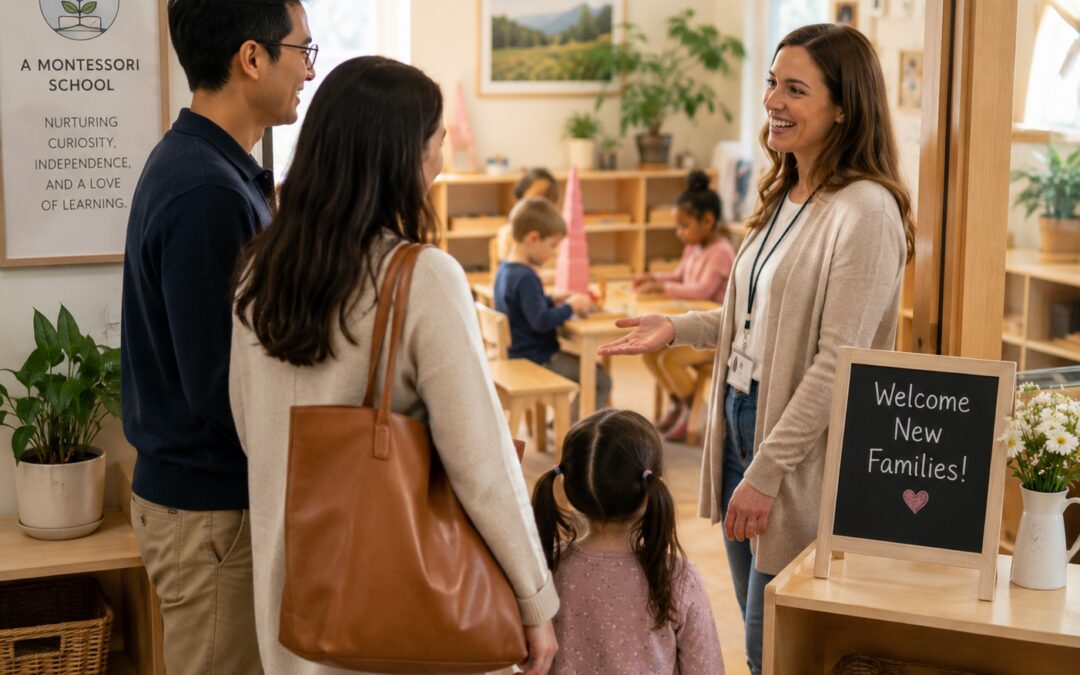
Parent ambassador programs

Parent ambassador programs
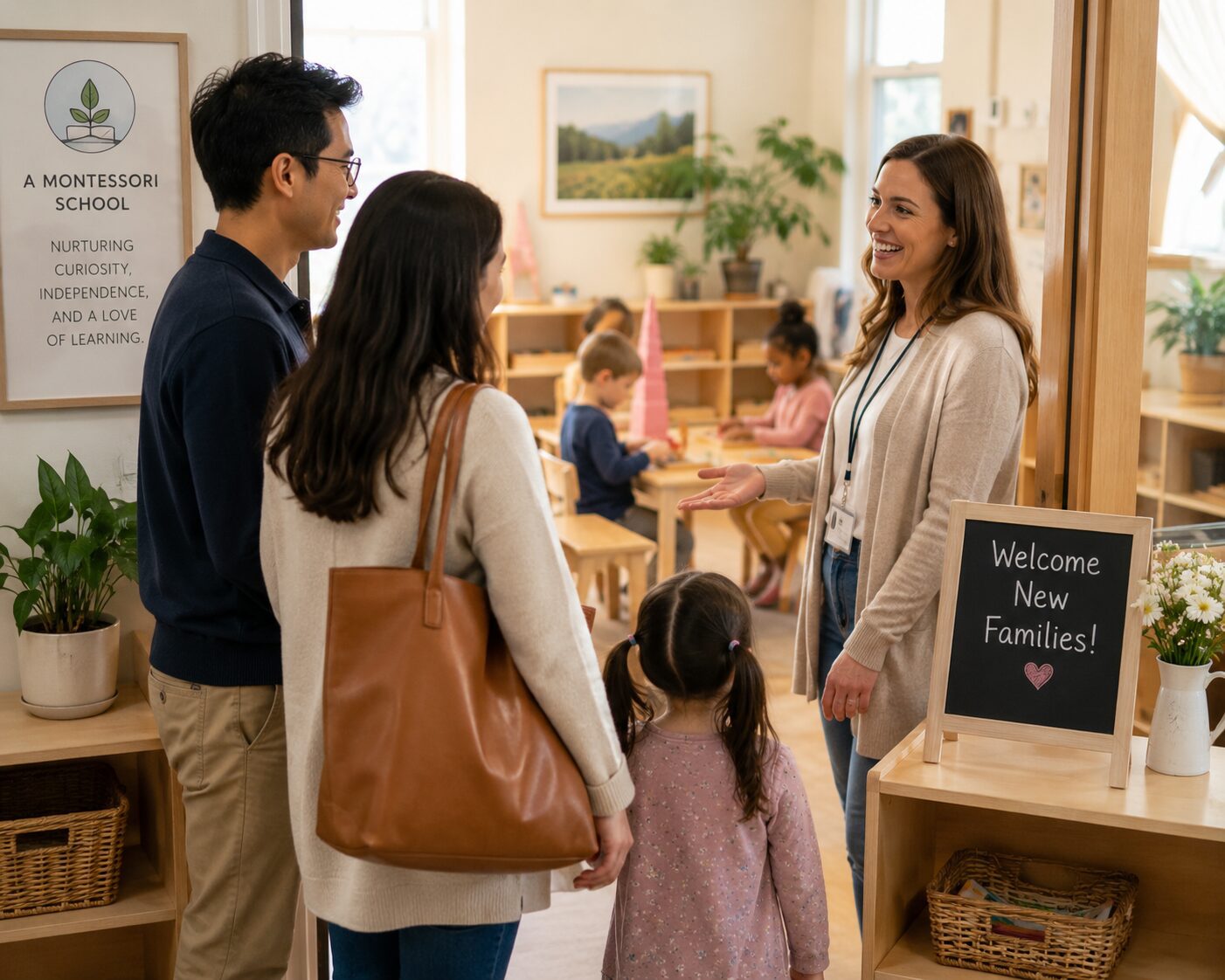
ideal parent

This article is part of an ongoing series from the Montessori Foundation exploring how schools can attract, enroll, and retain families who truly value Montessori education.

Through the Montessori Foundation’s Enrollment Accelerator Program, schools receive strategic support with marketing, admissions systems, websites, landing pages, advertising, parent communication, and enrollment growth strategy.


Through the Montessori Family Alliance, schools can provide families with ongoing Montessori parent education, practical parenting guidance, videos, articles, and AI-supported resources designed to help parents better understand Montessori and remain engaged for the long term.


Parent Ambassadors: One of the Most Powerful — and Underused — Strategies in Montessori School Growth

By Tim Seldin

For many Montessori schools, enrollment and retention are constant concerns. School leaders invest heavily in websites, social media, advertising, open houses, and admissions events, yet often overlook one of the most effective resources already sitting inside the community: their parents.

Parents talk.

They talk at soccer games, neighborhood gatherings, birthday parties, workplaces, playgrounds, churches, and online community groups. They talk with friends who are searching for schools, worried about their child, frustrated with traditional education, or simply wondering if there might be a better fit somewhere else.

And when parents speak authentically about a school they genuinely love, people listen in a way they rarely listen to advertising.

This is why a thoughtfully designed Parent Ambassador program can become one of the most important parts of a Montessori school’s admissions, enrollment, onboarding, and retention strategy.

A Parent Ambassador program is not simply a volunteer committee. Done well, it becomes a structured system for building relationships, extending the school’s reach into the community, and helping new families feel connected from the very beginning.

As I’ve worked with Montessori schools around the world, I’ve seen Parent Ambassador programs quietly transform schools. They strengthen word-of-mouth referrals, improve family retention, ease the anxiety of new parents, and help schools create the kind of warm, welcoming culture that families are seeking today.

Most importantly, Parent Ambassadors help prospective and new families feel that they are joining a community — not merely purchasing a service.

Parents Trust Parents

One of the realities of school admissions is that prospective parents often trust current parents more than they trust the school itself.

That may sound uncomfortable, but it is true.

Schools naturally present themselves in the best possible light. Parents understand that. What they really want to know is:

“What is it actually like to be part of this school?”

They want honest answers to questions such as:

• Does the school communicate well?
• Are the teachers warm and responsive?
• Will my child feel safe and happy?
• Will my family fit in socially?
• Do parents know one another?
• Is the community welcoming?
• Are people kind?
• Are families genuinely satisfied?

These are emotional and relational questions more than academic ones.

A Parent Ambassador program allows prospective families to hear authentic stories from parents who have already walked the path they are considering.

That kind of parent-to-parent conversation is extraordinarily powerful.

The Role of Parent Ambassadors in Admissions and Recruitment

Many schools think of Parent Ambassadors primarily as helpers at open houses. While they can certainly play that role, the strongest programs go much deeper.

A well-designed Parent Ambassador program supports admissions and recruitment in many ways:

• Welcoming prospective parents at school events
• Assisting with campus tours
• Hosting small coffee gatherings in homes or local cafés
• Connecting personally with inquiry families
• Following up after tours
• Sharing school content online
• Writing positive online reviews
• Attending community events
• Reaching out to friends and neighbors
• Helping explain Montessori to curious parents
• Offering reassurance during the decision-making process

Importantly, Parent Ambassadors are not “salespeople.”

The goal is not to pressure families. The goal is to build trust, answer questions honestly, and help families envision themselves becoming part of the school community.

The most effective ambassadors are warm, genuine, approachable people who naturally enjoy helping others feel comfortable.

Not Every Parent Needs the Same Role

One mistake schools sometimes make is assuming that every Parent Ambassador should do the same thing.

In reality, parents have different personalities, schedules, and strengths.

Some parents are natural hosts. Others are great organizers. Some are comfortable speaking publicly. Others are more comfortable quietly reaching out one-on-one to a new parent who seems uncertain or overwhelmed.

A successful Parent Ambassador program recognizes different levels of involvement and allows parents to contribute in ways that fit their lives.

Some ambassadors may simply agree to:

• Make a few welcoming phone calls each year
• Help one new family during onboarding
• Attend one admissions event
• Write a few online reviews
• Share social media posts occasionally
• Host one coffee gathering annually

That may be enough.

Schools should avoid turning Parent Ambassadors into an unpaid part-time workforce. Parents are volunteers. Most are already busy balancing careers, children, and family responsibilities.

The key is not asking a few parents to do everything.

The key is building a culture where many parents each contribute something manageable.

The First Year Matters More Than Schools Realize

One of the most important — and often overlooked — roles of Parent Ambassadors is helping onboard and support new families during their first year.

This is especially important in Montessori schools.

Many families arrive excited but uncertain. Montessori may feel unfamiliar. Parents may not fully understand mixed-age classrooms, the work cycle, observation, independence, normalization, or why children are not constantly bringing home worksheets and tests.

Even families who are enthusiastic about Montessori often experience moments of anxiety during the first year.

They wonder:

“Is this normal?”

“Is my child adjusting?”

“Why does Montessori look so different from what I expected?”

“What should I be doing at home?”

At the same time, many new parents are quietly trying to determine whether they socially belong in the community.

This is where Parent Ambassadors can make an enormous difference.

A warm phone call.

An invitation to sit together at a school event.

A reminder about an upcoming parent meeting.

An offer to meet for coffee.

A reassuring conversation after a difficult drop-off week.

These simple human gestures often determine whether a family begins to feel connected or isolated.

Schools sometimes underestimate how emotionally vulnerable new families can feel during their first months.

The families who stay for many years are often the families who quickly develop friendships and relationships inside the school community.

Building an Onboarding Playbook

One of the ideas we have been developing through the Montessori Family Alliance is the concept of a Parent Onboarding Playbook.

Most schools have admissions systems. Many have orientation events.

Far fewer have a systematic process for helping families successfully transition into the life and culture of the school during the entire first year.

An onboarding playbook helps schools intentionally guide new families through that experience.

This can include:

• Welcome email sequences
• Parent education resources
• Montessori orientation videos
• Weekly or monthly parent newsletters
• Classroom transition support
• Parent mentors or ambassadors
• Invitations to community events
• Parent coffees and discussion groups
• Guidance about Montessori at home
• Suggestions for helping children adjust
• Explanations of Montessori terminology and philosophy

The goal is not simply to inform parents.

The goal is to help parents feel confident, connected, and supported.

The Montessori Family Alliance has been developing tools and services specifically designed to help schools strengthen these kinds of school-family partnerships and onboarding systems.

Schools that intentionally support parents during the first year often see stronger retention, deeper parent engagement, and more positive word-of-mouth referrals over time.

Common Mistakes Schools Make

Over the years, I’ve also seen schools unintentionally weaken their Parent Ambassador programs through avoidable mistakes.

One common mistake is treating the program as a short-term initiative rather than an ongoing strategy. Another is holding too many meetings and over-organizing volunteers until enthusiasm fades.

Some schools also make the mistake of sending a mass email asking for volunteers.

Strong Parent Ambassador programs are usually built intentionally by personally inviting parents who:

• Love the school
• Have credibility with other families
• Communicate warmly and positively
• Understand the school’s culture
• Want to help others feel welcome

Equally important, the program should not simply be handed over to the parent association or left entirely volunteer-led. Effective programs require staff guidance and coordination, usually through admissions, advancement, or community engagement leadership.

A Culture of Partnership

At its heart, a Parent Ambassador program is really about partnership.

Montessori schools work best when families and schools see one another as collaborators rather than consumers and service providers.

When parents feel genuinely welcomed, informed, and valued, they become invested in the life of the school.

And invested parents naturally become advocates.

They tell friends.

They invite neighbors.

They defend the school when misconceptions arise.

They encourage uncertain new families.

They stay longer.

They help strengthen the community culture for everyone.

In many ways, the strongest admissions strategy is not marketing at all.

It is creating such a warm, authentic, mission-driven community that parents cannot help talking about it with others.

A thoughtful Parent Ambassador program helps make that possible.

Copyright 2026 The Montessori Foundation

Why Parents Hesitate to enroll (And Why They Rarely Say No)

Why Parents Hesitate to enroll (And Why They Rarely Say No)

ideal parent

This article is part of an ongoing series from the Montessori Foundation exploring how schools can attract, enroll, and retain families who truly value Montessori education. Through the Montessori Foundation’s Enrollment Accelerator Program, schools receive strategic support with marketing, admissions systems, websites, landing pages, advertising, parent communication, and enrollment growth strategy. Through the Montessori Family Alliance, schools can provide families with ongoing Montessori parent education, practical parenting guidance, videos, articles, and AI-supported resources designed to help parents better understand Montessori and remain engaged for the long term.


This article is part of an ongoing series from the Montessori Foundation exploring how schools can attract, enroll, and retain families who truly value Montessori education. Through the Montessori Foundation’s Enrollment Accelerator Program, schools receive strategic support with marketing, admissions systems, websites, landing pages, advertising, parent communication, and enrollment growth strategy. Through the Montessori Family Alliance, schools can provide families with ongoing Montessori parent education, practical parenting guidance, videos, articles, and AI-supported resources designed to help parents better understand Montessori and remain engaged for the long term.

Learn more about the Montessori Foundation’s programs here:

Enrollment Accelerator Program:
Montessori Family Alliance:

One of the most important things school leaders can understand about enrollment is this: most prospective families do not say no.

They hesitate. They delay. They stop responding. They say they are still thinking about it, that they need a little more time, that they love the school — and then they quietly enroll somewhere else, or nowhere at all.

This can be genuinely frustrating for admissions teams, especially when a family seemed enthusiastic during the tour. But hesitation is not random, and it is not indifference. Parents hesitate for reasons. And more often than schools realize, those reasons are not the ones schools tend to assume.

Many schools interpret hesitation primarily through practical lenses — tuition concerns, scheduling conflicts, competing options, or timing. Those factors certainly matter. But far more often, hesitation is psychological. Parents hesitate when they do not yet feel enough clarity, confidence, or certainty to move forward. Understanding this changes everything about how schools should approach admissions and follow-up.

Hesitation Is Usually About Uncertainty

Most parents are trying to make one of the most emotionally significant decisions of their lives. They are choosing who will influence their child each day, what kind of environment will shape them, what values will surround them, and what kind of future they are beginning to invest in. That naturally produces anxiety.

Montessori schools face an additional layer of this challenge because Montessori is genuinely different from conventional education. Families may feel strongly attracted to what they see and experience emotionally while still feeling genuinely uncertain intellectually. A parent may leave a tour thinking: this feels wonderful — but will my child actually learn enough? I love the atmosphere, but is this too unconventional? The children seem happy, but what happens later? This feels healthier, but what if we are making a mistake?

These are not objections in the traditional sense. They are unresolved uncertainties. And unresolved uncertainty almost always slows decision-making, regardless of how interested a family actually is.

Families Often Need Emotional Permission

One of the least understood dynamics in admissions work is that many parents are quietly looking for emotional permission before they feel ready to commit.

In Montessori education especially, families are often considering a path that differs meaningfully from mainstream expectations — from what their own parents did, from what their neighbors are doing, from what feels socially safe. That can feel risky in ways that are difficult to name directly. Parents may worry about what relatives will think, what friends will say, whether they will later regret the decision, or whether choosing something different makes them seem impractical or out of step.

Even parents who are genuinely excited about Montessori sometimes hesitate for exactly this reason. Choosing something unconventional carries a kind of psychological vulnerability. What many of these families are quietly searching for is reassurance — that other thoughtful, sensible families make this choice, that children truly thrive here over time, that the long-term outcomes are real, and that they are not making a mistake they will come to regret.

This is why trust matters so much in enrollment work. Parents are rarely looking only for information. They are looking for the confidence to say yes.

Parents Rarely Reveal Their Real Concerns Immediately

Another important truth is that parents often do not fully articulate what is actually worrying them during tours or admissions conversations. Instead, they tend to raise surface-level questions: Do you offer hot lunch? How much homework is there? What are your aftercare hours? How do children transition to middle school?

But underneath those practical questions, something else is often happening. The real concerns are deeper and harder to say out loud: Will my child fit in socially? Will my child succeed academically? Can I really trust this approach? Will my spouse support this decision? Will we belong here? Can we justify the cost?

Schools that answer only the surface question frequently miss the real conversation happening just beneath it. Strong admissions teams learn to listen for what is not quite being said — to hear the emotional question underneath the practical one, and to respond to both.

Busy Parents Delay Decisions by Default

Modern family life contributes heavily to hesitation in ways that have nothing to do with the school itself. Many parents today are genuinely overwhelmed — managing careers, finances, children’s schedules, digital overload, and a chronic level of decision fatigue that makes any complex new choice feel like too much to take on right now.

As a result, many families delay difficult decisions simply because they do not have the mental space to process them fully. This is especially likely when schools unintentionally add to that burden — with websites that are hard to navigate, admissions processes that require too many steps, or follow-up communication that is either absent or overwhelming.

A parent may genuinely like the school and still think: I just cannot deal with this right now. The easier schools make it for families to understand what Montessori is, why it matters, what outcomes they can realistically expect, and what the simple next step is, the more likely families are to keep moving forward instead of stalling.

Many Schools Misinterpret Silence

One of the most common admissions mistakes schools make is assuming that silence means a lack of interest. In most cases, silence means something quite different. It means uncertainty, or distraction, or an unresolved question the parent was not quite sure how to ask.

This is why consistent, thoughtful follow-up matters so much. Not aggressive pressure — that damages trust quickly. But genuinely helpful guidance. Schools that follow up well tend to share useful parent education, offer clear explanations of how Montessori works, provide stories and examples that make outcomes feel real, and help families regain their footing when life has pulled their attention elsewhere. Many families need multiple meaningful points of contact before they feel emotionally ready to make a decision. Schools that disappear after the tour frequently lose families who were genuinely interested.

School Tours Create Interest — But Not Always Confidence

Many Montessori tours are warm, informative, and genuinely inspiring. But inspiration alone does not always produce enrollment.

A family may walk away from a tour thinking it was beautiful — and still feel uncertain about academics, structure, socialization, long-term outcomes, or whether Montessori is truly right for their particular child. This is where many admissions processes break down. Schools often assume that if families enjoyed the tour, enrollment should follow naturally. But parents do not enroll simply because they had a positive experience. They enroll when they feel sufficiently confident to make a decision.

That confidence rarely arrives on its own. It comes from clear explanations, meaningful parent education, visible outcomes, honest conversations about concerns, and thoughtful follow-up that sustains connection and builds trust over time.

Clarity Reduces Hesitation

One of the most effective things schools can do to reduce hesitation is to become genuinely clearer in how they communicate.

Many schools unintentionally create uncertainty through language that sounds positive but explains very little. Phrases like whole child, child-centered learning, and lifelong learners are familiar enough that parents nod along — while still leaving the actual questions unanswered. What will my child become here? How does Montessori actually work? What outcomes should I realistically expect? Why does this approach matter, and how is it different from what other schools offer?

The clearer schools become in answering these questions, the safer parents tend to feel. Clarity builds confidence. Confidence reduces hesitation. This is not about simplifying Montessori — it is about respecting parents enough to explain it in terms that are honest and accessible.

The Goal Is Not Pressure — It Is Confidence

Some schools respond to hesitation by becoming overly passive, assuming that families will find their way back when they are ready. Others drift toward something that feels uncomfortably close to sales pressure. Neither approach serves families or schools well.

What families do not want is pressure. What they do want is leadership — schools that communicate clearly, answer concerns honestly, guide the conversation thoughtfully, and help them feel genuinely confident rather than rushed. The strongest admissions processes feel less like sales and more like trusted guidance from people who know what they are talking about and care about getting families to the right place.

Parent Education Is One of the Best Tools for Reducing Hesitation

Many of the concerns that cause families to hesitate begin to dissolve when parents truly understand Montessori. This is one of the core reasons the Montessori Foundation developed the Montessori Family Alliance — to help schools provide families with ongoing Montessori parent education, developmental guidance, parenting support, articles, videos, and AI-assisted resources designed specifically for the realities of busy modern family life. The goal is to help parents feel more confident in what they are seeing and experiencing, and to remain genuinely engaged in the educational journey over time.

The Foundation’s Enrollment Accelerator Program works alongside these efforts to help schools strengthen their marketing strategy, admissions systems, follow-up communication, websites, advertising, and enrollment messaging — so that schools are better equipped to guide families from initial curiosity all the way through to a confident decision.

Hesitation Is Not Failure

Perhaps the most important mindset shift admissions teams can make is recognizing that hesitation does not mean rejection. In most cases, hesitation simply means a family needs more confidence, more clarity, more reassurance, or more time to emotionally process a decision that genuinely matters to them.

Schools that understand this respond differently. Rather than becoming discouraged or reactive, they focus on building trust, strengthening clarity, educating parents, and maintaining connection through the uncertainty. They understand that enrollment decisions are rarely purely logical. They are deeply human. And human beings tend to move forward only when they finally feel safe enough — and confident enough — to say yes.

Copyright 2026 The Montessori Foundation

Independent School Recruitment and Admissions: The Hidden Parent Drivers – Fear, Aspiration, and Identity

Independent School Recruitment and Admissions: The Hidden Parent Drivers – Fear, Aspiration, and Identity

The Perfect Match

This article is part of an ongoing series from the Montessori Foundation exploring how schools can attract, enroll, and retain families who truly value Montessori education. Through the Montessori Foundation’s Enrollment Accelerator Program, schools receive strategic support with marketing, admissions systems, websites, landing pages, advertising, parent communication, and enrollment growth strategy. Through the Montessori Family Alliance, schools can provide families with ongoing Montessori parent education, practical parenting guidance, videos, articles, and AI-supported resources designed to help parents better understand Montessori and remain engaged for the long term.


One of the most common mistakes schools make is assuming that parents choose schools primarily through logic and careful analysis.

In reality, enrollment decisions are deeply emotional.

Parents may eventually justify their choice with rational explanations — the academics are strong, the schedule works, the class size is small, and the location is convenient. But underneath those practical justifications are almost always much deeper psychological forces at work. Fear. Hope. Aspiration. Identity. Belonging. Parents are not simply selecting an educational program. They are making decisions about what kind of childhood they want for their child, what kind of family they understand themselves to be, and what kind of future they are hoping to make possible.

Schools that understand these deeper motivations communicate far more effectively than schools that focus exclusively on logistics and features.

Most Parents Are Trying to Protect Something

At a deep level, many educational decisions are fundamentally protective.

Parents are often trying to preserve or nurture something they value in their child before the world has a chance to diminish it. Some are trying to protect curiosity, confidence, creativity, sensitivity, kindness, or a child’s natural joy in learning. Others are trying to shield their children from experiences they themselves found painful growing up — excessive pressure, rigid schooling, bullying, boredom, social exclusion, or the quiet erosion of self-esteem that happens when a child spends years feeling misunderstood.

This is one reason Montessori can resonate so powerfully with families even before they fully understand the philosophy. Many parents respond initially to something emotional rather than intellectual. The environment feels calmer. The approach feels more respectful. Something about it feels closer to the kind of childhood they have always hoped to give their child. That gut recognition — this feels healthier, this feels more human — is often the real beginning of a family’s Montessori journey.

Fear Is Often a Stronger Motivator Than Desire

One of the important truths of human psychology is that fear frequently drives decisions more powerfully than aspiration alone. Parents may genuinely hope their child becomes confident and independent. But they may feel even more urgency around specific fears: I don’t want my child to grow up hating school. I’m worried she’s losing her confidence. I’m afraid he’s going to become completely dependent on external rewards and pressure. I don’t want my child to spend years feeling stressed and anxious just to get through the day.

These concerns are often deeply personal and difficult for parents to articulate directly. Schools that communicate effectively understand this and respond with empathy and clarity — not by exploiting these fears, but by honestly acknowledging them. That distinction matters enormously. Fear-based manipulation quickly and permanently damages trust. But helping parents feel genuinely understood is one of the most powerful things a school can do.

Many parents today are quietly carrying real anxiety about overstimulation, social media, attention fragmentation, rising rates of childhood anxiety, and the loss of independence in children’s lives. Montessori schools are often uniquely well-positioned to address these concerns — but only if they have learned to explain their approach in terms that feel credible and human, not defensive or abstract.

Aspiration Matters Too

Parents are also drawn by aspiration — by some vision, whether fully conscious or not, of the kind of adult they hope their child will one day become.

Most families want children who are capable, resilient, thoughtful, compassionate, self-disciplined, creative, intellectually curious, socially confident, and internally motivated. Notice that most of these qualities are not narrowly academic. Parents certainly care about academic success, but many are increasingly aware that long-term success in life depends on qualities that grades and test scores do not capture particularly well.

This is one reason Montessori education resonates so strongly with thoughtful families. Montessori speaks to human development in its fullest sense — not only what children learn, but who they are becoming. When a school can help parents see that clearly, the conversation shifts from program comparison to genuine recognition.

Parents Are Also Making Identity Decisions

One of the least discussed dimensions of school enrollment is identity. When parents choose a school, they are often making a quiet statement — both to themselves and to the world around them — about who they are and what they value.

Some families see themselves as deeply child-centered. Others identify as progressive, or as intellectually serious, or as committed to raising children with strong values and social conscience. Some are drawn to warmth and community. Others respond to a sense of intellectual rigor or global credibility. School choice becomes intertwined with self-image in ways that parents themselves may not always fully recognize.

This does not make parents superficial. Identity is part of how human beings make meaning. Schools that understand this recognize that enrollment decisions are never purely transactional. Parents are choosing communities that reflect how they see themselves — or how they aspire to see themselves. Schools that project a clear, coherent identity tend to attract families who share it.

Belonging Matters More Than Schools Realize

Many schools significantly underestimate how much parents are evaluating social and cultural fit during the admissions process.

Families are quietly asking themselves a set of questions that rarely appear on any inquiry form: Will my child belong here? Will we belong here? Will we feel welcomed or judged? Do these people actually share our values? Will my child find real friends? Will we find something that feels like community?

This is especially important in Montessori schools, where the relationship between home and school tends to be more intentional and more genuinely relational than in most conventional settings. Parents are not simply evaluating curriculum or facilities. They are evaluating culture. They are reading every interaction for signals about whether this place will truly welcome their family.

This is why warmth matters. Why tours matter. Why the way a phone call is answered matters. Why the responsiveness of the admissions office matters. Families often remember how a school made them feel long after the specific details of the visit have faded. That emotional memory is frequently what determines whether they move forward or quietly drift away.

Busy Parents Need Emotional Clarity Quickly

The challenge this all creates is practical. Modern parents are genuinely overwhelmed — saturated with information, short on time, and making decisions while exhausted and distracted. Schools sometimes assume that prospective families are carefully studying educational philosophy before reaching out. In most cases, that is not what is happening.

Schools may have only moments to communicate enough value to generate genuine curiosity. This means learning to speak to emotionally meaningful ideas quickly and clearly — helping parents understand almost immediately what kinds of children thrive in this environment, what kinds of adults guide the community, what values shape the culture, and what kind of future the school is actively helping children build.

This is not about oversimplifying Montessori. It is about communicating in ways that real families, living real lives, can actually absorb. The strongest schools create layers — emotionally compelling first impressions that open the door, followed by progressively deeper opportunities for understanding and genuine engagement over time.

Schools That Understand Psychology Communicate Differently

Schools that have genuinely internalized parent psychology tend to market themselves in a noticeably different way. They spend less time listing program features and more time addressing human concerns. Rather than leading with curriculum descriptions, technology, and schedules, they speak to confidence, independence, belonging, emotional health, curiosity, resilience, and the long arc of human development. They help parents begin to ask the question that matters most: What might my child become here? That question is almost always more powerful than any list of academic offerings.

Parent Education Strengthens Trust and Retention

One of the most important practical realities in Montessori school leadership is that parent understanding directly affects enrollment stability, retention, and long-term school culture. Parents who deeply understand Montessori are far more likely to stay enrolled through the elementary years, support teachers effectively, trust the process during difficult moments, refer friends and colleagues, and become genuine advocates for the school.

This is one of the core reasons the Montessori Foundation developed the Montessori Family Alliance — to help schools provide families with ongoing Montessori parent education, developmental guidance, parenting support, articles, videos, and AI-assisted resources designed specifically for the realities of busy modern family life. The goal is not simply information delivery. It is building the kind of deep parent understanding that translates into lasting confidence, genuine community, and long-term commitment.

The Foundation’s Enrollment Accelerator Program works alongside these efforts to help schools strengthen their marketing strategy, messaging, websites, advertising, landing pages, admissions systems, and follow-up communication so that the families they attract are genuinely aligned with their mission and values from the very beginning.

Enrollment Decisions Are Ultimately Human Decisions

At its core, school marketing is not really about persuasion. It is about understanding human beings.

Parents arrive carrying hopes and fears, dreams and uncertainties, identity questions and deep aspirations for their children. The schools that communicate most powerfully are usually those that understand this clearly and respond with genuine clarity, empathy, confidence, warmth, and purpose.

When schools communicate at that level, marketing stops feeling like marketing. It begins to feel like trust.

Copyright 2026 The Montessori Foundation
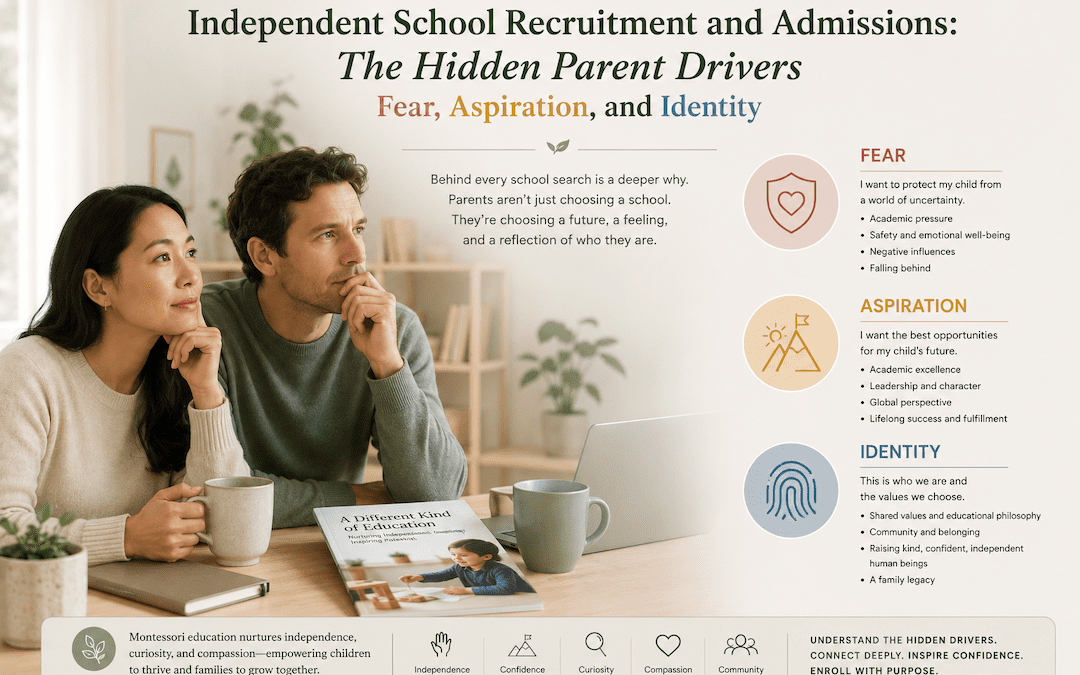
Inside the Mind of Your Ideal Parent

Inside the Mind of Your Ideal Parent

ideal parent

This article is part of an ongoing series from the Montessori Foundation exploring how schools can attract, enroll, and retain families who truly value Montessori education. Through the Montessori Foundation’s Enrollment Accelerator Program, schools receive strategic support with marketing, admissions systems, websites, landing pages, advertising, parent communication, and enrollment growth strategy. Through the Montessori Family Alliance, schools can provide families with ongoing Montessori parent education, practical parenting guidance, videos, articles, and AI-supported resources designed to help parents better understand Montessori and remain engaged for the long term.


One of the most common mistakes schools make in marketing is trying to appeal to everyone.

When a school attempts to speak to every possible family equally, its message almost always becomes vague, generic, and forgettable. The broader the message, the less powerfully it tends to connect with anyone in particular. Ironically, schools that try to reach everyone often end up reaching no one well.

Strong enrollment marketing starts from a much more focused question: Who are the families most likely to deeply value what we offer?

Not every family is looking for Montessori. Not every family is searching for the same kind of school culture, educational philosophy, or level of partnership. And that is not a problem to solve — it is a reality to work with. The goal is not universal appeal. The goal is alignment. Schools that consistently attract and retain committed long-term families almost always have a clearer picture of exactly who they are trying to reach.

Most Parents Are Not Comparing Educational Philosophies

One of the first things school leaders need to understand is that most prospective parents are not educational researchers. They are not spending their evenings comparing Maria Montessori, Dewey, Piaget, Reggio Emilia, classical education, and project-based learning. They are simply trying to answer a handful of deeply practical and deeply emotional questions: Will my child be happy here? Will my child be safe? Can I trust these people? Will this place actually help my child succeed? Will our family belong?

This matters because schools often overestimate how much parents care about educational philosophy in those first moments of contact. What parents care about first are outcomes and feelings. They want to understand what life might feel like for their child day to day, what kind of person their child may grow into over time, and whether this community feels trustworthy and genuinely supportive.

Montessori schools frequently lose prospective families by leading with philosophy before establishing emotional relevance. In my experience, parents generally become curious about Montessori philosophy after they have already begun to believe it might actually help their child, not before.

Parents Are Driven by Both Hope and Fear

Most enrollment decisions are shaped by a combination of aspiration and anxiety. Parents are simultaneously drawn toward something they want for their child and away from something they worry about.

Many of the families drawn to Montessori hope their children will become genuinely confident, independent, creative, emotionally healthy, curious, and self-motivated. They want their children to love learning and to develop into capable, socially thoughtful people. At the same time, many carry real fears — about excessive academic pressure, about anxiety and disengagement, about rigid schooling that crushes curiosity, about children becoming dependent on constant external rewards and approval.

Most parents will never articulate these fears directly. But they shape every decision nonetheless. Schools that understand these underlying emotional drivers communicate very differently from schools that simply describe their programs. The most effective Montessori marketing does not just explain what the school offers — it helps parents arrive at a quiet recognition: this place may help me protect and nurture what I value most about my child.

Today’s Parents Are Often Overwhelmed

It is also important to be honest about the practical reality that many modern parents are living. Most are genuinely overloaded — managing careers, financial stress, children’s schedules, aging parents, social obligations, and a constant stream of digital information and notifications. Even the most engaged and thoughtful parents often have limited mental bandwidth at any given moment.

This has real implications for how schools communicate. Many families will never read a lengthy philosophical explanation the first time they encounter your school. Schools often have only seconds to capture attention and generate enough curiosity to earn the next step. This does not mean parents are shallow or disinterested. It means schools must learn to communicate clearly, emotionally, and efficiently — and to create layers. The strongest schools offer simple, welcoming entry points for first contact, followed by progressively richer opportunities for deeper education and engagement as trust develops. Parents need to feel invited into the conversation, not immediately buried under it.

Different Parents Need Different Messages

It is also worth recognizing that not all prospective families are motivated by the same things, and a single message will rarely speak to all of them equally well.

Some parents are strongly academically driven and need genuine reassurance that Montessori children succeed intellectually and are well prepared for what comes next. Others are primarily searching for emotional safety, warmth, and an environment where their child can build confidence. Some are worried specifically about their child’s anxiety, attention difficulties, or social struggles. Others are drawn to creativity, independence, or a sense that the school’s values align with their own. Some families are actively seeking an alternative to conventional education; others are simply dissatisfied with where their child is now and cautiously exploring something different.

This means effective school communication needs layers and range. Schools that communicate only one dimension of what Montessori offers — academics, say, or freedom — often unintentionally limit their reach. The richness of Montessori education is precisely that it speaks to many of the things parents care most deeply about. Schools should let that richness show.

Parents Are Also Evaluating Themselves

There is one more dynamic worth understanding, and it tends to be underappreciated. When parents visit your school, they are not only evaluating whether the school is right for their child. They are also quietly asking whether they themselves will fit here.

This is especially true in Montessori communities, where the parent-school relationship tends to be more intentional and more genuinely relational than in most conventional settings. Parents are looking for signals — whether they will feel welcomed rather than judged, whether they can trust the teachers, whether their parenting values will be respected, and whether their child will truly belong. Families are not simply choosing an academic program. They are choosing a community and wondering whether it has a place for them.

This is one reason school culture matters so much in enrollment. It is present in every interaction — in how the phone is answered, how tours are conducted, how emails are written, and how staff members speak about children. Culture is either communicated intentionally or absorbed accidentally. The strongest schools are deliberate about it.

Strong Schools Combine Accessibility with Clarity

Some schools, feeling pressure to fill seats, try to make themselves appeal to every family that walks in. Others become so philosophically focused that they unintentionally come across as intimidating to families new to Montessori. Neither extreme serves the school or its prospective families well.

The healthiest schools strike a different balance. They make Montessori genuinely approachable and understandable while remaining honest about who they are, what they believe, how their program works, and what kind of partnership they are hoping to build with families. Many parents today are actively looking for schools that project confidence and clarity, not just warmth. Families dealing with conflicting parenting advice and educational noise often respond with real relief when a school communicates coherence and purpose. They do not need perfection. They need to know who you are.

Ideal Families Are Not Always Able to Afford Your Tuition

One of the more dangerous assumptions schools sometimes make is that their ideal family is simply the one most able to afford tuition. Financial sustainability is genuinely important — schools need families who can responsibly meet their tuition commitments. But long-term alignment matters far more than income alone.

Some affluent families may have little understanding of Montessori and little interest in genuine partnership with the school. Meanwhile, many deeply mission-aligned families will make significant financial sacrifices because they believe in what Montessori offers and want it for their children. The strongest school communities are built around shared values, trust, commitment, and long-term engagement — not purchasing power alone. Schools that understand this tend to make better enrollment decisions and build communities that are more stable and genuinely fulfilling for everyone in them.

Recruitment and Retention Depend on Parent Understanding

Families who truly understand Montessori stay longer, support teachers more effectively, and become genuine advocates for the school. This is one of the most consistent patterns in enrollment work, and it is one of the core reasons the Montessori Foundation developed the Montessori Family Alliance — to help schools provide families with ongoing parent education, developmental guidance, practical parenting support, videos, articles, and AI-assisted resources designed for busy modern parents. The goal is not simply delivering information. It is helping parents develop the kind of deep understanding and genuine confidence that translates into long-term commitment and community strength.

The Foundation’s Enrollment Accelerator Program works alongside these efforts to help schools strengthen their messaging, admissions systems, websites, advertising, social media, landing pages, follow-up communication, and long-term enrollment strategy — so that the families schools attract are genuinely aligned with their mission and values from the very beginning.

Enrollment Starts with Understanding People

At its core, effective school marketing is not really about marketing at all.

It is about understanding people — what parents hope for, what they fear, what pressures they are living under, what language actually resonates with them, and what kind of future they are quietly trying to build for their children. When schools communicate from that depth of understanding, the work stops feeling transactional. It begins to feel like a genuine connection. And genuine connection is what Montessori communities, at their best, have always been built on.

Copyright 2026 The Montessori Foundation
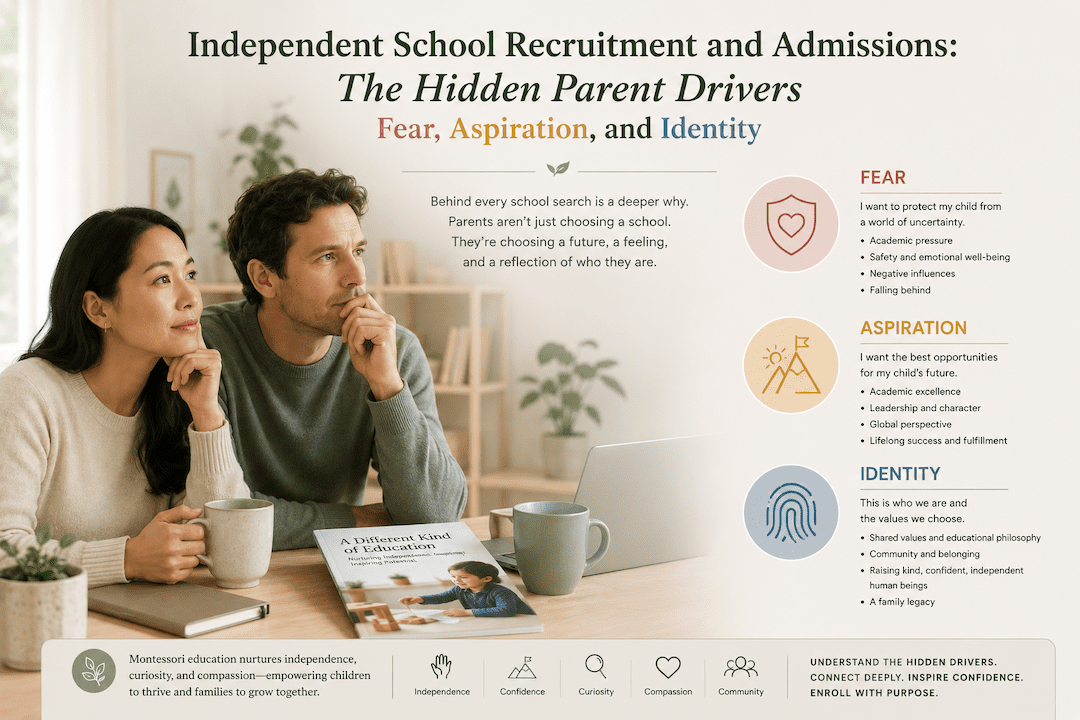
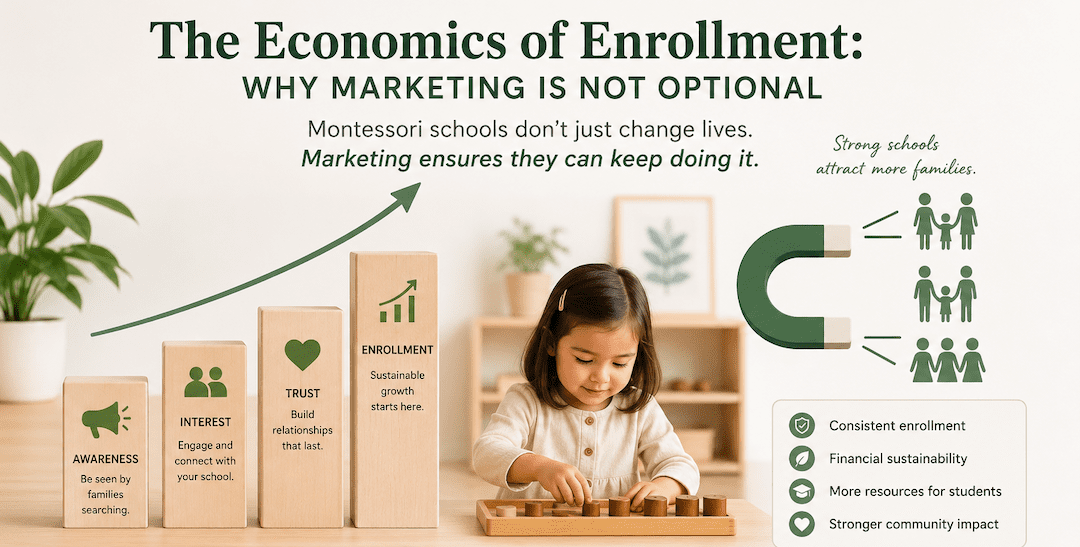
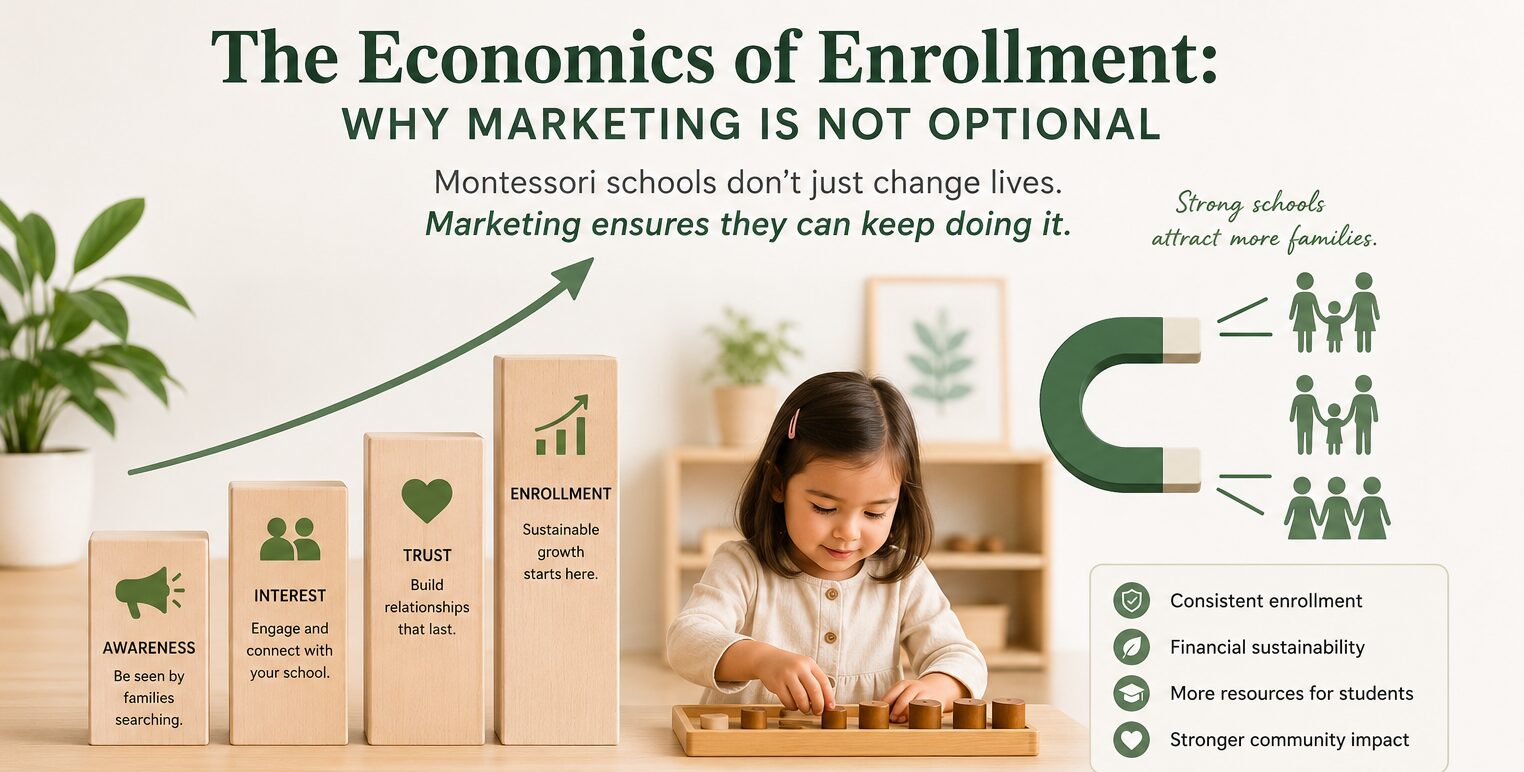
The Economics of Enrollment: Why Marketing Is Not Optional

The Economics of Enrollment: Why Marketing Is Not Optional

The Perfect Match

This article is part of an ongoing series from the Montessori Foundation exploring how schools can attract, enroll, and retain families who truly value Montessori education. Through the Montessori Foundation’s Enrollment Accelerator Program, schools receive strategic support with marketing, admissions systems, websites, landing pages, advertising, parent communication, and enrollment growth strategy. Through the Montessori Family Alliance, schools can provide families with ongoing Montessori parent education, practical parenting guidance, videos, articles, and AI-supported resources designed to help parents better understand Montessori and remain engaged for the long term.


Most Montessori school leaders entered the field of education because they care deeply about children, learning, and human development. Very few entered education because they wanted to think about marketing budgets, enrollment funnels, conversion rates, or financial forecasting.

Unfortunately, schools do not run on passion alone.

A school can have extraordinary teachers, beautiful classrooms, a powerful mission, and deeply committed leadership — and still struggle financially if enrollment is unstable. This is one of the hardest realities many school leaders eventually face. Good education alone does not guarantee strong enrollment. And without healthy enrollment, even genuinely excellent schools become vulnerable.

Empty Seats Are Expensive

One of the most important mindset shifts school leaders must make is understanding that every unfilled seat carries a real financial cost.

In most schools, the majority of operating expenses remain relatively fixed whether classrooms are full or partially empty. Rent or mortgage, insurance, utilities, payroll, benefits, technology, maintenance, supplies, licensing, and administrative overhead do not drop significantly because a classroom is missing a handful of children. A classroom running at eighty-five percent capacity costs almost as much to operate as one that is completely full.

This creates a powerful and often painful financial reality: small enrollment declines can produce disproportionately large financial stress. Losing five students, or failing to fill a toddler classroom, or watching a few elementary families choose not to reenroll can represent tens or even hundreds of thousands of dollars in lost revenue over time. And in most cases, schools cannot reduce staffing or facility costs proportionally without weakening the very program families came for in the first place.

This is why enrollment stability matters so much — not as a business goal separate from the mission, but as the financial foundation the mission depends on.

Marketing Is Not an Extra Expense

Many schools still treat marketing as optional or secondary. The thinking often goes: we will market more if enrollment drops, or we cannot afford marketing right now, or word of mouth has always been enough. But this framing has things exactly backward.

Strong marketing is not merely an expense. It is part of the infrastructure that supports enrollment stability and long-term sustainability. In most industries, organizations routinely invest meaningful percentages of revenue into marketing and audience development. Many schools spend surprisingly little while hoping for full classrooms.

The danger is a cycle that is easy to slide into without noticing. Enrollment softens. Finances tighten. Marketing gets reduced. Visibility declines. Inquiries slow further. Stress increases. Reactive decision-making takes over. By the time the problem feels urgent, the options available have narrowed considerably.

Healthy schools tend to approach marketing more proactively and consistently. They understand that visibility, communication, parent engagement, and admissions systems require steady ongoing investment — not emergency intervention after a crisis has already developed.

Reputation Alone Rarely Sustains Growth

Many Montessori schools were built during periods when reputation and word of mouth generated steady enrollment almost automatically. Some communities still benefit from this. But today’s landscape is meaningfully different.

Families now have more educational choices, more digital distractions, more competing messages, and often far less prior understanding of Montessori than earlier generations of parents. Birth rates have declined in many regions. Public pre-kindergarten programs have expanded. Charter schools and other alternatives market themselves actively. And parents increasingly begin their search online long before they ever contact a school directly.

Schools that rely entirely on reputation may gradually discover that fewer families are entering the pipeline each year — not because the school has changed, but because the environment around it has. Even schools with strong community standing increasingly need clear and current websites, effective follow-up systems, meaningful online visibility, compelling messaging, intentional parent education, and a thoughtful admissions strategy.

Marketing Is Broader Than Advertising

One reason school leaders sometimes resist the word marketing is that they associate it with advertising or salesmanship, neither of which fits easily with the values of most Montessori educators. But effective school marketing is much broader than advertising, and far more relational.

Your marketing includes the way inquiries are answered and how quickly calls are returned. It includes the tone of your emails, the clarity of your website, the quality of your photography, the experience of your school tour, your presence on social media, your parent events, your community partnerships, your alumni relationships, your online reviews, your newsletters, and the overall impression families carry away from every interaction with your school.

Everything communicates. And everything either builds trust or quietly erodes it.

Healthy enrollment growth is almost never the result of a single campaign or a burst of advertising. It usually comes from many smaller systems working together consistently and intentionally over time.

Even Grassroots Marketing Has Real Costs

Some schools respond to the marketing conversation by noting that they rely on grassroots efforts rather than paid advertising. Parent ambassadors, community events, partnerships, referral systems, open houses, workshops, local sponsorships, and school fairs can all be genuinely effective. But these approaches are not free.

They require planning, coordination, volunteer management, follow-up, staff time, creative materials, and sustained organizational discipline. The investment may not appear as an advertising line item in the budget, but it is still very real. Many schools unintentionally underestimate the true cost of generating and sustaining enrollment momentum — and then wonder why their efforts feel exhausting without producing the results they hoped for.

The Hidden Cost of Misalignment

There is another economic challenge that receives far less attention than it deserves: the cost of enrolling families who are not truly aligned with the school.

When schools feel pressure to fill seats, they sometimes lower expectations, oversimplify Montessori, or enroll families who do not genuinely understand the program. This may temporarily improve revenue. But it frequently creates longer-term problems — higher attrition, parent dissatisfaction, unrealistic expectations, classroom tension, teacher stress, and gradual damage to the school’s culture.

Not all enrollment growth is healthy growth.

The strongest schools tend to focus not simply on filling seats, but on attracting families who are genuinely likely to understand Montessori, engage positively with the community, support the culture, and remain enrolled for many years. Retention is one of the most powerful economic drivers in school sustainability. A family that enters a toddler and remains through the elementary years represents dramatically more financial stability — and community strength — than a family that leaves after one or two years, feeling confused or disappointed.

Parent Education Is an Economic Strategy

This is one of the most consistently overlooked realities in Montessori school leadership: parent education is not merely an enrichment offering. It is a retention strategy.

Parents who deeply understand Montessori tend to feel more confident, stay enrolled longer, support teachers more effectively, refer friends and colleagues, and become genuine ambassadors for the school. Parents who do not understand Montessori often become anxious when the experience differs from the conventional academic model they grew up expecting. That anxiety, left unaddressed, leads to attrition.

This is one of the core reasons the Montessori Foundation developed the Montessori Family Alliance — to help schools provide families with ongoing Montessori parent education, developmental guidance, parenting support, articles, videos, and AI-assisted resources designed specifically for busy modern families. The goal is not simply delivering information. The goal is to strengthen long-term parent understanding, confidence, engagement, and retention.

The Foundation’s Enrollment Accelerator Program works alongside these efforts to help schools build the systems that drive healthy enrollment: clear messaging, effective websites and landing pages, a strong admissions process, consistent follow-up, social media presence, digital advertising, and a thoughtful long-term enrollment strategy.

Enrollment Stability Creates Educational Stability

The economics of enrollment and the mission of the school are not separate concerns. They are deeply connected.

Strong enrollment allows schools to retain talented teachers, improve compensation, invest in facilities, expand programs, maintain healthy class sizes, and support meaningful professional development. It allows leaders to make decisions from a position of confidence rather than fear. Schools with stable enrollment can focus more fully on children and community because they are not constantly operating in survival mode — managing every small attrition event as a potential crisis.

Marketing, admissions, parent education, and retention systems are not distractions from the work of Montessori education. Done well and sustained over time, they are what make it possible.

Copyright 2026 The Montessori Foundation

Empowering Adolescents Through Soul-Centered Education

Empowering Adolescents Through Soul-Centered Education

The Perfect Match

By Jennifer Iamele Savage

Awkwardness, mood swings, selfies & hashtags—today’s adolescent culture is one that many do not understand. In fact, adolescence has long been a misunderstood stage of development. Bridging the period from childhood to adulthood, adolescents undergo so much physical growth that many assume they have experienced mental and emotional growth as well; however, their brains have not kept pace with their big bodies. Children have not seen this much growth since their first year of life, and in many ways, their actions and reactions can be equated with those of toddlers. Ask any parent of a teen, what seems like a meltdown or a tantrum very much exists at this stage. They are testing boundaries, and while they crave their independence, they also desire others in their lives to help them form their identity.

Secondary Montessori Philosophy

Dr. Maria Montessori compared the onset of adolescence to a sort of rebirth. Even though they are experiencing large growth like toddlers, they should never be infantilized. She said, “The adolescent must never be treated as a child, for that is a stage of life that he has surpassed. It is better to treat an adolescent as if he had greater value than he actually shows than as if he had less and let him feel that his merits and self-respect are disregarded.” Montessori’s words from the early 20th century could not be truer today. In this technology-crazed, selfie-obsessed society, adolescents need a place where they can develop their souls while not crushing their spirits.

Soul Centered Education

Soul, spirit, peace, and love are not words that are typically associated with secondary schools, and yet, arguably, now more than ever, these words should not be absent from any organization, especially education. Montessori schools seem to attract what author Chick Moormon refers to as “spirit whisperers” and help develop what the late founder of the Passage Works Institute, Rachael Kessler, called “the soul of education”. Montessorians believe in developing the whole child and respecting their physical, emotional, and spiritual needs. This type of environment empowers children and fosters autonomy.

Montessori Middle School Model

Many Americans believe that Montessori schools are just for early childhood. Nowadays, it is more common to see Montessori schools run through 6th grade, but the middle school model is still fairly new. Although she had developed the theory behind secondary schools, Maria Montessori never lived to see them exist. Dr. Betsy Coe, the late and great director of the Houston Montessori Center and Principal of School of the Woods in Houston, has devoted a major part of her life to studying this period and creating a program that is developmentally appropriate for today’s adolescents while maintaining the integrity of Dr. Montessori’s philosophy. The middle school Montessori model builds off of the previous Montessori years but

allows for the significance of their developmental transition. Students are organized into

multi-aged cohorts (7th and 8th) that function as a community, and Montessori schools promote peace through mindfulness training, opportunities for personal reflection, and service learning. Dr. Montessori envisioned schools as places where students learn practical life skills, and at the secondary level, truly become “children of the earth” (“Erd Kinder”). Consequently, Montessori middle schools include an environmental component in which students learn about sustainability, stewardship, and the transcendental power of nature. All curricular work is organized thematically and in an interdisciplinary way to mirror the interconnectedness of real life.

Students are given long blocks of time to complete work in an order of their choosing, and they have leadership opportunities through school-wide or community-based internships and the chance to lead meetings for their peers. Some of the main aims of the Montessori middle school are to simulate real life, to celebrate a student’s growth, to help them realize their place in the world, and to empower their individualism.

Supporting Adolescent Development: Understanding is Key

Whether or not a child has access or a desire to attend a Montessori school, there are still many ways to support adolescent development. Adolescents cannot be truly supported until they are understood. Dr. Maurice Elias, a professor of Psychology and the Director of the

Social-Emotional and Character Development Lab at Rutgers University has many suggestions in this area. Adapting Rachael Kessler’s work, he believes that anyone who interacts with adolescents should understand their basic needs for a positive sense of belonging; silence, solitude & time for reflection; joyful play & creative expression; a sense of how they fit into the larger world and society; and a chance to process and celebrate their rites of passage. Specific ways to honor these needs include providing teens with a space to be themselves and opening a dialogue with them. Helping them understand the significance of their rites of passage, creating opportunities for them to reflect, and respecting their desire for “alone time” are other ways you can support this impressionable period of development. Ultimately, they need strong mentors and allies who believe in them and encourage them to believe in themselves.

Article featured in Natural Awakenings of The Lowcountry

Biography

Jen Iamele Savage is a writer, educator, and empowerment coach whose work bridges the worlds of teaching, motherhood, and personal transformation. Her path has been shaped by a deep commitment to authentic living and a calling to help others—particularly women and mothers—reclaim their voice, worth, and purpose.

Jen began her professional journey as a high school English teacher, has worked in a variety of educational capacities, and is currently pursuing a doctorate in Montessori studies, deepening her commitment to whole-child, whole-person education. Her classroom has always been more than a place of academic learning; it’s where she nurtures reflection, voice, and connection. Drawing from her Montessori foundation and trauma-informed teaching background, she approaches education with compassion and curiosity, encouraging students to ask big questions about identity, purpose, and the world around them.

Jen’s writing, featured on platforms like Her View From HomeMotherly, and Charleston Moms, explores motherhood with both tenderness and fierce honesty. In her books—The Language of Mom Rage: From Injustice to Transformation and The Language of Transformation—she unpacks the emotional undercurrents of modern womanhood, offering readers language and frameworks to make sense of their inner experiences.

Whether she’s speaking to fellow educators about supporting the whole child or guiding a group of mothers through personal transformation, Jen’s work is rooted in a single truth: our hardest moments can become our greatest invitations. Her story is one of surrender, reclamation, and the radical idea that healing can start right where we are—in the classroom, in the kitchen, in the middle of a tantrum or a heartbreak.

Now living in Charleston, South Carolina, Jen is raising two children, continuing to teach, write, and lead with integrity and intention. Through every role she inhabits, she models what it means to be a mindful, purposeful woman in a world that often demands we disconnect from our inner voice.

How Parents Can Boost Kids’ Friendship Skills for School Success

How Parents Can Boost Kids’ Friendship Skills for School Success

The Perfect Match

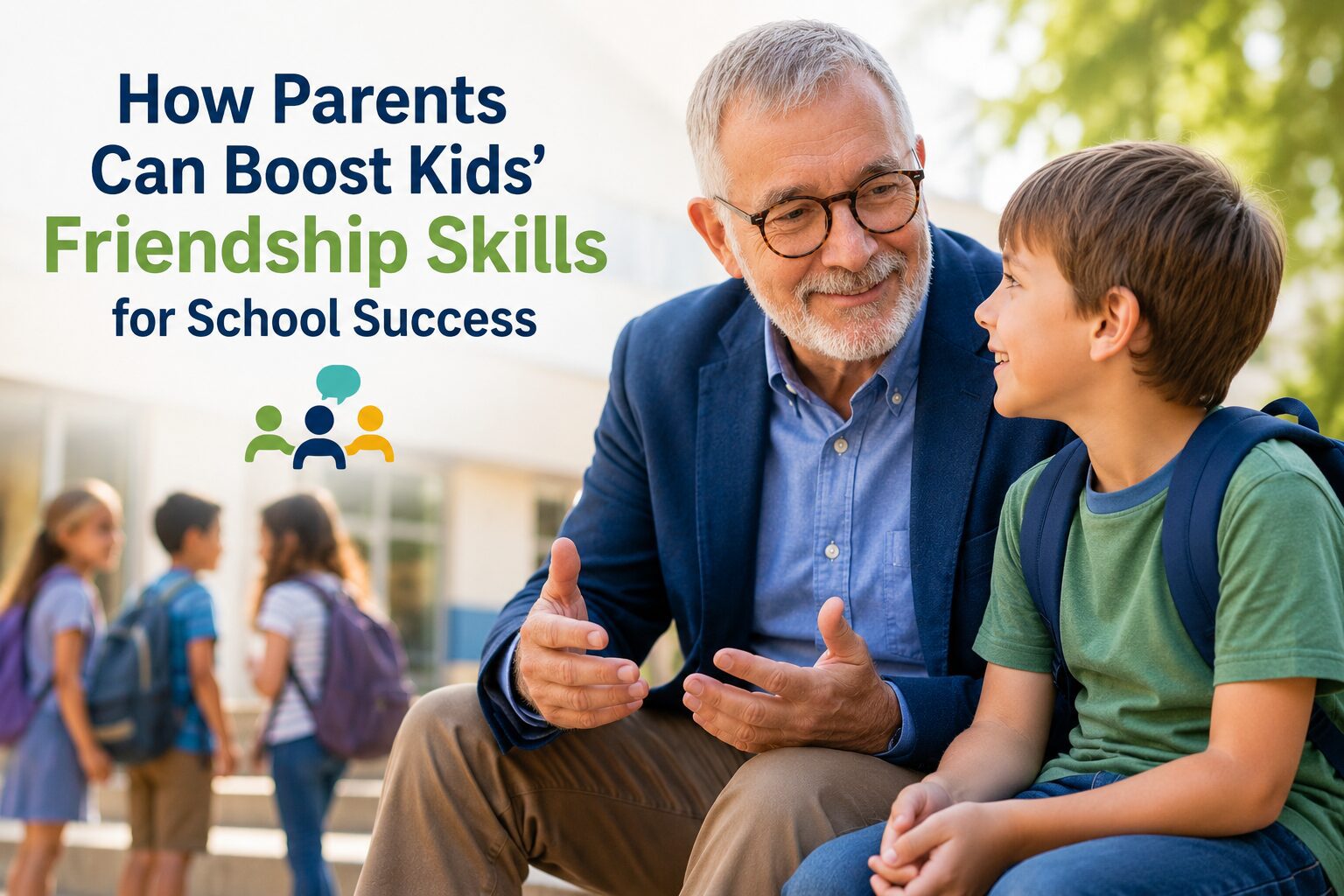
For parents of infants, toddlers, and preschoolers choosing early education, worries about school-day friendships can feel just as big as questions about curriculum, Montessori fit, and campus accessibility. Early childhood peer relationships are tender and messy, and common challenges in school friendships, hanging back at circle time, grabbing toys, melting down after a “no,” or clinging to one familiar adult, can leave parents wondering what teachers will see. Friendship skills development matters because it’s a core part of social-emotional learning at school, shaping how children communicate, cooperate, and recover from everyday conflicts. When these skills start to click, school feels safer and more connected.

Understanding the Building Blocks of Friendship

Friendship skills are built from a few basics that kids can practice every day: conversation, sharing, inclusion, and confidence. Conversation means taking turns talking and listening. Sharing means letting others use materials and waiting. Inclusion means noticing who is left out and making room; this supports learning for everyone.

This matters when you are comparing Montessori options, because classrooms expect kids to choose work, join groups, and solve small conflicts with guidance. Home practice gives your child a low-stakes “training ground” to learn what helps others feel safe and respected.

Picture snack time with one apple, two kids, and a timer. You coach “my turn, your turn,” invite a sibling into the game, and praise brave tries, even if it is messy.

A simple, low-pressure play meet-up at home makes these skills feel real fast.

Host a 30-Minute Practice Playdate (With Simple Invites)

Once you know the core ingredients, conversation, sharing, and inclusion, the next step is giving your child a safe place to rehearse them.

A small, low-key get-together at home can act like a “practice lab” for friendship: a familiar setting, a short time frame, and you nearby to gently guide. As the kids play, you can quietly coach simple turn-taking (“Let’s make sure everyone gets a turn”), support sharing (“Can you offer one piece to your friend?”), and prompt inclusion (“Who else should get a turn with that?”). Because the stakes feel low at home, children often relax enough to try new social moves, asking a question, waiting, joining in, which builds confidence they can carry into the classroom.

To set expectations in a friendly way, you can print invitations using an online invitation maker where you can design and order custom cards for different events with free templates, fonts, and images.

Next, you’ll learn five tiny habits you can use daily to keep these skills growing without making it a “big lesson.”

Tiny Friendship Habits You Can Repeat All Year

Try these small rituals to keep momentum.

These habits turn “be friendly” into simple, repeatable actions your child can practice over time. If you’re comparing Montessori education options for young children in San Francisco, these routines also mirror the steady, skills-first approach many Montessori classrooms use.

Two-Question Check-In
  • What it is: Ask “Who did you sit with?” and “What did you notice?” at pickup.
  • How often: Daily
  • Why it helps: It builds reflection and makes social details easier to recall later.
Kind Narration
  • What it is: Say out loud when you model waiting, greeting, and taking turns.
  • How often: Daily
  • Why it helps: Kids copy what they can name and see clearly.
Role-Play One Sticky Moment
  • What it is: Act out joining a game, then switch roles for one minute.
  • How often: 3 times per week
  • Why it helps: Rehearsal lowers anxiety when real chances show up.
Empathy Mirror Sentence
  • What it is: Practice “You felt ___ because ___” using a book or real event.
  • How often: Weekly
  • Why it helps: Compassion becomes a usable language.

Pick one habit this week, then adjust it to fit your family and schedule.

Friendship Skills Questions Parents Ask Most

A few quick answers to the worries that pop up at home.

Q: What friendship skills should I focus on before kindergarten?
A: Prioritize simple, repeatable skills: greeting, taking turns, using kind words, and repairing after a mistake. Many adults forget that social development in early childhood includes sharing, empathy, and clear communication, not just “being nice.” Pick one skill for two weeks and practice it in short playdates or at the playground.

Q: How can I help if my child is shy and freezes when others approach?
A: Start with low-pressure scripts your child can memorize, like “Can I play?” or “What are you building?” Practice at home with stuffed animals, then try it once in a calm setting. Celebrate effort, not outcomes, so bravery feels worth repeating.

Q: What should I do when my child keeps getting into conflicts?
A: Treat it as a coaching moment, not a character flaw. Help your child name feelings, state a need, and offer a fix: “I didn’t like that. Can I have a turn next?” Rehearse one repair phrase daily so it’s available when emotions run hot.

Q: Why does Montessori seem to support social confidence so well?
A: Many Montessori environments intentionally teach collaboration, independence, and respect for others, so social practice is built into the day. A helpful way to think about it is that Montessori education values social skills alongside academic learning. When touring, ask how guides model conflict resolution and how older and younger children interact.

Q: Can I teach friendship skills at home without lots of playdates?
A: Yes. Siblings, cousins, errands, and family dinners all offer real practice with waiting, listening, and polite disagreement. Choose one “people skill” for the week and point it out in the moment: “You waited, that helped everyone.”

Small steps, repeated calmly, build the kind of confidence kids carry into school.

Practice One Small Friendship Habit for Long-Term School Confidence

It’s hard to watch your child want friends but struggle with shyness, big feelings, or the back-and-forth of play. The most helpful mindset is steady, positive parenting for social growth, reflecting on social progress and keeping a simple commitment to friendship habits, rather than pushing for perfect moments. With that consistency, kids start to feel safer with peers, bounce back faster after conflict, and build the kind of connection that supports peer relationships at school. Small, repeated friendship habits build big social confidence over time. This week, you can pick one friendship skill to practice at home and notice when it shows up in real play. Over time, these tiny steps add up to long-term social success, resilience, and belonging.

Charlene Roth is the founder of Safetykid.info, a resource dedicated to helping parents and caregivers create safe, engaging, and skill-building environments for children. With a focus on practical advice and family-friendly projects, Charlene is passionate about fostering creativity and teamwork within the home while ensuring the well-being of every child.

Finding The Perfect Match: You Are Not Selling Your School — You Are Selling a Future

Finding The Perfect Match: You Are Not Selling Your School — You Are Selling a Future

The Perfect Match

This article is part of an ongoing series from the Montessori Foundation exploring how Montessori schools can attract, enroll, and retain families who truly value Montessori education. Through the Montessori Foundation’s Enrollment Accelerator Program, schools receive strategic support with marketing, admissions systems, websites, landing pages, advertising, parent communication, and enrollment growth strategy. Through the Montessori Family Alliance, schools can provide families with ongoing Montessori parent education, practical parenting guidance, videos, articles, and AI-supported resources designed to help parents better understand Montessori and remain engaged for the long term.
Learn more about the Montessori Foundation’s programs here:

Montessori Enrollment Accelerator Programhttps://go.montessori.org/enrollment-program

Montessori Family Alliancehttps://familyalliance.montessori.org/

One of the most important shifts a school leader can make is to understand that parents are not primarily buying a program. They are buying a vision of their child’s future.

This is true whether families are aware of it or not.

When parents inquire about your school, they are not simply comparing schedules, tuition rates, classroom materials, or enrichment offerings. Those things matter, but they are almost always secondary. Underneath nearly every enrollment decision is a much deeper emotional question: What kind of life do we hope our child will have?

Parents may express this in different ways. One wants her child to be confident. Another wants his son to keep loving learning. A third is worried that creativity will be crushed. Some simply want school to feel joyful rather than stressful. Others want their child to grow into a genuinely good person. The specific words vary, but the underlying hope is remarkably consistent. Parents are not buying education in the abstract. They are investing in who they believe their child may become.

Schools that understand this tend to communicate very differently from schools that focus primarily on features and logistics.

Most Schools Talk About Programs. Parents Think About Outcomes.

One of the reasons many school websites and admissions conversations feel flat or ineffective is that they focus heavily on operational details — class sizes, technology, facilities, schedules, safety protocols, and curriculum descriptions. Again, these things matter. But most parents are not emotionally moved by a list of features.

What parents are actually trying to answer is something different. Will my child thrive here? Will this school truly know my child as an individual? Will this environment strengthen or diminish the natural curiosity my child was born with? Will this community support our family?

Schools that connect most powerfully with prospective families help parents imagine a future. Not a fantasy. Not marketing hype. A believable, deeply human vision of what children often become when they are educated in environments that genuinely respect who they are.

This is one reason Montessori can be so compelling when it is explained well. Montessori education is not merely an instructional method. It is a long-term developmental journey. And the destination is not simply a diploma — it is a person.

Montessori’s Real Product Is Human Development

Traditional school marketing tends to focus heavily on academics because that is what many parents expect. Montessori schools sometimes fall into the same trap, working to prove their academic rigor in conventional terms.

Academic outcomes matter, and families deserve honest reassurance that their children will read, write, think mathematically, and be prepared for what comes next. But Montessori’s deepest value proposition is considerably larger than academics alone.

At its core, Montessori helps children develop concentration, independence, executive function, emotional self-regulation, curiosity, intrinsic motivation, responsibility, adaptability, social confidence, and genuine resilience. These qualities matter enormously in life — often more than any particular academic credential.

And increasingly, parents are recognizing this. The modern world is saturated with anxiety, distraction, screen dependency, social pressure, and systems built on external rewards and punishments. Many families are deeply worried about their children’s emotional well-being, focus, and sense of self. Parents may not initially use terms like executive function or self-regulation, but they immediately recognize the importance of children who are capable, thoughtful, organized, resilient, and internally motivated.

Montessori schools often produce these outcomes with remarkable consistency. The challenge is helping parents understand this clearly enough to appreciate what it is actually worth.

Parents Buy Emotionally and Justify Rationally

This is a reality many educators initially resist, but it is consistently true. Most enrollment decisions are emotional first and rational second.

Parents may later explain their choice in practical terms — the academics are strong, the schedule is convenient, the student-teacher ratio is excellent. But the deeper driver is almost always emotional. Parents choose schools where they can imagine their child being happy, safe, confident, and deeply known by adults who genuinely care about them.

This is not manipulation. It is simply how human beings make significant decisions.

Schools that communicate only through logic and information frequently fail to create a genuine emotional connection. At the same time, schools that rely entirely on emotional imagery without substance eventually lose trust. Strong marketing weaves both together — emotional resonance and intellectual credibility, in the right proportion. Parents need to feel both hopeful and confident at the same time.

The Importance of Storytelling

One of the most effective ways schools help families imagine the future is through stories.

Stories allow parents to visualize transformation. Instead of stating that the school develops independence, a school might describe a quietly shy child who gradually learned to greet visitors with confidence, organize her own work, and begin mentoring younger students through difficult tasks. Instead of claiming to support deep concentration, a school might describe a four-year-old so thoroughly absorbed in his work that he simply did not notice the room around him had gone quiet.

These moments help parents understand Montessori emotionally, in ways abstract explanations rarely can. Stories are memorable because they feel real and human.

This is one reason photographs, videos, parent testimonials, classroom observations, and alumni stories matter so much in Montessori marketing. They do not simply show prospective families what your school looks like. They help families feel what life inside your school is actually like — and begin to imagine their own child there.

Families Are Looking for Hope

School leaders should understand that many parents arrive carrying real fear and uncertainty. Some are worried that their child is anxious, struggling socially, or slowly losing interest in learning. Some have been disappointed by previous school experiences. Others feel overwhelmed by modern parenting and are quietly searching for community, guidance, and reassurance that things can be better.

In many cases, what parents are really looking for is hope. Not perfection. Not guarantees. Just the genuine belief that there might be another way.

The schools that communicate most powerfully are often those that help parents arrive at this recognition on their own — that their child may flourish here, that the struggle need not be constant, that something healthier and more human is actually possible. That emotional shift matters more than any brochure.

Busy Parents Need Clear, Accessible Communication

At the same time, schools must be honest about the practical reality. Modern parents are genuinely busy, frequently distracted, and thoroughly overloaded with competing information. Most families will not read lengthy philosophical explanations or attend a two-hour parent education event before deciding whether to make first contact.

Schools often have only moments to capture attention and create enough curiosity to earn the next step. This means schools must become better at communicating Montessori clearly, quickly, and compellingly — without sacrificing depth.

Not superficial. Clear.

Parents need messaging that helps them understand, almost immediately, why Montessori matters, what children tend to become over time, how the environment actually works, and why this particular journey might be worth serious consideration. Schools that bury their message under vague educational language often lose families before any real understanding has a chance to develop.

The strongest schools build layered communication: short, emotionally resonant entry points that invite curiosity, followed by progressively deeper opportunities for parent education and genuine engagement over time.

The Right Families Usually Want Leadership

Many schools worry that communicating their values clearly or articulating expectations honestly will discourage prospective families. In reality, clarity almost always builds trust.

Parents today are overwhelmed by choices and flooded with conflicting advice. Many are quietly looking for schools that project confidence, coherence, warmth, and genuine purpose. The strongest school communities are rarely built by trying to please everyone or by softening every expectation to avoid friction.

They are built by schools that are honest about who they are, what they believe, how Montessori works, and what kind of partnership they are genuinely hoping to build with families. Schools that communicate this kind of grounded clarity often become more attractive to mission-aligned families, not less. Parents who are truly searching for something different recognize authenticity when they encounter it.

Recruitment and Retention Depend on Parent Understanding

One of the most important truths in enrollment work is that attracting families and keeping them are not separate challenges. They are two dimensions of the same work.

Parents who truly understand Montessori are far more likely to remain committed through the elementary years and beyond. They are less likely to become anxious when their child’s progress does not mirror the conventional academic signals they grew up expecting. They are less likely to pull out when a neighbor tells them something alarming about unstructured classrooms. They are more likely to become genuine advocates for the school and the approach.

This is one reason the Montessori Foundation developed the Montessori Family Alliance — to help schools support parents through ongoing Montessori education, articles, videos, parenting guidance, developmental insights, and AI-supported tools that busy families can access whenever they have a few minutes. The goal is to help parents understand their child’s development more deeply, feel more confident in what they are witnessing, and remain genuinely connected to the school community over the long term.

The Foundation’s Enrollment Accelerator Program works alongside these efforts to help schools strengthen their marketing strategy, admissions systems, messaging, websites, advertising, landing pages, and enrollment follow-up so that the families schools attract are genuinely aligned with their mission and values from the very beginning.

Ultimately, Parents Are Investing in Who Their Child May Become

At its best, Montessori school marketing is not about persuasion. It is about helping families recognize possibilities.

Parents are not simply choosing between educational products. They are making one of the most emotionally significant decisions of their lives. They are asking what kind of environment will shape their child, what kind of adults will surround them day after day, and what kind of person their child may grow into here.

Schools that truly understand this communicate differently. They move beyond features and logistics. They help families envision a future worth believing in — and worth investing in.

Finding The Perfect Match: You Are Not Selling Your School — You Are Selling a Future

Making Montessori School Marketing Work: Reaching Busy Families and Building Strong School Communities

The Perfect Match

This article is part of an ongoing series from the Montessori Foundation exploring how Montessori schools can attract, enroll, and retain families who truly value Montessori education. Through the Montessori Foundation’s Enrollment Accelerator Program, schools receive strategic support with marketing, admissions systems, websites, landing pages, advertising, parent communication, and enrollment growth strategy. Through the Montessori Family Alliance, schools can provide families with ongoing Montessori parent education, practical parenting guidance, videos, articles, and AI-supported resources designed to help parents better understand Montessori and remain engaged for the long term.
Learn more about the Montessori Foundation’s programs here:

Montessori Enrollment Accelerator Programhttps://go.montessori.org/enrollment-program

Montessori Family Alliancehttps://familyalliance.montessori.org/

One of the greatest misconceptions in education is the belief that if a school is truly excellent, families will naturally find it, understand it, and enroll.

Sometimes that happens. More often, it does not.

Today’s families live in a world overflowing with choices, distractions, competing information, and relentless demands on their time and attention. Public schools, charter schools, magnet programs, childcare centers, online programs, homeschool communities, and publicly funded pre-kindergarten programs are all vying for the same families—and many of them market themselves aggressively.

Meanwhile, many Montessori schools continue to rely primarily on reputation, word of mouth, or the quiet hope that families will simply “get it” once they walk through the door.

In today’s environment, that is rarely enough.

Marketing is not separate from the mission of a Montessori school. Marketing is how families come to understand the mission in the first place. Without strong enrollment, programs weaken, staffing becomes unstable, and even wonderful schools end up with empty seats. Leaders become reactive rather than strategic. The work of building something meaningful gets replaced by the anxiety of keeping the lights on.

The question is not whether schools should market themselves. The question is how to do it effectively—and authentically.

Montessori Schools Face a Unique Challenge

Montessori schools are not simply offering convenience, childcare, or academic preparation. Montessori represents a fundamentally different understanding of how children learn and develop as human beings.

That is both the school’s greatest strength and one of its most significant marketing challenges.

To Montessori educators, concepts like mixed-age classrooms, uninterrupted work periods, freedom within limits, hands-on materials, and self-directed activity make deep developmental sense. To many prospective parents, however, these same ideas can feel unfamiliar, confusing, or even risky.

Parents walking into a Montessori classroom for the first time may not automatically understand what they are seeing. A calm, purposeful room where children move freely and work independently may not match their mental image of what school is supposed to look like. Without guidance, a parent might leave wondering whether the children are too free, whether there is enough structure, whether their child will learn what they need to know, and whether any of this is actually preparing children for the real world.

This is why Montessori marketing must do more than advertise. It must interpret.

The goal is not simply to show Montessori in action. The goal is to help families understand why Montessori works and what it produces in children over time.

Today’s Parents Are Busy and Overloaded

Schools must also reckon honestly with the reality that many modern parents are genuinely overwhelmed. This does not mean they care less about their children—quite the opposite. But many families are simultaneously managing careers, financial pressures, long commutes, children’s schedules, aging parents, and nonstop digital noise. They are trying to absorb information while exhausted and distracted.

It is a mistake to assume that prospective parents will invest large amounts of time carefully studying educational philosophy before deciding whether to inquire. Some will. Many will not.

In reality, schools often have only moments to capture attention and create enough curiosity to earn the next step. A social media post may have seconds to stop someone from scrolling. A landing page may have less than a minute to communicate value before a visitor moves on. A website that feels vague, cluttered, or hard to navigate loses families before they ever pick up the phone.

This means schools must learn to communicate Montessori in ways that are clear, emotionally resonant, visually compelling, and easy to absorb quickly. That does not mean oversimplifying Montessori or stripping it of its depth. It means meeting parents where they are.

The strongest schools create multiple levels of entry. They offer simple, accessible points of first contact for busy families, followed by progressively richer opportunities for parent education and deeper engagement. You have to earn the right to a parent’s sustained attention. The best schools understand that and plan for it.

Generic Messaging Is No Longer Enough

Many schools unintentionally obscure what makes them special behind language that could describe almost any educational program. “We nurture the whole child.” “We inspire lifelong learning.” “We provide individualized instruction.” These phrases sound positive, but nearly every school says some version of them. Parents comparing options often encounter a blur of interchangeable language that does little to explain why one program is meaningfully different from another.

Strong marketing requires specificity. What actually happens in your classrooms? What makes Montessori different from what a child would experience elsewhere? What changes do parents begin to notice in their children over time? How does Montessori support the development of executive function, concentration, independence, confidence, and genuine intrinsic motivation? What kinds of children flourish in your environment?

The more concrete and honest your communication becomes, the more effective it tends to be.

Marketing Is Not Just Advertising

Many school leaders think of marketing primarily in terms of paid advertising. Advertising matters, but it is only one piece of a much larger picture.

Your marketing includes everything a prospective family encounters from the moment they first hear about your school. It includes your website, your school tours, your admissions conversations, your follow-up systems, your social media presence, your online reviews, your photographs, your videos, your open houses, your newsletters, the way your staff answers the phone, and the experience families have when they walk in the door for the first time.

Everything communicates. Everything either builds or erodes trust.

Some schools invest in advertising but lose families because their websites are confusing or their admissions processes are too passive. Others rely on a strong reputation but fail to communicate effectively online, where most parents now begin their search. Strong enrollment is almost never the result of one brilliant campaign. It usually results from many smaller systems working together consistently over time.

Passive Admissions Rarely Work

Many schools approach admissions too passively without fully realizing it. A family visits. They enjoy the tour. They say they will think about it. And then they are never heard from again.

Most families do not say no directly. They hesitate. They delay. They become distracted. They drift toward what feels safer or more familiar. This hesitation is often psychological rather than financial. Parents may still be quietly wondering whether this will really work for their particular child, whether they can trust an approach so different from what they experienced growing up, whether their spouse is on board, or whether they might be making a mistake.

Strong admissions systems help families work through these concerns thoughtfully and with confidence. This is not about pressure or manipulation. It is about genuine leadership. Schools that succeed tend to follow up consistently, educate parents intentionally, explain Montessori clearly, address concerns proactively, and help families begin to picture themselves as real members of the school community.

The Best Schools Combine Warmth with Clear Expectations

Some schools respond to enrollment pressure by making everything easier, simpler, and less demanding, thinking this will attract more families. Others become unintentionally intimidating. Neither extreme serves the school or its families well.

The healthiest school communities combine genuine warmth and accessibility with clear expectations and confident leadership. Parents today are often searching for direction. Many feel overwhelmed by conflicting messages about parenting and education. Schools that communicate clearly who they are, how Montessori works, what they value, and what they genuinely expect from families frequently create stronger trust than schools that remain vague or appear to stand for nothing in particular.

This is not about becoming elitist or exclusionary. It is about being honest and intentional about community.

The goal is not simply to fill every seat with whoever is willing to enroll. The goal is to build a community of families who understand what they are entering into and are genuinely ready to be part of it. Schools that expect more from families often find—perhaps counterintuitively—that they retain families longer, because everyone’s expectations were clear from the beginning.

Marketing Requires Real Investment

One of the harder realities for many school leaders is recognizing that effective marketing requires meaningful and sustained investment. That investment takes many forms: advertising, professional photography and video, a well-designed website, landing pages, admissions software, social media, search engine optimization, staff training, events, parent education, and consistent follow-up. Even approaches that seem low-cost—community events, referral programs, parent ambassador efforts, local partnerships, school fairs—require real time, coordination, staff energy, and organizational discipline. The cost may not always appear as a line item in the budget, but the investment is real nonetheless.

Schools that consistently succeed with enrollment treat marketing as a strategic priority and sustain that effort over time, not just when seats are empty.

Recruitment and Retention Are Deeply Connected

The strongest schools understand that attracting families and keeping them are not separate challenges. They are two dimensions of the same work.

It is not enough to enroll a family if they leave before their child has had the chance to experience what Montessori can truly offer. This is especially important in Montessori education because the full benefits of the approach unfold gradually. Parents who do not yet deeply understand Montessori may become anxious if they expect conventional academic signals early on, or if they find themselves comparing their child’s classroom experience to what friends and neighbors describe at traditional schools.

This is one reason the Montessori Foundation developed the Montessori Family Alliance. The Alliance helps schools support parents through ongoing Montessori education, practical parenting resources, developmental guidance, videos, articles, and AI-supported tools that busy families can access whenever they have a few minutes. The goal is to help parents understand Montessori more deeply, feel more confident, and remain genuinely connected to the school community over the long term.
The Foundation’s Enrollment Accelerator Program works alongside these efforts to help schools strengthen their marketing strategy, admissions systems, messaging, websites, social media, advertising, and enrollment follow-up, so that the families schools attract are genuinely aligned with their mission and values from the start.

Marketing as an Extension of Your Mission

At its best, school marketing is not about salesmanship or manipulation. It is about clarity.

Somewhere in your community right now are families actively searching for what Montessori offers—even if they do not yet have the words to describe it. They want a place where children are respected, where independence is nurtured, where curiosity is taken seriously, and where learning feels meaningful rather than mechanical.

If schools do not communicate clearly and consistently, many of those families may never find them.

Strong marketing does not diminish the integrity of Montessori education. Done thoughtfully, it helps preserve and sustain it—for the next generation of children and for the families searching for something better right now.

Attracting, Enrolling, and Keeping Families Who Truly Value Your School

Attracting, Enrolling, and Keeping Families Who Truly Value Your School

The Perfect Match

There is a practical reality every Montessori school leader understands: you need to fill your seats. Enrollment drives revenue, revenue sustains staff, and staff sustains the program. That is simply how schools survive.

But there is a second reality — equally important, and often far less clearly articulated. Not every family that can enroll will strengthen your school. The long-term health of your program, its culture, its consistency, and its ability to deliver an authentic Montessori experience depend on enrolling families who understand the work, support it, and remain part of the community over time.

This series is about how to do that intentionally — not through pressure or persuasion, but through clarity, alignment, and honest communication.

A Shift in How to Think About Enrollment

Most schools approach enrollment as a numbers problem. How many inquiries came in this month? How many tours did we schedule? How many applications are in the pipeline? Those metrics matter, and I am not suggesting you ignore them. But they do not address the deeper question: Are we attracting the right families, and are we helping them recognize that this is the right place?

When that alignment is missing, the consequences tend to show up later. Families who enrolled but remain quietly uncertain. Parents who question core Montessori practices — not out of bad faith, but because no one helped them truly understand what they were choosing. Students who leave at key transition points. A slow erosion of community cohesion that is hard to name but impossible to miss.

When schools consistently attract families who genuinely value Montessori, the picture looks very different. Retention improves. Parent partnership deepens. Teachers feel supported rather than challenged. The program becomes more stable, more confident, and ultimately more effective. Enrollment, understood this way, is not simply about filling seats. It is about building the conditions under which Montessori can actually succeed.

Why So Many Schools Struggle to Communicate Their Value

Montessori education is widely respected. Many parents are curious about it. Some actively seek it out. And yet, in school after school, the same pattern appears. Families express interest, visit the campus, like what they see — and then hesitate. This is rarely because Montessori lacks value. It is almost always because that value is not being communicated in a way parents can fully understand and trust.

Most schools fall into the same trap. They explain Montessori. They describe the philosophy, the materials, and the multi-age classroom structure. All of that matters — but it is not what parents are actually trying to decide. Parents are not asking, “What is Montessori?” They are asking much more personal questions: Will this work for my child? Will my child be successful here? Am I making the right decision? When those questions are not clearly answered, hesitation is the entirely natural result.

What Parents Are Really Looking For

Parents are not shopping for an educational method. They are trying to secure a future for their child. They want to raise children who are confident and capable, independent and self-directed, thoughtful and socially aware — children who will succeed not only in school but in life.

Montessori aligns remarkably well with those goals. But schools often communicate that alignment indirectly, or not at all. Instead of clearly connecting Montessori to the outcomes parents care about most, messaging tends to stay abstract. Child-centered. Whole-child development. Hands-on learning. These phrases are accurate, but they do not reduce uncertainty. They do not help a parent clearly see what will actually be different for their child if they choose your school.

The Role of Communication in Building Trust

At its core, enrollment is a trust decision. Parents are choosing to invest financially, commit emotionally, and align their family with your school’s philosophy. That level of commitment requires genuine confidence — and confidence comes from communication that consistently does three things.

It makes the outcome visible. Parents need to understand not just what children do in a Montessori classroom, but what they become. They need to see children concentrating deeply, taking ownership of their work, collaborating and leading — not as abstract ideals, but as observable realities they can recognize and believe.

It provides evidence. Parents look for proof, whether they realize it or not. They want to know how you assess children’s progress, what success looks like at different ages, and how students fare when they move beyond your program. Without clear answers to those questions, even a strong initial interest can turn into hesitation.

It reduces uncertainty. Every prospective parent carries unspoken concerns: Will my child fall behind? Is this too different from what I know? What happens next? Strong schools do not avoid those questions. They address them directly, calmly, and consistently — and in doing so, they build the kind of trust that leads to genuine commitment.

The Cost of Getting This Wrong

When communication is unclear or incomplete, schools often compensate in ways that create new problems down the road. They try to appeal to everyone. They soften or dilute Montessori principles. They overpromise outcomes or oversimplify what the program actually is. They rely on the warmth of a tour rather than the clarity of a message.

These approaches may produce short-term enrollment numbers. But they often lead to long-term misalignment — families who enrolled but do not fully support the program, increased friction between parents and teachers, higher attrition at transition points, and a weaker, less cohesive community. This is not simply a marketing problem. It is a program integrity problem.

A More Effective Approach

The goal is not to convince more families to enroll. It is to help the right families recognize that they belong. That requires a shift — from explanation to alignment. Instead of asking how we describe Montessori, ask what the hopes and concerns are of the families you most want to serve, where Montessori clearly meets those needs, and how you communicate that connection in language parents immediately understand.

When that alignment is clear, marketing becomes more effective, admissions conversations become more productive, and decisions happen more quickly and with greater confidence. You spend less energy persuading and more time welcoming families who were already looking for exactly what you offer.

What This Series Will Cover

In the coming articles, we will take this framework and apply it practically across every major part of your enrollment system. We will look at how to write ads that capture attention and attract the right families, how to design websites and landing pages that build confidence rather than confusion, how to structure school visits so parents truly understand what they are seeing, and how to follow up in ways that move families from interest to genuine commitment. We will also look at messaging that supports long-term retention — not just initial enrollment — and at how to use images, video, and storytelling to make Montessori visible and compelling to the families you most want to reach.

The goal is a practical playbook — one that schools can use to strengthen enrollment while preserving the integrity of everything that makes Montessori worth choosing.

Filling seats matters. But filling them with the right families matters far more, because over time, those families shape everything: the tone of your community, the level of trust in your classrooms, the stability of your enrollment, the strength of your Montessori practice. When your communication is clear, consistent, and aligned with what parents truly value, something important happens. The right families recognize themselves in your message — and they choose to stay.

In the next article, we will look closely at how to identify the fears, desires, and decision-making patterns of your ideal families, and how to use that understanding to shape every piece of your messaging.