by Tim Seldin | MFA, Montessori Education, Montessori Parenting
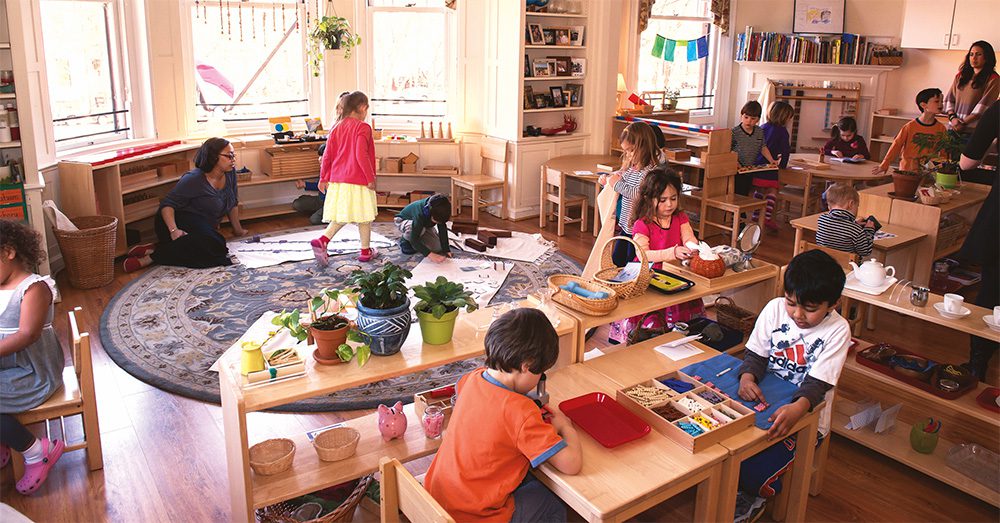
Although most schools try to remain faithful to their understanding of Dr. Montessori’s insights and research, they have all too some degree been influenced by the evolution of our culture and technology.
Perhaps the a more relevant question in selecting a Montessori school is to consider how well it matches your sense of what you want for your child.
Before coming to the Montessori Foundation, I served for twenty-two years as the Headmaster of the Barrie School outside of Washington, DC. In that role, every year I met with hundreds of families who were interested in enrollment. I always began each open house by reminding these bright, eager, and sometimes overly anxious parents that no one educational approach can be right for every child. The wisest goal is to seek out the best fit, not only between the child and the school, but also between parents’ values and goals for their child’s education, and what a given school can realistically deliver. I believe that finding the right school for mom and dad is as important as finding the right school for the child.
In the end, the selection of a Montessori school comes down to a matter of personal style and preference. If you visit a school and find yourself in harmony with its ambiance and practice, it will represent at least one example of what you define to be a good school.
In determining which school is best, parents have to trust their eyes, ears, and gut instincts. Nothing beats personal observation. The school that one parent raves about, may be completely wrong for another’s child. Conversely, another parent may have decided that “Montessori doesn’t work”, while it clearly is working very, very well for your family. I suggest that parents rely on their own experience, not hearsay from other families.
There is probably no clear-cut answer. Often one sign of a school’s commitment to professional excellence is their membership in one of the professional Montessori societies, such as the Association Montessori Internationale, the American Montessori Society, and the International Montessori Council, which is affiliated with the Montessori Foundation. All three also offer schools the opportunity to become accredited as well. There are several dozen other smaller organizations, and many excellent schools choose not to affiliate with any national organization.
by Greg Hicks | Mathematics, MFA, Montessori Education, Montessori Materials, Primary (3-6), Sensorial
It was Plato who said,
Geometry is the experience of the eternally existent. The study of the ‘One’ is among those that lead the mind on and turn it to the vision of reality.”
This is the basis of the sacred work of geometry. It is the study of the universe, the world we live within, and our interconnected relationship with it. It is called ‘sacred’ not because it adheres to a specific religious or spiritual ideology but, rather, because it offers the practitioner a way to appreciate the world with wonder and to explore life’s most fundamental questions. This is done through physical means, through the practice of geometry. Maria Montessori shared in this vision of geometry in speaking of, “the reciprocal relationship between man and the objects of the environment.”
It is this geometric exploration into the interconnectedness of the universe and themselves that truly speaks to the child. Children look upon the world to explore, discover, and reveal who they are: psychologically, emotionally, physically, and spiritually. This happens through their interactions with, and observations of, this relative, physical world. It is in this pursuit that sacred geometry entices the child. It offers the child a spiritual exploration through physical means, that guides and leads the child to the mystical wholeness they find within their own hearts and minds. In the child, Sacred Geometry fosters wonder, keen observation and a holistic understanding of the universe and the environment where they live.
It begins with the study of the ‘One,’ as Plato suggests. This is shown through the circle.
Children will find delight in using the compass to form all sorts and sizes of circles. The circle manifests as the image of oneness and is well represented in the art and architecture of the world’s great spiritual traditions, as in the “O of Giotto,” the Zen “Enso,” or in the stained glass of the famous Chartres Cathedral in Paris, France. Through the meditative practice of creating the circle, and reflecting on it, the image of wholeness is reflected back as the child’s own completeness.
The child then discovers how the ‘One’ becomes two. This is represented through creating an exact emanation of the original circle, formed on the circumference of the original. This precise emanation creates the birthplace of geometric shapes, the coming of duality and the construction of the world as we experience it.
This space, within the intersecting points of the two circumferences sharing the same radius is called the “Vesica Piscis,” or “Bladder of the Fish.” The “Vesica Piscis” holds the pure creative potentiality of the universe. It is at this point that children’s creative energy will flow freely and their minds are “turned to the vision of reality” as they discover the many shapes, images and artwork that arises within the “Vesica Piscis” and, ultimately, from the original circle or oneness.
They discover a line and its division, the constructive triangle, the manifest square, rectangle, and the many polygon constructions. Children’s sensitive periods for imagination are stimulated and come to life as they construct and observe each shape and experience the structures of the world. The child finds familiarity in these shapes through observing their environment and within themselves.
As children continue creating polygons within the original, with more and more sides through the bisection of the constructive triangles, they find something quite extraordinary: the many has returned to the “One.” How is this possible?
We experience it in geometry as the polygon slowly becomes the circle again, as more and more sides are added to it. The child might even say, “Look, it’s becoming the circle again!” But how does the “eternally existent” manifest in our own lives? This is the real question of Sacred Geometry and one for each of us to discover through our own practice, as the child does quite naturally through concentrated work. (Please note that this is a very brief introduction and overview of this topic and process, and is in no way meant to be taken as an exhaustive account.)
Each step along this geometric journey affords the child the opportunity to realize something about themselves and the environment in which they live. This ultimately manifests in beautiful artwork and mandalas that the children create from the spark in their heart/mind. Not just artwork on paper but the beautiful artwork of their being.
It is important that children are able to discover of their own accord and not be told what they might find or experience through this work. While this description is quite abstract, the child’s experience is real and actual and devoid of such unneeded intellectualizing. Any such explanation would only serve to diminish the child’s interest and wonder.
The study is also one that will take time and patience. No specific timeline should be set, it will come when it is ready. Some guidance on the process is all that is needed; a direction into the use of the compass and straight-edge and how to create the basic constructions is helpful. This is truly a journey of self-exploration and it is through the child’s self-discovery that Maria Montessori’s vision of peace in the world becomes a reality of humankind’s future.
Now, for the Montessori guide, the practice of Sacred Geometry leads us into our own inquiry. It offers us a medium for the internal work and preparation necessary to follow and guide the child with fresh eyes; within our classrooms and in the world. Working with the compass and straight-edge, we find a meditation on the building blocks of our life. Like the child, we begin with the circle and move step-by-step. We encounter our edges as we bump up against our own challenges. We must learn and practice patience and focus as we come to the work each time.
It gives us insight into the child’s challenges as well, as we realize our own limitations. Perhaps we notice our own insecurities in our ability to create the work as we would like. Or, we struggle with our desire for perfection, and with our comparisons to others. Ultimately, through practice, we come to see the shapes as complete as they are and realize that we, too, are complete as we are.
As we gaze upon these shapes and observe our world, we see that geometry is everywhere; it is this life itself and in and through each and every one of us. It is nature and the whole of the universe. Like the child, we discover things about ourselves that helps us appreciate our children and the wonder they experience in the world.
I encourage each and every one us to join in this exploration of the fascinating and awe-inspiring practice of Sacred Geometry. Learn and guide your children in how to utilize the geometer’s tools, the compass and straight-edge, to create inspiring geometric works, and take a personal journey of self-discovery, as we explore the structures and building blocks of the world in which we live.
Tomorrow’s Child / Sept 2016 / p 9
by Claire Salkowski | Family Resources, Lower Elementary (6-9), MFA, Montessori Education, Montessori Family Life, Montessori Parenting, Montessori students
about the time my son turned six or so, I vividly recall wondering who took my sweet little boy and replaced him with this foreign being! Much to my chagrin, I remember remarking to my son that I didn’t know who this new creature was, and I wanted the old one back! Some thirty years later, I deeply regret that callous statement, but such was the nature of this mammoth developmental change, as he moved from early childhood into the
elementary years.
The little boy, who previously enjoyed staying close to home and liked to be close to his sisters (“sandwiched between two girls,” as he used to say), now wanted more than anything to be the explorer and shunned girls, wanting to be with his male friends rather than just the family. The child, who happily played in the tub with his sisters as a three- and four-year-old now had to be coerced to bathe or shower.
Where before tears came easily, now it was a mark of toughness not to cry at all, no matter what the injury or insult. Rather than wanting to know what something was, he wanted to know the why or how of it all. “Why do I have to take a bath or make the bed when I’m just going to get dirty and get in it tonight? How do scientists know how old the universe is? Why did the
dinosaurs disappear? “
Where before he worshipped his father, now there were other heroes that captivated his admiration and imagination. Sports heroes and ‘super heroes’ were all the rage. He would spin a tale rife with pure imagination, fanciful journeys, and wild adventures and then spend hours writing it down to create his own adventure books. Once he was determined to write numbers “all the way to a billion” and created a number line that circled the house! He would roam the neighborhood collecting objects and items that would be carefully classified and squirreled away in drawers and hidden shelves. Everything had to be ‘fair,’ and he always had a reason and specific logic for when it wasn’t. I remember once when his sister and he were in the throes of some mighty squabble, he bounced on my bed and said with adamant fervor, “we needed a mediation.” Such was the quest for justice!
As a talented young gymnast, people often commented on his prowess, remarkable strength, and endurance. He seemed to need to prove how tough he could be and was willing to take risks to succeed at gymnastic feats that sometimes made his parents cringe. He practiced for hours on end, as maximum effort gave a feeling of conquest and accomplishment. As a young male, in a sports-crazed American society, athletic achievement provided easy entry into the path of peer approval.
He was also sensitive to the plight of others and, on more than one occasion, he and his sisters ventured out and marched with us to protest the injustices of war and collected food for the poor and clothes for the needy. He felt deeply that these things were not ‘fair’ and wondered aloud, “How could people treat each other that way?” He hoped that one day he could invent a machine that would allow us to make enough food to feed the world!
As I look back on those years, as a Montessori parent, teacher, and school administrator, it warms my heart to remember those days within the framework of time and the lens of development. That dear little boy, who graced our family and our first Montessori classrooms, just like his two amazing sisters, is a wonderful compassionate, caring and creative human being, all grown up with a son of his own. And now, as a Montessori grandmother (or “Gram”), we both get to watch as he now moves into this marvelous time of life when the small child becomes a ‘real boy.’
My daughters exhibited the same pattern of development that Montessori observed so keenly over a hundred years ago. They, too, became social beings, demonstrating what Montessori refers to as the “herding instinct,” spending hours with girlfriends roaming the neighborhood making up their own games. They began to reason and ask why, challenging the way things were and remarked on the ‘fairness’ of just about everything. Their curiosity reached into many areas of interest, each with their own eagerness to find out why.
They also demonstrated that tendency for elementary children to become ‘territorial,’ and each desperately wanted their own space. Sometimes it was literally drawing a line down the center of the room, or guarding a special drawer in the dresser; or keeping a secret box in the closet. They used their imaginations to create plays and shows, complete with costumes and handmade scenery, much to the delight of aunts and uncles at every holiday or special occasion. They collected My Little Ponies™, while their brother collected Super Heroes, Star Wars™ action figures, and rocks. They were each able to act on that natural impulse of the elementary child for collecting and categorizing.
I fondly remember my own childhood, as the eldest, directing my younger sisters in a host of ‘plays’ performed in our garage and hosting ‘fairs’ with my siblings and neighborhood friends to make some extra pocket money, another fascination of the elementary child. With a mere ten cents in my pocket, I could then walk to the Pollyette, a small old-time store that boasted a large penny-candy display. Feeling quite satisfied and rather excited, we could walk back to the neighborhood with a small paper bag full of our favorite sweets.
As a young little Catholic girl, my own ‘heroes’ were the saints, and I was captivated by their biographies, reading every book on saints in the public library. My childhood collections began with small statues, which I then used to create my own creative and much-protected ‘altar!’
After school, I walked to the library, read on my own, and then waited for a ride home from my father, who worked around the corner. It was my responsibility to make sure I appeared at his office at the appointed time; otherwise, I was expected to walk home and keep an eye on the younger ones. I am grateful for the fact that my own parents were willing to trust me with such responsibilities and freedoms. By the time I was twelve, I was babysitting the children of neighbors and was thrilled to be able to earn my own money on a regular basis.
And now my grandsons have a lemonade and cookie stand, complete with the requisite façade at every family yard sale, while eagerly earning the coveted cash. The others also spend hours sorting through, researching, then pricing their own toys and books, deciding which ones to sell, which to give away, and which to retain. They write their own adventure stories and make them into ‘books,’ and all five happily took part in a recent three-day ‘treasure hunt,’ complete with pirate chest and padded lock.
Each day, they had a series of clues they had to solve in order to collaboratively work out the math problem to find the numbers of the combination lock that held the treasures within. My eldest grandson suggested the hunt, following our years of storytelling about the ‘Fearsome Five,’ my nickname for the band of cousins, whose pirate adventures became the stuff of nighttime stories before bed and continue on, even now, as we create the story of the evolution into the ‘Sensational Six’ to accommodate the latest addition to the family.
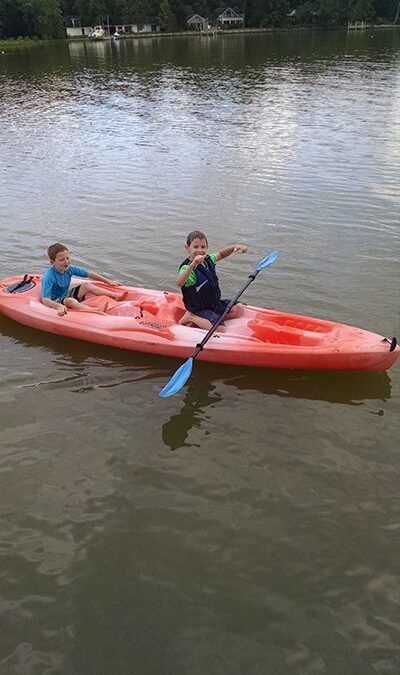
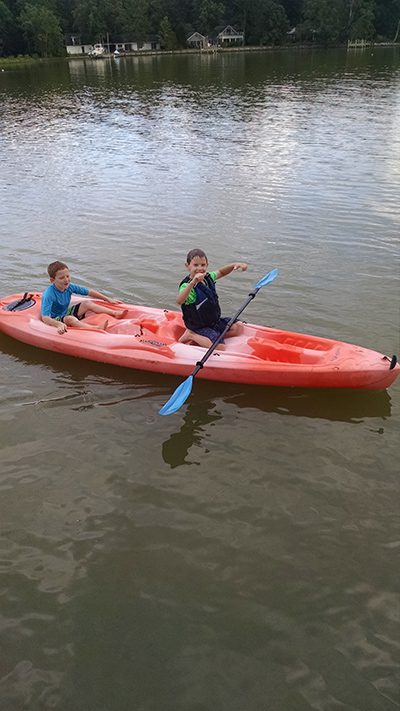
During the week they recently spent at ‘Gram and Grandad’s Camp on the Creek,’ they devised their own job chart so that they could all take responsibility for managing mealtime with the most efficiency and fairness. Each meal was divided into five tasks, including meal prep; set-up; table clearing; dishes; checking the crab pots; and watering the plants when all their crab catch had been consumed. Given the opportunity, elementary children will take on great responsibility, meeting the highest of expectations. It never ceases to amaze me how much (and how well) they can do so many things socially, intellectually, emotionally, and morally. Sometimes, we simply need to set the parameters and then stand back and watch. For sure, personality puts its own mark on each child, but there is, no doubt, a pattern of development that unfolds in the form of each unique individual, generation after generation.
As parents and grandparents, you can certainly encourage and support these wonderful traits that evolve in the elementary years. Look for ways for children to take greater responsibility within the family. Let them join classes, clubs, and teams, so that they can satisfy that ‘herd instinct’ and find their place in the social structure of their peers.
Answer their questions about the why and how of things, as you listen to the news, read the paper, or follow local and global events. Let them research their own interests, discover what entices them in the vast universe, and help them turn it into something that informs their days and their lives.
You’ll find that they will willingly invest hours of hard work into creating a final ‘product’ that they will proudly want to share or display. Let them test their strength, both physically (with challenging tasks or games) and emotionally (with the expectation to ‘work things out when something becomes difficult or the problem seems unsolvable). Offer help and assistance only when needed or requested. Remember that the need for independence is great, and, by working through difficulties, they gain that all-important sense of success. Don’t be tempted to rescue them when things get tough, as they inevitably will, since that is the very nature of life.
Give them their own space in the house or yard, both literally and figuratively. Over fifty years later, I still remember how my mother gave each of us a small space to create our own garden and how proud I was of the flowers and vegetables I was able to grow. I spent hours carefully cultivating each tiny plant and was amazed when seeds blossomed into green shoots and plants ripened into something I could share with the family. That love of the outside and gardening is still with me today.
Allow your elementary children to take responsibility for helping with all the tasks of running the household and being part of a family and community. Let them cook, clean, do laundry, mow the lawn, walk dogs, or make and sell things. Let them earn their own money by working in earnest. Teach them how to manage it well, by setting up a bank account or running a small ‘business.’ Allow them to take responsibility for caring for pets or younger siblings. Have them take responsibility for their own belongings, and give them a role in choosing what to recycle, give away, sell or carefully keep. Most of all, indulge their curiosity and encourage creativity in all its forms: from putting on plays to creating their own videos; writing; telling stories; painting; programming the computer; or exploring the myriad other electronic devices that are part of their world.
Remember that children are far more capable than we believe, so set the bar high and expect to be proud and amazed! This was Montessori’s message to us more than a century ago, as she, too, marveled at the ingenious way human beings evolve, develop, and find their place in the world. Although the personalities are different, as are the social times, this way of developing continues from generation to generation, and what was true about this age of 6-12 year-olds remains true today.
Elementary children need to test their wings, solve their own problems, and, ultimately, find their own place in the social order of their society. Our job is to nurture; encourage with opportunity; and support without suffocating their curiosity, creativity, and ways of reasoning. When we do our part well, we are able to witness the evolution of the child into the competent and capable adult, who contributes to us all. For me, there is no greater gift.
Claire J. Salkowski is a member of the International Montessori Council’s (IMC) Board of Trustees; Co-Chair of the IMC Accreditation Commission; founder and former Head of Freestate Montessori, Fork, MD.
Tomorrow’s Child / September 2016 / p 15