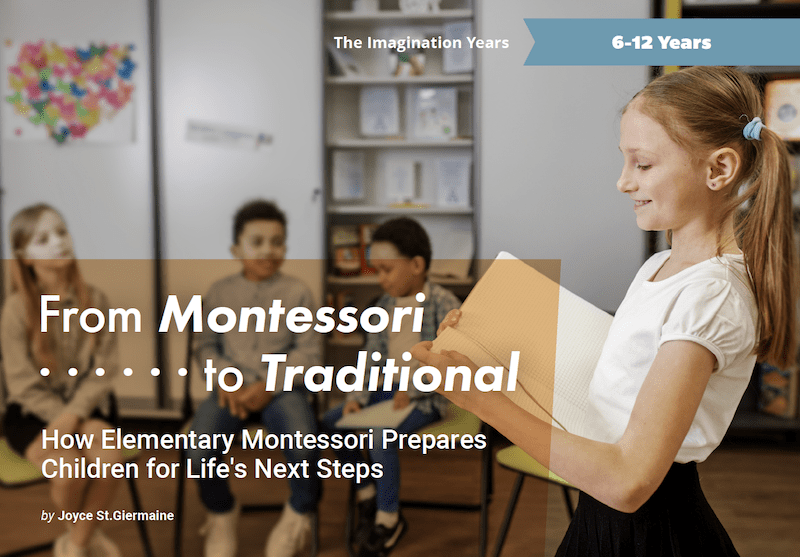
From Montessori to Traditional How Elementary Montessori Prepares Children for Life’s Next Steps

From Montessori to Traditional How Elementary Montessori Prepares Children for Life’s Next Steps
from montessori to traditional
by Joyce St.Giermaine

It’s a sunny morning at Oakwood Montessori School, and inside the brightly lit classrooms, a quiet buzz fills the air. In one corner, Maya (a fourth-grader) is constructing a model of a Roman arch, while Jacob (a fifth-grader) is busy calculating irregular shapes’ areas with Montessori geometry materials. Both are focused and seem to be motivated by inner curiosity.

Maya and Jacob have been in Montessori since they were toddlers, and most days are filled with moments of discovery. Today, for Maya, it’s exploring history through building this scale model of a Roman arch that holds together without mortar. For Jacob, it’s the satisfying moment when a challenging math problem clicks into place. They are, however, quietly developing something more enduring: self-reliance, critical thinking, and resilience; these are characteristics that will serve them well when they eventually shift to more traditional middle or high schools.

The elementary Montessori learning environment is clearly different from the traditional classrooms students may experience later. The area feels more like a studio or workshop than a typical classroom. Students move around and choose their activities, working alone or with a few others. This is a hallmark of the Montessori approach. It allows students like Maya and Jacob to explore their interests while still meeting set learning goals.

Claire, the Upper Elementary Montessori guide, observed, “They’re not just working because they have to. They’re engaged in work that they choose, which develops a much deeper connection to knowing.”

Jacob enjoys challenging math problems. He says that he has been spending as much time as he can on geometry for weeks. “He’s able to dive deep into subjects that interest him,” Claire describes. “And he’s establishing the discipline to keep going even when things get difficult.”

Maya’s experience with hands-on learning is typical in Montessori education. Through tasks like constructing a Roman aqueduct, she’s not simply discovering ancient civilizations; she’s learning more about engineering, team effort, and the value of water systems in society. She may not recognize it, but the flexibility to explore principles in such an experiential way is laying the groundwork for how she’ll approach finding out for the rest of her life.

What’s not obvious to the casual observer is that both Maya and Jacob are likewise sharpening skills that will reduce their ultimate shift to more conventional school settings. They are finding out how to handle their time, set objectives, and evaluate their progress with increasing self-reliance and very little assistance from trainers.

Navigating Freedom and Responsibility

In Montessori, children like Maya and Jacob have a substantial quantity of autonomy. Each day, they choose the work on which they want to concentrate, stabilizing their interests with the academic requirements. Although this technique might seem disorganized, it promotes a strong sense of obligation and self-motivation.

families invest an evening in the class for the students to share their work and projects.”

This capability to self-manage makes Montessori students especially well-prepared for the next steps in their education. In a traditional middle or high school, where deadlines are strict and schedules are set, this self-discipline will help them thrive.

Tanya, Maya’s mom, is confident that Maya will be ready for life after Montessori. “She currently has the skills to manage her work effectively. She has ownership of her education.”

Montessori Elementary education is not just about letting children explore; it’s about preparing them for the realities of the world beyond.

As they progress through the program, students like Maya and Jacob develop essential skills that will serve them well in conventional schools: critical thinking; problem-solving, and social intelligence. These abilities are not just for educational success but for life beyond academics, helping them navigate the complexities of the modern world.

Jacob’s mom, Laura, states, “He’s discovered how to plan his day. It’s not like he’s simply doing whatever he desires. Jacob knows what he needs to accomplish, and he has to figure out how to make it happen. Yes, he has a weekly work plan, but he also keeps a journal of what he’s done and puts together portfolios of his finest work. Like the majority of kids, Jacob doesn’t constantly tell us about what he’s performed in school unless it is something very amazing. However, he has so much to say at conference time or when

In Montessori classrooms, children of different ages interact, fostering a collaborative environment where older trainees coach more youthful ones. This mixed-age grouping helps children like Maya and Jacob establish social maturity and leadership abilities. It’s an experience that’s hard to replicate in standard schools but one that offers Montessori trainees an edge when it pertains to browsing new social environments.

“It’s incredible to observe how they handle group work,” their Montessori instructor, Claire, says. “They’re not simply trying to get things done rapidly; they’re focused on finding out together. That collaboration constructs a lot of emotional intelligence.”

Jacob, who will probably transition to a standard middle school after sixth grade, is currently revealing indications of being ready for the modification. His self-confidence in handling his time and overcoming problems without fear of failure will be crucial as he moves into a more traditional environment.

Montessori Graduates in High School

Many Montessori parents question how their children will adapt from the Montessori approach to a more structured standard class setting. The experiences of former Montessori students, who efficiently transitioned from Montessori to conventional high schools, demonstrate the value of Montessori education in equipping trainees for the needs of standard academic environments.

Sophie, who is now a junior at a competitive private high school, recalls how her Montessori background offered her an unanticipated advantage when she started ninth grade. “At first, I fretted about all the tests and deadlines,” she states. “But honestly, it wasn’t as hard as I thought it would be. I was currently used to handling my own time.”

Sophie gained valuable time management abilities in Montessori, which enabled her to organize her everyday jobs and schoolwork separately. This capability served her well when she started high school, as she adapted to the more strenuous schedule without feeling overwhelmed.

Unlike many of her brand-new schoolmates, Sophie felt confident in staying up to date with her work, attributing her success to the skills she obtained in Montessori.

Sophie’s mother, Jen, who initially stressed over the shift to high school, now feels the strong foundation Montessori offered. She appreciates Sophie’s resilience, capability to express concerns, and desire to take risks in her educational journey.

Daniel, a sophomore at a public high school, tells a comparable story. “In Montessori, you’re taught to think for yourself, not simply follow guidelines,” he stated. “That actually assisted me when I got to high school. I wasn’t scared to speak out in class or deal with jobs.”

Throughout his time at Montessori, Daniel participated in all sorts of creative activities that improved his ability to think critically and resolve problems. These qualities served him well in his new school’s more structured environment. “I believe Montessori made me more positive,” he says. “It taught me how to figure things out on my own, which is something I see some of my friends fight with.”

His mom, Lisa, concurs. “He’s not just going through the movements,” she says. “Montessori gave him the tools to really engage with what he’s learning, which’s carried over into high school.”

The Long-Term Impact of Montessori

Maya and Jacob’s years in elementary Montessori are setting them up for success. They are learning to think deeply, work independently, solve problems, and make friends.

For graduates like Sophie and Daniel, the shift to traditional schools has been less of a hurdle and more of an opportunity to apply the skills they’ve spent years developing.

As Sophie prepares for college, she’s optimistic that her Montessori background will continue to serve her well. “I don’t just remember stuff for tests,” she says. “I know how to study and learn. That’s what Montessori offered me.”

For parents like Jen and Lisa, the question of whether Montessori prepares children for traditional schools is clear. “Montessori isn’t just preparing them for the next grade,” Lisa states. “It’s not just about getting them ready for the next level. It’s about providing the abilities and values they require to be successful in life.”

The same can be said for Maya, Jacob, Sophie, and Daniel. Whether they are building Roman aqueducts, computing the area of an intricate shape, or tackling the difficulties of high school, Montessori has actually provided a structure that goes far beyond academics — it’s provided the ability to navigate whatever comes next. 

Joyce St. Giermaine is the Executive Director of the Montessori Foundation. Her background includes a lifetime of work in association management, law, banking, and institutional advancement. A lifelong learner, she is an accomplished photographer, editor, and graphic designer. Joyce is a former Montessori parent and grandparent.

A Global Campus

A Global Campus

A Global Campus
by Collin Carpino, NewGate Class of 2024

What do Africa, the Cayman Islands, Florida, Georgia, Maine, Prince Edward Island, Spain, Virginia, and Wisconsin have in common? Well, for me, this is the community that makes up my high school. I am a recent Montessori graduate from the Global Campus of NewGate School, the Lab School of the Montessori Foundation. In this environment, I spent my weekdays with teachers and classmates spanning the globe, each bringing his or her unique viewpoints to hands-on, collaborative projects, research, and community discussions. When I tell people I went to high school online, I am often met with an unenthusiastic response, although I feel quite enthusiastic about this untraditional path.

NewGate Global is a real-time, online campus branch of NewGate School in Sarasota, Florida. Although NewGate has been around for 40 years, the Global campus emerged during the COVID-19 pandemic, when many schools were forced to close their doors and go virtual. Many families that desired a Montessori experience for their adolescent children found the program to be a vibrant eLearning community.

Each Global school day starts with an opening meeting in which all students (ages 12-18) are present, along with at least two teachers. It is a time to acknowledge everyone, say good morning, and sometimes even celebrate birthdays. We also talk about our daily phenology* recordings in which we go outside to a special place and observe how the environment changes within each season. On Mondays, we always share highlights from the weekend. On Tuesdays, a country is spotlighted, and then on Wednesdays, that country’s culture and traditions are discussed. Thursdays are our student-facilitated Council meetings in which questions and concerns are proposed to the community; future events are mentioned; our World Walking project is updated; our Global Journal is discussed; and we always close with personal gratitude. Council is a time to strengthen our community. Sometimes, we meet with the in-person Sarasota campus to discuss a book or film. On Fridays, we share special interests.

Traditional Montessori Secondary classes are typically divided into three cycles. We have two: Grades 7-9 and Grades 10-12. Students meet throughout the week with their assigned cycle for literature and composition, the humanities, the sciences, mathematics, and Spanish classes. Occasionally, a student from Cycle 1 may need to be in a mathematics class in Cycle 2 because he/she needs a more advanced class. Our students study mathematics from pre-algebra through calculus. We are also held accountable each week for time spent in creativity, action, and service (CAS) via an ongoing portfolio project that continues from year to year, and students are involved each year in a weeklong internship, which is then brought back to the community and shared. Opportunities and events on the brick-and-mortar Sarasota (FL) campus are always extended to the Global campus, such as Drama Immersion Week, during which students are responsible for all aspects of the production of a well-known play and participation in the annual Through Women’s Eyes Film Festival in Sarasota.

Every aspect of NewGate Global is interactive, engaging, fun, and collaborative. Students are encouraged to eat lunch together one day a week and to attend CAS Art after school on Thursdays for an teacher-hosted interactive art experience. As a Montessori student, I never once dreaded going to class. Some of my favorite activities included building model bridges, a to-scale model of the Parthenon, a solar-powered oven, an insulated house, and homemade bread. I have loved reading and studying Ishmael by Daniel Quinn; Siddhartha by Hermann Hesse; and The Pearl by John Steinbeck. We look very closely at historical events. Some of my favorites: Lewis Hine’s artwork of the Progressive Era; the Dust Bowl of the 1930s; the Cold War; and Global Politics. In environmental science, I especially enjoyed the many projects created throughout the year in which we looked at the natural world and our footprint on it.

The most unexpected aspect of NewGate Global is the strong sense of community that is easily observed throughout the school day and in special events, such as the Global Showcase (held in winter and spring). In the past, students have shared their interests outside of the classroom, which have included: dance; athletics; theater; playing instruments; singing; photography; artwork; flying a plane; ocean conservation; sewing historically accurate clothing; needlework; green projects; poetry; and writing. One recent graduate even shared his experience as an American Ninja Warrior finalist, and another shared his sculptures on display for Carnival Cruise Line. The focus of these events is not to have a winner but to have a variety show that highlights talents and interests of our community.

At the end of the 2023 school year, the NewGate Global community met in person for the first time in Sarasota. It was our first global gathering, and it was both amazing as well as surprising to see each other in real life. The only downside to the event was that it was just too short. At the end of this last school year, we had our second global gathering on Prince Edward Island (PEI) at the Canadian Centre for Climate Change and Adaptation. We participated in a research project with the University of PEI and celebrated collaborative efforts to become a Peace Certified School through the Mattie Stepanek Foundation.

To learn more about the NewGate Global experience, visit Newgate.edu or contact teamglobal@newgate.edu. 

*Phenology is the study of phenomena or happenings and is applied to the recording and study of the dates of recurrent natural events.

Collin Carpino is currently enjoying his first year of college. Prior to this, he attended New Gate’s Global Campus online program for high school and for part of his eighth grade year and enjoyed in-person Montessori school from the second grade. He lives with his family in Georgia and Florida. Collin enjoys guitar, dystopian fiction, working out at the gym, swimming, volunteer work, and his dog and two cats.

Recommended & DIY Projects With Children: Yarn Mache

Recommended & DIY Projects With Children: Yarn Mache

Yarn Mache

It’s always fun to be creative together, get your hands (and lots of other stuff) messy, repurpose found articles, and experience the joy of giving! That’s what this project is all about. You and your child can make colorful bowls from yarn scraps to give during the holiday season. Try the following steps and see how easy it is.

Materials:

• cornstarch paste

• yarn scraps

• plastic wrap, and

• a bowl to use as a form

Making the paste:

• 1/4 cup cornstarch

• 1/4 cup of cold water

• 1 cup hot water

• A small saucepan

Directions:


3. Dip the yarn in the paste. Layer the saturated yarn over the frame until completely covered.


4. Allow to dry for several days. When hardened, gently remove from the frame.


1. Mix the starch with cold water in a small saucepan to make a smooth paste. Add hot water, stirring constantly, cook until it thickens. Remove from heat. Cool before using. (How much adult help and supervision with this part depends on the child’s age and experience.)

2. Cover the outside of the bowl frame with plastic wrap.


Drum roll, please! Ta Da! Now your child has something they have made to give to someone special, who will most likely cherish it. 

Lorna McGrath, is Director of IMC School Accreditation, Program Director of the Montessori Family Alliance, and Senior Consultant of The Montessori Foundation. Lorna has 41 years of experience in the field of education, teaching children from 18 months through 6 years old and from 12 through 18 years old in both public schools and independent Montessori schools. Lorna is a Montessori teacher educator, conference presenter, and school consultant.

Recruiting great Families: Following Up

Recruiting great Families: Following Up

Building Strong Relationships Through Effective Follow-Ups

In the competitive landscape of private education, Montessori schools have a unique advantage: a foundation built on trust, relationships, and a genuine commitment to the growth of children and families. Yet, even the most mission-driven schools can need help with a critical piece of the admissions process: follow-ups. The challenge is clear—how do you nurture prospective families and move them from interest to enrollment in a way that reflects Montessori values? The answer lies in effective, thoughtful, and well-structured follow-ups.

The Importance of Relationships in Admissions

At its core, Montessori education is about relationships between teachers and students, parents and schools, and children and the broader community. Admissions should mirror this philosophy. Families aren’t looking for a hard sell; they seek warmth, authenticity, and evidence that your school is the right partner in their child’s journey.

Our goal is to be approachable, kind, and genuinely interested in the families we serve. It’s not about pushing for enrollment; it’s about building trust and offering value.

Follow-ups allow Montessori schools to showcase these qualities, positioning themselves as trusted advisors rather than salespeople.

Understanding the Family Journey

Data shows that most families don’t make enrollment decisions overnight. In fact, 60% of families take six months to two years to decide on a school, and nearly two-thirds consider three or more options before enrolling. This prolonged decision-making process highlights the need for ongoing engagement.

A well-designed follow-up system ensures your school remains at the top of their mind throughout this journey. It provides families with the information they need, answers their unspoken questions, and reassures them that they’re making the right choice.

Crafting a Montessori-Inspired Follow-Up System

Effective follow-ups are more than just emails—they’re a blend of strategy, authenticity, and content that resonates with your audience. Here’s how Montessori schools can build a follow-up system aligned with their values:

1. Automate Without Losing the Personal Touch

Tools like AIMS, Hubspot, or Mailchimp can help automate routine follow-ups, ensuring no family falls through the cracks. However, automation should complement, not replace, personal interaction. For families expressing immediate interest, a quick phone call or personalized email can make all the difference.

2. Deliver Meaningful, Montessori-Aligned Content

Families value content that answers their questions and addresses their concerns. Consider creating a series of follow-up emails that highlight different aspects of your school, such as:

  • A welcome email that warmly introduces your school’s mission and values.
  • Videos showcasing your classrooms and Montessori materials in action.
  • Quick facts about your school’s programs, extracurricular activities, and alumni success.
  • Testimonials from current families and students.
  • Insights into what graduates achieve after leaving your school.

This sequence not only educates prospective families but also reinforces your credibility and expertise.

3. Engage Families Based on Their Needs

Every family is unique. Some may prioritize academic excellence, while others seek a nurturing environment or strong extracurricular programs. Use surveys or forms to understand their priorities and deliver customized follow-ups that address their specific interests.

For example, a family interested in athletics could receive content about your school’s sports programs, while a family exploring alternatives to public schools might appreciate insights into Montessori’s approach to personalized learning.

4. Leverage Technology to Stay Consistent

A robust follow-up system ensures consistency even during busy times. Platforms like Aims allow schools to create automated email sequences, track engagement, and adjust strategies based on what works. Tools like ChatGPT can also streamline content creation, helping you generate blog posts, emails, and social media updates quickly.

5. Incorporate Retargeting Ads

Beyond emails, retargeting ads on platforms like Facebook and Google help keep your school visible. These ads remind families of your school after they visit your website, encouraging them to re-engage.

Why Follow-Ups Matter

A robust follow-up system doesn’t just increase applications and tours—it builds trust, fosters relationships, and reflects the Montessori philosophy of respect and partnership. As Clint Losch, an admissions expert, explains, “Follow-ups are about keeping families engaged, answering their questions, and showing them you care. It’s one of the most important steps in admissions.”

Montessori school leaders must view follow-ups not as a task to check off but as an opportunity to connect with families on a deeper level. By implementing a thoughtful, well-structured follow-up process, your school can stand out in a crowded marketplace while staying true to its values.

Take Action

If your school doesn’t have a follow-up system in place, now is the time to act. Start small by creating a series of automated emails or setting up a retargeting campaign. Over time, build a library of content that addresses families’ needs and showcases the unique strengths of your Montessori school.

There’s no more important job than responding to inquiries with care and attention. A great follow-up system ensures that every family feels seen, heard, and valued.

With the right approach, follow-ups can transform your admissions process and strengthen your school community—one relationship at a time.

Which should I choose, AMS or AMI?

As Montessori school leaders and consultants, we are often asked about preferences in Montessori training or organizations.

It’s a common misconception to think of Montessori as being divided into two distinct “tribes,” such as AMI and AMS, each with rigidly defined philosophies.

In reality, Montessori is much broader and more nuanced. In North America, there are numerous Montessori organizations, with AMI, AMS, and IMC being the largest.

For teacher training programs in the U.S., the key credential to look for is accreditation by the Montessori Accreditation Council for Teacher Education (MACTE), which ensures a high standard of quality.


Philosophical and Practical Differences

    • AMI (Association Montessori Internationale): Founded by Dr. Montessori herself, AMI emphasizes fidelity to her original principles, practices, and lessons. It tends to adhere closely to Montessori’s core methodologies and may emphasize certain materials or approaches with greater consistency.

    • AMS (American Montessori Society): AMS embraces a broader and more inclusive interpretation of Montessori, allowing for differences in implementation and some incorporation of modern educational elements. AMS training often reflects a more diverse set of influences, including greater flexibility for adapting Montessori principles to different contexts.

    • IMC (International Montessori Council): IMC generally aligns more closely with AMI in its emphasis on Montessori’s original philosophy but also incorporates a contemporary perspective that supports practical application in a wide range of schools and communities.

That said, all three organizations share more in common than what divides them. They are united by their commitment to fostering respect for children’s natural development and supporting the spiritual transformation of the adult—a cornerstone of the Montessori approach.

Choosing the Right Training Program

When deciding between AMI, AMS, or another MACTE-accredited program, consider the following factors:

    1. Training Center Rigor: The quality and rigor of individual training centers can vary within any organization. Research the reputation and approach of the specific center you’re considering.

    1. Budget: Training programs can differ significantly in cost. Make sure the program aligns with your financial resources.

    1. Personal Learning Style: Some training centers emphasize hands-on practice, while others may focus more on theoretical discussions or group learning. Choose a program that matches your preferred way of learning.

    1. Long-Term Goals: If you aim to work in a particular type of Montessori school (e.g., AMI-affiliated, AMS-accredited, or independently Montessori), align your training choice with their requirements or preferences.

Hiring and Faculty Development: An Administrative Perspective

From a school administrator’s perspective, the practical challenge often lies in finding and retaining qualified Montessori teachers. Most schools aim to hire the best-trained Montessori educators available. However, the availability of AMI, AMS, or IMC-trained teachers can vary depending on location, budget, and timing.

Many schools also sponsor non-Montessori-trained teachers through a Montessori teacher education program that best fits the school’s needs and the candidate’s availability and learning style.

This approach can result in a faculty with diverse Montessori backgrounds, training experiences, and interpretations of best practices. While this diversity can enrich the school, it also presents challenges in ensuring consistency and coherence across classrooms. Administrators play a critical role in helping teachers find common ground and align on how Montessori principles are implemented throughout the school.

Strategies for Building a Cohesive Faculty

To support a faculty with diverse Montessori training, administrators can take the following steps:

Establish Clear Guidelines for Montessori Best Practices: Create a shared vision and expectations for how Montessori principles are applied in the school. This will ensure consistency while respecting individual teaching styles.

Invest in Professional Development: Provide ongoing training and workshops to deepen teachers’ understanding of Montessori philosophy and methods. These can be opportunities to bridge gaps between different training backgrounds.

Facilitate Collaboration: Encourage faculty collaboration to share ideas, address challenges, and build a cohesive understanding of Montessori best practices. Cross-classroom observations and peer mentoring can be particularly effective.

Emphasize Community and Culture: Help teachers focus on the heart of Montessori—how they connect with children and families and conduct themselves in the presence of children. This shared commitment to the spiritual transformation of the adult can unify a diverse team.

Support Non-Trained Teachers in Training: For teachers in the process of earning their certification, provide mentorship and classroom support to ensure they can immediately begin applying Montessori principles in their work.

Evaluate Montessori Teacher Preparation Program Fit: When sponsoring teachers for training, consider the strengths and needs of the individual and the school. Align the choice of training program with the school’s philosophy, budget, and the teacher’s ability to attend in-person or online sessions.

Ultimately, whether hiring trained teachers or sponsoring new ones, Montessori school administrators must prioritize cultivating a strong, unified culture of Montessori practice. By supporting a diverse faculty to align on shared principles, schools can ensure a consistent and high-quality Montessori experience for all children and families.


The Heart of Montessori

Finally, remember that learning Montessori lessons and philosophy is only part of the journey. Montessori education is fundamentally about how we connect with children and families and how we conduct ourselves in their presence. This is often referred to as the spiritual transformation of the adult—the deep personal growth and humility required to truly guide and nurture children as they explore and discover their world.

Rather than focusing solely on organizational affiliations, look for a training program and community that resonate with your values, inspires you to grow, and prepares you to make a meaningful impact on children and families.

The Montessori Foundation Is Here To Help!

The Montessori Foundation is an international Montessori nonprofit organization that provides school consulting, mentorship, and professional development onsite and online to Montessori schools around the world. We’re here to help.

Info@montessori.org

The Student Retention Ecosystem!

Unlocking the Potential: Building Faculty and Family School Partnerships to Enhance the Student Learning Experience

Wit and Wisdom: A Family Chat:  Making Time and Space for Unstructured Play

Wit and Wisdom: A Family Chat: Making Time and Space for Unstructured Play