
In Pursuit of the Correct Answer: The Role of Process and Discovery in Montessori

In Pursuit of the Correct Answer: The Role of Process and Discovery in Montessori

Changing our View of Education: A Positive Approach

The positive nature of the Montessori approach, with its emphasis on process and discovery, is central to why it works so well for children in their development. When Dr. Montessori lectured in London in 1946, she pointed out that conventional education focuses on mistakes.

Think of your own experiences and how your schooling was structured; you will probably remember that there was constant attention given to your errors. Avoiding errors was the thrust of the system. Even with a few enlightened, kind teachers here and there, who emphasized process and exploring bravely, the main message for how you were to learn things was by having your mistakes pointed out to you daily in the form of testing, performing in front of classmates, and reaching for the one “correct” answer to each question. This emphasis, by design, encourages children to lose confidence in their originality. And, yet, we know that developing unique perspectives is invaluable. Thus, the very thing that makes society prosper is being discouraged on a daily basis in our conventional school model.

You may be wondering how there could be another way to teach, when there are certain areas in life where there really is just one correct answer. Mathematics and science are not a matter of opinion, for instance. There are facts that children must learn in order to succeed in some areas. Which is more important: the process, which leaves room for originality, or the answer, which must be consistent with the truth? The answer is both, and Montessori’s approach allows for this interesting dynamic to play out in the classroom, as it does in real science laboratories and in sophisticated math discussions. Dr. Montessori discovered that there is an alternative way that children learn about exact answers.

Montessori’s view was that there is exactness in mathematics and science, which gives our universe balance and beautiful symmetry. Realizing this is truly awe-inspiring for children! But instead of having this phenomenon of exactitude dominate the whole educational approach (by trying to stuff answers into children’s minds), Montessori sought to awaken their wonder for exploration and to help children discover pathways of thinking that lead to correct answers. A prime example of this is the way elementary-aged children explore math through the specially designed materials that require several steps and attention to detail. The children ultimately arrive at the correct answer and are often quite satisfied with themselves after much effort; all the while, they are developing cognitive processes and character traits that contribute to future learning and problem solving.

…the very thing that makes society prosper is being discouraged on a daily basis in our conventional school model.

Discovery and Ownership

Through the materials and how they are presented by the trained teacher, Montessori children in an Elementary classroom search for the paths to find the true answers; when they get there, the results are their own discovery, just as if they were the first mathematicians to discover them. The result of this repeated experience makes children view mathematics as the wonderful puzzle that it is. The idea of being embarrassed at arriving at an incorrect answer is foreign to these children, for whom the taste of finding the right answer is so sweet that they want to explore other avenues and learn more. Mistakes are integral steps in every journey, and this reality becomes familiar and acceptable through repeated experience.

The Montessori materials guide children to find the ways that work, making the adult corrector obsolete in many cases. For instance, when two children do long division problems together with a material called Racks and Tubes, there are many places they might err. They could start off incorrectly by placing the tens board to the right of the units and work through the whole problem incorrectly, only to find at the end that their answer is incorrect (either by bringing it to an older friend who can do the problem longhand on paper, to the teacher who can check it, by using another math material to do the inverse problem and see if it matches, or by checking it themselves against a calculator).

They go back to their work—puzzled—and like two detectives, they re-examine how they set up the problem (which is often when they will identify this first mistake), or they employ a friend to see if they can identify where they may have lost the path. In my experience as a Montessori Elementary teacher, this is when the fun really begins if the adult supports an attitude of curiosity about finding the error.

Children will repeat a problem over and over, sometimes eliminating just one of several mistakes at a time in the same math equation or process. The important thing is for the teacher and community to support the quest to get to the end, so that the children do not fall into a habit of giving up too easily or repeat making the same mistake so many times that it gets ingrained! By keeping tabs on their progress, the teacher can see when to step in and point children in the right direction, perhaps making an observation and/or asking a question: “Oh! Wait, I see—look where your units board is. Do you remember where it belongs?” This is usually all that is needed to get an “Ah-ha!” and a delighted, re-energized effort to try the whole thing again. Children are remarkably resilient, especially when working with a friend and being allowed to own the whole process of the math equation. When they finally, leaning over the calculator with suspense, find that they have achieved the correct answer by their own efforts, it is an excited triumph that feeds the urge to tackle more and more problems.

Very rarely have I seen children want to get to the answer easily so they can quit. There are some who will be tempted to use a calculator to find the answer and just write it in, sometimes several times, to create the illusion that they have accomplished a lot of “work.” You may be surprised to hear that in a Montessori environment, that is the exception and not the norm. Teachers usually catch that pretty quickly, but even if they didn’t, and even if other children did not point to it and demand that the child work honestly and just as hard as them, the child who does this often abandons the practice after watching others glean the internal rewards of sustained efforts and true glory of finally getting that answer.

As children experience this quest again and again, they hone their skills each time. Eventually, the exercise becomes too easy for them, and they are ready to advance to another math process that brings them to their next level of challenge.

Developing Persistence

To describe all the ways children might error in the process of long division with Racks and Tubes would take too long here, but I’ll give you a sense: One child may write the problem down differently than their companion and, therefore, lay out some incorrect amounts when distributing the beads to be used (a mere flipping of two numbers, perhaps). This carelessness will eventually be discovered, and both children will realize the importance of double-checking with each other before they begin. They also might place the working number of beads in the wrong category or confuse the order of the categories (units, tens, hundreds, etc). Again, these are mistakes that reflect the need to double-check their layout before they begin the process.

Another place they may err is in physically dropping a bead or beads, losing them as they spring across the floor and losing count of how many were in the bowl to be distributed. This reminds them to slow down, be careful, and focus on their physical movements. They could also lose count or forget a step if they are interrupted by conversation or stop what they are doing to attend to something else in the middle of their process. This would illustrate the importance of sustaining their focus on the task at hand until finished. Finally, they might write the numbers down in the wrong order at the end, showing again a need for more careful, focused attention and awareness.

Montessori teachers tend to inspire a sense of wonder and nurture children’s curiosity and imagination.

Sometimes, two children have two different answers written down, and they’ll be perplexed about which one is correct, garnering more discussion and a backtracking of their steps. Watching all this is incredible; the amount of teamwork, social interaction, struggle, humor, fun, and agony that can accompany such a process as doing long division is positively brilliant in the sense of integrating all aspects of a child’s development as a person and a mathematician.

For a Montessori teacher, bearing witness to such self-discoveries is joyful. It is a special experience to spend one’s days in an Elementary Montessori classroom with children working with the Racks and Tubes! It can take more than an hour for children to complete a challenging problem (if you account for the self-correcting, they may need to do), but the learning that occurs is immeasurable. And the more children work with such processes, the faster they achieve success each time, fueling their desire to tackle more challenges all over the classroom.

This is just one example of how Montessori fuels the development of children’s resilience and perseverance in a very direct and effective way. And because a Montessori classroom is a vibrant community where everyone is working simultaneously on different things and seeing what others are doing, the practice of pushing oneself until achieving success is contagious. Children will stop and help each other, discuss, and share a conundrum, and sometimes get intrigued with each other’s experiences of learning. The learning is, therefore (in economic terms), a positive externality, meaning that the network of students spreads newfound information via witnessing and sharing experiences; this happens naturally in a Montessori Elementary classroom because of children’s gregarious social behavior at these ages. This is another example of where Dr. Montessori designed an approach that employs (rather than fights against) the developmental characteristics of children in this stage of life between ages six and twelve, specifically, their tendency to be very social and to always want to find out what their peers are doing.

In the above example, students may use the mantras they learned in their Primary years (ages five and six), such as “The units always go on the RIGHT” and “We always begin with the UNITS” (“except in division, when we begin with the highest category present”). Students love these little cues, and when the Primary teacher says them each time, she is with children in a math presentation, the children often chant along. There are just a few such mantras that carry over from Primary to Elementary, so children tend to remember these. We have found that children benefit from having such important points of interest brought to their attention regularly, so that they can commit them to memory.

When working on math and science, the children in a Montessori classroom don’t just value the exactness of a true answer; they love that there are answers to find, and they see each exact answer as a part that connects to a greater whole, creating a universal balance in which each component matters. With the Montessori approach (where the processes of discovery appeal to our children’s developmental characteristics at each age), finding correct answers is fun, sometimes eventful, and always intrinsically rewarding.

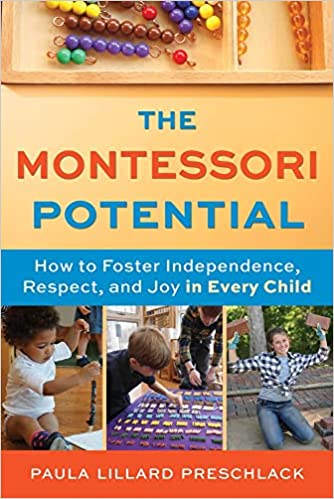
Paula Lillard Preschlack is a writer and a speaker. She has spent 25 years as a teacher and the head of school at Forest Bluff School. She just released her first book about Montessori education, The Montessori Potential. Paula Preschlack has given over 100 talks at Forest Buff School and at other Montessori schools, teacher training courses, and conferences. Her work focuses on the principles and successes of the Montessori approach, learned from over 25 years of teaching and observing children from birth to adulthood.

Paula is a graduate of Hampshire College and has a master’s degree in education from Loyola University, Baltimore, MD. She is AMI certified for all Montessori age levels: Assistants to Infancy, Primary, and Elementary, and she audited the NAMTA/AMI Orientation to Adolescent Studies in 2018.
Learning to Love Effort – How Montessori Fosters Perseverance

Learning to Love Effort – How Montessori Fosters Perseverance

Dr. Montessori observed that children are intrinsically inspired to exert great effort when their work is purposeful. Through close observation of a child in action in a Primary classroom, we can see how Montessori fosters perseverance.

In the Montessori approach, “work” is not a dirty word; it’s a glorious word. For children, real “work” is to form their own unique human being in the world through everything that they do and everything in which they engage. Think of how you feel when you are fully immersed in something you love to do. It could be polishing your antique car, fly fishing, writing a poem or a speech, solving a math equation, or helping a client. If you have work that absorbs you in such moments, then you understand that inspiring work feels good to children, too. Of course, children do not think of their actions as work, but Montessori proposed that what children do should be respected as their work.

The task of infants is to build a person, so that they are fully engaged in kicking their legs and making sounds, delighting in it, concentrating on it, and going on with it even when it takes effort. And here is a primary reason that Montessori is so timely for today’s youth: when we have found some piece of work that engages us fully, effort is a friend that helps us persevere. With the Montessori approach, children develop an attitude that effort is a friendly, natural part of any learning process. This is because effort is built into every activity at school that leads them into flow.

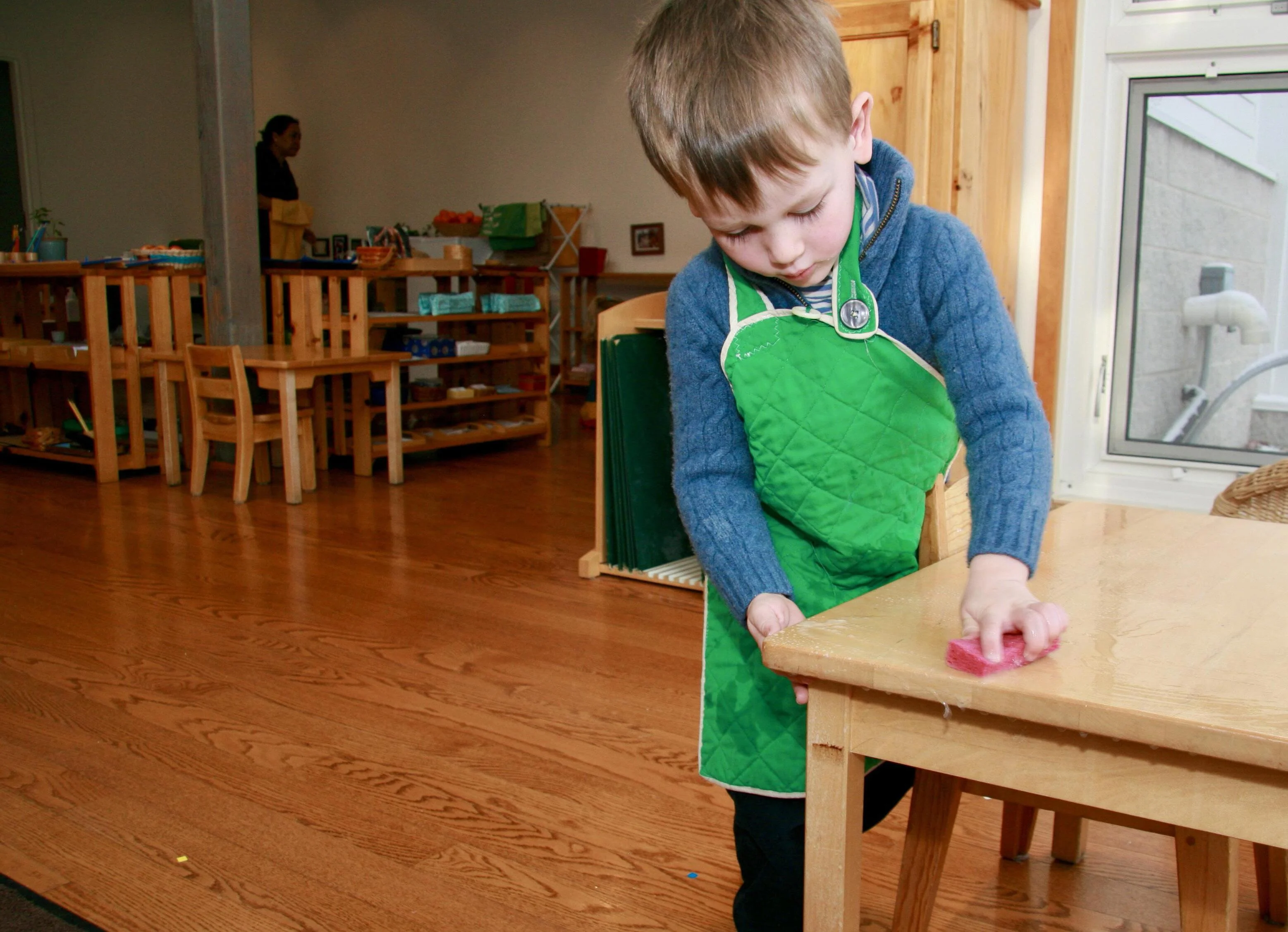
In a Primary classroom, I watched a four-year-old boy wash a table with such gusto and flourish that he seemed completely unaware of the other children walking past him and talking. He did not seem to hear the bells a child was playing on the far side of the room; the water splashing in the sink as another child filled and refilled his bucket just five feet away; the classroom door opening, a child entering, the door closing again; or a girl tap-tap-tapping her feet while she was counting out loud at a table three feet to his left, adding four digits numbers with a bead frame. All this and more were swirling around him, and he was bent over his work, apron hanging down and wet with water, making big, round motions with his arm as he scrubbed the surface of the wooden table. His long curly bangs were swinging over his brow, the shoelaces of one shoe untied and lying on the floor while he rocked forward and up on the balls of his feet to reach the far side of the table, one hand flat on the table to support his weight.

The boy paused when he had made the soapsuds cover every part of the table surface. He stood upright, took a step back, brushed his dark curls from his face with a wet forearm holding the child-sized scrub brush, glanced up at the child sitting near him, and just as quickly bent over his floor mat to his right with all the table washing materials laid out on it: sponge; soap dish with soap bar in it; a washcloth for drying; a tiny bucket half filled with water. He rubbed the scrub brush on the soap bar, stopped and looked at the bristles, re-wetted them in the bucket, and rubbed them on the soap again (quite firmly). When he noticed suds building, he paused again, glanced at the underside of the brush, and went back at it with the table surface.

He scrubbed and scrubbed, moving his circular motions around to cover the entire surface again. This repeated and went on for a good 15 minutes.

Beads of sweat formed on his forehead and his hair started to stick. He seemed unaware and unfazed, completely absorbed in his whole-body movement. Then he put the brush on the floor mat, squatted down, took the sponge, and started wiping the table in smooth, long swipes from one side to the other, eventually removing most of the suds. He bent over and plunged the sponge into the water bucket, and at that moment, another boy came over and said something to him. He smiled up at him, then looked back down and squeezed the sponge out with both hands, and the other boy walked away. He stood straight up, looked after the other boy for a moment, then watched the water dripping into the bucket from his sponge, long, slow drips. He looked pensive, watching…then squeezed the sponge out with more force, watched, then started wiping the table again.

He stopped after a while and sighed, stood up, and noticed a girl walking by with a tray of flowers. He then dried his table with the dry washcloth and quickly cleaned up the things on his mat, returning the water from the bucket into the child-level sink and taking the scrub brush over to the sink and rinsing it with a gushing stream of water (it dripped from his hand the whole way back to his mat but he did not notice this). He squatted down to his mat and put the sponge, dish with soap, and scrub brush back into the little bucket. He then paused and pulled them all out again.

He wiped the bottom of the bucket with the towel, walked across the room to drop it into the hamper, and retrieved a fresh towel from the shelf. He then walked back to the mat and, again, put each item into the bucket, with the folded towel on top. He carried the bucket by the handle— swinging it slightly as he walked—and placed it back on the shelf. He returned and rolled up the mat, stood, and then suddenly slowed down, straightened himself upright, and carried the mat ceremoniously towards the shelf with a tall posture, holding the rolled mat like one might a flagpole in a parade. He concentrated on his steps as he walked very slowly with dignity back to the shelf, returning the mat to its designated place and walking away with a relaxed and refreshed expression on his face.

Such episodes repeat throughout the day in a Montessori Primary classroom. This is a good example of how a child organizes thoughts and motions with a sequence of actions, integrating will, decision making, and body movements (both gross-motor and small-motor skills of fingers) while exercising care for materials and the environment. Children use such exercises to satisfy their craving for purposeful work: not of the work of washing tables per se, but the deeper work of building all the cognitive and physical aspects of their personalities. Dr. Montessori pointed out that young children need these organizing activities that have real purpose and connection to community life to build themselves through.

The effort and focus that rose out of this determined activity was that of the child; childern can measure and respond to the level of effort they feel rising in them during the activity and adjust and work with that sensation of effort. It is completely unadulterated and not manipulated or created by an outside force; it comes from within that individual child. So, effort is a different experience than the one we deliver to children when we give them an assignment. Accomplishing specific tasks, later when asked to, is something our Montessori children can willingly do with confidence because of such numerous experiences they have had of flowing with effort by their own accord.

These simple Practical Life activities (such as washing, cleaning, and arranging) lay the foundation not only for effort but for the organizing of thoughts as a child experiences sequences of actions and their outcomes in all their stages. Montessori uniquely employs such activities as the building blocks for thinking and doing. They deliberately and precisely set the stage for mathematics, language arts, and all the child’s intellectual and physical work to come. Simultaneously, our children’s healthy approach to effort translates into resilience and perseverance that will distinguish them in their later years. 

Paula Preschlack is a writer and a speaker. She has spent 25 years as a teacher and the head of school at Forest Bluff School. She just released her first book about Montessori education, The Montessori Potential. Paula Preschlack has given over 100 talks at Forest Buff School and at other Montessori schools, teacher training courses, and conferences. Her work focuses on the principles and successes of the Montessori approach, learned from over 25 years of teaching and observing children from birth to adulthood.

Paula is a graduate of Hampshire College and has a master’s degree in education from Loyola University, Baltimore, MD. She is AMI certified for all Montessori age levels: Assistants to Infancy, Primary, and Elementary, and she audited the NAMTA/AMI Orientation to Adolescent Studies in 2018. Paula is married to Jim Preschlack and has two children.

LET’S GET OUT OF THE WAY – DON’T OVER-PARENT; EMPOWER YOUR CHILDREN INSTEAD!

LET’S GET OUT OF THE WAY – DON’T OVER-PARENT; EMPOWER YOUR CHILDREN INSTEAD!

empower your children

By Paula Lillard Preschlack

Helicopter Interference

My college roommate visits me with her two teenage sons. She confides that she is worried that her 15-year-old isn’t working hard enough in school and “might be making poor choices about partying.” In our cabin kitchen, only moments later, I watch wide eyed while my friend takes the butter knife out of her son’s hand, pushes him aside, and says, “Here, let me make your sandwich. You have no idea what you’re doing.”

Have you ever seen this kind of interaction? Here’s a 15-year-old who isn’t allowed to make his own, albeit sub-par, sandwiches, but he’s expected to make responsible decisions about schoolwork and partying; and a parent, wanting nothing but the best for her son, who inserts herself into his attempt to make a sandwich, not seeing how doing so relates to his “poor choices.”

Many children are given the message — in small, seemingly benign ways — that they are not capable of making their own choices and developing independence. By not allowing children to try things and learn from their mistakes, we become obstacles to their growth. We become, according to the popular phrase, “helicopter parents.”

Helicopter parenting, a term coined by psychologists Jim Fay and Foster Cline in the 1990s, describes the too-common tendency to hover and interfere in children’s actions and decision making. As parents, we do this so regularly that most of us don’t even realize we’re doing it. Some may even feel as though something is amiss if we aren’t involved in our children’s business, because we see so many parents self-assuredly “hovering about.” For instance, a friend of mine recently dropped her daughter off at college and noticed that other parents set up their children’s bedrooms. She felt guilty driving away, even though her daughter told her she wanted to set up her own room. My friend had raised an independent young woman, but on that day, she wondered whether she was being a “neglectful” mother!

Collecting the Wisdom

In How to Raise an Adult: Break Free of the Overparenting Trap and Prepare Your Kid for Success, Julie Lythcott-Haims explains this phenomenon of unnecessary parental interference and ways to address it. While working as the dean of freshmen at Stanford University and raising her own children, Lythcott-Haims noticed the alarming “lack of purpose” many college-aged students reported feeling. She saw a causal link between overly involved parents, who made too many of their children’s decisions for them, and these college students, who were out of touch with their own desires, interests, and capabilities. Therefore, right when they should have been feeling the exhilaration of finally being out on their own, these young adults felt lost.

In The Gift of Failure, middle school teacher and parent Jessica Lahey shows how overprotective parents do everything in their power to keep their children from failing. Thus, they inadvertently take away their children’s opportunities to learn to solve their own problems. In her book, Lahey urges parents to allow their children’s little mistakes, such as forgetting homework or lunch money, to be the natural teaching moments that they are; when children are supported to think for themselves and adjust their behavior to improve their success, they learn that small failures are nothing to fear. In fact, this is how they naturally become independent.

In Grit: The Power of Passion and Perseverance, Angela Duckworth convinces us that when our children learn to get up again and again; after setbacks, they develop grit and determination. Duckworth’s anecdotes and research show that people succeed because of their perseverance and passion for their work, not because they were endowed with great gifts or had their paths smoothed over by hovering parents. It takes practice and experience to learn that hard work, struggle, and failures are all part of a successful journey. Therefore, it is important to allow our children to experience the natural ones that come their way.

Each of these authors agree that childhood is the time to practice making mistakes and solving small problems. The research is out there: Over-parenting cripple’s children, while supporting their independence leads to their success.

So if we have all this evidence and good advice, why is it so hard for us to follow it? We all want our children to grow up and become happily independent from us; no parent deliberately sabotages this process, and many are familiar with the messages in these books. But there may be a lack of practical advice on how to raise children to be independent, especially in this wave of helicoptering. Stepping aside to let our children learn from their experiences is counter to the parental mindset of our culture. We feel so responsible, we want to make sure our children succeed, and we care — though it’s hard to admit — what other people think. It isn’t easy to find the path to raising an independent child.

But the main issue, I believe, is that we approach parenting from an ingrained schooling model of “adult as teacher/director” and “child as learner/receiver.” This implies that helping children develop means directing them in their actions; however, the more an adult directs, the bigger an obstacle to a child’s independent thinking — and actions — he becomes. Therefore, another approach to education and parenting is both helpful and timely.

Finding an Approach that Works

As a parent and a teacher for more than twenty years, I’ve found the Montessori approach to be the most effective way to foster independence. This approach gives us both a framework for understanding child development and practical advice for supporting children from a very early age. Maria Montessori, who graduated from the University of Rome as a medical doctor in 1896, became accomplished in studies of anthropology, psychology, psychiatry, and philosophy. Montessori was a deep thinker; she studied the varied work of others and made astute observations of young children. Montessori noticed (with surprise) that children as young as three-years old were most attracted to learning the very skills that would serve them well, such as language and life skills. She found that when adults stood back — did not interfere or dominate — the children learned through their interactions with the environment, almost as if they were teaching themselves.

What made stepping aside possible for Montessori was her specially prepared school environment, which enabled children to learn through their own experiences. Her second ingredient was providing an adult who acted as a guide for the children rather than a lecturer or a director. Specifically, the teacher modeled how to work productively with Montessori-designed teaching materials within the boundaries of responsible behavior. As the students were supported to pursue their interests, they learned and became able to do far more than was expected, even by today’s standards. This happened repeatedly in Montessori’s observations and continues to happen in Montessori schools around the world today. The good news is parents can follow the basics of this approach at home by focusing on preparing the home environment for their children’s independence, showing them how to do things for themselves, and giving them freedom with boundaries of responsibility.

While working at Forest Bluff School in Lake Bluff, Illinois, I have been helping parents set up their homes to foster their children’s autonomy from infancy to adolescence. When I talk to parents about how to do this, I explain that it is a paradigm shift in our thinking. We need to shift our attention away from controlling and directing our children and onto preparing an environment that allows them to meet their own needs. This automatically changes the dynamics of the parent-child relationship. Children whose parents stay out of their way, wherever possible and appropriate, but who then model and provide the necessary boundaries and support, become far more confident and capable in every area of their lives.

Practical Advice: Start When They’re Young

To provide an environment that supports your children’s independence, begin by looking at the setup of your house. For example, let’s say you are the parent of a five-year-old and a three-year-old, wanting to start them on the path to making their own breakfasts. First, prepare a small pitcher of milk, roughly five inches tall, two bowls and spoons, and a small plastic container with two servings of cereal in it. Cut strawberries and leave them in a bowl with an adult-size spoon, which will act as a serving spoon to small hands. Set these items out on a low, child-sized table. Examine each item carefully to ensure that the children can manage them successfully; the table should come to their waist height, the plastic container should be soft enough to peel open easily, and everything should be sized to a child’s small hands.

The stage has been set. The low table is waiting for the children to come discover it, with all they need for breakfast. Your preparations say, “This action of getting breakfast can belong to you. You are allowed to do it. You can use these things and fulfill your own needs.” See what happens when your children enter the kitchen and find this little table prepared for them and, as necessary, help a little by showing them what to do. If you do this each morning, your children will get the hang of it and become increasingly independent.

Why does this work? Maria Montessori recognized that there is this innate spirit in very young children that makes them want (desperately) to do things, and this desire is what it means to be active, to feel useful, to be human. We are feeding that spirit when we prepare the environment and show children how to do things for themselves. The important point here is that our goal goes beyond cutting strawberries and getting breakfast. The development of a confident and thinking individual is the real goal. The activity of preparing one’s own breakfast is a means to reach that goal.

Children Grow by Their Own Efforts

Our children build and form themselves. It is not something that we do to them, but which they must do — and want to do — by their own efforts. This is the parenting mindset — the paradigm shift — that Montessori proposed with her approach. By getting ourselves out of the way, we encourage our children to have a direct relationship with the realities and consequences of their immediate surroundings. A natural process ensures that they learn through both the successes and mistakes they make along the way. Children raised with this approach learn to be responsible, make healthier choices for themselves, and are more confident, secure, and happy.

So, land your helicopters, parents, and put your energies into preparing the environment, modeling, and giving freedoms with responsible boundaries to your children. They can accomplish many things for themselves when we adults do our jobs and let them do theirs. Watch them take off! •

Paula Lillard Preschlack is a writer and a speaker. She has spent 25 years as a teacher and the head of school at Forest Bluff School. She is currently working on a book about Montessori education. Her work focuses on the principles and successes of the Montessori approach learned from over 25 years of teaching and observing children from birth to adulthood.

Paula is a graduate of Hampshire College and has a Master’s Degree in Education from Loyola University, Baltimore, MD. She is AMI certified for all Montessori age levels: Assistants to Infancy; Primary; and Elementary, and she audited the NAMTA/AMI Orientation to Adolescent Studies in 2018. Paula is married to Jim Preschlack and lives in Lake Forest with their son, Stanley (age 19), and daughter, Lillard (age 17).

Supporting the Development of Concentration

Supporting the Development of Concentration

Concentration: What is it?

In a LinkedIn post this past June, “Want Kids to Succeed?  Teach them Focus,” Daniel Goleman explains why concentrating is a precursor for both learning something new and developing self-control. We all know that success in school and in life depends on developing this ability, so it’s encouraging to see modern psychologists and educators recognize this is a fundamental skill to address in school. Goleman offers great suggestions.

There are limits, however, to what one can achieve in educational systems that interrupt students mid-thought to move them to a new subject, change teachers, and that breed competition with grades, rewards, and punishments. For these environments, Goleman proposes exercises for teachers to use to help their students slow themselves down, pay attention to their surroundings (themselves and their peers), and focus on what is being taught. Yet, the rest of the school day is so counter to this mindset that even with improved focus, children cannot develop a deep level of concentration and reach the ultimate benefits of doing so. And, alas, you cannot force a child to concentrate. So, what are we to do

In the Montessori educational approach, the development of concentration is already front and center in its every aspect. This may be a little-known fact. Kathleen Loyd, Ph.D, an AMI Montessori-trained teacher and a college professor, writes that, “…Amid all the comments typically heard explaining Montessori education, the value of concentration for optimal human development is rarely mentioned, yet this is the foundation of [her] work.” (NAMTA Journal, Winter 2011).

Maria Montessori recognized, as early as 1906, that to develop one’s ability to concentrate was essential to all else and, therefore, she began her work with this end in mind. In her lecture in Rome on April 3, 1913, she proposed that unless we work with the nature of the young child, we would be trying to attract a fleeting attention with our teaching efforts; instead, her approach was to “awaken” the attention in the child by presenting a material that meets his developmental needs and encourages spontaneous repetition as the child tries to figure it out. About human nature, she observed, “We do not observe all things indifferently, but there are some things that attract our attention and some which do not, so that the mind is built up…on something that is…actively seized.

            “This inborn primitive response can be understood as something that persists and begins to characterize the individual psyche. It is linked to some instinctive impulse…[it is a] principle for the construction of the inner-personality, which must, in turn, develop according to its own particular laws.

            “When viewed thus, attention is not something abstract, but something to be developed. In the world around us, we do not see everything, hear everything, and feel everything, but…we…notice [and] assimilate…to the degree to which our powers of concentration are capable. We cannot concentrate our attention haphazardly…but according to an inner drive.

            “If this is so…we cannot take the child’s attention and carry it where we will, but we should observe where the child’s attention tends to go, for that tendency reveals the path existing within the child or the developmental need that the child possesses by nature.  And this fact is repeated, not only in the child, but, I believe, throughout the whole life of the individual. 

            “…We can only be guided by facts.  In the case of the small child, we find that no child can concentrate on one object for a long time, unless the object itself spontaneously attracts the child’s attention.” 

Montessori made it her goal, then, to notice what objects attracted the children’s attention so strongly that they became fixed upon them and, thereby, developed their powers of concentration — powers which could then be transferred to other subjects as their interests were piqued, so that they learned many more things.  This also enabled them to form much greater self-control than adults thought possible in small children.

As a side note, I can see that some parents may mistake the way a child stares at a screen and becomes fixated on a video game to be ‘concentration,’ when it is, in fact, very different. We now know that the lights on screens, in a sense, ‘hijack’ the mind and take it where it will, giving the child no practice in being in charge of his mind. The passive experience does not contribute to developing powers of controlling one’s thoughts and regulating one’s emotions; thus, the difficultly in getting a child to look away from a screen, to get him to think of things other than his video game, and the temper tantrums or jittery behavior frequently reported in children after they spend time with digital screens.

What Montessori describes above and in many further writings has the superior qualities that Daniel Goleman, Mihaly Csikzentmihalyi, and other scientists, psychologists and educators recognize as a deep, engaged state in which the heart rate slows, the brain becomes active in measurable ways, and it synthesizes information. The personality becomes calm, self-controlled, and powerful. Csikzentmihalyi coined this state as “flow,” and Daniel Goleman calls it “attention,” or “focus.” When people are intensely interested in what they are doing and able to shut out external stimuli, we can say that they are fully concentrating.

Concentration can also take on the quality of being acutely aware of one’s surroundings and sensorial information, while simultaneously giving focused attention to one chosen thing. We call this being “mindful.” In a Montessori classroom, both the intense concentration that shuts out external stimulus and the subtle awareness of all that is around you (mindfulness) are being developed.  In a Montessori classroom, a child flows from one state to the other throughout the day, responding to an environment that encourages both these states. The Montessori environment encourages these states with long, uninterrupted work periods of up to three hours; a trained Montessori teacher who ‘connects’ the child to the materials he may work with by watching for his interests; and surrounding him with other concentrating, working children, who respect one another’s space.

Why is Concentration so Important?

Only when paying attention to what they are doing can people learn something new and make new pathways in their brains. Jeffery Schwartz, MD, and Sharon Begley reported on the findings of brain research in 1993: “…Although experience molds the brain, it molds only an attending brain: ‘Passive, unattended, or little-attended exercises are of limited value for driving’ plasticity, Merzenich and Jenkins concluded. ‘Plastic changes in brain representations are generated only when behaviors are specifically attended.’ And therein lies the key. Physical changes in the brain depend for their creation on a mental state in the mind:  the state called ‘attention.’ Paying attention matters…for the dynamic structure of the very circuits of the brain and for the brain’s ability to remake itself.” (Schwartz and Begley, 2000). Furthermore, paying attention is an act of the will, so Schwartz and Begley go on to explore the very point that Montessori herself makes in the previous quote: that to help people develop attention, we must follow their interests, so that their will is the driver.

The Organizing Mind Builds through Concentration

With this important goal of developing concentration, Montessori set out to develop materials that would not only attract the child’s attention but help him to build organization in his mind, learn about the real qualities of the world around him, and explore the minute differences in qualities so that he could see further details and categorize them in the wealth of information he discovers. I will give just one example of such materials: the Sensorial Materials for children ages three and four.

The Sensorial Materials help children to further develop their senses, which is how they explore their world:  touch, taste, smell, sound, and sight. The materials are objects made of beautiful wood and other natural substances that young children noticeably want to touch, hold, and explore with their senses. Montessori fine tuned these materials in response to how she saw the young children work with them.  The ones we use in our classrooms today are the models she designed after years of experimenting with many different children. She found that at certain ages and stages of development, children were more or less attracted to certain materials, so that we have guidelines on when to present a material to a child and what signs of readiness to look for.

These Sensorial Materials, such as the Brown Stair (which isolates the idea of thickness and thinness) the Red Rods (which isolate the concept of length and differences in length), and the Sound Cylinders (which isolate subtle differences in sound — they have sand inside to shake and discern the slight differences in the sound) are materials that show slight differences in temperature, weight, texture, and so on. Young children fix their attention on these materials and choose to repeat activities with them. They want to find minute differences and delight in doing so.

Some young children may take months to become proficient at finding differences in a particular material, and Montessori found that children will choose that material again and again, concentrating with it on their own for long periods of time, sometimes even after they have mastered it, deepening their understanding of what they have learned.  Later on, the Montessori teacher gives names for these detailed differences, so that child can name their newfound qualities: light, lighter, lightest, and so on.  This spontaneous choosing and repeating, along with the totally effortful focus that results, is remarkable.  This discovery is unique among educational approaches and, yet, the outcome is highly sought.

The result is not just the development of a heightened ability to concentrate, which later can be transferred to other areas of life, such as listening to the soccer coach or paying attention during a symphony without wiggling all over are abilities that are noticeable results in many Montessori students as young as four year old. Montessori pointed out that the child’s entire personality is transformed by this growing ability to concentrate, as he becomes more and more in control of his own mind and body.  Over time, a calmer, more clear-thinking personality emerges. Indeed, I have heard many parents remark with surprise and wonder that their child seemed to acquire pleasant manners just weeks after starting at our school. This is what Montessori noticed again and again, in all kinds of children:  They are more ready to cooperate, more eager to help fellows and interact generously, more at ease, happier and more interested in the world around them. It is as if their minds and spirits have been ‘woken up.’

Montessori also saw that the Sensorial materials and exercises gave children reference points and a structure within which to categorize impressions and organize their thoughts:  “They also structure their minds, which [are] developing in an orderly way, a phenomenon which has impressed psychologists who have tried to observe the formation of the mind.

 “So, we might say that all the objects which we call objects for sensorial education are the instruments of a mental gymnasium, which not only develop and strengthen the mind, but also order it….[and] hence the child acquires not only an order of mind but also a capacity for consecutive observation.…The emotional impact is the joy our children experience when becoming explorers of their environment. We find that this becomes a great impulse, the impulse of inquiry, so that the child does not tire of observing but presses forward to make observations….The passion for knowledge is aroused in the children much like the passion which develops in scientists who, in their studies, are continually making discoveries.”

It may sound strange to think of the child organizing his mind, but realize that Montessori was never proposing that the adult manipulate or decide what to put into the child’s mind, (the way a screen activity does, by the way). With her approach, the child’s own mind chooses what he is interested in, does the organizing of its own accord, and he is, therefore, teaching himself and building his own unique mind. The materials and the manner in which a trained Montessori teaches presents these materials to the child gives him all the guidance he needs to make use of the information and do the work on his own effectively.

How can we foster concentration at home?

Outside of school, parents can support this amazing development of concentration by being aware of how sensitive young children are to their surroundings:  Be as ‘present’ and ‘mindful’ as you can when you pick them up from school; leave the smart phone ringer off and tucked away when you are with your children; give them your attention and take the opportunities to be aware of the smells, sights, sounds of nature around you as you walk slowly to your car; talk with your children in the car, pointing out the changing colors of leaves on the passing trees, the weather of the sky; sit down at your child-sized table to eat together and take your time; steer the conversation to the ‘here and now’ rather than a list of activities that will follow.

During your child’s rest time, give yourself the gift of resting, too. Choose a good book, do yoga, or take a nap rather than getting sucked into your smart phone or the list of to-do’s. In the afternoons, take a walk or prepare the dinner meal with your children, talking about the foods as you do. When you have young children, don’t be ambitious! Now is the time in your life to be slow. This is how you provide a home life that helps your young children develop their natural powers of concentration.

If you have multiple children, try to spend time with one at a time (if possible) by asking a friend, caregiver, relative, or spouse to spend time with the others, even for 15 minutes.  When you are with several children at once, assign each child a different task and space to do it in so that they interfere with one another as little as possible. They are used to this habit at school, so you can continue it at home, too. Finally, as best you can, save your smart phone, to-do list, errands, and other more frenetic activities for when your children are not with you. That way, you can slow your pace when you are with your children.

We cannot force concentration, but we can create conditions for it to develop. As a parent, if you feel you cannot create ideal conditions for concentration, then make safeguarding against the obstacles to it your main goal. The most common obstacles to avoid are constant interruptions and televisions/screens/electronic toys.

Finally, be aware that your children are having a beautiful experience of concentration during the day in their Montessori classrooms. Having a little down time after school allows them to assimilate the unconscious impressions of the day in their minds.  If you have several children and the afternoon tends to be chaotic by nature, create a routine for everyone to spend a brief quiet time in their rooms or different parts of the house or yard after school, so that they have this much-needed time to let all the learning of the day sink in. There is a noticeable difference in the classrooms the next day for children who have uninterrupted downtime after school, specifically without screens. Your children are more likely to walk into school the next day, picking up where they left off, than children who spend their time outside of school racing from one activity, conversation, or playdate to another and who dive into bed without that precious time to think, read, or calm themselves. Time to play freely outside after school, relax, help with dinner, contribute in the home, and read directly supports their developing concentration and prepares them to get the most out of the next day in their Montessori classrooms.

Conclusion

Montessori — through her scientific observations of children — was able to point out how important concentration is for optimal development and the creation of an educational approach enhances it in every way.  She had no brain-imaging machines to prove the psychological phenomena she was seeing, but we certainly do today. And we can see the way our children become their best selves when they are able to concentrate on what they are doing. With concentration, not only are children more successful in their tasks and skill development, they also become more aware of (and empathetic to) those around them. Montessori told us:

The first essential for the child’s development is concentration. It lays the whole basis for his character and social behavior. He must find out how to concentrate, and for this he needs things to concentrate upon. This shows the importance of his surroundings, for no one acting on the outside can cause him to concentrate. Only he can organize his psychic life. None of us can do it for him. Indeed, it is just here that the importance of our schools really lies. They are places in which the child can find the kind of work that permits him to do this.” (The Absorbent Mind, 1967.)                      

Bibliography

Goleman, Daniel, “Want Kids to Succeed?  Teach Them Focus,” LinkedIn, 2016
Loyd, Kathleen, The Power of Concentration, NAMTA Journal, Winter 2011
Csikzentmihalyi, Mihaly, Flow, 1990
Schwartz, Jeffery and Begley, Sharon, The Mind and the Brain: Neuroplasticity and the Power of Mental Force, 2002
Montessori, Maria, The 1913 Rome Lectures, 2013
Montessori, Maria, The Absorbent Mind, 1967