Think of your own experiences and how your schooling was structured; you will probably remember that there was constant attention given to your errors. Avoiding errors was the thrust of the system. Even with a few enlightened, kind teachers here and there, who emphasized process and exploring bravely, the main message for how you were to learn things was by having your mistakes pointed out to you daily in the form of testing, performing in front of classmates, and reaching for the one “correct” answer to each question. This emphasis, by design, encourages children to lose confidence in their originality. And, yet, we know that developing unique perspectives is invaluable. Thus, the very thing that makes society prosper is being discouraged on a daily basis in our conventional school model.
You may be wondering how there could be another way to teach, when there are certain areas in life where there really is just one correct answer. Mathematics and science are not a matter of opinion, for instance. There are facts that children must learn in order to succeed in some areas. Which is more important: the process, which leaves room for originality, or the answer, which must be consistent with the truth? The answer is both, and Montessori’s approach allows for this interesting dynamic to play out in the classroom, as it does in real science laboratories and in sophisticated math discussions. Dr. Montessori discovered that there is an alternative way that children learn about exact answers.
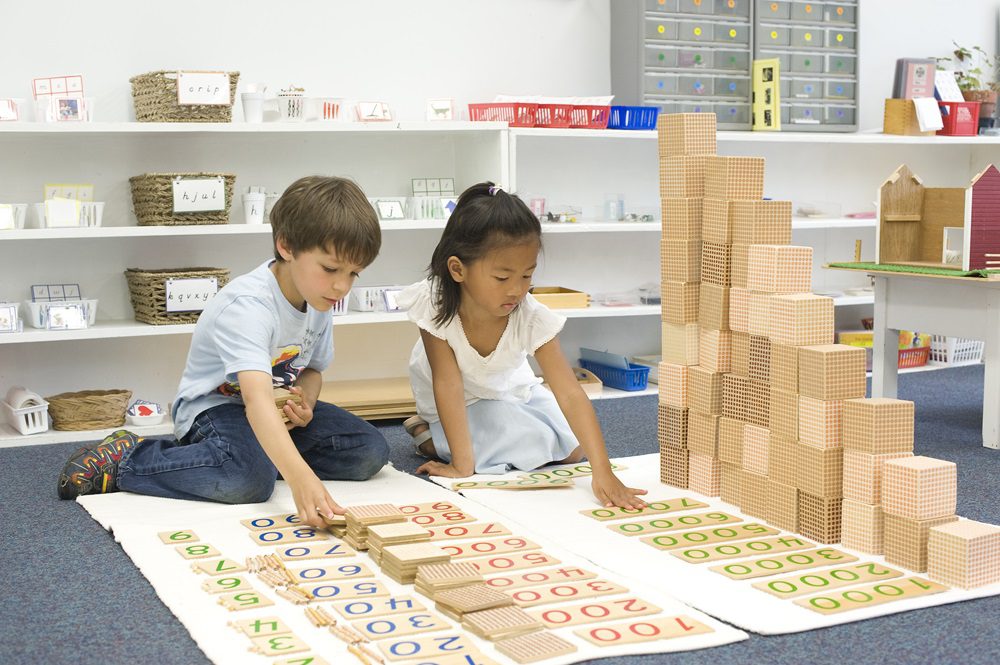
Montessori’s view was that there is exactness in mathematics and science, which gives our universe balance and beautiful symmetry. Realizing this is truly awe-inspiring for children! But instead of having this phenomenon of exactitude dominate the whole educational approach (by trying to stuff answers into children’s minds), Montessori sought to awaken their wonder for exploration and to help children discover pathways of thinking that lead to correct answers. A prime example of this is the way elementary-aged children explore math through the specially designed materials that require several steps and attention to detail. The children ultimately arrive at the correct answer and are often quite satisfied with themselves after much effort; all the while, they are developing cognitive processes and character traits that contribute to future learning and problem solving.
…the very thing that makes society prosper is being discouraged on a daily basis in our conventional school model.
Discovery and Ownership
Through the materials and how they are presented by the trained teacher, Montessori children in an Elementary classroom search for the paths to find the true answers; when they get there, the results are their own discovery, just as if they were the first mathematicians to discover them. The result of this repeated experience makes children view mathematics as the wonderful puzzle that it is. The idea of being embarrassed at arriving at an incorrect answer is foreign to these children, for whom the taste of finding the right answer is so sweet that they want to explore other avenues and learn more. Mistakes are integral steps in every journey, and this reality becomes familiar and acceptable through repeated experience.
The Montessori materials guide children to find the ways that work, making the adult corrector obsolete in many cases. For instance, when two children do long division problems together with a material called Racks and Tubes, there are many places they might err. They could start off incorrectly by placing the tens board to the right of the units and work through the whole problem incorrectly, only to find at the end that their answer is incorrect (either by bringing it to an older friend who can do the problem longhand on paper, to the teacher who can check it, by using another math material to do the inverse problem and see if it matches, or by checking it themselves against a calculator).
They go back to their work—puzzled—and like two detectives, they re-examine how they set up the problem (which is often when they will identify this first mistake), or they employ a friend to see if they can identify where they may have lost the path. In my experience as a Montessori Elementary teacher, this is when the fun really begins if the adult supports an attitude of curiosity about finding the error.
Children will repeat a problem over and over, sometimes eliminating just one of several mistakes at a time in the same math equation or process. The important thing is for the teacher and community to support the quest to get to the end, so that the children do not fall into a habit of giving up too easily or repeat making the same mistake so many times that it gets ingrained! By keeping tabs on their progress, the teacher can see when to step in and point children in the right direction, perhaps making an observation and/or asking a question: “Oh! Wait, I see—look where your units board is. Do you remember where it belongs?” This is usually all that is needed to get an “Ah-ha!” and a delighted, re-energized effort to try the whole thing again. Children are remarkably resilient, especially when working with a friend and being allowed to own the whole process of the math equation. When they finally, leaning over the calculator with suspense, find that they have achieved the correct answer by their own efforts, it is an excited triumph that feeds the urge to tackle more and more problems.
Very rarely have I seen children want to get to the answer easily so they can quit. There are some who will be tempted to use a calculator to find the answer and just write it in, sometimes several times, to create the illusion that they have accomplished a lot of “work.” You may be surprised to hear that in a Montessori environment, that is the exception and not the norm. Teachers usually catch that pretty quickly, but even if they didn’t, and even if other children did not point to it and demand that the child work honestly and just as hard as them, the child who does this often abandons the practice after watching others glean the internal rewards of sustained efforts and true glory of finally getting that answer.
As children experience this quest again and again, they hone their skills each time. Eventually, the exercise becomes too easy for them, and they are ready to advance to another math process that brings them to their next level of challenge.