By now, I hope you have all taken just a few moments to open your Montessori Family Alliance (MFA) account. Ask your school administrator for the link so that you have access to “The Montessori App,” where you can find everything you are looking for right on your phone, your computer, or your tablet.
Wit & Wisdom: A family chat! is broadcast on the last Wednesday of each month from 8:00-9:00 pm ET on Zoom. Topics include: strong-willed children; family communication; a candid conversation with a former Montessori family; financial literacy for children; and much more. It’s free!
Many of our member schools are offering “The Parenting Puzzle: Peacing It All Together” at their schools to help them translate the secrets of Montessori classroom leadership into Montessori homelife leadership. Ask your administrator when your school will be offering it.
Connect with your fellow Montessori families and schools around the globe.
Encourage your school leaders to capture important moments, fun events, school milestones and anniversaries, student trips, etc. by sharing high-resolution photos (with permission to publish). We just need your school’s name, location, and a few words about the event.
You can also send us a brief, real-life story with permission to publish along with high-resolution photos. Your story could be an “ooops” that didn’t work (lesson learned) story, a funny anecdote (here’s what happened on the way to school), a story about how you and your child worked on a project together, or any other story related to home or school life.
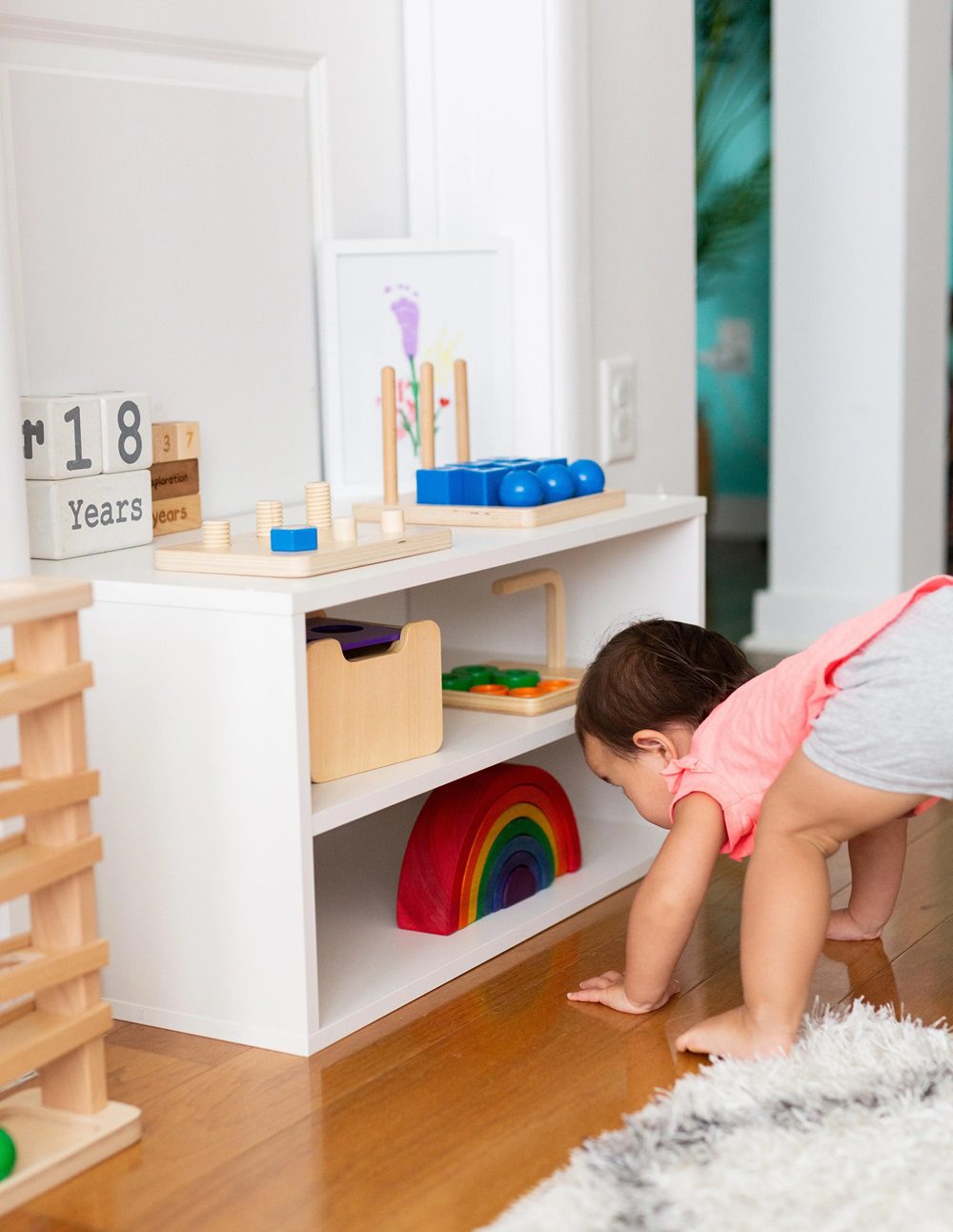
If you have poked around on the internet looking for information about Montessori homes or schools, you have come across the term “Prepared Environment.” The Prepared Environment is any space that is designed to maximize the experiences of the people who use the space. So, a Prepared Environment can be a classroom, a bedroom, the kitchen, dining, living, backyard, park…really any space. We use the term “Prepared Environment” to emphasize that these spaces are deliberately designed and the items in that layout are intentionally chosen.
When it comes to spaces for children, a Prepared Environment has a balance of opportunity and safety. Many companies market tools and gadgets to parents, appealing to their desire to create a safe home with educational experiences. It can be difficult to navigate the marketing and understand what experiences are best for your child and what items will help you create a safe home. Questions to ask, when preparing your home and routine for your child, are: Does this space allow for the freedom of movement that your child needs? Is it free of obstacles to development?
When we ask these questions, we learn what hopes and fears are guiding our parenting choices. Many parents ask:
Should we use baby gates?
When needed, yes. If you are using the gate to maximize independence and movement yet keep your child safe from using the stairs or reaching the stove (as just a couple examples), then yes, use baby gates to create a safe home. However, if you are using baby gates to keep your child from participating in family life (such as helping in the kitchen, independently washing their hands, or choosing activities to play/work with), then you may want to rethink how and why you are using baby gates.
Does a harness allow my impulsive child freedom when we go for walks?
One product that is marketed to parents with the promise of allowing freedom of movement is a harness. A harness gives both the parent and the child a false sense of security. Using a harness can send the message to your child that they are not trusted to explore, that you will control their body and keep them from logical consequences, and that, ultimately, you are in control of their body and they are not. For the parent, you may feel you are allowing your child to explore, but, instead, you are controlling their movement. You are keeping them from developing the skill of learning when and how to stop their own body. Using a harness also does not allow children to experience the capabilities of their bodies.
I understand that, when it comes to safety, it seems that controlling them is the best way. Rather than controlling their body in this way, you can, instead, choose experiences that they are ready to handle. One of my children, when young, was impulsive and would not look before ‘taking off.’ Rather than controlling their body, we changed our patterns to have outdoor experiences where our child could safely practice walking next to us, holding a hand, and then, eventually, just be by our side. We would go to a park or a small market to practice. And until our child understood the expectations and could not be as impulsive, we avoided large, busy parks and busy streets. This was a short period of time, but we dedicated our outdoor time to helping teach this skill, and then we were able to take our family on walks again.
When we see our child as not being able to handle the freedom, our reaction is usually to “lock it down” rather than take the small steps to help us get there. Sometimes our own agendas, busy schedules, or plans get in the way of taking the time children need to learn and understand their bodies and control of movement. The truth may be that a trip to Disney World is not what children can handle when they are in this phase. Rather than see it as denying them the opportunity to experience the magic, you can see that you are supporting their need to understand their bodies and all they can do with them!
Should I use “baby locks” on my cabinets?
When we describe a kitchen that welcomes all family members to take part in food preparation, we recommend having snacks that are accessible and child-size dishes and tools that your child can reach. When you take the time to prepare cabinets with your child in mind, you do not need to use baby locks on these cabinets. Make sure to limit the snacks available to the amount you want your child to eat in a day. When you have dishes and tools available, only make accessible what you have shown children to use safely and have observed them repeat the safe use. For more on this, my book First Foods to Family Meals explains how to create an accessible kitchen and how to prepare food preparation activities.
For cabinets with cleaning supplies and other items that pose a safety hazard, locks are the appropriate limit. When we create spaces that invite a child to take part and also learn limits, we are creating an environment that gives honest feedback. It is OK for your child to learn that not everything they can reach is for them. Additionally, they learn that there is usually a way they can participate safely.
These are just a few examples of how we can remove obstacles to a child’s freedom to move, all while creating safe spaces and experiences. It is through freedom of movement that a child learns controlled, refined, and purposeful movement guided by choice. As you prepare spaces and routines to include your child, remember there is a balance to offering freedom and maintaining safe and consistent spaces.
Follow @familyfriendlyhome for more information on preparing your home, or visit familyfriendlyhome.com.
Sarah Moudry is an education innovator whose work is focused on creating education environments and experiences that inspire growth and joy. Her work is rooted in Montessori philosophy and paired with her extensive experience as a designer. She is a guide at the NewGate school in Sarasota, Florida.
Recently, her projects include the founding of Studio June, a Montessori parent and child education center, and Family Friendly Home, an interior design company that creates inspirational home and school interiors.
Sarah’s most recent book, First Foods to Family Meals (2019), provides parents a Montessori grounding to help them include their children in preparing food at home. Sarah has created online courses that help parents, childcare professionals, and grandparents to incorporate Montessori theory into their lives.
Sarah has an M.Ed in Montessori education, a B.S. in environment and design, AMI Montessori certification for birth to six years, and is an Associate Member of ASID.
Dr. Montessori observed that children are intrinsically inspired to exert great effort when their work is purposeful. Through close observation of a child in action in a Primary classroom, we can see how Montessori fosters perseverance.
In the Montessori approach, “work” is not a dirty word; it’s a glorious word. For children, real “work” is to form their own unique human being in the world through everything that they do and everything in which they engage. Think of how you feel when you are fully immersed in something you love to do. It could be polishing your antique car, fly fishing, writing a poem or a speech, solving a math equation, or helping a client. If you have work that absorbs you in such moments, then you understand that inspiring work feels good to children, too. Of course, children do not think of their actions as work, but Montessori proposed that what children do should be respected as their work.
The task of infants is to build a person, so that they are fully engaged in kicking their legs and making sounds, delighting in it, concentrating on it, and going on with it even when it takes effort. And here is a primary reason that Montessori is so timely for today’s youth: when we have found some piece of work that engages us fully, effort is a friend that helps us persevere. With the Montessori approach, children develop an attitude that effort is a friendly, natural part of any learning process. This is because effort is built into every activity at school that leads them into flow.
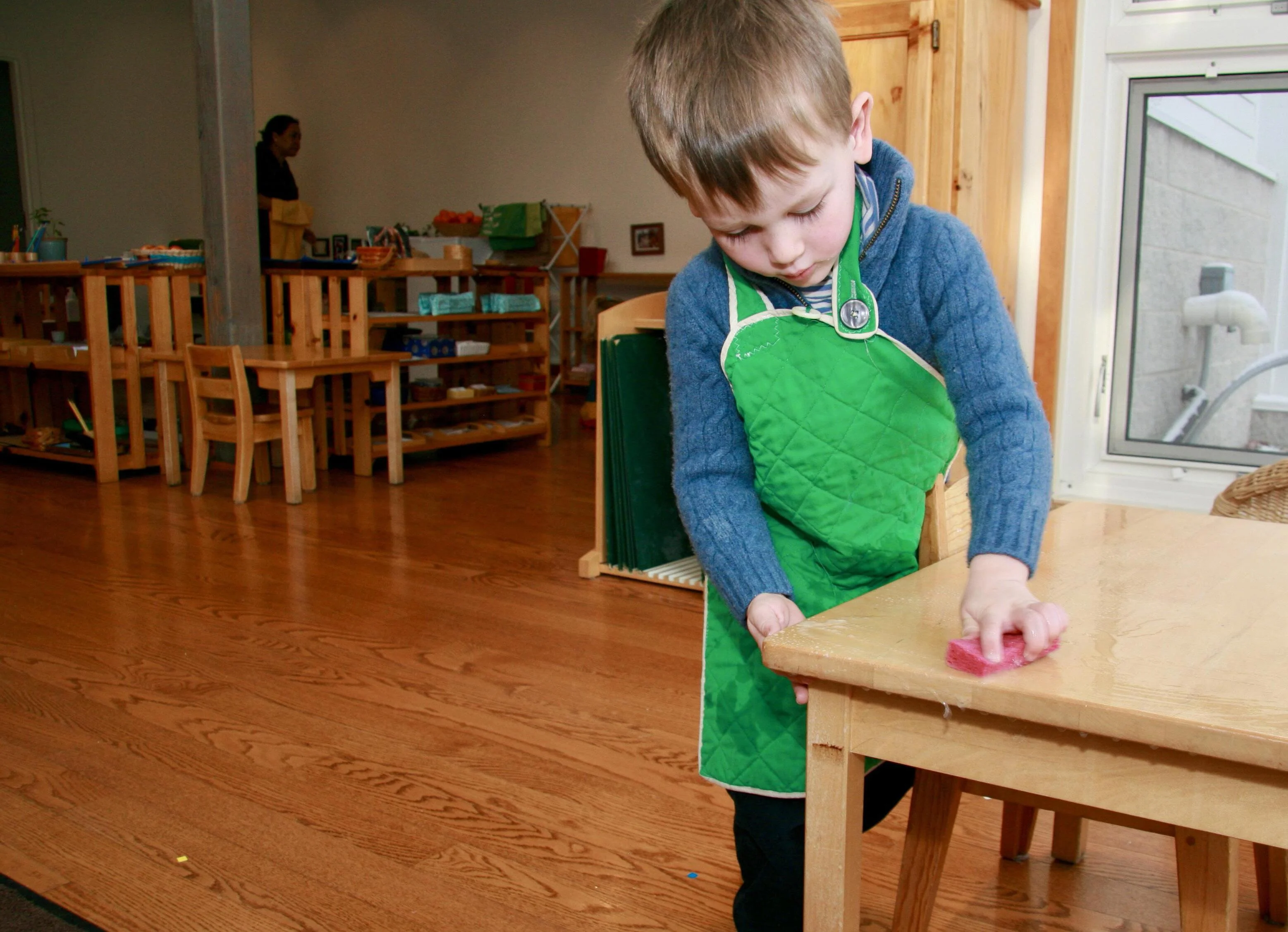
In a Primary classroom, I watched a four-year-old boy wash a table with such gusto and flourish that he seemed completely unaware of the other children walking past him and talking. He did not seem to hear the bells a child was playing on the far side of the room; the water splashing in the sink as another child filled and refilled his bucket just five feet away; the classroom door opening, a child entering, the door closing again; or a girl tap-tap-tapping her feet while she was counting out loud at a table three feet to his left, adding four digits numbers with a bead frame. All this and more were swirling around him, and he was bent over his work, apron hanging down and wet with water, making big, round motions with his arm as he scrubbed the surface of the wooden table. His long curly bangs were swinging over his brow, the shoelaces of one shoe untied and lying on the floor while he rocked forward and up on the balls of his feet to reach the far side of the table, one hand flat on the table to support his weight.
The boy paused when he had made the soapsuds cover every part of the table surface. He stood upright, took a step back, brushed his dark curls from his face with a wet forearm holding the child-sized scrub brush, glanced up at the child sitting near him, and just as quickly bent over his floor mat to his right with all the table washing materials laid out on it: sponge; soap dish with soap bar in it; a washcloth for drying; a tiny bucket half filled with water. He rubbed the scrub brush on the soap bar, stopped and looked at the bristles, re-wetted them in the bucket, and rubbed them on the soap again (quite firmly). When he noticed suds building, he paused again, glanced at the underside of the brush, and went back at it with the table surface.
He scrubbed and scrubbed, moving his circular motions around to cover the entire surface again. This repeated and went on for a good 15 minutes.
Beads of sweat formed on his forehead and his hair started to stick. He seemed unaware and unfazed, completely absorbed in his whole-body movement. Then he put the brush on the floor mat, squatted down, took the sponge, and started wiping the table in smooth, long swipes from one side to the other, eventually removing most of the suds. He bent over and plunged the sponge into the water bucket, and at that moment, another boy came over and said something to him. He smiled up at him, then looked back down and squeezed the sponge out with both hands, and the other boy walked away. He stood straight up, looked after the other boy for a moment, then watched the water dripping into the bucket from his sponge, long, slow drips. He looked pensive, watching…then squeezed the sponge out with more force, watched, then started wiping the table again.
He stopped after a while and sighed, stood up, and noticed a girl walking by with a tray of flowers. He then dried his table with the dry washcloth and quickly cleaned up the things on his mat, returning the water from the bucket into the child-level sink and taking the scrub brush over to the sink and rinsing it with a gushing stream of water (it dripped from his hand the whole way back to his mat but he did not notice this). He squatted down to his mat and put the sponge, dish with soap, and scrub brush back into the little bucket. He then paused and pulled them all out again.
He wiped the bottom of the bucket with the towel, walked across the room to drop it into the hamper, and retrieved a fresh towel from the shelf. He then walked back to the mat and, again, put each item into the bucket, with the folded towel on top. He carried the bucket by the handle— swinging it slightly as he walked—and placed it back on the shelf. He returned and rolled up the mat, stood, and then suddenly slowed down, straightened himself upright, and carried the mat ceremoniously towards the shelf with a tall posture, holding the rolled mat like one might a flagpole in a parade. He concentrated on his steps as he walked very slowly with dignity back to the shelf, returning the mat to its designated place and walking away with a relaxed and refreshed expression on his face.
Such episodes repeat throughout the day in a Montessori Primary classroom. This is a good example of how a child organizes thoughts and motions with a sequence of actions, integrating will, decision making, and body movements (both gross-motor and small-motor skills of fingers) while exercising care for materials and the environment. Children use such exercises to satisfy their craving for purposeful work: not of the work of washing tables per se, but the deeper work of building all the cognitive and physical aspects of their personalities. Dr. Montessori pointed out that young children need these organizing activities that have real purpose and connection to community life to build themselves through.
The effort and focus that rose out of this determined activity was that of the child; childern can measure and respond to the level of effort they feel rising in them during the activity and adjust and work with that sensation of effort. It is completely unadulterated and not manipulated or created by an outside force; it comes from within that individual child. So, effort is a different experience than the one we deliver to children when we give them an assignment. Accomplishing specific tasks, later when asked to, is something our Montessori children can willingly do with confidence because of such numerous experiences they have had of flowing with effort by their own accord.
These simple Practical Life activities (such as washing, cleaning, and arranging) lay the foundation not only for effort but for the organizing of thoughts as a child experiences sequences of actions and their outcomes in all their stages. Montessori uniquely employs such activities as the building blocks for thinking and doing. They deliberately and precisely set the stage for mathematics, language arts, and all the child’s intellectual and physical work to come. Simultaneously, our children’s healthy approach to effort translates into resilience and perseverance that will distinguish them in their later years.
Paula Preschlack is a writer and a speaker. She has spent 25 years as a teacher and the head of school at Forest Bluff School. She just released her first book about Montessori education, The Montessori Potential. Paula Preschlack has given over 100 talks at Forest Buff School and at other Montessori schools, teacher training courses, and conferences. Her work focuses on the principles and successes of the Montessori approach, learned from over 25 years of teaching and observing children from birth to adulthood.
Paula is a graduate of Hampshire College and has a master’s degree in education from Loyola University, Baltimore, MD. She is AMI certified for all Montessori age levels: Assistants to Infancy, Primary, and Elementary, and she audited the NAMTA/AMI Orientation to Adolescent Studies in 2018. Paula is married to Jim Preschlack and has two children.
“Mommy, why are there no more dinosaurs in the world today?” “Where do potatoes come from?” “Why is the sky blue?” If you’re a parent, such questions are a daily dose of wonder, but have you ever really considered how these everyday questions are connected to an expansive concept of the world?
Montessori education prompts children to connect the dots. You might have heard of ‘Cosmic Education’ during parent-teacher meetings or casual Montessori chitchats. Sounds a bit odd, doesn’t it?
At its heart, cosmic education is all about emphasizing the interconnectedness of everything. Dr. Montessori saw science and history as two lenses to view the captivating tale of our universe’s continuous unfolding.
It’s not just a fancy term or a subject in the Montessori curriculum. It’s a holistic approach that blends subjects like astronomy, chemistry, and biology. The aim? To stoke the embers of curiosity in our children and show them the magnificent web of life, where everything has its unique place.
From Potatoes to the Universe: It’s All Connected!
Mario Montessori wrote about his grandmother (Maria Montessori) and the concept of Cosmic Education in his book, Education for Human Development. He reflected on how his grandmother could effortlessly tie present moments to distant past events. Picture this: She’s peeling potatoes and, out of the blue, starts pondering about humankind’s journey of discovering the potato. A simple veggie makes her wonder about ancient civilizations and their agricultural practices!
Her unique gift was to make such connections, laying the groundwork for Cosmic Education. This allowed for merging the past with the present, making everyday activities feel like epic tales.
Think about how peeling potatoes could lead to tales of the potato’s journey from the New World to European dining tables. That’s the Montessori magic!
Swimming with the Salmon: Every Story Has a Lesson
Maria Montessori prompts us to ponder the salmon’s life cycle. These fish are born in freshwater, venture into the vast ocean, and, against all odds, find their way back home. It’s a biology lesson and a narrative of nature’s balance and magic.
Cosmic Education gives such stories context, teaching children the beauty and complexity of our world. Everything has a story and purpose, whether a humble potato or a migrating salmon.
Humans: The Cosmic Contributors
While salmon follow nature’s script, we humans can write our own. We can reach for the stars or recklessly consume our planet’s resources. Montessori’s Cosmic Education emphasizes our unique cosmic task: to cherish and protect our home.
More than Just School Lessons
Montessori’s Cosmic Education is more than just school lessons; it’s a philosophy. It’s about seeing the bigger picture, understanding our role in the universe, and acting responsibly. Children are not passive vessels to be filled with knowledge; they are young explorers hungry to understand their place in the cosmos.
Traditional education often starts with details, moving from basic concepts to the big picture. But Montessori flips this. Why? Because children are naturally curious about the universe, the stars, and the history of the world.
Once they see the grand tapestry, they’re eager to explore each thread.
For instance, instead of merely teaching kids about plants, Montessori education might start with the story of how the world began. Rather than giving them the right answers, a Montessori teacher will ask students to think about how they imagine our universe might have come to be. Some children may know the story from Genesis. Others may express a simple version of the concept of the Big Bang. Other ideas may include the concept of an oscillating universe that contracts and expands.
Montessori teachers tend to inspire a sense of wonder and nurture children’s curiosity and imagination.
For example, many years ago, we visited Wilmington Montessori School in Delaware to take photos for Tomorrow’s Child magazine. While there, we came across a wonderful lesson presented by one of their Elementary teachers. In a dark room, lit by the repeating flash of a strobe light, he popped a large black weather balloon filled with confetti and glitter, as he told the story of what scientists believe happened with the Big Bang at the beginning of the universe. The expression on the children’s faces, eyes wide and mouths open in surprise, they got a lesson that I am sure they remember to this day.
They were fascinated as their teacher described the concepts of all the atoms rapidly expanding away from the initial point of the Big Bang and swirling out into the distance, gradually forming stars, galaxies, planets, and the universe we know today.
My husband, Tim, is a Montessori educator. He often says that Montessori teachers ask children the right questions rather than give them the right answers.
I know that my children’s teachers offered them lots of information. But I also remember that the teachers didn’t tell them that there was one right answer. Their teachers encouraged them to question and look for alternative possible explanations but to always go to the best sources.
Montessori teachers tend to inspire a sense of wonder and nurture children’s curiosity and imagination.
So, in addition to learning how to read and write, clean a table, fold a napkin, sweep, and use a mop, they come away with some sense of the earth, the dance of the sun and the rain, and how it nurtures life. Once kids see this grand narrative, they’re naturally curious about the details: photosynthesis, the role of roots, and more.
Why Should You Care?
We often lose sight of the bigger picture in today’s fast-paced world, but our children need to grow up with a broader vision, understanding how things work and why they matter. They need to realize that every action, no matter how small, has consequences in this interconnected world.
I’ll never forget the day my four-year-old daughter announced that she had figured out where hamburger came from and refused to ever eat it again. For many years, she was a strict vegetarian, and, forty years later, she still won’t eat meat. A few years later, she was writing the president of the United States and the government of Japan, pleading with them to work together to stop fishing boats from hunting whales. She knew whales were beautiful, intelligent creatures and couldn’t understand how anyone could deliberately kill them. She was an activist then and still is today in her career as a forensic psychologist.
As parents, we aim to prepare our children for tests, careers, and life. We want them to be responsible adults, aware of their impact, and driven by purpose. Montessori’s Cosmic Education lays the foundation for this holistic growth.
So, dive into the story the next time your child asks about potatoes, stars, or the buzzing bee. Connect the dots. The universe is a grand, beautiful tapestry, and every thread, including your child, has a role to play. Montessori’s Cosmic Education is the compass that can guide them through it.
Joyce St. Giermaine is the Executive Director of the Montessori Foundation. Her background includes a lifetime of work in association management, law, Banking, and institutional advancement. A lifelong learner, she is an accomplished photographer, editor, and graphic designer. Joyce is a former Montessori parent and grandparent.
“Many have written or spoken of what school should look like from a developmental perspective, but nobody created the complete developmental package that Montessori did.
The underlying assumption in traditional education is that every child in a class can get through the same amount of material within a nine-month academic year, and, of course, this is absurd! Everyone who’s been in a classroom knows that not every child will proceed at the same pace.
The task of education must change. Schools should foster children’s growth and development from the earliest years. It must be, in the deepest sense, brain developmental.
In the Elementary years, it must be about problem-solving and social development, working with other people, and thinking.
In the later years, it really has to be about motivation, mission, and purpose. What are your unique capabilities? What are your unique interests? What are you going to bring to the world that makes you something special?
Imagine a scene: It’s 8:30 p.m. on a Friday. Your 15-year-old daughter, attending a sleepover, rings you up. There’s a shaky edge to her voice. Her friends, experimenting with alcohol, have disappointed her. She’s taken a stand, voiced her discontent, and now she’s isolated. However, she has made a decision that reflects maturity, wisdom, and a robust moral compass.
As a parent, such scenarios might make your heart race. Yet, they underscore the inevitable truth that children grow up facing numerous crosswinds that challenge their convictions. These defining moments shape their identity and decision-making capabilities. As they transition into teenagers (and then adults), they grapple with crucial life choices: selecting careers; colleges; or even life partners.
The Montessori term valorization of the personality beautifully encapsulates this rollercoaster journey toward self-discovery and identity formation. To valorize means to recognize value. In the context of adolescent growth, it signifies recognizing one’s self-worth.
Understanding the Adolescent Transformation
When you look at your little ones, it might be hard to visualize them as angst-filled teenagers. However, adolescence is just around the corner, with its whirlwind of hormonal changes, emotional highs and lows, and thirst for independence. This period marks a gradual detachment from parental reliance, ushering in an era of peer influence and self-exploration.
Pause for a moment. Ponder over the values, traits, and ideals you envision for your child as they embark on their journey to higher education and adulthood. What are your aspirations for them? Jot them down. These reflections will serve as a guiding compass in your parenting journey.
The Montessori Edge in Adolescent Education
Traditional middle and high schools often miss the mark. Their vast size and standardized curriculums frequently alienate students, rendering them mere statistics rather than unique individuals with distinct needs and potentials.
Montessori offers a refreshing departure. Rooted in the philosophy of Dr. Maria Montessori, it recognizes the distinct developmental needs of teenagers. While academic excellence is pursued, Montessori places equal emphasis on socio-emotional growth, interpersonal skills, and character development.
When battling the internal chaos of their shifting identities, young teens often grapple with self-doubt and a yearning for respect. Montessori environments offer them a sanctuary where they’re not just students but adults-in-training, embarking on a voyage of self-discovery.
Valorizing the Young Mind
Every teenager seeks acceptance. Yet, societal constructs often leave them feeling undervalued and misunderstood. The Montessori framework fills this void. It is designed to support the process of valorization, helping them discern their unique strengths, passions, and worth. Montessori middle and high schools champion the adolescent’s quest for identity through a rich program of group activities, hands-on projects, and real-world problem solving.
Activities span beyond the traditional. Students are constantly nudged out of their comfort zones, from camping adventures to creative projects. These experiences bolster their self-confidence and hone their collaborative, communication, and conflict-resolution skills.
Montessori’s emphasis on valorization becomes the bedrock for nurturing resilient, self-aware, and compassionate adults. Fortified by their Montessori experiences, these young individuals are ready to face university life and equipped to navigate life’s intricate maze with confidence and grace.
As parents, our primary goal is to see our children flourish into responsible, empathetic, and confident adults. Montessori middle and high schools serve as catalysts in this transformative journey. By valorizing each student, they lay the foundation for lifelong success, ensuring our children are prepared for both the academic rigors of university and the broader challenges of life.
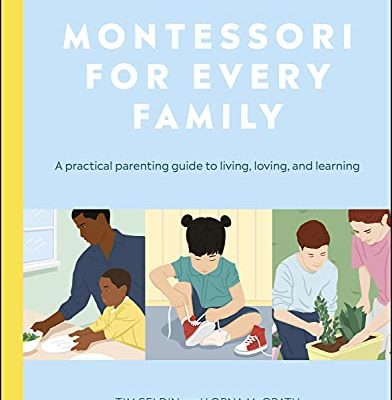
Tim Seldin is President of the Montessori Foundation and Chair of the International Montessori Council. His more than 40 years of experience in Montessori education includes 22 years as Headmaster of the Barrie School in Silver Spring, Maryland, his alma mater from toddler through high school graduation. Tim was Co-Founder and Director of the Institute for Advanced Montessori Studies and the Center for Guided Montessori Studies. He earned a B.A. in History and Philosophy from Georgetown University, an M.Ed. in Educational Administration and Supervision from The American University, and his Montessori certification from the American Montessori Society. Tim Seldin is the author of several books on Montessori Education, including How to Raise An Amazing Child, and The World in the Palm of Her Hand Look for his new book, Montessori for Every Family, co-authored with Lorna McGrath.
by Cassidy Eldredge, 2023 6th Grade Graduate, Bridgeview Montessori, Sagamore, MA
Bridgeview Montessori has been a big part of my life for more than eight years now, and it’s gone by so fast. One of my favorite things about Bridgeview is how this whole school is a community. It’s never awkward on the first day of school with new people. I’ve observed that, in the first week of school, we’re all comfortable with each other and already friends. And, unlike other schools, there’s rarely a day where I dread coming here; in fact, on many occasions, I’m excited for the day.
All these amazing people standing with me today have become great friends. We’ve all known each other since kindergarten, and each year, we become closer and closer. I don’t remember my first day at Bridgeview, but I do remember being so excited for Fridays. Every Friday, all the kindergarteners would come together, and Lucy, my teacher in the Red Room, often taught us a lesson. One lesson I remember in particular was learning how to read a clock. We all had these little pretend clocks, and Lucy walked us through how to tell the time. I didn’t really understand the concept, but little me was able to know exactly what time it was, if it was a quarter past one o’clock. My favorite part of Friday was how the kindergarteners got extra recess with Tiffany, our art teacher. We all would play together, and we played everything from tag to mermaids. We were such great friends then, and our friendship has grown stronger.
My third year was my most memorable year in Elementary I (Lower Elementary). I was finally a “big kid.” The year started out great. With so much responsibility, we were finally role models! We even had a great new teacher, Oona. Unfortunately, that didn’t last long… COVID… March 2020. Do I need to say more? And while I thought it was the end of the world, it wasn’t. I learned how to be patient while on Zoom and how to follow a schedule. Our teacher, Rebecca, even taught me how to play Scrabble™ on Zoom. And I often had math lessons with Oona. It was a hard end of the year, not being able to see my friends in person, but we still found ways to communicate. That was a hard trial, but in the Fourth Year, we reconnected as if Covid-19 had never happened. I’m not going to talk more about Fourth Year. It was a great year, minus all that mask and Covid stuff.
In science, I’ve learned so much about different kinds of ecosystems and all the food chains that occur in the Australian Outback. I also learned a lot about biomimicry for our last science fair project at Bridgeview. I never thought I could learn as much about polar bear paws as I did in these past few months. Just in this seemingly short year, I’ve also progressed a lot in math.
“Thankfully this isn’t the end, it’s just a new chapter in my life, and my time at Bridgeview Montessori has prepared me for it.”
I never thought I would be able to understand algebra, but my teacher proved me wrong. She helped me understand all the different parts of a problem, and while it may have taken a while, even negative numbers. One of my favorite activities this year was the Sixth-Year Sleepover. I would tell you more about it, but we promised our teachers, Sandy and Suzanne, that what happens at the Sixth YearSleepover stays at the Sixth-Year-Sleepover. We’ve also had many other field trips this year, including the Cape Cod Museum of Natural History, the Thornton Burgess Jam Kitchen, and many more fun activities.
Elementary II (Upper Elementary) has been one of my favorite years at Bridgeview. While a big part of it was the school and environment up here, an even bigger part of why I loved it so much was my teachers and classmates. To my teachers — thank you so much for helping me with any hard work, whether it be really explaining it to me to help me understand it or just telling me to read the instructions out loud. And, yes, that’s happened multiple times. Finally, thank you so much to our Head of School, who was also an amazing art teacher. You’ve helped me progress in art, which is important to me. And thank you for making my two last art classes ones I will never forget. I genuinely appreciate you letting us sketch and make potato art. I thank you all for being such patient, caring teachers, ones I will miss very much at my new school.
To my fellow Sixth-Year classmates — you are all wonderful people, and I will miss you. I’ve gotten to know all your fun and caring personalities, and I’m thankful that I was able to spend all this time with you. So, thank you to all my current and previous teachers and classmates.
If there’s one final thing I’ve learned at Bridgeview, it’s that change can be a good thing. Whether it be going from the Lower to Upper Elementary class or going to a new school, my teachers have taught me to be excited for a new opportunity. Thankfully, this isn’t the end, it’s just a new chapter in my life, and my time at Bridgeview Montessori has prepared me for it.
We have been involved in Montessori research for over two decades and welcome this opportunity to summarize some recent developments for Tomorrow’s Childs.
We both contributed to the recently published Bloomsbury Handbook of Montessori Education, a comprehensive reference containing an entire section on the “Science of Montessori Education.” With 62 chapters, more than 600 pages, and almost 100 authors from more than 25 countries, we know the handbook is not something most folks will read cover to cover. In this issue (and subsequent articles), we would like to highlight some of the research it contains.
Let’s look at some of the questions we often hear.
Q: Does Montessori education work?
A: The most common question we get as Montessori researchers is, “Does it work?” While giving a one-word answer is impossible, evidence supporting Montessori education continues to grow. A chapter in the Handbook discusses the challenges of conducting rigorous research on Montessori education, summarizes global evidence, and concludes that current studies largely demonstrate Montessori’s efficacy in promoting academic outcomes, executive function, and socio-emotional skills (Manship, 2023).
Two recent articles that formally reviewed current research support these findings. One article found Montessori education more effective in developing cognitive abilities, social skills, creativity, motor skills, and academic achievement (Demangeon et al., 2023). Another concluded that Montessori education produces more positive results for general academic ability (math and language), inner experience of school, executive function, and creativity (Randolph et al., 2023). One of the authors concludes, “Montessori education has a meaningful and positive impact on child outcomes, both academic and non-academic, relative to outcomes seen when using traditional educational methods” (p. 2).
Q: How do Montessori teachers track progress?
A: Assessment is a term that many Montessorians shy away from because they associate it with standardized testing. However, parents and policy-makers often ask how Montessori teachers know that their students are learning. The Handbook’s authors describe Montessori assessment as familiar to outsiders, saying it is student-centered, intertwined with instruction, based on observation, and informs a holistic picture of development carefully documented by teachers (Zoll et al., 2023). To keep all students optimally challenged, Montessori educators engage in this kind of classroom assessment daily to ensure they know where each of their students is within the individualized curriculum.
Q: Does Montessori education support social-emotional learning and other developmental outcomes?
A: Researchers are examining Montessori principles associated with nurturing social (or socio) emotional development and learning. Skills include being aware of one’s own emotions, managing one’s emotions (especially when they are strong), understanding others’ emotions, demonstrating kindness, and offering support when others are experiencing strong emotions (Crowder, et al., 2019). In the handbook chapter on the efficacy of Montessori pedagogy, Manship (2023) reported that young children in Montessori programs scored higher on social problem-solving tasks, demonstrated more positive playground behaviors, and had an increased ability to understand the perspectives of others. Manship also cited research findings that Montessori-educated children expressed greater creativity than same-age peers in traditional preschool settings in both the U.S. and France. Other areas where positive impacts of Montessori education were evident include social maturity and reduced anxiety in Elementary students. Manship concludes, “Overall, the evidence that the Montessori method is effective at supporting social-emotional and other outcomes supportive of learning is notably consistent” (p. 214).
Q: Is Montessori education outdated?
A: Since Montessori education has been around for more than 100 years, skeptics often assume it must be outdated. On the contrary, modern science is discovering new ways to demonstrate how and why the Montessori approach continues to serve children so well today.
Neuroscience. Two European authors summarized their neuroscience work in Handbook chapters. Fabri (2023) connects current neuroscience to Montessori’s ideas about critical periods, the importance of the environment, the role of emotional stimulation, the process of language acquisition, and the impact of movement on learning. In her chapter, Denervaud (2023) describes how she uses measures of behavior, brain structures, and neural responses to show that Montessori students are better able to detect and self-correct errors at an early age. She concludes that Montessori students have a healthier relationship with making mistakes when compared to students from traditional schools, likely because the approach encourages learning from errors rather than avoiding them.
Executive Functions. Cognitive science and quantitative psychology are other modern fields offering evidence that Montessori education is relevant today. Specifically, Mallett (2023) describes how Montessori education supports the development of executive functions by offering students regular opportunities to practice executive functions, scaffolding executive function skills, having a holistic focus that includes socio-emotional learning, and offering a differentiated curriculum with significant student choice and active learning experiences.
Intrinsic Motivation. The handbook chapter authored by Lillard and her graduate student Basargekar (2023) explains how interrelated elements of Montessori practices reflect current theories about the development of intrinsic motivation. Recommendations for fostering intrinsic motivation are organized around themes that are clearly found in Montessori classrooms, including autonomy (through student choice, classroom order, and teacher guidance), competence (through classroom organization, emphasizing embodied cognition, and offering interesting work), and relatedness (through teacher warmth, offering interconnected work, including three-year age groupings, and fostering an atmosphere of security and interrelatedness) (Basargekar & Lillard, 2023).
Q: What other research will be of interest to practitioners?
A: Montessori research continues to grow and address current societal issues and educational challenges. This section highlights recent articles of relevance to practitioners published in the Journal of Montessori Research. The journal is a publication of the American Montessori Society, launched in 2015 with support from the University of Kansas Libraries. Among the 60 blind peer-reviewed articles published to date, we discuss several that address the current state of Montessori education and issues of diversity, equity, inclusion, and belonging (DEIB) in the context of Montessori principles.
State of the Field, a comprehensive international census conducted in 2022, concluded that 15,763 Montessori schools operate in 154 countries today, with approximately 9 percent being government-funded (Debs et al., 2022).
In addition to obtaining a count of schools, the global study also undertook the ambitious task of identifying components of Montessori fidelity with broad international acceptance. These six elements emerged as essential aspects of Montessori education: clear evidence of the Montessori philosophy, mixed ages, trained teachers, materials, freedom of choice, and uninterrupted work blocks.
As the teacher shortage grows more alarming, supporting early-career teachers is essential. An elementary coaching tool designed by Murray, Daoust, and Mallett (2021) was reviewed by eighteen highly experienced AMS and AMI teacher educators. Teaching components identified as essential for high-quality Montessori instruction were organized into five areas: classroom leadership; philosophy and methods; presentations; the social/emotional environment; and professional behavior. The review resulted in a publicly available coaching tool containing 81 specific items that can serve as the basis of reflection by early career teachers with their mentors or supervising teachers. The authors state that the tool is designed for professional development, not performance evaluation.
Diversity, Equity, Inclusion, and Belonging, Lillard, Tong, and Bray (2023) continued ongoing investigations of racial and ethnic parity. Their study of 134 non-white and white preschoolers revealed that non-white children in Montessori settings scored significantly higher on indicators of executive function and social cognition, as well as early academics (literacy and math concepts), than their non-white peers in “business-as-usual” preschool programs, suggesting Montessori education’s potential to close the gap for historically marginalized children.
Public school teachers in Hawaii embraced the cosmic nature of Montessori learning to honor indigenous cultural components while addressing state-mandated Western science standards. A common holistic and relational worldview, beliefs based on observable facts and intuition, and recognition of the spiritual and scientific world working together emerged as themes in this qualitative study by Schonleber (2021). Teachers and school leaders purposefully incorporated Montessori principles into their teaching practices over a planned three year period. They noted the impact of timelines, emphasis on the natural world, and the Great Lessons in achieving their goal of creating a culturally restorative, decolonized science program.
Survey responses from 80 U.S. Montessori school heads regarding the inclusion of children with disabilities (CWD) confirm language and speech as the most frequently occurring disability among both infant/toddler and Children’s House learners (Long et al., 2022). Autism and attention deficit hyperactivity disorder were the next most frequently occurring disabilities, with emotional disorders least among infants and toddlers and motor disabilities least for primary children. CWD comprise 3.5 percent of infant/toddler communities and 8.5 percent of primary classrooms.
Teachers stated that while they feel fairly confident addressing children with disabilities’ needs, additional professional development regarding effective interventions is needed.
Q: Where does Montessori research go from here?
A: While it is exciting to see the progress in Montessori research over the past 20 years, more work remains. Evidence supports Montessori education’s effectiveness, but more large and robust studies are needed that will require significant funding.
We also need studies that will allow us to understand and communicate the mechanisms contributing to what is working.
Other significant challenges are emerging that require additional research in Montessori contexts, including understanding the needs of 21st-century families, development, and education in the digital age, navigating a plurilingual society, and many others.
Conversations about how we, as a society, address the challenges of educating today’s children are beginning to open the door to alternative approaches like Montessori education.
In a provocative piece entitled, “Why the Time is Ripe for an Education Revolution,” Angeline Lillard (2023) makes the case that it is time for a paradigm shift “away from teacher-text-centered learning and to highly structured instructional environments that support self-construction through limited free choice” (p. 1).
These conversations and the growing number of studies supporting Montessori education offer encouragement that Montessori educators will have increasing opportunities to serve a larger and more diverse population of children in the future.
The challenge will be meeting the demand for high-quality, experienced, and dedicated Montessori educators.
To learn more, check out the articles in the reference list and the research chapters in the Bloomsbury Handbook of Montessori Education.
The Handbook chapters referenced in this article and others in the “Science of Montessori Education” section are listed below.
Chapters numbers and authors from the “Science of Montessori Education Section” of the Bloomsbury Handbook of Montessori Education edited by A. K. Murray; E.Tebano Alquis; M.K. McKenna & M. Debs (2023) include the following :
18. “Revisiting the Foundations of Montessori Education from a Modern Neuroscience Perspective” — Mara Fabri
19. “A Logic Model for Informing Montessori Research” — Brooke Culclasure and Sally Morris Cote
20. “Fidelity Issues in Montessori Research” — Angela K. Murray and Carolyn Daoust
21. “Evaluating the Efficacy of Montessori Education” — Karen Manship
22. “Assessment in Montessori Education” — Susan Zoll, Laura Saylor, and Arya Ansari
23. “Neuroscience of Error Monitoring in the Montessori Context” — Solange Denervaud
24. “A Critical Consideration of Montessori Education and Its Relation to Cognitive Science and Concrete-to-Abstract Thinking” — Elida V. Laski and Muanjing Julia Wang
25. “Executive Functions in Montessori Education” — Jan Mallett
26. “Motivation and Self-Determination in Montessori Education” — Abha Basargekar and Angeline S. Lillard
27. “Montessori Education, Optimal Experience, and Flow” – Kevin Rathunde
REFERENCES
Crowder, M. K., Gordon, R. A., Brown, R.D., Davidson, L.A. & Domitrovich, C.D.(2019). Linking social emotional learning standards to the WCSD social-emotional competency assessment: A Rasch approach. School Psychology, 34(3), 281–295. https://doi.org/10.1037/spq0000308
Debs, M., deBrouwer, J., Murray, A., Lawrence, L., Tyne, M., & von der Wehl, C. (2022). Global diffusion of Montessori schools: A report from the 2022 global Montessori census. Journal of Montessori Research, 8(2), 1 – 11. https://doi.org/10.17161/jomr.v8i2.18675
Demangeon, A., Claudel-Valentin, S., Aubry, A., & Tazouti, Y. (2023). A Meta-Analysis of the Effects of Montessori Education on Five Fields of Development and Learning in Preschool and School-Age Children. Contemporary Educational Psychology, 102182. https://doi.org/10.1016/j. cedpsych.2023.102182
Lillard, A. S. (2023). Why the time is ripe for an education revolution. Frontiers in Developmental Psychology, 1, 1177576. https://doi.org/10.3389/fdpys.2023.1177576
Lillard, A., Tong, X. & Bray, P.M. (2023). Seeking racial and ethnic parity in preschool outcomes: An exploratory study of public Montessori schools vs. business-as-usual schools. Journal of Montessori Research, 9(1), 22 – 36. https://doi. org/10.17161/jomr.v9i1.19540
Long, T., Ferranti, N., & Westerman, C. (2022). Children with Disabilities Attending Montessori Programs in the United States. Journal of Montessori Research, 8(2), 16-32. https://doi.org/10.17161/jomr.v8i2.18639
Murray, A., Daoust, C., & Mallett, J. (2021). Designing the Montessori coaching tool elementary rubric for early-career professional development. Journal of Montessori Research, 7(2), 25 – 67. https://doi.org/10.17161/jomr.v7i2.15866
Randolph, J. J., Bryson, A., Menon, L., Henderson, D. K., Kureethara Manuel, A., Michaels, S., Rosenstein, d. l. w., McPherson, W., O’Grady, R., & Lillard, A. S. (2023). Montessori education’s impact on academic and nonacademic outcomes: A systematic review. Campbell Systematic Reviews, 19, e1330. https://doi.org/10.1002/cl2.1330
Schonleber, N. (2021). Using the cosmic curriculum of Dr. Montessori toward the development of a place-based indigenous science program. Journal of Montessori Research, 7(2), 12 – 24. https://doi.org/10.17161/jomr.v7i2.15763
Angela Murray is an associate research professor and graduate lecturer at the University of Kansas (KU), teaching courses in research methods and statistics. She is the director of the KU Center for Learner Agency Research and Action (CLARA), founding chair of the AERA Montessori Special Interest Group, founding editor of the Journal of Montessori Research, and lead editor for the Bloomsbury Handbook of Montessori Education. Dr. Murray earned her doctorate from KU in psychology and research in education, with a minor in cultural anthropology and was awarded honors for her dissertation, “Public Perceptions of Montessori Education.” She has published extensively on Montessori education and has presented on learner agency fostering pedagogies at numerous national and international conferences
Ann Epstein is a Professor of Early Childhood Education at the University of Wisconsin/La Crosse, where she directs the undergraduate ECE program. She teaches courses addressing Early Childhood language & literacy, special education, and kindergarten curriculum and assessment. Ann’s research interests include support for young children with disabilities and interdisciplinary teaching. Ann was a Montessori teacher with 3–6-year-olds before completing her doctoral studies in Early Childhood special education. She is the editor of Montessori Inclusion – Strategies and Stories of Support for Learners with Exceptionalities (2020) published by Parent/Child Press.
(a Montessori matching challenge for parents and students)
The Montessori School of Pensacola has been part of the educational community for 46 years! They provide programs for toddlers through middle schoolers on three campuses. During these many years of serving families and children, they have grown from a small preschool to over 200 students, purchased several different properties, renovated existing buildings, built new additions to their facilities, and survived Hurricane Ivan as well as Covid. They have continued to offer quality Montessori programs through many challenging years and are proud of their contributions to the Pensacola community.
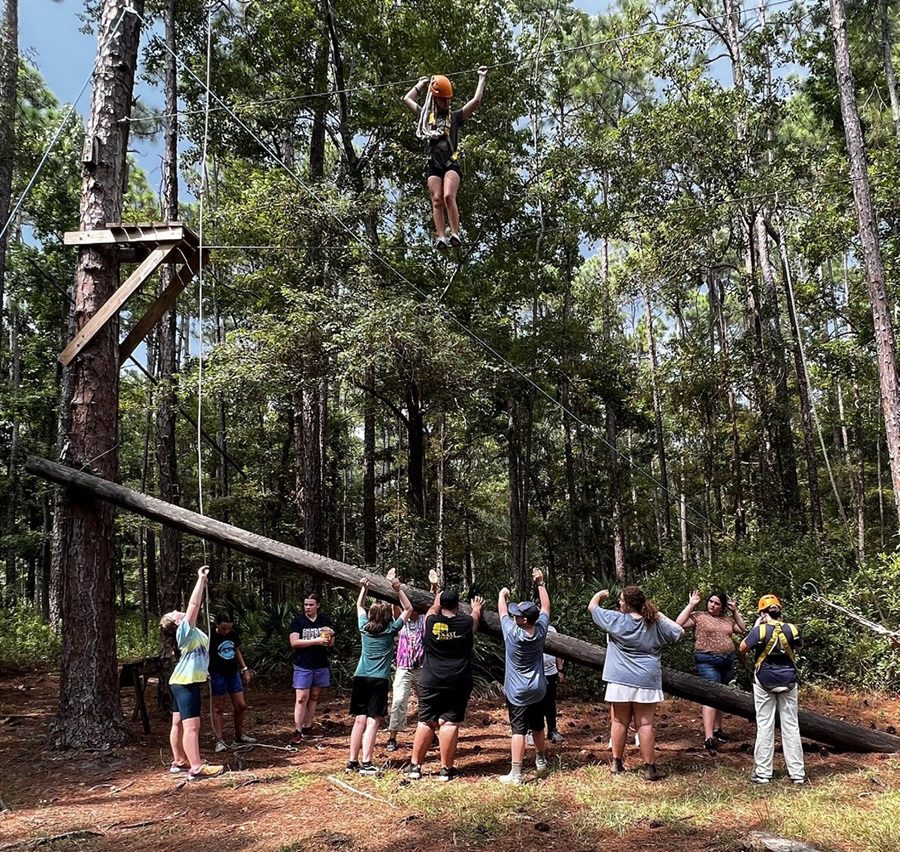
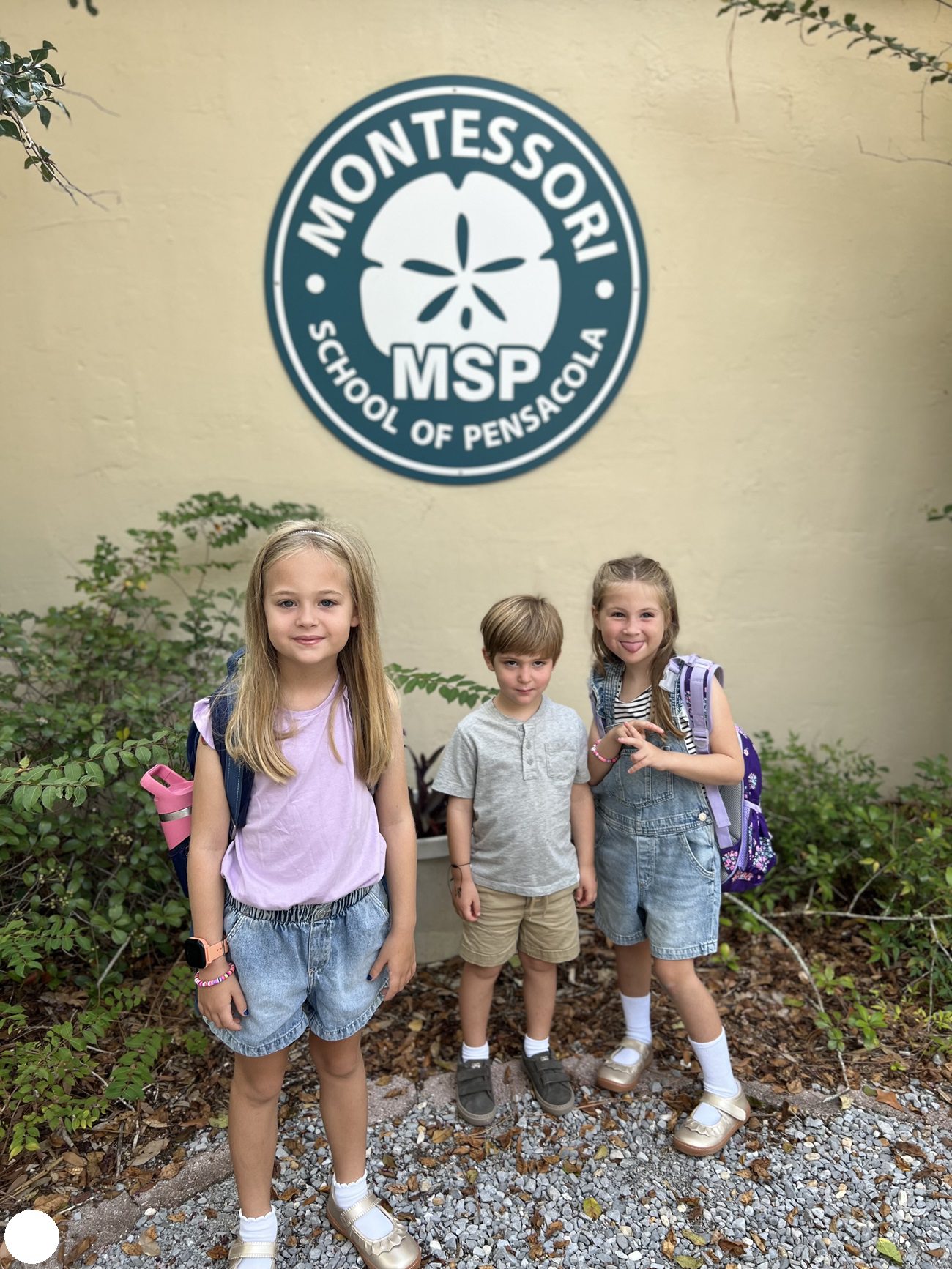
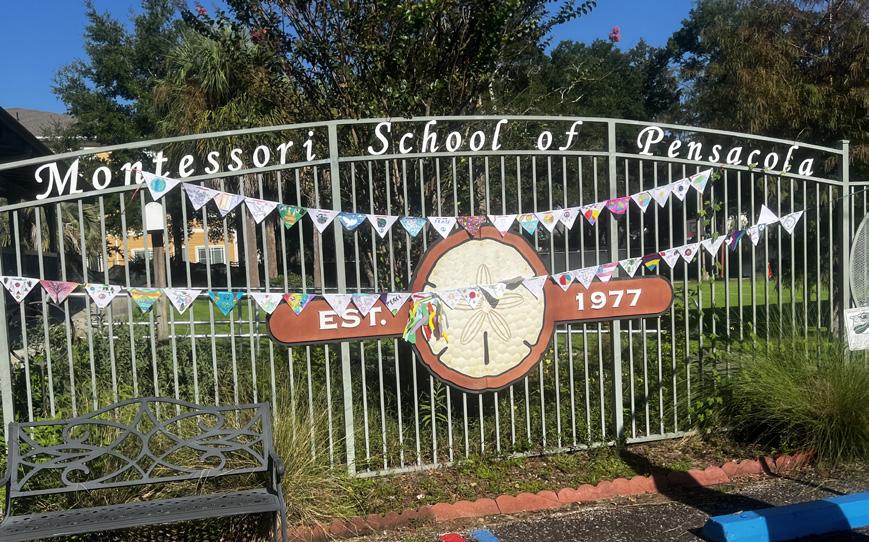
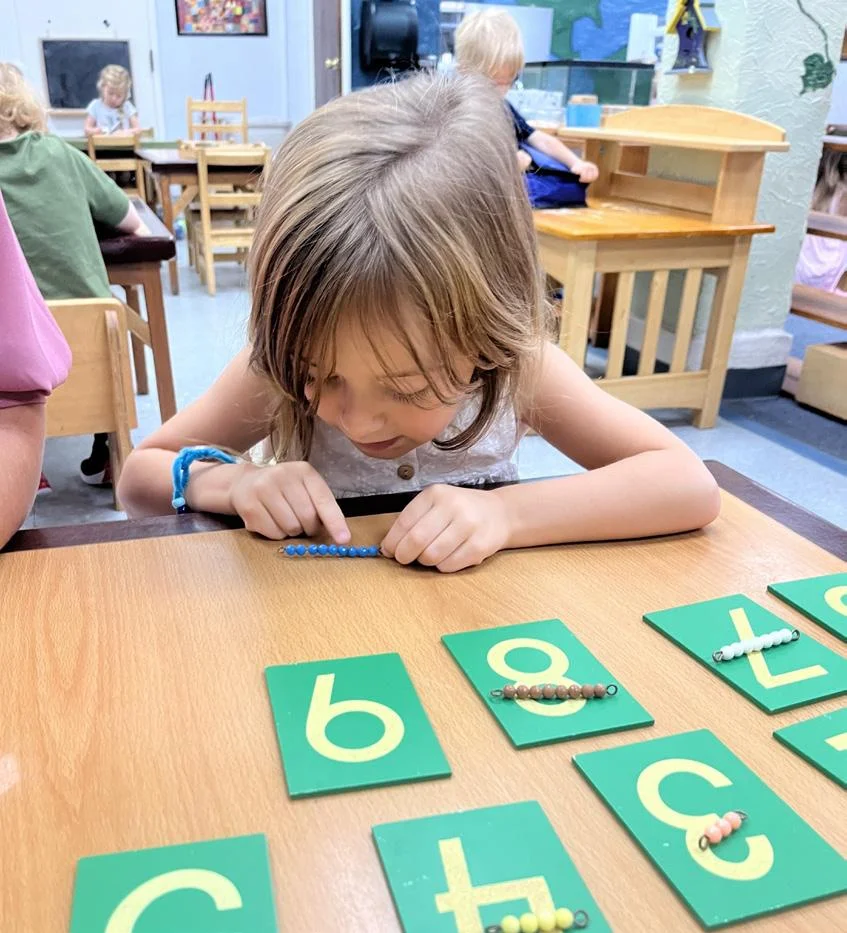
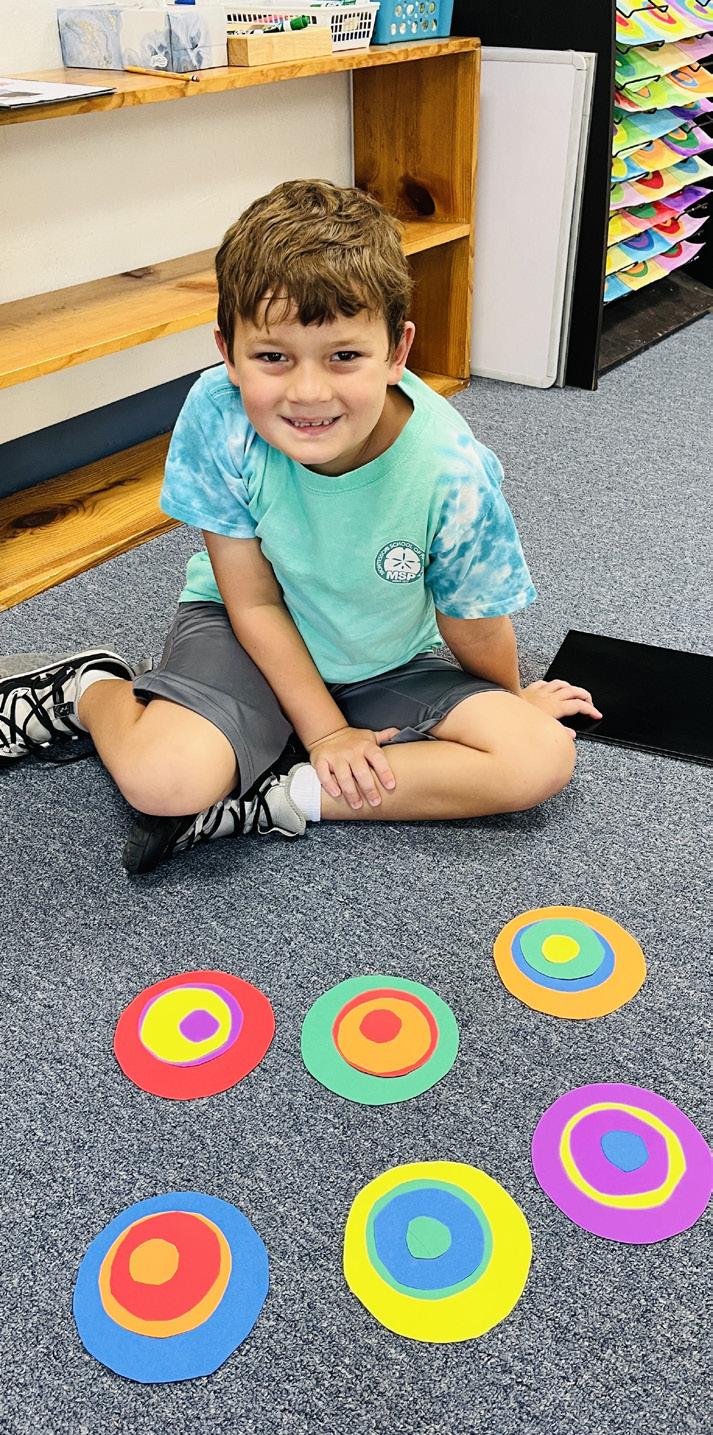
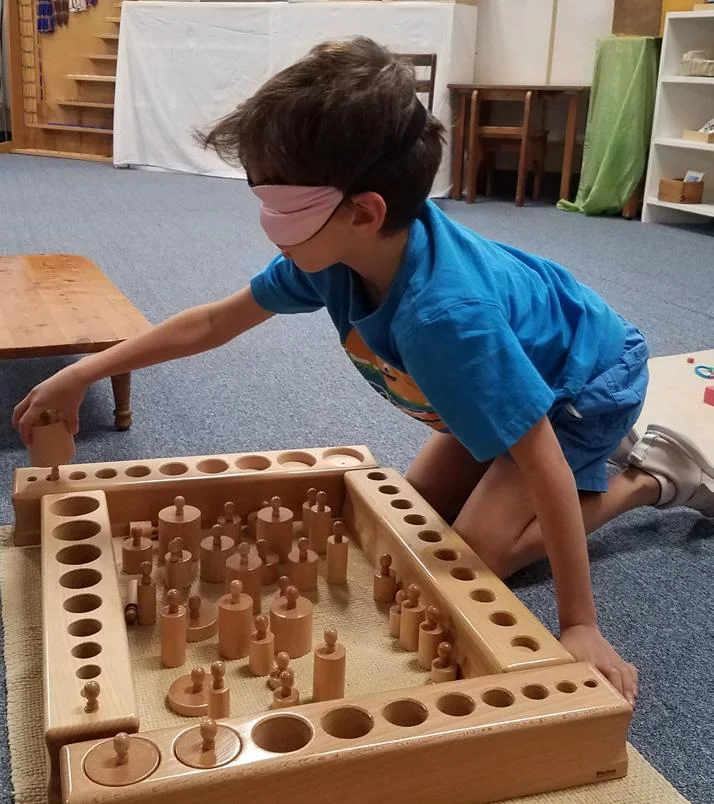
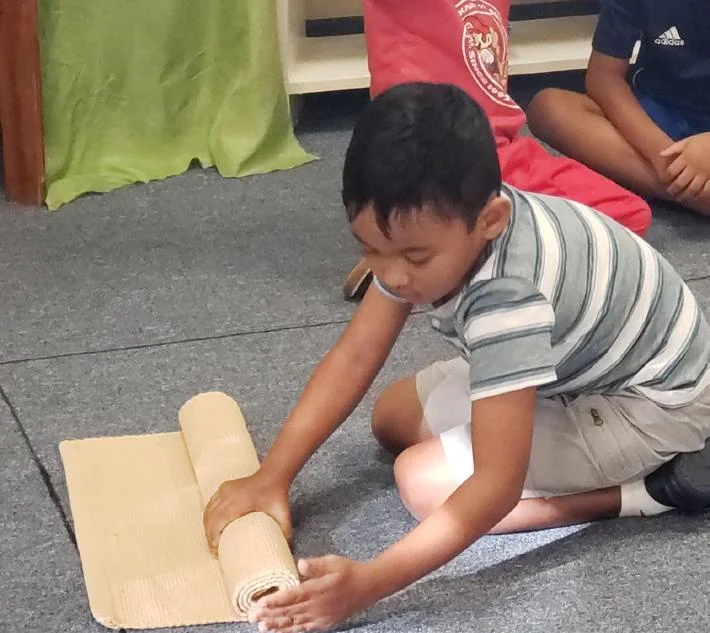
Here are just a few photos from the beginning of the 202324 school year at the Montessori School of Pensacola. Have fun with these photos. Try reading the caption and let your child find the matching photo. See if you and your child can figure out which photo goes with which caption. Enjoy!
1. The first day of school – 2023-24
2. An Early Childhood student doing a piece of math work, matching bead bars to numerals.
3. Middle School students at a local ropes course facility, building a strong foundation for the year.
4. Peace flags celebrating the International Day of Peace.
5. A Lower Elementary student creating art in the style of Kandinsky.
6. An Early Childhood student demonstrating how to roll work rugs so carefully.
7. Early Childhood student finding the matching hole for each knobbed cylinder while blindfolded.
Help your child develop independence in caring for self and their environment.
Age: When walking
Materials:
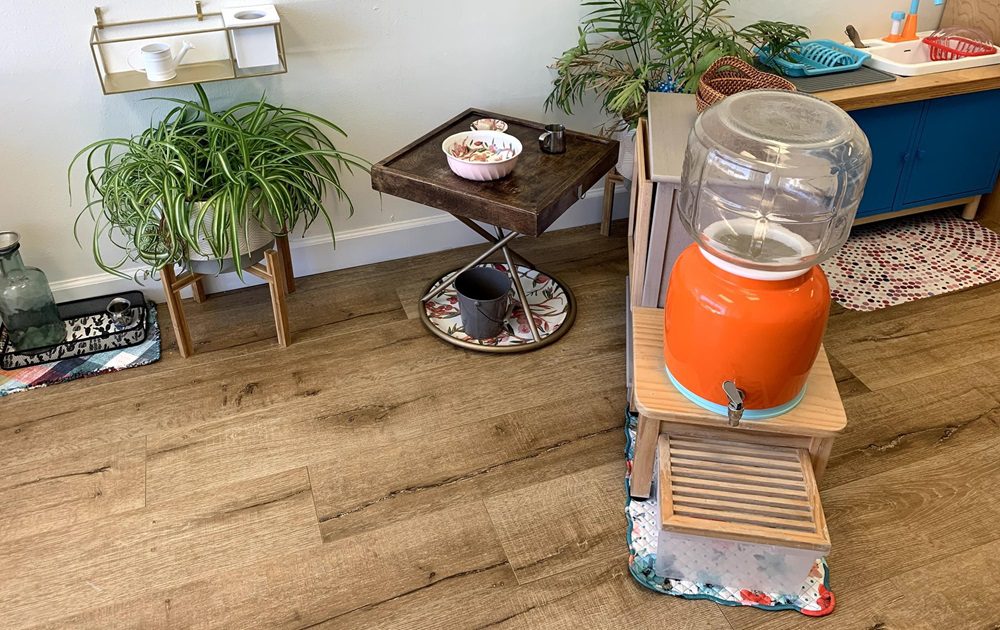
Water Jug
Grate
Water Dispenser
Water Dispenser and Stand
Low Stool
Bin
Sink Grate
Plastic Tub
Small Rug
3 oz. Pitcher
Preparation:
Place the rug on the floor where you would like to have the water source accessible to your child.
Place the tub on the rug and the sink grate on top of the tub.
Place the low stool over the grate and tub so that about half of the tub/grate is visible.
Fill the dispenser one-third full of water.
Place the dispenser on the stool so the spout is over the grate and tub.
Place the jug on top of the dispenser.
Show Your Child:
Tell your children you will show them how to get a glass of water.
Show them where their glasses are kept and ask them to place them on the table.
Show your children where you keep a little pitcher (about 3 oz).
Introduce the water source.
Bring the pitcher to the water source and show how to put the pitcher under the spout, on the grate.
Invite your children to try. *
Push the spout lever down to release a little water into the pitcher and let go.
Ask a child to have a turn.
They may need help to know when to let go.
Ask the child to carry the pitcher to the table with two hands.
Go with the child to the table.
Ask the child to put the pitcher on the table next to the glass.
Sit down, invite your child to pour the water into their glass. (It is important to make sure to sit while drinking. This prevents spills around the house and proper posture when drinking from a glass.)
Let children know that they can get water from the water source when they need.
This is a great time to show children where you keep clean-up cloths, just in case, they have a spill.
*For children younger than three, when we give them a chance to try each step, we keep their interest, we slow down the lesson, and we invite them to be a part of the process.
I started noticing that my son’s backpack was full of what I considered trash: broken rubber bands; the inner ring from a roll of tape; and bits of string. I asked him what they were for, and he just said that he needed them. I cleaned out any insect-attracting items, such as broken crackers and left the rest for whatever he had in mind. Then I noticed items moving from the recycling bin to his bedroom: egg boxes; milk cartons; and cardboard boxes of various sizes.
He said he needed them all. So, we agreed that he would keep them in a designated messy area in his room, then I took a deep breath and went with it. One day, he emerged with a “smoothie shop” made of cardboard and trash, each part thoughtfully glued together. With grace and courtesy, he took our orders, and we played along. He was so proud, and I silently thanked his Montessori teachers for showing us how to let him follow his interests.
— Tara, mother of John, aged 7 years
Reprinted with permission from DK Publishers – Montessori for Every Family: A Practical Parenting Guide to Living, Loving, and Learning by Tim Seldin and Lorna McGrath
WE ARE THINKING ABOUT THE UPCOMING HOLIDAYS AND HOW AND WHEN TO BRING OUR CHILD INTO OUR FAMILY’S TRADITIONS. SOMETIMES, IT FEELS TOTALLY OVERWHELMING, AND MAYBE IT IS JUST TOO SOON TO THINK ABOUT IT AT ALL. WHEN IS THE RIGHT TIME TO BEGIN, AND WHAT KINDS OF ACTIVITIES SHOULD WE BE THINKING ABOUT?
— A YOUNG FAMILY
Dear Young Family,
It is never too soon to begin creating intentional traditions or just living and sharing the seasons and the holidays and letting your repeated experiences grow into family traditions. The truth is, often, anything a family does twice is considered to be a tradition by children. As you enjoy celebrating the changing seasons or the holidays, it is natural to want to share that with your children and involve them in your joy. Your enthusiasm will be contagious, whether picking apples, carving pumpkins, planning Thanksgiving meals, putting out decorations, going to an Autumn fest, or walking in nature to appreciate the colorful leaves or flowers. Sharing them with young children sets the stage for future experiences — building memories extending into middle childhood, adolescence, and beyond. Shared experiences make strong families. And children will look forward to traditions.
Aim for yearly traditions spanning each season of the year. Traditions can revolve around nature, planting and harvesting, food and food preparation, and trips to the zoo, park, pumpkin patch, nature trails, or farmer’s market. They can also involve preparation of the home, such as decorating for a season, weeding out your clothes or toys as the children grow, or sharing sports experiences, either as spectators or as participants: skiing, snowboarding, skating, hiking, beach time, etc. Philanthropic projects can also be a part of holiday traditions that can grow with the family as the children’s ability to participate increases.
Any type or level of holiday tradition should be upbeat and fun; these activities will help build a strong family. Enjoy any holidays you may celebrate, especially the time you spend with each other.
Cathie Perolman is a reading specialist, Elementary educator, author, consultant, and creator of educational materials for Primary and Elementary students. Check out her new downloadable materials on her website cathieperolman.com.
For more than three decades, she has dedicated her energies to improving reading for all youngsters. She is the author of Practical Special Needs for the Montessori Method: A Handbook for 3-6 Teachers and Homeschoolers published by the Montessori Foundation (available through montessori.org.) She is a regular contributor to Tomorrow’s Child and Montessori Leadership magazines.
Cathie holds a BS in Early Childhood Education and a MEd in Elementary Education, with a concentration in reading. She is credentialed as a Montessori teacher. She is married and has two adult children and two adorable granddaughters.
Illustrated by Alishs Nicole Brumfield, Brenda Brambila, Esma Bošnjaković, Samantha Morales-Johnson, Sophia Marie Pappas, Tracy Nishimura Bishop, and Chie Ushio
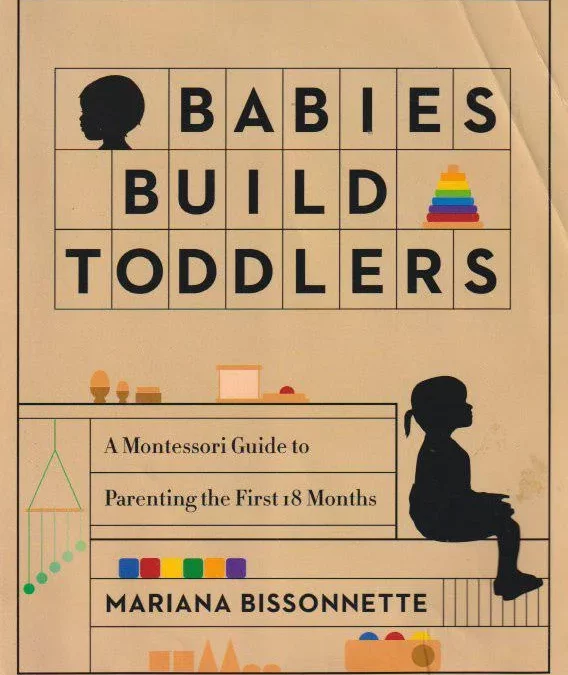
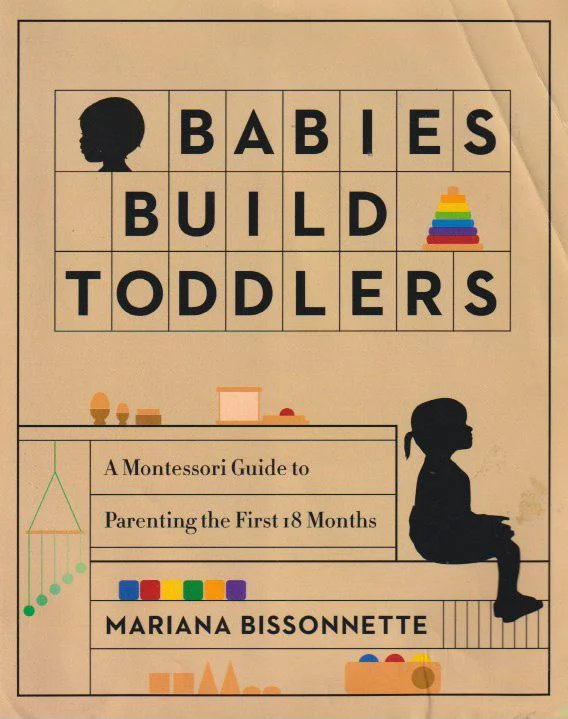
During the years that I have been studying the Montessori Method and philosophy, I have read, literally, hundreds of books written by Montessorians, as well as many experts from others in the field of child and adolescent development. Most recently, my focus has been on supporting families, and many good books are out now for parents. This one gets a gold star from me!
Babies Build Toddlers is written to support families of infants through 18 months old. Mariana Bissonnette brilliantly gives readers enough information about child development so that, when they are done, they actually feel secure in their knowledge of infant development and their capability to do the right things for their baby instead of being overwhelmed by too much and, frankly, too technical information.
The author uses a plant analogy to describe how the baby builds the toddler. It’s beautifully simple and sensible! And she has a wonderful sense of humor. You may notice that there is quite a list of illustrators for Bissonnette’s book. Nicely done! The illustrations are fun, colorful, multicultural, multiracial, and multigender. There is no one kind of family.
There are five parts:
The Plant (the toddler) This part explains who the toddler is.
The Roots (infant development) Here, the reader learns the critical areas of development for infants.
The Conditions (the physical and emotional environment) Now the reader learns what infants need to do in their home to develop to their full potential.
The Gardener (the adult’s role) Finally, the reader discovers how to best support their baby during these most important months of life.
The Full Chart (a timeline for your baby’s growth) The reader gets here, and they know they’re ready!
The author is a Montessorian. The values that we hold dear are all in here: respect; dignity; practice informed by observation; empathy; recognition of potential; independence; order; peaceful interactions; and more.
You can purchase this book (new or used) at most book distributors.
Just Ask … Be Different, Be Brave, Be You
Written by Sonia Sotomayor, US Supreme Court Justice
Illustrated by Rafael López
In this book, a group of children go together to a garden. They decide where to plant flowers, water trees, and enjoy the day together. As each child in the book introduces themselves, we learn that each child is “differently abled.” Some of them take medicine to keep healthy, and some use special tools to get around and learn or act differently than most children do.
The author suggests that, like only having one kind of plant, the world would be quite uninteresting, if all humans were the same. She also lets the readers know that it’s okay to ask about differences so we can better understand each other’s unique qualities and circumstances. The illustrations are done in lovely colors and give quite a realistic view of each of the children in the book.
Children 4-8 years old would enjoy this book.
Nell Plants A Tree
Written by Anne Wynter
Illustrated by Daniel Miyares
Wow! This one is a powerful, well-written, and beautifully illustrated book about a young girl named Nell who plants a seed. The steps from finding a seed to every step along the way to a fully grown tree producing its own pecans are laid out in a lovely and rhythmic story of then and now. It swings gently back and forth through time as the tree and the humans grow and change together over the years.
There is so much to explore about the growth and development of a tree in this story, especially the love, care, and attention it takes for it to thrive. How humans interact with this gift from nature becomes a truly heartwarming story. The memories that everyone makes in and around this tree will never be forgotten. Then, at the end, we come full circle as a new child finds a seed and asks Gramma Nell what to do with it. And, so, it starts again — the wonderful circle of life!
You Hold Me Up
Written by Monique Gray Smith and Danielle Daniel
This book demonstrates what it means to honor and support families, friends, and cultures using both text and illustrations. It is quite beautifully written as well as pictured. Though we cannot change horrific events that occurred in the past, we can change how we treat each other now. We can better understand each other, empathize with each other, and respectfully embrace each other.
Human history is not always a pretty sight; we need to study and learn from it honestly. Depending on the age and maturity of the child or children in your care, the material in this book can be simply read as a story of friends and family with a young audience. With a more mature audience, it could include the history that the author referred to in the back of the book. It can be presented in different ways to children from 3-10 years old.
The Colors of Us
Written by Karen Katz
This is a story about a mom helping her daughter, Lena, to develop an awareness of the many shades of colors that people have. Mom wants her daughter to recognize that skin color varies greatly. Then, when she paints people’s pictures, the colors will be uniquely theirs. They describe the colors by likening them to yummy things to eat, like honey or chocolate cupcakes, and to things found in nature, like autumn leaves or precious metals. At the end of the day, Lena realized that she needed to mix several colors together to create just the right one for each of her friends. The illustrations are bright and full of color, as you expect! Children from 4-8 years old would enjoy this book.
The Mighty Solar Panel — Because Nothing’s More Powerful than a Sunny Day!
Written by Daniel Jarrett
This is an interesting book published by an Australian solar company. The author tells the story of what solar panels are, how they collect energy, how excess energy is sent to storage plants, and the value of using solar power rather than fossil fuels.
The illustrations are colorful and lively. The Sun is the narrator and tells the boy the story. It would be interesting for children ages 5-9 years old.
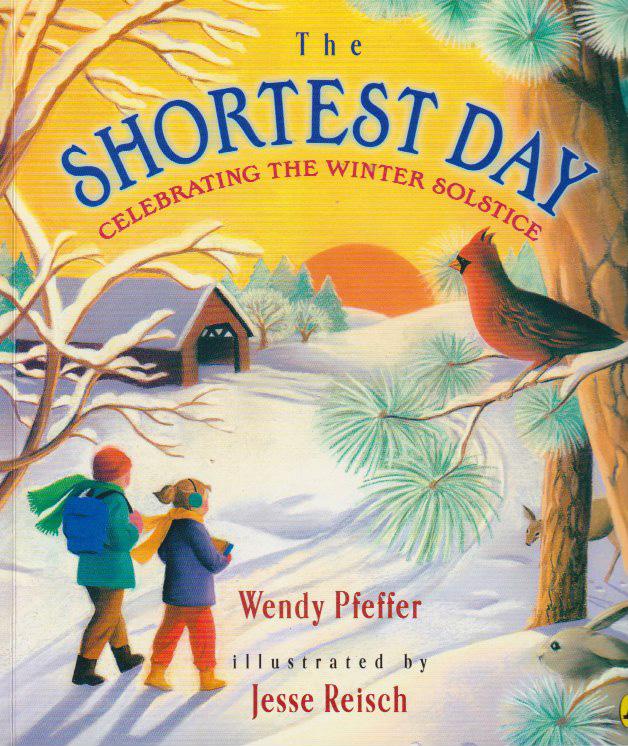
The Shortest Day: Celebrating The Winter Solstice
Written by Wendy Pfeffer
Illustrated by Jesse Reisch
Gorgeous, realistic illustrations! This paperback book beautifully shows the changes that the planet and living creatures go through as they prepare for the change in season. It is based in the northern hemisphere. The author explains in a clear and uncomplicated way what happens as the Earth revolves around the Sun.
You can also show your child how this works with a flashlight and a globe. See the back of the book for details.
Then, the author tells the story of how people felt when the seasons changed and what they learned about the Earth, the Sun, and the seasons. She tells what humans began to do to celebrate these changes in the year. The celebrations became yearly traditions, differing from place to place and according to human beliefs.
There are several pages of information and activities at the end of the book: an illustration of the Earth’s rotation; a sunrise/sunset chart; measuring shadows; northern and southernmost points during the year; the tilt of the Earth activity; a cupcake recipe; and a guide for creating a pinecone feeder for the birds.
This book is done quite well for children 5-8 years old. It is beautiful, encourages wonder and awe, and provides activities for families to do together.
Calling all teachers, parents, & children! We would love to publish reviews of your favorite books. Send book reviews to Lorna at: lornamcgraph@montessori.org
“We shall walk together on this path of life, for all things are part of the universe and are connected with each other to form one whole unity.”
— Maria Montessori, To Educate the Human Potential
One of my first experiences in Montessori pre-school was following my lead teacher and classmate to learn a long and lyrically complex chant about the three bears. And I found it wondrous how much three- and four-year-olds can learn and remember. Songs blend language and math, tune ears to listen to and be able to repeat sounds and strengthen memory. Singing together joins the individual to a group, yet never loses one’s individuality.
I make up songs and have done so since I was ten or eleven. I ‘taught’ pre-school as a Montessori guide for 24 years. We sang the The Alphabet Song backward: z,y,x,w,v,u,t. We clapped our hands and feet, clicked claves*, and shook shakers we made from paper towel rolls affixed with jingle bells. We sang, “Please, please, push in your chairs. (Fish can’t do it, and neither will bears).” Chairs were pushed in, and it was fun.
*A clave is one of a pair of cylindrical hardwood sticks that are used as a percussion instrument.
Scan the code to learn more about Walking Man Music or Click here
Membership in The Montessori Family Alliance means direct access to Montessori experts and other friends and parents of Montessori. Now, you have a one-stop resource for all of your Montessori needs. Brought to you by The Montessori Foundation.