Why Small Schools Work – Good Things Come in Small Packages

Why Small Schools Work – Good Things Come in Small Packages

A hundred years ago most schools were very small in comparison with the large elementary schools and enormous middle and high schools that we find across America and in much of the rest of the world.

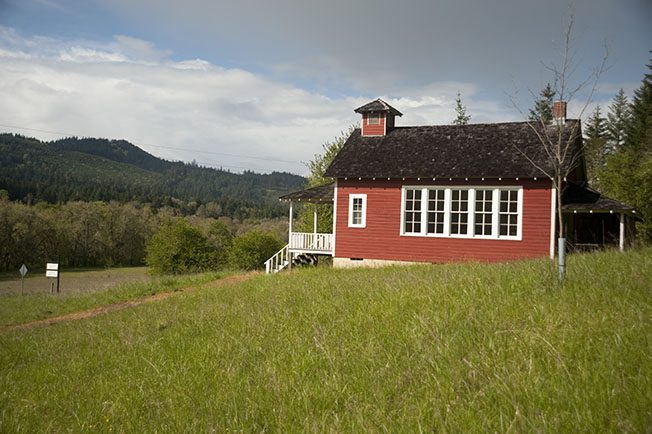
The one-room schoolhouse was the traditional American classroom model. Classes were multi-aged. Students learned from each other, especially the older students in the class, as well as from their teachers.

Junior and senior high schools were typically combined and commonly had enrollments of less than 400 students. With small enrollments, the choice of friends was limited. One benefit was that school friendships tended to grow strong and last for a lifetime.

Over the last hundred years, this tradition changed, and the one with which we are familiar became the norm. It is worth remembering how this came to be.

Before 1900, less than 10 percent of all students attended high school. Most began school at age six and left after the eighth grade. By 1910, the percentage attending high school had risen to 35 percent, but only 4 percent of American youth went on to college. In the past, high school was seen as preparation for college, and college was simply not seen as being needed for employment in most professions.

As the 20th century dawned, several social movements came together to transform the American educational system, and ultimately influence education throughout the world.

The first was the vigorous progressive drive to improve wages and working conditions in the increasingly urbanized and industrial economy of North America. One aspect was the campaign to discourage businesses and industries from employing children. The goal was both child protection and the elimination of this tremendous and inexpensive pool of labor. This laudable goal was accomplished by making child labor illegal and by requiring parents to send children to school.

The second great impetus to build even larger schools was the great wave of immigrants who came to the United States and Canada from Europe during the 1890s and early years of the twentieth century.

This was also a period of major growth in many industries, from mining to manufacturing, and the labor movement began to organize in response to low wages, long hours, and poor working conditions. This influx of immigrants and labor unrest led to a growing fear of socialism and foreign influences. As immigrant populations gathered in large cities and around industrial and mining communities, free (but compulsory) education was seen as the surest way to turn foreigners into loyal citizens. The public schools became the great ‘American Melting Pot’ and were idealized as a central part of the shared American experience. Whatever the positive outcomes of this trend, it also led to a movement from small independent local schools to large bureaucratic school systems.

As the economy began to shift, young teenagers who did not live on farms began to find it increasingly difficult to find a job, and social and economic pressure led many to stay in school longer.

At the same time, educational reformers saw the need to better prepare young people for the world of work, whether or not they had any interest in going on to college.

Thus, with both a growing population and a burgeoning number of young people between the age of 6 and 16 required to attend public schools, our cities began to find ways to house and educate a rapidly growing number of students.

Finally, to understand how schools grew from small neighborhood settings to modern shopping-mall-sized buildings that can house five hundred and more elementary students, and thousands of middle and high school students, under one roof, we have to remember that in the first half of the twentieth century most of North America was fascinated with industrial efficiency. Henry Ford popularized the idea of the assembly line, but many management experts contributed to the idea of standardization of parts, setting performance expectations, and laying out plans for making entire organizations more efficient.

Many good things came from this process, primarily greater output, technological innovation, and many more household goods and major purchases that have come to shape our lives. There is a direct line from the start of the modern industrial revolution to the cars that we drive, the modern kitchen, the entertainment industry, our cell phones, and the internet. The is also a direct connection between it and climate change, the pollution of our oceans, and the depersonalization of our society, which begins with our schools.

Whatever reasons explain (and perhaps once justified) the creation of large schools, today there is a strong case to reverse the trend.

From both studies and the experience of thousands of smaller public and nonpublic schools, we find that in these more personalized settings, students get a better education and feel more connected to the school community than in the large settings that many of us take for granted. This is true in inner cities and affluent suburban communities. It is true at every level, from elementary to high school. Major education reform groups, such as the Bill and Melinda Gates Foundation, have come to the same conclusion and invest vast sums into supporting the development of new small high school models.

As Jordan Hylden at Harvard University observed in 2004:

Students in small schools perform better academically, graduate at higher levels, are more likely to attend college, and earn higher salaries later on in life.

They participate more in extracurricular activities, have better rates of attendance, report greater positive attitudes towards learning, and are less likely to face school-related crime and violence.

Their teachers report greater job satisfaction and are more likely to feel as if they are succeeding in their work.

Their administrators and teachers are often more able to identify problems, respond innovatively and effectively, and adapt to change.

Their parents and relatives are more likely to become involved in the school.

Small schools are often characterized by personalized attention, curriculum integration and specialization, relational trust and respect, a student’s sense of belonging, a strong positive ethos, greater accountability, and a sense of communal mission.?

The point that I want to make is that bigger is not necessarily better, especially when it comes to designing schools. But large schools have become the norm.

Endless numbers of movies and television sitcoms showcase large public middle and high schools. Children take for granted that this is the way things are supposed to be. All through elementary school, many children long for the day when they can make the rite of passage and go to a big school. In affluent communities, the modern secondary level campus is shiny and new, and costs enough to keep property tax rates higher than ever.

Public education enjoys almost universal support from the American public. We take pride in our large schools. On the other hand, we hear conflicting messages from all sides, most commonly that our country’s students are falling further and further behind those of much of the rest of the world. We decry the state of schools today in America as a whole while reassuring each other that our local schools are among the best in the nation.

The seemly obvious solution is to spend still more money on our schools. There are inequities still to be found in American public education. Some districts have much greater resources, and some schools are grossly underfunded. But the evidence of the last several decades is that much of the money invested had led to modest outcomes in terms of overall student learning and the emotional climate within our schools. We have much more large modern buildings, Ipads, laptops, Smartboards, and educational technology that looks and sounds good but is not the direct link to deeper learning. Education is still centered around the direct relationship of children and adults who know how to facilitate their learning.

We hear snide jokes about the wasteful spending of the government, forgetting that the biggest spending arm of our government is typically right in our own community, where the public school system is often the largest employer in town and usually spends almost as much on centralized administration as on its classroom programs.

In recent years, technology is often seen as the answer, forgetting the wisdom of this old truth:

  • Tell me about something and I may quickly forget.
  • Show me and I may remember and understand.
  • But lead me to do something on my own, to experience it firsthand, and I will almost certainly remember it for a lifetime.’

Children learn best by doing, and they learn best of all within a school setting in which they feel safe, respected, and emotionally connected to their teachers and fellow students.This is very difficult to do in a school system that is obsessed with state-mandated standards, constantly changing curriculum, high-stakes testing, and students who are trained to follow instructions rather than think deeply and become engaged in their education.

Smaller School Size Is Not Enough

There are obvious trade-offs with a smaller enrollment. With fewer students and teachers, it becomes difficult to offer as many extra-curricular programs and widely varying courses of study.

But how much is enough? Which is more important: a choice among thirty different social studies courses or a school in which you find your own voice, live and work within a strong supportive community, and, as a young person, feel that adults really listen and treat you with kindness, warmth, and respect?

Today, many charter and private schools are increasingly specialized, offering families a greater range of choice. Smaller schools that put children at the center, rather than the teachers’ lesson plans, tend to create far more humane, kind, and effective educational outcomes in the long run, not only in terms of what can be measured on test scores, but in terms of the quality of relationships, character, and ability to work together to get things done.

It is time to go back to the good old days when schools were small, and everyone knew your name.
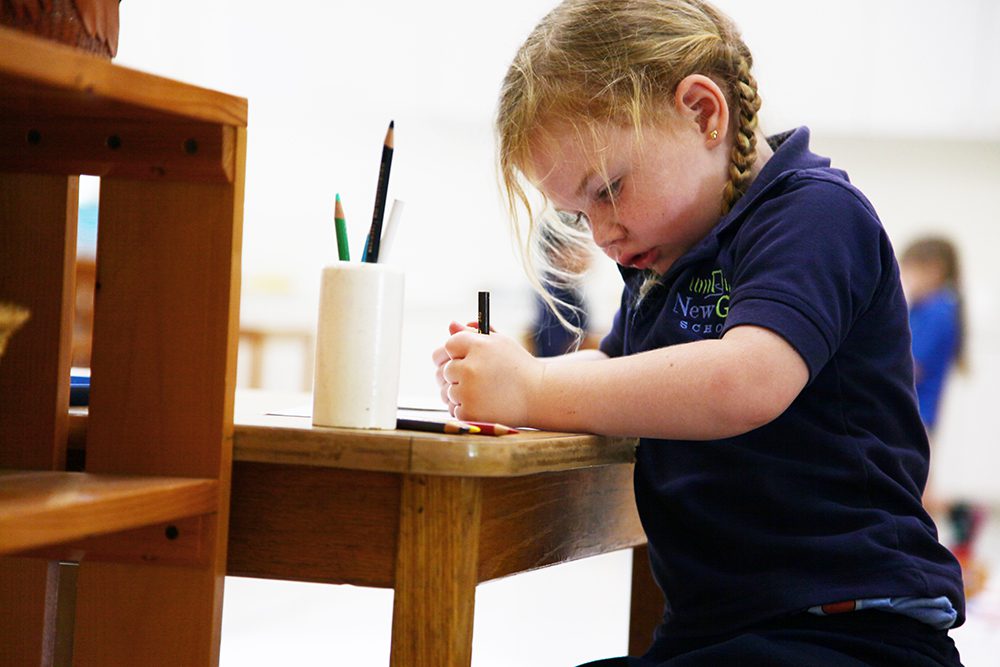
Negotiating the Montessori Maze

Negotiating the Montessori Maze

How Do Families Choose the Right Montessori School for Their Children?

In many areas of the US, today’s families have a choice when it comes to picking a Montessori school for their children: Private/Independent; Public/Charter; Parochial; Preschool; Elementary; Secondary; International Baccalaureate (IB); Accredited/Non-Accredited. What does it all mean?

The first thing to remember is that Montessori was the name of a person — Dr. Maria Montessori, Italy’s first female physician. It is a name given to a community of schools found across the US and Canada and in virtually every country in the world. What it is not is a franchise. Each school has a distinct personality, and although differences may seem significant at first glance, authentic Montessori schools follow the principles of Montessori education and have more commonalities than differences.

What makes a school Montessori is not the name or the word alone (many Montessori schools do not use ‘Montessori’ in the name of their school) but rather three main components:

  1. Each class is led by a formally trained and certified Montessori educator. This training, typically offered at the college-graduate level, involves more than a year or of specialized teacher education and a supervised student-teacher internship experience.
  2. Each class has the complete set of Montessori educational materials appropriate for children of the classroom’s age group.
  3. The class is organized and run according to basic principles that make a program Montessori instead of something else, which includes three-year, multi-age groupings.

Independent vs. Public Schools

Using US terminology, all independent schools are non-public, which means that they are not owned or operated by a state government. All private schools are independent in the sense that they have the freedom to organize their educational programs and build a faculty based on the principles that are the foundation and guidelines of the approach they embrace.

Public schools must follow a state-issued mandate. They are funded through taxation, and parents do not pay to have their children attend. Private schools, on the other hand, have more freedom to develop their own program and select families whose philosophy matches the school’s approach. These programs, whether or not they are for profit or non-profit, rely on the marketplace and the ultimate test is whether or not parents are willing to pay for their children to attend.

Montessori schools can be small or large. Some focus on a limited age range; others run from toddlers thru eighth or twelfth grade. Some schools will be using space leased from a church, synagogue or mosque. Some will have a few acres or some will have vast campuses. The quality of the program, in general, is not connected to how large or fancy the facility is. It can really be found in the nature of relationships among parents, teachers, and children. A great Montessori school is a real community.

Another difference can be its ownership. Some schools are owned by an individual family or the partnership of a couple of people who joined together to organize a new school (small groups for profit). Others will be nonprofit, run by a head of school and governed by a volunteer board of trustees. Some will be public schools run by the school district or charter Montessori schools, which are private schools serving through a charter as public schools.

The Educational Marketplace: Why Choose an Independent School

The most basic premise is that parents and schools choose each other and tend to do so very carefully. Each private school operates in an educational market place and succeeds only by establishing and serving a special niche in its community.

One of the reasons that parents turn to the private sector is that they know that their children will not be only a number among many. In addition, families often feel more comfortable with other school families that will be committed to their children’s education and share many of their same values. The reason why they do this is that they are looking for something that isn’t offered in the local schools, which is why for the last hundred years plus, almost all Montessori schools have been independent. With public funding comes public control. There is obviously a marvelous case for free public Montessori education. What’s not so obvious is the important role that independent schools play in developing innovation, offering families real alternatives and providing their students with an extraordinary level of attention and support.

The term parochial school tends to be limited to schools run by the Catholic church. Jewish, Islamic, and Christian Montessori schools also operate schools of their own with the goal of providing an education grounded in their faith. Independent schools are, by definition, not affiliated with any religious organization.

Finally, Montessori schools, like Waldorf, Regio Amelio, and other innovative schools offer a distinctly different educational program and philosophy. In the private school sector, some are run under the sponsorship of a faith. Most are independent. In the public sector, Montessori schools offer a public school program that meets the requirements and expectations of the state’s department of education in a way that is inspired by Montessori. Each school needs to be looked at individually to determine what is the best match for your family.

If this is your child’s first year in Montessori …

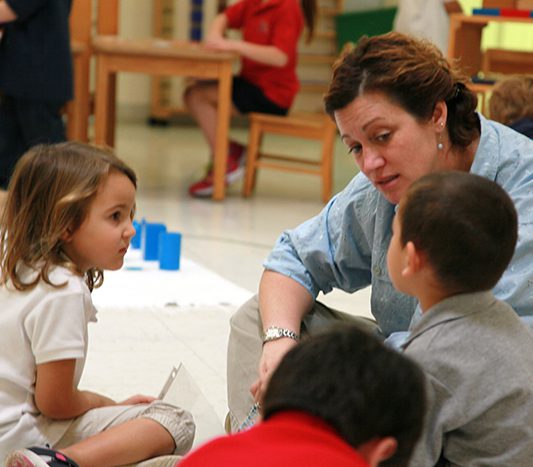
Most children begin their Montessori education in the 3-6 (Primary) classroom. If you are new to Montessori, perhaps the most obvious difference you will notice in a Montessori classroom is the role of the teachers (sometimes referred to as guides). Teachers are not the center of attention in the classroom, which doesn’t mean that they are not teaching. Rarely will teachers gather a group of children together to give them a lesson. In fact, children will tend to work alone or with other children more often than you’ll see them in a large or small group or with an adult. This is perfectly normal and consistent with the way children learn best.

Do not expect to be able to compare your children with their classmates. In this age when everyone is so concerned about grade levels and standards, Montessori has a decidedly different perspective. Our objective tends to be in opposition to the fundamental objectives that created and supported the traditional school systems from which most of us graduated. Our position is that the education with which we are most familiar were designed to assimilate large numbers of children from other countries and rural communities into a government-designed mindset of what was most needed in the 1900s: passive, Americanized, factory works, who knew the right answers and were not encouraged to think independently. Although the times have changed, for most children, the educational approach has not.

At the heart of Montessori education is the fundamental belief that no two children are the same; they learn at different paces and in different ways. When children are truly interested and have a choice, they tend to learn and retain much more. They do not just study for an exam, only to have the information fade away once the exam is passed.

For this reason, Montessori teachers tend to be guides and sources of inspiration. You might even refer to them as mentors and tutors. The whole secret of Montessori is that it tends to inspire in children a sense of their ownership of what they are learning in school. This assumption that children are born bright, curious, and capable tends to focus on what children are good at, while quietly working to strengthen other areas of learning that may not come as easily. Montessori focuses on the positive not the negative.

You will not see Montessori teachers hugging kids, saying “Good job.” There is a genuine sense of ownership among the children that this is their ‘house’ and this is their work. Montessori children do not work in order to achieve attention from adults. We want them to feel as partners, leaders in their classroom.

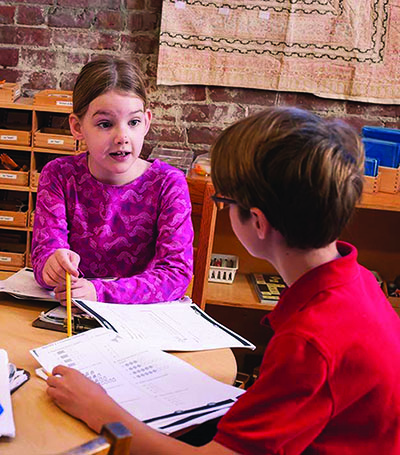
Another thing you’ll notice is that the children will tend to learn more from each other even more than from adults. This is not unique to Montessori. It is the way children have learned throughout history.

Curriculum

There is an extensive and well-defined Montessori curriculum for children from infancy through age 12. We call this Scope and Sequence, and it is way for teachers and parents to track lessons, the use of materials, and the progress of students. It constitutes about 400 printed pages and many schools are using the interactive digital version to manage classwork and communicate with parents. For schools that are interested in this tool, it is available through The Montessori Foundation (www.montessori.org). If your school has a copy, you may want to take a look. Be warned, though, it is not an easy read. What you will see is how a lesson is presented, the materials used, the age of the child when it is first presented, and how the lesson expands and transitions over the years from concrete hands-on manipulation of materials to sophisticated levels of abstraction

For those of you who are new to Montessori, your child is most likely in the Primary division. Another big difference you will notice in the 3-6 classroom is the absence of toys. You may have heard that Montessori places very little emphasis on fantasy. This is true; however, it is not that we think that fantasy has no value. We just don’t think children need any help with it. The fantasy life of young children tends to be quite rich without any help from us. Children don’t need to be taught to use their imagination. We believe that children under the age of six, in particular, are in a process of rapid brain development, which will happen naturally if they are exposed to the right stimulation. The Montessori program is designed to provide just that.

The stimulation that young children need is very different from what most people think of as formal education. Instead of listening to teachers talk, working in workbooks, or reading from a text, what they need is direct experience with real things. Very young children develop what you might think of as fundamental skills that will help them learn how to learn: development of an inner sense of order; an acute ability to observe things around them; development of the ability to voluntarily concentrate; development of strong eye-hand and large-muscle coordination and balance; and the development of a strong sense of independence and self-confidence.

To the casual observer, Montessori curriculum for children under the age of five may look like it’s focused on working with simple everyday tasks, such as sweeping, mopping, cleaning windows, etc. or with solving puzzles; however the underlying objections are much more complex and serve as the foundation for:

  1. the development of vocabulary;
  2. the development of an ability to problem solve, developing and implementing plans in organized ways, honing their eye-hand coordination and fine-motor skills; and
  3.  the development of observation skills (especially in the area of sensorial activities that involve acute attention to the discrimination of physical characteristics).

Experiences like this tend to lead children to an increased ability to learn new things for the rest of their lives.

As you become more accustomed to the Montessori classroom, you will notice that although the room is organized into different areas of interest, they are all inter-related. Most of what the children do shows how everything is connected to everything else. For example, lessons in geometry are also lessons in logic, artistic design, fine-motor control, vocabulary, mathematics, and so on.

Even though there is probably a classroom schedule posted, parents will find that for the most part, the students set their own schedule, especially during the morning work cycle (lasting from two to three hours).

If you observe a classroom on different days, you will notice that on some days, your children will tend to move from one activity to another, while, on other days, they will remain focused for very long periods of time on a single activity. This is how children develop the ability to voluntarily choose work, follow through, and concentrate.

You might notice that children go through phases, where they are fascinated by certain things. They may not be able to put it into words, but you will probably start hearing about puzzle maps, the Moveable Alphabet, and Metal Insets. This tendency to zero in on something, generated by the child’s own interest, is a very good thing. Parents may be worried that he’s not getting a balanced education; however, he’s learning everything about something that is his voluntary choice.

How will I know if Montessori is working for my child?

First, it’s likely that teachers will send home portfolios of paintings, papers that your child has created during the week. [Editor’s Note: Don’t be surprised if you see many, many variations of geometric drawings. Once children discover the metal insets, they love to practice fine-motor skills in every color! So many colors. I could have wallpapered my kitchen with triangles when my children were young.]

Many schools are now beginning to send out information by email. This may include videos, pictures of work, letters to the whole class, letters to you as a parent. Watch your email.

Don’t ask: What did you do in school today? Be specific. Ask: Did you work with the Pink Tower (learning the names of materials will help). Attend parent education nights and class meetings. Set up a time to observe in the classroom.

We hope that by the time you are reading this article, your children have settled into their Montessori classrooms and look forward to each new school day. If you would like to know more about Montessori, and we certainly encourage you to do so, there are many ways to become more familiar with the Montessori Method.

In addition to reading Tomorrow’s Child, there are a number of books and materials that you might find interesting and helpful. These include:

Montessori 101: A Guided Tour of the Montessori Classroom, The Montessori Foundation
How to Raise an Amazing Child: The Montessori Way, Tim Seldin
The Montessori Way, Tim Seldin and Paul Epstein, Ph.D.
Montessori Madness, Trevor Eissler
Understanding Montessori, Maren Schmidt
Montessori: A Modern Approach, Angelina Stoll-Lillard

All of these, and many more, are available online through the Montessori.org store (www.montessori.org).

Why Continue in Montessori Elementary?

Why Continue in Montessori Elementary?

Having sent a child to Montessori for the first three years, by now you have probably got a young person who is very full of herself, very self-assured, independent, and who absolutely loves to go to school.

As your child approaches the end of her third year in the Children’s House, I know that you are giving careful thought as to whether or not to continue with Montessori. Having had the gift of this sort of education myself through high school, and having seen my five children blossom in Montessori at the elementary level and beyond, I want to encourage you to remember that an investment in a fine education pays the best dividends. In the elementary Montessori program at your school, your children will have the opportunity to learn absolutely amazing things!

One of the things that you will see when you enter their new elementary classroom is joy, excitement, and enthusiasm. These are not children who are given workbooks and simplistic assignments to do over and over again. These will normally become deeply engaged in work that they will find interesting, meaningful, and often intriguing.

You will find that the elementary Montessori curriculum is highly enriched and challenging.

It is organized into three streams:

The first stream is the Mastery of Fundamental Skills and the acquisition of Basic, or Core, Knowledge. During the elementary years, Montessori students study all the basics found in a traditional curriculum, such as the memorization of math facts, spelling lessons, and the study of vocabulary, grammar, sentence analysis, creative and expository writing, and library research skills. But there is so much more to Montessori than the? Basics?

Elementary Montessori students explore the realm of mathematics, science and technology, the world of myth, great literature, history, world geography, civics, economics, anthropology, and the basic organization of human societies.

In this second stream of the Montessori curriculum are found what we call? Great Lessons? These are key areas of interconnected studies that are traditionally presented to all elementary Montessori students. They include the story of how the world came to be, the development of life on the Earth, the story of humankind, the development of our language and writing, and the development of mathematics and technology. They are intended to give children a cosmic perspective of the Earth and humanity’s place within the cosmos.

The third stream of the Montessori curriculum is Individually Chosen Research. As their proficiency in reading and composition grows, elementary Montessori students are encouraged to explore ever topic that captures their imagination.Students rarely use textbooks.They do a great deal of independent reading and library research.They gather information, assemble reports and portfolios and handmade books of their own, and teach what they have learned to their friends.Their oral presentations and written research reports grow in sophistication and complexity over the years.

At the elementary level, learning continues to be a hands-on experience, as students learn by trial, error, and discovery.

The old familiar Montessori materials continue to become more sophisticated. For example, in mathematics, the advanced elementary Montessori materials move on to more complex and abstract concepts in mathematics, such as long multiplication and division, operations with simple and decimal fractions, geometry, and pre-algebra.

The learning materials with which students work in the elementary program are so exciting, starting with the great lessons. For example, the Timeline of Life tells the story of the history of the Earth beginning with the Big Bang and the formation of the stars, leading down the geological eras of Earth’s history and the emergence of life over the millennia. These Great Lessons engage children and then send them off to do all kinds of research, which they are allowed to do on their own rate and their own pace. When students are excited about something and feel connected to it in their environment, that’s where real learning takes place, and that’s where Montessori shines.

Montessori helps children to be flexible, self-disciplined, independent learners and self-actualized adults. We all want our children to be able to master or learn anything they wish. I can figure it out, I can find the information, I can learn it, I can apply it. That is essentially what we strive to nurture in the elementary program.

Think about your Montessori child as she has grown thus far as he or she nears the end of the third year in the Children’s House or Casa as you call it in Canada. Now think ahead. What would you like to see your son or daughter be like at age 18?

If your dreams include a young man or young woman who truly loves school, thinks outside the box, thinks about others, then you’ve certainly done the right thing by giving your child the gift of a Montessori education. You’ve laid the right foundation.

Like me, like my family, and like so many million others like us, you’ve taken the first step. And now the question is what’s next?

I invite you to join us and let your child reap the benefits of continuing her Montessori education. The best is yet to come.

Webcast:  What makes a high-quality preschool program?

Webcast: Managing the Enrollment and Re-enrollment Process / Pt 3

This week we will continue our discussing of Managing the Enrollment and Reenrollment Process. This is the time of the year when tuitions are being set, open houses scheduled, re-enrollment begins, and phones hopefully ring off the hook with inquiries. For the last two weeks, the discussion was so lively that we realized this is […]

Webcast:  What makes a high-quality preschool program?

Webcast: Managing the Enrollment and Re-enrollment Process / Pt 2

This week we will continue our discussing of Managing the Enrollment and Reenrollment Process. This is the time of the year when tuitions are being set, open houses scheduled, re-enrollment begins, and phones hopefully ring off the hook with inquiries. For the last two weeks, the discussion was so lively that we realized this is […]

The Difference between Articles of Incorporation and ByLaws

hat is the difference between your Articles of Incorporation and Bylaws? A source of confusion for many board members is the difference between the organization’s Articles of Incorporation and Bylaws. It is common practice to divide the basic rules of an organization into two documents. The Articles of Incorporation typically defines the primary characteristics of […]

Kindergarten and Elementary Moving-Up Meetings

Sample Bylaws

It is common practice to divide the basic rules of an organization into two documents. The Articles of Incorporation typically defines the primary characteristics of the organization – its name and purpose and essential elements of the make-up of the board and its function. A second document, called the Bylaws, defines in somewhat greater detail the […]