To access this page, you will need to log in or become a member.
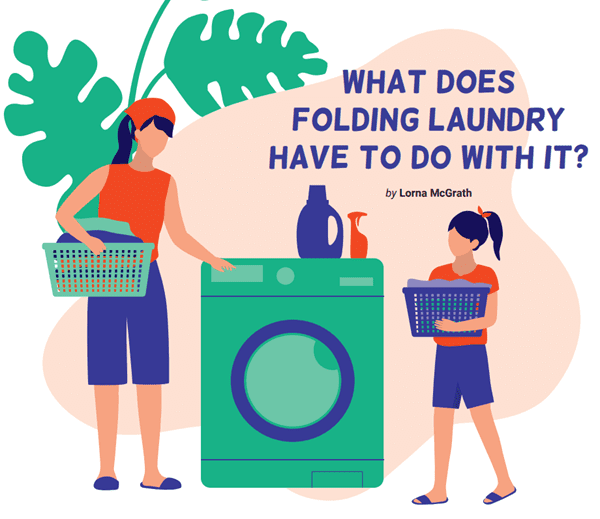
What Does the Laundry Have to Do with it?

What Does the Laundry Have to Do with it?

Practical Life is a fundamental part of the Montessori curriculum. Dr. Maria Montessori wrote, “Education should not just be preparation for university, but preparation for life.” We want our children to have the skills and knowledge to function very well independently: capable of caring for themselves and their environments; knowing how to behave in a manner that will lead them to success in all aspects of their personal, educational, and professional lives. Our responsibility as parents is to help them to be ready for successful, independent living.

In Montessori classrooms, at every level from toddlers to young adults we divide Practical Life into the following areas: Care of Oneself; Care of One’s Environment; Food Preparation; and Grace and Courtesy. Just as at every level in our classrooms children become more and more abstract thinkers and have less need of pre-made materials to demonstrate skills and concepts, so a similar evolution occurs in our homes.

In the early years children work with activities, all very neatly ordered and on the shelves. The activities are specifically designed for them to learn all sorts of Practical Life skills, such as dishwashing; preparing for their own snack; using utensils; and resolving conflicts using their words. The Practical Life area is quite obvious in a Toddler or Early Childhood classroom. In the Elementary years practical life materials are not always designated to an area or grouping of shelves. They tend to be placed around the indoor and outdoor environments where they can be accessed when needed. For example, you may find them in a garden shed, a kitchen area, or at a workbench with cabinets for tools. At the Adolescent level students may be helping with projects in the larger community such as Habitat for Humanity; traveling across town to the public library or the local college to do research; writing their resume and cover letters to set up internships for themselves in local businesses; or designing costumes for a performance.
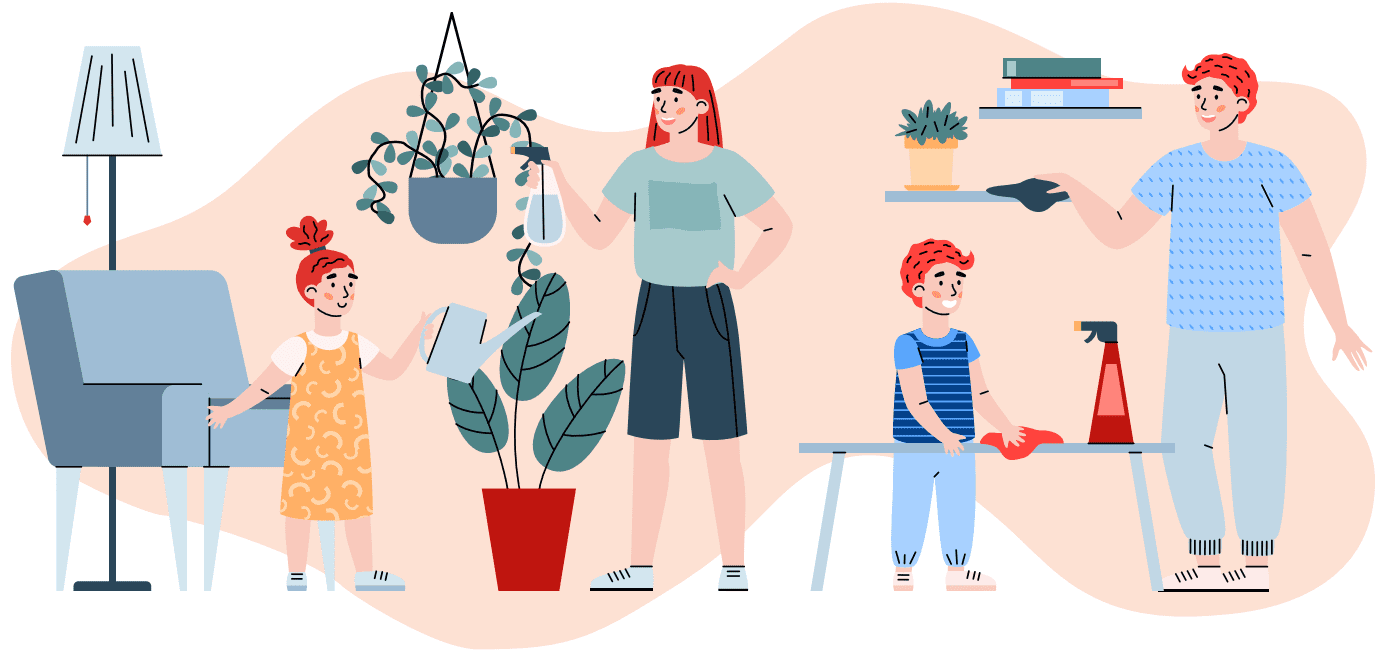
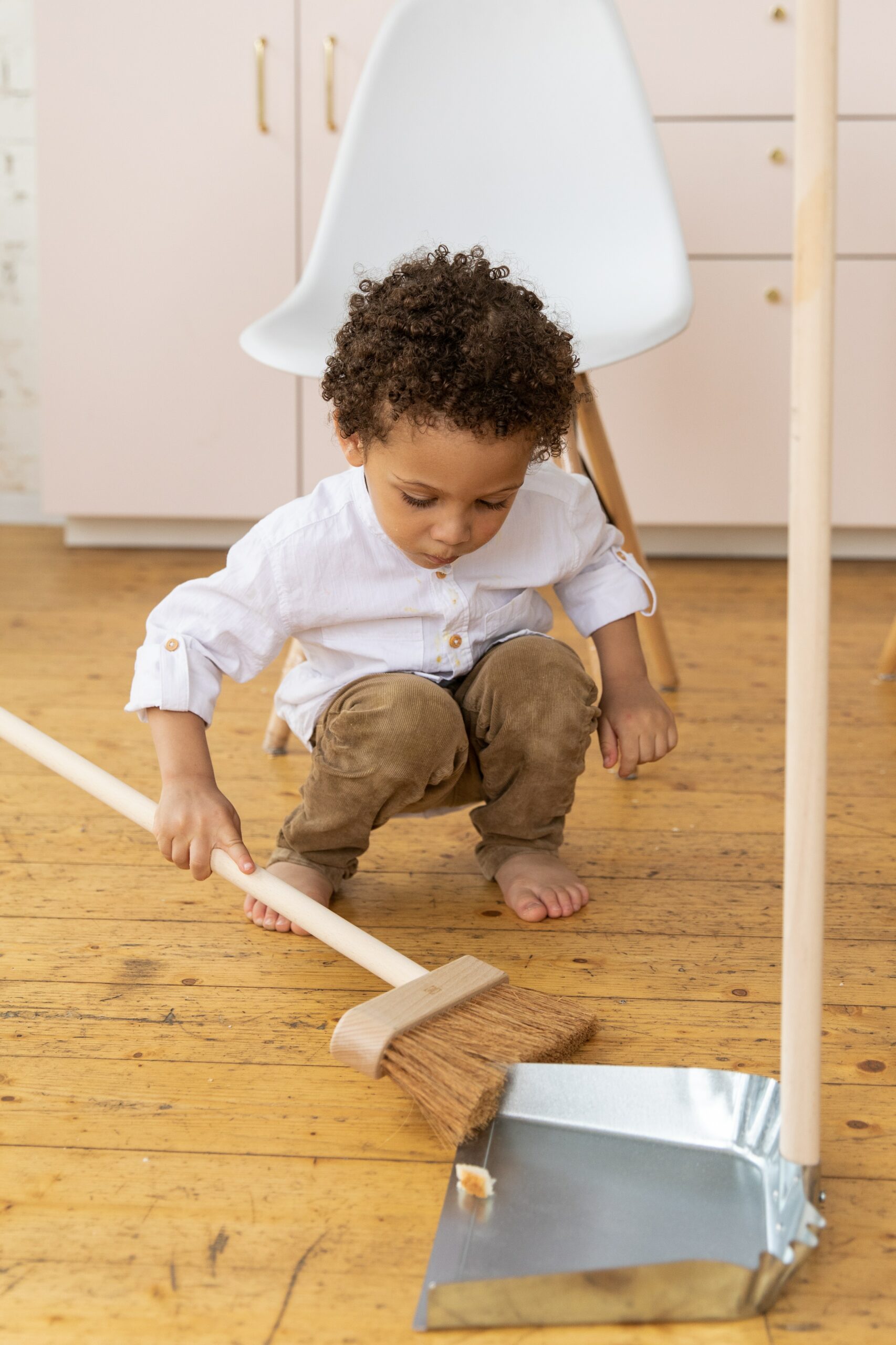
Throughout their home and school years these kinds of activities are important because they have dual purposes within each activity. The obvious purpose is the skill that they learn from each activity like how to use a dustpan and brush, how to plan and prepare a meal, how to interrupt politely, how to peel and cut bananas, how to get across town on a bus, or how to fold the laundry, etc. The other purpose is what we like to call the “hidden lessons” which are as, or more important than the actual skill attained. These hidden lessons are independence, order, concentration, and coordination.

So when we think about folding laundry, and we observe children doing that activity we can easily see that knowing how to fold it helps them to develop a skill that will allow them to be more independent. At the same time, they are learning to sort and categorize laundry items to create order, to pay attention and carefully fold clothing neatly, and to coordinate their hands and minds as they complete the activity. These are essential skills that apply to many aspects of their adult life. The beauty of it is that children do this work throughout their growing years without being conscious of all that they are learning.

So next time your child tells you about folding the laundry at school, or you watch your child folding and putting laundry away at home, notice the sparkle in their eye and the pride in their work that your children have when they participate in these everyday activities. 

The child who has felt a strong love for his surroundings, and for all living creatures, who has discovered joy and enthusiasm in work, gives us reason to hope that humanity can develop in a new direction.

Maria Montessori

Here are some of the activities for home and school, at each level of development.

Toddler Level

  • Dressing and undressing oneself
  • Feeding oneself
  • Toileting oneself
  • Saying hello and good-bye
  • Sharing
  • Cleaning up spills
  • Putting work away
  • Washing hands and bathing oneself

Primary Level

  • Sewing
  • Hand Washing
  • Dressing and undressing oneself
  • Preparing snacks and appetizers
  • Baking
  • Following simple recipes
  • Manners
  • Watering plants
  • Arranging flowers
  • Sweeping the floor
  • Washing dishes
  • Folding laundry
  • Gardening
  • Woodworking
  • Conflict resolution
  • Greeting and welcoming guests
  • Doing Laundry
  • Making the bed

Elementary Level

  • Preparing more complex recipes

  • Planning and preparing family meals

  • Writing invitations and thank you’s

  • Choosing appropriate clothing for different occasions

  • Telephone and texting manners

  • Running a business

  • Gardening

  • Managing money

  • Greeting and welcoming guests

  • Introducing people and oneself

  • Conflict resolution

  • Participating in team activities

  • Understanding rules and games

  • Planning “get togethers” and parties

  • Learning to dance

  • Allowances and chores

  • Cleaning and organizing their room

Secondary Level

  • Social networking etiquette and safety

  • Understanding body changes

  • Interacting appropriately with different genders

  • Dressing for the occasion

  • Community service

  • Bank accounts and debit cards

  • Reconciling check books

  • Check writing

  • Mind trust

  • Understanding advertising and it effects

  • Recognizing everyone’s contribution to the whole

  • Using public transportation
Going Out: A Japanese Tea Ceremony

Going Out: A Japanese Tea Ceremony

Japanese Tea Ceremony

For Montessori elementary and adolescent students, the opportunity for learning outside the classroom is an important part of the curriculum. Students may plan a “going out” for a small group of students related to a project, such as going to the grocery store for ingredients for a cooking project. Or a larger trip for the whole group may be planned, usually related to work going on in the classroom.

These opportunities to learn outside the classroom allow students to have hands-on opportunities with the world and their community. In the first plane of development (ages 0-6), we try to bring the world to the classroom, but in the second plane of development, we want to bring the student to the world. Although we cannot take the students around the world, we can take advantage of local opportunities that introduce students to places and activities from around the world.

The tea ceremony and tea appreciation are part of our curriculum at NewGate School. Students are given the opportunity to partake in tea ceremonies at school, and students were able to go to The John and Mable Ringling Museum of Art to experience an afternoon of a traditional Japanese tea ceremony, hosted by Dr. Rebecca Corbett, author of Cultivating Femininity: Women and Tea Culture in Edo & Meiji Japan.

The Japanese tea ceremony (Sado) is rooted in a tradition of mindfulness, naturalist intrigue, and political stability; all of which served to unify, strengthen, and pacify an ancient culture. Tea brokered the deal. Tea welcomed the guest. Tea served as a reminder to pause and appreciate the ephemeral nature of impermanence in an increasingly complex and turbulent world. When we arrived, our host explained how the natural surroundings play an important role in setting the mood; the sounds of the wind blowing through the bamboo grove and cedar branches, the bird song, all contributed to the experience of calm and tranquility presented during the ceremony. As the audience sat with straight spines, attentive to the moment of peace, receptive to the myriad gifts of nature, we were quickly interrupted by the sounds of gasoline-powered golf carts, transporting people to and fro, and prop planes flying above the Gulf of Mexico. Our host joked and suggested that, today, we would have to replace the more traditional sounds of nature with those of mechanized equipment and vehicles, to which the crowd laughed and relaxed further into their seats awaiting the ancient spectacle to unfold.

The designated guest was invited to partake, the sweet was offered, and the tea was prepared. Each gesture of the tea master was carried out with profound precision, meaning, and purpose. As this quiet dance unfolded, the noise of human interference quickly dissipated into an inner abyss of luminous silence that was noticeably felt by all; the experience became palpable. For this brief moment, that felt like an eternity, we were all interconnected: students, teachers, guests, masters, all one. Before we knew it, the ceremony had come to a close, and our host opened up the floor for questions. NewGate students quickly raised their hands in unison! Though I am biased, naturally in a way a teacher would be toward their students, their questions were thoughtful, mature, and insightful. The audience was captivated by the interaction between young people and our host. The students asked questions such as, “What was the food item presented at the beginning of the ritual? What is the significance of the design on the belt (obi) of your kimono?” Our host was visibly pleased with the genuine sincerity and enthusiasm of our students. Eventually, their questions had to be capped off as another group prepared to receive the presentation; otherwise, their dialogue could have continued indefinitely.

This kind of interaction, unexpected by many adults, is typical of students who are expanding their knowledge and building on what they have already experienced. The opportunity to interact with specialists, whether a traditional host for a tea ceremony, or the stocker at the local grocery store, provides a living, hands-on opportunity to ask questions and fulfill curiosity.

The Ringling Museum (Sarasota, FL) also provided a tour of the traditional, yet modern, Japanese Tea House that was recently constructed on the grounds. The tea house is regularly available to view from the outside; there are large glass windows showing the craftsmanship of the interior and the equipment inside. However, today was different. We could actually walk inside, feel the tatami mats below our feet and smell the scent of grass, cedar, and pine. The students delighted in asking more questions and exploring the tea house. We learned that the tea house was designed by a student from the Ringling College of Art + Design. The design combines elements of a traditional tea house, fused with classical, modern Sarasota architecture.

Being able to go out and explore, whether exploring nature, the visual arts, or experiences such as a tea ceremony or live theater, provides a deeper understanding of lessons learned in the classroom. By becoming a part of the larger community, with family, a small group, the whole class, or even the whole school, bonds are strengthened, lessons are learned, and new interests are kindled. Taking the time to let students help plan and attend opportunities, especially those that are out of their regular experiences, both with school and with the family, is time well spent. Those memories of experiences will remain with them and be building blocks for continued learning.

Practical Life for Older Students At Home and At School

Practical Life for Older Students At Home and At School

Book Review – The Vegetarian Cookbook: More Than 50 Recipes for Young Cooks

Book Review – The Vegetarian Cookbook: More Than 50 Recipes for Young Cooks

The Vegetarian Cookbook: More than 50 Recipes for Young Cooks

Written by DK publishers

My son and his family are vegetarians. I wondered if there were any vegetarian cookbooks for children. So I went searching and, lo and behold, there were quite a few!

I found one that looked good to me (on the internet), it was the right age grouping for my grandson, and the description seemed like it was laid out in a way that was easy to use and simple enough for a young child. I bought it. Well, much to my chagrin, this book was not child friendly or, in my case, adult friendly. All the measurements were in grams, the photos showing the steps were too small (about 16 on an 8×10 page), and the photos had no instructions. At any rate it was totally unsuitable for me (master’s degree in Home ‘Ec’ and a Montessori 3-6 credentialed teacher) or for my grandson (5 years old, loves to eat and cook, and goes to a Montessori school). What a disappointment!

Today, I looked again and found a beautiful book by DK publishers with beautiful photos, an introductory section with kitchen rules, equipment, and healthy eating with food groups. Once the child is prepared, we get into the recipes that include breakfasts, snacks, lunches, drinks, entrées, and sweets. There are easy-to-follow steps with one photo and brief written instructions for each step. Everything looks delicious, as DK is masterful with their photographic illustrations. I can’t wait to cook with my grandson next time he comes over. The recipes would work for 4–8-year-olds and their parents or some other adults who love to eat and cook! It can be found on amazon.com

10 Ways to Prepare for Summer

10 Ways to Prepare for Summer

10 Ways to Prepare for Summer

by Cheryl Allen & Lorna McGrath

1. Maintain a routine–getting up at a similar time each day, eating at regular times, keeping enough routine to keep your child comfortable. This is important for all ages. It gives them a sense of stability. It is especially important in early childhood, as these children are especially sensitive to order and consistency.

2. Keep up your family meeting schedule. Remember that family meetings provide opportunities for everyone to have a voice, be a leader, and take part in shaping the summer. If you have visitors, invite them to join your meeting.

3. Create and discuss family expectations for behavior at home, out on the town, and when traveling. These are great topics for family meetings as you prepare for summer.

4. Find out what each family member is hoping for from the summer and see if you can meet each family member’s goal. This is another topic for a family meeting. Remember to break down preparation topics into manageable pieces so that you don’t feel as if everything has to be covered in one meeting.

5. If possible, schedule only one or two activities or camps in the summer to provide consistency. Also, if these activities or camps can be chosen with your family values about respectful interactions among participants and adults in mind, the experience will probably be more enjoyable and productive for your child.

6. Let your child know about plans for the day and what may be required ahead of time so your child can plan. Even though you will share with each other at your family meetings what’s up for the week, it is important to look at each day in more detail as the day begins.

7. Allow for relaxation time each day, especially if you are traveling or have visitors. As always, we suggest that consciously planning for downtime is as important as planning for activities.

8. Encourage time for practical life activities–gardening, cooking, and cleaning. Practical life activities bring us back to our family community, interacting together, doing meaningful work, and learning to use math and science in our everyday lives.

9. If you don’t already have this, develop a quieting space for each family member. Creating “quieting spaces” for each family member involves multiple family meetings, so start planning them now. As school comes to an end, consider quieting spaces for summer travels.

10. Plan your schedule so that you’re home in time to prepare for the new school year. We always think that summer will last forever, but before we know it, it’s time to go back to school. It’s helpful to the whole family to get back into a home routine at least a week before school starts. •

Cheryl Allen is the Associate Coordinator of the MontessoriFamily Alliance and is also a parenting educator and a Montessori consultant with the MontessoriFoundation. Cheryl attended Montessori school as a child. After some time as a traditional Secondary teacher, she worked in Montessori classrooms, 3-6, 6-9, and 9-12, earning certifications from both AMS (3-6and 6-9) and IMC (6-12). She is a teacher educator, workshop presenter, and member of IMC accreditation teams. Cheryl’s two children attended Montessori from age two through high school graduation.

Lorna McGrath, MEd, is Director of IMC School Accreditation, Program Director of the MontessoriFamily Alliance, and Senior Consultant of The Montessori Foundation. Lorna has 41 years of experience in the field of education, teaching children from 18 months through 6 years old and from 12 through 18 years old in both public schools and independent Montessori schools. Lorna is a Montessori teacher educator, conference presenter, and school consultant. She can be reached at lornamcgrath@montessori.org

Beyond Bribes, Rewards, and Punishments

Beyond Bribes, Rewards, and Punishments


story from: Tomorrow's Child Magazine May 2022
A Montessori Approach to Clean…

Beyond Rewards, Bribes, & Punishment

A Montessori Approach to Building Intrinsic Motivation

42 ways that the Montessori approach builds intrinsic discipline in our children.

by Simone Davies

In my last article on a Montessori approach to discipline, I mentioned that we don’t use rewards, bribes, or punishment in a Montessori classroom. And there is not a teacher at the front telling everyone what they need to do. Yet, if you observe in a Montessori classroom, there is a gentle hum of conversation and movement and a lot of concentrated children who are motivated to work.

So, not surprisingly, I received many questions about a Montessori approach to building intrinsic motivation in the child. Intrinsic motivation is doing something because you have the inner drive to do it, not because of some external reason like a reward or threat.

I love a good list so here are 42 ways that the Montessori approach builds intrinsic discipline in our children.

Note: It’s a holistic approach where each part is intrinsically linked. So, while it may seem overwhelming to do all these things, rest assured they also naturally build on one another.

42 Ways to Build Intrinsic Motivation

1. Build an environment where they can have success; knowing where they can find things and having things at their level.

2. Create opportunities for them to build independence – they see themselves as capable.

3. Cultivate opportunities to work together, cooperate and care for others – they see their input matters; a 0-3 child is observing and beginning their social development in their family. With a care giver, and/or nursery; the 3-6 child is part of their family and their class; and the 6-12 child wants to work and be a part of a group.

4. Value process over product; there is more learning in the doing than in the result.

5. Use encouragement rather than praise. When they hear, “You worked hard to get your shirt on all by yourself ” rather than “good job,” they learn to look to themselves to understand what worked, rather than looking to us for praise.

6. Give them freedom to work on things they are interested in – rather than what the teacher/adult tells them – or a timeline.

7. Provide safe limits. Offer security and show that someone cares about them.

8. Allow them the freedom to choose what, where, and with whom they’d like to work.

9. Provide a clear rhythm to their day so that they know what to expect.

10. Help them learn respect for themselves, each other, and the environment – they feel truly accepted and learn to accept others.

11. Encourage those agreements are made together – they feel like a valued member of the community.

12. Let them know that it’s a safe place to practice boundaries – we can support them with words if needed, “I’d like to work by myself right now. It will be available soon.”

13. Honor who they are; each member is unique and valued – builds their sense of self.

14. Help them learn to look after themselves, others, and the environment – it’s empowering to be able to do this for themselves.

15. Show trust in them – by removing external rewards and punishments.

16. Help them to make amends when needed – they know that when they get it wrong, they will take responsibility and learn from the experience.

17. Value curiosity – learning is about finding out rather than memorizing facts

18. Allow them to have choices – they have ‘agency’ in their days

19. Provide honest, instructive feedback – we see what’s going well and how they can do better; give them gentle guidance to keep improving.

20. Offer different ways to learn; we all learn in different ways and on different days; the materials appeal to kinesthetic, visual, and aural learners, and they can choose how they’d like to present their work, from a booklet to a survey to a poster etc.

21. Be their guide – not their boss or servant

22. Help children build ‘scaffold skills’ – where each activity builds on the next to allow mastery.

23. Support them to develop their own routines/ rhythms, such as taking an activity to a table or mat and returning it when it’s done.

24. Help children develop their thinking skills – they are learning to learn through hands-on learning and making discoveries for themselves; they help younger children and consolidate their own learning; they reflect on what they have learned.

25. Keep it real; children are not learning just for the sake of learning. They are learning how it applies in the real world giving meaning to their work.

26. The absence of tests or punishments allows a natural love of learning, while maintaining their creativity and interest in learning

27. Model intrinsic motivation ourselves as adults; our actions are more powerful than our words.

28. Provide control-of-error activities, which will allow children to discover their errors and try again.

29. Offer challenges at the appropriate level. Children do not feel unmotivated, because they know that they can do hard things, and they do not want to give up.

30. Encourage service in the community. This allows children to see and appreciate the impact of their work.

31. Children can have a healthy relationship with failure: the guide and classmates are supportive; children are able to stay with something until they master it and are ready to move onto the next activity; and they learn to ask for help if needed.

32. Remove competition for sticker charts or praise; children do not need rewards from others. Help them look to themselves instead of someone else.

33. Allow time to help children build skills, e.g., planning skills, learning to dress themselves, how to make a report, etc.

34. Children are in charge of their own learning: they learn uniquely, have their unique interests; and are on their own unique timeline.

35. Adults can trust the Montessori process, without forcing their own agenda.

36. Help children support themselves as they become members of their society.

37. Be patient; learning happens at its own pace and isn’t forced.

38. Plant seeds of curiosity, enough to get them interested, and not too much to allow them to discover the rest for themselves.

39. Encourage the possibility for big work and big ideas that looks at the interdisciplinary nature of the universe.

40. Allow space for all voices; we want everyone in our community to feel valued, accepted, and safe.

41. Avoid criticism or correction; instead, observe where children are in their process, and offer another opportunity to teach it again.

42. Learn from others. We can see others learning and be inspired to learn that too.

It’s never too late to start applying these principles. We can even scaffold the skills with a child in Upper Elementary (9-12 years), first helping them plan, then letting them take over more and more steps themselves. •

Simone Davies is the author of The Montessori Toddler and co-author of The MontessoriBaby, comprehensive guides to raising toddlers and infants in a Montessori way. The books are based on her 15+ years’ experience working as an AMI Montessori teacher in Sydney and in Amsterdam. She also has a popular blog, Instagram, and podcast “The Montessori Notebook”.She is also mother to two young adults.Simone currently runs parent-childMontessori classes in Amsterdam at her school, Jacaranda Tree Montessori, and is working on another book with Junnifa Uzodike, The Montessori Child for children from 3-12 years.

With hundreds of practical ideas for every aspect of living with a toddler, here are five principles for feeding your child’s natural curiosity, from “Trust in the child” to “Fostering a sense of wonder.” Step-by step ways to cultivate daily routines with ease, like brushing teeth, toilet-training, and dealing with siblings

The Dump Truck Story

The Dump Truck Story

The Dump Truck Story

What happens when we normalize ‘disaster’ thinking and accept the mess

by Alicia Diaz-David

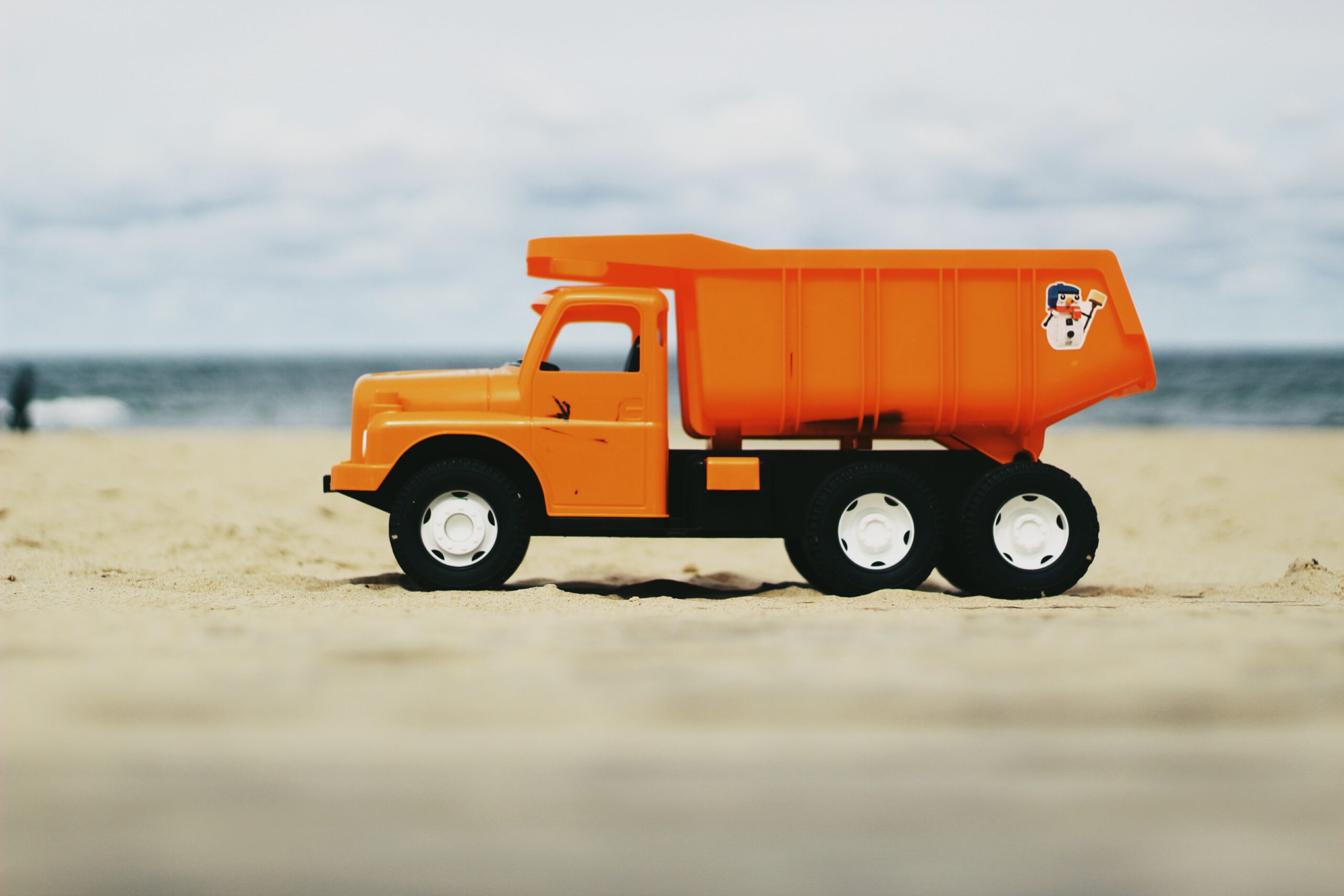
When my son was two years old, he scribbled on his dump truck with a brown marker and announced that he would wash it right there in the middle of our living room floor. My first reaction was to gasp when I noticed the brown scribbles. My second reaction was to see where his plan of action would take him.

So, I watched as he used the foaming soap dispenser to lather his hands and then rub the foam on the dump truck that was still on the living room floor. And I watched as he headed to the bathroom to fill his large bath-time cup with water to rinse off the foamy soap.

And that’s when I jumped in. Not stopping him but offering him another line of thinking by asking what would happen if he poured the water on the truck right there where it was. Thankfully, he responded that it would spill. I suggested we bring the dump truck outside to our front steps, where a giant water spill would not matter as much.

And the rest happened as you might imagine. My son happily poured water over the soapy brown marker and watched as it splashed on the cement pavers, instead of the living room floor. He went back inside the house to get a towel, which he smoothed over the water droplets on his beloved dump truck. And he smiled proudly at all that he had done.

If you are familiar with the principles of Montessori and the practice of following the child, this story may seem reasonable enough. It may seem as nothing more than a toddler exploring and experimenting with his dump truck and a mom observing and conscientiously guiding the learning moment that would unfold. However, when I submitted this story for a recent publication, it was changed. The edited version included the words, “This is going to be a disaster,” and I admit it stopped me in my tracks when I read it.

Not only was I impacted by the fact that a piece of original writing would be so altered, but also by the idea that our current thinking about children exploring and experimenting is so readily equated to things turning into a disaster.

The truth is, there is a great deal of learning in the so-called disaster. The mindful parent recognizes the learning potential when a child is following her own reasoning. The prepared adult is ever-present, jumping in to help only with the hard parts. That is the true meaning of Montessori parenting, as I’ve read in countless books, learned in Montessori training, and experienced personally with my own children at home.

So, I write today to challenge this thinking and normalize what we would otherwise consider a ‘disaster.’ When we let our children explore their ideas, when we observe this process, we realize that we are truly being given the gift of watching a genius at play.

Our job as adults is not to limit or edit this experience but to let it unfold and only redirect it when necessary. What I learned from my two-year-old son that day—what I witnessed—was a young toddler exhibiting complex executive-function skills, a little boy filled with resolute determination, a confident multi-cultural child ready and willing to solve problems in the world.

I hope that in the future, we don’t edit stories like this. These are moments to cherish for what they are … the awakening of life itself. •

Alicia Diaz-David is a parent and educator with over 15 years’ experience in education. She has followed the Montessori approach at home since her children were born and is a certified Montessori guide for ages 3-6. She is also the founder of TeachLearnMontessori.org, which is dedicated to helping parents better understand the Montessori philosophy and simplify the approach. You can learn more about supporting children’s growth and development using Montessori via the real-life stories she shares on Instagram @MontessoriwithAlicia or on her blog at TeachLearnMontessori.org.

50 Ways to Celebrate Summer Learning

50 Ways to Celebrate Summer Learning

50 Ways to Celebrate Summer Learning

by Cheryl Allen

Summer is a time of more daylight, warmer temperatures, and more time outdoors. We may think that, for children who are out of school in the summer, it is not a time of learning. Yet, it can be an incredible time of learning. Here are fifty ways to help your child learn and grow while not in school.

Explore

1. Let your child plan an activity for the day or some activities for the summer. They can use maps, stick to a budget, and do the research.

2. Go on a searching hike, in nature or an urban setting; look for objects in the shapes of the letters in your name, or in sets of your favorite number, or particular colors.

3. Learn about the plants and animals that are near you. What are those birds by your home? What are the names of the plants you see every day?

4. Walk at your child’s pace. Notice the smells of different plants, admire the bugs, follow your child’s lead.

5. Play board games.

6. Learn card or magic tricks.

7. Learn jokes and present a comedy show.

8. Play unplugged games, such as Hangman, your own version of Pictionary, I Spy, or other paper-and-pencil games.

9. Think of free or inexpensive ways you could help neighbors and act on them.

10. Create a scavenger hunt and follow the clues.

11. Try out new playgrounds nearby.

12. Go to a grocery store you do not usually go to, especially if it has a focus on an ethnicity different than your usual cooking.

13. Allow time for daydreaming.

14. Try outdoor science experiments.

15. Plan a dream vacation.

16. Find some art to admire, outside or in a museum. Discuss what each person likes about it.

17. Explore distances and make a map. How far are you from family members, favorite types of animals, friends, or any other thing that can be mapped?

Communicate

18. Make time for reading every day, or nearly every day.

19. Visit the library and allow your child to make choices of reading material on their own.

20. Encourage your child to tell a friend or a family member about a book they read; retelling helps develop understanding.

21. Write letters to friends and family.

22. Address the envelope for that letter. Writing the address correctly on an envelope takes practice.

23. Keep a summer journal or a travel journal. Write in it regularly and include printed photos, pressed flowers, or leaves, ticket stubs, maps, or any reasonably flat items that remind them of the events written about.

24. Have your child create lists for things to do, grocery lists, books read or books to read, movies to watch, anything that can be listed.

25. Write a letter to their future self and store it or use a site that will email you in a certain amount of time.

26. Create a kindness list; how many acts of kindness can be performed this summer?

27. Count cars, bikes, dogs, flowers, anything you see regularly in your travels.

28. Find letters of the alphabet or make up a silly sentence using letters or words on items in the grocery store. Only one word or letter per item!

Create

29. Build a design of your child’s own creation or follow the directions from a set, with Legos™, blocks, or other building materials.

30. Learn to build card houses.

31. Plan and build a birdhouse.

32. Make your own playdough and sculpt with it.

33. Water down paint, place paper outside, and use squirt guns filled with the watery paint for a creation.

34. Set up objects outside and trace their shadows onto paper.

35. Put on a show–write it, practice it, design costumes and props, and perform for others. Record the show to share it with family that cannot attend in person.

36. Use chalk to draw outside, then use water and a scrub brush to erase it.

37. Plan dinner for a night and help make it.

38. Make a salad. Make dressing to go with it for an extra skill-building opportunity.

39. Grow vegetables and harvest them for dinner.

40. Find a recipe and cook with a new-to-you food.

41. Shuck corn, peel potatoes, wash, and spin lettuce dry, participate in cooking preparation.

42. For older children, set a cooking challenge to use ingredients and make a meal.

43. Sketch or paint flowers at your home or a nearby location.

44. Draw self-portraits directly on the mirror using window markers.

45. Clean the mirror after drawing on it.

46. Wash windows (an adult may need to wash the top).

47. Water the garden or potted plants.

48. Organize an area of your home together, especially one that your child uses regularly.

49. Explore with cash, count coins, save for an item, buy something with cash and check the change received.

50. Make leaf or bark rubbings and label them with the type of tree or bush they came from. •

Cheryl Allen is the Associate Coordinator of the Montessori Family Alliance and is also a parenting educator and a Montessori consultant with the Montessori Foundation. Cheryl attended Montessori school as a child. After some time as a traditional Secondary teacher, she worked in Montessori classrooms, 3-6, 6-9, and 9-12, earning certifications from both AMS (3-6 and 6-9) and IMC (6-12). She is a teacher educator, workshop presenter, and member of IMC accreditation teams. Cheryl’s two children attended Montessori from age two through high school graduation.

The Power of Hands-on Learning

The Power of Hands-on Learning

The Power of Hands-on Learning

by Mary Ellen Maunz

“What the hand does, the mind remembers.” – Dr. Maria Montessori

If a child is able to use their hands to discover, their discoveries become more meaningful to them. The concepts they learn are much more rooted than any rote memorization could be, because in using their hands, they experience their learning. They are an active participant.

Active Education

If you picture a traditional classroom, you would likely see a teacher standing at the front of the room near a black- or whiteboard, speaking to children who are lined up in desks, memorizing facts, or attentively looking at and listening to their instructor.

In recent years, concepts such as “table groups” and “flexible seating,” where children can sit in small groups, or choose where they sit, have allowed for some redesign throughout the classroom.

In addition to the arrangement of the environment itself, many teachers and administrators have also looked to hands-on or non-traditional classroom experiences like “project-based learning,” “design thinking,” “the maker movement,” and “the flipped classroom,” for ways to engage children in their learning.

These shifts in education are a reminder that schooling isn’t one-size-fits-all. Individual needs can be addressed when we take the time to step back, assess what we are doing, and make the decision to move forward with purpose. Need some guidance for change? Read on!

Making Changes

If you are unsure where to start, let me give you one powerful idea.

Start with the child’s hands. Sure. Easy. The child’s hands. What? Let me explain.

If you can make a change in learning, begin with just one simple step. Try this: begin by watching hands. Hands are smart. Really smart. Just like our heads. Often, however, this seems to be forgotten.

If you ever have the opportunity to observe someone learning a new skill, I would challenge you to watch their hands. It is through touching and manipulating that information is taken in through the hands and delivered to the brain.

Use Your Hands!

Adults seem to think that it is okay for younger children to work with their hands when they are learning. Think about it: sandboxes, water tables, Play-doh™! But somewhere along the way, these manipulatives got a bad rap for being “childish.” Why?

If you’ve ever seen someone participate in an activity they love, you’ve very likely seen them using their hands! You’ve likely witnessed someone building with tools, fixing up a vehicle, or playing an instrument. How about someone turning the page of a book, digging in the dirt while gardening, or making food?

Why should learning through math, science, history, or languages be any different? Utilize an abacus for addition, measure velocity when launching a marshmallow with a spoon, tea-dye a map, or handle pairs of objects that rhyme. Whether formal or informal education, using your hands helps!

In the Montessori Classroom

Dr. Maria Montessori was a scientist who spent time observing children. In doing so, she realized that children wanted real-world, hands-on application for learning. Not only did they want it, but they also experienced joy in using their hands.

Through experimentation and careful calculation, Montessori developed materials for children to use. These lessons intentionally foster self-discovery and serve learning goals. Over one hundred years later, the observations she made then still hold true. Regardless of subject matter, children enjoy, and benefit from, using their hands to learn.

In a Montessori classroom you will see hands-on learning EVERYWHERE! A child washing a table is learning care of their environment, while also preparing their hand muscles for similar movements in writing. Placing cubes on top of one another for the Pink Tower allows children to learn precision of movement, while also allowing their body to experience, physically, the difference in 1 cubic centimeter ten times over! Not only this, but it is also teaching the basics of the mathematics base ten system. Rarely is a lesson in a Montessori classroom taught for one purpose only, and usually, with time, the hands-on learning leads to multiple objectives.

A Personalized Journey

Learning is not a race with a finish line. It’s a constant stroll through a variety of experiences that all necessitate different paths and use different materials.

Whether Montessori is your muse, you want to improve learning for your students, or you just personally like to get your hands dirty, don’t wait! The world is waiting for you. Explore! Dig in! •

Mary Ellen Maunz is the Founder and Program Director of Age of Montessori. She has more than 50 years of experience inMontessori education for both teachers and parents. She collaborated for two decades with Dr. Elisabeth Caspari, student and personal friend of Maria Montessori. She is an international authority on Early Childhood and Elementary education and has lectured and taught students in seven countries on five continents. Internationally-renowned author and lecturer, Maunz is on a lifelong mission to help parents understand the underlying needs of the developing child. Find our blogs, webinars, professional development and MACTE certified teacher education courses at: ageofmontessori.org

Making Lunch

Making Lunch

One of the most challenging parts of having children in school is making lunches. With some guidance, children can make their own lunch. It then becomes a win/win situation. You do not need to make lunch daily, your child gets to practice practical life skills, and your children are more likely to eat their lunches. As with all new skills, it may take more time initially, yet the work and time will benefit both of you for years to come.

How can a young child prepare their lunch each day? Preparation of the environment, the necessary tools, and a lesson will all be necessary.

Preparing the Environment:

• Make appropriate food for lunches available at child height. This may mean reserving space on a low cabinet and low shelf in the refrigerator for lunch materials. At our house, we used colored baskets in the cabinet and refrigerator to quickly designate which items were for lunches.

• If needed, divide the food into servings before lunches are made. Your child can help you do this after school or over the weekend. If five baby carrots are an appropriate serving for your child, make a few bags with five carrots in each.

• Make sure your child can open and close any containers used and manage their lunch box.

• Consider when lunch should be prepared. If your child has trouble getting out of the house in the morning, make lunch the night before and store it in the refrigerator if needed. If your child is usually ready early, the morning is a great time for this job.

The Necessary Tools:

• Have utensils your child can use to make lunch, such as: a knife for spreading and cutting; a cutting board; containers that your children can open and close; and lunch boxes that allow them to pack easily.

• A list of ideas in written or picture form may be helpful for your child.

• Decide what you expect for lunch. What constitutes a main meal? What is a snack? Do you have a guideline of how many fruits or vegetables need to be included?

A Lesson or a few lessons):

• Discuss the plan with your child.

• Show where the tools and materials for making lunch are.

• Talk about what should be included in lunch and why, i.e., you need energy for growth and your day; these foods are not allowed at school for allergy or other health reasons; these items do not transport well. Share the reason for the guidelines.

• Work with your child the first few times and discuss what you are doing and checking: e.g., “I don’t see any fruit in here. Would you like to add a fruit or another vegetable?”

• Show your child how to clean out their lunch box at home before just adding to it.

Follow Up:

• Peek inside the lunches that are going to school. Do they meet nutritional needs as you expect?

• Discuss options and ideas with your child before grocery shopping.

• If you have leftovers from dinner, ask if your child would like some for lunch and plan together how to make that work.

• Let your child’s teacher know that your family is making this change. Your child may be pleased and possibly even distracted by the lunch they made at first, so letting the teacher know means they can help with these changes.

Enjoy the small break this gives you and the independence it gives your child.


Cheryl Allen is the Associate Coordinator of the Montessori Family Alliance and is also a parenting educator and a Montessori consultant with the Montessori Foundation. Cheryl attended Montessori school as a child. After sometime as a traditional Secondary teacher, she worked in Montessori classrooms, 3-6, 6-9,and 9-12, earning certifications from both AMS (3-6 and 6-9) and IMC (6-12). She is a teacher educator, workshop presenter, and member of IMC accreditation teams. Cheryl’s two children attended Montessori from age two through high school graduation.

A Sense of Place

A Sense of Place

Engendering Love of One’s Home with Adolescents

The NewGate School, Global Campus Students, Research Their Place on Earth and Weave a Story to Share

By Amy Kremer-Treibly and Elizabeth Hale


The NewGate School’s Global Campus is composed of students in seventh through twelfth grades who live in Canada, the US, the Caymans, and Tanzania. These students are the first cohort of the Global Campus, and they work together with a dedicated faculty for humanities, math, science, and Spanish academic courses, as well as working in their home communities on creativity, physical wellness, and service.

Adolescents seek answers to key questions: Who am I? Where am I? What’s happening?

In order to gain insights and impressions of where each student resides, they set out as investigators of their own backyard, town, city, and country, with special attention to who inhabited the land first, including animals, plants, and humans. Students have been sharing their stories as presentations to the community in Opening Meetings held each morning of the week. This project offers a rich opportunity for students to explore the question of where do I find myself living right now?

During this process, students access local historical societies and talk to family and neighbors about generational memories of the place. Some students highlight developments, such as industry and railroad access. Others brought names of indigenous tribes to our attention, as well as the plants and animals that have thrived in the past and either do or do not live now. Overwhelmingly, the students learn more about where they call home. In addition to acquiring knowledge of place, by pausing and giving attention to the land that supports our lives, the people who have come before, and the bounty that nourishes us, we all grow in our appreciation and gratitude for home.

It has been said that to love a place and show true care for it, one must spend time, look with earnestness for the hidden treasures to be revealed, and then we can fully celebrate our home. Indigenous wisdom embodies connection and relationship, and for that reason, we like to include the Haudenosaunee Thanksgiving Greeting, which we read aloud in turns during Council before Thanksgiving. •

REFERENCE

Smithsonian Museum Blog. https://tinyurl.com/mvvjxu4f


Amy Kremer-Treibly, M.A. earned her Bachelor’s Degree in Anthropology at Loyola University where she also enjoyed studying Spanish during a study abroad term in Quito, Ecuador, and learning about world religions as her minor. She began her teaching career in a refugee resettlement program teaching ESL to adult students from around the world followed by teaching Spanish at the elementary level. While teaching at a Great Books Foundation high school in Arizona, she earned her Master’s Degree in Experiential Education at Prescott College with a focus on building schools and learning experiences to promote engagement, eco-literacy, and stewardship.

Elizabeth Hale teaches Humanities and other courses with NewGate School’s Global campus. She spent the last 13 years developing Heartmoor Farm Education Centre in central Virginia teaching Literature, Humanities, and Mindfulness to adolescents while nurturing her connection with the natural world specifically through contemplative practices, the stewardship of plants, and formal study of Western Herbalism. With 24 years of teaching experience, in classroom environments from Oregon and Ohio to Virginia, she has worked with families through all stages of their children’s development.

Raising Helpers

Raising Helpers

by Theresa of Montessoriinreallife.com

One of the most wonderful things about toddlers is how they so inherently want to help. They are eager to be involved, be near us, and participate in our day-to-day activities. What we deem “chores,” toddlers see as what they are: meaningful contributions to our family or community.

After toddlerhood, we often notice a shift. Children seem less intrinsically motivated to help and view helping more as a chore. This is a natural part of development: they are more independent and focused on their own work and play. They are discovering who they are and where their own interests lie, which is a beautiful thing. It also doesn’t mean it’s the end of helping!

How do we continue to foster this motivation and raise helpers beyond the toddler years? Here are a few tips that I’ve been keeping in mind in our own home lately. These can be incorporated in toddlerhood and well beyond!

Help Our Children

Our children learn how to help through us helping them. When we respond to their requests for help, they are more likely to do so in return. Helping doesn’t mean doing a task for them, but rather offering just enough help to get them through a tough spot.

Model It

Not only should we think about how we are offering help to our children, but how can we offer help to our partner, a friend, or our community? The more our children see us being helpers, the more likely they will want to be a helper too.

Talk About It

“In our family, we help each other.” This is a phrase that we repeat often at home. The more we say and hear this, the more ingrained it becomes and the more natural it feels to be a helper in the family. Importantly, this phrase is said in a gentle way, not as a command.

Make It Part Of The Routine

When we make helping a part of our daily rhythm, it becomes natural. In our family, certain tasks are the kids’ responsibility every day: putting shoes and coats away, setting the table, feeding the dog, wiping up spills, tidying toys, etc. These tasks aren’t rewarded but rather just part of the routine.

Don’t Force It

Inviting doesn’t guarantee our children will help. Even when these tasks are part of the daily (or weekly) routine, everyone has off days. We can offer grace and let it go. Often, the next day, or at a different time, they are ready to help again.

Offer Opportunities

Sometimes we move so quickly through our own chores, we forget that we could involve our children. As much as possible, I try to do chores in front of the children so that they have the opportunity to join in and help. Often, what we consider mundane tasks are satisfying for our children. Having cleaning tools that are appropriately sized for our children makes them feel especially capable.

Accept It As Is

When our children do help, we may find that they’re ‘help’ doesn’t lead to the outcome we desire. The dishes might not be as clean, or the laundry might not be folded in a neat stack. When this happens, we can thank them for helping and appreciate the effort that went into it. Rather than correct them at the moment, we can model again another time, and try to be patient, as every skill takes time.

How can your child help today? •


Theresa is a mom to two, a former Montessori guide, and the founder of the blog Montessori in Real Life(www.montessoriinreallife.com). Prior to momming and blogging, she went to graduate school for developmental psychology and earned her Montessori infant/toddler guide certification. Since transitioning from teaching to motherhood, Theresa found a new passion sharing her love of Montessori with parents,while continuing to implement the Montessori philosophy in her own home.

Messy Spaces for Art and Hobbies

Messy Spaces for Art and Hobbies

by Tim Seldin and Lorna McGrath

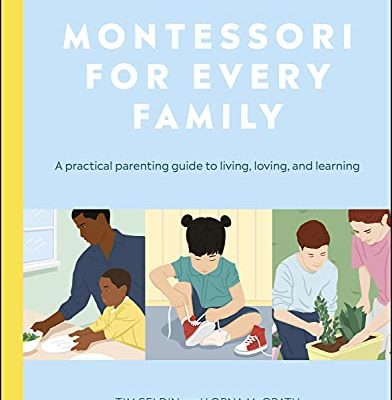
An excerpt from Montessori For Every Family, published by DK Press, 2021

In most families, there are hobbies, interests, and activities that can be messy, need to be left in place to continue to work on later, or where special tools and supplies can be kept on hand and are easily found as needed. A messy space like this could be a spare room in your house, in the basement if you have one, or in your family garage.

It could be a craft and art studio for sculpting or making pottery or an area for woodworking with a workbench with tools arranged on shelves or hanging from a pegboard. It might be a room where you keep your paints and an easel, a photography or video studio with lighting and backdrops, or a space for tools to work on your cars or bicycles.

Keeping order in mind as you plan and organize the space is key to reducing frustration when you can’t find a tool you need or something you’ve just created gets knocked over. When there is clutter and disorder, accidents are more likely to happen and safety to be compromised. It also becomes more difficult to concentrate on the project at hand.

In a Montessori-inspired home, we want to think about what kind of space is needed for your interests or hobbies with all members of the family in mind. Your children are likely to want to be around you as much as possible, as well as needing a space where they can do the things that they prefer. So the idea is to think about the activities that your family members enjoy and consider which ones can be done in the same space.

Many families do not have a spare room, a basement, or even a garage that could be turned into a messy room. What are you to do then? Of course, everything depends on the ages and interests of your children, which may be very different from child to child, but the basic concepts remain the same. Our goal is to allow children to do activities that may be too messy to allow in their bedrooms, the kitchen, or the living room. When you live in a small apartment or home, you have to think outside of the box. You may make an exception to the general rule, and create a small area in the child’s bedroom where you lay down a protective heavy plastic covering on the floor and allow your child to paint, work with clay, glue models together, and other things using a washable covering to protect the surface of the kitchen table. The goal is to encourage children to feel that they can explore hobbies and interests while having your house (or backpack) become a mess.

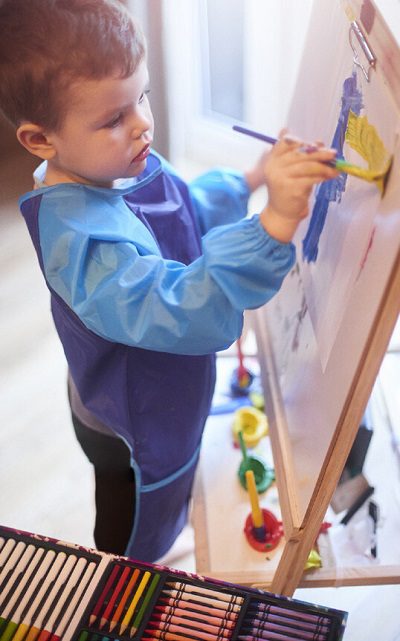
Real-life story: When Jennie first went to school, she was fascinated with the art materials in her Montessori class. She loved to paint and draw with the beautiful beeswax crayons and colored pencils that were part of the classroom environment. When she would come home, she would often ask her mom if she could have an art studio. Jennie and her mom bought her a set of simple water paints and brushes, a small tabletop easel, and a stack of water-paint paper. They set up a little art studio with tile on the floor that could be easily cleaned if any paint spilled. Mom also bought some picture frames made from matte board so Jennie could hang her favorite paintings. As time went by, Jennie moved from water paints to charcoal and pastels and finally tempera and oil paints. but her interest in drawing and painting never faded away. Today, Jennie has grown up and has a career in science, but she still enjoys painting and loves going to art galleries.

Real-life story: I started noticing my son’s school backpack was full of what I considered trash. Broken rubber bands, the inner ring from a roll of tape, bits of string, etc… for and he just said that he needed them. Then, I started noticing items moving from the recycle bin to his bedroom. Egg cartons, milk jugs, cardboard boxes of all sizes…..it was looking like a recycling center in his room. I would ask him what they were. He kept saying he “needed” it all, so I walked out, took a deep breath, and went with it when what I really wanted to do was put it all back in the trash and have a clean house! Then, one day, he emerged from his room with a giant “smoothie shop” that served all types of smoothies (made out of cardboard and “trash”). This shop was so amazingly detailed and each bit of “trash” served a thought-out purpose. He used amazing grace and courtesy to take our orders and serve us smoothies. We all drank some delicious smoothies that day, and I silently thanked all of his Montessori teachers for teaching me to follow his interests… even when those interests looked like “trash!” —Tara, mother of John 9 years old


Lorna McGrath, M.Ed., is Director of IMC School Accreditation, Program Director of the Montessori Family Alliance, and Senior Consultant of The Montessori Foundation. Lorna has 41 years of experience in the field of education, teaching children from 18 months through 6 years old and from 12 through 18 years old in both public schools and independent Montessori schools. Lorna is a Montessori teacher educator, conference presenter, and school consultant. She can be reached at lornamcgrath@montessori.org.

Tim Seldin is President of the Montessori Foundation and Chair of the International Montessori Council. His more than40 years of experience in Montessori education includes 22years as Headmaster of the Barrie School in Silver Spring, Maryland, his alma mater from toddler through high school graduation. Tim was Co-Founder and Director of the Institute for Advanced Montessori Studies and the Center for Guided Montessori Studies. He earned a B.A. in History and Philosophy from Georgetown University, a M.Ed. in Educational Administration and Supervision from The American University, and his Montessori certification from the American Montessori Society. Tim Seldin is the author of several books on Montessori Education, including How to Raise An Amazing Child, The World in the Palm of Her Hand, and his new book, Montessori for Everyone, co-authored with Lorna McGrath.

Some Of Our Favorite Supplies For An Art Area In Your Home

Some Of Our Favorite Supplies For An Art Area In Your Home

“As well as being part of our history and a way of understanding other people’s experiences, art is also a form of personal expression, like poetry, song, dance, and telling stories. It is a form of human connection that can evoke feelings, thoughts, and hopefully appreciation and understanding. Montessori encourages families to expose children to as many forms of art as possible. Encouraging your child’s interest in art and giving them room to be creative provides them with experiences that will endure.” — Excerpt from Montessori for Every Family by Lorna McGrath & Tim Seldin

The new book, Montessori For Every Family: A practical parenting guide to living, loving, and learning, by Lorna McGrath and Tim Seldin, shares some ways to encourage an enjoyment of art and to set up a space to create. We have searched out materials to help you set up an inviting art space in your home.

A child-sized wooden table can be your art area for years. Look for a sturdy table and chairs that fit under the table. If you do not have space for a separate art table, consider a coffee table with storage nearby.

Pictures by different artists can be chosen by you or your child if you visit an art museum, or ordered from art.com. Also consider a piece of wood with clips attached and a variety of postcards for a changing display.

You may want a paper roll so you can create different sized pieces of paper.

The MÅLA

Paper roll holder with storage is a good choice. It is available from several vendors, including Amazon. Here is a link to one from IKEA: tinyurl.com/ mrxfc27e

MÅLA Apron

Keeping clothes neat during art exploration is difficult for some of us, so a smock can be a beneficial part of any art set up. tinyurl.com/2zzsetah

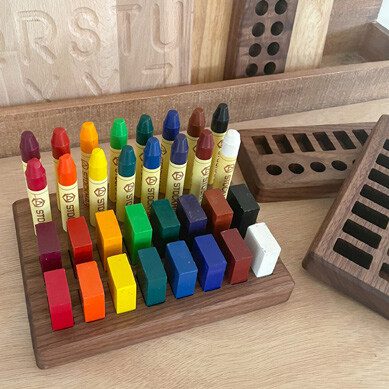
Stockmar Beeswax Crayons

Beeswax crayons allow for layering of colors and draw smoothly. They also last longer than traditional crayons. tinyurl.com/289usjem

Eco Finger Paint

Changing out art materials for different ages can help keep their interest up. Young children enjoy the opportunity to finger paint; this finger paint is made with food-grade materials, so you do not need to worry too much when painty fingers go into mouths. ecokidsusa.com/ eco-finger-paint/

Watercolor Pencils

Older children may like the many different ways to draw with watercolor pencils. tinyurl.com/2p9a6d5n

Add a pad of watercolor paper. ecokidsusa.com/eco-art-pad-1

Watercolors

This all-natural, set of opaque watercolors has magnetic pots of color, so just a few can be used at a time. tinyurl.com/3ruhf9yu

Honeysticks

For younger children, who may even like to taste their paints, Honeysticks is a set made from food-grade ingredients. tinyurl.com/bdfjy9w9

Beeswax or Soft Dough

Younger children may find beeswax or soft dough easiest to use. Stockmar modeling beeswax warms up in your hands and smells delicious. tinyurl.com/mws8axc3

Soft play dough can be reused again and again. tinyurl.com/2p9zy89v

Include a container or two, to collect items for collage and sculpture making. Egg cartons, confetti, rubber bands, pom poms, whatever could be reused and is appropriate for their use, can go in the containers for building and creating. Be creative, and follow your child’s interests. Have fun with these ideas and supplies, and add your own art area in your home.