
Technology and Montessori: Thumbs Up or Thumbs Down?
 It was nearly “a long time ago in a galaxy far away” that Montessori education first came to the world. The year 1907 was, indeed, a fairly long time ago, none of the parents of children in Montessori schools today had been born yet and neither had their grandparents.
In 1907 the world was very different. There was no commercial air travel. The average person didn’t travel further than 200 miles from their home and transatlantic communication was principally by boat (the first transatlantic radio signal was in 1901; the first cross-country telephone signal across the US wasn’t until 1915). ‘Technology’ was very basic, and most people didn’t spend a lot of time concerning themselves with it; technology was the arena of engineers and builders.
Public education was less than fifty years old in 1907, and schools were primarily concerned with reading, writing, and arithmetic. And here’s an interesting quotation from the era:
“The central and dominant aim of [today’s technology] is to bring the world to the classroom, to make universally available the services of the finest teachers, the inspiration of the greatest leaders and unfolding world events, which through [the technology] may come as a vibrant and challenging textbook of the air.”
Sounds like another public policy speech about tablets and wifi in schools, right? In fact, this was a statement by Benjamin Darrow in the early 1920s when radio (!) was being introduced to some of New York City’s high schools for the first time. It seems that every new technology is going to save the day for education – completely change the way children learn, how well they learn and truly come to engage them. Radio, then television in the 1970s and 80s, then computers, then having all schools ‘wired’ for internet access were all championed as the thing what would finally fix/improve education. None of it has been a game changer. None of it has affected test scores or actual student learning or engagement. Today, educators and parents are as worried as ever about the state of our schools. And they still go on thinking that computers/technology is the source of the solution. As a culture, we are fascinated by the “faster, brighter” of just about anything.
Educational psychologist Jane Healy (in her book Failure to Connect) shares what William Ruckeyser (with the non-profit organization Learning in the Real World) told her about people’s clinging to this view despite any evidence: “The nearest thing I can draw a parallel to is a theological discussion. There’s so much an element of faith here that demanding evidence is almost a sign of heresy.” Healy spent many years as a teacher in conventional schools, then as a principal, before turning to psychology. As she learned more about how the human brain develops and how children, people, actually learn, she came to see that the world of education needed serious transformation, writing:
“Do I risk being stoned in the public marketplace if I suggest that the purpose of education is not to make kids economically valuable, but rather to enable them to develop intellectual and personal worth as well as practical skills?”
Healy understands what Dr. Montessori understood: education is about serving life, about guiding a child’s development so that the outcomes serve to prepare and empower children to make lives for themselves, to find success in the world. Healy made her point some 90 years after the first Montessori school was established.
Yet, because Dr. Montessori’s work comes from a very different age, there are some who question its relevance today, given the very different culture of the early 21st century. The chant goes like this: “Ours is a fast-paced, interconnected world. We need an education model that will ready children to live and succeed in this world.”
This view was discussed recently by Mark Powell in “Modernizing Montessori,” published in Montessori Leadership and Tomorrow’s Child in January 2015. He makes the case for thoughtful integration of technology into Montessori environments as a way of preparing children for life. For the most part, he details applications for above age 6, but he sees some limited usefulness in the Primary environment. There’s an undertone in his piece that it’s a given that we need to introduce technology (and more of it) into Montessori environments. I’m not so sure I’m ready to jump on that bandwagon as a ‘need’ in Montessori classrooms, and Healy would be equally cautious.
Like many others before, Powell suggests that because Dr. Montessori was a scientist and a non-conformist visionary (my words), he feels confident speculating that: surely she would have embraced the new technologies of our time.
Dr. Montessori herself once wrote:
“Times have changed, and science has made great progress, and so has our work; but our principles have only been confirmed, and along with them our conviction that mankind can hope for a solution to its problems, among which the most urgent are those of peace and unity, only by turning its attention and energies to the discovery of the child and to the development of the great potentialities of the human personality in the course of its formation.”
“Our Principles have been confirmed.” Principles have the wonderful benefit of being general; you don’t have to have every imaginable example available to be able to formulate one and, the principle once formed, then has the merit of applying to a wide range of specific situations not imagined or even imaginable at the time. Take theft, for example. Once we have the principle that we don’t take other people’s things, we don’t need to enumerate all the things that we won’t take. It suffices to ask Is this mine? at the moment one contemplates taking something.
Dr. Montessori said, “We do not say that we want to prepare a school for the [child]; we wish to prepare an environment for life…” Her concern was clearly about “preparation for life” and not merely how to succeed at school. She shared the view of people today that education must be relevant and ready children for adult life. How is Montessori education in the 21st century doing with this? Are Montessori children not only adequately prepared for today’s world, but incredibly prepared?
Dr. Montessori spent a significant amount of time writing about the development of the human being. Her work amounted to laying out the principles of human development. She went into thorough detail about the actual needs of human development across the span from birth to maturity. Her perspective is much broader than that of most educators and policy makers. In truly looking at “what is education for?” she famously railed against “the passing on of information” and against “the mere transmission of a greater amount of information,” which was (and sadly remain) the perspective of conventional education.
Dr. Montessori didn’t focus on a specific media or device as being essential to education. She said that we need to use what is part of our time and culture because that is our world. But we do so at the developmentally appropriate time. It is not a lack of understanding about technology that keeps most technologies out of Montessori environments, especially at the younger ages; it is an understanding of what is truly essential to human development that does.
The typewriter was relevant through much of the 20th century, though most Montessori schools didn’t bother teaching that, and neither did most conventional schools prior to high school. This was not a disadvantage to anyone. Typing was a skill required by some and was acquired if and when it became necessary. Using a computer today, a tablet, voice-controlled devices, and so on are not challenging things for adults or adolescents to learn, and they don’t assist in the learning process. Our time with children is better spent helping them learn how to think and to develop the lifelong skills that Healy and Dr. Montessori mention, skills which today are also being discussed significantly.
The American Montessori Society’s position statement on technology inclusion lists the skills/competencies as: digital-age literacy, inventive-thinking skills, effective communication skills, and high productivity skills. These are indeed necessary for success in today’s world. In fact, these skills have been much talked about in recent years as the real focus of transforming education. Fortunately, though not surprisingly, three out of four of these are exactly what Montessori environments support and produce. They are perfect examples of “Montessori outcomes:” the ability to think critically and divergently; excellent written and oral communication skills; and efficient time management with quality work. This is not surprising, because when you set out to “prepare a child for life” you would need to concern yourself with these skills; they are just what success in the world requires.
Of course, few Montessorians list “digital-age literacy” as a Montessori outcome, but that is because it comes later, like typing would have 40 years ago. The state of technology today is such that the learning curve is extremely short. Give an adolescent a computer today and they will have it mastered in under a week. The innovators in technology over the past 40 years were not “digital natives” and seem to have moved the rest of us forward quite nicely. My own experience with a computer wasn’t until my junior year in a private high school, circa 1980, and that was cutting-edge (public schools didn’t have any computers). My point is that learning how to use technology is not a challenge today, and it wasn’t in the past.
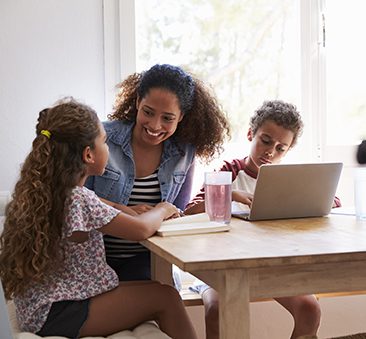
Let’s say a word about this since children today are being handed phones and tablets from infancy. “So easy even an infant can master it!” should be the sales pitch. And it’s true: a tap here, a swipe there… the human brain is so powerful that these simple gestures are easily absorbed by the youngest child. And today they are doing just this. And that’s the shame.
Jane Healy spent a significant amount of time researching technology use by children of all ages and wrote her book, Failure to Connect, as a result. There she discusses not only what the interaction with technology does to the developing brain, emotional life, and psychology of a child but also what experiences are not being seen and the effect of this loss. There is no shortage of writing of this question. The glazed, blank stare of a child into a screen is too familiar. But, what is operating below the surface, unseen, is where the real danger lies?
The passive activities that children are engaging with in the games that they play on these devices leads them towards a lack of emotion regulation, poor inhibitory control (driven by the instant gratification of the games), and a lack of control with the actual world. If we are aiming to help children live healthy, productive lives, these experiences are just the opposite of what we need to offer the developing child.
So, let’s return to the questions: How is Montessori doing with preparing children for today’s world and culture? Are Montessori children not only adequately prepared for today’s world, but incredibly prepared?
There has been significant research over the past fifteen years on these questions, and the summaries are available. The bottom line is that Montessori schools do exceedingly well on all fronts. Research shows not just academic prowess, but things like ‘justice’ and ‘fairness’ have been considered.
One research undertaking (http://psychology.about.com/od/PositivePsychology/a/flow.htm) looked at the levels of ‘flow’ that children in Montessori experience and the results were incredibly flattering. So the data is coming in and it will be heaped on top of the personal, anecdotal evidence that has piled up since 1907: parents know that Montessori is the best thing for their child. Quality succeeds. There are more Montessori schools in 2015 than ever before and more growing at both the younger, 0-3 year level as well as the middle and high school levels. Why? Parents want more. Why? Because they know it works. There are more public and charter Montessori schools today than ever before and more coming.
What is the full list of desired outcomes or competencies for success today? There are numerous lists and sources, and they seem to converge on a list like this: adaptability; intrinsic motivation; leadership skills; excellent communication skills; resourcefulness; problem-solving skills; empathy; and creativity. There are others, but this is the core.
The amazing thing that occurred when these lists began to be generated and discussed was that they ended up looking like what Montessori schools were already promoting as their outcomes. NOT on the list of 21st-century competencies is “high SAT scores,” “straight-A students,” or anything academic at all. It turns out that the world is coming to realize that to be successful in life you need a whole lot more than reading, writing, and arithmetic.
Dr. Montessori had this figured out in 1907. This is why Montessori education is growing faster than ever. It is not old, tired, or outdated because it continues to meet the developmental needs of human beings and provides a guided structure to support the development of life-serving, success-building competencies.
Editor’s Note: This is a response to an article by Mark Powell that appeared in the January 2015 issue of Tomorrow’s Child, in which he describes “digital natives”… children who are growing up in a technological age … and how this new technology complements (or doesn’t) the teaching of Maria Montessori.
Tomorrow’s Child / January 2016 / pg 9

Montessori: Does It Work? What Research says About Montessori And Student Outcomes
To continue reading, you will need to choose a subscription plan.

Webcast: Montessori Compass – The story behind the software
To continue reading, you will need to choose a subscription plan.
Research for the Montessori Classroom
To continue reading, you will need to choose a subscription plan.
Supporting the Development of Concentration
Concentration: What is it?
In a LinkedIn post this past June, “Want Kids to Succeed? Teach them Focus,” Daniel Goleman explains why concentrating is a precursor for both learning something new and developing self-control. We all know that success in school and in life depends on developing this ability, so it’s encouraging to see modern psychologists and educators recognize this is a fundamental skill to address in school. Goleman offers great suggestions.
There are limits, however, to what one can achieve in educational systems that interrupt students mid-thought to move them to a new subject, change teachers, and that breed competition with grades, rewards, and punishments. For these environments, Goleman proposes exercises for teachers to use to help their students slow themselves down, pay attention to their surroundings (themselves and their peers), and focus on what is being taught. Yet, the rest of the school day is so counter to this mindset that even with improved focus, children cannot develop a deep level of concentration and reach the ultimate benefits of doing so. And, alas, you cannot force a child to concentrate. So, what are we to do
In the Montessori educational approach, the development of concentration is already front and center in its every aspect. This may be a little-known fact. Kathleen Loyd, Ph.D, an AMI Montessori-trained teacher and a college professor, writes that, “…Amid all the comments typically heard explaining Montessori education, the value of concentration for optimal human development is rarely mentioned, yet this is the foundation of [her] work.” (NAMTA Journal, Winter 2011).
Maria Montessori recognized, as early as 1906, that to develop one’s ability to concentrate was essential to all else and, therefore, she began her work with this end in mind. In her lecture in Rome on April 3, 1913, she proposed that unless we work with the nature of the young child, we would be trying to attract a fleeting attention with our teaching efforts; instead, her approach was to “awaken” the attention in the child by presenting a material that meets his developmental needs and encourages spontaneous repetition as the child tries to figure it out. About human nature, she observed, “We do not observe all things indifferently, but there are some things that attract our attention and some which do not, so that the mind is built up…on something that is…actively seized.
“This inborn primitive response can be understood as something that persists and begins to characterize the individual psyche. It is linked to some instinctive impulse…[it is a] principle for the construction of the inner-personality, which must, in turn, develop according to its own particular laws.
“When viewed thus, attention is not something abstract, but something to be developed. In the world around us, we do not see everything, hear everything, and feel everything, but…we…notice [and] assimilate…to the degree to which our powers of concentration are capable. We cannot concentrate our attention haphazardly…but according to an inner drive.
“If this is so…we cannot take the child’s attention and carry it where we will, but we should observe where the child’s attention tends to go, for that tendency reveals the path existing within the child or the developmental need that the child possesses by nature. And this fact is repeated, not only in the child, but, I believe, throughout the whole life of the individual.
“…We can only be guided by facts. In the case of the small child, we find that no child can concentrate on one object for a long time, unless the object itself spontaneously attracts the child’s attention.”
Montessori made it her goal, then, to notice what objects attracted the children’s attention so strongly that they became fixed upon them and, thereby, developed their powers of concentration — powers which could then be transferred to other subjects as their interests were piqued, so that they learned many more things. This also enabled them to form much greater self-control than adults thought possible in small children.
As a side note, I can see that some parents may mistake the way a child stares at a screen and becomes fixated on a video game to be ‘concentration,’ when it is, in fact, very different. We now know that the lights on screens, in a sense, ‘hijack’ the mind and take it where it will, giving the child no practice in being in charge of his mind. The passive experience does not contribute to developing powers of controlling one’s thoughts and regulating one’s emotions; thus, the difficultly in getting a child to look away from a screen, to get him to think of things other than his video game, and the temper tantrums or jittery behavior frequently reported in children after they spend time with digital screens.
What Montessori describes above and in many further writings has the superior qualities that Daniel Goleman, Mihaly Csikzentmihalyi, and other scientists, psychologists and educators recognize as a deep, engaged state in which the heart rate slows, the brain becomes active in measurable ways, and it synthesizes information. The personality becomes calm, self-controlled, and powerful. Csikzentmihalyi coined this state as “flow,” and Daniel Goleman calls it “attention,” or “focus.” When people are intensely interested in what they are doing and able to shut out external stimuli, we can say that they are fully concentrating.
Concentration can also take on the quality of being acutely aware of one’s surroundings and sensorial information, while simultaneously giving focused attention to one chosen thing. We call this being “mindful.” In a Montessori classroom, both the intense concentration that shuts out external stimulus and the subtle awareness of all that is around you (mindfulness) are being developed. In a Montessori classroom, a child flows from one state to the other throughout the day, responding to an environment that encourages both these states. The Montessori environment encourages these states with long, uninterrupted work periods of up to three hours; a trained Montessori teacher who ‘connects’ the child to the materials he may work with by watching for his interests; and surrounding him with other concentrating, working children, who respect one another’s space.
Why is Concentration so Important?
Only when paying attention to what they are doing can people learn something new and make new pathways in their brains. Jeffery Schwartz, MD, and Sharon Begley reported on the findings of brain research in 1993: “…Although experience molds the brain, it molds only an attending brain: ‘Passive, unattended, or little-attended exercises are of limited value for driving’ plasticity, Merzenich and Jenkins concluded. ‘Plastic changes in brain representations are generated only when behaviors are specifically attended.’ And therein lies the key. Physical changes in the brain depend for their creation on a mental state in the mind: the state called ‘attention.’ Paying attention matters…for the dynamic structure of the very circuits of the brain and for the brain’s ability to remake itself.” (Schwartz and Begley, 2000). Furthermore, paying attention is an act of the will, so Schwartz and Begley go on to explore the very point that Montessori herself makes in the previous quote: that to help people develop attention, we must follow their interests, so that their will is the driver.
The Organizing Mind Builds through Concentration
With this important goal of developing concentration, Montessori set out to develop materials that would not only attract the child’s attention but help him to build organization in his mind, learn about the real qualities of the world around him, and explore the minute differences in qualities so that he could see further details and categorize them in the wealth of information he discovers. I will give just one example of such materials: the Sensorial Materials for children ages three and four.
The Sensorial Materials help children to further develop their senses, which is how they explore their world: touch, taste, smell, sound, and sight. The materials are objects made of beautiful wood and other natural substances that young children noticeably want to touch, hold, and explore with their senses. Montessori fine tuned these materials in response to how she saw the young children work with them. The ones we use in our classrooms today are the models she designed after years of experimenting with many different children. She found that at certain ages and stages of development, children were more or less attracted to certain materials, so that we have guidelines on when to present a material to a child and what signs of readiness to look for.
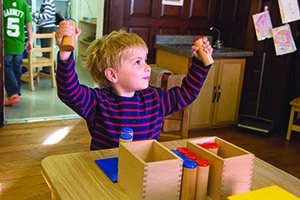
These Sensorial Materials, such as the Brown Stair (which isolates the idea of thickness and thinness) the Red Rods (which isolate the concept of length and differences in length), and the Sound Cylinders (which isolate subtle differences in sound — they have sand inside to shake and discern the slight differences in the sound) are materials that show slight differences in temperature, weight, texture, and so on. Young children fix their attention on these materials and choose to repeat activities with them. They want to find minute differences and delight in doing so.
Some young children may take months to become proficient at finding differences in a particular material, and Montessori found that children will choose that material again and again, concentrating with it on their own for long periods of time, sometimes even after they have mastered it, deepening their understanding of what they have learned. Later on, the Montessori teacher gives names for these detailed differences, so that child can name their newfound qualities: light, lighter, lightest, and so on. This spontaneous choosing and repeating, along with the totally effortful focus that results, is remarkable. This discovery is unique among educational approaches and, yet, the outcome is highly sought.
The result is not just the development of a heightened ability to concentrate, which later can be transferred to other areas of life, such as listening to the soccer coach or paying attention during a symphony without wiggling all over are abilities that are noticeable results in many Montessori students as young as four year old. Montessori pointed out that the child’s entire personality is transformed by this growing ability to concentrate, as he becomes more and more in control of his own mind and body. Over time, a calmer, more clear-thinking personality emerges. Indeed, I have heard many parents remark with surprise and wonder that their child seemed to acquire pleasant manners just weeks after starting at our school. This is what Montessori noticed again and again, in all kinds of children: They are more ready to cooperate, more eager to help fellows and interact generously, more at ease, happier and more interested in the world around them. It is as if their minds and spirits have been ‘woken up.’
Montessori also saw that the Sensorial materials and exercises gave children reference points and a structure within which to categorize impressions and organize their thoughts: “They also structure their minds, which [are] developing in an orderly way, a phenomenon which has impressed psychologists who have tried to observe the formation of the mind.
“So, we might say that all the objects which we call objects for sensorial education are the instruments of a mental gymnasium, which not only develop and strengthen the mind, but also order it….[and] hence the child acquires not only an order of mind but also a capacity for consecutive observation.…The emotional impact is the joy our children experience when becoming explorers of their environment. We find that this becomes a great impulse, the impulse of inquiry, so that the child does not tire of observing but presses forward to make observations….The passion for knowledge is aroused in the children much like the passion which develops in scientists who, in their studies, are continually making discoveries.”
It may sound strange to think of the child organizing his mind, but realize that Montessori was never proposing that the adult manipulate or decide what to put into the child’s mind, (the way a screen activity does, by the way). With her approach, the child’s own mind chooses what he is interested in, does the organizing of its own accord, and he is, therefore, teaching himself and building his own unique mind. The materials and the manner in which a trained Montessori teaches presents these materials to the child gives him all the guidance he needs to make use of the information and do the work on his own effectively.
How can we foster concentration at home?
Outside of school, parents can support this amazing development of concentration by being aware of how sensitive young children are to their surroundings: Be as ‘present’ and ‘mindful’ as you can when you pick them up from school; leave the smart phone ringer off and tucked away when you are with your children; give them your attention and take the opportunities to be aware of the smells, sights, sounds of nature around you as you walk slowly to your car; talk with your children in the car, pointing out the changing colors of leaves on the passing trees, the weather of the sky; sit down at your child-sized table to eat together and take your time; steer the conversation to the ‘here and now’ rather than a list of activities that will follow.
During your child’s rest time, give yourself the gift of resting, too. Choose a good book, do yoga, or take a nap rather than getting sucked into your smart phone or the list of to-do’s. In the afternoons, take a walk or prepare the dinner meal with your children, talking about the foods as you do. When you have young children, don’t be ambitious! Now is the time in your life to be slow. This is how you provide a home life that helps your young children develop their natural powers of concentration.
If you have multiple children, try to spend time with one at a time (if possible) by asking a friend, caregiver, relative, or spouse to spend time with the others, even for 15 minutes. When you are with several children at once, assign each child a different task and space to do it in so that they interfere with one another as little as possible. They are used to this habit at school, so you can continue it at home, too. Finally, as best you can, save your smart phone, to-do list, errands, and other more frenetic activities for when your children are not with you. That way, you can slow your pace when you are with your children.
We cannot force concentration, but we can create conditions for it to develop. As a parent, if you feel you cannot create ideal conditions for concentration, then make safeguarding against the obstacles to it your main goal. The most common obstacles to avoid are constant interruptions and televisions/screens/electronic toys.
Finally, be aware that your children are having a beautiful experience of concentration during the day in their Montessori classrooms. Having a little down time after school allows them to assimilate the unconscious impressions of the day in their minds. If you have several children and the afternoon tends to be chaotic by nature, create a routine for everyone to spend a brief quiet time in their rooms or different parts of the house or yard after school, so that they have this much-needed time to let all the learning of the day sink in. There is a noticeable difference in the classrooms the next day for children who have uninterrupted downtime after school, specifically without screens. Your children are more likely to walk into school the next day, picking up where they left off, than children who spend their time outside of school racing from one activity, conversation, or playdate to another and who dive into bed without that precious time to think, read, or calm themselves. Time to play freely outside after school, relax, help with dinner, contribute in the home, and read directly supports their developing concentration and prepares them to get the most out of the next day in their Montessori classrooms.
Conclusion
Montessori — through her scientific observations of children — was able to point out how important concentration is for optimal development and the creation of an educational approach enhances it in every way. She had no brain-imaging machines to prove the psychological phenomena she was seeing, but we certainly do today. And we can see the way our children become their best selves when they are able to concentrate on what they are doing. With concentration, not only are children more successful in their tasks and skill development, they also become more aware of (and empathetic to) those around them. Montessori told us:
“The first essential for the child’s development is concentration. It lays the whole basis for his character and social behavior. He must find out how to concentrate, and for this he needs things to concentrate upon. This shows the importance of his surroundings, for no one acting on the outside can cause him to concentrate. Only he can organize his psychic life. None of us can do it for him. Indeed, it is just here that the importance of our schools really lies. They are places in which the child can find the kind of work that permits him to do this.” (The Absorbent Mind, 1967.)
Bibliography
Goleman, Daniel, “Want Kids to Succeed? Teach Them Focus,” LinkedIn, 2016
Loyd, Kathleen, The Power of Concentration, NAMTA Journal, Winter 2011
Csikzentmihalyi, Mihaly, Flow, 1990
Schwartz, Jeffery and Begley, Sharon, The Mind and the Brain: Neuroplasticity and the Power of Mental Force, 2002
Montessori, Maria, The 1913 Rome Lectures, 2013
Montessori, Maria, The Absorbent Mind, 1967
Featured
-
 The Montessori Way, Revised and Expanded: An Education for Life; A Comprehensive Guide for Parents and Teachers
$25.00
The Montessori Way, Revised and Expanded: An Education for Life; A Comprehensive Guide for Parents and Teachers
$25.00
-
The Montessori Child: A Parent's Guide to Raising Capable Children with Creative Minds and Compassionate Hearts (The Parents' Guide to Montessori)
$20.00
-
The Montessori Toddler: A Parent's Guide to Raising a Curious and Responsible Human Being (The Parents' Guide to Montessori)
$20.00
-
Montessori in Action: Building Resilient Montessori Schools 1st Edition
$29.95
-
Bulk Order, 30 Copies of Montessori for Every Family: A Practical Parenting Guide To Living, Loving, And Learning
Original price was: $600.00.$510.00Current price is: $510.00.


Products
-
The Montessori Way, Revised and Expanded: An Education for Life; A Comprehensive Guide for Parents and Teachers
$25.00
-
The Montessori Child: A Parent's Guide to Raising Capable Children with Creative Minds and Compassionate Hearts (The Parents' Guide to Montessori)
$20.00
-
The Montessori Toddler: A Parent's Guide to Raising a Curious and Responsible Human Being (The Parents' Guide to Montessori)
$20.00
-
Montessori in Action: Building Resilient Montessori Schools 1st Edition
$29.95
-
Bulk Order, 30 Copies of Montessori for Every Family: A Practical Parenting Guide To Living, Loving, And Learning
Original price was: $600.00.$510.00Current price is: $510.00.