If you haven’t reviewed your employee handbook lately—or haven’t yet written one—consider this your gentle nudge. In the Montessori world, we tend to take a compassionate view of the natural world. We teach children to observe living creatures with curiosity and care. That’s beautiful—and exactly what we want to nurture. But every now and then, that curiosity extends a little too far… like when a well-meaning teacher picks up a “dead” rat on the playground, only to discover it was still very much alive. Yes, it really happened. Fortunately, the teacher was okay (after a trip to the doctor), but the incident prompted an important realization for the school leader: We need a clear policy about what to do when pests show up at school. Because let’s face it—at some point, they will. Whether it’s a wasp nest in the outdoor classroom, a snake curled up in the garden, or a mouse making itself at home behind the snack cabinet, every Montessori campus eventually has an unexpected visitor. And because Montessori teachers are a special kind of human—nurturing, unflappable, and almost unfailingly kind—we’re the folks most likely to say, “Aww… look at that little guy!” instead of backing away and calling for help. That’s why your staff handbook should spell out a simple, clear, no-room-for-interpretation Pest Encounter Policy. Something that says: Don’t touch it. Keep children away. Notify administration immediately. Let trained professionals handle it. Document the incident. Not only does this keep your team and your students safe, it also protects your school from liability. It shows you’ve prepared your staff, and you’re taking proactive steps to manage risks thoughtfully and responsibly. If you don’t already have a pest policy in place—or if you’re not sure whether yours covers all the bases—now’s a good time to review it. And if you’re starting from scratch, you’re welcome to use or adapt this sample policy we just helped a client develop. Click this link to download the sample Pest Encounter Policy https://lnkd.in/eJP6bzP3 Feel free to customize it for your own school’s name and context. As Montessori leaders, we model calm, capable responses to the unexpected. Having the right policies in place gives our team the confidence to do just that. And if you do end up with a class pet rat? Well—just make sure it came from the pet store and not the playground,
In the ever-evolving landscape of education, Montessori schools face the dual challenge of staying true to their mission while navigating the practical realities of enrollment. Many families today are overwhelmed, time-constrained, and simply looking for a school that feels safe, nurturing, and convenient. Often, their first priority is to solve a problem—find a school that fits their child’s immediate needs and secure a spot quickly. Yet behind this urgency is a deeper desire: to find a place where their child can thrive and where they, as parents, feel a sense of trust and belonging.
Recognizing this, Montessori schools must meet prospective families where they are—acknowledging the pressure and pace of modern parenting—while gently guiding them toward a fuller understanding of what it means to join a Montessori community. This article presents a refined approach to enrollment and engagement—one grounded in relationship-building, authentic storytelling, and an unwavering commitment to the school’s mission. We call it “Finding the Perfect Match.”
Traditional enrollment strategies often follow a transactional model: attract attention, provide information, and ask for a decision. This approach treats parents as consumers and education as a product. In contrast, the Montessori approach to enrollment invites families into a journey of mutual discovery. It allows prospective parents to engage not only with what Montessori education is, but with what it feels like to be part of a deeply connected school community. The goal shifts from simply filling seats to forming genuine partnerships that support the child’s development and the school’s long-term culture.
The first step in this relationship-based model is to increase visibility and awareness in the local community. Schools must be intentional in making their presence known—not through broad marketing campaigns, but through targeted, values-driven outreach. This might include participating in community festivals, setting up interactive Montessori exhibits at farmers’ markets, offering parenting workshops at local libraries, and creating vibrant, informative bulletin boards in nearby cafes and businesses. These outreach efforts are led by admissions and development staff but must be supported by the broader school community. Consistency and follow-through are essential. A member of the admissions team should be assigned to track outreach events, update materials, and personally follow up with contacts.
Once a prospective parent makes initial contact—whether through an email, a website inquiry, or by visiting the school—it is vital to respond promptly and personally. The initial reply should reflect warmth and attentiveness. Ideally, the response includes an invitation to visit, observe a classroom, and speak with a school leader or experienced teacher. The process should feel welcoming and affirming, not automated or rushed. Each inquiry is a potential relationship, and how that relationship begins often shapes whether it continues. For parents in crisis mode, who simply want to enroll quickly, the key is responsiveness and clarity—combined with gentle pacing that opens the door to deeper engagement once the immediate need is met.
Rather than relying solely on a single tour or presentation, schools can create an intentional series of touchpoints that gradually deepen engagement. A family might begin with an observation morning, followed by an invitation to attend a community event or curriculum night. They may be offered an opportunity to speak with current parents or receive a series of short, mission-driven emails that highlight key aspects of Montessori education. At each step, the emphasis should be on listening, understanding, and trust-building. The admissions team should develop and manage a simple CRM system or tracking tool to log these touchpoints and ensure follow-up is timely and meaningful.
Equally important is the active participation of the current parent community. These parents serve as natural ambassadors and advocates when invited to do so. Schools can provide them with tools such as “invite a friend” postcards, social media graphics, or talking points about Montessori education. Admissions staff can host informal gatherings or coffee chats where current families invite neighbors or friends to visit the school. This parent-to-parent outreach feels more personal and authentic than traditional marketing and can be an especially effective way to reach values-aligned families.
When a family decides to enroll, the onboarding process should be seen not as an administrative task, but as the beginning of a long-term partnership. New families should be welcomed with intention and care. This may include a personalized welcome packet, a video or letter from the Head of School, and an invitation to a new family orientation. Pairing each new family with a mentor family offers an additional layer of support and connection. The admissions team and classroom guides should check in during the first few weeks, ensuring that new families feel seen, supported, and empowered to participate.
A successful community is not built solely through events—it is built through ongoing, meaningful communication. Families should be regularly informed not only of upcoming activities but of the deeper purpose behind those activities. School leaders should share stories from the classroom, reflections on Montessori principles in action, and opportunities for involvement that go beyond volunteering. Families need to know that their voice matters, their ideas are welcome, and their contributions—whether time, talent, or financial support—make a meaningful difference.
To support this, schools should implement structures that facilitate two-way communication. Parent surveys, listening circles, and community forums provide families with avenues to share their experiences and offer input. Classroom guides and administrators must be accessible and responsive. A family liaison or community engagement coordinator can help manage these connections and ensure that families remain engaged over time.
The implementation of this approach requires clearly defined roles and responsibilities. The admissions team leads the design and execution of the enrollment pathway, including outreach, tours, and follow-up. The Head of School ensures alignment between the school’s philosophy and the admissions process, while teachers and classroom guides provide key insights and help families experience the pedagogy in action. Parent volunteers serve as hosts, mentors, and storytellers. All of this is guided by a shared commitment to cultivating a vibrant, values-aligned community.
This approach to enrollment and engagement is not about fast growth or flashy campaigns. It is about honoring the values that Montessori education holds dear: respect for the individual, trust in human development, and the power of authentic relationships. By focusing on fit, cultivating connection, and supporting families with care and intention, Montessori schools can create communities that are not only full—but full of purpose, joy, and enduring commitment.
Finding the perfect match means telling the truth about who you are, what you believe, and what it means to be part of your school. When this message is conveyed consistently and sincerely, the right families will not only find your school—they will help it flourish.
In Montessori education, we are continuously testing and refining our understanding. Science is not about believing something because a public figure says it; it is about seeking reliable information. The same principle applies to education—our approach must be guided by observation, adaptation, and evidence-based methods.
One significant challenge in many Montessori schools today, especially in public settings, is that students are not entering at the optimal age. Montessori education is most effective when children begin at age three. If a child enters at four or five, they have already missed critical developmental time. While they may eventually catch up, their experience will not be the same as that of a child who had the full early childhood Montessori experience. If we seek the best outcomes associated with Montessori, we must adhere as closely as possible to the principles and methods that made it successful.
Maria Montessori herself evolved her methods over time. For example, in her early writings, she suggested young children needed sugar—a belief we now understand differently. It is essential to contextualize her work historically while maintaining fidelity to her core principles.
Integrating Late-Entry Students into Montessori
In public Montessori schools, it is common for students to join at later grade levels, such as second or third grade, without prior Montessori experience. This presents challenges, but they are not insurmountable. The key is diagnostic, prescriptive teaching—analyzing what the child knows, identifying gaps, and meeting them where they are. We celebrate what they already understand to build confidence and create a safe, supportive environment for learning.
A crucial goal is to prevent children from feeling embarrassed or insecure about their knowledge gaps. Fear and shame are barriers to learning. When children feel safe, valued, and free from ridicule, they are more likely to engage with and absorb new material. Emotional safety is not just an educational priority—it is a foundation for overall well-being. Many school shootings, for example, stem from a lack of emotional security. The more we create emotionally safe schools, the more physically safe schools.
Understanding the Montessori Curriculum
For Montessori-trained educators, the curriculum is often thought of in terms of the albums used for training. However, in public school settings, the curriculum is defined by state standards. Montessori is a European-derived educational approach, which is why its math sequence differs from the typical American sequence. In Montessori, fractions are introduced around age five, whereas many public schools do not introduce them until third or fifth grade.
Montessori education is a tool—one that must be adapted within various educational frameworks. The materials themselves are beautifully designed, but they are not magical. Simply having them in a classroom does not ensure learning. The effectiveness of Montessori education depends on how we use these tools to support individual students.
Historically, Montessori teachers relied on handwritten records to track student progress. While these methods worked, they were not always reliable. In the private sector, some schools have faced lawsuits for failing to document student progress adequately. In public Montessori schools, record-keeping is critical for accountability and ensuring students are meeting benchmarks.
A common issue in Montessori is that students may appear to understand a concept but later struggle with it. For example, a child may demonstrate mastery of long division using Montessori materials but forget how to apply it months later. This is what we call “orbital velocity” in learning—students must reach a point where their knowledge is deeply ingrained rather than temporarily memorized. Authentic learning is a permanent change in the learner.
The Role of Assessment and Curriculum Planning
Montessori education emphasizes hands-on, experiential learning, but it is essential to have a structured way of assessing progress. The Montessori Foundation provides a detailed scope and sequence that outlines learning objectives across different age levels. Teachers must continually assess whether students have mastered concepts and ensure they retain knowledge over time.
In traditional education, scaffolding is used to build upon prior knowledge systematically. In Montessori, learning is more fluid, with constant cycles of reinforcement. Teachers must ask themselves: Is this lesson essential for the child’s progression? Some skills, such as handwriting, may be deprioritized in certain districts, yet they remain vital in others. It is up to the educator to determine what is necessary and how to adapt within their given framework.
Ultimately, Montessori education is a philosophy and a tool. It requires educators to be adaptable, observant, and deeply committed to guiding each child toward meaningful learning. By fostering a culture of curiosity, respect, and perseverance, we empower students to reach their full potential.
Looking Ahead
Montessori educators must navigate the complexities of curriculum adaptation, student integration, and record-keeping while maintaining the integrity of Montessori principles. As we move forward, it is essential to continue refining our methods, supporting teachers, and ensuring that all students—regardless of when they enter Montessori—receive the best possible education.
Education is an evolving journey. Whether in public or private Montessori settings, our goal remains the same: to provide children with the tools, confidence, and knowledge they need to succeed in an ever-changing world.
Teaching is not just about academics—it is about connecting with human beings. We may think we are here to teach mathematics, grammar, and vocabulary, but our real job is to build relationships. Some children enter the classroom open and eager to connect, while others challenge us, testing boundaries and seeking attention in unconventional ways.
One key lesson in working with children is not allowing one or two difficult students to overshadow the growth and well-being of the entire group. This does not mean leaving struggling children behind but rather ensuring that the community remains strong. A harmonious classroom culture—where students feel connected, valued, and engaged—becomes a foundation for individual growth. The more we foster a culture of belonging, the more children will respond positively to their learning environment.
Across different cultures, parents and teachers have intuitively understood this. In some Indigenous communities, for example, adults tend not to become frustrated with children’s disruptive behavior; they recognize it as part of the learning process. They guide children with patience, knowing that they will eventually mature. This perspective reminds us that discipline should be rooted in understanding rather than frustration.
A strong classroom culture starts with recognizing and nurturing the willing—the students who are ready to engage. These students become role models, influencing their peers far more effectively than any adult can. Children listen to each other in ways they may not always listen to adults, making peer relationships a powerful tool for guiding behavior.
At the heart of effective teaching is the idea that every child must feel loved and respected, even when their behavior is challenging. This does not mean tolerating all actions but rather setting clear, firm, and consistent boundaries while maintaining a sense of care. A child may act out, but they need to know they are still valued. This principle echoes in the best examples of teaching across history, where educators have combined firm expectations with a deep personal investment in their students’ success.
Discipline is not about control—it is about guidance. Yelling at a child to stop shouting, for example, only reinforces the behavior. The goal is to model the behavior we want to see and to create an environment where children understand expectations naturally. Some children are naturally oppositional, always looking for a conflict, but that does not mean they are beyond reach. It simply means we have not yet found the right approach to connect with them.
Beyond academics, our work is to form relationships. This starts with simple gestures: sitting at a child’s level, looking them in the eye, and listening—genuinely listening. When children feel seen and heard, they are more likely to engage positively. Not every child will respond immediately, but fostering a culture of respect and care creates long-term change.
The Montessori approach, at its core, is about human development. Maria Montessori herself was a trailblazer—more than just an educator, she was a scientist, a feminist, and a visionary who challenged the status quo. She saw potential in children that society overlooked, particularly those from marginalized backgrounds. Her work was not just about teaching; it was about reshaping society by nurturing individuals who could think, create, and contribute meaningfully.
Her first significant work with children took place in an institution for those deemed “deficient,” many of whom were abandoned and neglected. Within two years, Montessori’s methods enabled these children to pass standardized exams designed for their typically developing peers. This success led her to ask: If these children, considered to be at a disadvantage, could achieve so much, what untapped potential lay in all children?
Montessori’s work was not just about education—it was about shaping a more peaceful world. She lived through a time of global conflict, witnessing the brutality of industrialized warfare. Her belief was that actual change could only come from raising children in a way that nurtured empathy, independence, and a sense of responsibility to others. This is why dictatorships—whether Nazi Germany, Fascist Italy, or Soviet Russia—feared and shut down Montessori schools. They understood that free-thinking, self-directed children grow into empowered adults who are more challenging to manipulate.
The impact of Montessori education is profound. While not every student will carry Montessori principles with them for life, many do, and those who do are forever changed. The goal is to create individuals who are not just academically competent but who embody what in Yiddish is called a “Mensch”—a genuinely good and decent person.
For those working in education today, especially in Montessori settings, the mission is clear: we are not just teaching subjects; we are shaping lives. Every day spent with students is an opportunity to make a difference and to create a world where children grow into thoughtful, compassionate, and capable adults.
This work is not always easy, but it is always meaningful. And that, more than anything, is why it matters.
Explore how technology can enhance learning while staying true to Montessori principles, fostering independence and creativity in students.
The Role of Technology in Montessori
Incorporating technology into Montessori education requires a delicate balance to ensure it complements rather than replaces hands-on learning. Our mission is to guide educators in using digital tools to support student-led inquiry, creativity, and practical life skills, while maintaining the integrity of Montessori’s core values. We believe in a thoughtful integration that respects the developmental stages of children, using technology as a bridge to enhance cultural studies, global connections, and real-world applications.
Key Features of Technology in Montessori
Enhancing Cultural Studies
Utilize digital resources like virtual field trips to deepen students’ understanding of diverse cultures and global perspectives.
Supporting Creativity and Independence
Encourage students to use digital storytelling and multimedia projects to express their ideas and reflect on their learning journey.
Promoting Logical Reasoning
Introduce coding and robotics to develop problem-solving skills and computational thinking, aligning with Montessori’s emphasis on practical life activities.
Step 1: Assess the Needs – Begin by evaluating the current curriculum and identifying areas where technology can enhance learning without overshadowing traditional Montessori methods.
Step 2
Step 2: Select Appropriate Tools – Choose digital tools that align with Montessori principles, such as research apps, digital storytelling platforms, and coding programs.
Step 3
Step 3: Implement Gradually – Introduce technology in stages, starting with older students, to ensure a smooth transition and maintain the integrity of Montessori education.
Technology Integration in Montessori Education
How can technology be used without disrupting Montessori principles?
What is the best age to introduce technology in Montessori schools?
Technology is best introduced in lower elementary (6-9 years) with limited use, expanding in upper elementary and adolescence with more complex tools.
How does technology support Montessori learning?
Technology supports Montessori learning by providing resources for research, creativity, and collaboration, enhancing hands-on experiences.
What are some recommended digital tools for Montessori classrooms?
Recommended tools include Google Earth for geography, Book Creator for storytelling, and Scratch for coding, all of which encourage active learning.
How can we ensure technology use is developmentally appropriate?
Ensure technology is used intentionally, interactively, and integrated into meaningful, student-led learning experiences.
How do we balance screen time with hands-on activities?
Maintain a balanced approach by designating tech-free zones and specific technology windows to minimize screen exposure.
What role does technology play in public Montessori programs?
In public Montessori programs, technology helps meet state mandates for digital literacy while supporting Montessori’s discovery-based learning approach.
Can technology replace traditional Montessori materials?
No, technology should complement, not replace, hands-on Montessori materials, ensuring students engage in self-correcting, experiential learning.
How can technology enhance cultural studies in Montessori?
Technology can enhance cultural studies through virtual field trips and global video conferencing, expanding students’ understanding of the world.
What strategies help integrate technology effectively?
Effective integration involves using technology to extend cultural studies, support student independence, and maintain a balanced approach.
Sarah Martinez remembers sitting at her kitchen table three years ago, agonizing over whether to keep her daughter Emma in Montessori for kindergarten. The public school was right around the corner, and the choice seemed obvious at first. Yet something held her back from making that switch—an intuition that would later prove transformative for her daughter’s education.
Each year, thousands of parents face this same pivotal decision point in their children’s educational journey. When your child can attend the local public schools for free, why would anyone want to invest in another year’s tuition? While the answer may be connected to family finances, many families make their children’s education a top priority and see the choice of staying in Montessori as an essential investment in their children’s future.
Other families hope to have their children move to another highly regarded private school. They worry that if they don’t get in at the earliest age, these schools will begin accepting other children and they will never get a spot. They don’t realize that many well-known private schools focus their attention on the higher grades but offer programs for younger children to meet the demands of their existing families. Often, these early childhood programs are much less sophisticated than those provided by Montessori schools.
The key point to keep in mind is that everything comes together in the third year of the Montessori Children’s House program, the kindergarten year. This is a time when Montessori children blossom!
“Free public kindergarten versus another year of tuition; it felt like such an obvious decision at first,” reflects Michael Chen, whose son is now in fourth grade. “But when we really looked at what our son would be giving up by leaving Montessori, the calculation changed completely.”
Consistency matters deeply, especially in the first six years of life. When children transfer from Montessori to a traditional kindergarten, they face a dramatic shift in their learning environment. “The adjustment period alone took months,” shares Jennifer Blake, whose first child transferred to traditional kindergarten before she made a different choice for her younger children. “Looking back, we lost precious learning time just helping our daughter adapt to a completely different way of being in school.”
The contrast between Montessori and conventional kindergarten programs goes far beyond teaching methods. In traditional kindergarten settings, children must adjust to an environment where morning announcements interrupt the flow of learning; group instruction takes precedence over individual exploration; and teacher-directed activities replace self-directed learning. Most kindergartens have much lower expectations for five-year-olds than Montessori programs, which dramatically changes the course of their learning during this crucial year of their lives.
Maria Anderson, now a high school math teacher, saw this difference clearly when observing both systems. “In my son’s Montessori class, five-year-olds work with sophisticated mathematical concepts using concrete materials. Their understanding of the decimal system, place value, and mathematical operations becomes internalized through hands-on experience. When children leave before they’ve had time to fully absorb these concepts, that early learning often evaporates because it isn’t reinforced in traditional settings.”
Lisa Thompson witnessed this difference firsthand when her daughter Kate completed the three-year Montessori cycle before moving to a public school for first grade. “By the time Kate entered first grade, she had such a solid foundation in mathematics and language that she was able to help other students. But it wasn’t just about academic skills; she knew how to learn independently and wasn’t thrown off by new challenges.”
The research supporting the Montessori approach continues to grow. Educational psychologist Howard Gardner noted a concerning pattern in traditional education: “Many schools have fallen into a pattern of giving kids exercises and drills that result in their getting answers on tests that look like understanding. Most students, from as young as those in kindergarten to students in some of the finest colleges in America, do not understand what they’ve studied in the most basic sense of the term. They cannot take knowledge learned in one setting and apply it appropriately in a different setting.”
Montessori’s focus on teaching for understanding directly addresses this challenge. In a primary Montessori classroom, three- and four-year-olds benefit from two years of sensorial preparation for academic skills by working with concrete materials. This hands-on experience gradually allows the child to form mental pictures of abstract concepts. Parents and educators have often underestimated the value of these sensorial experiences. Yet, research consistently shows that young children learn by observing and manipulating their environment, not through textbooks and workbook exercises.
Robert Patel’s experience with his son Jake illustrated another crucial aspect of the kindergarten year: leadership development. “We almost pulled Jake out after his fourth year,” Robert admits. “But watching him become a classroom leader during his kindergarten year transformed him from a hesitant child into a confident learner. That confidence has stayed with him through middle school.”
Many parents worry that their five-year-old will spend the kindergarten year taking care of younger children instead of doing their own work. Emily Williams, whose daughter Rachel is now in college, laughs at this common concern. “What we discovered was that teaching younger children actually deepened Rachel’s understanding of the concepts she had learned. When she had to explain something to a younger child, it really cemented her own learning.”
Five-year-olds are typically the leaders and role models in the primary Montessori classroom. They help set the tone and serve as examples of appropriate behavior. They often help younger children with their work, teach lessons or correct errors. Most have been waiting the longest time to be one of the ‘big kids,’ and the experience of playing this leadership role does wonders to reinforce their sense of autonomy and self-confidence.
The kindergarten year is also a time of profound intellectual development. Five-year-olds are beginning to reflect upon the world in new ways. They pay closer attention, notice more details, ask more questions, and begin to explain the world in their own terms. It’s a crucial period of integration when children begin to synthesize everything they’ve learned in their first few years.
David Foster, whose daughter continued in Montessori through elementary school, saw this integration process firsthand. “During that kindergarten year, we watched in amazement as all the pieces started coming together. The careful preparation of the previous two years suddenly blossomed into this incredible period of growth and understanding.”
By the end of age five, Montessori students commonly develop advanced academic skills, but this isn’t our ultimate goal. Our real hope is that these children will feel good about themselves and enjoy learning. The key concept is readiness. In Montessori, if a child is not developmentally ready to advance to a new skill or level of understanding, they are neither left behind nor made to feel like a failure. Our goal is not to ensure that children develop at a predetermined rate but to ensure that whatever they do, they do well and feel good about themselves as learners.
“The decision to stay for kindergarten was really our first step in recognizing how powerful this approach to education could be,” reflects Jennifer Blake, whose children ultimately attended Montessori through eighth grade. “My children learned not just academic skills but how to think, how to solve problems, and how to be confident learners. That foundation has served them incredibly well throughout their education.”
When making this crucial decision for your child, remember that kindergarten is more than just another year of preschool. It’s the culmination of a carefully prepared cycle of learning that builds toward the moment when children consolidate their skills, embrace leadership roles, and integrate their understanding of the world around them. As countless families have discovered, the investment in that final year can yield returns that last a lifetime.
Tim Seldin is President of the Montessori Foundation. His more than 40 years of experience in Montessori education includes 22 years as Headmaster of the Barrie School in Silver Spring, Maryland, his alma mater from toddler through high school graduation. Tim was Co-Founder and Director of the Institute for Advanced Montessori Studies and the Center for Guided Montessori Studies. He earned a B.A. in History and Philosophy from Georgetown University, an M.Ed. in Educational Administration and Supervision from The American University, and his Montessori certification from the American Montessori Society.
Tim is the author of several books on Montessori Education, including How to Raise An Amazing Child, and The World in the Palm of Her Hand. Please be sure to look for his new books, The Montessori Way co-authored with Paul Epstein and Robin Howe and Montessori for Every Family, co-authored with Lorna McGrath.
“All activities connected with caring for oneself and the environment—like getting dressed, preparing food, setting the table, wiping floors, clearing dishes—these are tasks that adults often avoid. Yet, for children between one and four, these jobs are a source of joy, and they eagerly rise to the invitation to participate.”
— Dr. Silvana Montanaro
“I love Montessori! I get to make snacks and serve them to my friends. It’s like being a real waiter.” — Phillip, age 5
This photograph from a century ago shows a young Montessori child ladling soup for her classmates at lunchtime. It’s easy to imagine her parents asking the same question many do today: “What does this have to do with learning to read or write?” In Montessori, Practical Life activities—like washing tables, pouring water, polishing, sweeping, and dusting—are not just chores; they are foundational learning experiences.
Through these hands-on tasks, children develop an inner sense of order, focus, and independence. By caring for their environment, meeting their own needs, and helping others, Montessori students learn more than just skills—they learn how to learn.
Here’s a glimpse into a Montessori day that captures this philosophy:
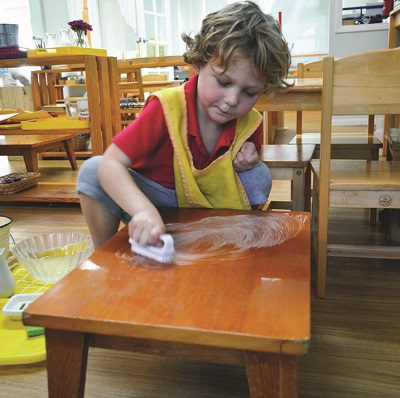
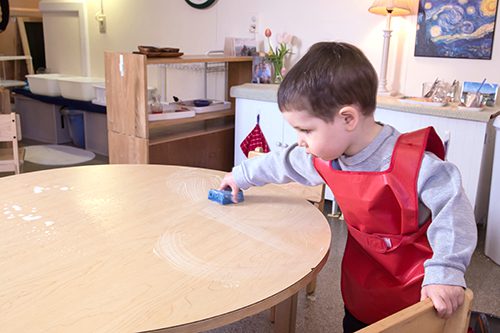
It’s 10 o’clock, and Amani is hungry. She heads over to the snack table and prepares celery sticks with peanut butter, pouring herself apple juice from a pitcher made for small hands. When she finishes, Amani carefully wipes her placemat. This inspires her to clean, so she gathers a small bucket, sponge, brush, towel, and soap and starts washing a table methodically.
As she scrubs, she’s absorbed by the patterns of the soap suds. When she’s done, she tidies up, leaving the table somewhat clean—but that’s not the point. What Amani is truly learning is patience, independence, and the ability to concentrate on a sequence of steps.
Another child, Meredith, sees that the widows need to be cleaned. She gathers the window washing kit and begins to spray a nontoxic solution on the glass. She uses a small squeegee and wipes it with a clean cloth. When done, she moves on, choosing activities that interest her.
In a Montessori classroom, children are genuinely responsible for their space. When hungry, they prepare snacks; when spills happen, they clean up. They practice self-care and community care—each action cultivating confidence and independence.
A Foundation Beyond Skills
Montessori isn’t just about teaching children to count or read. It’s about shaping the people they will become. We focus on developing self-discovery, resilience, and a joyful pursuit of knowledge. This isn’t merely an academic education but an education of the heart and mind. In this setting, children learn with patience, curiosity, and a sense of personal responsibility.
Montessori’s classroom for children between three and six years old is called a Children’s House—a true community of young children. Dr. Maria Montessori’s vision was not to create a more advanced kindergarten but an empowering environment where children are respected as individuals. Here, they develop social and emotional connections, form lasting friendships, and take pride in their shared responsibility for the space and each other.
As children thrive in this nurturing community, they begin to believe in themselves. In this atmosphere, they maintain their natural curiosity and willingness to explore. They learn that mistakes are not failures but stepping stones to growth. With this foundation, they grow to view learning as a journey rather than a destination.
Growing up this way
As a child, I attended the Barrie School in Washington, D.C. Barrie was founded by my mother in 1932. Later, I returned to teach and eventually served as headmaster for 22 years.
As a child, I remember arriving at school on frosty mornings, stopping by the kitchen for a piece of toast or some cereal, and helping myself with a bit of guidance from older students. As we grew, so did our contributions to the school.
Barrie was a community of several hundred children ranging in age from two to eighteen. Our food was homemade in the school kitchen, and older students volunteered to help with preparation. I spent mornings peeling potatoes and stirring stew alongside our cook, Edith, and friends.
After meals, we carried dishes back to the kitchen, washed them by hand, swept sidewalks, watered gardens, fed animals, and tutored younger students.
These daily acts connected us with everyone on campus—from the bus drivers to teachers. They taught us the importance of community, and to this day, I still enjoy washing dishes.
The Lifelong Value of Practical Life Skills
“In the special environment prepared for the child, they express an inner need: ‘Help me to do it by myself!’ Their work will no longer weigh them down.” — Dr. Maria Montessori
In Montessori, the classroom itself is a “children’s house,” where children play an active role in caring for the space. They prepare snacks, clean tables, sweep floors, and organize shelves. Through these activities, they learn much more than basic tasks; they develop self-respect, resilience, and a love for learning.
Confidence grows when children feel capable and independent. Montessori classrooms are designed to foster this growth. Here, children’s actions say, “Help me learn to do it for myself!” By encouraging them to be self-sufficient and organized, we set the stage for a lifetime of strong work habits and a sense of responsibility.
Independence does not magically appear as children grow; it must be nurtured. In Montessori, children start young, learning to tie their shoes or pour their own milk. Small successes like these lead to a sense of confidence and pride.
As they mature, Montessori students learn Practical Life skills that prepare them for daily living, like cooking, sewing, managing money, gardening, and even simple home repairs. However, perhaps the most essential skill is learning how to work and play with others kindly. Kindness and respect are daily practices in the Montessori classroom, where children learn to be thoughtful and responsible toward their community. They learn to treat themselves and others with dignity.
Montessori schools aim to be close-knit communities where people learn together in an atmosphere of warmth, respect, and cooperation. Teachers are mentors and guides, helping children grow in understanding and compassion for each other’s unique backgrounds and interests.
Montessori Practical Life activities are the heart of Montessori education. They teach children to be confident, responsible, and independent human beings who find joy in learning and meaningful work.
INSIDE MONTESSORI: A DOCUMENTARY INSIDE MONTESSORI (82:05) is a documentary film and library of short videos (chapter & focus videos and bonus videos) that reframe the national education conversation toward creating learning environments that allow children to...
Concentration: What is it? n a LinkedIn post this past June, “Want Kids to Succeed? Teach them Focus,” Daniel Goleman explains why concentrating is a precursor for both learning something new and developing self-control. We all know that success...
A younger child observes an older classmate working independently in a calm, mixed-age Montessori prepared environment. The first time parents encounter a Montessori mixed-age classroom, it can raise real questions. Wouldn't a three-year-old be better off with a room...
Real-world activity gives children time to concentrate, experiment, and discover what they can do. Snapshot Smartphones and tablets can be remarkable tools. They can also absorb enormous amounts of a child's time and attention. For young children especially, the...
Snapshot A good home art area does not need to be elaborate. It needs to be inviting, orderly, accessible, and stocked with materials children can use more independently. The goal is not to produce perfect projects. It is to give children a place to draw, paint, cut,...
Snapshot A Montessori parent conference is more than a progress report. It is a chance for the two groups of people who know your child best, parents and teachers, to compare notes, ask questions, notice patterns, and think together about what your child needs...
Snapshot Gardening doesn't have to end when the weather turns cold. A sunny windowsill, a few pots, and some seeds can give children months of meaningful work. An indoor garden offers something screens and toys cannot: a living thing that changes slowly and needs real...
Snapshot How does a child get from counting three crackers at snack time to working with multiplication, fractions, geometry, and eventually algebra? In Montessori, mathematics is a carefully constructed journey. Children begin with quantities they can see and...
Montessori teachers are trained to observe. We notice the three-year-old who has suddenly begun settling into long periods of concentration. We see the five-year-old who is quietly becoming a leader in the classroom. We recognize the elementary child who once avoided...
A calm, childproofed bedroom prepared for independent movement and rest. The first time a patient's mother described her toddler's “floor bed” to me, I assumed she meant the kid had knocked the mattress off the frame again. I was wrong, and it turned into one of those...
Parents sometimes walk into a Montessori classroom and notice something missing. No stack of worksheets. No workbooks lined up on a shelf. No thick folder of papers coming home each week showing exactly what got covered that day. If there is not much paper coming...
September is usually a wonderful month in schools. The classrooms are freshly prepared. Teachers are energized. Parents are hopeful. Children arrive with new backpacks, new lunchboxes, and stories about new friends. For families who have just enrolled, there is often...
Observation begins with giving a child respectful space to concentrate. "Follow the child" may be one of the most frequently repeated phrases in Montessori education, and one of the most easily misunderstood. To someone hearing it for the first time, it can sound as...
Even a difficult morning can become an opportunity to notice what children are ready to do for themselves. It's 7:42 in the morning. Someone can't find a shoe. The lunch isn't packed. Your child suddenly remembers something that absolutely must go to school today. You...
Walk into a Montessori classroom for young children and you may see something that seems a little surprising. A young child carefully pours water between two small pitchers on a simple tray. A child may be carefully pouring water from one small pitcher into another....
Discover the transformative power of Montessori education. Connect with us for a personalized consultation or subscribe to our newsletter for insightful resources that empower school leaders and parents alike.
Empowering Montessori Schools Through Strategic Tuition Planning
Unlock the Potential of Your School's Financial Future
Discover how strategic tuition planning can enhance your school’s sustainability and strengthen community trust. Learn to balance affordability with quality education.
At this time of the year, many of us who lead private schools have just gone through the process of setting tuition for next year. The odds are that we simply took last year’s numbers and adjusted them by a factor representing our projected increased cost of operations and wages. Strategic tuition planning is crucial for Montessori schools as it directly impacts financial sustainability and community relationships. By understanding the unique needs of families and aligning tuition with the school’s mission, leaders can ensure long-term success. This approach not only supports operational costs but also enhances educational quality, making it accessible to a diverse range of families.
Challenges in Tuition Setting
Setting the right tuition is a complex task for schools, balancing financial needs with community expectations.
Exclusivity Concerns
High tuition rates can inadvertently exclude families, reducing diversity and accessibility within the school community.
Budget Dependency
Tuition is often the primary source of income, making schools vulnerable to fluctuations in enrollment and economic conditions.
Emotional Impact
Unexpected tuition increases can lead to dissatisfaction and erode trust if not communicated effectively to families.
Explore answers to some of the most frequently asked questions regarding tuition planning and management for Montessori schools.
What factors should be considered when setting tuition?
When setting tuition, consider factors like market research, parent demographics, school value proposition, and operational costs. These elements ensure that tuition aligns with both financial goals and community expectations.
How can schools communicate tuition changes effectively?
Effective communication involves announcing changes well in advance, explaining the reasons behind them, and inviting feedback from families. Transparency and openness help maintain trust.
What are common mistakes in tuition setting?
Common mistakes include ignoring the socioeconomic makeup of families, setting tuition without data, and failing to communicate changes clearly. These errors can lead to dissatisfaction and enrollment issues.
How does tuition affect school branding?
Tuition reflects the perceived value of a school. A higher tuition can signal premium quality, while a lower tuition might attract a broader audience but could also imply lower quality. Balance is key.
What role does market research play in tuition planning?
Market research helps identify the financial capacity of families and compares the school’s offerings to competitors. It provides data-driven insights essential for informed tuition decisions.
How can discounts be used strategically?
Discounts, such as sibling or referral discounts, can attract and retain families while ensuring fairness. They should be part of a broader strategy to balance affordability and revenue.
Our consultation process begins with an initial assessment of your school’s unique needs and challenges.
Step 2
Next, we conduct thorough market research to gather data on parent demographics and competitive analysis.
Step 3
Finally, we provide tailored recommendations and strategies to optimize tuition planning and communication.
Common Mistakes in Tuition Setting
One of the most frequent errors in tuition setting is neglecting to consider the diverse demographics of the parent community. Schools must understand the financial backgrounds and expectations of their families to set a tuition that aligns with their needs. Additionally, failing to communicate changes effectively can lead to mistrust and dissatisfaction. Schools should ensure that any adjustments to tuition are clearly explained and justified to maintain transparency and trust.
Strategic Tuition Planning
Strategic tuition planning involves a comprehensive approach that balances financial sustainability with the school’s mission and values. Key considerations include understanding the market, defining the school’s value proposition, and using tuition as a marketing tool. Schools should conduct market research to assess the financial capacity of their parent body and compare their offerings to competitors. Defining a clear value proposition helps communicate the benefits and quality of the education provided, ensuring that tuition reflects the school’s worth.
The Role of Communication
Effective communication is crucial when introducing tuition changes. Schools should announce increases well in advance and provide clear reasons for the changes, such as rising operational costs or enhanced educational offerings. By inviting families to discuss concerns and providing a platform for feedback, schools can foster trust and mitigate resistance. Highlighting the value and benefits that tuition supports, through testimonials and success stories, helps reinforce the positive impact of the investment families make in their children’s education.
Key Takeaways for Strategic Tuition Planning
Essential Insights for Effective Tuition Management
Strategic tuition planning is crucial for aligning your school’s financial goals with its mission. Start by conducting thorough market research to understand your community’s demographics and financial capabilities. Clear communication is key; ensure families understand the reasons behind tuition changes to build trust. Flexibility in pricing, such as offering discounts or financial aid, can help balance affordability with revenue needs. By integrating these strategies, schools can maintain enrollment and ensure long-term sustainability.
Partner with Us for Strategic Tuition Success
Are you ready to optimize your school’s tuition strategy? Our team of senior Montessori school consultants and coaches is here to support you in developing a comprehensive plan that aligns with your school’s values and financial objectives. Please reach out to us today to schedule a consultation and explore how we can help in enhancing your tuition planning process. Together, we can ensure your school thrives while maintaining strong community relationships.
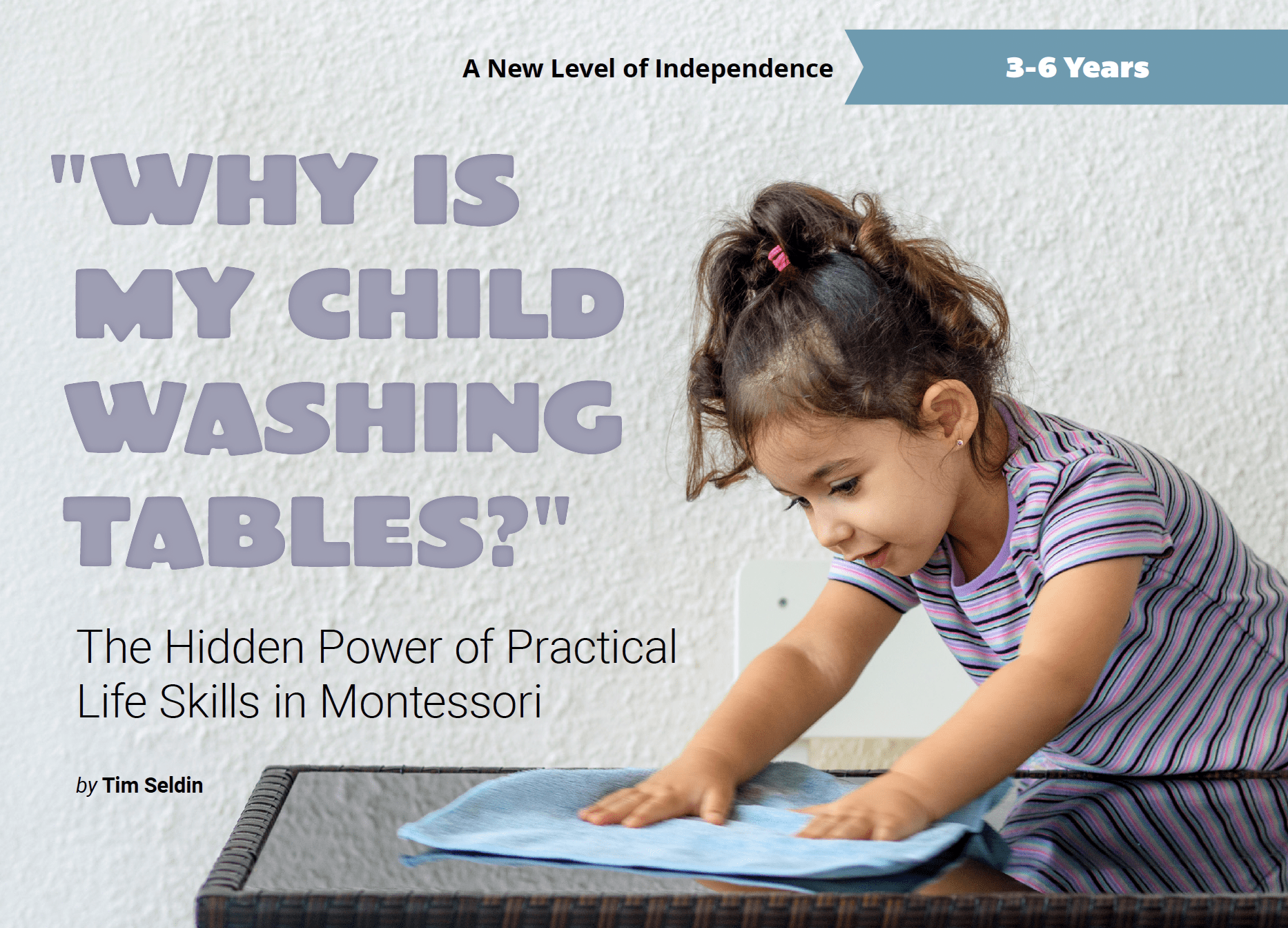
The Hidden Power of Practical Life Skills in Montessori
by Tim Seldin
“All activities connected with caring for oneself and the environment—like getting dressed, preparing food, setting the table, wiping floors, clearing dishes—these are tasks that adults often avoid. Yet, for children between one and four, these jobs are a source of joy, and they eagerly rise to the invitation to participate.” — Dr. Silvana Montanaro
“I love Montessori! I get to make snacks and serve them to my friends. It’s like being a real waiter.” — Phillip, age 5
This photograph from a century ago shows a young Montessori child ladling soup for her classmates at lunchtime. It’s easy to imagine her parents asking the same question many do today: “What does this have to do with learning to read or write?” In Montessori, Practical Life activities—such as washing tables, pouring water, polishing, sweeping, and dusting—are not just chores; they are foundational learning experiences.
Through these hands-on tasks, children develop an inner sense of order, focus, and independence. By caring for their environment, meeting their own needs, and helping others, Montessori students learn more than just skills—they learn how to learn.
Here’s a glimpse into a Montessori day that captures this philosophy:
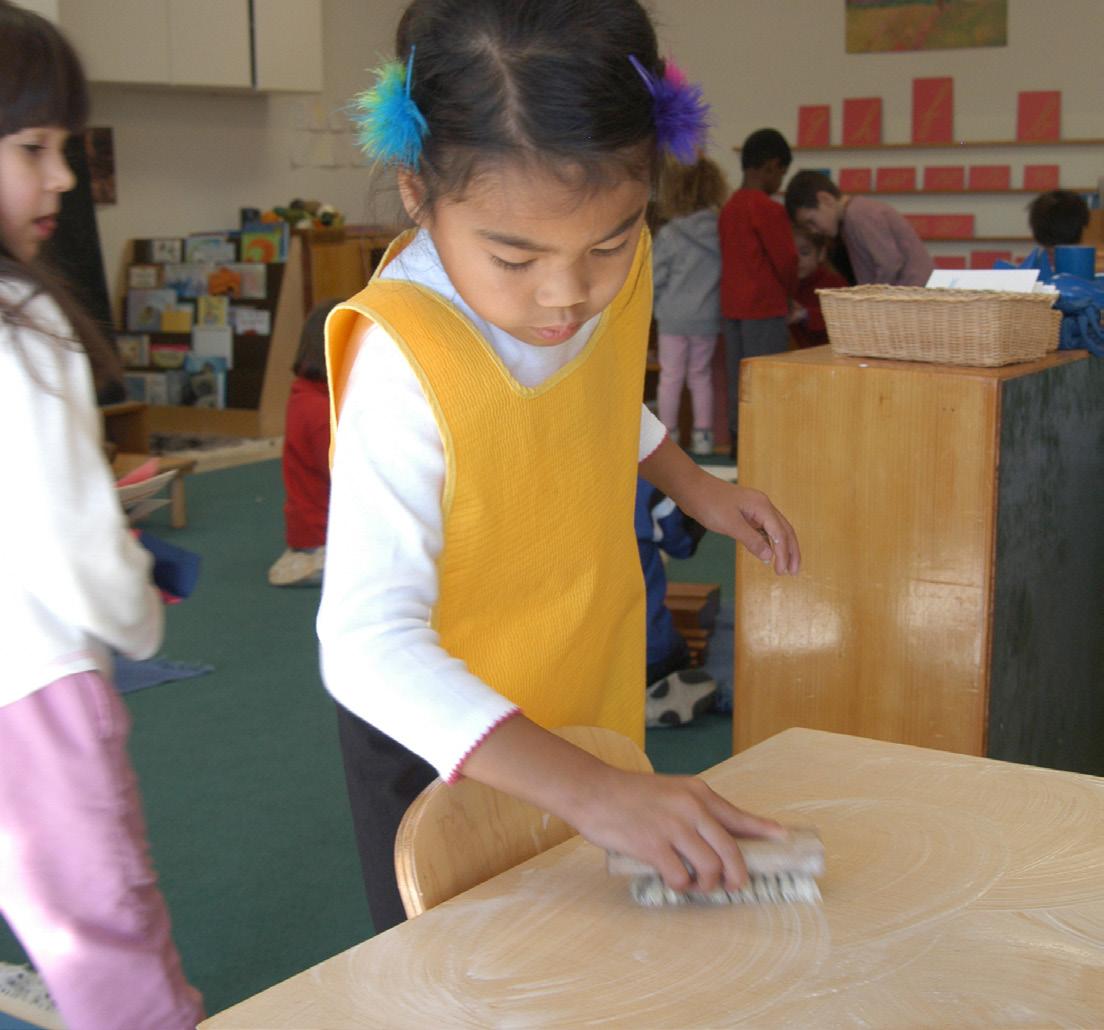
It’s 10 o’clock, and Amani is hungry. She heads over to the snack table and prepares celery sticks with peanut butter, pouring herself apple juice from a pitcher made for small hands. When she finishes, Amani carefully wipes her placemat. This inspires her to clean, so she gathers a small bucket, sponge, brush, towel, and soap, and she starts methodically washing a table.
As she scrubs, she’s absorbed by the patterns of the soap suds. When she’s done, she tidies up, leaving the table somewhat clean—but that’s not the point. What Amani is truly learning is patience, independence, and the ability to concentrate on a sequence of steps.
Another child, Meredith, sees that the windows need to be cleaned. She gathers the window-washing kit and begins to spray a nontoxic solution on the glass. She uses a small squeegee and wipes it with a clean cloth. When done, she moves on, choosing activities that interest her.
In a Montessori classroom, children are genuinely responsible for their space. When hungry, they prepare snacks; when spills happen, they clean up. They practice self-care and community care—each action cultivating confidence and independence.
A Foundation Beyond Skills
Montessori isn’t just about teaching children to count or read; it’s about shaping the people they will become. We focus on developing self-discovery, resilience, and a joyful pursuit of knowledge. This isn’t merely an academic education but an education of the heart and mind. In this setting, children learn with patience, curiosity, and a sense of personal responsibility.
Montessori’s classroom for children between three and six years old is called a Children’s House—a true community of young children. Dr. Maria Montessori’s vision was not to create a more advanced kindergarten but an empowering environment where children are respected as individuals. Here, they develop social and emotional connections, form lasting friendships, and take pride in their shared responsibility for the space and each other.
As children thrive in this nurturing community, they begin to believe in themselves. In this atmosphere, they maintain their natural curiosity and willingness to explore. They learn that mistakes are not failures but stepping stones to growth. With this foundation, they grow to view learning as a journey rather than a destination.
Growing up this way
As a child, I attended the Barrie School in Washington, D.C. Barrie was founded by my mother in 1932. Later,
I returned to teach and eventually served as headmaster for 22 years.
As a child, I remember arriving at school on frosty mornings, stopping by the kitchen for a piece of toast or some cereal, and helping myself with a bit of guidance from older students. As we grew, so did our contributions to the school.
Barrie was a community of several hundred children ranging in age from two to eighteen. Our food was made in the school kitchen, and older students volunteered to help with preparation. I spent mornings peeling potatoes and stirring stew alongside our cook, Edith, and friends.
After meals, we carried dishes back to the kitchen, washed them by hand, swept sidewalks, watered gardens, fed animals, and tutored younger students.
These daily acts connected us with everyone on campus— from bus drivers to teachers. They taught us the importance of community, and to this day, I still enjoy washing dishes.
The Lifelong Value of Practical Life Skills
“In the special environment prepared for the child, they express an inner need: ‘Help me to do it by myself!’
In Montessori, the classroom itself is a “children’s house,” where children play an active role in caring for the space. They prepare snacks, clean tables, sweep floors, and organize shelves. Through these activities, they learn much more than basic tasks; they develop self-respect, resilience, and a love for learning.
Confidence grows when children feel capable and independent. Montessori classrooms are designed to foster this growth. Here, children’s actions say, “Help me learn to do it for myself!” By encouraging them to be self-sufficient and organized, we set the stage for a lifetime of strong work habits and a sense of responsibility.
Independence does not magically appear as children grow; it must be nurtured. In Montessori, children start young, learning to tie their shoes or pour their own milk. Small successes like these lead to a sense of confidence and pride.
As they mature, Montessori students learn Practical Life skills that prepare them for daily living, like cooking, sewing, managing money, gardening, and even simple home repairs. However, perhaps the most essential skill is learning how to work and play with others kindly. Kindness and respect are daily practices in the Montessori classroom, where children learn to be thoughtful and responsible toward their community. They learn to treat themselves and others with dignity.
Montessori schools aim to be close-knit communities where people learn together in an atmosphere of warmth, respect, and cooperation. Teachers are mentors and guides, helping children grow in understanding and compassion for each other’s unique backgrounds and interests.
Montessori Practical Life activities are the heart of Montessori education. They teach children to be confident, responsible, and independent human beings who find joy in learning and meaningful work.
Tim Seldin is President of the Montessori Foundation and Chair of the International Montessori Council. His more than 40 years of experience in Montessori education includes 22 years as Headmaster of the Barrie School in Silver Spring, Maryland, his alma mater from toddler through high school graduation. Tim was Co-Founder and Director of the Institute for Advanced Montessori Studies and the Center for Guided Montessori Studies. He earned a B.A. in History and Philosophy from Georgetown University, an M.Ed. in Educational Administration and Supervision from The American University, and his Montessori certification from the American Montessori Society.
Tim is the author of several books on Montessori Education, including How to Raise An Amazing Child, Montessori 101, The World in the Palm of Her Hand. and Montessori for Every Family, co-authored with Lorna McGrath. Look for The Montessori Way, coming out in May, 2025.
Many parents believe that the word discipline means to punish. In reality, it means to teach.
Testing your limits
Every child will test the rules to some degree. In fact, most acts of testing parents are a normal part of a child’s process of growing up. When children test adults, it is often their way of expressing feelings that they don’t understand, and from our responses, they gradually learn how to handle their emotions appropriately. By testing the limits, they learn that we really care about certain ground rules of grace and courtesy in our relationships. In acting out, they are taking their first tentative steps towards independence, attempting to demonstrate that we don’t control them completely.
Family ground rules
Some families have far too many rules when all that is needed are some basic guidelines that underpin what we expect and hope from all members of the human race. There is no need to be creative and think up something to govern every aspect of your children’s lives. Agree on your family’s ground rules and get them written down and displayed so that both parents and caregivers can refer to them. Teach your child how to do the right thing rather than focusing on their mistakes. In the Montessori-inspired home, there are usually just a few basic rules.
• Treat everyone with respect.
• If you use something, put it back correctly when you are finished.
• If you break or spill something, clean it up.
• Tell the truth, and don’t be afraid to admit when you make a mistake.
You should be absolutely clear in your mind about your family’s ground rules. Explain them positively rather than as prohibitions. Instead of saying, “Don’t do that!” the rules should tell your child what to do. Teach them how to follow them as if you were teaching any lesson in everyday life skills. Model the same behaviors that you are trying to encourage in your child. Consciously try to catch your child doing something right and reinforce and acknowledge even the small steps they are taking in the right direction. Don’t wait until they have mastered a new skill; encourage them along the way.
When your child breaks a ground rule, you can do several things other than scold, threaten, or punish.
You can redirect them by suggesting a more appropriate choice. You can remind them of the ground rule and politely (but firmly) ask them to stop. If the situation is not emotionally charged (that is, if you are not personally aggravated), you can re-teach the basic lesson about how to handle such situations.
Be consistent. If you find that you cannot bring yourself to reinforce a rule, again and again, it should not be a ground rule. A few good rules are much better than dozens that are often ignored.
Teaching tidiness
Show your child how to put their toys away after they have finished playing with them.
Reducing Power Struggles
Sooner or later, every child will stubbornly say, “No, I don’t want to!” This is the power struggle that starts in the toddler years and often continues throughout childhood and adolescence. Many people call the toddler stage the “terrible twos,” but it doesn’t have to be—not with two-year-olds or with older children.
Power struggles start in situations where parents and children are determined to get their own way, and neither party is willing to back down. Underneath, each feels frustrated and threatened. Parents feel that their children are directly challenging their authority. Children in situations such as this are usually feeling powerless. They are attempting to assert their autonomy and establish more of a balance of power in their relationship with their parents.
Don’t punish, teach.
Threats and punishments are not good tools for getting children to behave. When children are angry or asserting their independence, they often misbehave and don’t care if they are punished.
Those children who do respond to threats and are shaken by punishments are anxious to please us and win back our love. Arguably, these children will respond just as well to other forms of discipline. While punishments tend to produce immediate results, they are rarely long-lasting.
Explaining ground rules positively
Teach your child how to handle certain situations rather than scold or punish them.
Strategies for minimizing power struggles
Here are some strategies to help reduce the number of power struggles and the use of the word “No!” you and your children can get most, if not all, of what you are after.
Power struggles can be minimized by giving your child meaningful levels of independence and responsibility in everyday life. This makes her feel powerful and grown up.
Reserve “no” for really important issues, such as an activity that might harm your child, others, or one that causes damage.
Give your children choices. Whenever you can, look for ways to let your children choose between two equally acceptable alternatives. “Would you like to have water or milk with your dinner?”
Teach your child to politely say “no”: “Mom, I really do not feel like doing that now.”
Teach your child to do things correctly and emphasize the positive rather than using anger. Above all else, try never to ask your child unanswerable questions, such as, “How many times do I have to tell you?” to which the response would be, “I don’t know, Dad! How many times do you have to tell me?”
Teaching Lessons In Grace And Courtesy At Home
Practicing games that teach good manners can help your child learn how to behave well in any company. Here are some more ideas for lessons in grace and courtesy:
Keep in mind Robert Heinlein’s golden rule of family life: “Kindness and courtesy are even more important between husbands and wives and parents and children than between total strangers.”
Don’t simply give in; look for ways that might allow you to back down gracefully. Often, through compromise, both
• Saying “please” and “thank you.”
• Using a kind tone when speaking to your child: no whining or yelling.
• Asking for a turn or if you can play too.
• Introducing yourself.
• Opening and closing doors.
• Coughing and sneezing in a way that protects others.
• Giving people compliments and encouragement.
• Allowing others to pass in front of you or to go first.
• Saying “excuse me” if you bump into someone.
• Responding politely when someone calls you or says your name.
• Walking around areas where other children are working or playing on the floor and not stepping over them.
• Learning how to wait.
• Not interrupting other people when they are talking.
• Answering the telephone politely.
Good Manners
In Montessori schools, the “lessons in grace and courtesy” (exercises that set a tone of respect and kindness) are taught alongside the more conventional subjects in the curriculum.
We show our children how to shake hands, greet a friend, and say goodbye. We demonstrate how to politely interrupt someone who is busy and how to tell someone, “no, thank you.” We teach children how to speak indoors and how to play nicely. We show them how to offer a sincere apology and how to resolve conflicts peacefully. We help children develop body control through balance and coordination lessons, which foster grace and courtesy.
We teach children grace, which is how to move thoughtfully. This allows them to navigate spaces without bumping into others or dropping items and to enter a room with awareness and composure.
As parents, we can teach our children socially appropriate behavior using similar Montessori strategies.
Simple Lessons
The first step is to explain a situation and demonstrate the right way to handle it. Then, have your child practice with you. Children enjoy these lessons if they are kept short, and if they are not embarrassed by making a mistake.
For example, if your children tend to yell at the top of their lungs inside the house, you need to show them how to keep the noise to a level that does not disturb other people. As it is happening, politely ask your child to speak softly. Then, choose a moment when neither of you is upset to give them a lesson on the right way to speak indoors.
Speak in simple language. You might say: “I want to talk to you about indoor voices. When we are outdoors, it’s so big, and sometimes we need to shout so we can hear each other. When we are outdoors, it doesn’t hurt our ears when someone talks loudly, so we can use our outdoor voices. But when we are indoors, it hurts our ears if we talk too loudly. When we are indoors, we need to use our indoor voices.”
Now, show your child what you mean. Talk very loudly and ask, “Was I using my indoor voice or my outdoor voice?” Talk normally. “What do you think? Was I using my indoor or my outdoor voice?”
You can teach all sorts of lessons this way, everything from saying “please” and “thank you” to closing doors quietly. Some families have the “manner of the week.” They introduce a new courtesy rule each week and practice it over meals and around the house.
Role Models
To teach children good manners, they need to see that their parents follow them consistently as well. The example that we set through our behavior is more powerful than anything we say. Children absorb everything they see us do, especially when they are very young, and soon, they begin to talk and act just like us. We are their role models.
Bearing in mind that your child will be influenced profoundly by the people around them, engage them in a discussion about the behavior of the children and adults with whom they spend their time—grandparents, cousins, family friends, playmates, etc. It is not your place to judge your extended family or other people’s families and how they behave, nor is this something you can control or avoid. Instead, be curious and ask questions that help your child navigate these differences.
Often, parents worry about the “negative influence” of others and seek to protect their children from these experiences. Still, exposure to different behaviors, value systems, cultures, and parenting styles can be seen as opportunities for your child to practice grace and courtesy, inclusion, tolerance, and your family values in different contexts.
Learning Kindness, Courtesy, and Manners in Practice
Children learn by example, but they can also be shown how to behave in a caring way through role play. Present these short exercises in calm moments rather than using them to point out a mistake.
Meet and greet: Teach your child the correct way to welcome visitors into their home.
Table manners: Show your child how to pull a chair out and put it back and how to sit down on it correctly.
Careful carrying: Teach your child how to bring something to you, carrying it using both hands and then to set it down correctly.
Care and compassion: Encourage your child to show concern for a friend who is upset.
Coordination and control: Have your child practice walking carefully along a line and watching where they are going to improve balance and coordination.
Saying goodbye: Your child starts to learn friendship skills when they are shown how to offer warm greetings and goodbyes.
This article is an excerpt from How to Raise an Amazing Child the Montessori Way (2nd Edition) by Tim Seldin, published by DK Press.
Building Strong Relationships Through Effective Follow-Ups
In the competitive landscape of private education, Montessori schools have a unique advantage: a foundation built on trust, relationships, and a genuine commitment to the growth of children and families. Yet, even the most mission-driven schools can need help with a critical piece of the admissions process: follow-ups. The challenge is clear—how do you nurture prospective families and move them from interest to enrollment in a way that reflects Montessori values? The answer lies in effective, thoughtful, and well-structured follow-ups.
The Importance of Relationships in Admissions
At its core, Montessori education is about relationships between teachers and students, parents and schools, and children and the broader community. Admissions should mirror this philosophy. Families aren’t looking for a hard sell; they seek warmth, authenticity, and evidence that your school is the right partner in their child’s journey.
Our goal is to be approachable, kind, and genuinely interested in the families we serve. It’s not about pushing for enrollment; it’s about building trust and offering value.
Follow-ups allow Montessori schools to showcase these qualities, positioning themselves as trusted advisors rather than salespeople.
Understanding the Family Journey
Data shows that most families don’t make enrollment decisions overnight. In fact, 60% of families take six months to two years to decide on a school, and nearly two-thirds consider three or more options before enrolling. This prolonged decision-making process highlights the need for ongoing engagement.
A well-designed follow-up system ensures your school remains at the top of their mind throughout this journey. It provides families with the information they need, answers their unspoken questions, and reassures them that they’re making the right choice.
Crafting a Montessori-Inspired Follow-Up System
Effective follow-ups are more than just emails—they’re a blend of strategy, authenticity, and content that resonates with your audience. Here’s how Montessori schools can build a follow-up system aligned with their values:
1. Automate Without Losing the Personal Touch
Tools like AIMS, Hubspot, or Mailchimp can help automate routine follow-ups, ensuring no family falls through the cracks. However, automation should complement, not replace, personal interaction. For families expressing immediate interest, a quick phone call or personalized email can make all the difference.
2. Deliver Meaningful, Montessori-Aligned Content
Families value content that answers their questions and addresses their concerns. Consider creating a series of follow-up emails that highlight different aspects of your school, such as:
A welcome email that warmly introduces your school’s mission and values.
Videos showcasing your classrooms and Montessori materials in action.
Quick facts about your school’s programs, extracurricular activities, and alumni success.
Testimonials from current families and students.
Insights into what graduates achieve after leaving your school.
This sequence not only educates prospective families but also reinforces your credibility and expertise.
3. Engage Families Based on Their Needs
Every family is unique. Some may prioritize academic excellence, while others seek a nurturing environment or strong extracurricular programs. Use surveys or forms to understand their priorities and deliver customized follow-ups that address their specific interests.
For example, a family interested in athletics could receive content about your school’s sports programs, while a family exploring alternatives to public schools might appreciate insights into Montessori’s approach to personalized learning.
4. Leverage Technology to Stay Consistent
A robust follow-up system ensures consistency even during busy times. Platforms like Aims allow schools to create automated email sequences, track engagement, and adjust strategies based on what works. Tools like ChatGPT can also streamline content creation, helping you generate blog posts, emails, and social media updates quickly.
5. Incorporate Retargeting Ads
Beyond emails, retargeting ads on platforms like Facebook and Google help keep your school visible. These ads remind families of your school after they visit your website, encouraging them to re-engage.
Why Follow-Ups Matter
A robust follow-up system doesn’t just increase applications and tours—it builds trust, fosters relationships, and reflects the Montessori philosophy of respect and partnership. As Clint Losch, an admissions expert, explains, “Follow-ups are about keeping families engaged, answering their questions, and showing them you care. It’s one of the most important steps in admissions.”
Montessori school leaders must view follow-ups not as a task to check off but as an opportunity to connect with families on a deeper level. By implementing a thoughtful, well-structured follow-up process, your school can stand out in a crowded marketplace while staying true to its values.
Take Action
If your school doesn’t have a follow-up system in place, now is the time to act. Start small by creating a series of automated emails or setting up a retargeting campaign. Over time, build a library of content that addresses families’ needs and showcases the unique strengths of your Montessori school.
There’s no more important job than responding to inquiries with care and attention. A great follow-up system ensures that every family feels seen, heard, and valued.
With the right approach, follow-ups can transform your admissions process and strengthen your school community—one relationship at a time.
As Montessori school leaders and consultants, we are often asked about preferences in Montessori training or organizations.
It’s a common misconception to think of Montessori as being divided into two distinct “tribes,” such as AMI and AMS, each with rigidly defined philosophies.
In reality, Montessori is much broader and more nuanced. In North America, there are numerous Montessori organizations, with AMI, AMS, and IMC being the largest.
For teacher training programs in the U.S., the key credential to look for is accreditation by the Montessori Accreditation Council for Teacher Education (MACTE), which ensures a high standard of quality.
Philosophical and Practical Differences
AMI (Association Montessori Internationale): Founded by Dr. Montessori herself, AMI emphasizes fidelity to her original principles, practices, and lessons. It tends to adhere closely to Montessori’s core methodologies and may emphasize certain materials or approaches with greater consistency.
AMS (American Montessori Society): AMS embraces a broader and more inclusive interpretation of Montessori, allowing for differences in implementation and some incorporation of modern educational elements. AMS training often reflects a more diverse set of influences, including greater flexibility for adapting Montessori principles to different contexts.
IMC (International Montessori Council): IMC generally aligns more closely with AMI in its emphasis on Montessori’s original philosophy but also incorporates a contemporary perspective that supports practical application in a wide range of schools and communities.
That said, all three organizations share more in common than what divides them. They are united by their commitment to fostering respect for children’s natural development and supporting the spiritual transformation of the adult—a cornerstone of the Montessori approach.
Choosing the Right Training Program
When deciding between AMI, AMS, or another MACTE-accredited program, consider the following factors:
Training Center Rigor: The quality and rigor of individual training centers can vary within any organization. Research the reputation and approach of the specific center you’re considering.
Budget: Training programs can differ significantly in cost. Make sure the program aligns with your financial resources.
Personal Learning Style: Some training centers emphasize hands-on practice, while others may focus more on theoretical discussions or group learning. Choose a program that matches your preferred way of learning.
Long-Term Goals: If you aim to work in a particular type of Montessori school (e.g., AMI-affiliated, AMS-accredited, or independently Montessori), align your training choice with their requirements or preferences.
Hiring and Faculty Development: An Administrative Perspective
From a school administrator’s perspective, the practical challenge often lies in finding and retaining qualified Montessori teachers. Most schools aim to hire the best-trained Montessori educators available. However, the availability of AMI, AMS, or IMC-trained teachers can vary depending on location, budget, and timing.
Many schools also sponsor non-Montessori-trained teachers through a Montessori teacher education program that best fits the school’s needs and the candidate’s availability and learning style.
This approach can result in a faculty with diverse Montessori backgrounds, training experiences, and interpretations of best practices. While this diversity can enrich the school, it also presents challenges in ensuring consistency and coherence across classrooms. Administrators play a critical role in helping teachers find common ground and align on how Montessori principles are implemented throughout the school.
Strategies for Building a Cohesive Faculty
To support a faculty with diverse Montessori training, administrators can take the following steps:
Establish Clear Guidelines for Montessori Best Practices: Create a shared vision and expectations for how Montessori principles are applied in the school. This will ensure consistency while respecting individual teaching styles.
Invest in Professional Development: Provide ongoing training and workshops to deepen teachers’ understanding of Montessori philosophy and methods. These can be opportunities to bridge gaps between different training backgrounds.
Facilitate Collaboration: Encourage faculty collaboration to share ideas, address challenges, and build a cohesive understanding of Montessori best practices. Cross-classroom observations and peer mentoring can be particularly effective.
Emphasize Community and Culture: Help teachers focus on the heart of Montessori—how they connect with children and families and conduct themselves in the presence of children. This shared commitment to the spiritual transformation of the adult can unify a diverse team.
Support Non-Trained Teachers in Training: For teachers in the process of earning their certification, provide mentorship and classroom support to ensure they can immediately begin applying Montessori principles in their work.
Evaluate Montessori Teacher Preparation Program Fit: When sponsoring teachers for training, consider the strengths and needs of the individual and the school. Align the choice of training program with the school’s philosophy, budget, and the teacher’s ability to attend in-person or online sessions.
Ultimately, whether hiring trained teachers or sponsoring new ones, Montessori school administrators must prioritize cultivating a strong, unified culture of Montessori practice. By supporting a diverse faculty to align on shared principles, schools can ensure a consistent and high-quality Montessori experience for all children and families.
The Heart of Montessori
Finally, remember that learning Montessori lessons and philosophy is only part of the journey. Montessori education is fundamentally about how we connect with children and families and how we conduct ourselves in their presence. This is often referred to as the spiritual transformation of the adult—the deep personal growth and humility required to truly guide and nurture children as they explore and discover their world.
Rather than focusing solely on organizational affiliations, look for a training program and community that resonate with your values, inspires you to grow, and prepares you to make a meaningful impact on children and families.
The Montessori Foundation Is Here To Help!
The Montessori Foundation is an international Montessori nonprofit organization that provides school consulting, mentorship, and professional development onsite and online to Montessori schools around the world. We’re here to help.
“The child should love everything that he learns, for his mental and emotional growths are linked. Whatever is presented to him must be made beautiful and clear, striking his imagination.
Since it has been seen to be necessary to give so much to the child, let us give him a vision of the whole universe. The universe is an imposing reality, and an answer to all questions.”
— Maria Montessori
Perhaps it happens on the first day of the elementary class or perhaps a few days later. A child, smiling broadly, arrives home to tell about the wonders of the day — the chart with the angels that carry the fire and the ice, the piece of terra cotta that is suddenly smashed, the paper that seems to defy gravity, and the volcano that really sparks and hisses and overflows with ash. And the story the teacher told!
That exciting and wonderful story about the coming of the universe and the earth! Montessori elementary has begun its new school year with the First Great Lesson, the story of the formation of the universe and the earth, and presented to the elementary child for his contemplation and study of the whole universe.
Dr. Montessori called upon a need to do “cosmic education.” To give the children the “whole” and the ability to see how the parts of the whole are interconnected was, in her view, the only approach that would truly satisfy the elementary child — the child who asks endless questions. Rather than force such a child to sit still and learn what has been chosen for him, she believed the child should be given everything to explore. The Great Lessons introduce everything that can be explored in one way or another. The Great Lessons inspire and activate the studies of the children and the work of the classroom.
The Five Great Lessons are not really lessons to be learned but are impressionistic stories to be told. “Impressionistic” means that these lessons are told as grand stories that will inspire and ignite the imagination, interest, and curiosity in the child rather than as a listing of facts. They are presented with drama, mystery, rich language, and awe. Dr. Montessori said that the Montessori elementary teacher must be a “storyteller of the truth.” She told her teachers to sow as many seeds of interest into the fertile minds of the children as are possible — some will germinate now; others will be held to do so later. When the child enters the elementary, he brings with him a reasoning mind, a mind capable of imagining the vastness of space and the march of time — so now we open the door to all of that through these Great Lessons of the elementary.
As well as possessing a powerful imagination, the child at this time is physically and intellectually strong. His need to know is as large as the universe and so that is what we lay before him. From this, he may eagerly choose his studies.
Generally, the children are told when a Great Lesson will be presented. Even for the children who have seen them each year, it is exciting to know one is coming. Every year they are a little different. Perhaps the teacher has brought some new artifacts to examine along with the story. Perhaps she adds some interesting facts that were not mentioned before.
Perhaps there are additional experiments. Perhaps the child hears some information that was missed in previous years. The children recognize elements of the stories ideas and facts that come from their own interests and independent studies. And then, there is always much that is new and fascinating and worthy of exploration. The Lesson is given; the discussion is opened; the exploratory work begins.
The First Great Lesson is the Coming of the Universe and the Earth. From nothing came into being the elemental universe. From that came our sun and its children, the planets. This lesson has many impressionistic charts and experiments that introduce geology, chemistry and more. From this lesson came earth science studies and the inspiration to appreciate an ordered and harmonious universe.
The Second Great Lesson is the Coming of Life. As a long, undated timeline is rolled out, the teacher points out the coming of the microorganisms, plants and animals that appeared on earth — each with a life to live and a contribution to make to the earth. When all was ready, at the very end of the timeline, we see human beings appearing. From this lesson came life-science studies and the inspiration to appreciate the service that all things do for each other and the great diversity of life.
The Third Great Lesson is the Coming of Human Beings. When human beings came, they came with three special gifts: a mind that could think and imagine, a hand that could work, and a heart that could love. And so it is today, as human beings, we must think, imagine, work and love. From this lesson some history, culture, and philosophy studies and the inspiration to appreciate what makes us fully human and the universal need to make a life for oneself in every place in every time.
The Fourth Great Lesson is Communication in Signs. We tell the story of the development of a written alphabet and the awesome ability we have to commit our thoughts to paper — thoughts that might endure for all time — using only 26 little, but very powerful, symbols. From this lesson came all language studies and the inspiration to appreciate the magnificent power of being able to read, understand, and write to communicate.
The Fifth Great Lesson is the Story of Numbers
We tell the story of the development of our decimal system of numeration and the powerful language of science, music, and design — mathematics. With only ten symbols and the use of the right place, any number can be symbolized and easily manipulated — thus making it possible to calculate and express even what we cannot encompass in our minds. From this lesson come all math and geometry studies and the inspiration to appreciate the discovery of the secrets of the universe, invention, and our modern world.
More than mere stories, Dr. Montessori saw these stories as setting the stage for the children to feel gratitude and admiration. In the first three Lessons, gratitude to God. In the last two Lessons, gratitude to man — often the unknown man or woman whose labor and insight built the foundations of knowledge and craft that gave us what we enjoy today. The Great Lessons are the starting point from which all of the work of the classroom begins. They are referred to when new work is introduced. They are never a work unto themselves for the children but are a tool to aid the teacher to inspire the children’s work. The Great Lessons are the heart and soul of the elementary classroom.
This appeared in Tomorrow’s Child Magazine Spring 2001
Membership in The Montessori Family Alliance means direct access to Montessori experts and other friends and parents of Montessori. Now, you have a one-stop resource for all of your Montessori needs. Brought to you by The Montessori Foundation.