
To access this page, you will need to log in or become a member.
Right From the Start

Right From the Start

INSIDE A MONTESSORI INFANT CLASSROOM

0-3 YEARS

Some Montessori schools are fortunate to have the physical space and community to offer an infant program. This is a fantastic opportunity for families, as parents return to work when their maternity/parental leave is over! As with all childcare and school enrollment decisions; do the research; take a school tour; ask lots of questions; talk to other parents; and observe classrooms.

What should parents expect when starting?

Once you have decided to enroll your infant in a Montessori classroom, there will be changes to your daily routine. This is a whole new world for the child. There will be a settling-in period as any new infant in group care transitions to life outside the home. Most assuredly, there will be a shift in daytime sleep patterns, as a newly enrolled infant adjusts to the new sounds and routines of the classroom. Breastfeeding moms will want to plan for bottle-feeding if unable to come to school and nurse during the day. Schedules and routines are geared towards each individual child in the Montessori infant environment. As development progresses, a child’s napping routines and dietary needs continue to change. For example, a newly mobile infant will most likely require more nourishment during the day. Think of the energy they expend! Families may also experience changes in their child’s home schedule as development progresses.

Parents will want to send their infant to school in simple, comfortable clothing that supports movement and exploration. Shoes aren’t really necessary and may hinder movement in the classroom, although shoes may be needed for mobile infants outside. Many teachers will ask parents for a small supply of clothes to keep in the classroom as spills, leaks, and spitting up are common. Keeping a light jacket at school can be helpful for spur-of-the-moment outside time when it unexpectedly turns out to be a nice day. Always have a supply of diapers at school. Types of diapers (cloth or disposable) vary widely among families and schools. Toileting awareness begins with older infants, and a supply of cloth underwear may be needed.

Caregiving

The caregiving moments shared with an adult are a substantial and important part of an infant’s day. These include: bottles/eating; diapering/toileting; changing clothes; hand washing; and soothing to sleep. “Quality infant caregiving is based on respectful and responsive relation-based care by the adult through sensitive observation of the infant.” (Kovach and Patrick, 2008, p. 13). Teachers will build loving, trusting relationships with each child during caregiving, and this promotes a healthy sense of self and feeling valued. In addition, your child will feel safe and secure with kind, responsive caregiving and consistent routines; this allows children to freely explore and learn about the exciting new world around them. Teachers will be observing your infant for cues about hunger, tiredness, and other caregiving needs.

Freedom of Movement, Freedom of Choice, and the Prepared Environment

An essential element of the Montessori environment is freedom of movement. When not involved in caregiving routines or resting, an infant will be playing on the floor in a safe space for movement and exploration. While this may look mundane to the casual observer, these infants are actively engaged in rapid cognitive and physical development.

“When awake and physically separated from its mother, a baby’s next natural playground is the floor. It is from the ground that a child can learn to develop muscle tone as an opposing force to gravity.” (Goddard Blythe, 2005, p. 183). On the floor, a variety of safe objects are placed nearby so that infants can choose what they want to hold or manipulate. A child’s hands play an essential role in freedom of movement. Maria Montessori wrote and lectured extensively about the crucial role hands play in brain and body development. “Children develop their senses by handling objects.” “Coordination is developed through movement, especially through the movements of the hands.” (Montessori, 2012, p. 167). For immobile infants, items are placed nearby so they can practice reaching, touching, and grasping. Once infants are mobile, they are free to move and explore around the classroom. They may engage in cause-and-effect activities, such as stacking or dumping. Some days a mobile infant may prefer sustained large muscle activity such as a pull-up bar or climbing over a low bridge.

Parents will notice there are no electronic toys (think flashing lights and shrill mechanical sounds) in an infant classroom. “Being entertained by overstimulating objects can influence babies to observe and become passive rather than active participants.” (Kovach & Da Ros-Voseles, 2008, p. 137). Infants are encouraged to explore and make discoveries on their own at their own pace; this empowering freedom of choice promotes cognitive learning and curiosity about the world around them. Another essential practice in the Montessori environment is repetition. A child will play with an object or engage in an activity until they are no longer interested. This supports concentration and working memory—important components of brain development. Typically, once an infant has exhausted their interest in a particular item or activity, they move on to something else. Teachers will observe their readiness for new materials and activities as development progresses.

THERE WILL BE A SETTLING-IN PERIOD AS ANY NEW INFANT IN GROUP CARE TRANSITIONS TO LIFE OUTSIDE THE HOME.

Language

The explosion of language that begins at birth continues in the Montessori infant classroom. The classroom environment will be rich with both verbal and non-verbal communication from teachers. Non-verbal communication includes eye contact, facial expressions, and gentle touches. Teachers will verbally prepare an infant for caregiving procedures and talk through the process with them. Teachers will also offer vocabulary words and richly describe new situations and opportunities. Of course, verbal conversations between a teacher and a young infant are mostly one-sided, but expressive language develops as an older infant begins with simple one-syllable words like ba or ball. Singing simple songs or rhymes is also a part of daily life in the classroom.

Some infants will experience more than one language if parents speak a different language at home. A young child’s brain is especially suited for multiple language acquisition. Most young children easily shift from their home language to the primary language of the classroom.

A love of reading books that starts at home will continue in the Montessori classroom. The infant classroom environment is prepared with easily reachable board books. Once they are mobile, an infant can freely choose a board book to flip through on the floor or offer to a teacher to read out loud. Spontaneous book reading on the floor with a teacher is common as infants adore choosing a book and having a teacher read to them and spotlight the photos or illustrations. The infant classroom books are based in realism: photos, illustrations, and simple text depict real life. This aligns with brain development at this age; the infant’s brain isn’t ready to comprehend abstract concepts or fantasy topics.

MOST YOUNG CHILDREN EASILY SHIFT FROM THEIR HOME LANGUAGE TO THE PRIMARY LANGUAGE OF THE CLASSROOM.

Building Community and Nurturing Independence

Once enrolled in a Montessori school, infants will interact daily with other infants. The value of this social opportunity is priceless. Infant-to-infant interactions promote healthy social and emotional growth as well as nurturing a sense of belonging in their classroom community. Most infants will naturally gravitate toward one another and communicate through facial expressions, sounds, and hand movements. Teachers will supervise interactions and provide positive guidance if needed, such as modeling a gentle touch. Heart-warming moments of early empathy development are common, such as one infant picking up a dropped cup and handing it to their classmate who dropped it.

Another community-building and fun part of the Montessori infant environment are meals or snacks eaten at a table with others. Low tables and chairs allow infants to have a meal with their classmates, once they are ready to begin eating purees or solids that parents bring with them. Some schools may provide snacks and meals for older infants. Infants at the table will also be introduced to drinking water from small open cups and try their hand at using a small spoon. This is lovely to observe! Just as most of us adults enjoy a meal with others, so do infants. Older, walking infants may help prepare the table or clean up afterwards; they are very drawn to these purposeful activities of daily life.

As infants grow older, they will also be invited to actively participate in their body care such as diapering, toileting, and changing clothes or shoes. This supports their growing autonomy and independence.

Time in Nature

Your infant may also be spending more time outdoors than ever before. Being in nature on a beautiful day is a soothing and rejuvenating experience for children and adults. These early years are the beginning of a child’s relationship with nature. Most Montessori infant programs offer time outside the classroom: gazing at the autumn leaves on a tree or smelling the springtime flowers. “Trees, leaves, and flowers are nature’s own mobiles” (Davies and Uzodike, 2021, p. 157). Time in nature and fresh air provide a wide array of sensory experiences for the growing brain. Once an infant is mobile, they will begin joyously exploring the wonders of nature as they use their large muscles for balance and coordinated movement like walking on uneven terrain or climbing a hill. Outside time also promotes increased social interaction among infants as they engage in an activity together and express their delight.

Communication and Working as a Team

Regular communication between parents and teachers is crucial for nurturing a child’s healthy development. Many schools use a digital app or school-specific software to relay daily information to parents, such as eating, sleeping, diapering, and supply needs. Communication goes both ways. Parents should not hesitate to express concerns or ask questions. Teachers and parents must also have open communication about sicknesses and the child’s health. Communication at morning drop-off is important, too. For example, writing a simple note or brief verbal communication at morning drop-off can be very helpful for teachers. “My child didn’t sleep well last night” will assist teachers with your child’s care and needs that day. Many Montessori schools schedule regular conferences so that parents will have uninterrupted time to talk to their child’s teachers, ask questions, discuss developmental milestones, and plan ahead.

The Montessori Journey Continues…

Infant Montessori teachers will closely observe the children and the classroom environment for ongoing healthy brain and body development in the first 18 months of life (classroom age ranges will vary by school). Through kind and responsive caregiving, teachers will build a secure, trusting relationship with each infant and family so that a child can grow and learn at their own pace. Time immersed in a Montessori infant classroom will surely fly by, and before you know it, your child will be ready to begin the next stage of their childhood journey in the toddler classroom.

REFERENCES

Davies, S. and Uzodike, J. 2021. The Montessori Baby. Workman Publishing, NY

Goodard Blythe, S. 2005. The WellBalanced Child. Hawthorn Press, Gloucestershire, UK

Kovach, B. and Da Ros-Voseles, D. 2008. Being With Babies. Gryphon House, Inc. Silver Spring, MD

Kovach, B. and Patrick, S. 2012. Being with Infants & Toddlers. LBK Publishing, Tulsa, OK

Montessori, M. 2012. The 1946 London Lectures. Montessori-Pierson Publishing Company, Amsterdam, The Netherlands

Alanea Williams. began her Montessori journey at SAS Institute Infant and Toddler Center in Cary, NC. During her 18 years there, she earned an AMS Infant/Toddler Credential and was a lead teacher as well as a teacher trainer. For the past 6 years, she has been guiding teachers at the infant/toddler level with The Center for Guided Montessori Studies.

She has a B.S. in Biology from Florida Tech and a M.S. in Fisheries from Louisiana State University.


Supporting Your Children’s Natural Growth in Language and Literacy

Supporting Your Children’s Natural Growth in Language and Literacy

Screen Time and Learning: Setting Kind but Firm Family Guidelines

Screen Time and Learning: Setting Kind but Firm Family Guidelines

Helping Your Toddler Adjust to School

Helping Your Toddler Adjust to School

Is this your child’s first school experience – their first time away from home or from a primary caregiver? Or is it the transition from being at home with parents, grandparents, or a special aunt or uncle? Transitions are not easy for any of us and they can be especially difficult when you are somewhere between birth and two years old. Join us and one of our Montessori Toddler guides to learn ways to help ease separation anxiety for both you and your child with special guests Kathy Leitch and Kristi Antczak.

How Much Is Too Much?: Planning Their After School Activities

How Much Is Too Much?: Planning Their After School Activities

Part 2: Home Strategies for Reducing Childhood Anxiety

Part 2: Home Strategies for Reducing Childhood Anxiety

Part 2: Home Strategies for Reducing Childhood Anxiety

Part 1: Home Strategies for Reducing Childhood Anxiety

Leave Time for Being Out of Doors

Leave Time for Being Out of Doors

Affordable Summer Activities

Affordable Summer Activities

Collaborative, Inclusive Art Projects with Margot Garfield Anderson

Collaborative, Inclusive Art Projects with Margot Garfield Anderson

Summer Survival Guide  Balancing Fun and Learning with Engaging Science Activities

Summer Survival Guide Balancing Fun and Learning with Engaging Science Activities

There’s an App for That

There’s an App for That

woman with cat using computer


The home of everything Montessori is now only one click away.

Have you ever found yourself trying to schedule a doctor’s appointment and wondering when that field trip is scheduled so you don’t schedule them on the same day? Or trying to respond to a friend of a friend who wants to know, “What is Montessori anyway? Is it worth it?” You know that you can access both the school calendar, and an article you can share, but do you have time to gather all that information? What if there was one app for that?

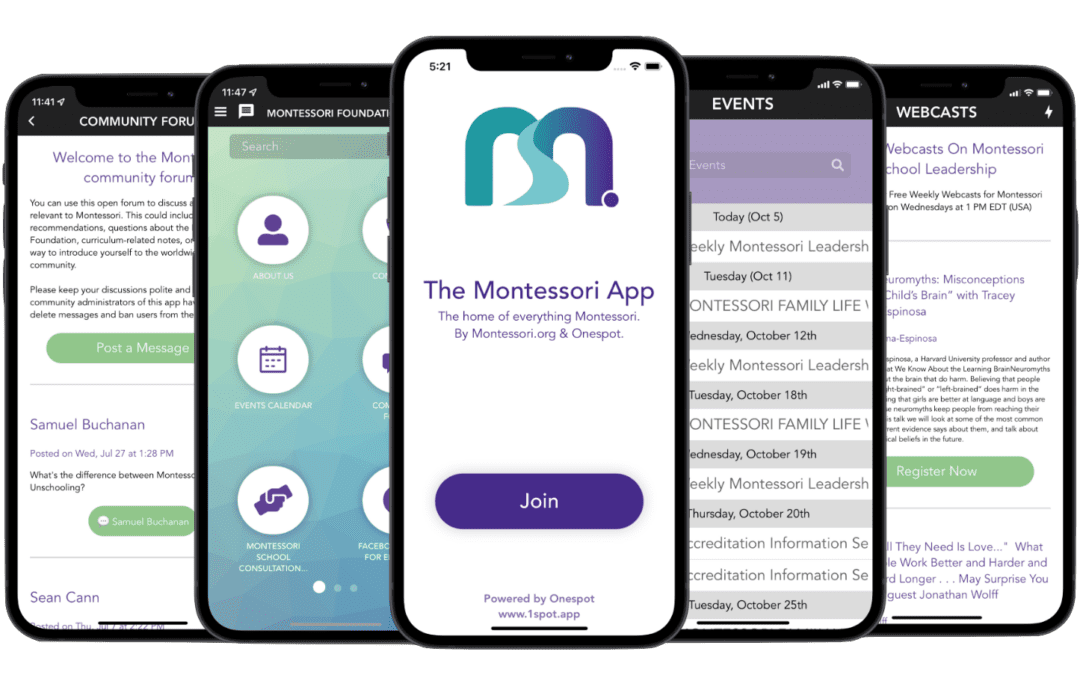
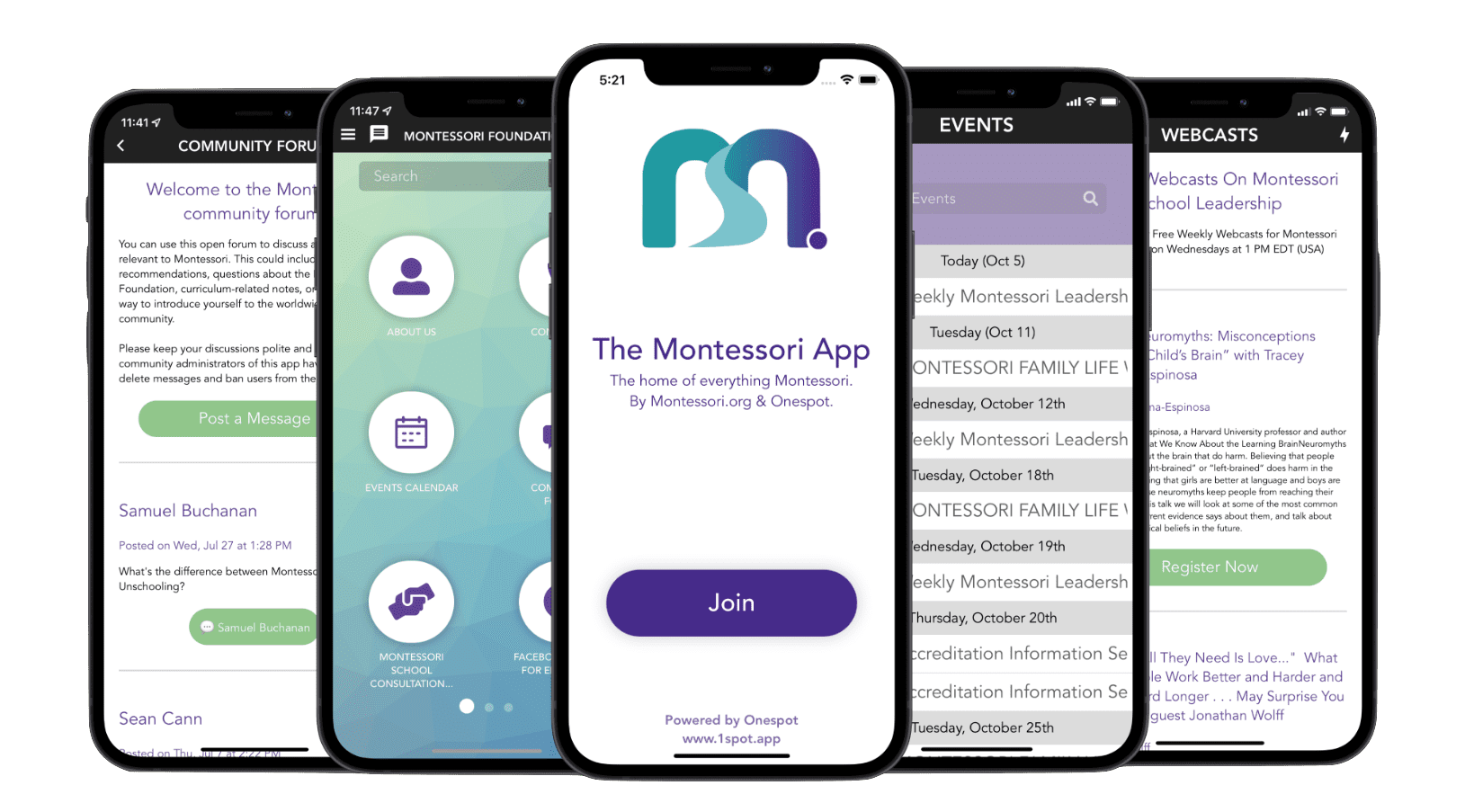
Montessori.org—home of the Montessori Foundation, the International Montessori Council, and the Montessori Family Alliance—officially released The Montessori App on the iOS and Android app stores. This new app organizes all Montessori.org resources into one central spot. In addition to Montessori.org resources, this partnership also allows any Montessori school to have its own school-specific app within The Montessori App, making it a true one-stop-shop for any Montessori school’s community. Anyone can install this new app for free by searching for montessori.org on the app store.

The Foundation’s new mobile app allows anyone in the Montessori community to easily access all of Montessori.org’s information in a user-friendly, personalized way. This new home for everything Montessori is helpful for parents, teachers, school administrators, and anyone else interested in learning more about what Montessori has to offer. Now anyone can join the app to discover upcoming events and webcasts, receive personalized messages about things happening in the Montessori community, and much more.

“It will be a very easy way for interested parents to put Montessori resources on their phone,” said Tim Seldin, founder and President of the Montessori Foundation and Chair of the IMC. “For no cost, they can get information about Montessori, they can check out Montessori schools, they can get many of their questions answered.” He emphasized that “amid the cacophony of noise about Montessori that’s out there,” one of the Montessori Foundation’s goals was to create a way to bring Montessori resources to parents through “something that they can use on a smartphone in those few minutes that the average parent has to sit still, without their child tugging on their shirt.”

The Montessori Foundation has been creating resources, starting with Tomorrow’s Child, the Montessori parenting magazine, for 30 years. In the last seven years, weekly webinars have been added and all are available on the website and on the app. If you have a question about cooking with your child, the lessons, or materials in the classroom, traveling with your child, or anything else pertaining to Montessori, you should be able to find an article or a webinar with ideas on the topic.

Building a mobile app wasn’t a new idea for Montessori.org. Seldin said that they had been very intrigued by the idea of having their own custom mobile app for montessori.org resources for some time. “The reason why we didn’t do it before — and we’ve really thought about this for a few years now — is the cost has been astronomical,” said Seldin. “I mean, we actually bought a do-it-yourself app maker, and it frankly never worked correctly. It was a giant pain in the neck.”

Seldin then met the founders of Onespot, a startup that empowers any school to have a custom, school-specific mobile app without needing to write a single line of code. Seldin said that when he started working with the Onespot founders, “We were able to get something up and running very quickly for the Montessori Foundation, the International Montessori Council, our Montessori Family Alliance, and our Montessori marketplace. That’s really complicated.” The Onespot platform was able to take that complicated system and make it simple.

The platform is like website builders, like Squarespace or Wix, but for mobile apps. Complex organizations (such as schools, businesses, non-profits, or even montessori. org) can use Onespot to make custom, easyto-use mobile apps. And because the platform was developed with scalable technology, the founders can keep the pricing incredibly af- fordable, while still providing top-notch customer service. “It was just obvious to me that they were on to something,” said Seldin.

As this is the first iOS and Android mobile app of its kind, The Montessori App is exciting for the whole Montessori community worldwide.

Montessori schools tend to use many online tools these days for communicating with parents about student progress or sharing other communications.

This new app brings everything together in one place, so parents don’t need to remember five or more different websites and download five or more different apps. This is the first app that deeply solves the community side of Montessori.

“It’s like a Montessori super app,” said Samuel Buchanan, one of Onespot’s founders. “It’s a new home for all Montessori resources, and Montessori schools around the world are starting to move in.”

One of those first schools to get their own custom app created within The Montessori App is the Montessori Children’s School in Key West, Florida. “I like it because it kind of ties us into a bigger picture, so people see it’s not just our little school down here; there’s a bigger entity out there,” said Amy O’Connor, the Executive Director of the school. She added that if parents “want to grow more with Montessori, there are all sorts of resources on montessori.org. I just think it gives more of a lift to substantiate what we’re doing here.”

Jessica Losardo, Director of Operations at the Montessori Children’s School, is also excited about the new app, saying that “should a parent consider Montessori, they can go to the Montessori Foundation’s website and actually research all the different schools to see how they compare to each other—what they’re doing similarly, what they’re doing differently—so that they get a very well-rounded idea of Montessori.”

Having their own app for their school within The Montessori App allows the Children’s School—as well as a growing number of other Montessori schools—to consolidate all their existing platforms and websites into one central spot on the device their community members use most: their phones.

According to a recent TechCrunch article, people around the world now spend an average of four to five hours per day using mobile apps, and that number continues to rise, accelerated by the COVID-19 pandemic.

Centralizing all their school-specific platforms has been tremendously helpful for the Children’s School. “I was starting to feel like we had a lot of places that we were asking parents to visit,” said O’Connor. “We use Montessori Compass, SchoolCues, and a program called Clockify for parents to document their volunteer hours. And it just seems like a lot of apps.”

And they’re not the only ones feeling overwhelmed by the growing number of different apps and platforms that a school community needs to keep track of. Seldin, who has worked with hundreds of Montessori schools over the years, echoed the same sentiment, saying that “parents find it very frustrating to remember how to access their child’s records or the school calendar, or you name it. Even though most schools provide answers on their websites, it’s not always easy to navigate on a smartphone.” He added, “As we end up with more and more online tools and more and more online ways of communicating, there’s really something to having one central place to collect it all.”

The Montessori Foundation launched The Montessori App to be exactly that—one spot for everything Montessori. And as Montessori schools around the world are continuing to join in with their own app inside The Montessori App, this unifying solution is spreading quickly to the whole Montessori community.

“All our work-related stuff is there. Or, for a parent, all their school-related stuff is right there”, said O’Connor. “I think it just makes life easier. And when it’s easier for the parents, or the staff, or whomever, then the school experiences more engagement.”

You can learn more about this collaboration between the Montessori Foundation & Onespot by downloading The Montessori App. See how your school can join the platform by visiting www.MontessoriMobileApps.com (www.seabirdapps.com/montessori-school)

Advice from Montessori Family Alliance Friends

Advice from Montessori Family Alliance Friends

women talking

Reaching out to a friend who has children a bit older than yours can be a very comfortable way to get advice about your own parenting. When you are a part of the Montessori Family Alliance, the people to reach out to have very helpful pieces of advice.

Christine Lowry

The Montessori Foundation

Being a parent is both the most challenging and rewarding thing we can do. My advice is to respect your child’s sense of dignity. Children (especially young children) have a remarkable sense of self-worth, self-direction for their own growth, a sense of their value as people, and being worthy of honor and respect.

I had a sense of its importance as a parent but didn’t have the right language for it until I partnered with parents in my school. We often underestimate our children’s rich emotional life; their natural attunement to us, to their environment, and to the world; their need to explore, do it themselves; and struggle until they get it without our help. Their ‘inner guide’ is the motivation for everything they do. Sometimes, they ‘push back,’ and we feel that they are challenging us. Perhaps, if we could take just a moment to reflect on our child’s intense sense of dignity, we could more easily let go of our need now and see their need in a different light.

Cathie Perolman

Montessori Teacher Educator

If I had the chance to enhance my family, I would have created more family traditions during our younger years. We would have started with a weekly family pizza dinner and game night. This could have started with very simple frozen pizza and evolved into family-made pizza as the children got older and could cook. The games could have started out very short and simple and grown into more challenging games as the children grew. Initially, we could have included just our nuclear family, embracing their friends and other family members when they were tweens or teens. Perhaps this prediction would have carried over into their own families.

Other traditions might have included special breakfasts that we all helped plan, cook, and enjoyed on holidays, days off from school, snow days, etc. Remember, it only takes doing something twice for it to become a beloved family tradition. This could also have been true for something special after school on the last day of the school year or the first morning the family wakes up on summer vacation. I had a friend who said that weeks, months, and years needed to have “punctuation in the book of life.” Looking forward to doing things together helps a family want to spend time together, which is so important.

David Rotberg

Guide at Pines Montessori, Houston, TX

My wife gave birth to a beautiful baby girl and, instantly, we were parents. As a new parent, a new part of me seemed to come alive; a part of me that I didn’t know even existed.

As a young parent, I began to feel that I needed to ‘know’ how to raise a child ‘the right way.’ I read countless books about raising girls. We tried so many things, and yet none of it felt natural because it wasn’t us. We were just doing exactly what the books told us to do.

We spoke with friends and mentors who had older children (or were empty nesters) and asked for their advice/wisdom. Well, fast forward three more children (all boys), and we discovered there was not that one book, that one class, or that one person with all the answers. We eventually found what worked best for our family and what felt right for us. In addition, I also felt a responsibility to help our children live as themselves as much as possible.

By trying to fabricate experiences, read books, and schedule playdates, I tried to force their development too much and redirect their personalities. It didn’t happen at any moment in my parenting, but just gradually, over time, I realized that I had to trust what my wife and I were doing. Our children would be exactly who they were meant to be, and, to an extent, their personalities were hard-wired. I felt that I could breathe more and just trust my children’s growth. It took about five or six years and a few children to learn that, but hey, who’s counting?

Allowing children to make their own decisions and helping them to accept the natural consequences, positive or negative, of their decisions is my best parenting advice. As parents, we support our children by modeling decision making and helping them weigh the possible outcomes. Sometimes, allowing children to fail is what allows them to grow.

Lorna McGrath

The Montessori Foundation

When your child seems to be struggling with something, it can become an ongoing struggle, weighing them down or weakening their self-confidence. Talk to them. Help them with their self-talk and assure them that everyone struggles with something. Most things can be overcome with practice, time, support from others, and determination.

Be empathetic without trying to make it all better. They must do that. Don’t pity them; instead, be confident when they are not. Show them your strength, patience, and willingness to receive help from others. Let them know, “You/we got this!”

Margot Garfield-Anderson

The Montessori Foundation (retired)

My best advice to parents and grandparents is not to spoil anyone with things; instead, be invested and present when you have time with them. Bring them to places to show them there’s a world out there. Expose them to all the arts; take them on nature walks and teach them how to fix something when it’s broken or how to put something together. My favorite is to get them into the kitchen to cook— anything that helps them unplug from those devices. Help them learn to be of service in their communities.

I try to do this with my four granddaughters as well. We do art projects, listen to musicals, watch old movies, play board games, and do puzzles. We knit or crotchet, we paper mâché, we go to museums and science centers; we are going on a cave exploration this summer. I try to create times they will want to replicate and look back upon with the fondest of memories.

Dr. Nora Faris

Montessori Guide, NewGate School

One of the most revelatory experiences for me as a mom and as a person new to Montessori was just how wonderful the notion of Practical Life could be. As a new mom coming to Montessori twenty years ago, I was amazed as I observed what the children in the Primary classrooms could do by themselves. Not only did James (my husband) and I enroll the children in a Montessori school as fast as they would let us, but we left determined to see what else they could do for themselves at home, which turns out to be a lot! Adopting the motto “If you can do it for yourself, you should” has truly helped our children develop into the confident, capable young adults they have become.

As we get the occasional texts from our college-aged kids that read, “Thanks for teaching me how to do my laundry and cook,” or “Thanks for teaching me how to do hard things,” we are grateful for the lessons learned as new parents. Letting go of perfection-oftask thinking to make way for independenthuman-in-development activities was the best decision we made as parents. And, once we understood that anything could be broken into smaller steps towards a larger goal, we created a home environment that allowed our children to become confident and selfsufficient. This worked for driving practice, talk practice, form-completion practice, and more. As James and I look towards retirement, we wonder what practical-life lessons lay in store for us, too. We are eager to learn and set practical-life goals for ourselves as well.

Tammy Willen

Head of School, Bay Montessori School (Lexington Park, MD)

Through my time as a parent and a Montessori educator, I’ve learned many things I wish I could have put into practice when my children were young. As a child, I was a Montessori student, and as an adult, I became a Montessori educator. Therefore, I was very knowledgeable of the “Montessori Method” and did my best to parent along a similar path. Now that my kids are teenagers and I have life experience and more training, I’ve learned a few things I wish I’d done when my kids were young.

Many parents think we know what’s best for our children. Although my heart was in the right place, I often forgot to listen to my child, both through their words and through their actions. Most parents think a three-year-old still needs a nap and a four-year-old needs to eat at each meal. We think a seven-year-old should know how to read, and a ten-year-old should know how to speak kindly to a friend. We often spend a great amount of time trying to control our child’s behaviors. What I encourage others to do is to observe, model, follow, and guide.

If I could go back to my children’s preschool years, I’d throw my expectations (and everyone else’s) out the window and watch my child show me their full potential. In schools, I hear many parents say, “He should be…” or “I wish she could…” or “When she does ….” My advice to parents is to eliminate should from your vocabulary and let your child blossom at their own unique pace.

Cheryl Allen

The Montessori Foundation

Family meetings, held regularly, give every person in the family a chance to be a part of decisions and solutions. Knowing that your topic of concern or interest will be addressed goes a long way in helping to develop confidence. Having a voice in the family can make connections stronger and allow the family to work together.

Renee Duchainey-Farkes

The Montessori Foundation

I would advise parents to be focused on a partnership with the school and the teachers, because we are all working for a common purpose: the child. Parents should attend as many school events as possible, even those that are not focused specifically on their child; it helps build school community.

Share expectations and goals for your child with the teacher and get affirmation that these are the right ones for your child. Learn from your child’s teacher.

Share your family’s culture, values, and parenting practices with your child’s teacher. Attend PTA meetings and get involved, if you can, to support the school to be the best place for children. Actively help teachers and the school to recruit volunteer parents to help. 

The Magic of Reading Together

The Magic of Reading Together

Physical Wellness: Part 3 – Physical Wellness: The Activities We Do with Nicolas Lepine