When your child becomes a toddler, you may suddenly begin hearing about fine-motor skill development. There are many ways to develop fine-motor skills, and they are often discussed as if writing is the ultimate outcome. Yet, getting through a day without using your fine-motor skills would be very difficult. We use fine-motor skills, those small movements we make with our hands, fingers, and arms to manage buttons, zippers, and tying when we get dressed, to feed ourselves, turn pages of books or magazines, and keyboard, text, and use the remote, all of that before we have written anything!
New research from Georgetown University (Cortes et al., 2022) demonstrates that fine-motor skill development at 42 months of age correlates to visuospatial deductive reasoning in adolescence. Visuospatial refers to being able to compare two- and three-dimensional objects and deductive reasoning; in this case, it refers to being able to pick which object or drawing from given choices should come next in the series. Although brain imaging continues to improve and those improvements continue to provide more detailed information, brain imaging has shown that motor skills, reasoning, and spatial cognition share common areas in the brain (Cona & Scarpazza, 2019). The ability to make inferences is connected to visuospatial deductive reasoning. For example: Kim ran home. When she got there, she had to stop to catch her breath and wipe perspiration from her face and neck. Did Kim run home quickly or run slowly?
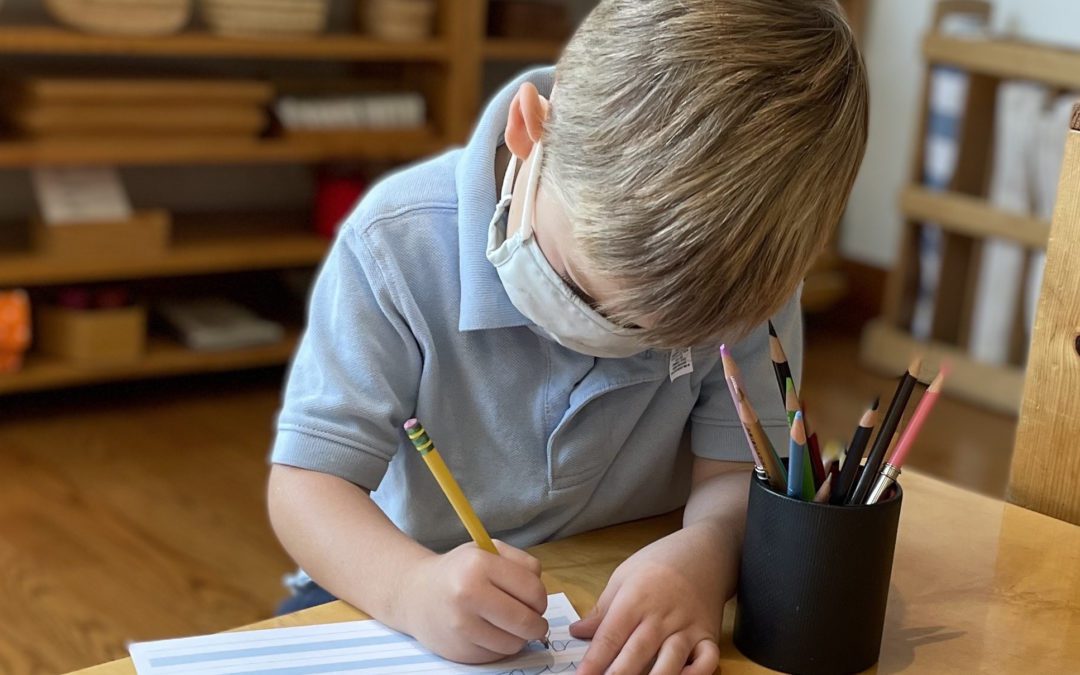
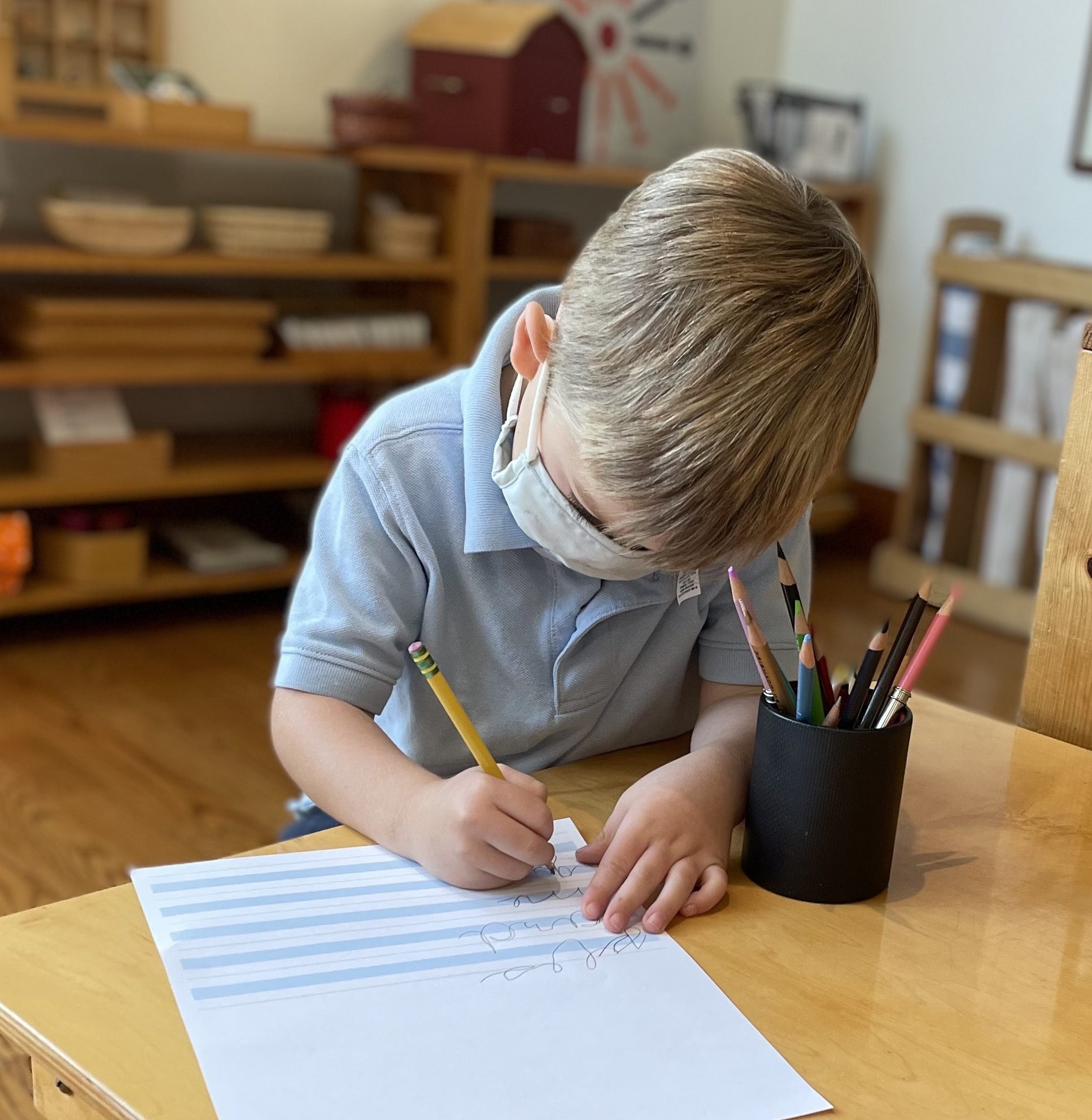
In a Montessori 3-6 classroom, students develop their fine-motor skills through many different materials. The Practical Life area of the classroom develops a variety of fine-motor skills, from the Dressing Frames to pouring and scooping. The materials in the Sensorial area also actively utilize fine-motor skills, such as the pincer grip with the Cylinder Blocks and careful carrying of the cubes of the Pink Tower, Red Rods, and Brown Stairs. The Metal Insets, a language work which creates the movements that form all the letters of the alphabet, also develop fine-motor skills. Using pencils and cutting with scissors also develop fine-motor skills in the hand.
How can fine-motor skills be developed at home? Allowing your child to perform daily tasks, even though it takes longer, is important. Feeding themselves to the best of their ability, wiping down their eating area, and dressing themselves are all opportunities for fine-motor skill development.
Other work options you can create at home:
Art opportunities: lacing beads or pasta on string; drawing in shaving cream; all coloring and painting; playdough or other moldable mixtures.
Water opportunities: using a turkey baster to move water from one container to another (or from a small bucket to a garden); making bubbles with a whisk, a squirt of liquid soap, and some water.
Other opportunities: opening and closing small jars or other containers; pushing uncooked spaghetti through the holes of a colander; scooping uncooked rice or beans from one container to another.
Seventy-six years ago, Dr. Montessori was leading us to the same conclusion as today’s research, using different means of observation. She reminded us, “The hands help the development of the intellect. When a child can use his hands, he can have a quantity of
experiences in the environment through using them. To develop his consciousness, then his intellect, and then his will, he must have exercises and experiences.” (Montessori, 2012, page 130) •
RESOURCES
Cona G. & Scarpazza, C. (2019). Where is the “where” in the brain? A meta-analysis of neuroimaging studies on spatial cognition. Human Brain Mapping, 40(6), 1867-1886.
Cortes, R. A., Green, A. E., Barr, R. F., & Ryan, R. M. (2022, March 31). Fine-motor skills during early childhood predict visuospatial deductive reasoning in adolescence. Developmental Psychology. Advance online publication.
Montessori, M. (2012). The 1946 London Lectures. Montessori-Pierson Publishing Company.
Cheryl Allen was a classroom Montessori guide for 18years and is now Director ofParent Education with the Montessori Family Alliance. As a child, Cheryl attendeda Montessori school from age 2 through the3rd grade. She earned her BA in History fromGeorgetown University and her Master’s inTeaching from Simmons College in Boston.Cheryl is an AMS-certified Early Childhoodand Elementary Montessori teacher, holdsIMC certification in advanced ElementaryMontessori education, and is currentlypursuing a Topics of Human BehaviorGraduate Certificate from Harvard University.
The Montessori Approach to Living Well in Anxious Times
The Covid 19 pandemic has brought about so many feelings in all of us: fear, uncertainty, sadness, loneliness, isolation, confusion, a sense of accomplishment, a sense of failure, a lack of connection, a loss of normalcy. I have seen a wide variety of reactions. Some have lived in constant fear, while others have gone about their lives, trying to maintain some sense of the ordinary. There are also people like me, who, as an extremely careful (some might say ‘germaphobe’) pre-Covid, already washed their hands multiple times a day, avoided people with colds, and pushed doors open with a foot. We felt comfortable and less anxious than in non-Covid times, because all of a sudden, others were finally doing what we had wanted them to do all along. We were fortunate to have in-person learning last school year with no Covid cases in our student body—quite a feat! The reason it is vital for students to be in school is not only because children need routine and structure, but because children crave and thrive in an environment that is prepared just for them— materials that appeal to their developmental needs; furniture that fits their bodies; teachers who are fully present and watching for every detail that tells them what your child needs to work on or if they’re ready to move on. This year, despite our hopes at the start of summer, we are in masks again. But we are still in person, taking the necessary precautions to keep our children, teachers, and staff safe.
Fortunately, the Montessori Method deliberately prepares children to experience and move beyond uncertainty and failure.
Montessori materials provide a built-in control of error. That means that if a cylinder doesn’t fit in a particular hole, there is another one that will. So, children encounter small ‘failures’ or ‘mistakes’ throughout their day at school. If they don’t exchange the golden beads correctly (10 units = 1 ten), the answer won’t be correct.
In facing these constant challenges, children come to view them not as obstacles, but as part of learning. Mistakes are a natural part of the learning process.
Our Secondary level students learn that each time they take a trip together. During these week(s)-long trips with their teachers, young adolescents make all the decisions, such as the route they will take, the amount of food they will need, and the gear they pack. These are all decisions that they must make and live with during these intense and transformational trips. Teens come out of the Secondary level with a confidence unmatched by children at traditional schools, because they come to know that they are capable of managing a high level of responsibility, for themselves and each other.
One of the overwhelming fears in the pandemic is the feeling of uncertainty. Covid has taken away our ability to control and know the outcome of every situation.
This is a valuable life skill we need more than ever today: being comfortable with uncertainty. As much as we have learned about pandemics, no one is certain of the outcome. How are we helping to prepare our children to be okay not knowing?
Montessori students are very self-aware. They have experienced the independence to choose which shirt to wear to school; the ability to pack and make their lunch each day; and decide the work they will do each morning.
Montessori teachers encourage curiosity, wondering out loud to the elementary child, “I don’t know why black holes exist…hmmm…I bet you could find out.” bringing their own individual gifts to the community. This is one of the ways we show each child respect, by listening to, encouraging, and supporting their own questions, thoughts, and ideas.
If you are familiar with the Montessori Method, you have heard about the “Absorbent Mind” of each young child. Parents experience it firsthand when we hear our child repeat something we have said, sometimes even embarrassing us out in public.
Dr. Montessori’s observation of children convinced her that what exists in the environment of each child becomes part of them. In Education for a New World, Dr. Montessori wrote, “These impressions not only penetrate the mind of the child, they form it; they become incarnated, for the child makes his own ‘mental flesh’ in using the things that are in his environment. We have called this type of mind the “absorbent mind…”
In the first plane of development (birth — age six), this absorbent mind takes in the language, sounds, smells, sights, tastes, and feelings that surround children at home and everywhere they go. That’s why we prepare our classroom environments so precisely. Home is their primary environment, but once they begin school, their classroom is their next one: a microcosm of society. As students move to the Elementary and Secondary levels, their world expands. Our job is to prepare children for the time when they will enter society in all its fullness. Our goal is to help them become leaders of that society, to know their place in it, and how they can contribute to the good of all — caring for the world in which they live.
In the classroom, children are provided with predictable routines and environments, freedoms and responsibilities, respect for individuality, and the joy of being part of a community who works together, caring for each other.
Children who are born into a situation of neglect hold onto that for their entire lives; science shows that healthy development is disrupted. We know about the plasticity of the brain, so some progress can be made, but often, these children have difficulty with executive functioning, emotional regulation, indiscriminate friendliness, and high anxiety.
In contrast, the warmth and affection provided to your children positively alters neural circuitry in the brain, which influences their health throughout their lives. This can protect them against the harmful effects of childhood stress.
One clear way for our children to feel our affection is by reading to them each night before bed. The nurturing that comes from the physical warmth and closeness of cuddling in bed, along with the sharing of a favorite book, will provide such strong memories for them later in life, so much so that a feeling of security will be part of their inner being.
One of our school’s founders, Paula Polk Lillard, writes in her article, Through Darkness to the Light, that, “It is the intangibles of life— love, courage, optimism, a sense of freedom— that sees us through life’s challenges and gives us a glimpse of a deeper level of reality than we can ever fully comprehend or articulate … The result was that we were not afraid to grow up. The world to us appeared as an exciting place, full of possibilities.” That’s what we want for our children.
Dan Baker, a psychologist and author, says, “We don’t describe the world we see. We see the world we describe.” We need to be careful how we describe the world to our children; rather than developing a sense of doom and helplessness, provide them with optimism about the future in which they will take part.
Focus on the positive things in our lives. Any stress that we are experiencing in our daily lives will be observed, absorbed, and acted out by our children. In our Montessori training, there is an entire lecture on preparing ourselves as teachers of these children. In The Discovery of the Child, Dr. Montessori writes, “[the teacher] must acquire a moral alertness… that is revealed in her tranquility, patience, charity, and humility. Not words, but virtues, are her main qualifications.” So we are always working on both personal and professional goals at our school (Forest Bluff School) so that we can be our very best for our children. The pandemic has brought out emotions that we may not have felt before. One obvious one is, of course, anxiety—a cognitive state in which we have feelings of tension, nervousness, restlessness, having a sense of impending danger, panic, or doom. Children will see this manifested on our faces, in our tone of voice, and in our reactions to other’s comments or thoughts.
We need to keep ourselves in check. As our children become older, we can talk to them a little more about our worries and our concerns. In the second plane of development (6—12), they have a reasoning mind and are more able to understand the issues facing society.
For their drama performance last year, the children in our 9-12 class actually wrote three vignettes on different pandemics: the Black Death, Yellow Fever; and the flu of 1918. They did this to help process their feelings about the Covid pandemic. But even our Elementary children, who understand the need to wear masks and socially distance, we’re still anxious about the measures we needed to take in the classrooms. And our oldest
The pandemic has brought out emotions that we may not have felt before. One obvious one is, of course, anxiety…
students in the Secondary level discussed and debated the merits of quarantining before their trips (dogsledding in Minnesota and canoeing in northern Wisconsin). Children in early adolescence can understand and handle more complex and divisive issues, such as mandating vaccination, but they are not yet fully their own person.
So, children of all ages are affected by how we, the adults in their lives, act and react to the stressors in our own lives. That’s why it is critical that we focus on good things, rather than on things that worry and concern us.
One of the most effective ways of doing this is to practice gratitude. When we are thinking about what we are grateful for in our lives, it makes it harder to be sucked into the anxiety vortex. We know from a study of mental health that one of the things that people suffering from depression and anxiety do is to ruminate on the same worry over and over. Depression and anxiety most often operate in tandem, and once a developing child starts to go down that path, it’s a long and difficult journey back to good mental health.
It is important that we do everything we can to stay positive in our own mental attitude. Try to remind yourself of the beauty all around us—our children, most of all, but also the simplicity and peace that comes from being outside in nature. disorder, outlining the problems that come from us not spending enough time outdoors. He writes that direct exposure to nature is essential to healthy physical and emotional development, both for children and adults. We know the effects of ADHD, obesity, and depression stem partly from us sitting indoors, spending time on our screens, for example.
Nature is healing. Not only does it bring us a sense of peace and calm, but it reminds us of the great big world in which we live and our part in it. The beauty of nature reminds us that there is a spirituality that we and our children are longing for.
Take a positive approach to everything you do with your children. There are lots of good ideas in the book Let’s Go Outside! by Jennifer Ward, and here are some concrete ideas I’ve gathered for you to take home and try:
Have a scavenger hunt in the woods behind your house.
Find different types of leaves, then take them home and make a collage out of them, or for the older children, have them look them up, label them, and categorize them according to their shape.
Get ideas from the British sculptor Andy Goldsworthy, who works with nature objects, creating incredibly beautiful and unique works of art outdoors. Then, make art with nature objects: mosaics, collages, paintings in the outdoors, find the letters of the alphabet from things in nature, do leaf rubbings, make sun prints.
Find more ideas at montessori.org.
I spoke with a parent in the Secondary Level, who told me that her child, who is almost fourteen, asked for her to be around more. We are all motivated by relationships. I was listening to a Hidden Brain podcast the other day, and the topic was happiness. Those who engage in social interactions are the happiest. To be most fulfilled, we need to be engaged with each other. That’s why the pandemic has been so damaging, why therapists are booked for months in advance, why animal shelters are empty.
Gratitude is the antidote to taking things for granted. Oftentimes, we forget too easily the gifts that we have been given. We forget that life is impermanent. If it doesn’t come naturally to you, you must remind yourself how grateful you are for all you have. Once we received the stay-at-home order last year, we very swiftly went into our own lockdowns. It wasn’t until then that we realized how much we missed seeing others face-to-face, feeling their touch, giving hugs to our friends or our grandparents. It wasn’t until we lost those pleasures, that we realized what we had pre-pandemic.
We faced much of that again this summer, but let us not forget how meaningful and vital those small things are once we come out of this challenging time. Let’s share with our children the gifts of affection and love that they need and desire.
When we just focus on what we’re doing— the activities of our daily lives—we find more happiness. Don’t rush your children through their day, but give them time to get fully engaged in an activity. Once they are, step away and do your own thing. They will get used to this, and this ability of children to be comfortable with themselves helps foster intrinsic motivation.
We want the children to focus on the journey, not the arrival. That’s the reason we don’t send home every piece of work your child does at school. It’s about the process of working with the materials they have chosen: utilizing their pincer grip to develop fine-motor control, which leads to better handwriting; advancing their ability to concentrate, following the steps and progress from one inset to multiples, concentrating as they are developing while creating their metal inset.
Just because you are sad about wearing a mask again this year, guess what? Your children are very adaptable and don’t mind it as much as you think. I have observed in our classrooms daily since school began, and what I have seen is wondrous. They aren’t talking about or complaining about wearing a mask. We project our fears and anxieties onto our children without even realizing we’re doing it. When we live like that, we are simply trying to get to the next moment, the next day, the next week. Remind yourself that your children are at school to work with these beautiful materials and to soak up everything in their classrooms and outdoor environments.
In addition, try not to talk about your own worries in front of your children. “Listen more; talk less” is a good mantra. Only if they ask, explain to your 3-year-old why we wear a mask at school, calmly saying, “We’re helping others by wearing a mask, so that we all try to keep each other healthy.” With courage, you and your children feel empowered to take on each new day, each new challenge. They are not overwhelmed by the statistics and data, and we need not be either. Let them know that humans are amazingly adaptable, and that with their gifts of intellect and will, spirit and curiosity, we have (as a species) accomplished incredible things.
Reassure your older children that this is not the first time the world has experienced a pandemic. If we model courage and optimism ourselves, our children will pick that up and understand that they, too, have the abilities and gifts to overcome any challenge that comes their way. In doing this, not only will you aid in their healthy emotional development, but you will be happier yourself. Maria Montessori said, “Joy, feeling one’s own value, being appreciated and loved by others, feeling useful and capable of production, are all factors of enormous value for the human soul.”
Create and maintain a sense of order in your home. Dr. Montessori wrote, “Order is one of the needs of life which, when it is satisfied, produces a real happiness.” Stick to your routines, waking up at the same time each day, having them make their own lunch, reading before bedtime. The comfort they derive from the stability in their day will help them feel secure and safe. They will know what to expect, which is extremely beneficial for younger children, and they will know that you are there and that you love them. This will provide them with a sense of joy, as well.
At the dinner table, share stories of your family’s history. Bruce Feiler, author of The Secrets of Happy Families, recommends we write a family narrative—what values are important in your family? Have you talked about it? Do you have a family mission statement? Do your children know it? Feiler also cites Marshall Duke and Robyn Fivush’s research, which found that the more children know about their family’s history, the stronger their feelings of self-worth and their sense of control over their lives.
They created a “Do-You-Know?” scale: Do you know where your grandparents grew up? Do you know where your parents met? Do you know where your mom and dad went to high school? So, tell them your stories, so they come to understand their own place in your family!
Another way to provide peace in your homes is to do some form of mindfulness meditation, a practice of self-awareness in body and mind. We always recommend that you not over-schedule your children’s afternoons and weekends. We all need this time, and after a full day in a Montessori classroom, children have lots to process and work through—all the activities they did, all the social interactions they had. They need time every day to relax their bodies and minds.
Meditation can help with this. It can be as simple as deep breathing. Breathe in on a count of four (1-2-3-4), hold (for a couple of seconds), and breathe out on a count of six (1-2-3-4-5-6). Do that three times with your children throughout the day, or when you’re feeling stressed. They’ll think it’s fun because it’s a new and different way of breathing. This helps relax their bodies and settle their minds, providing emotional balance and resilience in dealing with difficult situations. Dianne Maroney, founder of the Imagine Project, writes that, “Mindfulness creates resilience because it promotes an understanding of one’s emotions, the ability to control emotions, and a deeper sense of knowing what we are fully capable of.”
There are many resources on meditating with children. Do a body scan with your child, having them focus on one part of their body at a time, considering how each part feels in that moment. Pause occasionally in their day and have them identify one thing they can see, one thing they can hear, one thing they can smell, and one thing they can feel. It brings them into the present moment and creates a sense of self-awareness.
When issues of political or social unrest come up in your family, listen, acknowledge their feelings, and then talk about those in history who have stood for leadership and courage. When you express gratitude for others’ accomplishments and kindness, your children are then better able to approach, with respect and understanding, the differences they encounter in others and in the world. Talk about ways to peacefully accept and respect those with different views and opinion. These interactions happen daily in the classroom and outside of it, and the children are shown ways and given language to express their feelings with kindness. These types of interactions help them to develop the necessary skills of listening, cooperation, compromise, and mutual respect.
Gratitude can also be fostered by serving others in need. This begins in the classroom, where each child cares for the environment: watering the plants; washing the dishes; dusting the shelves. They learn that their contribution to the class is important, as it also is at home. As children get older, this will translate to their realization that this care extends to those outside their own community. Here are a few ideas of ways your children can serve the larger society in which they live, while having to stay within the safety of their own homes during the pandemic:
As a family, packing “blessing bags,” with supplies those experiencing homelessness need when living on the streets, is a wonderful way to give to others who are less fortunate. Our family made some last year, filling a gallon-size bag with things like granola bars, hand warmers, bottles of water, needed hygiene items, and a list of shelters and local organizations that could help them. We kept the bags in our car, and when we traveled into the city and stopped at a traffic light, guess how thrilled the person was to get one of these? One man said, “Oh, I love these!”
Anytime we can get outside ourselves— our own concerns and agendas—we gain a different perspective. We forget about our problems and are able to see that often, they pale in comparison to others’. Children need to see these things as they get older, and at the Elementary and Secondary levels, they are well able to use their sense of compassion to help others outside their immediate environments. Often, non-profit organizations don’t accept volunteers under the age of sixteen, so be creative! Make bookmarks for the elderly and drop them off at a retirement community. Shop for your local food pantry with your children, dropping the needed items off at the store or church collection points. Make homemade valentines to share with elderly neighbors.
Finally, one of the virtues I dearly espouse is hope. Without it, we would be living in a place of darkness. When we have something to look forward to, things always seem rosier. Research shows that anticipation of something can be more enjoyable than the thing itself. During the pandemic, we have had to cancel plans and vacations and time with family and friends, so it’s been difficult to place our hope in anything specific. I think of hope as the belief that things will improve. This is not a superficial cheerfulness, but the faith I have that this pandemic will end. We can’t know when or how things may be different on the other side, but we have the strength to endure the losses and hardships until that time; and then when it comes, we can hold onto the gratitude long after our circumstances change. If we make that paradigm shift in our thinking, our children will sense it and come out of this time of darkness knowing there will always be light to see us through.
Bibliography:
Baker, D. What Happy People Know. USA: Rodale, 2003.
Feiler, B. The Secrets of Happy Families. New York: HarperCollins Publishers, 2013.
Lillard, P. “Through Darkness to the Light,” Forest Bluff School Blog Article Number 65 (April 12, 2020): 5.
Louv, R. Last Child in the Woods. New York: Workman Publishing, 2008.
Maroney, D. “Using Mindfulness during Stressful Times.” Accessed September 8, 2021. https://theimagineproject.org/ using-mindfulness-during-stressful-times/. Montessori, M. Education for a New World. Amsterdam: Montessori-Pierson Publishing Company, 2018.
Montessori, M. The Discovery of the Child. Translated by M. Joseph Costelloe. New York: Ballantine Books, 1967.
Montessori, M. The Absorbent Mind. Translated by M. Joseph Costelloe. New York: Bantam Doubleday Dell, 1984.
Montessori, M. The Secret of Childhood. Translated by M. Joseph Costelloe. New York: Ballantine Books, 1966.
Vadantam, S. Hidden Brain Podcast. “Where Happiness Hides.” September 6, 2021.
Ward, J. Let’s Go Outside! Boston: Trumpeter Books, 2009.
Laura Earls began her Montessori career at Forest Bluff School nearly thirty years ago. She has recently returned to Lake Bluff, Illinois to take on the role of Head of School there, bringing with her a genuine love for the school and a deep understanding of its child-centered mission. Laura first came to Forest Bluff in 1994 as a Lower Elementary teacher, after earning her AMI Elementary Montessori Certification at the Montessori Institute of Milwaukee with Margaret Stephenson and Allyn Travis. During that first year, Paula Polk Lillard profiled Laura’s classroom in the book, Montessori Today, and in 1998, Laura was invited to speak at the AMI-USA National Conference on respect as the basis of grace and courtesy in the Elementary classroom.
After moving to Wisconsin to raise her three children, Laura received her AMI Primary Montessori Certification at the Midwest Montessori Institute with Hildegard Solzbacher. She then directed a Primary class at a Montessori school in Lake Country, Wisconsin, where she also served as Director of Admissions. Laura received her BA in art history from the University of Dallas and did graduate work in art history at the University of Notre Dame. She has lived and studied in both Paris and Rome and is an accomplished pianist.
Editor’s Note: We know that the authors of this article really meant it to help teachers remember how important setting up children’s environments is to maximize the potential of each child at each stage during the early childhood years. However, because of how broadly they talk about the classroom environment, the principles can also be applied to the home environment. If you are a parent, there may be two “take-aways’’ for you. One might be that you have a better understanding of the many facets to be considered by Montessori teachers as they prepare their classrooms for your child. The second might be ideas for setting up a rich and supportive environment for your child at home. I found it helpful to change the word “materials” in this article to toys or activities as I read through it.
Early Childhood, the period between birth and age six, is the most critical period in postnatal human development and learning. During this time, basic movements are mastered, speech is developed, senses are consolidated, and bodies acclimate to sensory input. With this tremendous development taking place, the environment where children spend their days must reflect the constantly changing needs of childhood.
During their first months, children are in a state of unconscious absorption in which they learn from their environment spontaneously and effortlessly. This period of intense mental activity gradually leads to a state of conscious absorption, allowing for more purposefully chosen activities. At the same time, there is a tremendous quest toward both independence and a need for order. The optimal early childhood environment will have opportunities for children to gain the self-help skills they need in order to build confidence and realize self-liberation; providing order in the physical arrangement of the furnishings, the materials, and the activities offered.
The role of the caregiver, or educator, is to prepare the environment to meet the needs of the unique group of children in their care. There are several factors that need to be considered in order to provide a space that will enrich their experience in a developmentally appropriate manner:
MEETING THE NEED FOR MOVEMENT
As we learned from Dr. Maria Montessori (1870 – 1952), movement is intrinsically satisfying. It also affects psychic and spiritual energies; eventually, it helps children acquire abstract thinking by first enabling them to experience abstract concepts through concrete forms. Young children need to move! Knowing the ages, developmental levels, and needs of the children in your care will enable you to arrange the environment to provide the appropriate amount of physical activity.
Infants and Toddlers: If you are serving infants, who need to creep or crawl, provide open, obstacle-free spaces with warm flooring surfaces of varying textures that they can safely navigate and explore. Toddlers need space for independent exploration, as well as secure objects for grasping and pulling themselves into sitting and standing positions. Later. they will need apparatus for stretching and developing their arm and leg muscles, such as climbing triangles, dome climbers, and short sets of stairs. At this age children begin to learn when and where it is appropriate to run and climb and when it is safer to walk or keep feet on the ground. With guidance, toddlers will start to make the appropriate choices.
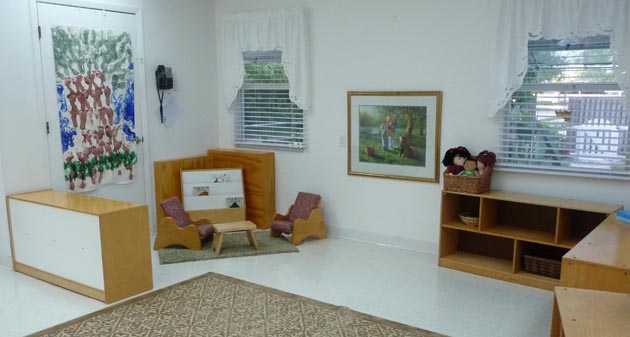
Preschoolers (ages 3—6): Preschoolers need spaces to: move back and forth between shelves, tables, and large open floor areas for unencumbered work; individual spaces, such as cozy reading corners, where they can settle, concentrate, and focus; and spaces to congregate in small and large groups. Long narrow openings tend to encourage running, which can be a safety hazard. Try to break up these long expanses with furniture or plants. A combination of child-sized tables and chairs (preferably adjustable to each child’s height); shelves and cubbies that they can comfortably reach; and open floor space will accommodate multiple types of activities.
MEETING SENSORY NEEDS IN THE ENVIRONMENT
Visual Component: Because young children are constantly adjusting to the barrage of sensory impressions they receive, what children see plays an important role in environment preparation. We live in a world focused on extensive visual stimulation. Although there is a trend to provide eye-popping bright colors or bold primary colors in early childhood environments, a palette of neutral colors and/ or colors from nature can be more conducive to learning and to promoting a sense of calm. A subtler background allows the materials to stand out and attract the child’s interest. In addition, urged on by décor manufacturers, early childhood educators (and parents) often plaster their environments with posters and other materials. However, uncluttered walls can be comforting, soothing, and far less distracting. Be selective and discriminating in choosing what is displayed and hang thoughtfully chosen artwork at the child’s eye level.
Considering your lighting is also important. Lots of natural light is optimal in any setting. If artificial lighting is also necessary, using incandescent bulbs will lend a warmer glow to your environment than the cool blue of fluorescents. You might also want to explore energy-efficient LEDs. In any case, remember safety considerations with young children, ensuring stability, taking care with cords, hot bulbs, and shades.
Auditory Component: Have you considered the sounds the children can hear in your learning environment? Just as your classroom can be visually cluttered, noises such as side conversations, small-group lessons, musical instruments, the rustle of leaves, or even the whisper of wind can make the classroom feel cluttered auditorily. Determine which of these noises are appealing and conducive to learning and which are distracting. Try to adjust the ones you’d like to control or mitigate by using sound-absorbing materials such as rugs and carpeting. Add soft pillows and child-sized upholstered chairs to the reading nook. Hang fabric curtains at the windows or draped across ceilings. If your budget allows, you may also want to consider unobtrusive acoustic panels for walls and ceilings.
Tactile Component: Are the surfaces of your furniture smooth and free of dangerous or pointy edges? Do you provide a variety of materials that appeal to the sense of touch, such as soft woolens, smooth silks, warm wooden objects, and cool metals, which encourage the child to explore and discover the unique characteristics of each? For babies and toddlers still crawling and creeping, have you considered the different sensations they feel on their hands and knees as they make their way around on varying surfaces?
Olfactory Component: What smells greet the children? Whenever possible, avoid the use of harsh-smelling chemical cleaners. Allow fresh air to permeate the environment. Objects with appealing scents, such as a cinnamon bark box or a clove box, can be enjoyed by the children. Fragrant herb plants that are safely edible, such as sage, rosemary, and lavender, also make lovely additions. Allow children to use a mortar and pestle to crush them to release their enticing scents into the air.
Choosing Materials: Besides the physical attributes of your home, there are various considerations to take into account regarding learning and play materials:
Quality: Are the materials constructed to last through use by many children?
Are they safe and free of sharp edges and small parts not suitable for children under three? Are they attractive and inviting?
Relevance: Do the materials embody and respect the personal identifiers that make up the diversity of your family and the wider community in which you live, such as race, ethnicity, and languages? Do they take into consideration the children’s interests, and inspire new ones?
Developmental levels: Do the materials and activities provide appropriate learning experiences for all the ages and ability levels in the class?
Language development: Does the variety of materials offered expose the children to the vast array of living and non-living things offered by our world and the rich vocabulary associated with them to expand their burgeoning language development? Are there opportunities for them to express themselves?
In Conclusion: Considering these various factors when creating living and learning environments for young children will help you provide spaces that benefit them by enriching their experience in a developmentally appropriate manner that contributes to their physical, cognitive, and social-emotional growth and learning.
REFERENCES:
Bagnoli, D. (2021) “Montessori by Design: School Spaces That Stay True to the Montessori Method.” Montessori Life. 33 (1). 26 – 35.Montessori, M. (1964). The Montessori Method. New York, NY: Schocken Books.
Photos in this article courtesy of Alicia Diaz-David.
Marie M. Conti, M.Ed. is head of The Wetherill School in Gladwyne, PA, and a former member of the American Montessori Society board of directors. She has more than 40 years of experience as a Montessori classroom teacher and administrator. Contact her at marie@wetherillschool.org.
Marcy K. Krever is a freelance writer and the former Senior Director of Communication & Community at the American Montessori Society. Contact her at marcykremer@gmail.com.
Montessori is an education centered around peace. How do we help students spend a lifetime, not only accepting and sharing peace, but also feeling secure in the idea that, what is ‘different’ from them and their understanding is interesting and exciting rather than weird or wrong? Communities that are different from their own community can be found next door, a few streets over, or countries or continents away. Finding comfort with even a few of the noticeable differences can help us take notice of these differences as an exciting opportunity. It is said that travel is the best education, and as we have the ability to bring the world to our children through what is offered in the classroom and our homes.
Dr. Cindy Acker stated, in a September 1, 2021 Montessori Foundation Town Hall: “A diverse population isn’t where we want to go, it’s a starting point maybe, but where we want to get to is an inclusive environment, where everybody feels that they have a place, and their place is no less than or no more than someone else’s place. Tim Seldin (President of the Montessori Foundation) often talks about a circle of equals, and we want children to have that lens about each other and the communities that they will encounter when they leave us. That’s the legacy that we will leave for them.” How do we, especially if our community is not as diverse as we would like, help offer this lens of a circle of equals?
Within both the Montessori classroom and the home, the sensorial area and cultural studies provide many opportunities to introduce these communities’ children to what they may encounter when they leave Montessori. Sensorial, the development of the senses, focuses on comparisons of size, color, texture, weight, taste, smell, and sound. If you enter a new environment, or even think about a new environment, these concepts are how you would explain and experience it. With some research and thought, sensorial items from around the globe can be shared in class or in the home, with no special Montessori materials needed.
Sharing food is a window into a different culture. Before traveling some place that she felt would bombard her senses with different experiences, my mother would search for a restaurant serving food from the area she was planning to visit. For her, this let her have a bit of what she would be experiencing in her travels; she was developing her senses to prepare herself for a new community. Searching out different types of restaurants can help your child try different foods, utensils, and decor. Cooking with recipes from different communities gives a chance to experience even more deeply. Take the time to smell the spices used and compare them with spices you use with greater regularity. How is the dish traditionally served? What fruits and vegetables are local to the community that are included in the recipe? What utensils are used to eat the dish when it is served in the community?
Comparing textiles from a particular region can support sensorial understanding of an area different from the one you are currently living in. Fabric matching with different types of materials, colors, or patterns of fabric can familiarize the eye to particular styles. Stories of how the fabric is made, or was made, can also provide connection and understanding of communities in a variety of areas. Different fabrics are used in a variety of ways; some may be used as head coverings; there are fabrics that are typically used for clothing (even different fabrics for bottoms and tops); and there are fabrics used around the house as table or furniture coverings. Exploring fabric from a variety of continents or countries can lead to further discussion and understanding of the natural resources of the area, temperatures in the area, stories told in textiles, and clothing styles.
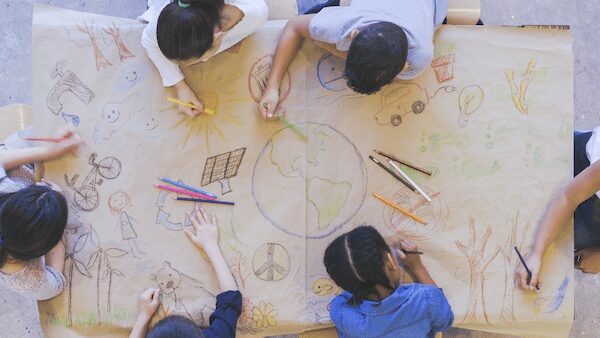
Color comparison is an important part of sensorial work at school and at home. Making the effort to add colored pencils, crayons, and paint that allows students to draw humans with a variety of skin colors offers a way to represent all students in the class, family members, and their current and future communities. Gathering art materials that make creating different skin tones easy for children is one of the simplest ways to encourage the creation of a variety of communities by your young artist. Packages of world skin-toned colored pencils, crayons, and paint are available by several companies.
Music and musical instruments invite discrimination of sound and allows inquiry into the different materials and shapes used for the instrument’s native to a region. Creating a playlist of regional folk or contemporary music lets you hear the language(s) spoken in that area, as well as hearing a variety of instruments. Children could try to learn songs, play along on an instrument, listen for a particular instrument, or simply enjoy music that they have not heard before. Exploring simple instruments, such as styles of drums and handheld instruments, allows children to try to recreate the music they hear and examine the materials and shapes of the instruments.
The large Puzzle Maps seen in most Montessori classrooms, along with the Land and Water Forms are part of the sensorial area; geography is learned by shape, size, comparison, and connection before it is learned by name. Connecting the names of countries to continents and location on the globe helps provide a ‘hook’ for specific information learned later. Knowing that a country is very far north, or very close to the equator, helps organize why certain food items are specialties there, or why specific styles of clothing are worn. Exploring types of trees or flowers through pictures (or even sanded pieces of wood) can offer insight into different parts of the world. Looking at the shapes of leaves on native trees can provide insight to similarities and differences in biomes. Exploring geography and science sensorially helps us understand the differences in natural elements in various regions of the world; it can help us appreciate the positives of these differences, without judgment or comparison.
Using the lens of the Fundamental Needs of Humans to learn about societies allows students, and adults, to see that all civilizations need to meet the same needs and use their available resources to do so. One can easily envision that a community in a rainforest and a community in the desert would meet the same common needs of clothing and transportation in different ways. In the previously mentioned Montessori Foundation Town Hall, Dr. Cindy Acker said, “…the lens we want to hold is one of unifying, one of destigmatizing, one of inclusivity, not just diversity.” Bringing different communities of the world to our sensorial and cultural studies, at school and at home, gives us a tool to find and use the lens of global understanding.
We have the ability to bring the world to our children through what is offered in the classroom and our homes.
This article is an outcome of a Montessori Foundation Town Hall gathering and is built, with great thanks, on the work done by Dr. Cindy Acker and Sarah Levalley for that Town Hall. Their preparation and clear explanation, as always, allow the rest of us to build upon that knowledge, use it in our lives and classrooms, and to share the ideas and knowledge with others.
Cheryl Allen is the Associate Coordinator of the Montessori Foundation Family Network and is also a parenting educator and a Montessori consultant with the Montessori Foundation. Cheryl attended Montessori school as a child. After some time as a traditional Secondary teacher, she worked in Montessori classrooms, 3-6, 6-9, and 9-12, earning certifications from both AMS (3-6 and 6-9) and IMC (6-12). She is a teacher educator, workshop presenter, and member of IMC accreditation teams. Cheryl’s two children attended Montessori from age two through high school graduation.
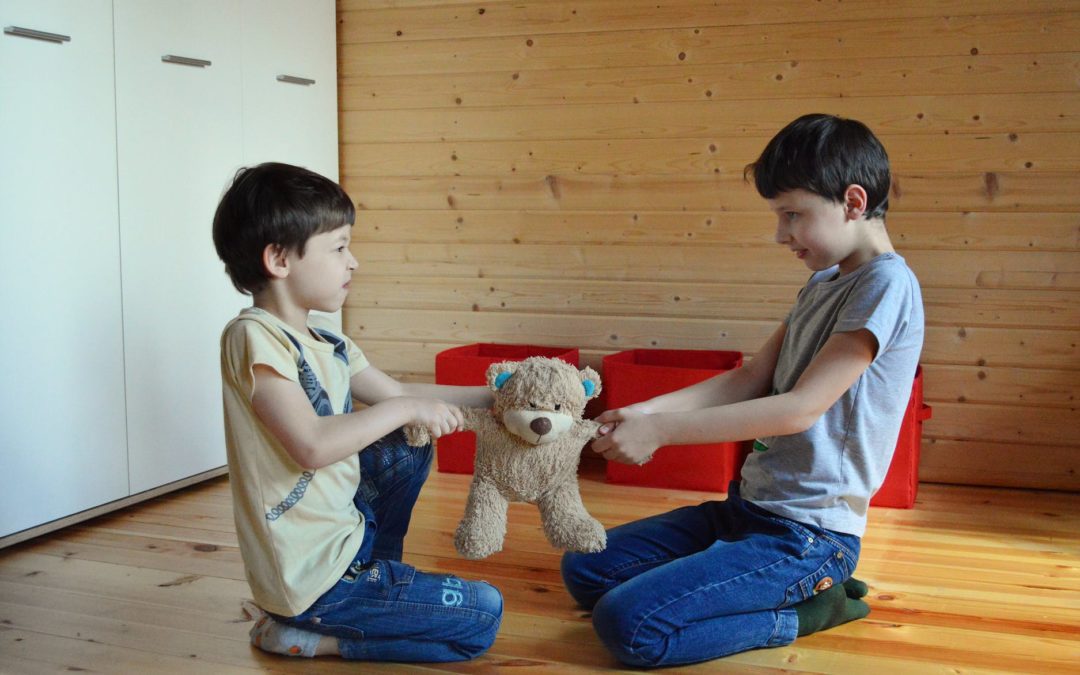
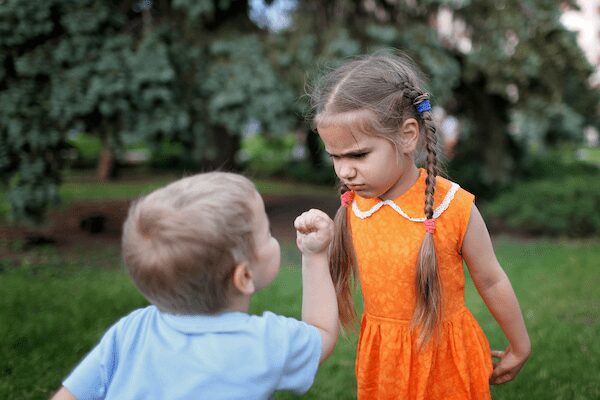
You know the scene. Two children both want the same thing. Or one of them is hurting the other. Or they are complaining and nagging each other.
We can’t help ourselves, we come to the rescue. “Why don’t you go first, and then the other one can have a turn next?” “Why are you always picking on your brother?” “Why can’t you two just leave each other alone.”
When we step in like this, we actually make things worse. The children start to get irritated at us. They think that we take sides (usually in favor of the younger child), and the fighting can often escalate as the children are getting our attention, even if it is negative attention.
So what can we do instead?
We can be the mediator rather than judge and jury. A mediator listens to both sides but stays neutral.
“It looks like you were playing with that, and (to the other child) you’d really like a turn too.”
“You seem really upset. Will you each tell me what’s going on for you?”
Then, do nothing. PAUSE. See if the children can work it out. Perhaps remind them of a rule, “We share by taking turns. It will be available soon.” But stop yourself from solving the problem for them.
And what if there is a young baby? You’d be surprised at the solutions they come up with. I often give the example of Oliver and Emma both wanting to play with the same vehicle. Oliver would have been under two and Emma was just crawling. I stated something like, “Two kids and one vehicle. I wonder how you’ll solve the problem,” and then PAUSED. I proceeded to watch quietly as Oliver took the front wheels off the vehicle to give to Emma and they both played with half each. A far more creative solution than I would have come up with, and they solved the problem themselves.
And if they are hurting each other. We can still step in without blaming either of them. We can separate them – “you go to this side and you come to the other side” — and, once they are calm, they can solve the problem with us as a neutral mediator if needed.
Give it a try for a week and see how you go:
1. Be neutral;
2. Let them be heard; and
3. PAUSE to see if they can solve the problem themselves
You might enjoy visiting Simone’s blog at themontessorinotebook.com. We appreciate her granting permission to use this post. ¢
Simone Davies is the author of The Montessori Toddler and co-author of The Montessori Baby, comprehensive guides to raising toddlers and infants in a Montessori way. The books are based on her 15+ years’ experience working as an AMI Montessori teacher in Sydney and in Amsterdam. She also has a popular blog, instagram, and podcast The Montessori Notebook. She is also mother to two young adults. Simone currently runs parent-child Montessori classes in Amsterdam at her school Jacaranda Tree Montessori and is working on another book with Junnifa Uzodike, The Montessori Child for children from 3-12 years.
Finding Montessori helped her so much when raising her own children, and it’s now her passion to help other parents introduce these ideas in their homes too. She was looking to find a way to be with her kids that wasn’t about bossing, threatening, or bribing them. Or giving them free rein either. And she wanted them to have a positive experience of school, not just to pass tests, but to love learning.
For more than a hundred years, children in Montessori schools have been practicing the Silence Game as part of their regular routine. Maria Montessori discovered that children experience great pleasure from the self-control that produces real silence. This is a silence that comes from within the child rather from the demands or rewards for silence that we often make of children.
“At first when I had not yet understood the soul of the child, I thought of showing sweets and little toys to the children, promising to give them one…I imagined that gifts were needed to obtain such efforts from children. Very soon I was forced to admit that this was useless.” Maria Montessori
Over the years, as an adult educator, I have coached teachers in using the Silence Game as a regular classroom practice, not as a tool to control their behavior. When children are given the opportunity to make silence, they become aware of their bodies and emotions. In our schools we practice the Silence Game as a group, especially at first. The idea is to create complete stillness in the classroom from which true silence emerges.
This practice often starts during group time with just 15 to 20 seconds of stillness. Children may close their eyes as a help to minimize distractions. The teacher may ask them to just listen for sounds in the room like the pump from the fish tank, the AC turning on or off, or the teacher’s soft voice whispering their name to go quietly back to work. As the children increasingly develop their skills in self-quieting, the length of time for this activity increases. This gift of self-awareness and self-calming is priceless.
The holiday season reminds me that it is easy to get off track and forget what’s important and fun! As we approach the holiday season with all the events and activities, the gift giving and receiving, the traditional foods that are out of our typical diets, and the media bombarding us, we may be filled with a mixture of joyous anticipation and dread of the hectic pace that holidays often bring. Our children’s impression of how to act and what to feel during the holiday season is most often influenced by us: their parents and our families.
The Silence Game can be implemented at home as well as at school. It can offer family members a challenging and fun activity that encourages and supports the development of self-control, calming the spirit, and helping to focus on the joy of the holidays. This practice is not a demand for obedience or control but a challenge to perfect ourselves. When we practice it together the Silence Game can have a profound effect on all the family members.
“One day I had the idea of using silence to test the children’s keenness of hearing, so I thought of calling them by name, in a low whisper… This exercise in patient waiting demanded a patience that I thought impossible”. — Maria Montessori
Here are some ideas for starting the Silence Game at home:
• The idea of ‘making silence’ can be introduced at your weekly family meeting. It can be a wonderful way to start your meeting each week by getting everyone calm and centered. Have your family gather on the floor, sitting in a circle. During the first few weeks it would be best for the adults to lead so that the children can become familiar with the process. After that, leadership can be rotated among family members as it is their turn to facilitate the weekly meeting. The leader can whisper people’s names as a signal that silent time is over, and the meeting will start.
• Other times of the day for ‘making silence’ could be right before or after a meal or just before going to bed. It’s a great way to start or end the day.
• One way to bring family members to the ‘making-silence’ activity might be to create a sign that says, Silence and walk quietly around the room to, show the sign, which is their signal to gather, and go on to the next person.
• Another way to call them to gather for silence could be to have a small music box to carry from one person to another instead of the sign.
You will need to explain before implementing the practice how the ‘making-silence’ activity works and what signals will be used. Don’t be discouraged if children three and younger have some difficulty with this kind of activity. If your child will sit quietly in your lap or beside you for a few seconds, that’s a good start.
What else can parents do to cultivate ‘calm and peace’ during the din of the holiday season for our children? Here are some ideas:
• Recognize your own feelings. Are you anxious, joyful, overwhelmed, excited, etc.? How we feel (and how we handle those feelings) can have a great deal to do with how the rest of the family is feeling and behaving.
• Remember to take care of yourselves. Do something for yourself, such as reading a book, listening to soothing music, taking a hot bath, or doing some type of exercise. Take time to do something daily that refreshes, renews, and re-energizes you.
• Leave time in the days and weeks during the season for unscheduled family time to relax and take it easy. It could be reading or telling stories, doing a puzzle together, or having a quiet family meal together. The key words here are together and relax.
You can give your family the gift of silence during this holiday season and throughout the year. Enjoy! ¢
Lorna McGrath has 40+ years of experience in the field of education, teaching children from 18 months through 6 years old and from 12 through 18 years old in both public schools and independent Montessori schools. She received her M.Ed. with a concentration in Family Counseling from the University of Georgia and her Montessori certification from the American Montessori Society. She also served as Associate Head of NewGate School.
Lorna is a Senior Consultant and Director of Family Resources at the Montessori Foundation as well as a Montessori teacher educator, conference presenter, and school consultant. She has used her many years of experience, working with families in the educational setting, to develop programs for parents as well as teachers and children.
Most recently, she and Tim Seldin have published a book, Montessori for Every Family — a practical parenting guide for living, loving, and learning.
We all appreciate the teachers in our lives, but how do we share that gratitude when we may not know much about them beyond the classroom? Here are ten ideas:
1. Say thank you, and be specific about it: in person or by taking the time to write a note from you or helping your child write one.
2. Tell the administrators what you see and appreciate. The positive information does not get shared as often as concerns, so share your positive observations.
3. Offer to buy or do something specific for the classroom. “I hear you are looking for more plants for the garden, could my child and I get some for you?”
4. Provide a gift card related to what you notice in the classroom. Are fabulous art projects coming home? Get a gift card to the local art supply store.
5. Bring coffee and muffins or lunch to the teachers.
6. Give movie tickets, so your teacher has a chance to relax.
7. Give a gift card to a local bookstore (most teachers love to read).
8. Discover a restaurant they like. A gift certificate for a dinner out is always appreciated.
10. Present a gift card for a local grocery store. It can reduce a little stress during high-spending times.
Gifts should be a joy to give and receive, yet sometimes they can cause us stress. In Montessori, we consider how any item will help the child build themselves into the adult they are meant to be. To invite Montessori into your home and family, consider toys that encourage the child to think creatively and independently; toys that will last longer than the box; and realize that fewer toys that meet these criteria may be more engaging than an over-abundance of toys. We are sharing some ideas for all budgets, mostly from smaller sites, which work for a variety of ages and interests to get you started.
Here are some examples of some Montessori-inspired gifts. The Montessori Foundation is in no way affiliated with any of these companies or products. We just like them. If you are interested in a product, the QR-code or the tiny-URLs will help you find it. You will probably find other companies that offer the same product at more or less cost. You may also find some products that are sold out, you know, because of Covid and shipping delays. Sigh!
In fact, I tell them all of the time to get out of my house and go away. Like the unforgettable and motivational lyrics from the song Roam, by the B52’s, I beg my children to “roam where you want to, roam around the world.” A simple song if anything, but the lyrics are truly profound, if not by design and invention, then definitely by divine intervention. This happy little song demands of its listener:
Roam if you want to Roam around the world
Roam if you want to Without wings, without wheels
Roam if you want to Roam around the world
Roam if you want to Without anything but the love we feel
So, it’s ok to roam physically and mentally without the need of anything else but simply “the love we feel.” It makes sense that we humans go to the places that we want to, and the impetus is usually the love we feel within our hearts about that person, place, or a thing that we want to see or know better. However, we can’t fall in love with what we don’t know exists, and we can’t feel what we cannot touch. That’s where the roaming part comes in. Children do not learn best just by simply listening; they need to experience things.
My fellow parents, it can only be an advantage to the human brain, and the human being, to have many different experiences in one’s life. Of course, we don’t have to do anything at all; you are fine just the way you are, as am I. However, I do believe that almost everyone will agree that being a student of the universe cannot possibly be a bad thing. There must be something of value in knowing something (anything) about different languages, religions, customs, cultures, cuisines, music, nations, histories, literature, governments, and people. All the aforementioned can be summarized under the umbrella of culture, which can be defined as all the manifestations of human achievement regarded collectively.
My children have huge dreams and aspirations for their own future, but they regard so much of their world through the lens of their immediate orbit, which may be quite large to them, but is rather small within the scheme of things. I used to take them everywhere I could when they were younger. We have traveled abroad and experienced many different cultures everywhere. At home, I expose them to my British roots, and their mother does the same with tales of her youth and South American customs. When it comes to making a citizen of the world, too much is never enough. So, I actively encourage my kids to continue to not only thirst for culture, but to drink it, and drink from it often.
Younger children need parents for them to move beyond their immediate surroundings. The acquisition of culture is best when directly experienced by the child. They need us to be able to get them there “without wings and without wheels.” The vast menu of cultural differences scattered throughout the planet are all right here for our consumption. We can find ethnic communities, local festivals, diverse food, virtual tours via the internet, and just good old-fashioned “read to me mommy and daddy,” which can obviously be an excellent time to bond and get closer.
Imagine the many questions, the awe and wonder, the breathtaking revelations that will come from the myriad cultural encounters to which our children will be drawn. You do it! Why must their first immersive cultural encounters come from future college experiences, their future date night, or a future friend from another global setting? I strongly suggest that you let the process begin with you! Provide a forward-thinking cultural narrative now for your children, while they are young, and allow them to be able to make global decisions later. Knowing something about the world other than our own can help our children to navigate better the changing times that are upon us.
KNOWING SOMETHING ABOUT THE WORLD OTHER THAN OUR OWN CAN HELP OUR CHILDREN TO NAVIGATE BETTER THE CHANGING TIMES THAT ARE UPON US.
And if you are thinking about providing a rich cultural experience for your children, trying to pick out the “Apex Culture’’ for this process will certainly be an exercise in futility, as every culture has what we may deem as moral highs and lows. No’sir-ee Bob! It looks like the most effective way is just to dive in the best way you can and pick a little bit of some of everything.
One of the outstanding lines echoed in the song is the sentiment that we should roam “without anything but the love we feel.” ‘What does this mean? Are you being asked to roam in the places you have already been? Should we only discover the places we already know and love? I would tend to think not, since they follow that admonishing lyric with another enthusiastic cheer that we should “roam around the world!” I think (and hope) that we should all try to venture somewhere else and become something different with each new experience.
Quick story: I identify with the Christian faith and have done so all my life. At one point, I drove the same route to work for about 13 years 50 miles each way. Every day, I hit a stretch of narrow highway on I-675, with walls of tall evergreen trees lining either side of this familiar road. There was nothing remarkable about the scenery, but the beautiful Georgia sky meeting the tops of the trees.
One day, I noticed some intricate marble latticework beginning to emerge from the tops of the trees. This was a massive construction in development. Day by day, this chiseled chalk white structure would grow higher and higher from behind the tops of the tall Georgia pine.
After some time, I discovered that it was a Hindu Temple, a community temple, a restaurant, and a cultural museum. I was so intrigued by the design of the building and the intricacy of the marble work that I HAD to go and check out this place. After some time, I took my wife and children to this new Hindu temple, spent the day there, and was not disappointed. The physical design and interior alone were truly amazing sights to behold. The smell of incense and saffron filled the temple air and, while unusual to me, I would be dishonest if I said that these scents were not pleasant to my senses. While there, we watched the worshipers pray, we read about their beliefs, we sat and ate some of the most amazing foods I have ever tasted: our taste buds were not ready for this deliciousness. We sat and consumed the very same food that they ate, while we listened to the music of their faith; I was no less a Christian for it. We met strangers with different accents and languages, but we all laughed together in the same language. It was, in all honesty, truly an amazing day of love and learning, one that my two 20-years -plus children and my 15-yearold have not forgotten. This was just one of many times I have nudged my children into the fray and over the cliff of cultural diversity.
This song is not a convenient metaphor for me. I really do believe that there is something very real within the commanding lyrics of this song. I would like to imagine that these three wacky bandmates at the beginning of their career had the early opportunity to travel more and experienced success through the lens of their expanded world; it somehow changed them.
Exposure to culture helps us to grow into more complete human beings. It is literally the fiber that binds humanity. It doesn’t matter if you travel to it, or bring it to you, culture is the space between strength and weakness. Mark Twain once said, “Travel is fatal to prejudice, bigotry, and narrow-mindedness, and many of our people need it sorely on these accounts, “Roam” is the embodiment of Mark Twain’s words. Our children cannot get up and simply roam where they want to. They rely on us to help expand their universe and guide the journey. Since our kids don’t know what they don’t know, I suggest we get going.
Michael Crump and his six siblings grew up together in the UK. He received a BA in Sociology/Education from Ashford University. Michael attended Manhattan College for two years and lived in NYC for 16 years. After working in corporate management for 25 years Michael decided to join his wife, Arlette, as a teacher at her school, the Montessori Village Academy in GA. He completed his Montessori Elementary Teacher Certification in an IMC training program. Michael and Arlette have three children – Isaiah and Morgan in college and Mattison, a working actor in high school.
I have always done everything for my children. I just thought that is what good parents did! I thought it showed my love. But now that they are growing up, and I am learning more about the Montessori Method from their school and my reading, I understand that I need to expect more from them and let them help around the house. This is both a practical and a mindset change! Can you help me get started?
—AN EXCITED MOM
Dear Mom,
Congratulations on making the decision to afford your children more responsibility, and opportunities to contribute to the family. This is a key concept in happy and healthy families, and you cannot start too young. The key is to begin small, teach each skill to your children, and then have consistent expectations that the job has become their responsibility and is no longer yours. Let it happen naturally, as the child has the skills to take on a task!
Let’s choose one activity to use as an example: bath time. Your goal is for your child to learn to take a bath independently: from getting pajamas to leaving the bathroom as he found it. This is a process that will take years to learn, and we certainly are not advocating that you leave your child alone in a tub of water until he is mature enough to be safe.
Taking a bath requires a child to do a series of steps that will complete the goal. The child needs to: get pajamas and bring them into the bathroom; turn on the bath water at the correct temperature; undress; get in the bath; turn off the water, when the bath reaches the correct height/ temperature: wash the body; rinse off the soap; wash hair, if needed; rinse hair; get out of the bath; dry off; put on pajamas; let the water out of the tub; dry any spills; hang the towel; and put the dirty clothes in the hamper.
How can we begin to teach a child all those steps? Begin today to turn over one step at a time to the child. Do not do anything for your child that she can do herself.
Be sure your child can find her pajamas in the same place each night. (I always put them under the child’s pillow, and my children wore the same pair of pajamas until they were dirty. This saved on laundry and made life simpler for our family.) Say to your child, “Now that you are getting older, you are ready to start learning how to take your own bath. Please get your pajamas and bring them into the bathroom and then come and get me.” That is now a task for the child every night! You will need to be sure it is done, but you will never do it for her again.
You can turn on the water until she is old enough to do it herself. You can place a mark on the chrome that shows how far to turn the handle on the faucet. (A permanent marker works well.) This is especially important, if the turning the water on also controls the water temperature! Be there while the child does it for as long as it takes for you to be certain that she can manage it herself. This is one of the more difficult steps in the process, and you will need to be involved in it longer.
Teach your child how to wash. How does the soap get onto the washcloth? You may need to do that part, but they can do the actual washing. First you will be there while she is washing, watching to be sure she is doing it correctly. In time, you will come back and check and “help” to do the difficult parts.
The key is to begin small, teach each skill to your children, and then have consistent expectations that the job has become their responsibility and is no longer yours.
Washing hair is one part I helped with for many years. I checked to be sure the hair had all the soap removed. Eventually, she will wash her entire body herself! Even a very young child can rinse off alone. You may need to talk her through the process, check and be sure she rinsed all the spots and gotten all the soap off (especially in the folds of the skin), but you do not need to do it for her.
Once the child is rinsed, she can open the drain to let the water out of the tub. She can get out of the tub and begin to dry off. (Be sure to teach her to “hold on” as she exits the tub — as wet is often slippery.) You can come and help as needed. (I always said I needed a hug when they were in the towel, and I checked that my child was dry before putting on her pajamas). Dressing is a skill that children begin to learn as early as 18 months. By four, this is totally the child’s responsibility.
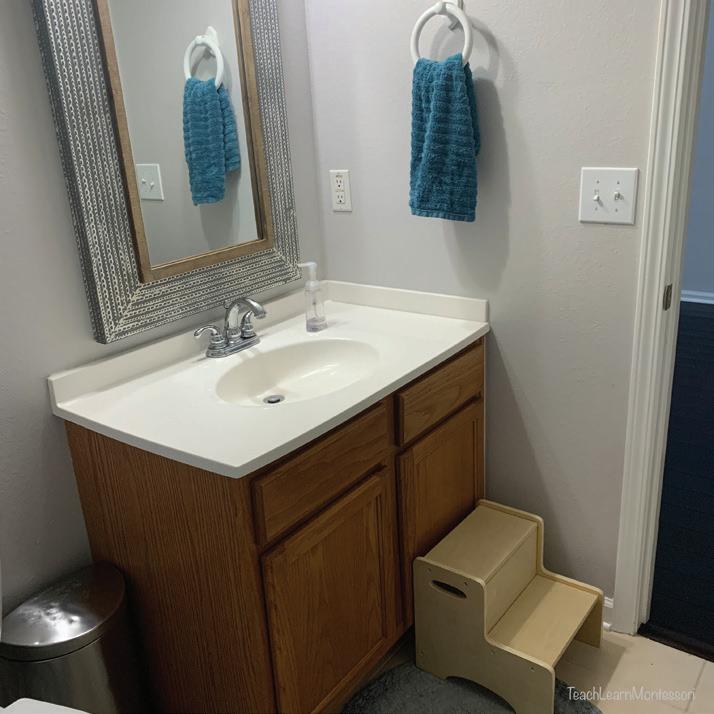
Drying the bathroom may require you to point out areas of water. Some people prefer to do this before the child is in pajamas, as she may get wet doing it! Children can hang up the towel if the hook is at an appropriate height for them. Hooks are now easy to buy and can be moved as the child grows!
A child as young as 18 months can learn to put her dirty clothes in the hamper, and that is an easy job to turn over to the child immediately.
When you are beginning to teach a series of skills, discuss the sequence of steps in the process with your child. What comes next? Can you do that part yourself? Always talk to your child about how she will be able to do this part in a few months/years This sets the tone that you know/expect that your child will ultimately be a self-sufficient person.
You can apply the same principles to any task. Let your child carry the laundry downstairs; put the toilet paper in the closet, and later onto the toilet paper holder, or put the vegetables in the veggie drawer when you come home with groceries. A child of three can even put three carrots in each small plastic container for lunch. Then, when packing lunch for himself, he simply removes a container.
Have fun letting your children take on more and more responsibility and let us know how it is going! ¢
Cathie Perolman is a reading specialist, elementary educator, author, consultant, and creator of educational materials for primary and elementary students. Check out her new downloadable materials on her website cathieperolman.com.
For more than three decades, she has dedicated her energies to improving reading for all youngsters. She is the author of Practical Special Needs for the Montessori Method: A Handbook for 3-6 Teachers and Homeschoolers published by the Montessori Foundation (available through montessori.org.) She is a regular contributor to Tomorrow’s Child and Montessori Leadership magazines.
With the coronavirus crisis causing unprecedented job losses, many families are experiencing uncertainty around money. Even families with relatively solid financial footing are feeling a need to rethink family finances.
Our impulse as parents is to protect our children from financial difficulties. But our current situation creates an immense opportunity for family discussion—especially at a time when families need everyone pulling in the same direction.
Whatever your financial circumstances, you can step into age-appropriate conversations. Children can learn that everyone faces economic adversity at some point in life. But we can teach skills that build resilience. Let me suggest four steps to guide your conversations.
1. Start with the headlines.
Before you begin talking about money concerns as a family, clarify the facts you want to share: Focus on the news your child needs to know and how that news impacts your family. Keep it simple and straightforward. For example:
• Mom lost her job, and we need to talk about what that means for our family. • Dad’s job is secure, but we still think it’s time for us to be cautious. • Mom’s business has fewer customers, so that means less income for our family.
Those focused statements kick off further disclosure and conversation. While you can share additional details, your goal is to avoid a monologue. Move to dialogue!
Creating space for children to express their thoughts and feelings is crucial.
2. Invite feedback.
Creating space for children to express their thoughts and feelings is crucial. If you jump to solutionfinding too soon, you risk shutting down their responses. Draw out your child with open-ended questions:
• What questions do you have about what I just said? (Not:
“Do you have questions?” but
“What are your questions?”) • What do you think this means for us as a family? • How do you feel right now?
If your child doesn’t voice a response, that’s okay. Circle back to the question later in the discussion or within a day or two.
3. Brainstorm solutions together.
Adjusting family finances impacts everyone. Inviting everyone to find solutions improves buyin from all. Older children can help you consider key numbers in your family budget. Younger children think more readily about their own “money in, money out.” Consider these questions:
• How can we work together to increase our income? • What do we spend on that’s easy to cut back? • Which things feel most important to keep?
Now is the time to discuss any emergency funds you can access—money put away for a time like this. It’s a teachable moment for older children to understand that living on their own means building a reserve of at least three- to six-months income.
4. Speak and act with confidence.
Your family conversations can normalize the experience of adversity and teach your child to pivot quickly.
One of the best ways to display confidence is to find opportunities to share and volunteer—giving time, even if you can’t give money. Discuss how some people need help with everyday food insecurity, as well as what you can do for the elderly and others who are isolating alone.
As a family, you can’t always control what happens. But you can talk about it. Remind your child that you’re working together—and that you will get through this.
Nathan Dungan is the founder and president of Share Save Spend® . He speaks and consults with organizations and families on the topic of financial wellbeing. Nathan uses a Wellbeing Framework to help individuals and families build capabilities that are most relevant for them and the goals of their family.
He is the author of three books and numerous resources for organizations and families. Nathan’s newest resource, Money Sanity U®, is a subscriptionbased virtual learning library for organizations that addresses a variety of money topics in a simple and interactive format— all designed to help improve financial wellbeing. You can learn more at sharesavespend.com.
I have been a children’s music teacher for nearly half a century! I started teaching in Michigan and continued in the U.S. Virgin Islands, California, Hawaii, and New Mexico. In the beginning, I was expected to create my own curriculum. Because I was a musician, everyone assumed I knew how to implement a music program. The truth was, I had no idea!
Fortunately, in 1974, I received a scholarship to become an accredited Early Childhood teacher through the American Montessori Society. The Montessori philosophy and rationale inspired me to find an age-appropriate approach to passing on the language of music to young children. After careful observation, trial and error, and field research (classroom experience), I began to understand what young children need most from a music lesson.
Catalyst for Learning
Music can serve as a catalyst for learning. Early Childhood musical experiences are far more important than we imagine. Music is not just entertainment or recreation for young children. It can serve as a catalyst for learning. It aids in the development of cognitive skills (the core skills the brain uses to think, learn, read, remember, reason, and concentrate).
Research affirms the many benefits of music that extend beyond the craftsmanship and art of music itself. Music helps develop self-esteem, body awareness, balance, compassion and respect, sharing skills, gross-motor control, fine-motor control, problem solving, work ethics, and the ability to think creatively. These are the very skills that parents expect their children to learn at school.
It has often been said that music is the universal language. If so, then children should be introduced to music at the same time they are developing language, ages one to five. Similar to learning a language, music needs to be in the child’s environment on a daily basis, gradually increasing vocabulary. In a preschool setting, this means creating a daily routine of interactive songs and musical activities aimed at developing basic music skills. Through engaging in the songs and presentations, children acquire a musical repertoire of melodies, rhythms, lyrics, and musical concepts.
These Early Childhood musical experiences help them learn to focus, maintain attention, process information, and become better learners. Music needs to be the child’s environment on a daily basis, gradually increasing vocabulary.
AMulti-Sensory Approach
The Montessori Method recognizes that each child has a unique way of taking in information; some children are very auditory, others visual, and some need a hands-on experience. Montessori is a multi-sensory approach, so the activities stimulate more than just one sense, thus fully engaging the child. I follow a similar approach when singing with young children.
The goal of a song is to invite the child’s participation through listening, singing, and utilizing hand motions or finger plays. The combination of these events holds the child’s interest from the beginning of the song to the end. The completion of a project is very important for young children; to successfully reach the end of the song leaves them feeling accomplished and builds their self-esteem. They often applaud at the end of the song! That applause is not for me. It means that they are proud of the fact that they completed the song.
Children learn through repetition. Doing something just once is never enough. It is important that they repeat the songs and exercises several times before moving on to new material. In my songs, I utilize a form of repetition called the “echo” or call and response. This is where I sing a short musical phrase, and the children repeat it after me. Using an echo, they do not have to learn the song. They feel successful the first time they hear it, because they are simply repeating lyrics and melodies. The lyrics have accompanying movements or instructions, so the children repeat the phrase while performing the movements. The act of being my echo and merging the motions with the lyrics invites the children’s participation and keeps them fully engaged. Utilizing the echo improves their listening skills and their ability to follow oral instructions.
A good example is my song, “Ladybug.” We use our hand to represent the ladybug and start out with one hand behind our back. As I sing “ladybug, ladybug,” the children move their hand from behind their back while repeating my phrase. I then sing “landed on my head” (they repeat the melody and motion), “crawled onto my nose” (echo) “and over to my ear” (echo). “Ladybug, ladybug” (echo), “crawled on my neck” (echo) “and then she flew away” (echo). This is a very popular song with children worldwide.
What are the Solfeggio frequencies?
Solfeggio frequencies make up the ancient 6-tone scale thought to have been used in sacred music, including the beautiful and well-known Gregorian Chants. The chants and their special tones were believed to impart spiritual blessings when sung in harmony. Each Solfeggio tone is comprised of a frequency required to balance your energy and keep your body, mind, and spirit in perfect harmony.
I sometimes use verbal instructions for the children to echo. For example, I might say “girls stand up” (echo), “just the girls stand up” (echo), “girls touch your nose” (echo), “bend down and touch your toes” (echo), “girls turn around” (echo), “now turn the other way” (echo), “jump three times” (echo), “now quietly sit down” (echo), “thank you girls” (echo). They simply repeat my verbal commands while acting them out.
By starting with the girls, I have created an expectation; the boys know that they will also have the next turn. This idea of creating and fulfilling an expectation is a tool I use to create enthusiasm for the lessons. As I am leading the presentation, I am constantly evaluating and assessing how well the child is doing. This allows me the opportunity to adjust the level of difficulty accordingly. I want it to be challenging, yet within the grasp of the child.
Music activities stimulate more than just one sense, thus fully engaging the child.
Once the children are comfortable with the concept of echoes, it plays a major role in future lessons: the introduction and performance of rhythm band instruments (tambourines, rhythm sticks, triangle, maracas, hand drums, and cymbals), solfeggio with the hand bells (Do, Re Mi, Fa, So, La, Ti, Do), and even the introduction of rhythmic notation (a quarter note = ta, two eighth notes = titi, and a half note = to-o) all utilize the echo.
Create a Consistent Format
A daily music class with kindergarten-aged children usually lasts 30 minutes. I begin with verbal echoes and then proceed to echoes utilizing patschen (clapping, tapping knees, tapping the floor, snapping fingers, etc.). I then take out my ukulele and accompany myself by singing a few interactive songs. Halfway through the lesson, we stand and dance or participate in a gross-motor activity.
Besides my ukulele, I always bring a bag of rhythm band instruments. The bag creates a lot of excitement and is a good diversion from the other activities. All I must do is say, “I have something in my bag I want to show you,” and I immediately have every child’s attention. When I reach in the bag, I take my time and make noise moving the instruments around as if looking for a certain one. This again creates excitement and an expectation. When I take the instrument out of the bag, there is always an “ooh” from the children!
I introduce the instrument by telling them its name and allowing them the opportunity to hear and play it before placing it back in the bag. I always conclude my classes with a calm echo and goodbye song.
The songs and lesson content may vary, but the method and format of every class is the same, creating continuity and familiarity within the classes. These musical experiences become highly anticipated and appreciated by the children. I thoroughly enjoy my time in the classroom! I smile and laugh often. I genuinely have fun, which translates into the children having fun.
Building a Musical Foundation
My goal has always been to pass the language of music on to children. These early childhood musical interactions help them become better learners. They also provide a sound musical foundation. If these children choose to play an instrument in elementary or middle school, they most definitely will have an advantage and are more likely to succeed.
Parents, if you want your children to have a strong foundation in music, you must be a good role model. Sing and dance around the house; let your children observe you enjoying and interacting with music. Invite your children to join you and share the music that you like with them. Sing children’s songs and participate with them by acting out the motions. Take them to concerts or musical events. Allow them opportunities to explore playing musical instruments like drums or percussion.
The most important thing is to bring music into focus! It is all around us, so draw the child’s attention to it, and they will fully appreciate and enjoy the wonders of music throughout their lives! ¢
Frank Leto is an Early Childhood educator, a musician, a composer, and a Montessori teacher who has been working in Montessori schools throughout the country for 40 years. He is also a professional musician, Orff music teacher, and steel band director. He brilliantly combines his skills as both teacher and musician to create a sound that children love! Frank’s music for children is exceptionally popular with teachers and parents throughout the United States. His music is designed to encourage children’s participation through singing, dancing, fingerplays, games, and exercises.
Frank has ten interactive, multicultural CD’s, two of which have won educational awards. Some of his music is also available in Spanish and Mandarin. He also has a curriculum book, Method to Music, which outlines his unique approach to music education.
He travels nationally and internationally, presenting keynote speeches and workshops at educational conferences. Contact Frank Leto at: musicalventures@gmail.com or visit his website at: frankleto.com.
Membership in The Montessori Family Alliance means direct access to Montessori experts and other friends and parents of Montessori. Now, you have a one-stop resource for all of your Montessori needs. Brought to you by The Montessori Foundation.