

ARE YOU KIDDING ME! Employing Humor To Guide Children Toward Better Learning and Behavior
To continue reading, you will need to choose a subscription plan.

What We Believe Our Children Receive: Living Out Our Family Values
To continue reading, you will need to choose a subscription plan.
How Much Is Too Much?: Giving Children What They Need May Not Always Be What They Want
To continue reading, you will need to choose a subscription plan.
What Do You Want Me To Do?: Telling Your Child What To Do Rather Than What Not To Do
To continue reading, you will need to choose a subscription plan.

Are We Really All Friends?
ARE WE REALLY ALL FRIENDS?
by Betsy Merena
In this article, we will discuss the appropriateness of the long-standing tradition of using the term “friends” as an all-encompassing definition of peer relationships in the early childhood classroom environment. Through a personal anecdote that spurred self-reflection and a pivot in my own teaching practices, we will discover informed alternatives that ease the pressure created by expectations of universal friendship.
“But what is a social life if not the solving of social problems, behaving properly, and pursing aims acceptable to all?”
Ubiquitous in almost all preschool classrooms across the country, both Montessori and mainstream, is the idea that we’re all friends. But are we really?
Receiving lessons in, and creating an environment rich in, Grace and Courtesy is a hallmark of a good Montessori education. But is universal friendship an equally essential ideal? As guides in the Montessori toddler and primary environments and beyond, we want pleasant interactions among our students. We want cooperative work and play efforts. We want classrooms full of children who enjoy being there and being together. And we guide, teach, and prepare the environment, with those goals in mind.
But do we need to enforce the idea that we’re all friends?
It wasn’t until I became the parent of a primary-aged Montessori student that I came face-to-face with the pitfalls of this concept. All my previous years of experience in the world of early childhood education were full of songs and encouragements, championing the same basic message: we’re all friends.
But what if that’s not true?
Here’s what happened to jumpstart this shift in my thinking. My daughter, four years old at the time and a second-year primary student, was having trouble with a boy in her class. As the toddlers’ guide in the same school, I had the benefit of hearing the teachers discuss various students and how to handle the challenging situations that crop up in any given year. Plus, we share a playground and recess time. So, I was able to observe my daughter and her class daily. I knew that this boy, new to the school, was having a harder time than most acclimating to the classroom environment and was targeting a few specific children with some of the worst of his behaviors. My daughter was one of them.
As parents, my husband and I fielded her frustrations and complaints at home with the standard responses: Talk to him and tell him “No.” Your friends should make you feel good pretty much all the time; if they’re not, and if they’re not respecting your body, then you don’t have to be friends with them.
It was at that point that my daughter broke down into crocodile-sized tears and said, “But my teacher says we’re all friends.”
It felt like the air was knocked from my lungs. In that moment, it felt like the entirety of my teaching career flashed before my eyes. How many times had I said those same exact words to my students? We’ve sung those words and sentiments at our morning circle countless times. Full of the best intentions, I’ve said them over and over to children who were struggling to get along.
But what if that phrase, that sentiment, is doing more harm than good?
What if it’s giving young children, and their developing social skills and social understandings, a skewed idea of what friendship is and what it means to exist in a cooperative environment with our peers?
As adults, we live and work in a society with each other. We navigate relationships of all kinds in many ways. But no one ever expects us to be friends with everyone with whom we regularly interact. Why do we ask that of children?
Instead of saying we’re all friends, let’s try, “We are a community” instead. In communities, people are expected to act with grace and courtesy toward each other, but they are not expected to be friends with everyone. We can set healthy boundaries and still be kind. We can recognize how other people make us feel and choose who we honor with the title of ‘friend’.
In a community, we can all work towards the same goals; we can share experiences. We can learn and grow together. We can do all these classroom basics without the pressure of being friends with every single person.
After I caught my breath, I looked my daughter in her tear-rimmed eyes and said, “You do not have to be friends with anyone who makes you feel this badly. You are classmates and part of the same community. You need to be kind to each other, but you do not have to be friends.”
The relief that realization had on my daughter was immediate and profound. And its magnitude hit me in the same way. Children, even young children, can be classmates without the pressure or expectation of being friends.
As guides, and as parents, we know that some children’s personalities are like oil and water. It is so much more empowering to say to them honestly, “You don’t have to be friends, but you must be respectful, kind, and courteous to each other.”
Perhaps then, as these children grow, they’ll have a healthier view of friendship. We can hope that they will have a more robust emotional and social tool kit for existing cooperatively with people who they just don’t click with well.
And, what a poignant lesson this could be for us as an American community right now. We might not all be friends, we might disagree, but we must be respectful, kind, and courteous to each other.
“The social rights of children must be recognized so that a world suited to their needs may be constructed for them.” – Maria Montessori
REFERENCES:
Montessori, M. (1967) The Absorbent Mind, p225
Montessori, M. (1966) The Secret of Childhood, p225
Betsy Merena is an AMS certified toddler guide at The Montessori School of Westminster inWestminster, Maryland with over a decade of teaching experience in early childhood classrooms. Along with her husband and daughter, now in her first year of lower elementary at the same school,Betsy loves to explore the world through travel and cooking. She also volunteers asa Girl Scout troop leader for her daughter’s troop and enjoys spending time camping.

Three Rules for Positively Guiding Toddlers
How do we decide when a toddler’s behavior is inappropriate? Together we will discuss the questions to ask ourselves before we intervene in a child’s play. Then, we will consider three simple, easy to understand rules that aid toddlers’ understanding, support collaboration and help avoid power struggles.

Sample Discipline Policy – Damariscotta Montessori School (based on positive discipline)
Damariscotta Montessori School uses positive discipline, which is implemented in a developmentally and age-appropriate fashion to meet the needs of the individual child. Our focus is on how to help children resolve problems and empower them to have a successful experience in the classroom and school community. The goal of our discipline policy is to provide an environment that promotes respect and safety for each person as well as the space we share.
The need for discipline within a Montessori classroom is greatly reduced by the prepared environment. The teachers make a point of keeping engaging activities available for the children so there is never a lack of something interesting for each student to do. The teacher may also redesign the work areas, jobs available, number of children allowed in a work area, etc., in response to classroom behavior.
For younger children, the primary method in a Montessori classroom is redirection – moving the child from a disruptive activity and engaging him or her in something more productive. Emphasis is put on directing a child to what they may do (making appropriate choices) rather than telling them what they may not do. For elementary-aged children, the primary method used in a Montessori classroom is involving the child in making respectful and constructive choices. This may be done using mini-conferences, reflective listening and questioning, giving limited choices, making agreements, class meetings, helping to resolve conflict, etc.
The classrooms also utilize a peace area. This is a comfortable area in which the child may relax and calm down, or to try to resolve conflict with another child. The child may choose to go to the peace area her- or himself or may be requested to visit the area by a teacher, or, in the case of conflict resolution, by another child. On occasion, in the event of unsafe physical or verbal behavior, or a persistent problem, a child may be removed from the classroom for a period of time to collect him or herself and to give the staff an opportunity to help resolve the situation.
Parents will be notified of significant or persistent disciplinary problems at school in a timely manner. If it is necessary to involve parents in the resolution of a problem at school, it will be done with a spirit of cooperation and with the aim of helping the child. Parental support during that time is very much appreciated. Through conferences, goals will be mutually agreed upon. If the goals are not able to be met within an allotted time, further professional help or other school placement will be considered for the child. Parents or faculty may call upon the Head of School to act as a facilitator at any time. Should it become apparent that a family cannot be supportive of the school’s missions or goals, it may be necessary for the Head of School to consider whether it is in the best interest of the school to keep the child enrolled at DMS.
In order to provide an environment that is physically and emotionally safe for all children, suspension or expulsion procedures may be executed in the event of serious and/or persistent behavior problems. Such behavior includes but is not limited to: defacing or damaging property (school or other), profanity (verbal or written), triggering a fire alarm, violence, threats of violence, blatant disrespect, disorderly conduct, and endangering the safety of self or others. This kind of disciplinary action will be determined by the Head of School upon consultation with the faculty. The Board of Directors will be notified in the event that such disciplinary action is taken.
—
44 Deer Meadow Lane
Jefferson, ME 04348
207-380-3465
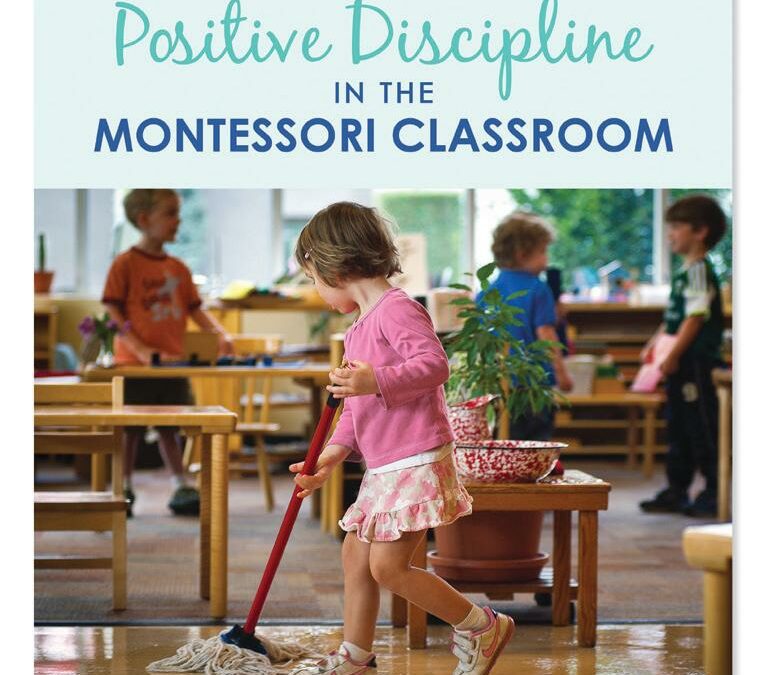
Why are Children so Different Today
by Jane Nelsen, EdD and Chip DeLorenzo, MEd
When working with Montessori teachers, we always start by asking them to list their current stressors. Inevitably, they share that children exhibit a high degree of disrespect, entitlement, and lack of self-regulation. Children don’t listen to adults. Teachers overwhelmingly agree that these behaviors are more frequent and blatant now than when they grew up or when they first started working with children. Teachers who’ve been in their profession for a while observe that schoolwide misbehavior seems more intense than in previous generations. They often ask: What happened to the good old days, when children respected adults? Where are all these behavioral issues coming from? Is it environmental? Is it parenting? Too much screen time?
The Culture Shift
Was there really such a thing as the good old days? We know that, since there have been children, there has been misbehavior; however, there have been some significant changes in society in the last fifty years that have impacted children. We believe that these changes provide an explanation for some of the differences that we are seeing in children’s behavior today; it can help us prepare the social-emotional environment in our classrooms to help compensate for outside factors beyond our control (e.g., video games, diet, materialism, entitlement, and child-centered homes where children decide what and where to eat, what to watch on TV, etc.). Fifty years ago, the world was rife with models of authoritarian leadership and submission. You could find examples at home, where dad’s word was final; in workplaces where the boss was the boss; and in schools where the teacher was considered a highly respected authority figure. In those good old days, there was cultural support for top-down (or vertical) leadership. Parents didn’t ‘advocate’ for their children. If a child was reprimanded at school or in his neighborhood, his parents were likely to take the adult’s word for what happened without much interest in what the child had to say. Neighbors could discipline each other’s children with the full blessing of the parents.
Through the rose-colored glasses of educators who grew up in an authoritarian culture, it may seem like authoritarian methods ‘worked,’ because children are remembered as being more compliant and obedient. On a tough day, compliant and obedient children might seem like water in the desert to a discouraged teacher. But what are the long-term results of demanding that children be compliant and obedient? Too often children become ‘approval junkies’ or ‘rebels without a cause, except when they need to prove, “You can’t make me!”
Montessori wrote, “No social problem is as universal as the oppression of the child.”1 And while it may have seemed easier to require children to comply in an authoritarian culture, the result was the oppression of the child’s spirit. Oppression was the very thing that human rights advocates have been fighting against for decades. It is oppression that Montessori felt was the root cause of war.
At the turn of the last century, educational and psychological pioneers, such as Maria Montessori and Alfred Adler, were writing and lecturing about a radical idea: equality even for children (including equal rights to dignity and respect). While this idea would not meet much resistance today, it was considered counterculture at the time.
Permissiveness
During the 1960s and 1970s, human rights movements gained momentum. The idea that all people were worthy of dignity and respect gained wider acceptance in western cultures; however, this was a messy and arduous process, especially for parents and educators.
The rules were being rewritten; yet, parents and teachers did not yet have cultural support and access to respectful discipline tools to replace the old authoritarian methods. As a result, like most countercultural movements, the pendulum swung the other way, and permissive parenting and teaching became more common. We are still reeling from this pendulum swing today.
Soon, alternative or experimental parenting models gained traction. Especially in the home, yelling was replaced with discussion, bargaining, and negotiating. Spankings were replaced with time-outs. Punishments were replaced with rewards. Children were given more freedom and more choices—but without limits or responsibility. The authoritarian top-down model of parenting and teaching was replaced with permissiveness.
The problem with permissiveness, though, is that it is still top-down. It’s just that the roles are reversed. In the permissive model, the child is on top and the adult is on the bottom. As Maria Montessori wrote, “To let the child do as he likes when he has not yet developed any powers of control is to betray the idea of freedom.”2
Indulgence
Children today are exposed to a myriad of stimuli that vie for their attention. Children have more things, more entertainment, more recreational experiences, more toys, more media, more ‘educational’ experiences that deliver information without true interaction, more activities, more everything. Children are the center of the universe. They often decide what kind of meals are prepared at home and where the family should go when eating out. On the other hand, they are often not taught many real-world skills. In our frenzy for progress, we have inadvertently stolen opportunities for true human connection, discovery, and exploration.
Fewer Opportunities for Real Responsibility
We do not need children the way that we did up to the early part of the twentieth century. Children, generally, are no longer needed to make the farm or the household run on a day-to-day basis or to bring income into the home.
(Chip) grew up in a farming community in upstate New York. It was not uncommon for some of my classmates to have been up since before daylight doing chores to help keep the family farm going. Most twelve-year-olds who lived on working farms had tractor licenses. They didn’t spend their weekends playing soccer, taking dance lessons, or having play-dates. Those of us who didn’t live on a farm had paper routes, mowed lawns, worked in small shops, and had responsibilities at home. It was real work. It was real responsibility.
Real responsibility gave young people the opportunity to develop some incredible life skills. They knew that they were needed and that they were capable. They had the opportunity to develop practical life skills and qualities, such as resilience, perseverance, self-discipline, responsibility, and a strong work ethic. Children were needed but not usually respected or treated as equal in value to adults.
( Jane) grew up in a city; however, children were still expected to do chores, including scrubbing toilets. Having homework was not an acceptable excuse. And my parents didn’t help with homework; that was considered my responsibility. There wasn’t any pressure to get good grades to get into a good college. Most girls got married right out of high school and were expected to be stay-at-home wives and mothers. Fortunately, a wise mentor advised me to take one college class a semester so I would have a degree by the time my children were grown. Eleven years and five children later, I received my BA.
As the movement to value children gained momentum, we provided them fewer opportunities to truly feel needed. Today, most children don’t make their own lunches for school, and many don’t have chores. In the name of love, they are given too much and required to do too little. They develop an attitude of entitlement. In an effort to give children ‘the best,’ adults have robbed them of the opportunity to develop strong characters and to experience the sense of belonging (unconditional love) and significance (capability and responsibility) that comes with making a meaningful contribution.
Many people are drawn to the concept of ‘positive discipline,’ because they are against punishment and authoritarian methods of discipline. However, some ‘positive discipline’ followers mistakenly perceive that the best way to avoid authoritarian methods is to simply provide love. This can lead to permissiveness, because these parents are kind (to provide love) but are not firm (which helps children experience significance through learning skills for responsibility and capability).
You can give children love, but they need to develop responsibility. When parents don’t understand the importance of helping children develop responsibility, children often fall into the trap of pampering, which often leads to development of an ‘entitlement’ mentality. When parents understand the difference between belonging and significance (along with the importance of balancing both), they can help children develop the characteristics and life skills they need for successful living.
The Montessori curriculum is designed for children to develop a sense of significance through responsibility and capability. As you will soon see, a sense of belonging is created through the basic ‘positive discipline’ concept of ‘connection before correction’ and the involvement in daily class meetings to give and receive compliments and to focus on solutions.

Fewer Siblings
Another dynamic to mention is that of family size and birth order. In addition to today’s busy lives, where children are given more and less is required of them, families are also having fewer children than at any other time in our recent history. Most families today have one or two children. Today it is not uncommon for a classroom to be populated with many only children. Recently, my (Chip’s) school had a classroom of twenty-two children, of which seventeen were only children and the rest younger siblings (no middle children). While the research on birth order is controversial, many teachers report noticeable anecdotal effects. With smaller families comes more adult help and intervention. There are fewer opportunities for children to develop responsibility and more opportunities for parents to do for children what they can do for themselves.
In today’s world, providing opportunities for children to contribute in meaningful ways and develop true responsibility takes intentionality. It’s hard work.
If you have ever had a small class size, you know how hard it can be to promote independence among the children and how intentional you need to be to do so. When I (Chip) was a young teacher, just learning the ropes, I thought I would prefer a smaller class size. It seemed more manageable in many ways (giving lessons, staying organized, managing behavior, etc.). However, it turned out to be a lot more work. While I was able to give the children more individualized attention, the more I gave them, the more they seemed to need, both socially and academically.
After a few years of experience, I was given a much larger class of thirty students. With more students, the children had to become more independent. Out of necessity I had to learn to trust the children, and as a result I found out how responsible, independent, and capable they could be. More importantly, they discovered their own capabilities. It was amazing to see them rise to the occasion, just as Montessori had said they would.

Other Factors
In addition to increased permissive parenting, fewer opportunities for true responsibility, and fewer siblings, we have other external factors that affect children’s behavior. Screen time now dominates the hours spent at home; children are over-scheduled; some children rarely see their parents because of busy work schedules; there are a variety of lifestyle choices and family structures; there are violent video games and cyberbullying.
The good news is, that while the modern factors that affect children are real and significant, misbehavior is not new. In The Secret of Childhood, a teacher writes to Montessori about her experience with “pampered children”:
An American teacher, Miss G., wrote to me as follows from Washington: “The children snatched the objects from each other’s hands. If I tried to show something to one of them, the others would drop what they had in their hands and gather noisily about me. When I finished explaining an object, they would all fight for it. The children showed no real interest in the various materials. They passed from one object to another without lingering over any of them. One child was so incapable of staying in one place that he could not remain seated long enough to run his hands over any of the objects given to him. In many instances movement of the children was aimless: they simply ran about the room heedless of the damage done. They ran into the table, upset chairs, and trampled upon the material provided for them. Sometimes they would begin to work in one spot, then run off, take another object, and abandon it for no reason whatsoever.” 3
Sound familiar? This is a wonderful reminder that we are not alone and that the good old days were not always easy. Today’s problems are not new problems, even if some behaviors are exacerbated by different factors. Maria Montessori, Alfred Adler, and Rudolf Dreikurs were brilliant thinkers. Their philosophies have survived and grown while many others have come and gone. And we have to admit that we are delighted that neuroscience now validates the effectiveness of these methods that have contributed so much to the world of happier parents, teachers, and children.
Excerpted from Positive Discipline in the Montessori Classroom: Preparing an Environment that Fosters Respect, Kindness & Responsibility. Originally
Jane Nelsen, EdD, is a California Licensed Marriage & Family Therapist and author or co-author of nearly 20 positive discipline books, including Positive Discipline Parenting Tools with her daughter, Mary, and her son, Brad; and numerous experiential training manuals for parents, teachers, couples, and businesses. She earned her doctorate in education from the University of San Francisco, but her formal training has been secondary to her hands-on training as the mother of seven, grandmother of twenty-two, and great-grandmother of eighteen. She now shares this wealth of knowledge and experience as a popular keynote speaker and workshop leader throughout the world. Learn more about Jane’s work at: www.positivediscipline.com
Chip DeLorenzo, MEd, is a school consultant and positive discipline trainer; he specializes in training staff and administration at schools worldwide in positive discipline methods and practices. Chip served as Head of School of the Damariscotta Montessori School, in Nobleboro, Maine, for twenty years. A veteran teacher and school administrator, he began his teaching career in 1995 after serving in the United States Air Force and working as a financial advisor. Chip is the father of four amazing Montessori children. Lean more about Chip’s work at: www.chipdelorenzo.com
3 Montessori, M. The Secret of Childhood (Delhi: Aakar Books, 2013), 143–144.
Book Review: Positive Discipline in the Montessori Classroom

I have been a Montessorian and educator for over forty years — as an assistant, a Primary and Lower Elementary head teacher, a school founder, a head of school, and a Montessori teacher educator. As I read Positive Discipline in the Montessori Classroom, I found myself revisiting all those roles, not to mention my personal roles as parent and grandparent. On every page of this book, I experienced flashes of insight — as well as flashbacks. I saw myself, as well as the teachers, assistants, and parents in my school, and the interns I’ve taught, in so many of the mistaken and misguided responses to children’s behavior over the years (as well as in some of the successful responses). If only we all had this book at the beginning of our Montessori journeys! I have no doubt that many of those mistakes would still have occurred, but the wisdom in this book would have helped me and others recognize and redirect ourselves, and, more importantly, helped us exit the shadows of self-doubt and uncertainty much more quickly.
I’ve used Jane Nelsen’s Positive Discipline books for years, both in my school and in my teacher education classes, but what Jane and Chip DeLorenzo have done with this book — bringing Positive Discipline and Montessori together — is groundbreaking. The authors draw fascinating historical connections between the work and philosophy of Alfred Adler and Rudolf Dreikurs (the forebears of Positive Discipline) and Maria Montessori. Now that Positive Discipline has been interpreted for and integrated into a Montessori context, it will be so much easier for educators to apply it.
Over the years, our classroom leadership and school training manuals have grown thicker and thicker as we have collected ever-growing research and resources on the social-emotional needs of children. This book easily replaces all these resources when it comes to the psychological, social, emotional, and spiritual aspects of preparing the environment. The authors have woven all this together in a way that exemplifies — and amplifies — Montessori’s thinking. This book will become a staple in teacher education, and will supplement, or even replace, a major part of schools’ training manuals.
Positive Discipline in the Montessori Classroom supports the very complex inner work of the transformation of the teacher. Moving from a position of controlling children to a position of observing, guiding and supporting children is challenging, even when one knows and believes it is the right thing to do. This book asks the questions and provides the evidence that will help us recognize our own barriers to change. Even more critically, it offers tools and practical advice for moving in a new direction. Every teacher faces moments when they have reacted badly or simply have no idea how to proceed in an effective, respectful way. In this book, they will find support, answers, and clear guidance. If I were still in the classroom, this book would probably be next to the bed for those sleepless nights when I was puzzling out what to do next with a child or a situation.
It begins with developing the skills of self-awareness, social awareness, and cultural awareness that allow one to resolve conflict with others. Positive Discipline in the Montessori Classroom beautifully addresses these skills, and as a result will become foundational for peace education segments of our teacher training, supplemented with the antibias and cultural awareness elements that we are confronting with fresh eyes at the moment.
This book asks the questions and provides the evidence that will help us recognize our own barriers to change.
I am grateful to Jane and Chip for writing this book, and for sharing their own personal stories. They also share many real-life experiences with children to which I think we can all relate. The authors detail appropriate and effective responses to situations by age level, so whether readers work with toddlers or adolescents (or anywhere in between), they will find rich, relevant material here. Questions for discussion at the end of each chapter spark thought, and can easily be converted into scenarios and reflections to make instructional use more active and engaging.
Reading Positive Discipline in the Montessori Classroom was a real pleasure. While I believe it’s essential to read the book cover to cover, to fully integrate the concepts into one’s practice, I envision readers will dog-ear many sections and return to them when new and challenging situations arise. Jane and Chip have given us a clear, contemporary, and practical roadmap for all Montessorians to follow, with dignity and respect for every child.

Mary Schneider is the director of the Montessori Education Institute of the Pacific NW in the Seattle area. She has been involved in Montessori teacher preparation since 1984 and served on the AMS teacher education committee from 2002 to 2017. She is also a former classroom teacher at the Early Childhood and Lower Elementary Levels, and the retired founder and Head of School of Woodinville Montessori School.
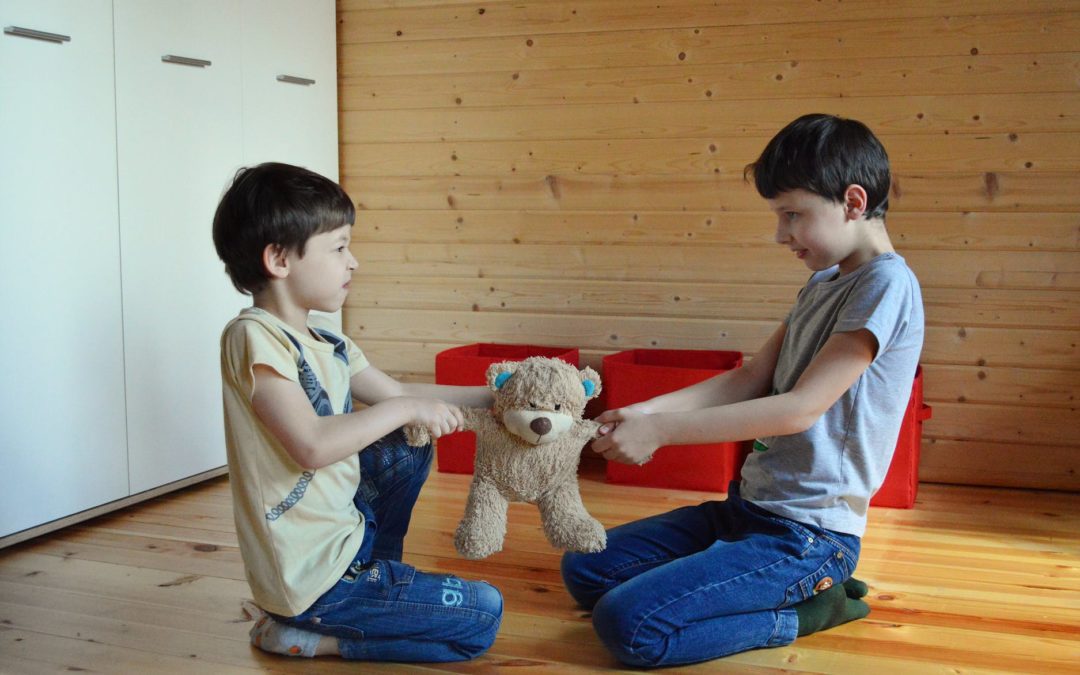
Staying Neutral: How To Manage Siblings Fighting
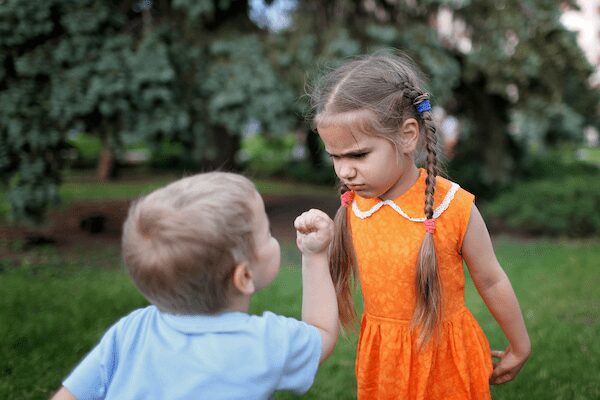 You know the scene. Two children both want the same thing. Or one of them is hurting the other. Or they are complaining and nagging each other.
We can’t help ourselves, we come to the rescue. “Why don’t you go first, and then the other one can have a turn next?” “Why are you always picking on your brother?” “Why can’t you two just leave each other alone.”
When we step in like this, we actually make things worse. The children start to get irritated at us. They think that we take sides (usually in favor of the younger child), and the fighting can often escalate as the children are getting our attention, even if it is negative attention.
So what can we do instead?
We can be the mediator rather than judge and jury. A mediator listens to both sides but stays neutral.
“It looks like you were playing with that, and (to the other child) you’d really like a turn too.”
“You seem really upset. Will you each tell me what’s going on for you?”
Then, do nothing. PAUSE. See if the children can work it out. Perhaps remind them of a rule, “We share by taking turns. It will be available soon.” But stop yourself from solving the problem for them.
And what if there is a young baby? You’d be surprised at the solutions they come up with. I often give the example of Oliver and Emma both wanting to play with the same vehicle. Oliver would have been under two and Emma was just crawling. I stated something like, “Two kids and one vehicle. I wonder how you’ll solve the problem,” and then PAUSED. I proceeded to watch quietly as Oliver took the front wheels off the vehicle to give to Emma and they both played with half each. A far more creative solution than I would have come up with, and they solved the problem themselves.
And if they are hurting each other. We can still step in without blaming either of them. We can separate them – “you go to this side and you come to the other side” — and, once they are calm, they can solve the problem with us as a neutral mediator if needed.
Give it a try for a week and see how you go:
1. Be neutral;
2. Let them be heard; and
3. PAUSE to see if they can solve the problem themselves
You might enjoy visiting Simone’s blog at themontessorinotebook.com. We appreciate her granting permission to use this post. ¢
Simone Davies is the author of The Montessori Toddler and co-author of The Montessori Baby, comprehensive guides to raising toddlers and infants in a Montessori way. The books are based on her 15+ years’ experience working as an AMI Montessori teacher in Sydney and in Amsterdam. She also has a popular blog, instagram, and podcast The Montessori Notebook. She is also mother to two young adults. Simone currently runs parent-child Montessori classes in Amsterdam at her school Jacaranda Tree Montessori and is working on another book with Junnifa Uzodike, The Montessori Child for children from 3-12 years.
Finding Montessori helped her so much when raising her own children, and it’s now her passion to help other parents introduce these ideas in their homes too. She was looking to find a way to be with her kids that wasn’t about bossing, threatening, or bribing them. Or giving them free rein either. And she wanted them to have a positive experience of school, not just to pass tests, but to love learning.
Psychologist vs Mom- How Do Montessori Teachers Do It?
To continue reading, you will need to choose a subscription plan.
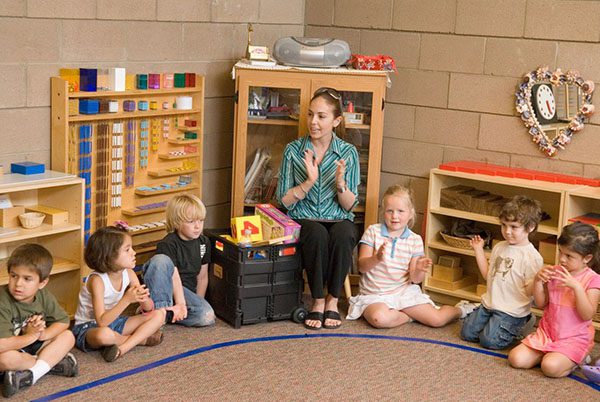
Peacemaking Circles
To continue reading, you will need to choose a subscription plan.

Peace and Punishment
To continue reading, you will need to choose a subscription plan.
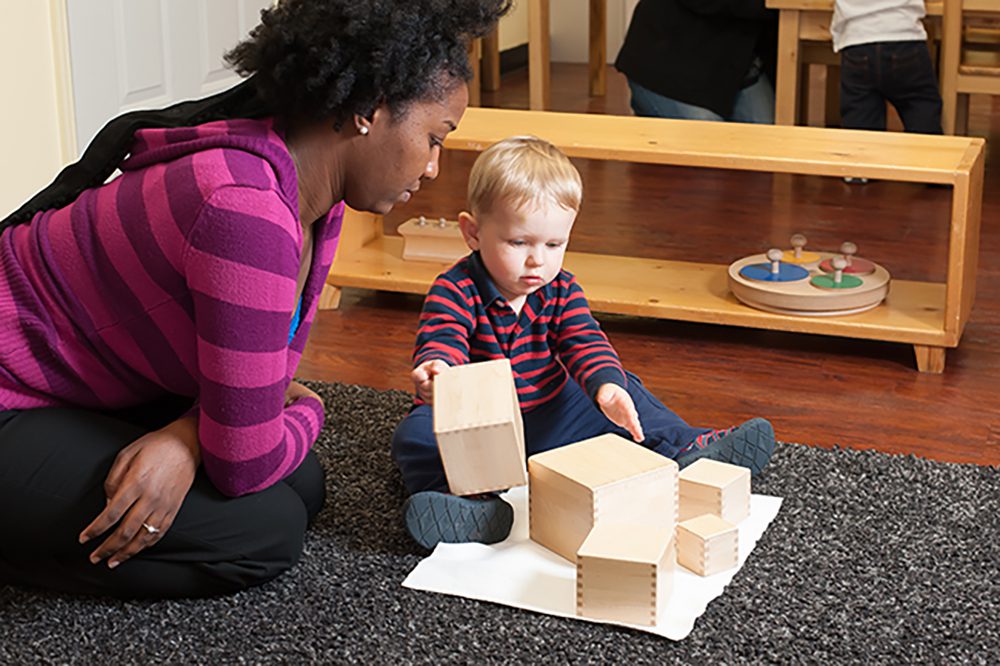
The Flow of Montessori
To continue reading, you will need to choose a subscription plan.
Montessori, Darwin and Telling The New Story Of Evolution
by David Loye
In the beginning there was the Domination System and the Organism. Then the Love System entered life and meaningful Evolution began…
This is the disarming and I hope engaging way my telling of the new story of the new story of evolution begins.
Behind it lies a long unknown connection between the theories of Charles Darwin and Maria Montessori that a startling new reconstruction of Darwin’s theory reveals.
As has long been evident to anyone familiar with standard Darwinism and Montessori their theories as taught throughout the 20th century have been poles apart. Surely nothing could be farther from Montessori’s approach in her original rescuing of Italian slum children than the stereotypical keystone ideas for standard Darwinism of “survival of the fittest” and the supremacy of selfishness, or the idea of “selfish genes” popularized by ostensibly Darwinian sociobiologist Richard Dawkins.
Yet what happens if, at last, we are confronted with the startling but incontestable fact that in The Descent of Man Darwin actually wrote only twice of “survival of the fittest” – once to apologize for actually ever using the term. So what does he write of? 95 times of love! 92 times of moral sensitivity! And 200 times of brain and mind!
Morever, in designating what in contrast to the origin of species advances human evolution, he specifically says natural selection (i.e., survival of the fittest) drops off in importance at our level of emergence and “other agencies” become more important.
And what are these other agencies? Above all, Darwin wrote in hundreds of editions of his book in a majority of the languages of this earth for scientists, educators, and all the rest of us to read – but ignore – for over a century, are “the moral qualities.”
These, Darwin said, are “advanced, either directly or indirectly, much more through the effects of habit, by our reasoning powers, by instruction, by religion, etc., than through natural selection.”
As an educator via classroom but much more so by the books I have written over many years, I personally find this Darwin to be clearly in the tradition articulated by Montessori as well as by Pestalozzi earlier, and by Dewey, Piaget, on up to morally oriented, progressive and holistic educators such as Nel Noddings and Ron Miller in our time.
But while this discovery of the “new” Darwin is startling and encouraging, what we now do with it is a far more important matter. Indeed, it is, I am convinced, a matter bearing on whether our species is to live up to and fulfill its incredible potential, or —as thousands of species have before us and currently — eventually fall by the wayside in evolution.
A vital scientific challenge is to wed the two halves of Darwin’s theory. For that is what now confronts us. On one hand is the vital first half described in Origin of Species for laying a good part of the foundation for evolution. But on the other is the completing half for his theory, this thrilling superstructure in tune with progressive spirituality, progressive philosophy, progressive science, and progressive education over by now thousands of years.
As I develop at length elsewhere, underlying both Darwin and the work and theories of a long stream of great thinkers including cultural evolution theorist Riane Eisler in our time there lies, in basic systems terms, the maturational sequence and interaction of a Domination System and a Love System.
And what is the challenge for education? Most of us have been forced to teach only the destructive Darwinian first half for over a century. But having been unwitting collaborators, what can we do now to make up for this now?
One way is to get behind the effort of the newly formed Darwin Project. With a Council of over 50 American, European, and Asian scientists and educators, our goal is to shift teaching at all levels of education, as well as globally throughout the power of the media, from a disastrous focus solely on Darwin’s first half to the prohuman, prosocial, and clearly progressive emphasis for Darwin’s completion of theory.
Here one of the most effective things the Montessori movement, with its international scope, can help pioneer is the telling of the new story of evolution which weds both halves.
The Great Adventure
The new website for The Darwin Project (www.thedarwinproject.com) outlines the challenge and, in many ways, the prospects for pioneering educators. Specific to the opportunity for the Montessori movement is the “Great Adventure” segment of the website and component “Telling the New Story.”
Going by how Darwin’s perception of the Love System was suppressed for a century, we can begin to see how long it takes to change anything in science if it bumps up against an established paradigm. It is evident then that normally wedding the two halves could take science another century. Going then by how long it takes for what is written in scientific language about anything really new to be translated into and widely published in the everyday language we all use, we may add another fifty years or so. Then of course beyond all that are the schools. Once such a project got this far one must add another forty years or so of committees and school boards to decide whether this odd and controversial new hybrid thing of a theory of human evolution involving so subversive a matter as love, as well as the more serviceable matter of domination, is suitable for the instruction of the young. Then one must add another thirty years for consultants to assess and parcel it out by grade levels for the curricula.
As it is evident we no longer have a century to waste in this way— indeed quite possibly less than a decade—I have gone ahead and wedded the two halves into what, out of now many years involvement in evolution theory and education, into what I believe is as close as presently possible to the full and true story of human evolution.
The aim is to provide teachers with a story line that can be adapted for use anywhere along the line for K-12 into college and graduate studies. The idea is not to set this forth as some inviolable and forever enduring integration of theory and story, but just to get the full story down in one place and for a teacher to read, and think about, and then rework to present at one’s particular grade level.
One would start with the easiest part for the earliest level, then work up by stages, so that by the time students reach college they would possess the whole story and theory from which to launch out on their own.
What follows here is a sampler for the opening of what in its entirety will be available for free downloading from the Darwin Project website by the time this article is published. As you read, please keep in mind this is not the actual telling of the story, which is up to you, but merely the meta-story, or story line for individual shaping.
Telling the New Story
In the beginning there was the Domination System and the Organism. Then the Love System entered life and meaningful Evolution began…
A good place to start is to think of what was mostly taught and thought for a whole century to be the whole picture for the Darwinian theory and story of evolution, then ask ourselves what is the story that now emerges from a melding of the old with the new.
If we look at both Origin and Descent carefully in relation to one another, and also at precisely when they emerged within the pattern of Darwin’s creative life, it is evident we are looking at a perspective on human evolution based on his perception of three primary entities, forces, or—in the most useful term we use in science today— systems at work in the lives of our species over thousands of years.
Out of the creativity of the middle years of his great fame and immense impact on the lives of all of us, there is the Domination System he wrote of in The Origin of Species.
Out of the creativity of his early and final years— as will be detailed in Darwin’s Unfolding Revolution, the key book for this website section also to be available for download— there is the Love System he writes of in The Descent of Man.
And then there is the third, most vital part of all, the major player in this drama on which he actually focused from beginning to end, but which again was very close to also being ignored: the Organism.
There is this life form for every living thing, plant or animal, from the earliest point in the emergence of life on this earth, to all creatures living today from the smallest to the largest.
There is this life form that includes ourselves, as the species with the most advanced brains and greatest capacity to change things around on this earth— therefore the species not only with a clear evolutionary responsibility for the well being of all other life forms as well as for the earth itself, but also the only species capable of recognizing and acting on this responsibility.
This puts the weight on us to approach the question of how we are to tell the new story as more than a matter of entertainment, or of only trying to get the science right. It says squarely—to repeat what certainly bears repeating, as it is all too easy to flinch and turn away—that it is up to us to get clear on this story as a bedrock matter of species survival. And then as parents, teachers, writers, activists, as well as scientists and other scholars concerned about gaining the better life for us all, to as widely and as quickly as possible start telling this story to try to save us from ourselves by speeding up the process of our evolution.
Here we see a basic sketch for the three primary systems I touched on in the two stage-setting lines which head and open our story, to which I will refer to as we move along.
IMAGE 1
Here is the fiercely self-protective “closed mind” of the Domination System in contrast with the still formative and venturing “open mind” of the Love System—and the wiggly lines of their differing impact on us, as well as the wiggly lines of our impact (or lack of impact) back on them.
I have purposely left this and all successor sketches in their squiggly homespun “natural state,” just as I drew them, in order to give the flavor of something drawn quickly on a blackboard.
My goal is to encourage the teller of the new story to, as much as possible, use the quick, hand drawn pictures many of us naturally resort to.
There is something about how the fact of a hand moving in tandem with a mind can engage others better than the best of professional drawings or slides, which risk the sterile “uptown” polish that signals to some readers “this is dead, finished and 7 intimidating, so skip on.”
The Domination System, the Love System, and the Organism
But one must be careful here. The true story of human evolution—that is, of the evolution of all species up to, reflected within, and including ourselves—does not begin with abstractions such as these or any others at this level of thinking.
Nor does it begin, as in the old theory and the old story, with the grim, foreboding weight of Natural Selection as this large mysterious force external to ourselves.
Why was this the ominous emphasis for the old story? Within this new approach to telling the new story an important reason could be what comes to mind if we look at ourselves in relation to all other life on this planet, over the 100,000 years of our rise as the species homo sapiens sapiens. It would seem that because of our situation on this earth as the chief thinking representative for all other organisms, in the way the mind works, inevitably we were driven to seek large, mysterious ideas to account for the haunting mystery of where we came from, who we really are, and where we may be going.
This certainly seems to be why for centuries before Darwin this space in mind was filled with either the fearful or the comforting idea of God. But with the success of Darwin’s Origin of Species— as scores of ministers discerned and decried at the time—the idea of Natural Selection began to shove God out of that place for the Big Answer.
In further looking at our situation over the past century from the perspective of systems psychology, I am convinced that within the unconscious of the Western educated man and woman the hole in mind this displacement left behind came to be filled with two kinds of patterns for thought that have worked against us.
One is what I identify in the article “Montessori, Darwin, and Human Evolution” in Montessori Leadership as the “bog holes” of PseudoDarwinian Mind—i.e., the powerfully compelling but distorted partial reading of reality rising from Origin of Species or “first-half” Darwinism, such as the governing idea that as all life involves “the war of all against all” or “survival of the fittest.”
This is a complicated matter that many teachers will not want to fool with, nor will most students short of college and graduate school be equipped to deal with it. So I leave it to others to figure out where and how to best fit in this vital aspect of underlying systems dynamics and what can become the stranglehold of paradigm on our minds. This leaves us with the question of what to do with first half Darwinian science’s nightmare creation of Natural Selection as the main or even sole over-riding explanation for evolution.
The history of many centuries and the psychology of the last few has repeatedly shown us that whatever we may find or teach is in the end a small chink of knowledge tossed into the vast boiling pot of much else working within and shaping the minds of our time. So it was I believe that during the 20 th century within the unconscious of the nonscientist as first child, then adult, there also came to exist within the hole for the Big Answer an unsettling picture linked to the powerfully enduring image of Mary Shelley’s Frankenstein’s monster from earlier.
IMAGE 2
Here we see Natural Selection as this giant invisible force that strides among us, occasionally reaching down to pick and choose and gobble us up as though we are no more than the food that it may arbitrarily eat now, or let us go for later, as though saving us for desert.
This, I suggest, is a sketch for the psychic bugaboo of Natural Selection in pursuit of Variation that operates today in unconscious mind of millions of us.
It is obviously the connection with no place in the education of the child, which for many vital reasons must be sheltered and protected as long as possible. But by the time the late teen-ager is beginning to contemplate the responsibilities of adulthood, it can become meaningful to that cohort of the particularly bright, caring and courageous upon whom the better future for our species depends.
For then it can become crucial they understand how this gift of misguided modern science came to reinforce the dark earlier gift of regressive religion in the abysmal figure of a vicious deity who must be placated with blood sacrifice—which drives the terrorists and more generally still exists in the unconscious of other millions of us on this planet.
Important this fledgling leadership cohort understand, yes. But most important they are encouraged by the great teacher to go on beyond understand to decide what they personally are going to do about it. . .
L’Envoi
And so the new story goes on our website: on and on through first half and second half with my sketches and guesses as to what parts could be best to bring in early in a child’s education, and where it’s best to wait until later, on into graduate school.
As one can see from this sample, this is an idea in much need of thinking through for presentation from the Montessori perspective.
I hope this is enough to encourage creative Montessorians to pursue this new telling of the story of human evolution by going to our Darwin Project website (www.thedarwinproject.com) and downloading the rest of the story, or rather, the story line, and going to work on it.
I hope, too, I have begun to convey how extremely important this pioneering contribution by Montessorians could be to the advance toward the better world that the first woman in Italy to gain her medical degree set in motion, really not so long ago as evolution goes.

Adolescence Without Tears – The Montessori High School
To continue reading, you will need to choose a subscription plan.
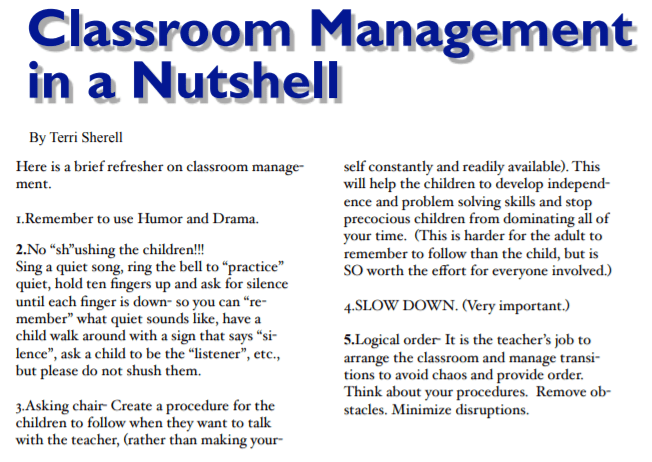
Classroom Management in a Nutshell
To continue reading, you will need to choose a subscription plan.
Featured
-
 The Montessori Way, Revised and Expanded: An Education for Life; A Comprehensive Guide for Parents and Teachers
$25.00
The Montessori Way, Revised and Expanded: An Education for Life; A Comprehensive Guide for Parents and Teachers
$25.00
-
The Montessori Child: A Parent's Guide to Raising Capable Children with Creative Minds and Compassionate Hearts (The Parents' Guide to Montessori)
$20.00
-
The Montessori Toddler: A Parent's Guide to Raising a Curious and Responsible Human Being (The Parents' Guide to Montessori)
$20.00
-
Montessori in Action: Building Resilient Montessori Schools 1st Edition
$29.95
-
Bulk Order, 30 Copies of Montessori for Every Family: A Practical Parenting Guide To Living, Loving, And Learning
Original price was: $600.00.$510.00Current price is: $510.00.


Products
-
The Montessori Way, Revised and Expanded: An Education for Life; A Comprehensive Guide for Parents and Teachers
$25.00
-
The Montessori Child: A Parent's Guide to Raising Capable Children with Creative Minds and Compassionate Hearts (The Parents' Guide to Montessori)
$20.00
-
The Montessori Toddler: A Parent's Guide to Raising a Curious and Responsible Human Being (The Parents' Guide to Montessori)
$20.00
-
Montessori in Action: Building Resilient Montessori Schools 1st Edition
$29.95
-
Bulk Order, 30 Copies of Montessori for Every Family: A Practical Parenting Guide To Living, Loving, And Learning
Original price was: $600.00.$510.00Current price is: $510.00.