Many schools invite and some even require that parents “visit” their child’s classroom in preparation for conferences. Many parents are not exactly sure what is expected of them and of what to expect to see when they are there. Our team will help parents better understand what to look for, how to look and listen, and the intention of the teachers’ invitations.
Elementary and middle school children, along with their parents and teachers, will love this book. It is a hilarious review of wild animals from around the world! Each animal is rated in a humorous way that tells the reader a little something about the creatures. Animals Reviewed also includes the common name for the animal, its scientific name, and a zoo or aquarium where it can be found. This information is great because some of these animals may tickle a child’s curiosity and may motivate them to do more in-depth research about the animal. They may even be able to go see the animal in person if a zoo or aquarium nearby has one in residence. Enjoy!
”I declare after all there is no enjoyment like reading! How much sooner one tires of any thing than of a book! When I have a house of my own, I shall be miserable if I have not an excellent library.”
—JANE AUSTEN
Make Music!
by Norma Jean Haynes, Ann Sayre Wiseman, and John Langstaff
Another wonderful book for adventurous children and grown ups who want to have fun making music! The book is laid out in categories starting with Beginning Notes (pun intended I’m sure!); Household Things that Ring and Ping; Body Music; Percussion Beats and Rhythms; Breath Music: the Winds, The String Section; Instruments from the Workshop; and Creating Music. I’m excited just writing down the names of the sections and that’s not all. This book has beautiful photos of real children in action and having so much fun with music. Make Music is a great resource for an afterschool studio or for the vacation home or cabin, or at home on a school break, or ongoing project. The audience for the projects would probably be elementary-age children because of their skill and social levels; although, very clever teachers or parents could probably modify some of the projects for younger children as well.
Hatching the Cosmic Egg
Written by Michael Dorer Illustrated by Beth Wilson Music by Andrew Kutt
Michael Dorer, a well- known Montessori educator, author, and conference presenter, has now written his first children’s book and it’s ‘wonder-full.’ Hatching the Cosmic Egg opens with a request for the reader to “think of the very biggest thing you can.” I’m already intrigued and excited, and I think elementary children will be, too!
On each of the next few pages is a gorgeous, two-page, colorful drawing of very large earthly things that children might imagine and the author asking; Is it a great, gray elephant? Next two-page spread: A tall, snowy mountain? And so on. Then he begins to ask about more stellar images like the sun and the stars. This is so cool because the book brings the child’s mind to bigger and bigger images leading up to: It’s the UNIVERSE!
Now the story begins! This book encourages and entices children to think big about the universe, about themselves, and their part in the universe. Dorer, being the great storyteller that he is, seamlessly incorporates concepts from the great lessons and brings the readers to an awesome affirmation that they are connected to and part of everything in the universe.
Beth Wilson’s illustrations are perfect for the story, both in style and simplicity. They add to the wonder of this book. And, there’s more. With each book comes a CD with music and song by Andrew Kutt that enhances the story for readers in a totally different genre. This book needs to be in every home and classroom!
The Memory Box
Written by Joanna Rowland Illustrated by Thea Baker
Editor’s Note: I would like to personally thank Lorna for picking this book to review. My family suffered a great loss this year. It has had an enormous impact on all of us, especially my two grandsons (ages seven and eight). After reading this review, I immediately ordered this book on Amazon. This is such a difficult part or ‘adulting,’ but it is so needed to help children who struggle (often silently) to understand and find a way to celebrate and remember someone they loved so much.
The Memory Box is a very helpful book for children who have lost a loved one. It brings to light a variety of emotions from fear to sadness to happiness that children may experience as they go through the grief process and beyond. Sometimes, adults find it difficult to talk about feelings and death, especially if the person who has died is someone they loved as well. This book helps adults, as it tells a story about a child who is grieving, what feelings she experiences, and how she creates a “memory box.” The illustrations are lovely, almost whimsical, and yet realistic. At the end of the book there is a section to help adults support children through their loss. Children four years old through elementary and possibly the middle school years would benefit from The Memory Box.
Treasure Basket Explorations
Written by Laura Wilhelm Photos by Gryphon House and Shutterstock
Treasure basket exploration is a terrific idea for not-yet-mobile infants. The concept could be modified in some ways to better fit toddler’s through kindergartener’s strong sense of order. I struggled a little bit with this concept because I know from my own observations, as well as those of Maria Montessori and interactions with children in the early childhood years (birth-6 years old), that this period of time in a child’s development is crucial for preparing an environment that instills a very orderly way of thinking. At the infant and toddler stage of development, little ones are all about moving and exploring, so the baskets work well. There is a certain amount of order to it because the objects are contained within the basket. They come out of the basket and, when finished, return to the basket (sometimes by the infant or toddler—more often than not by the parent or teacher). The baskets are almost like introductory work for the primary level (3-6 years old), where the activities are contained in baskets or on trays but are designed to teach a skill rather than just allow for exploration.
I need to do more research about “heuristic learning” to truly understand what it is. As I read this book, it sounds like you put a bunch of stuff in a pile and the children get to “explore” it. For me it sounds a bit too unstructured for 3-6-year-olds, as they are really ready for order and imitation rather strictly exploration. Their activities always have some flexibility for exploration but also have a beginning, a middle, and end within each activity.
So, there are some very usable ideas for the infant-toddler years, and some ideas that can be modified for older children in Treasure Basket Exploration.
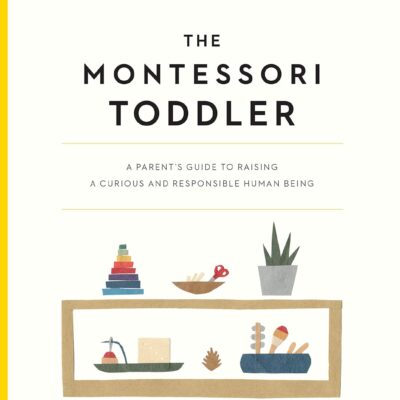
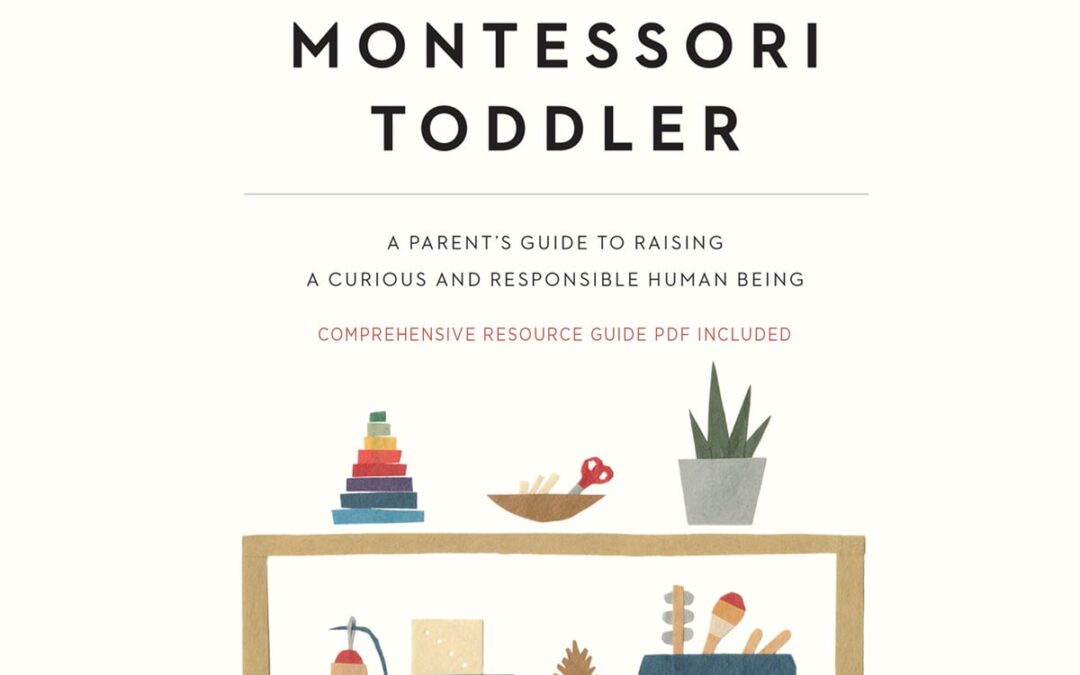
The Montessori Toddler: A Parent’s Guide to Raising a Curious and Responsible Being
Written by Simone Davies Illustrated by Hiyoko Imai
When I looked at the cover of this book I was intrigued. It was simple with a kind of unique illustration of a shelf with activities, and it was written for parents of toddlers—encouraging signs. Then I looked at the table of contents which was 3.33 pages long. Hmmm. Busy parents with small toddlers. Looks a little off-putting to me. So, I flipped through the book. I like photos and illustrations. There were very few photos and quite a few illustrations, but lots of words to read in this 248- page volume. Oh boy!
I made myself look more closely, and what I found was delightfully appealing. That huge table of contents I discovered was because the author listed each topic in each chapter, so it looked a lot more daunting than it truly is. Many of the topics listed are half a page to two pages at most. A parent can easily read a quick snippet and put the book down. They can also easily look up a specific topic that they are interested in because the topics are listed in such detail.
After looking more carefully, I really like the design. Simone Davies is very thorough. Her knowledge, understanding, and enjoyment of this age group is very apparent, and she shares it well with her audience. Often toddlers are misunderstood and so behave in ways that parents find difficult. Davies touches on some key points when thinking about toddlers. The first two chapters give parents valuable information about this stage in a child’s development and a brief introduction to Montessori. The rest of the book helps parents see their role as changing from a servant during infancy to a guide during toddlerhood and beyond. She brilliantly describes how to create a home environment that supports toddler success, both physically and emotionally, with furnishings and activities, as well as discipline.
The Montessori Toddler is a great resource for parents of infants, so that they can prepare for toddlerhood and for parents of toddlers who are already in the midst of toddlerhood.
This is a truly gorgeous book for children! Cynthia’s words flow as you turn the pages, and she describes how the natural world is constantly transforming. The photographs superbly illustrate the transformations in nature. The message is about paying attention and to be in awe of all that is around us in the world and realizing how dynamic nature is. And watch for this – “What goes around, comes around.”
Cynthia includes three pages at the end of book for parents and teachers to share with children about different areas of science.
Beautifully written, beautifully illustrated, and a beautiful message for readers! Night Becomes Day would be a terrific addition to children’s (ages 3-8 years old) book collections at home, at school, or both.
Cynthia Argentine has been a guest on our Montessori Family Life Webinar Series. Join the Montessori Foundation Family Network at www.montessori.org to watch the broadcast, Science— An Open Door to Creativity: How
Science Connects Kids to Nature, Arts, Literature, and More with Cynthia Argentine. Visit her website www.cynthiaargentine.com to purchase this and other books she has written.
Garden Oaks is a public school in a neighborhood of Houston, TX, called the Heights.
The school was under-enrolled at 405 students with five Montessori and 19 traditional classrooms when Dr. Lindsey Pollock arrived in 2008. The district tasked her to convert the entire school to Montessori.
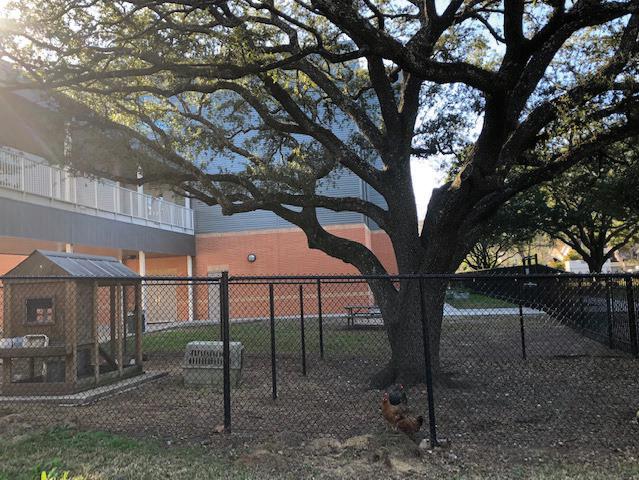
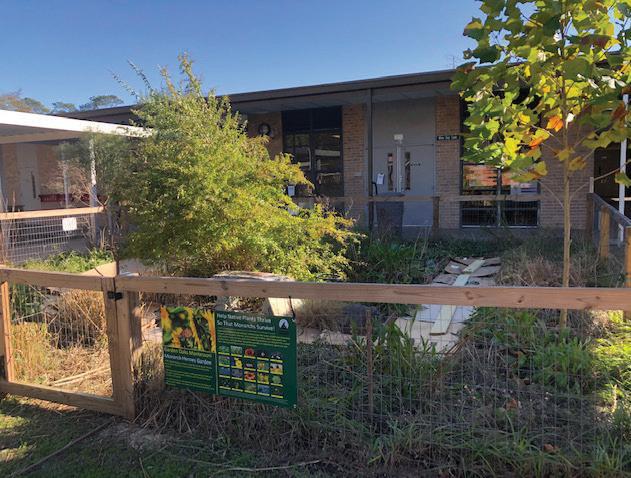
Today, under the guidance and direction of Dr. Pollock and her team, the school has completed construction of a three-story building that houses nine early childhood, eleven upper elementary, and four secondary Montessori classrooms, enrolled close to nine hundred students, and created areas on campus for environmental studies, such as gardens, water collection stations, a meteorology center, and two roosters.
They also have a technology center, a gymnasium, science lab, art room, library, cafeteria, nurses station, reception areas, and administrative offices. They recently received recognition from Educational Results Partnership (ERP) as a leader in student achievement. Garden Oaks is featured on their website – https://dataportal.edresults.org/Metrics/HonorRoll.
The IMC is proud of the accomplishments of Garden Oaks Montessori Magnet School and welcomes them as the first public IMC accredited school. Congratulations to Dr. Pollock and the Garden Oaks school community.
Amanda Sebba has been selected as the new principal of Garden Oaks Montessori. She has served as the assistant principal for the past four years at Braeburn Elementary School.
For more than a hundred years, children in Montessori schools have been practicing the Silence Game as part of their regular routine. Maria Montessori discovered that children experience great pleasure from the self-control that produces real silence. This is a silence that comes from within the child rather from the demands or rewards for silence that we often make of children.
“At first when I had not yet understood the soul of the child, I thought of showing sweets and little toys to the children, promising to give them one…I imagined that gifts were needed to obtain such efforts from children. Very soon I was forced to admit that this was useless.” Maria Montessori
Over the years, as an adult educator, I have coached teachers in using the Silence Game as a regular classroom practice, not as a tool to control their behavior. When children are given the opportunity to make silence, they become aware of their bodies and emotions. In our schools we practice the Silence Game as a group, especially at first. The idea is to create complete stillness in the classroom from which true silence emerges.
This practice often starts during group time with just 15 to 20 seconds of stillness. Children may close their eyes as a help to minimize distractions. The teacher may ask them to just listen for sounds in the room like the pump from the fish tank, the AC turning on or off, or the teacher’s soft voice whispering their name to go quietly back to work. As the children increasingly develop their skills in self-quieting, the length of time for this activity increases. This gift of self-awareness and self-calming is priceless.
The holiday season reminds me that it is easy to get off track and forget what’s important and fun! As we approach the holiday season with all the events and activities, the gift giving and receiving, the traditional foods that are out of our typical diets, and the media bombarding us, we may be filled with a mixture of joyous anticipation and dread of the hectic pace that holidays often bring. Our children’s impression of how to act and what to feel during the holiday season is most often influenced by us: their parents and our families.
The Silence Game can be implemented at home as well as at school. It can offer family members a challenging and fun activity that encourages and supports the development of self-control, calming the spirit, and helping to focus on the joy of the holidays. This practice is not a demand for obedience or control but a challenge to perfect ourselves. When we practice it together the Silence Game can have a profound effect on all the family members.
“One day I had the idea of using silence to test the children’s keenness of hearing, so I thought of calling them by name, in a low whisper… This exercise in patient waiting demanded a patience that I thought impossible”. — Maria Montessori
Here are some ideas for starting the Silence Game at home:
• The idea of ‘making silence’ can be introduced at your weekly family meeting. It can be a wonderful way to start your meeting each week by getting everyone calm and centered. Have your family gather on the floor, sitting in a circle. During the first few weeks it would be best for the adults to lead so that the children can become familiar with the process. After that, leadership can be rotated among family members as it is their turn to facilitate the weekly meeting. The leader can whisper people’s names as a signal that silent time is over, and the meeting will start.
• Other times of the day for ‘making silence’ could be right before or after a meal or just before going to bed. It’s a great way to start or end the day.
• One way to bring family members to the ‘making-silence’ activity might be to create a sign that says, Silence and walk quietly around the room to, show the sign, which is their signal to gather, and go on to the next person.
• Another way to call them to gather for silence could be to have a small music box to carry from one person to another instead of the sign.
You will need to explain before implementing the practice how the ‘making-silence’ activity works and what signals will be used. Don’t be discouraged if children three and younger have some difficulty with this kind of activity. If your child will sit quietly in your lap or beside you for a few seconds, that’s a good start.
What else can parents do to cultivate ‘calm and peace’ during the din of the holiday season for our children? Here are some ideas:
• Recognize your own feelings. Are you anxious, joyful, overwhelmed, excited, etc.? How we feel (and how we handle those feelings) can have a great deal to do with how the rest of the family is feeling and behaving.
• Remember to take care of yourselves. Do something for yourself, such as reading a book, listening to soothing music, taking a hot bath, or doing some type of exercise. Take time to do something daily that refreshes, renews, and re-energizes you.
• Leave time in the days and weeks during the season for unscheduled family time to relax and take it easy. It could be reading or telling stories, doing a puzzle together, or having a quiet family meal together. The key words here are together and relax.
You can give your family the gift of silence during this holiday season and throughout the year. Enjoy! ¢
Lorna McGrath has 40+ years of experience in the field of education, teaching children from 18 months through 6 years old and from 12 through 18 years old in both public schools and independent Montessori schools. She received her M.Ed. with a concentration in Family Counseling from the University of Georgia and her Montessori certification from the American Montessori Society. She also served as Associate Head of NewGate School.
Lorna is a Senior Consultant and Director of Family Resources at the Montessori Foundation as well as a Montessori teacher educator, conference presenter, and school consultant. She has used her many years of experience, working with families in the educational setting, to develop programs for parents as well as teachers and children.
Most recently, she and Tim Seldin have published a book, Montessori for Every Family — a practical parenting guide for living, loving, and learning.





 ”I declare after all there is no enjoyment like reading! How much sooner one tires of any thing than of a book! When I have a house of my own, I shall be miserable if I have not an excellent library.”