Tomorrow’s Child – May 2022 Digital Issue
Tomorrow’s Child – February 2022 Digital Issue
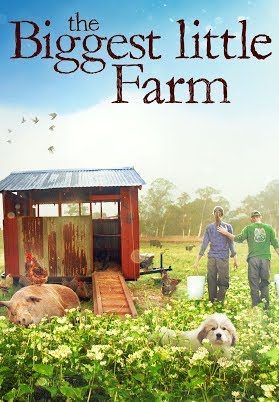
MOVIE REVIEW: The Biggest Little Farm
A documentary produced this year is our top pick for all elementary-on-up children, educators, and parents to watch. It’s called The Biggest Little Farm.
In 2009, a California cinematographer and a food blogger met and married. The Biggest Little Farm follows the couple as they attempt to build a sustainable farm an hour north of Los Angeles, CA. With the help of a dedicated environmentalist, they work through the trials and tribulations of achieving perfect (almost, anyway) harmony with nature.
This is the movie to introduce or reinforce many of the Cosmic Education lessons. It will help everyone understand the fragile balance of nature and how easy it is to be destroyed. The visuals are stunning, and the relationship with the animals on the farm are endearing. This movie brought joy, tears, and hope to me, and I highly recommend sharing it with all families to open up discussion on what each of us needs to be aware of to help do whatever we can to respect nature and protect our earth. •

DEAR CATHIE: A CONCERNED PARENT
DEAR CATHIE—
I have visited a number of Montessori schools as we consider a placement for our 3 and 4 year old children next year. I see the children all busy on different projects, and it all looks great. But can it really work? How can one teacher, even with an assistant, really keep track of who did what and be sure that each child is progressing and getting what she or he needs? All those children—all those needs. I can see it more for younger children, but I really get concerned in the Elementary grades. Does this method really work?
— A CONCERNED PARENT
Dear Concerned Parent,
I am so glad you are looking at Montessori schools for your children and that you have started the search so early. Many schools have rolling admissions and are open to admission at times other than the start of the school year or semester.
The Montessori Method works, as it is truly an individualized approach to education. Each child spends his or her school days in a carefully prepared environment with a group of multi-aged learners and a guide. A child chooses activities that call to her from within that environment while her guide watches her interests and offers lessons. From there, she develops a set of skills upon which to build. She practices the lessons she has learned and asks for new lessons as soon as those are comfortably mastered.
Children in the Montessori prepared environment also have the opportunity to watch others work and are often enticed by the work of those older children, aspiring to do what they do. This leads to more and more advanced work within the classroom as a whole and by your child individually. No child needs to wait for another child to have mastered a skill to move on! She has a new lesson as soon as she is able. Children also assist others younger than themselves, often teaching lessons they have already mastered. The child teaching lessons is one of the best ways to ensure mastery and confidence about something they have learned. It also leads to a kind and caring community.
Children have a say in what parts of the curriculum with which they engage and when they do so—always with awareness and support from the guide and other adults in the room.
Guides spend time observing the class to see which children are working at the mastery level on certain skills and are ready for a new lesson, which children need re-presentation, and which children need social
encouragement. They carefully chart these observations on paper or on the many computer programs that are now available and used in schools. While the classroom may look free flowing and easy going, it is actually a skill and data-driven environment, even though students do follow their own interests and work on projects and activities of their choosing. Their connection with their guide—often for three
years—enhances this relationship and connection and allows for learning to happen more easily from year to year. They offer carefully timed lessons to children as they are ready. These lessons are often one on one, but can be executed with the whole class or small groups. It is often hard to find the guide in the classroom as she is working with only a few children at a time.
In answer to your question, yes, the Method can and does work!
Children have a say in what parts of the curriculum with which they engage and when they do so— always with awareness and support from the guide and other adults in the room. Children learn initiative, self-control, and discipline while mastering basic skills. This method truly parallels the expectations and skills needed as a child grows and faces more adult challenges.
Enjoy your journey looking at schools! Montessori schools truly are unparalleled! •
Cathie Perolmanis a reading specialist, elementary educator, author, consultant, and creator of educational materials for primary and elementary students. Check out her new downloadable materials on her website cathieperolman.com.
For more than three decades she has dedicated her energies to improving reading for all youngsters.
She is the author of Practical Special Needs for the Montessori Method: A Handbook for 3-6Teachers and Homeschoolers published by the Montessori Foundation (available throughmontessori.org.) She is a regular contributor to Tomorrow’s Child and Montessori Leadership magazines.
Cathie Perolman holds a BS in Early Childhood Education and a MEd in Elementary Education with a concentration in reading. She is credentialed as a Montessori teacher. She is married and has two adult children and two adorable granddaughters. Cathie lives in Ellicott City, Maryland with her husband.
TOMORROW’S CHILD © • NOVEMBER 2019 • WWW.MONTESSORI.ORG
BOOK REVIEWS assembled by Lorna McGrath
Animals Reviewed
by Association of Zoos & Aquariums

Elementary and middle school children, along with their parents and teachers, will love this book. It is a hilarious review of wild animals from around the world! Each animal is rated in a humorous way that tells the reader a little something about the creatures. Animals Reviewed also includes the common name for the animal, its scientific name, and a zoo or aquarium where it can be found. This information is great because some of these animals may tickle a child’s curiosity and may motivate them to do more in-depth research about the animal. They may even be able to go see the animal in person if a zoo or aquarium nearby has one in residence. Enjoy!
 ”I declare after all there is no enjoyment like reading! How much sooner one tires of any thing than of a book! When I have a house of my own, I shall be miserable if I have not an excellent library.”
 ”I declare after all there is no enjoyment like reading! How much sooner one tires of any thing than of a book! When I have a house of my own, I shall be miserable if I have not an excellent library.”
—JANE AUSTEN
Make Music!
by Norma Jean Haynes, Ann Sayre Wiseman, and John Langstaff

Another wonderful book for adventurous children and grown ups who want to have fun making music! The book is laid out in categories starting with Beginning Notes (pun intended I’m sure!); Household Things that Ring and Ping; Body Music; Percussion Beats and Rhythms; Breath Music: the Winds, The String Section; Instruments from the Workshop; and Creating Music. I’m excited just writing down the names of the sections and that’s not all. This book has beautiful photos of real children in action and having so much fun with music. Make Music is a great resource for an afterschool studio or for the vacation home or cabin, or at home on a school break, or ongoing project. The audience for the projects would probably be elementary-age children because of their skill and social levels; although, very clever teachers or parents could probably modify some of the projects for younger children as well.
Hatching the Cosmic Egg
Written by Michael Dorer Illustrated by Beth Wilson Music by Andrew Kutt

Michael Dorer, a well- known Montessori educator, author, and conference presenter, has now written his first children’s book and it’s ‘wonder-full.’ Hatching the Cosmic Egg opens with a request for the reader to “think of the very biggest thing you can.” I’m already intrigued and excited, and I think elementary children will be, too!
On each of the next few pages is a gorgeous, two-page, colorful drawing of very large earthly things that children might imagine and the author asking; Is it a great, gray elephant? Next two-page spread: A tall, snowy mountain? And so on. Then he begins to ask about more stellar images like the sun and the stars. This is so cool because the book brings the child’s mind to bigger and bigger images leading up to: It’s the UNIVERSE!
Now the story begins! This book encourages and entices children to think big about the universe, about themselves, and their part in the universe. Dorer, being the great storyteller that he is, seamlessly incorporates concepts from the great lessons and brings the readers to an awesome affirmation that they are connected to and part of everything in the universe.
Beth Wilson’s illustrations are perfect for the story, both in style and simplicity. They add to the wonder of this book. And, there’s more. With each book comes a CD with music and song by Andrew Kutt that enhances the story for readers in a totally different genre. This book needs to be in every home and classroom!
The Memory Box
Written by Joanna Rowland Illustrated by Thea Baker

Editor’s Note: I would like to personally thank Lorna for picking this book to review. My family suffered a great loss this year. It has had an enormous impact on all of us, especially my two grandsons (ages seven and eight). After reading this review, I immediately ordered this book on Amazon. This is such a difficult part or ‘adulting,’ but it is so needed to help children who struggle (often silently) to understand and find a way to celebrate and remember someone they loved so much.
The Memory Box is a very helpful book for children who have lost a loved one. It brings to light a variety of emotions from fear to sadness to happiness that children may experience as they go through the grief process and beyond. Sometimes, adults find it difficult to talk about feelings and death, especially if the person who has died is someone they loved as well. This book helps adults, as it tells a story about a child who is grieving, what feelings she experiences, and how she creates a “memory box.” The illustrations are lovely, almost whimsical, and yet realistic. At the end of the book there is a section to help adults support children through their loss. Children four years old through elementary and possibly the middle school years would benefit from The Memory Box.
Treasure Basket Explorations
Written by Laura Wilhelm Photos by Gryphon House and Shutterstock

Treasure basket exploration is a terrific idea for not-yet-mobile infants. The concept could be modified in some ways to better fit toddler’s through kindergartener’s strong sense of order. I struggled a little bit with this concept because I know from my own observations, as well as those of Maria Montessori and interactions with children in the early childhood years (birth-6 years old), that this period of time in a child’s development is crucial for preparing an environment that instills a very orderly way of thinking. At the infant and toddler stage of development, little ones are all about moving and exploring, so the baskets work well. There is a certain amount of order to it because the objects are contained within the basket. They come out of the basket and, when finished, return to the basket (sometimes by the infant or toddler—more often than not by the parent or teacher). The baskets are almost like introductory work for the primary level (3-6 years old), where the activities are contained in baskets or on trays but are designed to teach a skill rather than just allow for exploration.
I need to do more research about “heuristic learning” to truly understand what it is. As I read this book, it sounds like you put a bunch of stuff in a pile and the children get to “explore” it. For me it sounds a bit too unstructured for 3-6-year-olds, as they are really ready for order and imitation rather strictly exploration. Their activities always have some flexibility for exploration but also have a beginning, a middle, and end within each activity.
So, there are some very usable ideas for the infant-toddler years, and some ideas that can be modified for older children in Treasure Basket Exploration.
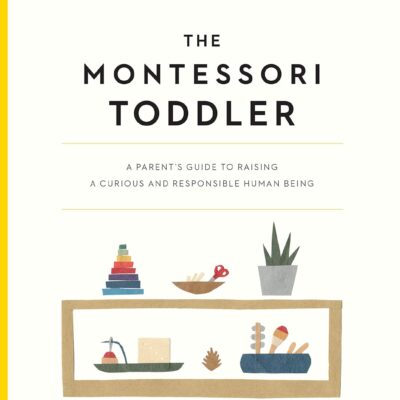
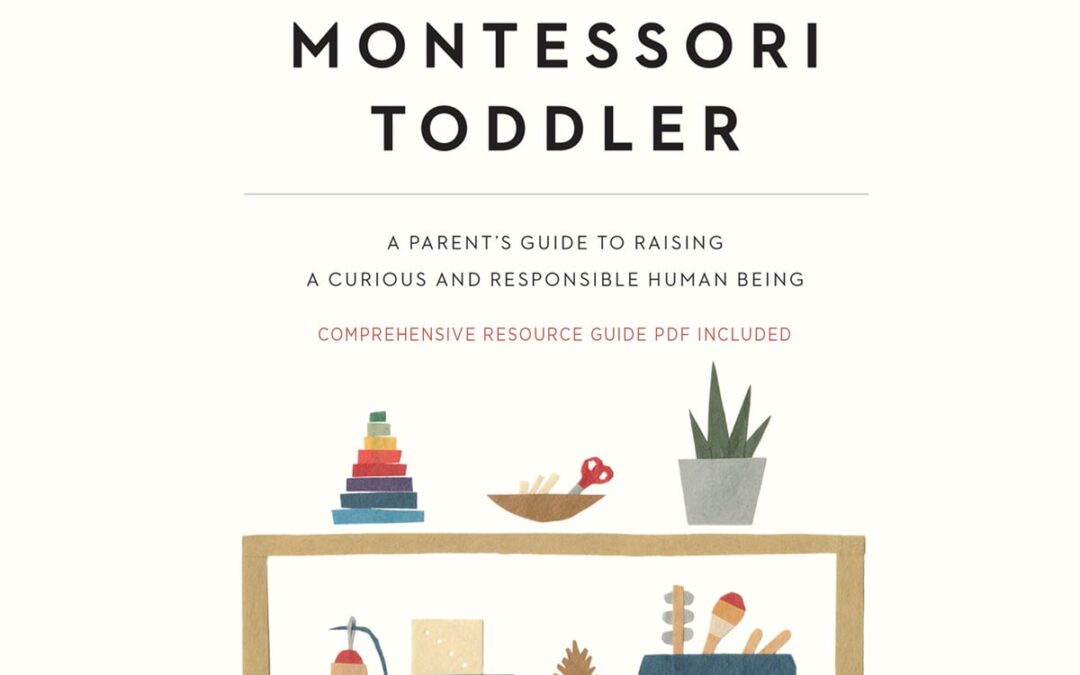
The Montessori Toddler: A Parent’s Guide to Raising a Curious and Responsible Being
Written by Simone Davies Illustrated by Hiyoko Imai

When I looked at the cover of this book I was intrigued. It was simple with a kind of unique illustration of a shelf with activities, and it was written for parents of toddlers—encouraging signs. Then I looked at the table of contents which was 3.33 pages long. Hmmm. Busy parents with small toddlers. Looks a little off-putting to me. So, I flipped through the book. I like photos and illustrations. There were very few photos and quite a few illustrations, but lots of words to read in this 248- page volume. Oh boy!
I made myself look more closely, and what I found was delightfully appealing. That huge table of contents I discovered was because the author listed each topic in each chapter, so it looked a lot more daunting than it truly is. Many of the topics listed are half a page to two pages at most. A parent can easily read a quick snippet and put the book down. They can also easily look up a specific topic that they are interested in because the topics are listed in such detail.
After looking more carefully, I really like the design. Simone Davies is very thorough. Her knowledge, understanding, and enjoyment of this age group is very apparent, and she shares it well with her audience. Often toddlers are misunderstood and so behave in ways that parents find difficult. Davies touches on some key points when thinking about toddlers. The first two chapters give parents valuable information about this stage in a child’s development and a brief introduction to Montessori. The rest of the book helps parents see their role as changing from a servant during infancy to a guide during toddlerhood and beyond. She brilliantly describes how to create a home environment that supports toddler success, both physically and emotionally, with furnishings and activities, as well as discipline.
The Montessori Toddler is a great resource for parents of infants, so that they can prepare for toddlerhood and for parents of toddlers who are already in the midst of toddlerhood.
TOMORROW’S CHILD © • NOVEMBER 2019 • WWW.MONTESSORI.ORG
BOOK REVIEWS by NewGate Secondary Students
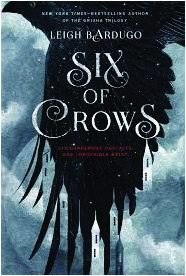
Six of Crows
by Leigh Bardugo

If you like complex characters, a thrilling story, and Victorianesque setting, then you will love Six of Crows by Leigh Bardugo. This book tells the story of a convict, a sharpshooter, a runaway, a spy, a heart render, and a thief who band together to pull off an impossible heist.
Six of Crows takes place in the Grishaverse, a world where certain people called Grisha have the power to manipulate the tides, the wind, or even the chemicals in your body. Every chapter in this book follows the story from a different character’s point of view. The narrative switches between Kaz Brekker, a criminal underworld mastermind; Jesper, a sharpshooter, who can’t walk away from a bet; Wylan, the runaway son of a rich merchant; Inej, a circus performer turned into a deadly assassin; Nina, a Grisha heartrender far from home; and Matthias, a Drüskelle, witch hunter, and a convict. All of them must put aside their differences to complete an impossible heist, not only to save the world but for the money.
The first half of this book takes place in the city of Ketterdam, a city based on Amsterdam, specifically in The Barrel, the part of town with all the gambling halls are where anyone will do anything for the right price. The Barrel is home to thieves, conartists, and, most importantly, gangs. It’s a place where everyone is trying to outsmart everyone else. The second half takes place in the faraway country of Fjerda, a cold unforgiving country filled with Drüskelle. Overall, I loved the setting; I just wish we could have explored The Barrel more. Kaz, also known as Dirtyhands, is a lieutenant in a gang called the Dregs. Inej is a kind, yet dangerous, Suli acrobat who, through a series of unfortunate events, finds herself an assassin. Jesper is a jittery and funny sharpshooter, who can’t walk away from a wager. Nina is decisive and independent. Matthias is cold and a good soldier. Wylan is the moral compass of the team.
Six of Crows is a must-read for anyone who enjoys thrilling, suspenseful, and magical books. With its complex characters, engaging, and intriguing setting, Six of Crows is not only a good book but a masterpiece.
Reviewed by Daniel Pellizzari,10th grade
Matched
by Ally Condie

In the book Matched, a girl named Cassia lives in a tightly controlled society where decisions are made for her. Officials decide, no one else. They decide whom you love, where you work, when you die, and more.
Ally Condie’s husband gave her the idea to write the book, Matched. She had a conversation with him about marriage in the fall of 2008. He asked, “What if someone wrote the perfect algorithm for lining people up, and the government used it to decide whom you married, when you married, etc.?” But some of Condie’s inspiration also came from general experiences, such as becoming a parent and falling in love.
The main characters in this book are Cassia Reyes and Bram Reyes, Bram and Cassia’s parents, Cassia’s grandfather (Xander), and Ky. My favorite character is Cassia’s grandfather (aka Samuel Reyes) because he’s so sweet and he understands Cassia. He’s kind and gentle to everybody, and he loves poetry. In this story, Samuel is always there for his family, as well.
I would like to experience what living in that society would be like. Cassia is so closely monitored all the time and isn’t free to do whatever she pleases—other people control everything Cassia does from the time that she eats to the time that she dies. It would be really interesting to see what that would be like.
Matched is definitely one of my favorite books. It’s very well written and interesting to read. The book has many unexpected twists, turns, and lies that make you need to keep reading. If I could change one thing about this book, I would change something that happens to Cassia’s grandfather. If you want to know what happens to him, you should read the book!
I highly recommend this book because it opens up your mind and makes you more grateful to know that you aren’t always being watched or monitored at all times. It’s so crazy to think how free we are compared to these people who live in a place where they’re just like everyone else—from clothes, to school, to work, and even to falling in love. If you’re the type of person who likes family, adventure, fantasy, and love, then I believe that this would be the perfect book for you!
Reviewed by Maya Stutzman,9th grade
Flowers for Algernon
by Daniel Keyes

Flowers for Algernon is highly acclaimed, having earned the Nebula Award for Science fiction and Hugo award for best novel and considered a classic by many. Written initially as a short story in 1959, it was later expanded into a novel in 1966. The book challenges the status quo of science fiction, focusing not on laser guns, but on the human mind. When it was released in 1959, it changed the very definition of science fiction. However, besides the science aspect of the book, it also has a more important message about humanity.
The story follows Charlie Gordon, a developmentally delayed man who wants more than anything to be smart. When two scientists choose him to be part of a science experiment meant to raise his IQ, his view of the world is completely changed. Now he has to deal with the difficulties that come with intelligence and the painful memories that begin to manifest in his head. I won’t say that this book will change your life, but it should definitely make you think. For me, Flowers for Algernon really pulled at my heartstrings and made me feel emotions that few books have been able to elicit.
Before I elaborate more on the story, I would like to mention that this book is not for kids any younger than secondary school age or those who are afraid to feel a little uncomfortable. The reason I say this is as Charlie remembers more and more of his past, the book takes a darker turn. There are also some slightly mature moments in the second half of the book.
Charlie’s character goes through multiple changes as his intelligence increases. He starts off as a man who has the mind of a kid, working at a bakery owned by a family friend. This is the only place he is able to work, and the owner acts as a father figure to him. He can’t remember anything and is constantly bullied by the other workers. Then, when he receives surgery that slowly increases his intelligence, his character completely changes. He becomes a hyperintelligent person who remembers everything and is able to learn twenty different languages, but now he realizes everything that has happened to him in his life. He now understands that he was previously living in the moment but not able to understand the moment. He had no control over his life, yet now he does, and he’s impossibly frustrated by this. People treat him completely differently and are scared of him. He’s mad at the world, at people, and at his circumstances. He only finds true companionship with the lab mouse, Algernon, that was the scientists original laboratory test subject.
A cool aspect of Flowers for Algernon is how the book itself is written. The story is told in the first person and is written in progress reports by Charlie. This gives the reader a new way to look into the protagonist’s mind, and I really enjoyed reading something that is written so uniquely.
One of the major reasons why I truly recommend this book is its great message. It shows that people who have mental disabilities are still people. We shouldn’t treat people differently just because they struggle with simpler tasks. If anything, we should support them and help them like we would any other person.
Reviewed by Micah Levine,10th grade
Between Shades of Gray
by Ruta Sepetys

“Have you ever wondered what a human life is worth? That morning, my brother’s was worth a pocket watch.”
Between Shades of Gray is a historical fiction novel written by Lithuanian-American writer, Ruta Sepetys. Sepetys’ heritage inspired the creation of Between Shades of Gray, her first novel. This chilling novel is centered around the soul-crushing events of the sovietinvasion within the country of Lithuania in 1941. During this time, soviet police took men, women, and children and dispersed them wherever they pleased, all while leaving the captives uninformed of their destination. The soviets would tear families apart, leaving them to question the fate of their loved ones. The soviets essentially forced the Lithuanians to live as slaves under extremely harsh, inhumane conditions, while having to comply with every order given to them; if they failed to comply, it could mean instant death.
Between Shades of Gray begins with backstory on Kostas Vilkas. Kostas is the husband of Elena and father to Lina and Jonas. Like many other able-bodied men, he was taken and separated from his wife and children. His wife, Elena, is an intelligent and caring woman. Elena can be seen taking on the role of the voice of reason, as well as being a source of positivity. Their daughter, Lina, is a young teenage girl with a passion for art, only 15, when she and her family were taken from their home. Lina’s younger brother, Jonas, was only ten years old when their family was taken. Although they do have their mother by their side the majority of the time, both Lina and Jonas are forced to grow up extremely quickly due to the hardships they face within their situation. However, when the children briefly reconnect with their father, bumping into him in a nearby train car, Kostas gives the children words of wisdom, telling them to stay strong and not to give up. This empowers Lina and Jonas, making them want to keep going despite all their struggles.
The family, minus the father, was forced aboard a train headed towards Siberia. Here, they meet many fellow Lithuanian captives; most memorably, they meet Andrius Arvydas.
Andrius is around the same age as Lina, and during the novel, they become love interests. The family also meets Mr. Stalas, Mrs. Grybas, Ona, and others. They all soon come to be familiar with Komorov, the commander. It seems as if Komorov is the embodiment of evil; he is the main antagonist. Along with the commander, the Lithuanians also get to know Nikolai Kretzsky. Kretzsky is another soldier who takes part in torturing and ordering the captives around. However, as time progresses, Elena strikes an odd friendship with Kretzsky and it’s revealed that he isn’t completely evil.
Between Shades of Gray demonstrates many important themes, including: morality, sacrifice, integrity, strength, and much more. I love watching the characters develop and grow throughout their story. Each character looks at what it was like to be a captive in the mid 1900s from different perspectives; and you are somewhat put into their shoes. I especially appreciate that, to create this novel, Septeys interviewed real survivors of this time. The fact that everything happening directly stems from those peoples’ truths gives the story life; it gives the story more real feelings and emotions. It shows a more historically accurate representation of their hardships. Their stories must be shared, and the way Septeys delivers their stories is beautiful. Septeys makes the story more personal, incorporating thoughts directly from the protagonists’ minds.
Septeys brings to light the crushing tragedy of the persecution of Stalin’s victims in such a way that is extremely powerful and full of raw emotions. This novel covers such a real and touching topic, I would direct the novel to a more mature audience. Anybody who enjoys more intimate, emotional novels will love this book. Be warned, Between Shades of Gray is a rollercoaster; you better make sure to buckle up.
Reviewed by Katherine Laub,9th grade
Ninth and tenth grade students at NewGate School are reading and writing like crazy! Writing reviews for real publications provides students with an authentic reason for writing. Do you have students or children who would like to send in reviews? For submission guidelines, contact: lornamcgrath@montessori.org.
TOMORROW’S CHILD © • NOVEMBER 2019 • WWW.MONTESSORI.ORG

Parenting 101: How Giving A Simple Direction Can Create Clarity
Quite often with a 3-, 4- or 5-year-old, there’s a lot of grey areas when they’re testing boundaries and you’re not sure a break is necessary—maybe he’s touching the baby’s face and he’s looking at you and he’s got this look in his eye like he’s thinking, “Can I do this? How about this? Am I making you nervous? What can I do before you say something?”
Typically, parents give ambiguous information in these moments, like, “Be careful. Your baby brother is very delicate, so I need you to be gentle.”
What is more effective in these moments is to give a clear action direction, “I need you to come and stand next to me for a moment.” Then, if he’s not moving to follow your direction, count: “5…4…3…2…1…”. And if he hasn’t come to you by the end of the count, give him a break. If he does come to you, have him stay there for a moment and then either let him return or give him a direction to play somewhere else. This inserts a very clear map for him (and you) to follow in that moment. You’ve asked him for something specific, and you’ve given him a clear timeline. He’ll begin to take your direction in these moments, because he doesn’t want a break.
It’s important that the parents aren’t threatening to do a break (so it’s not—“I need you to come over to me, or I’m going to give you a break”) because we want him to generate this thought and self-prompt in this moment.
You say, “I need you to come and sit on the couch to play.” He ignores you and you say, “5…4…3…2…1….” Then if he’s
There’s no judgment in your tone with this; it’s easy, it’s fun, it’s playful—like your child. This speaks directly to the difference between punishments and consequences.
still not on the couch, and you say in a relaxed tone, “Oh, now I need you to take a break.” Now he looks up and says, “No, no, no! I’ll sit on the couch.” And you respond, “It’s no big deal. You take the break; then you can go to the couch. Right now, you have a short break.”
You follow this pattern because your goal is to have your child follow your directions when you give them. Once you have a break process in place, you can give all kinds of other prompts, because now he takes your words seriously. As you move forward, you ask him to do what you need, and if he doesn’t, you give him a break, or you count down and then give him a break. But you don’t always have to count down.
You might simply ask your child to do something and then pause quietly for five seconds and then give the break. You don’t have to do it the same way each time because you want to keep him on his toes, so he learns to hold an awareness of your needs. There’s no judgment in your tone with this; it’s easy, it’s fun, it’s playful—like your child. This speaks directly to the difference between punishments and consequences.
You can begin by giving a clear direction and then counting. A few days later, you shift to pausing quietly for 5 seconds, then giving the break. Inevitably, your child will say, “Wait! You didn’t count!” and you can tell him, “Well I’m not always going to count. I don’t want to work so hard. You know what happens after I give you a direction. I wait a few moments, and then you get a break. It’s no big deal; you take the break, and you come right back.” The tone of voice you use and the lack of moralizing is the difference between punishment and consequence. You’re shifting from judgment and anger, which implies his actions are either good or bad, to good-natured coaching with cause and effect.
There is often a misunderstanding that administering cause and effect without judgment is too soft, but it’s not; it’s actually more effective. When your child is very defiant you can give consequence after consequence after consequence and frustrate the heck out of him. But the more you frustrate him, the more your tone should be sweet and empathetic so that your children focuses on the consequence of their choices rather than your judgment of them. •
Joe Newman was born and adopted in1963. In 1970 he was diagnosed ADHD and medicated with Ritalin. Every where he went, the playground, the classroom, even at home, Joe heard one message loud and c ear: you’re broken; your brain doesn’t work; you don’t belong.” No surprises when, at eighteen, he dropped out of college, shaved his hair into a mohawk and took off to surf the coastlines of the Caribbean and Central America. It was out in the world, working scores of jobs and starting his own businesses, where Joe realized he was not actually broken. Away from the tethers of school and home, Joe realized the same qualities called disorders were also qualities of positivity and value. Aggression became passion, distractibility became broad understanding, and stubbornness became tenacity. Realizing there must be millions of children out there, just like him, with ferocious spirits but misunderstood, he threw himself into finding and reaching these children.
His book, Raising Lions, has developed a growing following not simply because it helps parents understand why their children behave the way they do, but because the tools and solutions actually work.
TOMORROW’S CHILD © • NOVEMBER 2019 • WWW.MONTESSORI.ORG

Health & Wellness: The New Rules of Peanut Allergies: What Concerned Parents Need to Know
by Libby Ryan and Nicole Harris Updated September 16, 2019 from Parents.com
New guidelines encourage us to introduce peanuts to all kids much earlier. Plus, the FDA recently supported development of a drug aimed at lessening the severity of allergic reactions from peanuts. Here’s what you need to know.
This article brings a new, exciting possibility for allergy sufferers but should not be taken lightly or without the help of qualified medical personnel.
Everything you think you know about peanut allergies might be about to change. In March 2019, the American Academy of Pediatrics (AAP) released new guidelines for introducing kids to peanuts in the hope of decreasing the prevalence of this widespread allergy.
The study says babies should be given peanuts early, in order to prevent allergic reactions. In fact, multiple reports in the past decades have shown the benefit of introducing peanuts to highrisk babies when they are between 4 to 6 months old (with proper medical supervision). Infants with less of a risk can start these foods at 6 months or older, following the pattern of the family’s normal diet.
Previously, kids in danger of developing an allergy were supposed to avoid any contact with peanuts for the first three years of their lives, according to Hugh Sampson, M.D., director of the Elliot and Roslyn Jaffe Food Allergy Institute at Mount Sinai and a Parents advisor.
The study says babies should be given peanuts early, in order to prevent allergic reactions.
Then, in 2008, the AAP said that babies should not be refrained from eating allergens like peanuts, milk, and eggs. Being introduced to these allergens wouldn’t prevent them from developing eczema, skin conditions, and food allergies, according to the report.
But the March 2019 guidelines state that high-risk children should have peanuts in their diet much sooner. In turn, the babies will (they hope) have less of a risk of developing allergies in the future.
So how can a parent know if their baby might be at high risk of developing a peanut allergy? Two main signs your little one could be ready for a peanut intervention are egg allergies or severe eczema, according to the National Institute of Allergy and
Infectious Diseases (NIAID). Talk to your pediatrician if your child has either or both conditions; your doctor can do an allergy test to find out the best timing for introducing peanuts.
Whole peanuts are a choking hazard for infants and small children, says Drew Bird, M.D., director of the Food Allergy Center at Children’s Health in Dallas. For your baby’s first bites, you can stir a small amount of peanut powder into a puree or spread a thin layer of peanut butter on toast.
The sticky consistency of thick peanut butter can also be hard for little mouths to handle, so Dr. Bird recommends two teaspoons of smooth peanut butter mixed with two teaspoons of warm water for babies just starting solids.
It’s also important to keep serving your child peanuts once they’ve been introduced. “Foods that are in the diet more frequently are less likely to cause problems down the road,” Dr. Bird explains. He also stresses that children who have already been diagnosed with a peanut allergy should continue to use the same caution around peanut products as always.
If your child does have an allergic reaction, symptoms may include swelling lips, coughing, vomiting, or rashes that look like mosquito bites around the mouth or other parts of the body, and they would begin almost immediately after eating. If your child has a reaction, call your doctor immediately. •
TOMORROW’S CHILD © • NOVEMBER 2019 • WWW.MONTESSORI.ORG

MONTESSORI MYTHS: PART 1
Each year, during the start of school, teachers and administrators try to explain to new parents the essence of the term Montessori. In this article, we’ll try to explain what Montessori is and is not, dispelling, we hope, a few misperceptions about Montessori education in the process.
Its simplest form, Montessori is the philosophy of child and human development as presented by Dr. Maria Montessori, an Italian physician who lived from 1870 to 1952. In the early 1900s, Dr. Montessori built her work with mentally challenged children on the research and studies of Jean Itard (1774-1838), best known for his work with the “Wild Boy of Aveyron” and Edward Seguin (1821- 1882), who expanded Itard’s work with deaf children. In 1907, Dr. Montessori began using her teaching materials with normal children in a Rome tenement and discovered what she called “the Secret of Childhood.” The secret? Children love to be involved in self-directed purposeful activities. When given a prepared environment of meaningful projects, along with the time to do those tasks at their own pace, children will choose to engage in activities that will create learning in personal and powerful ways. Over the past one hundred years, Montessori classrooms all over the world have proven that, when correctly implemented, Dr Montessori’s philosophy works for children of all socio-economic circumstances and all levels of ability. In a properly prepared Montessori classroom, research shows that children learn faster and more easily than in traditional schools. However, the implementation of Montessori philosophy is a school’s biggest challenge.
There are many factors to consider when putting theory into practice, for example: the individual children in the classroom, their ages and emotional well-being; parent support and understanding of Montessori philosophy; and the training and experience of teachers, assistants, and administrators. These are only a few of the elements that create a Montessori school. Because of this, Montessori schools come in all shapes and sizes, including the small in-home class for a few children to schools with hundreds of students, from newborns through high school.
While schools come in many shapes and sizes, all successful Montessori classrooms require three key elements: 1. well-trained adults; 2. specially prepared environments; and 3. children’s free choice of activity within a three-hour work cycle. Finding the right school for your family—whether it’s Montessori, public, parochial, alternative, traditional or home school— requires a bit of investigative work and an understanding of the needs and concerns you have for your family. Being clear about what Montessori education is and what it is not can help you make an informed decision.
Let me use my twenty-five years of Montessori experience to help dispel a few misconceptions about Montessori schools, some of which I’ve held myself.
MYTH #1: Montessori Is Just for Rich Kids
Many Montessori schools in the United States are private schools, begun in the early to mid- 1960s, a time when most public education didn’t offer kindergarten, and only 5 percent of children went to preschool, compared with the 67 percent reported in the 2000 census. When many Montessori schools were established, private preschools might have been an option only for those in urban well-to-do areas, thus giving the impression that only wealthy families could afford Montessori schools. The first schools that Montessori established were in the slums of Rome, for children left at home while parents were out working, and certainly not for rich kids . Today, in the United States, there are over 300 public Montessori schools and 100 charter schools that offer taxpayerfinanced schooling, along with thousands of private, not-for-profit Montessori programs that use charitable donations to offer low-cost tuition. Montessori education, through these low-cost options, is available to families interested in quality education. Many private, highdollar schools offer scholarships, and some states offer childcare credits and assistance to low-income families.
MYTH #2: Montessori Is Just for Gifted Kids
Montessori is for all children. Since Montessori preschools begin working with threeyear-olds in a prepared learning environment, Montessori students learn to read, write, and understand the world around them in ways that they can easily express. To the casual observer, Montessori students may appear advanced for their age, leading to the assumption that the schools cater to gifted children. In reality, a Montessori school offers children of differing abilities ways to express their unique personalities, through activities using hands on materials, language, numbers, art, music, movement and more. Montessori schooling helps each child develop individuality in a way that accentuates his or her innate intelligence. Montessori schools can help make most kids ‘gifted’ kids.
MYTH #3: Montessori Is for Learning Disabled Children
It is true that Dr. Montessori began her work with children who were institutionalized, due to physical or mental impairments. When using her methods and materials with normal children, Montessori discovered that children learned more quickly using her teaching methods. There are some Montessori schools and programs that cater specifically to children who have learning challenges. In many Montessori schools, however, children with special needs are included, when those requirements can be met with existing school resources.
MYTH #4: Montessori Is Affiliated with the Catholic Church
Like many preschools, some Montessori programs may be sponsored by a church or synagogue, but most Montessori schools are established as independent entities. Conversely, a school might be housed in a church building and not have any religious affiliation. Since Montessori refers to a philosophy, not an organization, schools are free to have relationships with other organizations, including churches.
Some of the first Montessori programs were sponsored by Catholic or other religious organizations. Dr. Montessori was Catholic and worked on developing religious, educational, hands-on learning experiences for young children. The Montessori movement, however, has no religious affiliations. Montessori schools all over the world reflect the specific values and beliefs of the staff members and families that form each school community. Around the world, there are Montessori schools that are part of Christian, Muslim, Jewish, and other religious communities.
MYTH #5: In Montessori Classrooms, Children Run Around and Do Whatever They Want
When looking at a Montessori classroom you may see 25 or more children involved in individual or small-group activities. It is possible that each child will be doing something different. At first glance, a classroom may look like a hive of bumblebees.
If you take the time to follow the activities of two children, over the course of a three-hour work period, you should observe a series of self-directed activities. The children aren’t running wild. They are each involved in selfselected work, designed to build concentration and support independent learning.
Choosing what you do is not the same as doing whatever you want. A well-known anecdote about Montessori students doing what they like, comes from E.M. Standing’s book, Maria Montessori—Her Life and Work: “A rather captious and skeptical visitor to a Montessori class once buttonholed one of the children—a little girl of seven—and asked: ‘Is it true that in this school you are allowed to do anything you like?’ ‘I don’t know about that,’ replied the little maiden cautiously, ‘but I do know that we like what we do’.”
MYTH #6: Montessorians Are a Selective Clique
One definition of a clique is: an exclusive circle of people with a common purpose. Many Montessori teachers could be accused of this because of their intense desire to be of service in the life of a child, coupled with the teacher’s knowledge of child development. While many schools have tight-knit communities, they are not exclusive.
You should look for a school where you and your family feel welcomed. For many years, Montessori training programs were only available in a few larger cities. Often certified required prospective teachers relocate for a year of study. Now Montessori teacher’s training is mainstream and more accessible, with colleges and universities offering graduate programs in Montessori education, in conjunction with Montessori training centers. Loyola College in Maryland, New York University, and Xavier University are only a few of the many institutions of higher learning that include Montessori teacher’s training.
Dr. Montessori’s books, full of Italian scientific and psychological terminology, translated into the British English of the early 1990s, can be difficult for the modern reader to follow. To parents, the use of Montessori-specific terms and quotes may at times take on esoteric tones of an elusive inner circle. The enthusiasm and dedication evident in the work of many Montessorians might be misinterpreted as excluding to uninitiated newcomers.
My experience with Montessori teachers and administrators has been that they are eager to share their knowledge with others. •
Look for Part 2 of Montessori Myths in the next edition of Tomorrow’s Child.
Maren Stark Schmidt founded a Montessori school and has AMI elementary teaching credentials. She currently writes the award-winning syndicated newspaper column, Kids Talk, and is author of Understanding Montessori: A Guide for Parent sand Building Cathedrals Not Walls.
TOMORROW’S CHILD © • NOVEMBER 2019 • WWW.MONTESSORI.ORG

IB Is Something I Never Expected I Would End Up Doing
by Madison Dodd, NewGate Student
I have always pursued alternative education, whether that be through Montessori, Waldorf, or homeschool. Therefore, it was a shock to me to think that I would be involved in a program so widely recognized across all types of schools. I remember my first day touring NewGate School as a high school freshman. I met with Tim Seldin, who showed me around campus and encouraged me to give the IB Diploma Program a shot once my junior year came, to which I replied, “But I can’t do math!” (to which he replied, “Just do an IB Certificate!”).
I did not expect how much I was going to push myself over the course of these two years. I wasn’t aware of how much I was truly capable of. I remember the first day of our science (Biology HL) class, our teacher told us there was going to be a ‘learning curve’ and that we should prepare ourselves to not always get A’s on our test like we may be accustomed to. Although my classmates and I took in this information, it didn’t quite set in until we all studied for one of our first big tests We thought it was our best work yet, but then we realized that we all just scored in the ‘2-3 range’ … out of 7!
Suddenly, our teachers were no longer there to give us all the tools to get a good grade in the class, to make sure our homework was done on time, or to make sure we were present for the lessons. By IB’s design, the weight was now put on us, as the students, and it was time to get to work.
WHAT IS IB?
In a nutshell, IB is a two-year diploma or certificate program that is internationally recognized across universities to award college credit. That means that from junior to senior year, you will be in the same classes preparing for (depending on your course) between two to three final exams that will be scored from 1 to 7 in each subject. These courses will be three higher level (HL) courses and three standard level (SL) courses. The difference simply being that a HL course may have some extra requirements that SL students don’t have to complete.
Along with the end-of-year exams, there is the Internal Assessment that you must complete in each IB course. In Biology, that might look like a science experiment that you write a paper about. In Literature and Performance, you adapt a short story or poem into a play. The teachers grade it and then send it off to IB to be assessed by them.
I did not enter the program feeling that I was someone who was even remotely able to tackle all of these requirements. However, by putting in the work, learning how to manage my time, and not get in the way of myself, I’m able to positively reflect on it now.
In addition to your coursework, you must complete the Extended Essay (EE), which is a 4000-word research paper that is situated in one of your six IB courses. Then, there is the additional class you must take called “Theory of Knowledge” or “TOK.” This is essentially a philosophy class, and the only two requirements for it are that you complete:
• One TOK essay using one of IB’s supplied prompts
• A TOK presentation in which you develop your own research question and explore it using a real-world example
All of these go towards your final IB score, which can be up to 45 points. I promise this will all begin to make more sense once you are in the course.
Finally, at the heart of IB’s program, there is CAS (Creativity, Action, and Service). This is something you complete outside of school and, most of the time, you are already doing it. Do you play a sport or an instrument? If so, the action and creativity boxes are already checked off.
The only requirement for CAS is that you create a portfolio containing reflections about these activities throughout your two years (mine is in the form of a blog) and that you complete one CAS project, which can involve one or all of the CAS components, and is at least six weeks long. While this does not go towards your score, you will not receive your diploma if you do not complete it.
Overall, IB takes a global approach by looking at big ideas across disciplines. You will notice yourself finding connections between something you learned in science class with something you are talking about in Spanish. No matter what you’re studying, students dig deep into subjects and try to find answers.
WHAT IF YOU DON’T WANT TO COMMIT TOALL THAT EXTRA COURSEWORK?
For whatever reason, if a student does not want to do the full IB Diploma, they can take up to three IB courses; they only need to complete what is required in that course. That means no CAS, no EE, and no TOK. This represents the difference between the higher level and the standard level requirements in the courses. This is beneficial for a student who might have a tighter schedule and doesn’t have time for the full diploma or has a subject area they do not want to take at such an intensive level.
MY EXPERIENCE
IB is usually perceived as a big, scary, and difficult program that only those suited for ivy leagues can survive. However, through my experience, I have learned that it is not the skills that you enter the program with that matter; rather, it is the skills you will acquire throughout the program that will carry you to the exams.
I did not think, at the beginning of my junior year, that I would be leading a discussion in my social and cultural anthropology class about hegemony in marginalized groups in East Harlem. I also did not think I would ever receive a 90 percent on a math test, but it happened! For me, IB has been a journey full of self-discovery and lots and lots of struggling. However, my own academic struggles have taught me so much about who I am and what I am capable of.
I did not enter the program feeling that I was someone who was even remotely able to tackle all of these requirements. However, by putting in the work, learning how to manage my time, and not get in the way of myself, I’m able to positively reflect on it now. I can’t speak for every school, but at New- Gate the support system from the teachers and students is something I attribute to why I entered IB in the first place. Therefore, I encourage anyone considering the program to try it. Your name is not even registered as an IB student until late in your senior year, meaning you have time to see if the program works for you and adapt accordingly.
Looking back, all the stress tears I cried, the coffee I consumed, and nights I stayed up were all formative in enabling me to believe in myself. Even though I am not at the finish line, it is now in my line of sight, and I am sprinting towards it faster than I ever have before, with my teachers and family cheering me on until I arrive. •

Madison Dodd is a high school senior in the IB Diploma Program attending NewGate School. She lives in Sarasota, Florida with her parents and younger brother.
Experiential Learning at the Secondary Level: NewGate School
by Amy Kremer-Treibly, NewGate Secondary Guide, Master of Experiential Education
”Only practical work and experience lead the young to maturity.”
– MARIA MONTESSORI, THE ABSORBENT MIND
In NewGate’s Montessori learning environment there are several key experiences that contribute to the whole development of all students enrolled in the program. According to Maria Montessori, “Experience is a key for the intensification of instruction given inside the school…it is self-evident that the possession of (and contact with) real things brings, above all, a real quantity of knowledge.” Key experiences for students in the NewGate Secondary Program include the following:
Secondary Orientation Program
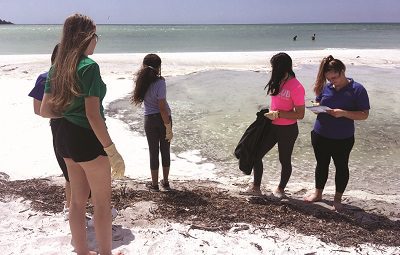
Each school year begins with the Orientation Trip, where the search for individual identity intertwines with the onset of leadership, teamwork, and the positive social development of the secondary community. Students bond with their peers and their teachers in an environment outside the classroom. We work on low- and high-ropes course initiatives to build teamwork and communication skills. We also work as a team to develop the ground rules that will function as our common-good contract for the year. Finally, the structure, schedule, and topics of the year’s course of studies are presented. This is both an on- and off-campus experience.
Service Learning Course
Students participate weekly in a service-learning course, a chance for adolescents to validate their own self-worth and share their talents and skills with the wider community. This course encourages students to make a decision to participate positively in society. Every week, students are involved in various service activities, ranging from community in-reach with primary and elementary students in their classrooms to maintenance and beautification of the campus and physical environment. Students also venture out into the Sarasota (FL) community every week to work with a service organization of their choice. Through their service-learning activities, students develop positive citizenship characteristics that will enable them to contribute to an improved sense of community in the world around them. The service-learning course is just one component of the secondary program that engages the students in authentic, hands-on learning environments.
”Success in life depends in every case on self confidence and the knowledge of one’s own capacity and many sided powers of adaptation. The consciousness of knowing how to make oneself useful, how to help mankind in many ways, fills the soul with noble confidence.”
—MARIA MONTESSORI
The Gardening and Culinary Project
Gardening and working in the kitchen is a fundamental component of the adolescent’s meaningful work in New Gate School’s secondary program. Students prepare plots, plant, observe, and maintain the gardens throughout the year. All secondary students also work in the kitchen, learning basic kitchen skills and preparing food, using ingredients from the gardens (as much as possible) to share with the community. Students prepare and serve a meal to the school community on a quarterly basis. Students also participate in discussions and field trips to explore their connection to the land and food.
Internships
Every year students plan and experience a one-week internship. The faculty works with students to find a meaningful internship that presents them with an opportunity to conduct themselves in a professional workplace and a chance to work with positive role models and community experts. Students enjoy the opportunity to engage in a learning experience that enhances classroom learning and extends beyond the traditional four walls of the classroom. In preparation for the internship experience, they spend time in workshops for resumé writing, business letters, interviewing, thank-you letters, and oral presentations. First cycle students (7th-8th grade) can choose a placement in the local Sarasota community, while second- (9th-10th grade) and third-cycle (11th-12th grade) students can choose national and international placements.
Drama Immersion Week
Students in the entire secondary program stop their regular class schedule for a week each year and immerse themselves in the work of the theater. Students work with a faculty director to stage performances for the school and local community. Students form several work crews involved in the final production: acting, scenery, costumes and/or publicity. Since all students participate in some way, this program serves as a great creative collaboration for the adolescents. The team building and confidence that develops throughout the week is valuable and enjoyable for everyone.

Research Trip
Each year, students augment their course of studies with a weeklong research trip. These trips are journeys that depend upon student leadership and community building. The purpose of the class trips is multifold. The positive social development of the adolescent is enhanced, and the ‘hands-on’ learning experience that is acquired while in the field engages students in several of the broader disciplines: natural history; creative arts; history; and physical education. Trip preparation occurs throughout the school year and is often linked with curriculum work, with a week of intensive prep closer to the trip dates. Each student is encouraged to earn at least half the cost for the end-of-year trips, through school, student, and parent-organized fundraisers and through their own savings. This experience is central to the participatory creation of community. •
Amy Kremer-Treibly has taught throughout the NewGate secondary program since 2002, primarily with English reading, writing and theater projects and has been teaching for 23 years. She is also an International Baccalaureate Diploma Program Instructor, Librarian and CAS Advisor. She has spent many years developing the secondary program’s experiential learning and looks for every opportunity to get students off campus and into the community for learning opportunities. She also leads the annual drama immersion weeks with students at each secondary level to build memorable theatrical productions in the space of a week. One of her great joys is helping every student find gateway books that lead to a life long love of reading, and she builds every opportunity possible to share books with students from toddler through high school levels.
Amy earned her Bachelor’s Degree in Anthropology at Loyola University. She began her teaching career in a refugee resettlement program teaching ESL to adult students from around the world, followed by teaching Spanish at the elementary level. While teaching at a Great Books Foundation high school in Arizona, she earned her Master’s Degree in Experiential Education at Prescott College with a focus on building schools and learning experiences to promote engagement, ecoliteracy, and stewardship.
TOMORROW’S CHILD © • NOVEMBER 2019 • WWW.MONTESSORI.ORG
Helping Children to Be Successful: Developing Grit
by Rachel Buechler
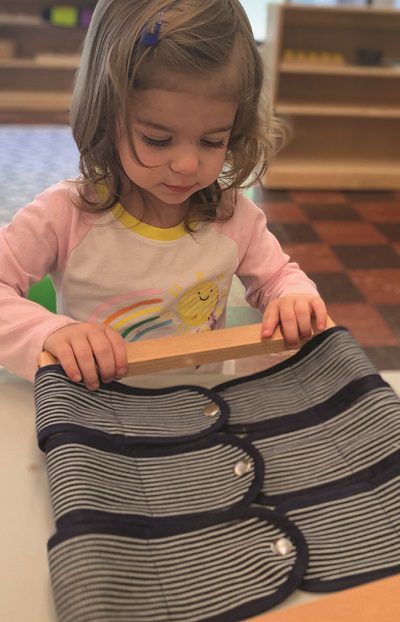
 A little girl sits at the table with the Snap Dressing Frame. She has picked it up several times before today and quickly returned it to its stand after a short attempt. Today she picks it up and places it on the table. She tries the first snap; it doesn’t connect. She looks at the snap from the left side, then the right side. She tries again; it doesn’t connect. She looks at her teacher for help. The teacher demonstrates how to connect the snap then returns it to its unconnected state. The child moves onto the snap above and, as she pushes down, she hears it connect. She pauses, smiles. Then goes back to try the first one; it still doesn’t connect. She squeals in frustration. She takes a moment to look again and again; then she keeps trying. This continues for twenty minutes until she looks at the dressing frame and the three connected snaps. She sighs and smiles then exclaims, “I did it!” Her teacher says, “You did it!” The little girl continues to look at the completed work before quickly taking it apart again to repeat the lesson.
There is so much for us to learn from this toddler’s determination to work on mastering this lesson. She is showing us how we can develop a skill that will place us ahead of others in the working world: grit. Grit is what keeps us working with our children, even when it is hard, even when we think we aren’t getting the results we want, or the progress is slower than we hoped. No matter what, we keep thinking of new ideas to try and keep believing we will see results. We are displaying grit. How can you help your students, or your own children, develop grit?
1. EXPRESS FRUSTRATION
Let the child experience frustration. This is hard to do when we can see the solution to their problem is so easy for us to fix. As they try to fit puzzle pieces into a board, we can see they just need to turn it a little further, and we can feel so helpful if we just showed them how it fit by reaching over to place the piece. If we continue to solve the child’s frustrations, we are robbing them of the opportunity to feel greater success in working through the issue. We are also telling them that anytime they are frustrated, they should rely on an adult to solve the issue. We need our future leaders to learn how to problem solve and persist to solution by accepting frustration, then working through it.
2. THE RIGHT AMOUNT OF HELP
During the Dressing Frame story, the teacher did show that the snap can be connected and, thus, modeled the action for the child. The teacher also returned the snap to its original state so the child would continue to work from where she left off. Deciding exactly what help children need is critical to allowing them to persist with the challenge, but not discourage them by completing it on their behalf. It also helps children to learn when to ask for help.
If we continue to solve the child’s frustrations, we are robbing them of the opportunity to feel greater success in working through the issue.
3. ENCOURAGE REPETITION
Even if children don’t succeed with lessons, tomorrow might just be the day they will figure it out. Maria Montessori believed repetition was the key to mastering a skill. If an infant went to walk for the first time but fell after one step, and we said: “Looks like that’s not the activity for you,” they would likely feel discouraged from attempting it again. Our response is more likely to be supportive, helping them up and encouraging them to try again and again until they are walking with stability. This is how we should help our children attempt many lessons in different areas of the classroom or skills at home. There are times when a child masters a difficult skill and then finds joy from repeating the lesson over again, as it gets easier and easier each time. As new skills are developing, mistakes will be made. When mistakes are made, we must be matter of fact about them. As the book, The Montessori Toddler, says, “Mistakes are simply opportunities to learn… if they break or spill things, we can have things at the ready for them to help tidy it up…. We can model being friendly about mistakes by not taking ourselves too seriously when we make mistakes” (Davis, 2018, p.93).

4. CELEBRATE VICTORY
The child had picked up the Snap Dressing Frame several times on various days before and realized, through self-awareness, that this was not a task that would give her immediate success. There were other skills that needed to be built first. This shows great knowledge in knowing her own abilities and where she is ready to seek the next challenge. By allowing children to guide their own learning journeys through choice and freedom, they develop more than the academic skills. They build skills in planning, organization, order, and determination (or grit). The growth of these skills allows children to feel internal celebration when they complete activities on which they have been working. This grows confidence as children learn how to fail and keep persisting until they succeed. As the book, The Confidence Code, says, “failing fast allows for constant adjustment, testing, and then quick movement toward what will actually work” (Kay & Shipman, 2014, p. 140).
ADULT INTERVENTIONS THAT DISCOURAGE THE DEVELOPMENT OF GRIT:
• Jumping in to help before you have assessed exactly how much help the child truly needs. Give only this amount of help. The joy within the child comes from persisting through a difficult task to reaching completion.
• Saying “good job” or “I like it when you_____”. These statements make the success about you and not about the internal development of the child.
• Moving the child away from a task because you think it looks too difficult prevents developing grit. Let them try; model it. Help them to determine what is too difficult. Don’t become frustrated or upset about mistakes made.
REFERENCES:
Davies, S. (2018) The Montessori Toddler. Amsterdam: Jacaranda Tree Publishing Kay, K. & Shipman, C. (2014). The Confidence Code. New York: HarperCollins
Rachel Buechler earned her BA in Education in 2009 before relocating to Charlotte, NC from England, UK. She joined Charlotte Montessori School in 2010and was the Lead Toddler Teacher for three years. During that time she earned her Infant/Toddler Montessori Certification. Ms. Buechler enjoys the individualization of the Montessori classroom foreach child and watching them follow their own unique interests as they learn and grow in the classroom.
TOMORROW’S CHILD © • NOVEMBER 2019 • WWW.MONTESSORI.ORG
What Makes Montessori Different?
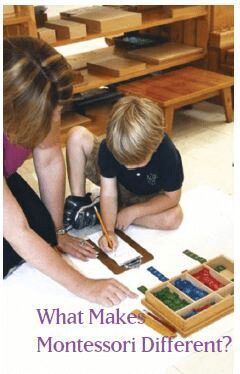 Montessori schools are not completely different from other schools. Over the last century, Dr. Maria Montessori’s ideas have had a profound and growing influence on education around the world. However, while individual elements of her program are finding their way into more traditional classrooms every year, there is a cumulative impact that we see when schools fully implement the entire Montessori model, which creates something quite distinct.
- Montessori schools begin with a deep respect for children as unique individuals. They work from a deep concern for their social and emotional development.
- Montessori schools are warm and supportive communities of students, teachers, and parents. Children don’t get lost in the crowd!
- Montessori consciously teaches children to be kind and peaceful.
- Montessori classrooms are bright and exciting environments for learning.
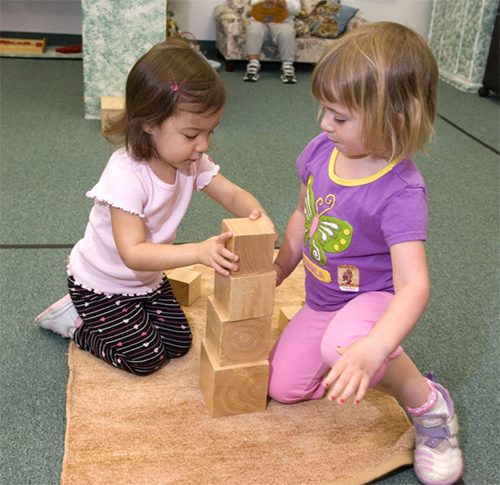
- Montessori classes bring children together in multi-age groups, rather than classes comprised of just one grade level. Normally, they span three age levels. Children stay with their teachers for three years. This allows teachers to develop close, long-term relationships with their pupils, allows them to know each child’s learning style very well, and encourages a strong sense of community among the children. Every year, more non-Montessori schools adopt this effective strategy.
- Montessori classrooms are not run by the teachers alone. Students are taught to manage their own community and develop leadership skills and independence.
- Montessori assumes that children are born intelligent; they simply learn in different ways and progress at their own pace. The Montessori approach to education is consciously designed to recognize and address different learning styles, helping students learn to study most effectively. Students progress as they master new skills, moving ahead as quickly as they are ready.
- Montessori students rarely rely on texts and workbooks. Why? Because many of the skills and concepts that children learn are abstract, and texts simply don’t bring them to life. Also, in the case of reading, many reading series fail to collect first-rate and compelling stories and essays; instead, Montessori relies upon hands-on concrete learning materials and the library, where children are introduced to the best in literature and reference materials.
- Learning is not focused on rote drill and memorization. The goal is to develop students who really understand their schoolwork.
“Bring the child to the consciousness of his own dignity, and he will feel free. We see no limit to what should be offered to the child, for his will be an immense field of chosen activity.” –Maria Montessori**
- Montessori students learn through hands-on experience, investigation, and research. They become actively engaged in their studies, rather than passively waiting to be taught.
- Montessori challenges and sets high expectations for all students, not only those considered ‘gifted.’
- Students develop self-discipline and an internal sense of purpose and motivation. After graduation from Montessori, these values serve them well in high school, college, and in their lives as adults.
- Montessori schools normally reflect a highly diverse student body, and their curriculum promotes mutual respect and a global perspective.
- Students develop a love for the natural world. Natural science and outdoor education is an important elements of our children’s experience.
- The Montessori curriculum is carefully structured and integrated to demonstrate the connections among the different subject areas. Every class teaches critical thinking, composition, and research. History lessons link architecture, the arts, science, and technology.
- Students learn to care about others through community service.
- Montessori teachers facilitate learning, coach students along, and students come to know them as friends and mentors.
- Students learn not to be afraid of making mistakes; they come to see their mistakes as natural steps in the learning process.
- Montessori students learn to collaborate and work together in learning and on major projects. They strive for their personal best, rather than compete against one another for the highest grade in their class.
Tomorrow’s Child | Welcome | November 2021
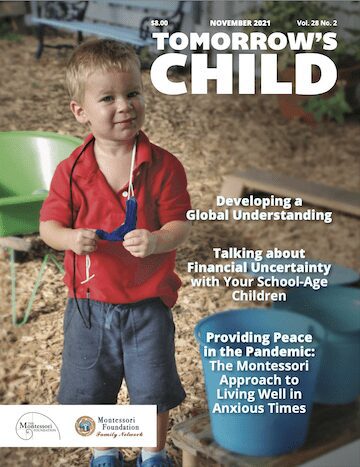
This issue of Tomorrow’s Child addresses how Montessori schools support children’s emotional well-being during a stressful time, teaching global understanding, how we prepare Montessori learning environments, sibling rivalry, the Montessori Silence Game, teaching music, showing gratitude, gift suggestions, book reviews, and much more.
Click here to see the complete issue as it appears in print.
Additionally, with our last issue, we launched a new mobile-friendly platform for viewing the digital edition. You can find that new platform here.
Tomorrow’s Child – November 2021 Digital Issue

Montessori leadership | Welcome | Vol. 23 Issue 1 2021
 This issue of Montessori Leadership includes
Maria Montessori’s 151st Birthday By Kathleen Dzura
Leading with Emotional Intelligence By Dane Peters
Book Review: Positive Discipline in the Montessori Classroom By Mary Schneider
Why are children so different today (book excerpt) by Jane Nelsen, Ed.D and Chip DeLorenzo, M.Ed
Storytelling and Executive Functioning by Michael Dorer, Ed.D.
Where have all the teachers gone? By Daniel “Robin” Howe
So, what is special education? By Christine Lowry, M.Ed.
So, what is special education? Q & A column By Christing Lowry and Kathy Leitch
Sarasota University & CGMS Announce Historic Partnership
Spotlight on Accredited School: Garden Oaks Montessori By Lorna McGrath, M.Ed
Click here to see the complete issue as it appears in print.
Additionally, we have begun a new mobile-friendly platform for viewing the digital edition. You can find that new platform here.

Tomorrow’s Child | Welcome | March 2021
To continue reading, you will need to choose a subscription plan.
Featured
-
Montessori Family Alliance School Group Membership (Print & Digital 2026 1/2 year pricing)
Original price was: $30.00.$15.00Current price is: $15.00.
-
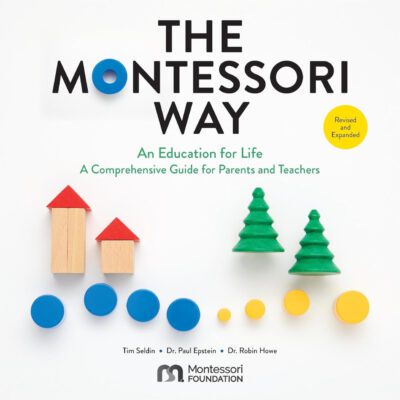
The Montessori Way, Revised and Expanded: An Education for Life; A Comprehensive Guide for Parents and Teachers
$25.00
-
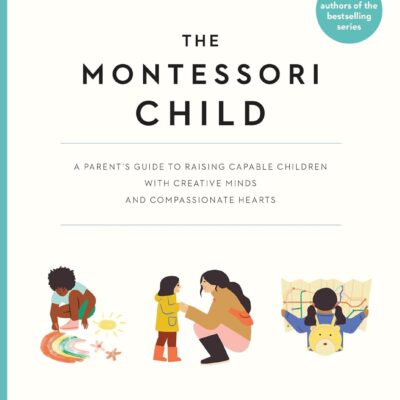
The Montessori Child: A Parent's Guide to Raising Capable Children with Creative Minds and Compassionate Hearts (The Parents' Guide to Montessori)
$20.00
-
The Montessori Toddler: A Parent's Guide to Raising a Curious and Responsible Human Being (The Parents' Guide to Montessori)
$20.00
-
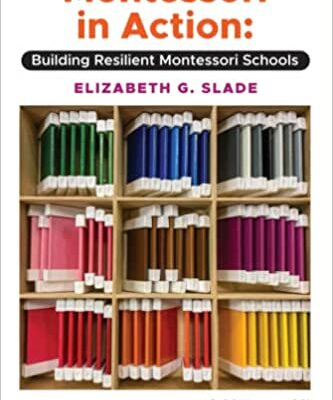
Montessori in Action: Building Resilient Montessori Schools 1st Edition
$29.95