
To access this page, you will need to log in or become a member.
The Courage To Be a Montessori Parent

The Courage To Be a Montessori Parent

mom and child


By Joyce St. Giermaine

  • Montessori is great for little children but that’s it!
  • Montessori is warm and fuzzy. Children enjoy it, but the real world isn’t warm and fuzzy. They have to grow up sometime.
  • I’m worried that Montessori shelters my child from life.
  • Your children are still in Montessori. You should be thinking about their future. You do want them to go to college, don’t you?

As a Montessori parent, you’ve probably heard many statements like those above, and you can probably add a few of your own. These remarks often are expressed by parents to other parents. Sometimes they come from well-meaning relatives, co-workers, neighbors, and just about anybody who knows you have a child in a Montessori school. When it comes to Montessori, it seems that everyone has an opinion.

When my children first started Montessori many years ago, I heard the statement “It takes courage to be a Montessori parent.” I used to believe that it took courage because Montessori was an experimental program to which I was offering the use of my children as guinea pigs. As I became better informed, I quickly discovered this was not the case. Montessori has actually been around for over one hundred years and has been proven successful in many different educational environments throughout the world.

So what does it mean “It takes courage?” Maybe it’s because Montessori tends to encourage children to think for themselves and articulate their own opinions. This is all wonderful, but as a parent, there are moments when it would be a whole lot easier to deal with a six-year-old who blindly and obediently accepts your explanation for why you don’t want to create a recycling center right in the middle of your kitchen or a four-year-old who announces that she knows where hamburger really comes from and she’s never going to eat it or any other animal ever again, period!

That must be it, I thought. It takes courage to live with these self-actualized, intelligent little creatures that have been encouraged by Montessori to think logically and express their opinions. I stuck with this understanding of the “courage” statement for a number of years. As a parent of two children who grew up in a Montessori school for ten years, I’ve got a million examples of a Montessori mother’s courage in action, but that’s the subject of another article.

As my children got older, I came to understand the courage statement in a whole different light. About the time that my children hit kindergarten, I found myself constantly defending my choice to keep my children in Montessori through the elementary years. The opinions of relatives were the most difficult and the hardest to discount because they came from people who were legitimately concerned about their grandchildren, or nieces and nephews. A case in point. My husband went to a New England boarding school, followed by Yale, followed by medical school at Columbia. He later topped it off by obtaining a law degree. Observing his grandson working with little beads while lying flat on his belly during a visit to the school, it was clear from the bemused expression on my father-in-law’s face that Grampa Dan not only had doubts about Montessori, he also had doubts about us as parents.

The pressure can be enormous. There were many times when we were very tempted to walk away from Montessori and put our children into the capable hands of a more traditional school. After all, we turned out all right. Or did we?

Speaking only from my own personal experience, I question how we as a society have come to define “success.” Is a child who grows up to become a doctor or a lawyer any more successful than a carpenter or a musician or a teacher or a homemaker? Do well-intended parents unconsciously push their children into status careers that send out all the right messages that we as a society have come to accept as the true measure of success.

Does it matter to us that our child grows up to be happy with her choice in careers, that she has a sense of fulfillment every day that she goes to work, that she approaches each day of her adult life with the same enthusiasm and eagerness to grow that she experienced as a child in the Montessori classroom, that she is able to accept the challenges that life has to offer and has the ability to adapt to new ideas and technology, that she understands that whatever gifts of intelligence and ability she possesses they are truly gifts and that others have other abilities and gifts that are different from her own? If we as parents can answer yes to these questions, then I believe our children are well placed in a Montessori environment for as long as we are able to keep them there.

In designing the cover, we tried to find a provocative, and indeed a shocking way, to visually portray the question: Does Montessori prepare children for the real world? The cover has a great deal of personal significance to me for three reasons. First, the boy in the picture is my son. I can assure you he does not look like that in real life (see insert). Second, it is the first and possibly only time I have ever succeeded in getting him into a tie and jacket long enough to have a picture taken (my mother will be so happy). Third, and most importantly, as a young adult, I chose a career in law for all the wrong reasons.

I believed that becoming a lawyer would give me prestige and wealth. What it gave me that I hadn’t counted on was an ulcer and the nagging feeling that I should be doing something else with my life. Please don’t get me wrong. I don’t dislike lawyers (or tasseled loafers) — even trial lawyers are ok with me as long as I don’t have to join them in the courtroom. There is nothing wrong with the law, medicine, teaching, carpentry, or anything else as long as it is what is right for the individual.

If the answer to the question of whether or not Montessori prepares children for the real world is to be judged by whether or not great percentages of Montessori students will go on to a professional career, then the answer is maybe. If the answer to the question is to be judged by whether or not Montessori prepares children for life, the answer is an unequivocal yes.

As a parent, I have very high expectations for my children from Montessori. I expect them to be well prepared academically so that they will be able to follow their dreams wherever that may take them, but I hope that they will be able to continue making the responsible choices I see them make every day in their classrooms, I hope that they will be able to retain the love of learning and creativity that hasn’t been driven out of them by a system that is so intent upon conformity that it places individuality at grave risk.

I care about academics, but I know that my children will get them from any good school, Montessori or otherwise. For me, the true value of Montessori goes beyond academics. When I look at my own children, I see behavior patterns that are different from my own at their age. I feel very comfortable that Montessori prepares children for the real world. In an interview, David Kahn once remarked, “Montessori is the real world. It’s the dichotomy that’s false.” When you think about it, there’s a lot of sense behind that statement.

I often wish I could have had a Montessori experience as a child. Things might have turned out differently. For one thing, I could have saved all that money on law school, but then I really do believe that all learning experiences have value. Maybe a bit of Montessori did rub off on me after all. At the age of 35, I quit the practice of law and I’m now doing something I find much more fulfilling, something I probably should have done in the beginning if I had not tried so hard to jam my round-pegged personality into a square professional hole.

When I announced that I wasn’t going to practice law anymore, the initial overwhelming response was, “What do you mean you’re not going to practice law anymore. How do you think you’re going to survive in the real world without a profession?” Sound familiar?

More than anything, I hope that we as parents will have the courage to recognize and continue to support the human values and life lessons that our children are learning in their Montessori classrooms every day. As for my children growing up to pursue some kind of yuppie career, that’s ok as long as it’s right for them. Our world could probably use a lot more Montessori lawyers, politicians, and doctors who understand that there’s more to life than being book smart. Above all, though, I think that as parents and educators we must never accept the premise that our objective must be to teach children to survive life. Better we should help them learn to celebrate it!

If You Can Only Do One Thing Montessori, Do This

If You Can Only Do One Thing Montessori, Do This

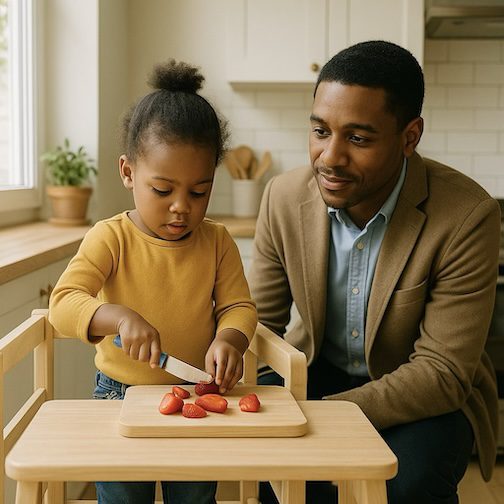
Father and daughter

Many parents ask, “I can’t do it all—what should I never skip?” It’s a question that comes from a very real place. Life with young children is full, messy, and unpredictable. Between work, meals, laundry, and the emotional rollercoaster of toddlerhood, even the most well-intentioned parents can feel overwhelmed. Montessori may sound ideal in theory—but how do you begin when you’re just trying to get everyone dressed and out the door?

If you can only do one thing Montessori, let it be this: protect your child’s independence. More than any shelf, material, or routine, it is the child’s growing sense of self-agency that defines the heart of Montessori.

That means stepping back, even when it’s hard. It means letting your child struggle a bit—not in frustration, but in effort. It’s holding back the instinct to swoop in and fix, and instead allowing them to discover that they can do hard things. When a child senses that you trust them to do for themselves, something powerful takes root. They begin to believe in their own ability.

Consider the simple act of getting dressed. A two-year-old trying to put on socks may fumble, get them inside out, or put them on the wrong feet. It would be so much faster to just do it for them. But those few extra minutes of patience are an investment. Over time, the child not only learns the mechanics of dressing—they build confidence. They begin to see themselves as capable.

Or imagine the morning rush before school. You’re trying to get breakfast on the table and lunches packed. Your child wants to help pour their own cereal. You’re tempted to say no—it might spill, it will take longer. But this is where independence is born. Instead of brushing it off, you bring out a small pitcher with milk and a child-sized bowl. You stand close, just in case, but you let them pour. If it spills, you clean it up together. And then you see it—that proud little smile that says, “I did it.”

These aren’t just conveniences or chores. These are moments of trust, of growth, and of identity. The child isn’t helping—they’re participating. They are learning that they matter, that they are part of the family, and that they have the power to contribute.

Montessori reminds us that true independence is not just about doing things on your own—it’s about developing the executive function skills that make that possible. When children are allowed to choose their clothes, prepare a snack, or water the plants, they’re practicing planning, focus, self-control, and problem-solving. These skills form the foundation not only for academic success but for life.

Independence also transforms the parent-child relationship. Instead of being locked in constant correction, you become a guide and a partner. You begin to notice more. You step back, observe, and let your child lead. And in doing so, you create space for connection that isn’t based on control, but on mutual respect.

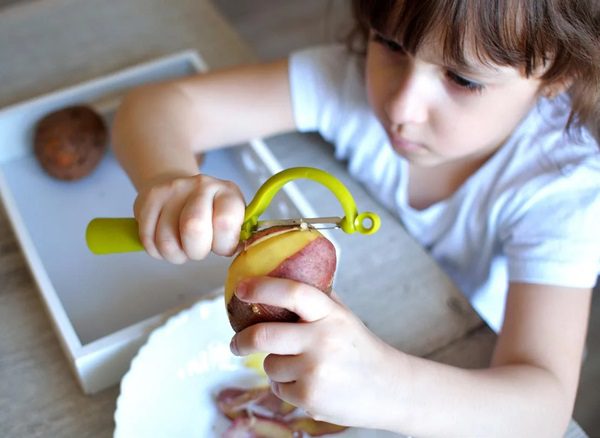
This approach doesn’t require special tools or a perfect home environment. It starts with noticing your child’s desire to do things for themselves—and saying yes more often. Yes, you may carry your plate to the sink. Yes, you may put your shoes on, even if they’re on the wrong feet. Yes, you may help stir the pancake batter, even if it’s a bit messy.

Every time you say yes, you’re saying something deeper: I see you. I trust you. You are capable.

This isn’t about letting children run wild or do whatever they want. Montessori is built on the idea of freedom within limits. We prepare the environment, set clear expectations, and then step back. We create spaces that invite independe nce and make it safe to explore. We hold boundaries with kindness, and we support children without rescuing them.

So if your days feel rushed, if you’re not sure where to start with Montessori, start here. Create a little time and space for your child to try things on their own. Resist the urge to jump in. Celebrate effort over perfection. And above all, let your child know—again and again—that you believe in their capabilities.

Because when a child knows they are trusted, they begin to trust themselves. And that, more than anything else, is what Montessori is all about.

The Benefits of Your Toddler Moving into the Primary Level

The Benefits of Your Toddler Moving into the Primary Level

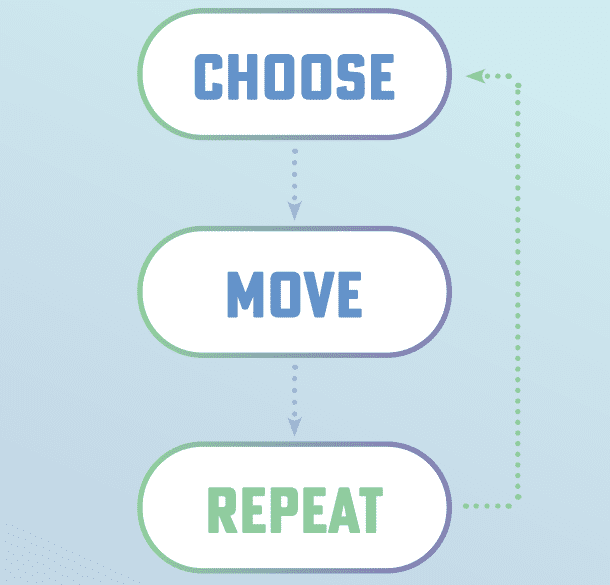
Choose. Move. Repeat.

Choose. Move. Repeat.

These three words can guide your choices as a parent of a young child.

You make choices based on what you believe to be best for your child and family. These choices may be based on emotion, assumptions, or exasperation. I encourage you to consider making your decisions based on a system you know can work.

When you can create a system for yourself in your decision making for your children, you may find that you have better, less-stressful outcomes and more confidence as a parent.

Although all situations and families are different, many of the choices you make as a parent in a day can go back to these three words: Choose. Move. Repeat.

These are the three freedoms that Dr. Maria Montessori provided for in her first classroom and are still part of every authentic Montessori environment (whether home or school).

The freedom to choose.

The freedom to move.

And the freedom to repeat .

Within a classroom, this may seem easy, but what does this mean as a parent?

I recommend that as a parent, when faced with making a decision about What’s for dinner? Do we go to the park or on a walk? or Will you wear a blue or green hat? you come back to these three freedoms.

Ask yourself: How can I offer my child choice in this situation?

For example, if it is dinner, can he choose between carrots or green beans?

Then ask, How can my child have the freedom to move in this situation?

You can offer your child freedom of movement with dinner is by inviting them to help set the table or wash the carrots?

Whenever you incorporate movement into a task, you help children connect and learn. Children need to move to learn and can get very frustrated when expected to be still.

The next question you can ask is: What part of this can we repeat?

Well, when it comes to dinner, I suggest just one dinner (Ha!). You can think about what are the repetitions within the dinner? When setting the table, how many place settings are needed? When washing the carrots, how many carrots need to be washed? Then how can this become a daily activity? Can you repeat this multiple times a week? Can your child come to count on this as a predictable routine?

Choose, move, repeat. These three words can be a system and checklist for parents while bringing consistency, predictability, and routine to your days. They are the three words that can create harmony in your busy family life.

Sarah Moudry (@sarahmoudry) is an education innovator whose work is focused on creating education environments and experiences that inspire growth and joy. Her work is rooted in Montessori philosophy and paired with her extensive experience as a designer.

Recently, her projects included the founding of StudioJune (@thestudiojune), a Montessori parent and child education center, and Family Friendly Home (@familyfriendlyhome), an interior design company that creates inspirational home and school interiors.

Sarah is the author of books and online courses that help parents, childcare professionals, and grandparents to incorporate Montessori practice into their lives. She has an M.Ed in Montessori education, a B.S. in environment and design, AMI Montessori certification for birth to six years, and is an Associate Member of ASID.

The Progression of Left to Right in Montessori Language Development

The Progression of Left to Right in Montessori Language Development

The Montessori Method, developed by Dr. Maria Montessori, is renowned for its child-centered approach to education. Within the Montessori classroom, language development plays a crucial role in nurturing a child’s ability to communicate effectively. While the Montessori Method itself is adaptable to various writing systems and cultural contexts, it often incorporates a left-to-right progression in language activities and materials. This article explores the reasons behind the left-to-right progression in Montessori language development, provides examples of materials used in the classroom, and highlights research insights on this topic.

The Importance of Left-to-Right Progression: The left-to-right progression is a convention followed in many languages for reading and writing. Introducing children to language and literacy skills in a manner that aligns with this convention can facilitate their understanding of written texts and prepare them for independent reading and writing. By incorporating left-to-right progression in language activities, Montessori educators create an environment that not only supports language development but also prepares children for successful literacy experiences beyond the classroom. The consistent use of this convention helps children build essential cognitive and linguistic skills, fostering their ability to read, write, and engage with written language effectively.

Examples of Materials and Activities in Montessori Language Development

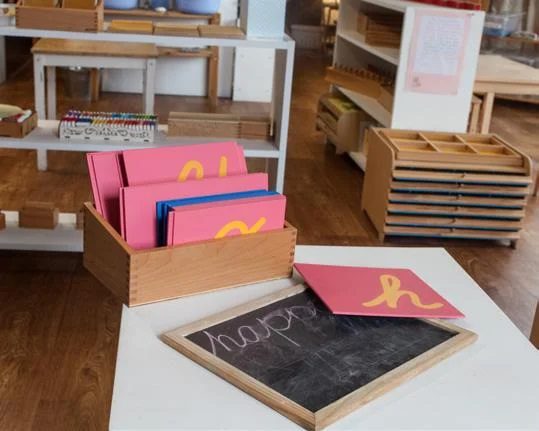
Sandpaper Letters: Sandpaper Letters are tactile materials with textured letters mounted on wooden boards. Children trace the shape of each letter with their fingers while simultaneously associating the sound with the symbol. These letters are typically arranged from left to right, reinforcing the directionality of writing.

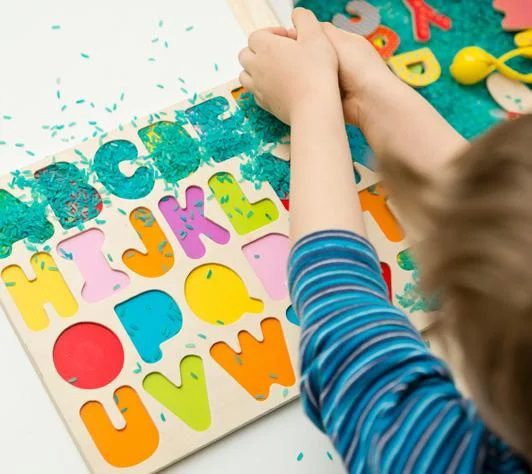
Moveable Alphabet: The Moveable Alphabet is a set of individual letters, often made of wood or plastic, that children can manipulate to form words. Children choose letters and arrange them from left to right to represent the sounds they hear in words. This activity aligns with the left-to-right progression of writing in many languages.

Reading Books: Montessori classrooms include a variety of books at different reading levels. As children progress in their reading abilities, they are encouraged to read from left to right, following the conventional reading direction. Teachers provide guidance and support as children navigate the pages and sentences.

Research Insights: While specific research articles linking Montessori materials with left-to-right progression in language development are limited, studies have highlighted the effectiveness of the Montessori method in enhancing early literacy skills. Research by Lillard and Else-Quest (2006) found that children in Montessori programs showed higher levels of phonological awareness, letter recognition, and early reading skills compared to non-Montessori peers. Furthermore, studies by Rathunde and Csikszentmihalyi (2005) and Dohrmann et al. (2007) indicated that Montessori education fosters independent reading and writing skills, with children developing a sense of confidence and engagement in their language abilities. Introducing children to language and literacy skills in a manner that reflects this convention has several important benefits: alignment with reading and writing conventions; cognitive organization; structure preparation for independent reading; and writing consistency and familiarity.

Conclusion: While the Montessori Method itself is adaptable to different writing systems and languages, it often incorporates a left-to-right progression in language development activities and materials. The use of materials, such as Sandpaper Letters, Moveable Alphabets, and reading books, supports the natural progression of reading and writing skills in many cultures. While further research specifically linking Montessori materials to left-to-right progression is limited (as mentioned earlier in this article), existing studies demonstrate the effectiveness of the Montessori Method in promoting early literacy skills and independent language exploration in children.

Overall, the left-to-right progression in Montessori language development aligns with the conventions followed in many languages, providing children with a solid foundation for future reading and writing skills. By understanding and practicing this natural flow of language, children are equipped with the tools to navigate and comprehend the written world around them.

References

Lillard, A. S., & Else-Quest, N. (2006). Evaluating Montessori Education. Science, 313(5795), 1893-1894. Rathunde, K., & Csikszentmihalyi, M. (2005). Middle school students’ motivation and quality of experience: A comparison of Montessori and traditional school environments. American Journal of Education, 111(3), 341-371. Dohrmann, K. R., Nishida, T. K., Gartner, A., Lipsky, D. K., Grimm, K. J., & Bugental, D. B. (2007). High school outcomes for students in a public Montessori program. Journal of Research in Childhood Education, 22(2), 205-217.

Aradhna Dhawan is a certified Montessori Educator 3-6. Eager to expand her knowledge, refine her skills, and create a prepared environment that fosters independence, critical thinking, and a love for learning. Through this pursuit, Aradhnah is currently pursuing AMI Elementary Diploma 6-12 and AMI School Leadership Certificate.

What to Look for in Montessori Schools

What to Look for in Montessori Schools

Motivated to Grow: The Child’s Passion for Work

Motivated to Grow: The Child’s Passion for Work

Independent work begins with choice, and choice is a necessary work element for self-development.

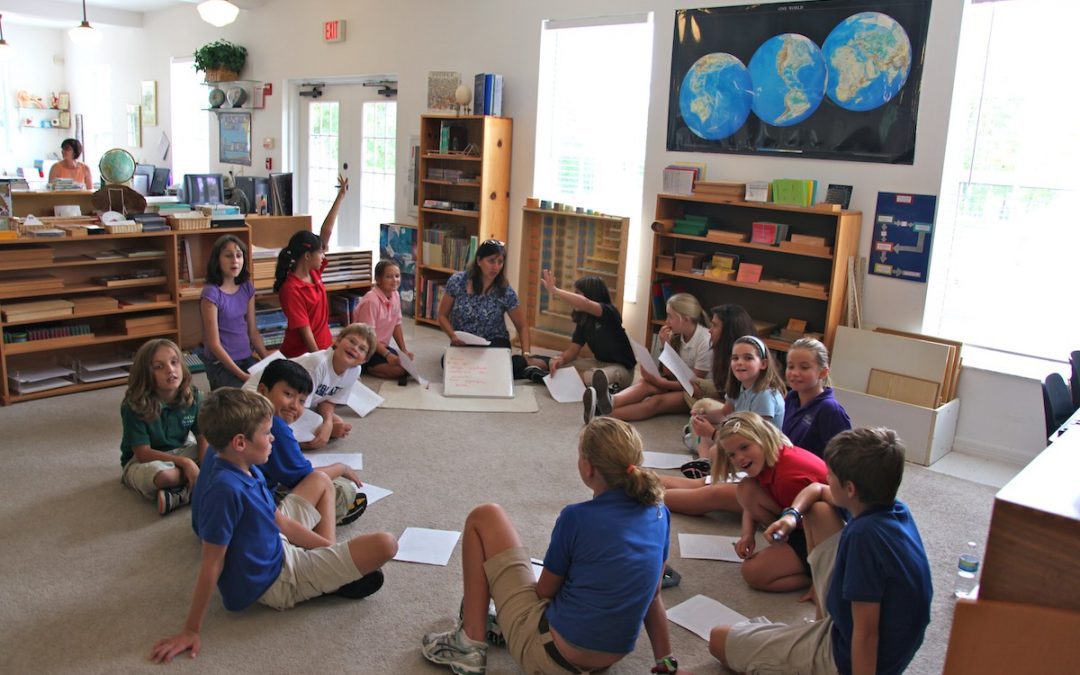
Look in a Montessori classroom with twenty or more very busy children between the ages of almost three and six, and you will see children who are passionate about their work. They are focused, self-directed, and persistent. Three-year-old John cuts an apple and then shares apple slices with his friends. Four-year-old Peter traces metal shapes with colored pencils. Five-year-old Sara counts colored wooden squares and then writes numerals on a math paper. When children work with passion, they are curious, creative, inquisitive, imaginative, constructive, thoughtful, orderly, and more. Children love to work. This is how they grow.

Children’s “work” has many meanings.

In a Montessori setting, the word “work” conveys several meanings. Work identifies a learning activity. For example, a food preparation work, a writing work, or a math work. When a child uses a learning activity, he may say, “This is my work.”

Work activities occur during the “work period.” The classroom schedule may include a 2 ½ to 3 hour morning work period. The schedule may also include a shorter afternoon work period. During the work period, children may choose work that is for one child; other works may be used by two or more children. Some works are designed to be used on a table. Other work is used on a floor. Before bringing it to the floor, children will unroll a work rug. The work rug assists the young child with keeping the learning objects together on the rug. The work rug also announces to the other children, “Please walk around my work.”

“Work” also describes a child’s responsibilities for taking care of the work materials. It can happen that a child finishes her work, and then she may decide to go to the shelf and choose another work, another learning activity. The teacher will offer the child a gentle reminder, “Please put your work away before you choose another work.”

Children’s work has both practical and developmental purpose.

“Work” refers to the practical purpose found in each learning activity. For example, a child works with the subtraction strip board and learns a subtraction process. Another child works with the bow-tying dressing frame and learns a bow-tying process. Work has yet another meaning. The child’s process of self-development is also called work. For this reason, we do not interrupt children when they work. They are developing their potential within themselves. The work of the child is to become an adult.

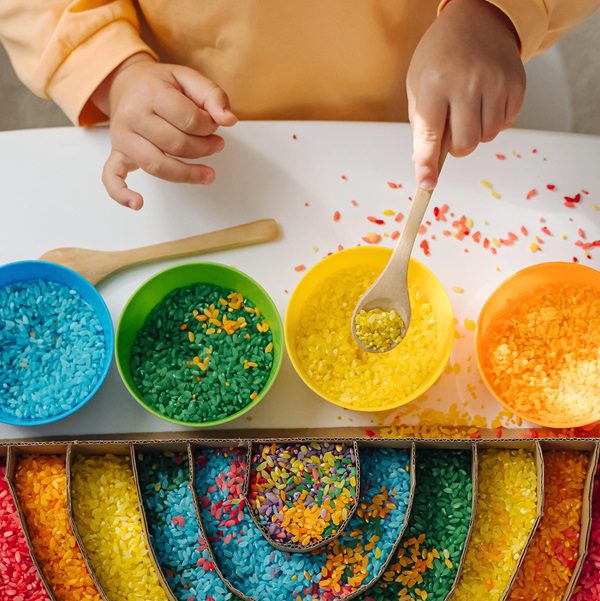
For example, three-year-old Martha transfers dried beans from one bowl to a second with a wooden tong. The practical purpose for this work is to learn to use tongs. The developmental purpose is to learn to concentrate and strengthen and develop hand coordination, a necessary preparation for learning to write when she is older.

Children’s work has several more characteristics.

Several more characteristics describe children engaged in purposeful, self-development work. Children will work independently from others. They become absorbed and concentrate for long periods of time. Children will use learning activities with tremendous repetition; they complete a work task, and then they do it all over again. And they are not concerned about making mistakes; mistakes are children’s recipes for learning.

Children make independent choices when they work.

Remarkably, young children are compelled to engage in activities by themselves. They are not directed by teachers. In the Montessori classroom, a teacher will not do anything for children if they are ready for us to show them how to do it themselves.

Independent work begins with choice, and choice is a necessary work element for self-development. When children make independent choices, they learn to become self-directed and self-disciplined. Children choose their own work. Each child will also choose how to use it and how long to use it. When children choose their own work, they are choosing what they need for their growth and development. They choose what they need to develop their unique potential. Consequently, no two children learn at the same time or in the same way, and each child will only learn when she is ready.

Children who are independent can choose their own work and work with concentration. They can persist, overcome challenges, and self-correct. They have developed habits of learning.

Children develop understanding when they work.

Work with the Montessori materials assists children with developing conceptual understanding. For example, size is an abstract concept. If young children could reason and learn solely with language, we could tell them the meaning of size, and they would understand. Instead, young children are perceptual learners. Young children learn with their senses (sight, sound, touch, taste, and smell) and from what they can do with objects.

Perceptual learners “think” with objects. They understand concepts by arranging and comparing objects. Something is rough because it is not smooth. Something is sweet because it is not sour.

For example, four-year-old Martin arranges a set of ten wooden rods. A practical purpose for this material is to understand length. Each rod is painted in the same red color. The shortest red rod is 10 cm. long; the next is 20 cm. long; and the next rods progress in length by ten more centimeters to the longest red rod which is 100 cm. or 1 meter long. Martin places the red rods randomly on his work rug. He then places two rods side-by-side, compares their lengths, and in this way arranges all ten rods from shortest to longest. Martin now mixes the rods and sorts them by length again. Martin repeats his work with the red rods six times.

Children prefer the process of work and not results.

Children are not result oriented. They are, instead, process oriented, and they are compelled to work with repetition. Children may prefer process because they are not interested in perfection. Perfection is a final state; there is no further growth after becoming perfect. The child’s purpose is to develop his or her unlimited potential, and repetition is how they do this.

For example, two-year-old Beth has been working with an apron for about ten minutes. She puts it on over her head, and then she takes it off. She looks at the apron, turns it sideways, and then puts it on over her head. And then takes it off, and then puts it back on. At any moment an adult could help Beth, but Beth does not ask for help. Apparently, she is not interested in wearing the apron. Beth’s choice is developmental. She is purposefully practicing putting it on and taking it off.

Three-year-old Tommy picks up a pitcher containing red-colored water. Tommy places a funnel into an empty jar, he pours the colored water into the funnel and watches the water drain into the jar. Now he places the funnel into a second jar, pours water into the funnel, and again watches the water drain. Some water spills onto the table. He places the pitcher on the table, picks up a small sponge, wipes the water spill, and squeezes the sponge into the pitcher. He now pours the jar water back into the pitcher. Then he does it all over again, and then again. Tommy busies himself for some 25 minutes with this activity. Sometimes he pours slowly, sometimes quickly, sometimes with the funnel, and sometimes without. The practical purpose of this work is to learn to pour liquids through a funnel and to decide to stop pouring when the jars are filled. The developmental purpose is to develop coordination, concentrate, and make judgments.

Children develop both practical skills and satisfy developmental purposes from repetition and practice. They develop their abilities to concentrate, observe, compare, make decisions, innovate, and more. For example, four-year-old Michelle has been sorting and building with 27 colored blocks already for 15 minutes. The colored blocks make up ten different combinations of sizes and colors. When put together, the blocks form a trinomial cube. Michelle is absorbed. She sorts the blocks by sizes and colors, builds the cube, and then takes it apart. Then she builds the cube all over again, each time beginning with a different block. Perhaps she is fascinated with the size and color patterns; perhaps she is fascinated with how these blocks always come together and form a cube.

Children’s work includes making many mistakes.

Children are mistake oriented; they are not afraid to make many, many mistakes. We should celebrate the necessity of making mistakes because this is how children learn. Their work process is to explore, investigate, make mistakes, discover, and then do It again. For example, learning to pour requires developing eye and hand coordination that prevents spilling. Learning to spell requires developing writing coordination and knowledge of English phonemes that prevent writing pear as pair or writing see as sea.

The Montessori learning materials are designed to guide children to learn to recognize and then self-correct their mistakes. For example, Tammy works with the Knobbed Cylinder Block. The purpose of this material is to learn about size and to develop the ability to reason and make judgments. There are ten cylinders in the block. The ten cylinders are the same length, and they differ in diameter. Each cylinder fits exactly into one hole in the block. Tammy takes out each cylinder and then puts them back into the block. Sometimes she puts cylinders in the wrong places — the cylinders do not fit into the wrong places. Once the cylinders are properly returned, she repeats and does it all over again. Some children will repeat this work process 15, 20, or more times.

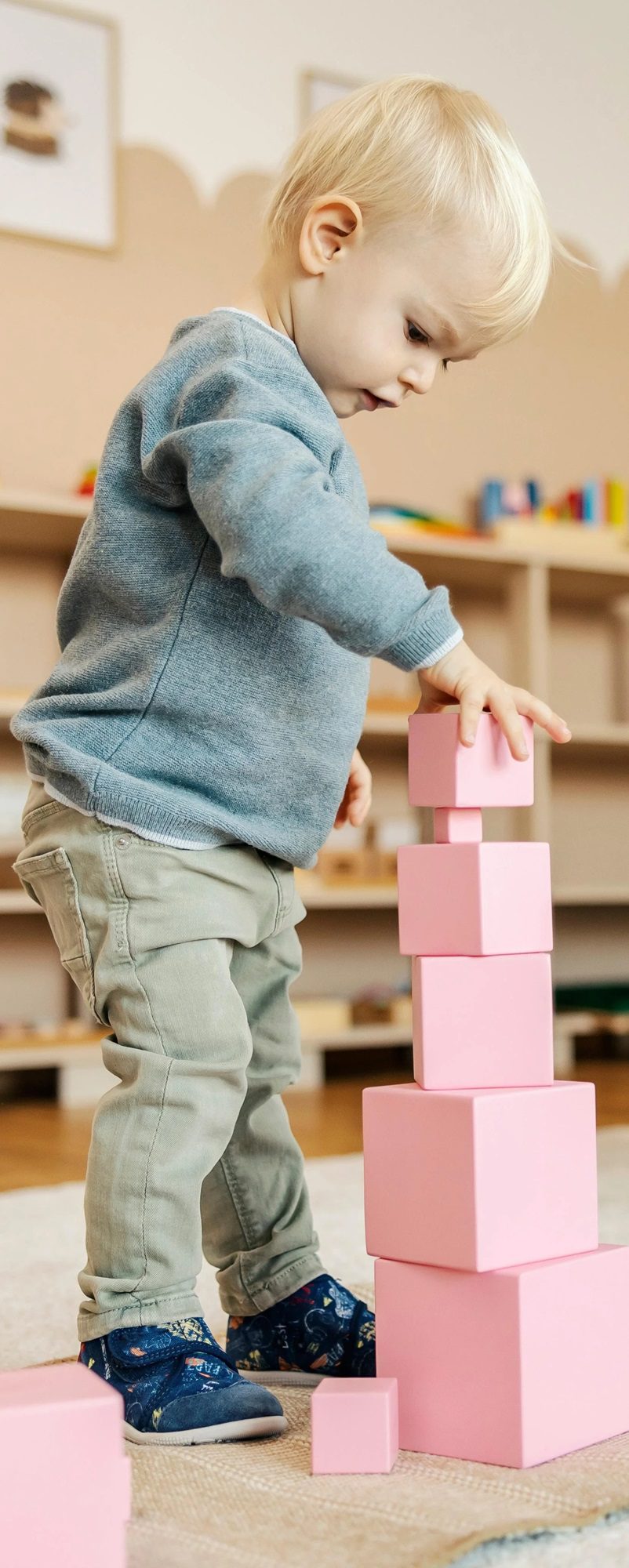
Erin builds a block tower, and the tower falls. She tries again, and she stacks the blocks in a different way. The tower falls again. From these building mistakes, Erin gains valuable experiential knowledge about cause and effect, balance, creative problem solving, and the value of learning from trial and error. This work is called the Pink Tower. This is a set of ten cubes, and the cubes are painted in an identical pink color. The cubes are not the same size. They are graded in size from 1 cm3 to 10 cm3. The purpose of this work is for the child to develop an understanding of size. Children develop this understanding with their senses. They hold and see each cube, compare the sizes and weights of each cube, and arrange the cubes in order from largest to smallest or from smallest to largest.

When children work, their repetition guides them to learn how to self-correct. Although the cubes differ in size, the child may place some of the cubes in the wrong size order. Should this happen, the teacher will merely observe and patiently wait and see what the child will do next. Will the child notice the sequence of cubes is not in a size order? Will the child self-correct and rearrange the cubes?

Children’s work differs from adults’ work.

Remarkably, work does not tire children. Instead, they become energized from engaging in work they have chosen. Adults, of course, also work, and we also develop ourselves from our work. For example, we go to the gym and “workout.” We can work to master some knowledge and skills and better ourselves. We also work to produce results. We often work efficiently and effectively to produce the most results we can, in the least amount of time, and with the least amount of effort. We love results, and we feel satisfied when we check it off the list. We adults are motivated to work for intrinsic and extrinsic rewards. We work out at the gym for the benefit of health and strength. And we may work at work for the benefit of a salary.

Children work for the benefit of growing up and becoming adults, and they do this without a contract or promise of salary in exchange for their time and the value they produce. When young children finish an activity, they do not check it off a list. Instead, they may do their work all over again. Children’s work often lacks efficiency and effectiveness. They may make unpredictable movements, and they may make many messes. Unlike an adult, young children do not work with minimal effort. They are “all in!” They love to work! Dr. Maria Montessori described a child’s work process:

[The] child has a personality which he is seeking to expand; he has initiative, he chooses his own work, persists in it, changes it according to his inner needs; he does not shirk effort, he rather goes in search of it, and with great joy overcomes obstacles within his capacity. (Dr. Montessori’s Own Handbook, pp.77- 78.)

For children, work is a continuous process of self-development, and children must work to develop everything: their personalities and walking, running, climbing; understanding and speaking language; socializing and expressing emotions; reasoning and creating; overcoming obstacles and persisting; solving problems, being creative, and more.

Children passionately engage in work because they are passionate to grow and become themselves. When they work, they are scientists, filled with wonder and curiosity. They are intent on investigating the world and developing themselves. They are not afraid to experiment and see what will happen when they try this and then that. For children, it’s all in a day’s work. 

Paul Epstein is the educational director of Designs for Lifelong Learning. He has worked in education as an administrator, university professor, teacher trainer, classroom teacher, researcher, consultant, and author.

Paul brings transformative learning experiences to educators and parents throughout the world. He is the author of numerous articles and books including An Observer’s Notebook: Learning from Children with the Observation C.O.R.E. He is also the co-author of The 60-Day Montessori Observation Workbook and The Montessori Way, a definitive work on the Montessori experience.

His administrative experiences include working as a head of Montessori schools, and he brought the International Baccalaureate Middle Years Program to one of the schools. Paul also works as a director and instructor of Montessori teacher education programs. He has been a Montessori classroom teacher in Montessori early childhood, middle, and high school programs.

Paul holds Montessori teacher certification in early childhood and secondary levels one and two from the American Montessori Society and his doctorate is in Cultural Anthropology.

In Pursuit of the Correct Answer: The Role of Process and Discovery in Montessori

In Pursuit of the Correct Answer: The Role of Process and Discovery in Montessori

Changing our View of Education: A Positive Approach

The positive nature of the Montessori approach, with its emphasis on process and discovery, is central to why it works so well for children in their development. When Dr. Montessori lectured in London in 1946, she pointed out that conventional education focuses on mistakes.

Think of your own experiences and how your schooling was structured; you will probably remember that there was constant attention given to your errors. Avoiding errors was the thrust of the system. Even with a few enlightened, kind teachers here and there, who emphasized process and exploring bravely, the main message for how you were to learn things was by having your mistakes pointed out to you daily in the form of testing, performing in front of classmates, and reaching for the one “correct” answer to each question. This emphasis, by design, encourages children to lose confidence in their originality. And, yet, we know that developing unique perspectives is invaluable. Thus, the very thing that makes society prosper is being discouraged on a daily basis in our conventional school model.

You may be wondering how there could be another way to teach, when there are certain areas in life where there really is just one correct answer. Mathematics and science are not a matter of opinion, for instance. There are facts that children must learn in order to succeed in some areas. Which is more important: the process, which leaves room for originality, or the answer, which must be consistent with the truth? The answer is both, and Montessori’s approach allows for this interesting dynamic to play out in the classroom, as it does in real science laboratories and in sophisticated math discussions. Dr. Montessori discovered that there is an alternative way that children learn about exact answers.

Montessori’s view was that there is exactness in mathematics and science, which gives our universe balance and beautiful symmetry. Realizing this is truly awe-inspiring for children! But instead of having this phenomenon of exactitude dominate the whole educational approach (by trying to stuff answers into children’s minds), Montessori sought to awaken their wonder for exploration and to help children discover pathways of thinking that lead to correct answers. A prime example of this is the way elementary-aged children explore math through the specially designed materials that require several steps and attention to detail. The children ultimately arrive at the correct answer and are often quite satisfied with themselves after much effort; all the while, they are developing cognitive processes and character traits that contribute to future learning and problem solving.

…the very thing that makes society prosper is being discouraged on a daily basis in our conventional school model.

Discovery and Ownership

Through the materials and how they are presented by the trained teacher, Montessori children in an Elementary classroom search for the paths to find the true answers; when they get there, the results are their own discovery, just as if they were the first mathematicians to discover them. The result of this repeated experience makes children view mathematics as the wonderful puzzle that it is. The idea of being embarrassed at arriving at an incorrect answer is foreign to these children, for whom the taste of finding the right answer is so sweet that they want to explore other avenues and learn more. Mistakes are integral steps in every journey, and this reality becomes familiar and acceptable through repeated experience.

The Montessori materials guide children to find the ways that work, making the adult corrector obsolete in many cases. For instance, when two children do long division problems together with a material called Racks and Tubes, there are many places they might err. They could start off incorrectly by placing the tens board to the right of the units and work through the whole problem incorrectly, only to find at the end that their answer is incorrect (either by bringing it to an older friend who can do the problem longhand on paper, to the teacher who can check it, by using another math material to do the inverse problem and see if it matches, or by checking it themselves against a calculator).

They go back to their work—puzzled—and like two detectives, they re-examine how they set up the problem (which is often when they will identify this first mistake), or they employ a friend to see if they can identify where they may have lost the path. In my experience as a Montessori Elementary teacher, this is when the fun really begins if the adult supports an attitude of curiosity about finding the error.

Children will repeat a problem over and over, sometimes eliminating just one of several mistakes at a time in the same math equation or process. The important thing is for the teacher and community to support the quest to get to the end, so that the children do not fall into a habit of giving up too easily or repeat making the same mistake so many times that it gets ingrained! By keeping tabs on their progress, the teacher can see when to step in and point children in the right direction, perhaps making an observation and/or asking a question: “Oh! Wait, I see—look where your units board is. Do you remember where it belongs?” This is usually all that is needed to get an “Ah-ha!” and a delighted, re-energized effort to try the whole thing again. Children are remarkably resilient, especially when working with a friend and being allowed to own the whole process of the math equation. When they finally, leaning over the calculator with suspense, find that they have achieved the correct answer by their own efforts, it is an excited triumph that feeds the urge to tackle more and more problems.

Very rarely have I seen children want to get to the answer easily so they can quit. There are some who will be tempted to use a calculator to find the answer and just write it in, sometimes several times, to create the illusion that they have accomplished a lot of “work.” You may be surprised to hear that in a Montessori environment, that is the exception and not the norm. Teachers usually catch that pretty quickly, but even if they didn’t, and even if other children did not point to it and demand that the child work honestly and just as hard as them, the child who does this often abandons the practice after watching others glean the internal rewards of sustained efforts and true glory of finally getting that answer.

As children experience this quest again and again, they hone their skills each time. Eventually, the exercise becomes too easy for them, and they are ready to advance to another math process that brings them to their next level of challenge.

Developing Persistence

To describe all the ways children might error in the process of long division with Racks and Tubes would take too long here, but I’ll give you a sense: One child may write the problem down differently than their companion and, therefore, lay out some incorrect amounts when distributing the beads to be used (a mere flipping of two numbers, perhaps). This carelessness will eventually be discovered, and both children will realize the importance of double-checking with each other before they begin. They also might place the working number of beads in the wrong category or confuse the order of the categories (units, tens, hundreds, etc). Again, these are mistakes that reflect the need to double-check their layout before they begin the process.

Another place they may err is in physically dropping a bead or beads, losing them as they spring across the floor and losing count of how many were in the bowl to be distributed. This reminds them to slow down, be careful, and focus on their physical movements. They could also lose count or forget a step if they are interrupted by conversation or stop what they are doing to attend to something else in the middle of their process. This would illustrate the importance of sustaining their focus on the task at hand until finished. Finally, they might write the numbers down in the wrong order at the end, showing again a need for more careful, focused attention and awareness.

Montessori teachers tend to inspire a sense of wonder and nurture children’s curiosity and imagination.

Sometimes, two children have two different answers written down, and they’ll be perplexed about which one is correct, garnering more discussion and a backtracking of their steps. Watching all this is incredible; the amount of teamwork, social interaction, struggle, humor, fun, and agony that can accompany such a process as doing long division is positively brilliant in the sense of integrating all aspects of a child’s development as a person and a mathematician.

For a Montessori teacher, bearing witness to such self-discoveries is joyful. It is a special experience to spend one’s days in an Elementary Montessori classroom with children working with the Racks and Tubes! It can take more than an hour for children to complete a challenging problem (if you account for the self-correcting, they may need to do), but the learning that occurs is immeasurable. And the more children work with such processes, the faster they achieve success each time, fueling their desire to tackle more challenges all over the classroom.

This is just one example of how Montessori fuels the development of children’s resilience and perseverance in a very direct and effective way. And because a Montessori classroom is a vibrant community where everyone is working simultaneously on different things and seeing what others are doing, the practice of pushing oneself until achieving success is contagious. Children will stop and help each other, discuss, and share a conundrum, and sometimes get intrigued with each other’s experiences of learning. The learning is, therefore (in economic terms), a positive externality, meaning that the network of students spreads newfound information via witnessing and sharing experiences; this happens naturally in a Montessori Elementary classroom because of children’s gregarious social behavior at these ages. This is another example of where Dr. Montessori designed an approach that employs (rather than fights against) the developmental characteristics of children in this stage of life between ages six and twelve, specifically, their tendency to be very social and to always want to find out what their peers are doing.

In the above example, students may use the mantras they learned in their Primary years (ages five and six), such as “The units always go on the RIGHT” and “We always begin with the UNITS” (“except in division, when we begin with the highest category present”). Students love these little cues, and when the Primary teacher says them each time, she is with children in a math presentation, the children often chant along. There are just a few such mantras that carry over from Primary to Elementary, so children tend to remember these. We have found that children benefit from having such important points of interest brought to their attention regularly, so that they can commit them to memory.

When working on math and science, the children in a Montessori classroom don’t just value the exactness of a true answer; they love that there are answers to find, and they see each exact answer as a part that connects to a greater whole, creating a universal balance in which each component matters. With the Montessori approach (where the processes of discovery appeal to our children’s developmental characteristics at each age), finding correct answers is fun, sometimes eventful, and always intrinsically rewarding.

Paula Lillard Preschlack is a writer and a speaker. She has spent 25 years as a teacher and the head of school at Forest Bluff School. She just released her first book about Montessori education, The Montessori Potential. Paula Preschlack has given over 100 talks at Forest Buff School and at other Montessori schools, teacher training courses, and conferences. Her work focuses on the principles and successes of the Montessori approach, learned from over 25 years of teaching and observing children from birth to adulthood.

Paula is a graduate of Hampshire College and has a master’s degree in education from Loyola University, Baltimore, MD. She is AMI certified for all Montessori age levels: Assistants to Infancy, Primary, and Elementary, and she audited the NAMTA/AMI Orientation to Adolescent Studies in 2018.