To access this page, you will need to log in or become a member.
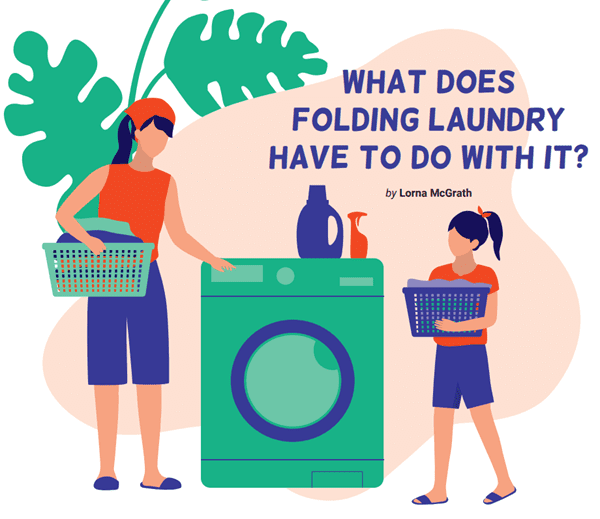
What Does the Laundry Have to Do with it?

What Does the Laundry Have to Do with it?

Practical Life is a fundamental part of the Montessori curriculum. Dr. Maria Montessori wrote, “Education should not just be preparation for university, but preparation for life.” We want our children to have the skills and knowledge to function very well independently: capable of caring for themselves and their environments; knowing how to behave in a manner that will lead them to success in all aspects of their personal, educational, and professional lives. Our responsibility as parents is to help them to be ready for successful, independent living.

In Montessori classrooms, at every level from toddlers to young adults we divide Practical Life into the following areas: Care of Oneself; Care of One’s Environment; Food Preparation; and Grace and Courtesy. Just as at every level in our classrooms children become more and more abstract thinkers and have less need of pre-made materials to demonstrate skills and concepts, so a similar evolution occurs in our homes.

In the early years children work with activities, all very neatly ordered and on the shelves. The activities are specifically designed for them to learn all sorts of Practical Life skills, such as dishwashing; preparing for their own snack; using utensils; and resolving conflicts using their words. The Practical Life area is quite obvious in a Toddler or Early Childhood classroom. In the Elementary years practical life materials are not always designated to an area or grouping of shelves. They tend to be placed around the indoor and outdoor environments where they can be accessed when needed. For example, you may find them in a garden shed, a kitchen area, or at a workbench with cabinets for tools. At the Adolescent level students may be helping with projects in the larger community such as Habitat for Humanity; traveling across town to the public library or the local college to do research; writing their resume and cover letters to set up internships for themselves in local businesses; or designing costumes for a performance.
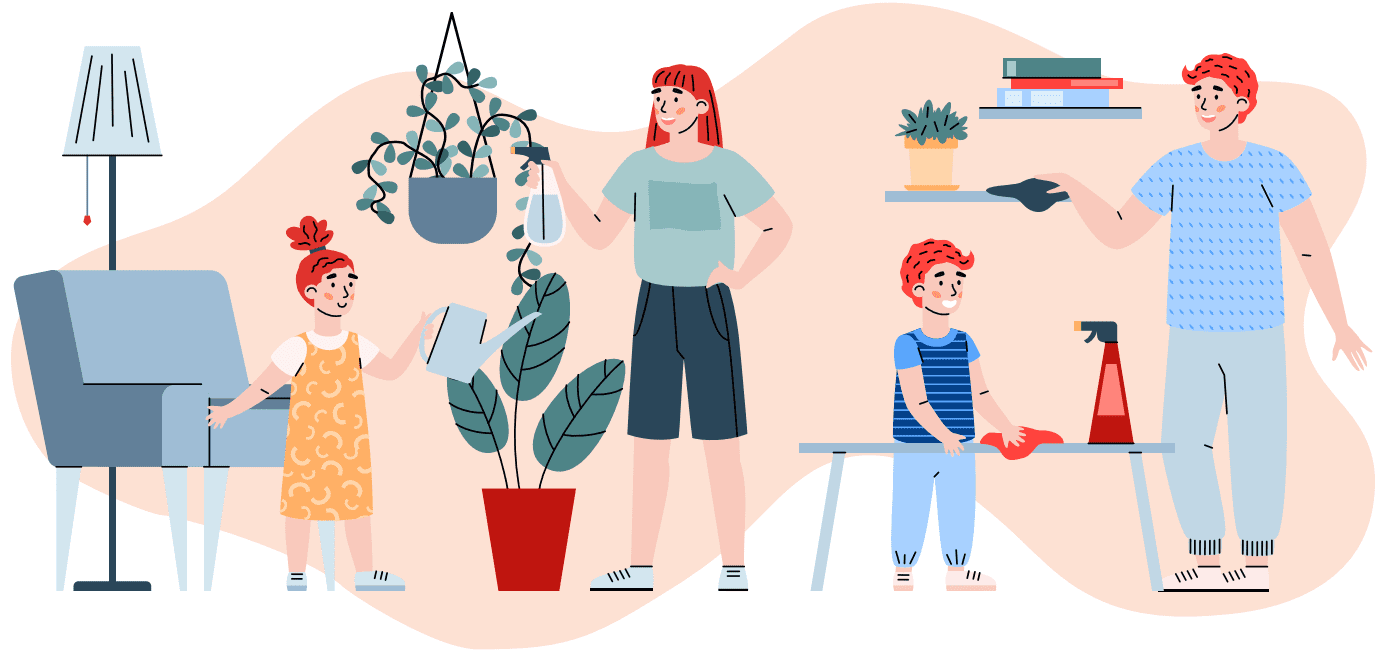
Throughout their home and school years these kinds of activities are important because they have dual purposes within each activity. The obvious purpose is the skill that they learn from each activity like how to use a dustpan and brush, how to plan and prepare a meal, how to interrupt politely, how to peel and cut bananas, how to get across town on a bus, or how to fold the laundry, etc. The other purpose is what we like to call the “hidden lessons” which are as, or more important than the actual skill attained. These hidden lessons are independence, order, concentration, and coordination.

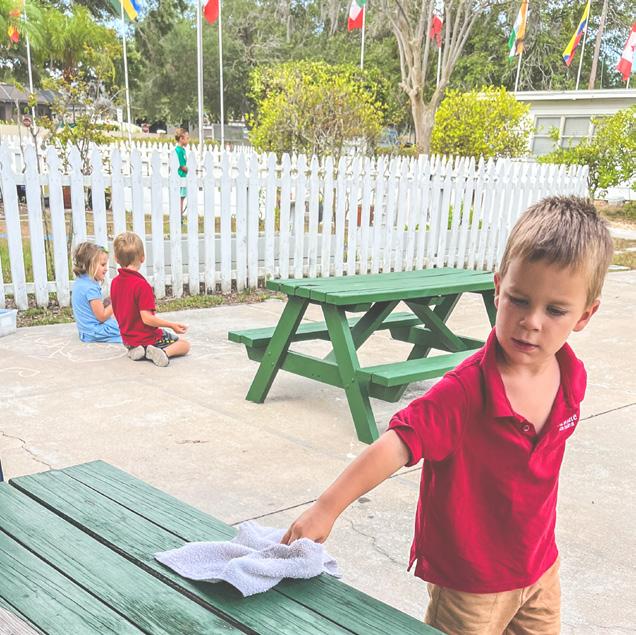
So when we think about folding laundry, and we observe children doing that activity we can easily see that knowing how to fold it helps them to develop a skill that will allow them to be more independent. At the same time, they are learning to sort and categorize laundry items to create order, to pay attention and carefully fold clothing neatly, and to coordinate their hands and minds as they complete the activity. These are essential skills that apply to many aspects of their adult life. The beauty of it is that children do this work throughout their growing years without being conscious of all that they are learning.

So next time your child tells you about folding the laundry at school, or you watch your child folding and putting laundry away at home, notice the sparkle in their eye and the pride in their work that your children have when they participate in these everyday activities. 

The child who has felt a strong love for his surroundings, and for all living creatures, who has discovered joy and enthusiasm in work, gives us reason to hope that humanity can develop in a new direction.

Maria Montessori

Here are some of the activities for home and school, at each level of development.

Toddler Level

  • Dressing and undressing oneself
  • Feeding oneself
  • Toileting oneself
  • Saying hello and good-bye
  • Sharing
  • Cleaning up spills
  • Putting work away
  • Washing hands and bathing oneself

Primary Level

  • Sewing
  • Hand Washing
  • Dressing and undressing oneself
  • Preparing snacks and appetizers
  • Baking
  • Following simple recipes
  • Manners
  • Watering plants
  • Arranging flowers
  • Sweeping the floor
  • Washing dishes
  • Folding laundry
  • Gardening
  • Woodworking
  • Conflict resolution
  • Greeting and welcoming guests
  • Doing Laundry
  • Making the bed

Elementary Level

  • Preparing more complex recipes

  • Planning and preparing family meals

  • Writing invitations and thank you’s

  • Choosing appropriate clothing for different occasions

  • Telephone and texting manners

  • Running a business

  • Gardening

  • Managing money

  • Greeting and welcoming guests

  • Introducing people and oneself

  • Conflict resolution

  • Participating in team activities

  • Understanding rules and games

  • Planning “get togethers” and parties

  • Learning to dance

  • Allowances and chores

  • Cleaning and organizing their room

Secondary Level

  • Social networking etiquette and safety

  • Understanding body changes

  • Interacting appropriately with different genders

  • Dressing for the occasion

  • Community service

  • Bank accounts and debit cards

  • Reconciling check books

  • Check writing

  • Mind trust

  • Understanding advertising and it effects

  • Recognizing everyone’s contribution to the whole

  • Using public transportation
What to Look for in Montessori Schools

What to Look for in Montessori Schools

Montessori Education: Into the Adolescent Years!

Montessori Education: Into the Adolescent Years!

What do parents care about in your middle school or high school? How is your program meeting student and parent hopes?

What do parents care about in your middle school or high school? How is your program meeting student and parent hopes?

How to Engage Productively in Your Child’s Education

How to Engage Productively in Your Child’s Education

Where Are You on Your Montessori Parent Journey?

Where Are You on Your Montessori Parent Journey?

Montessori’s Cosmic Curriculum

Montessori’s Cosmic Curriculum

Nurturing Curiosity, Creativity, and Imagination

“Mommy, why are there no more dinosaurs in the world today?” “Where do potatoes come from?” “Why is the sky blue?” If you’re a parent, such questions are a daily dose of wonder, but have you ever really considered how these everyday questions are connected to an expansive concept of the world?

Montessori education prompts children to connect the dots. You might have heard of ‘Cosmic Education’ during parent-teacher meetings or casual Montessori chitchats. Sounds a bit odd, doesn’t it?

At its heart, cosmic education is all about emphasizing the interconnectedness of everything. Dr. Montessori saw science and history as two lenses to view the captivating tale of our universe’s continuous unfolding.

It’s not just a fancy term or a subject in the Montessori curriculum. It’s a holistic approach that blends subjects like astronomy, chemistry, and biology. The aim? To stoke the embers of curiosity in our children and show them the magnificent web of life, where everything has its unique place.

From Potatoes to the Universe: It’s All Connected!

Mario Montessori wrote about his grandmother (Maria Montessori) and the concept of Cosmic Education in his book, Education for Human Development. He reflected on how his grandmother could effortlessly tie present moments to distant past events. Picture this: She’s peeling potatoes and, out of the blue, starts pondering about humankind’s journey of discovering the potato. A simple veggie makes her wonder about ancient civilizations and their agricultural practices!

Her unique gift was to make such connections, laying the groundwork for Cosmic Education. This allowed for merging the past with the present, making everyday activities feel like epic tales.

Think about how peeling potatoes could lead to tales of the potato’s journey from the New World to European dining tables. That’s the Montessori magic!

Swimming with the Salmon: Every Story Has a Lesson

Maria Montessori prompts us to ponder the salmon’s life cycle. These fish are born in freshwater, venture into the vast ocean, and, against all odds, find their way back home. It’s a biology lesson and a narrative of nature’s balance and magic.

Cosmic Education gives such stories context, teaching children the beauty and complexity of our world. Everything has a story and purpose, whether a humble potato or a migrating salmon.

Humans: The Cosmic Contributors

While salmon follow nature’s script, we humans can write our own. We can reach for the stars or recklessly consume our planet’s resources. Montessori’s Cosmic Education emphasizes our unique cosmic task: to cherish and protect our home.

More than Just School Lessons

Montessori’s Cosmic Education is more than just school lessons; it’s a philosophy. It’s about seeing the bigger picture, understanding our role in the universe, and acting responsibly. Children are not passive vessels to be filled with knowledge; they are young explorers hungry to understand their place in the cosmos.

Traditional education often starts with details, moving from basic concepts to the big picture. But Montessori flips this. Why? Because children are naturally curious about the universe, the stars, and the history of the world.

Once they see the grand tapestry, they’re eager to explore each thread.

For instance, instead of merely teaching kids about plants, Montessori education might start with the story of how the world began. Rather than giving them the right answers, a Montessori teacher will ask students to think about how they imagine our universe might have come to be. Some children may know the story from Genesis. Others may express a simple version of the concept of the Big Bang. Other ideas may include the concept of an oscillating universe that contracts and expands.

Montessori teachers tend to inspire a sense of wonder and nurture children’s curiosity and imagination.

For example, many years ago, we visited Wilmington Montessori School in Delaware to take photos for Tomorrow’s Child magazine. While there, we came across a wonderful lesson presented by one of their Elementary teachers. In a dark room, lit by the repeating flash of a strobe light, he popped a large black weather balloon filled with confetti and glitter, as he told the story of what scientists believe happened with the Big Bang at the beginning of the universe. The expression on the children’s faces, eyes wide and mouths open in surprise, they got a lesson that I am sure they remember to this day.

They were fascinated as their teacher described the concepts of all the atoms rapidly expanding away from the initial point of the Big Bang and swirling out into the distance, gradually forming stars, galaxies, planets, and the universe we know today.

My husband, Tim, is a Montessori educator. He often says that Montessori teachers ask children the right questions rather than give them the right answers.

I know that my children’s teachers offered them lots of information. But I also remember that the teachers didn’t tell them that there was one right answer. Their teachers encouraged them to question and look for alternative possible explanations but to always go to the best sources.

Montessori teachers tend to inspire a sense of wonder and nurture children’s curiosity and imagination.

So, in addition to learning how to read and write, clean a table, fold a napkin, sweep, and use a mop, they come away with some sense of the earth, the dance of the sun and the rain, and how it nurtures life. Once kids see this grand narrative, they’re naturally curious about the details: photosynthesis, the role of roots, and more.

Why Should You Care?

We often lose sight of the bigger picture in today’s fast-paced world, but our children need to grow up with a broader vision, understanding how things work and why they matter. They need to realize that every action, no matter how small, has consequences in this interconnected world.

I’ll never forget the day my four-year-old daughter announced that she had figured out where hamburger came from and refused to ever eat it again. For many years, she was a strict vegetarian, and, forty years later, she still won’t eat meat. A few years later, she was writing the president of the United States and the government of Japan, pleading with them to work together to stop fishing boats from hunting whales. She knew whales were beautiful, intelligent creatures and couldn’t understand how anyone could deliberately kill them. She was an activist then and still is today in her career as a forensic psychologist.

As parents, we aim to prepare our children for tests, careers, and life. We want them to be responsible adults, aware of their impact, and driven by purpose. Montessori’s Cosmic Education lays the foundation for this holistic growth.

So, dive into the story the next time your child asks about potatoes, stars, or the buzzing bee. Connect the dots. The universe is a grand, beautiful tapestry, and every thread, including your child, has a role to play. Montessori’s Cosmic Education is the compass that can guide them through it. 

Joyce St. Giermaine is the Executive Director of the Montessori Foundation. Her background includes a lifetime of work in association management, law, Banking, and institutional advancement. A lifelong learner, she is an accomplished photographer, editor, and graphic designer. Joyce is a former Montessori parent and grandparent.

Books, Books, Books: for Reading Together or for Giving

Books, Books, Books: for Reading Together or for Giving

Grace & Courtesy in a Montessori Classroom

Grace & Courtesy in a Montessori Classroom

RIGHT FROM THE START (0-3 YEARS)

by Alex Gallen

“It is the child who absorbs material from the world about him; he who molds it into the man of the future.” Maria Montessori, The Absorbent Mind.

As a new parent shopping for preschools, you may wonder why you should invest in a Montessori education. What differentiates a Montessori education from other private or public schools?

As a Montessori parent and guide, I can say with confidence that investing in a Montessori education is an investment in peace education to raise a citizen of the world. Maria Montessori once said, “Peace is what every human being is craving, and it can be brought about by humanity through the child.” A flower cannot blossom without sunshine, and in our classroom, sunshine is peace, and the children blossom.

Children learn peace through the continuous lessons in grace and courtesy, which is the foundation on which the classroom flows. Montessori guides focus on the child as a whole. We look at the emotional, social, and physical factors of the individual child. Grace and Courtesy lessons are the backbone of Montessori education and one of the main ingredients in building a Montessori child, but what does Grace and Courtesy mean, and look like, in the Montessori environment?

Grace and Courtesy lessons, along with guiding moments, are daily activities involving personal interactions, where children show consideration, empathy, and politeness toward themselves and others by using respectful language and manners.

Some examples of Grace and Courtesy may include: Saying “excuse me” while walking close to someone; washing hands before eating; properly unpacking a lunchbox; knocking on the door before entering the restroom; asking to join an activity politely; carrying a chair safely; properly greeting a visitor; or properly disposing of food or trash after eating. You may see a child completing an activity, politely blowing their nose, learning to sneeze by turning away from people, learning to wait for a turn, and peacefully engaged in solving a disagreement. The list can be endless, and there will always be opportunities to engage the individual child, or the whole class, in a Grace and Courtesy moment or lesson.

Maria Montessori wrote about the first plane of development, which takes place from birth to age six. Around two and a half years of age and up to six years of age, the child leaves behind the stage of infancy and self-immersion and becomes more sensitive to social interactions with peers as well as adults. A child’s mind is like a sponge, and it has the capacity to absorb a great deal from its surroundings. During this time the child shows a significant inner need for order to make sense of his environment and learn how to interact appropriately with others.

If you’ve lived and/or worked with small children, I am sure you have noticed how they respond to changes in routine. I remember a time in the classroom when we were singing the same song we always sing before eating lunch, and one child happened to be in the bathroom at that moment. When he came out of the bathroom, he was very upset that he had missed the lunch song. In this plane of development, children can become easily frustrated if they notice another individual not following directions: “Look at how Isabella is carrying her rug and work at the same time!” These moments are the best opportunity to demonstrate to children how to navigate their shock and disappointment with grace.

During the first plane of development, the window of opportunity is open for the child to absorb lessons on Grace and Courtesy effortlessly and for these graces and courtesies to become a part of the whole child.

As a parent and/or guide, how can we help children assimilate these lessons?

It is ideal to observe the child and promote positive behavior. For example, if you notice that the child is cleaning his room, you might say, “I can see that you cleaned your room, I bet you like knowing where to find everything.” It is always better to promote good behavior than to give negative attention such as, “Your room looks messy again.”

Most importantly these lessons always need to be consistent and clear. For example, if your child keeps getting up from the table during lunch, you need to model the behavior you wish to impart and stay seated while eating. Acknowledge the progress that your child makes. You might say, “It was nice having a good meal all sitting down together.” Keep the expectations consistent, changing them can be confusing and may send mixed messages to your child. If you allow your child to get up every now and then, you are basically saying this behavior is acceptable.

In our classroom, we welcome all opportunities to guide children to assimilate these graces and courtesies, guiding them to learn ways to conduct themselves in everyday society. It is vital for children to develop the appropriate social skills to be able to manage conflict resolution, cope with emotions, handle stressful situations; and be a good citizen of the world.

“It is the child who absorbs material from the world about him; he who molds it into the man of the future.” Maria Montessori, The Absorbent Mind

Alexandra “Alex” Gallen is a primary guide at NewGate Montessori School. Alex earned her BA in Psychology from the University of South Florida and is certified in Early Childhood from the Montessori Accreditation Council for Teacher Education (MACTE). Alex is originally from Lima, Peru; she moved to Florida in 2001. Alex taught Spanish for several years before getting Montessori certified and enjoys integrating Spanish into her lessons. Alex first came across the Montessori Method while looking for schools for her children, and she made it her mission to raise her three children this way.

Supporting Your Children’s Natural Growth in Language and Literacy

Supporting Your Children’s Natural Growth in Language and Literacy

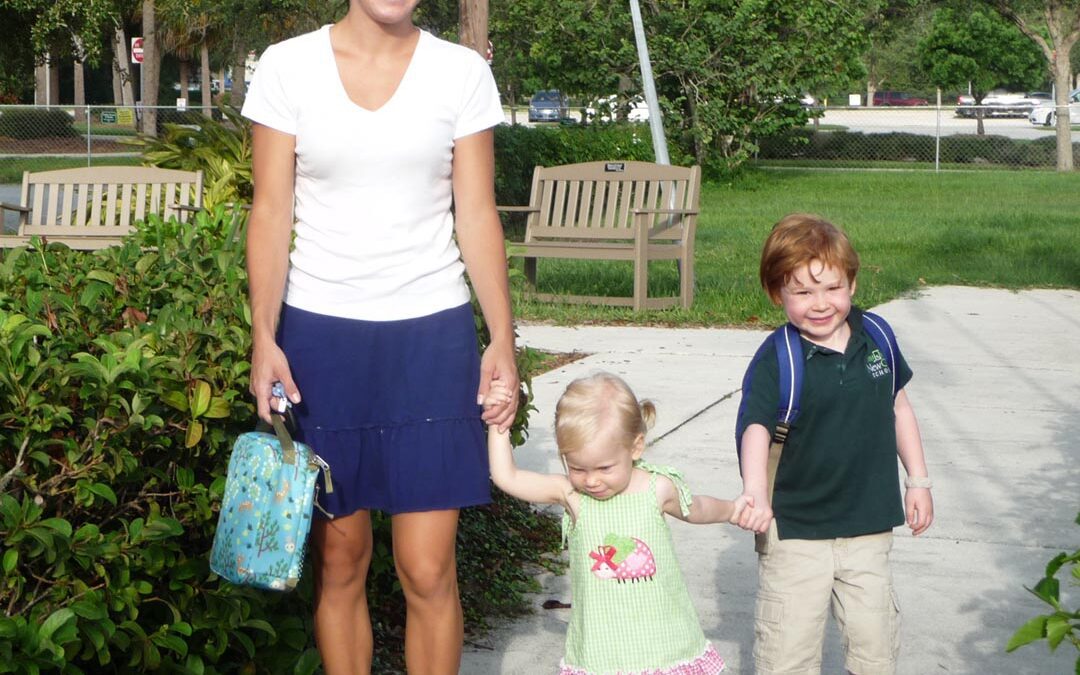
Helping Your Toddler Adjust to School

Helping Your Toddler Adjust to School

Is this your child’s first school experience – their first time away from home or from a primary caregiver? Or is it the transition from being at home with parents, grandparents, or a special aunt or uncle? Transitions are not easy for any of us and they can be especially difficult when you are somewhere between birth and two years old. Join us and one of our Montessori Toddler guides to learn ways to help ease separation anxiety for both you and your child with special guests Kathy Leitch and Kristi Antczak.

INSIDE Montessori: DOcumentary

INSIDE Montessori: DOcumentary

INSIDE MONTESSORI

INSIDE MONTESSORI: A DOCUMENTARY 

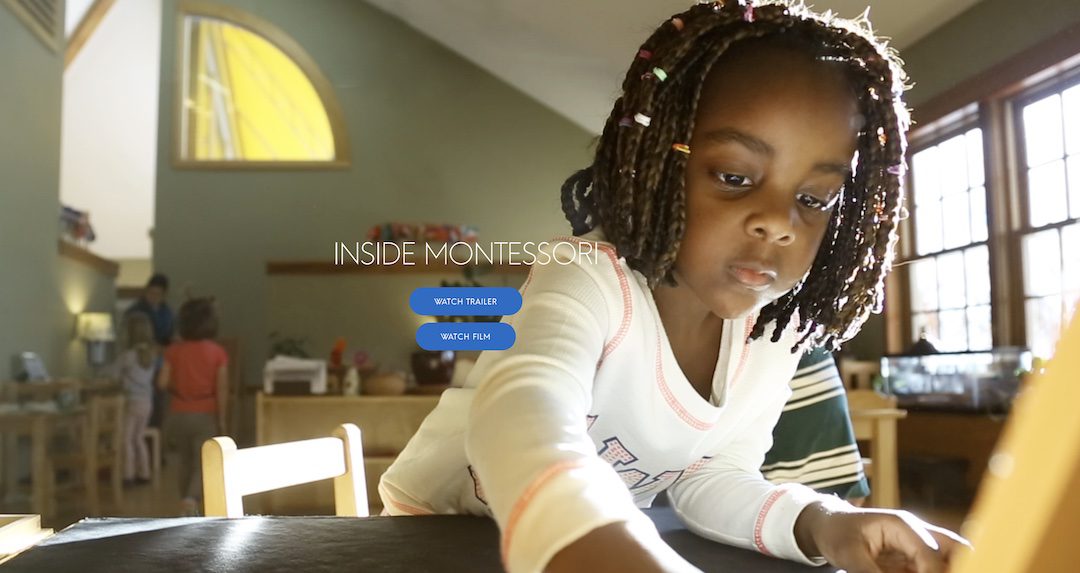
INSIDE MONTESSORI (82:05) is a documentary film and library of short videos (chapter & focus videos and bonus videos) that reframe the national education conversation toward creating learning environments that allow children to achieve their full potential. The proven, developmental and child-centered practices of Montessori education can support ALL children, regardless of background and learning style, in having the opportunity to flourish in learning and in life.

The film explores what Montessori education is and how it differs from traditional education. It showcases how Montessori is giving children of all ages the chance to achieve their full potential.

Part 2: Home Strategies for Reducing Childhood Anxiety

Part 2: Home Strategies for Reducing Childhood Anxiety

Part 2: Home Strategies for Reducing Childhood Anxiety

Part 1: Home Strategies for Reducing Childhood Anxiety

Leave Time for Being Out of Doors

Leave Time for Being Out of Doors