
Family Fun is More Than Fluff
To continue reading, you will need to choose a subscription plan.

The Dump Truck Story
The Dump Truck Story
What happens when we normalize ‘disaster’ thinking and accept the mess
by Alicia Diaz-David
When my son was two years old, he scribbled on his dump truck with a brown marker and announced that he would wash it right there in the middle of our living room floor. My first reaction was to gasp when I noticed the brown scribbles. My second reaction was to see where his plan of action would take him.
So, I watched as he used the foaming soap dispenser to lather his hands and then rub the foam on the dump truck that was still on the living room floor. And I watched as he headed to the bathroom to fill his large bath-time cup with water to rinse off the foamy soap.
And that’s when I jumped in. Not stopping him but offering him another line of thinking by asking what would happen if he poured the water on the truck right there where it was. Thankfully, he responded that it would spill. I suggested we bring the dump truck outside to our front steps, where a giant water spill would not matter as much.
And the rest happened as you might imagine. My son happily poured water over the soapy brown marker and watched as it splashed on the cement pavers, instead of the living room floor. He went back inside the house to get a towel, which he smoothed over the water droplets on his beloved dump truck. And he smiled proudly at all that he had done.
If you are familiar with the principles of Montessori and the practice of following the child, this story may seem reasonable enough. It may seem as nothing more than a toddler exploring and experimenting with his dump truck and a mom observing and conscientiously guiding the learning moment that would unfold. However, when I submitted this story for a recent publication, it was changed. The edited version included the words, “This is going to be a disaster,” and I admit it stopped me in my tracks when I read it.
Not only was I impacted by the fact that a piece of original writing would be so altered, but also by the idea that our current thinking about children exploring and experimenting is so readily equated to things turning into a disaster.
The truth is, there is a great deal of learning in the so-called disaster. The mindful parent recognizes the learning potential when a child is following her own reasoning. The prepared adult is ever-present, jumping in to help only with the hard parts. That is the true meaning of Montessori parenting, as I’ve read in countless books, learned in Montessori training, and experienced personally with my own children at home.
So, I write today to challenge this thinking and normalize what we would otherwise consider a ‘disaster.’ When we let our children explore their ideas, when we observe this process, we realize that we are truly being given the gift of watching a genius at play.
Our job as adults is not to limit or edit this experience but to let it unfold and only redirect it when necessary. What I learned from my two-year-old son that day—what I witnessed—was a young toddler exhibiting complex executive-function skills, a little boy filled with resolute determination, a confident multi-cultural child ready and willing to solve problems in the world.
I hope that in the future, we don’t edit stories like this. These are moments to cherish for what they are … the awakening of life itself. •
Alicia Diaz-David is a parent and educator with over 15 years’ experience in education. She has followed the Montessori approach at home since her children were born and is a certified Montessori guide for ages 3-6. She is also the founder of TeachLearnMontessori.org, which is dedicated to helping parents better understand the Montessori philosophy and simplify the approach. You can learn more about supporting children’s growth and development using Montessori via the real-life stories she shares on Instagram @MontessoriwithAlicia or on her blog at TeachLearnMontessori.org.

A Sense of Place
Engendering Love of One’s Home with Adolescents
The NewGate School, Global Campus Students, Research Their Place on Earth and Weave a Story to Share
By Amy Kremer-Treibly and Elizabeth Hale
The NewGate School’s Global Campus is composed of students in seventh through twelfth grades who live in Canada, the US, the Caymans, and Tanzania. These students are the first cohort of the Global Campus, and they work together with a dedicated faculty for humanities, math, science, and Spanish academic courses, as well as working in their home communities on creativity, physical wellness, and service.
Adolescents seek answers to key questions: Who am I? Where am I? What’s happening?
In order to gain insights and impressions of where each student resides, they set out as investigators of their own backyard, town, city, and country, with special attention to who inhabited the land first, including animals, plants, and humans. Students have been sharing their stories as presentations to the community in Opening Meetings held each morning of the week. This project offers a rich opportunity for students to explore the question of where do I find myself living right now?
During this process, students access local historical societies and talk to family and neighbors about generational memories of the place. Some students highlight developments, such as industry and railroad access. Others brought names of indigenous tribes to our attention, as well as the plants and animals that have thrived in the past and either do or do not live now. Overwhelmingly, the students learn more about where they call home. In addition to acquiring knowledge of place, by pausing and giving attention to the land that supports our lives, the people who have come before, and the bounty that nourishes us, we all grow in our appreciation and gratitude for home.
It has been said that to love a place and show true care for it, one must spend time, look with earnestness for the hidden treasures to be revealed, and then we can fully celebrate our home. Indigenous wisdom embodies connection and relationship, and for that reason, we like to include the Haudenosaunee Thanksgiving Greeting, which we read aloud in turns during Council before Thanksgiving. •
REFERENCE
Smithsonian Museum Blog. https://tinyurl.com/mvvjxu4f
Amy Kremer-Treibly, M.A. earned her Bachelor’s Degree in Anthropology at Loyola University where she also enjoyed studying Spanish during a study abroad term in Quito, Ecuador, and learning about world religions as her minor. She began her teaching career in a refugee resettlement program teaching ESL to adult students from around the world followed by teaching Spanish at the elementary level. While teaching at a Great Books Foundation high school in Arizona, she earned her Master’s Degree in Experiential Education at Prescott College with a focus on building schools and learning experiences to promote engagement, eco-literacy, and stewardship.
Elizabeth Hale teaches Humanities and other courses with NewGate School’s Global campus. She spent the last 13 years developing Heartmoor Farm Education Centre in central Virginia teaching Literature, Humanities, and Mindfulness to adolescents while nurturing her connection with the natural world specifically through contemplative practices, the stewardship of plants, and formal study of Western Herbalism. With 24 years of teaching experience, in classroom environments from Oregon and Ohio to Virginia, she has worked with families through all stages of their children’s development.
What Is The Montessori Method?
We, as parents, love to see our children become independent and self-sufficient as they grow and age. But sometimes, we may need help to get them to that point. We can do so by implementing the Montessori Method into their lives. Montessori emphasizes teaching children to be self-regulating and to be able to learn the concepts of independence. It is a great tool to help your children be more confident in their abilities. Indeed, independence is the best gift we can give to our children, as it enables them to be self-sufficient and know how to take care of themselves.
Today, we live in a time when there is a lot of pressure on children at home, school, or work. The idea behind the Montessori Method is to teach children that being themselves will give them the ability to succeed in life. Children need to feel confident, capable and become more independent so that they can defend their ideas, thoughts, and feelings against pressure from others. But the question now is how this Method helps children become independent. Well, that’s what you are going to learn in this article. But first, let’s understand what the Montessori Method is.
WHAT IS THE MONTESSORI METHOD?

It is an educational method that Maria Montessori developed. It has been implemented globally and has helped children develop learning skills for independence, self-regulating, and creativity. The Montessori Method uses a hands-on approach, where children learn through experiences to find their way of learning.
THE MONTESSORI METHOD WILL HAVE THE CHILDREN LEARN FROM THEIR MISTAKES AND ENCOURAGE THEM TO KEEP LEARNING, BECAUSE THEY ARE NOT PERFECT IN EVERYTHING.
How can the Montessori Method help your child to be independent?
The Montessori Method is designed to be flexible and adaptable to meet each child’s needs. It allows children to be exposed to different learning environments and solve problems by themselves. The Montessori Method emphasizes making lessons fun-filled and interesting to capture the child’s attention and develop their thinking skills.
Here are four ways that Montessori helps your child become independent:
ONE
The Montessori Method encourages children to become more independent, through a stress-free environment.
The Montessori Method is a great tool to help children become independent by giving them a stress-free environment. It helps children become less dependent, because they need not rely on parents or teachers for help. It teaches kids how to solve problems by themselves.
For example, when you are doing your work, it is certainly stressful to stop your work and ask for help from another person if you do not know how to do something. The Montessori Method teaches us that we must not stop what we are doing until we have finished it. It is an excellent tool to teach children how to do their work without disruptions, but to only stop if necessary. It teaches children that they only need to pause when they are stuck on something or need help.
TWO
The Montessori Method encourages children to learn how to solve problems.
Learning how to deal with problems is one of children’s most rewarding experiences. The Montessori Method gives children opportunities to learn on a broad scope of different topics to develop their problem-solving skills; they will not need to rely on others for help.
For instance, if a child is trying to understand how to use a slow cooker, he is expected to figure it out by himself. Even if you want to teach him how to use it, the child must remember what you taught him. The Montessori Method allows children to take an active role in their education and figure out most problems on their own. It seems easy at first, but doing this will develop their problem-solving skills and increase their independence.
THREE
The Montessori Method helps children become more respectful of their ability.
The Montessori Method positively impacts children’s self-confidence and self-esteem, because it helps them appreciate what they are accomplishing. It helps them become better learners by giving them more confidence in their learning ability. The Montessori Method is a great tool to encourage children to learn more about what they have and who they are.
For example, if a child is having trouble learning how to play the violin, it may affect her self-worth and self-esteem. Children may think that they cannot learn or do not have what it takes to become good violinists, so they give up. But the Montessori Method will have the children learn from their mistakes and encourage them to keep learning, because they are not perfect in everything. As a result, this will teach them how to accept their capability for learning new things.
FOUR
The Montessori Method helps children to be independent by reinforcing self-confidence.
The Montessori Method helps children become more confident by giving them opportunities to learn new things and feel proud about themselves when they accomplish something great. This Method gives children the opportunity to learn new things and achieve something great by themselves. Therefore, they are more confident in believing that they are independent, because they know how to solve their problems without depending on other people’s help.
For example, let’s imagine that your children decide to ride a unicycle for the first time.
They are not ready yet, but they still want to try. By doing this, they will understand that even though it is not easy, there is a way that they can overcome challenges with riding a unicycle and challenges in life. This develops self-confidence. As they learn how to approach new challenges, they will be able to do more and more for themselves.
HOW CAN PARENTS HELP ENCOURAGE CHILDREN’S INDEPENDENCE AT HOME?
We should encourage our children to be increasingly independent right from the start, but they need guidance and coaching. They need to learn the basics: proper hygiene and the daily habits of independent living when they are older. Help them learn to do things carefully with confidence.
Though more children today can be considered self-sufficient, learning through experiences and making mistakes will help them develop a sense of responsibility and become more self-reliant later in life. Even with care, mistakes happen. Let’s help them to learn from their mistakes with patience and calm.

If we allow our children to do tasks independently, we will witness steady growth in their capability.
For example, let children:
• Place foods on their plate: You can give them advice, but let children learn how to pick up and put things onto their plates.
• Wash their hands: You can talk with them about the importance of washing hands, but let them learn how to scrub, wash, and rinse themselves.
• Brush their teeth: This is another task you can do with your child but let them do it alone after you’ve given instructions on how to brush, what part of the mouth to use the toothbrush, and when to spit out afterward.
• Pick out clothes they want to wear: In case you don’t have enough time to lend a hand in picking, let your children select the clothes they wish to wear, once they have learned the basics of choosing outfits on their own, using simple instructions from you, such as, “Choose a shirt that has long sleeves.”
• Choose their toys: Let your children choose the toys they want to play with, but make sure you don’t allow them to play with dangerous items like knives or scissors.
These simple steps will help your child feel comfortable when they start to face challenges on their own and help them understand the importance of independent living.
Final Thoughts
Children develop their independence in different ways as they grow and learn about the world. The Montessori Method is an effective way for children to learn how to be independent with their own decisions and find new ways of solving their problems on their own. The Montessori Method is the best way for children to develop skills that will help them cope with anything they encounter. •

Andrea Gibbs was born, raised, and still lives in New York. She is a work-at-home mom with a background in business development, strategy, and social media marketing. She contributes to a blog at the Montessori Academy to motivate and educate other parents about how they can get their children ahead of the game in school. montessori-academy.com/why-the-montessori-method-works
Storytelling and Executive Functioning
All classroom teachers have had experiences with children who have difficulty in school; often, it’s unclear why. We might try a number of things and still find frustration. Often, the students clearly want to do well and evince great potential, but their difficulties or challenges aren’t attributable to any sort of obvious learning disability or special need.
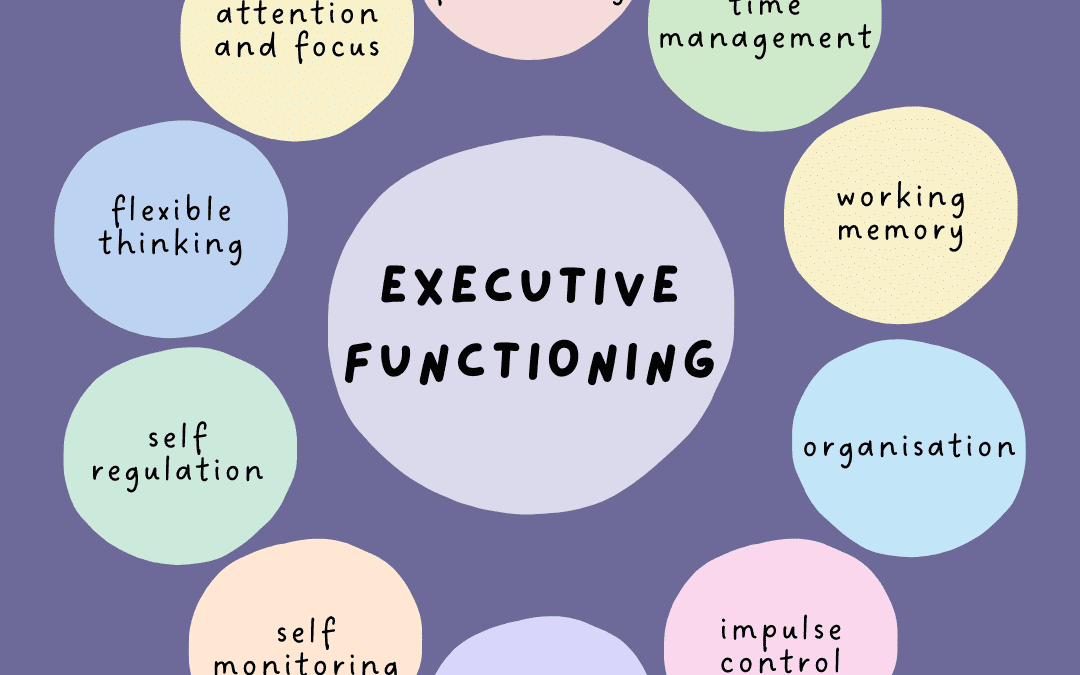
In these elusive cases, it is important to consider that there may be impediments to executive functioning, the set of key skills that we use every day in our daily lives, our learning, our work, and in any sort of performance.
We also regularly work with young people who seem to “get it.” They are attentive, seem to follow our lessons, and appear to understand essential concepts embedded in our lessons. In these cases, it is important to consider that these students may have greater capability in the key areas of executive functioning.
Executive functioning is key to our ability to navigate the world.
Simply stated, executive functioning is a set of essential mental skills that we employ at all ages, from early childhood through adulthood. Three of these functions, possibly the most important, are: working memory; cognitive flexibility; and inhibition control.
Working memory refers to our everyday memory, our use of it, and our ability to access it. Cognitive flexibility is adaptable, manageable, and responsive thinking. Inhibition control refers to the willpower that one manifests over one’s own actions, such as restraint, self-control, and discretion.
I cannot overstate how important these three skills are. They underlie most successful behaviors in school and, indeed, our entire professional adult life. Executive functions make possible a large number of intellectual and psychological achievements, including: advanced thinking, or mentally playing with ideas; careful planning, or taking time before acting or performing; flexibility, or meeting unexpected or unanticipated challenges; perseverance, or resisting temptation and developing stick-to-itiveness and maintaining focus.
The good news is that these skills or abilities can be nurtured, developed, and refined, so that even if one or more of them is at a less-than-ideal level, they can be improved and maintained. In short, they can be taught in our classrooms in a way that promotes their growth and utility. How? We can do this by using, quite possibly, the most ancient teaching technique: storytelling.
Storytelling has a unique relationship to each of these skills: it directly addresses and encourages working memory, cognitive flexibility, and inhibition control. Let’s look at each one and see how storytelling can benefit and support its growth.
Whenever we need to remember something important, such as our list for the supermarket, where we parked our car, a friend’s phone number, or a set of instructions for any task, we rely on working memory. Working memory is simply the ability to hold information in one’s mind over a brief period of time and being able to apply that information to various scenarios.
Most neuroscientists agree that there is some limitation to the capacity for working memory, although that limitation (and whether it can be adjusted) is up for debate.
Of course, memories do get lost or diluted over time, but there are some ways to slow or even stop that process.
One way to improve working memory is what researchers call maintenance rehearsal, or simply repeating information mentally without regard to its significance or meaning. An example might be going over and over in one’s mind the exact items on a grocery list in the hope that nothing will be forgotten. This method may be used productively, though with limited utility, in school settings: memorizing arithmetic fact tables; conjugating verbs; or drilling spelling lists and foreign language vocabulary.
A second approach is what researchers call elaborative rehearsal: recognizing some significance or meaning about certain information, then associating it with other information. Mnemonic devices fall into this category, as do any associations or relationships that can be established among and between various ideas, facts, or procedures. An interesting note is that researchers believe that elaborative rehearsal can help move information from working memory into long-term memory. This makes any experience that creates associations especially valuable for learners. Storytelling offers particular and substantial opportunities for elaborative rehearsal. First of all, stories often relate immediate impressions or bits of information to larger pictures which can, in turn, be applied to actual life situations. For example, who can forget the image of the grumbling fox stomping off, muttering “Sour Grapes!” in Aesop’s fable The Fox and the Grapes? Who can avoid applying the story’s implicit insights to everyday situations?
Stories create an image repertoire that is accessible through working memory and can be applied to situations both familiar and unanticipated. After hearing the story of the Four Strange Brothers from The Deep Well of Time, children have come to me years later still characterizing the four arithmetic operations as brothers and using the images in that story as mental hooks which have been translated into long-term memory.
One of the most important characteristics of classroom storytelling is repetition, which aids listeners in not only following the story but developing and utilizing the working memory to learn the story themselves. The repetition sets up what amounts to a series of mental guideposts that children can (and do!) follow in re-telling the story.

There are two forms of repetition that are common in storytelling: pattern repetition and word or phrase repetition.
Pattern repetition is the reiteration of specific behaviors, situations, or ways of communicating or acting. Regularly repeated patterns frequent the plots of many stories and folktales the world over. Well known examples are The Little Red Hen or Stone Soup. Another example is in the descriptions of each character in The Four Strange Brothers. The repeated patterns in these stories and others like them provide a well-defined structural framework for working memory.
One of the most common pattern repetitions in traditional storytelling is the “rule of three.” This refers to a pattern in which there are three characters or three situations—the first two somehow fail, but the third is successful, however unlikely it may seem. The Three Little Pigs, Goldilocks, and the Three Bears, and The Fool of The World (a Russian folktale) all employ the rule of three. Another example is my story Measuring the Farm, in The Deep Well of Time.
Becoming familiar with the rule of three encourages the listener to make predictions based on the unfolding three-part storyline. This involves working memory on several levels. Memory usage is encouraged by the three-part structure, and it is also rewarded when that structure is revealed to be a unifying plot element, as had been anticipated. This involves the listener in making predictions, creating a hypothesis of what will unfold. “Minds exist to predict what will happen next. They mine the present for clues they refine with help from the past…to anticipate the immediate future.” (Boyd, page 134).
The second form of repetition used in stories is direct word or phrase repetition. This refers to a specific pattern of words literally and exactly repeated. In the opening moments of a story, these words or phrases become immediately recognizable to the listeners. The children may even chant along, “Run, run as fast as you can! You can’t catch me, I’m the gingerbread man!”
In The Deep Well of Time, an example of specific word patterning occurs in The Four Strange Brothers. Recalling these specific passages can sometimes be enhanced by being written in a rhythmic or poetic format.
The gift of the memorable is one of the key benefits of storytelling that I introduced in The Deep Well of Time. The gift of the memorable refers to the presentation of stories or lessons, or even components of them—like striking images, characters, or incidents—in such a way as to facilitate children’s recall, even many years later. This concept exemplifies an important way that more constricted short-term working memory moves into more stable, long-term memory. By using stories, teachers can consciously and intentionally create memorable moments in their classrooms. These moments may well be recorded in a child’s memory for years to come.
Orally told stories are rich with images, characters, and plot devices, as well as patterns. These all have the capacity to stand out and find a special place in children’s memories. These memories are of a specific kind called episodic memories. Episodic memory records particular events that a child experiences. It can be linked to a specific place or time that essentially ‘grounds’ the incident or image.
These episodic memories are not always related to actual events in the child’s life: they are just as often based on events, places, people, or times that are experienced vicariously—through stories. This is how we may remember the evil queen in Snow White reciting “Mirror, mirror on the wall…,” the Mad Hatter’s tea party from Alice’s Adventures in Wonderland, or Cinderella’s glass slipper. These story-based images are recorded in episodic memory.1

For children to follow a story and then later discuss and comment on its content and meaning is oral comprehension, an important precursor to any form of reading or literary comprehension. Oral comprehension clearly requires working memory. Listening to stories, discussing them, and using them as bases for comprehension exercises also develops episodic working memory.
In the same way, when children use those orally told stories as launching pads to make up their own stories, orally and in writing, working memory is required. There may be no other activity in the classroom which has so many applications to working memory as stories and all that goes with them: storytelling; story absorption; acting out stories; retelling stories; and writing story-based compositions.
Cognitive Flexibility
The second major pillar of executive functioning is cognitive flexibility: the ability to switch between thinking about two different concepts or to think about multiple concepts simultaneously. It includes: mentally rearranging; reevaluating, and integrating a variety of ideas and images, many of them new or unusual, as well as sometimes challenging preconceived notions. The term also applies to our ability to consider or adopt alternative approaches, solutions, or courses of action.
One of the essential characteristics of cognitive flexibility is the ability to think in images, archetypes, representations, and metaphors – “out of the box” thinking. This flexibility allows us to hold in our minds an external “reality” like everyday life, while we simultaneously immerse ourselves in metaphorical worlds of fiction, fantasy, or make-believe
In the stories in The Deep Well of Time, geometric shapes get together to plan clubs based on their characteristics; numbers conspire to form groups; and triangles try to fit into rooms that just seem too small. In other stories, nouns and verbs have active discussions, cats tell tales, elves make materials, and strange images from dreams become reality. Metaphorical thinking, which is innately flexible, is at the heart of storytelling. The very essence of meta-phorical thinking is the manipulation of images and ideas, changing established rules of existence, and putting ideas, images, people, thoughts, animals, or supernatural beings into situations, which are unusual, impossible, or unheard of in the ‘real’ world. This is clearly thinking about multiple concepts simultaneously.
Story listeners and story participants develop the ability to appreciate these situations and use this sort of thinking in a variety of situations. Doing so keeps us fresh, or at least keeps our thinking fresh. This is essential, not only in young people but in adults as well. Magnusson and Brim (2014) draw attention to the fact that “Cognitive flexibility declines with age and often results in an inability to adapt to new situations and environments.”
I believe that this effect of age can be diminished, at least somewhat, by active story participation. Storytelling, story listening, participation, and story creation all demand and utilize cognitive flexibility. Just as all physical exercise maintains and increases fitness, ongoing exercise of metaphorical thinking and applied imagination can maintain and strengthen cognitive flexibility and “cognitive fitness.”
More, listeners to stories react emotionally as well as cognitively to the story. This dual response demands key components of cognitive flexibility: imagination, visualization, interpretation, personification, and identification. It means putting one’s imaginative self into the story and leaving one’s real, earthbound, strictly logical self behind. It may mean accepting what seems to be impossible and then examining the consequences.
Thinking only in straightforward patterns and within highly structured and rigid organization is simply not possible while being immersed in stories. Stories take us to a higher place. In support of this idea, I wrote in The Deep Well of Time (p.22) that,
As soon as words like “once upon a time” are uttered … children enter into what poet Samuel Taylor Coleridge called the “willing suspension of disbelief” (Coleridge, 1817, p. 174). This stimulates the motivation of a story listener to accept and enter into the world of a fictional or fantastical tale as if it were literally true, even while he or she fundamentally understands that it is not. Children in the elementary years relish this distinction, just as we adults do when we enjoy novels, theatre, and film.
Inhibition Control
The third of the three critical components of executive functioning is inhibitory (or inhibition) control, sometimes also called response inhibition. Inhibition control is the ability to put off gratification, to not require immediacy in response, or to avoid acting impulsively. It means not getting what one wants immediately but being able to wait patiently. Inhibition control suggests planning, forethought, and anticipation of responses or repercussions.
Inhibitory control involves being able to control one’s attention, behavior, thoughts, and/or emotions to override a strong internal predisposition or external lure; instead, to do what’s more appropriate or needed. Without inhibitory control, we would be at the mercy of impulses, old habits of thought or action (conditioned responses), and/ or stimuli in the environment that pull us this way or that. (Diamond, 2013, ¶ 1).
Inhibitory control is essential in social situations and is at the core of many traditional manners lessons, not to mention the “Grace and Courtesy” element of the Montessori classroom. It is an essential component of self-regulation in any setting; it prevents us from making fools of ourselves!
Problems with inhibition are seen at three levels (Brenitz, 2020): motor, attentional, and behavioral.
Attentional control issues appear as distractibility or difficulty paying attention. For example, during a lesson or while at work, a child is easily distracted by a sound outside, another child in the classroom, or even some innocuous object.
Poor control in motor behavior often manifests in overactive or uncontrolled movement. For example, certain children may not be able to control their movements during a presentation or lesson. In that case, a child may fidget, get up and wander around, or even roll about on the floor.
Behavioral control issues present as impulsive behavior that cannot be inhibited. It might include shouting, hitting, or bumping into another child.
One of the first things that story listeners need to master is control of their bodies, voices, and minds. They quickly learn not to shout out comments or questions in the midst of a story or to jump up and make physical gestures. Story appreciation means controlling one’s impulses for questions and responses until the story has been concluded. Discussion of the story not only requires cognitive flexibility but also develops inhibition control; one must avoid immediate and thoughtless responses to others that can damage or destroy the discussion process.
When I tell stories as a visitor, teaching artist, or artist-in-residence, I always explain to my young audience that I have two rules, and two rules only. First, they are to stay quiet. No questions, no hands up, no whispering. However, I do assure them that if they have questions, I will certainly address those questions immediately after the story.
The second rule is: Keep your hands and your bodies to yourselves. This means no touching, poking, or high-fiving.
Essentially, I am asking them to develop and exhibit inhibitory control. This kind of inhibition makes it possible for them to stay quiet and focused when a story is being told, even though they may want to say or do something.
Amazingly, these rules work. In classes that I have led, for toddlers through teens, the listeners almost invariably practice inhibition control. The only groups with whom I sometimes have problems are adult learners, but they, too, eventually practice control.
The reason my rules work is that stories are intrinsically rewarding. They are, by their very nature, so positive and engaging that students and other listeners want very much to hear what comes next and how it all turns out. They don’t want to be shut out of the remainder of the story because of an untoward word, action, or behavior. As a result, they learn, quite successfully, higher degrees of self-control. This also translates into a sort of shared group expectation of controlled behavior.
When these three elements (working memory, cognitive flexibility, and inhibition control) are established, and in place, they are not limited to the storytelling and story listening context. In fact, once these skills are learned and mastered through stories and storytelling, they can be transferred to many other areas and contexts within the classroom and the school. They simply become habits of mind, regular, reinforcing tendencies that produce consistent, beneficial results.
This constitutes a strong argument for emphasizing storytelling in every area of the curriculum and throughout the school. It can be foundational in the development and support of executive functioning.
There are, of course, many other excellent reasons, discussed here and in many other articles, for stories to be told in schools of every sort and at every age level. However, every one of those other benefits is enhanced by working memory, cognitive flexibility, and inhibition control. One of the wonders of storytelling is that it successfully develops and enhances these skills, intrinsically and joyfully rewarding the listener, the entire student population, and the storyteller as well.
1 Thank you to Ashley Darcy, Montessori teacher educator, for suggestions and valuable ideas on repetition and working memory. (Personal communication, November 21, 2020).
References
Boyd, B. (2009). On the origin of stories: Evolution, cognition, and fiction. Cambridge, MA: Harvard University Press
Brenitz, S. (2020). Inhibition: Cognitive ability making up part of our executive functions. Retrieved from: https://www.cognifit.com/ science/cognitive-skills/inhibition
Carroll, L. (1869). Alice’s adventures in wonderland. Boston: Lee and Shepard.
Coleridge, S. T. (1817, reprinted 1834). Biographia literaria. New York: Leavitt, Lord & Co.
Diamond, A. (2013). Executive functions. Annual Review of Psychology Vol. 64: 135-168 (Volume publication date January 2013). First published online as a Review in Advance on September 27, 2012. Retrieved from: https://doi.org/10.1146 annurev-psych-113011-143750
Dorer, M. (2016). The deep well of time:The transformative power of storytelling in the classroom. Santa Rosa, CA: Parent Child Press.
Magnusson, K.R. & Brim, B.L. (2014). “The aging brain.” In Reference module in biomedical sciences. Retrieved from: https:// www.sciencedirect.com/topics/ neuroscience/cognitive-flexibility
Storytelling and Emotional Intelligence
To continue reading, you will need to choose a subscription plan.
Montessori, Darwin and Telling The New Story Of Evolution
by David Loye
In the beginning there was the Domination System and the Organism. Then the Love System entered life and meaningful Evolution began…
This is the disarming and I hope engaging way my telling of the new story of the new story of evolution begins.
Behind it lies a long unknown connection between the theories of Charles Darwin and Maria Montessori that a startling new reconstruction of Darwin’s theory reveals.
As has long been evident to anyone familiar with standard Darwinism and Montessori their theories as taught throughout the 20th century have been poles apart. Surely nothing could be farther from Montessori’s approach in her original rescuing of Italian slum children than the stereotypical keystone ideas for standard Darwinism of “survival of the fittest” and the supremacy of selfishness, or the idea of “selfish genes” popularized by ostensibly Darwinian sociobiologist Richard Dawkins.
Yet what happens if, at last, we are confronted with the startling but incontestable fact that in The Descent of Man Darwin actually wrote only twice of “survival of the fittest” – once to apologize for actually ever using the term. So what does he write of? 95 times of love! 92 times of moral sensitivity! And 200 times of brain and mind!
Morever, in designating what in contrast to the origin of species advances human evolution, he specifically says natural selection (i.e., survival of the fittest) drops off in importance at our level of emergence and “other agencies” become more important.
And what are these other agencies? Above all, Darwin wrote in hundreds of editions of his book in a majority of the languages of this earth for scientists, educators, and all the rest of us to read – but ignore – for over a century, are “the moral qualities.”
These, Darwin said, are “advanced, either directly or indirectly, much more through the effects of habit, by our reasoning powers, by instruction, by religion, etc., than through natural selection.”
As an educator via classroom but much more so by the books I have written over many years, I personally find this Darwin to be clearly in the tradition articulated by Montessori as well as by Pestalozzi earlier, and by Dewey, Piaget, on up to morally oriented, progressive and holistic educators such as Nel Noddings and Ron Miller in our time.
But while this discovery of the “new” Darwin is startling and encouraging, what we now do with it is a far more important matter. Indeed, it is, I am convinced, a matter bearing on whether our species is to live up to and fulfill its incredible potential, or —as thousands of species have before us and currently — eventually fall by the wayside in evolution.
A vital scientific challenge is to wed the two halves of Darwin’s theory. For that is what now confronts us. On one hand is the vital first half described in Origin of Species for laying a good part of the foundation for evolution. But on the other is the completing half for his theory, this thrilling superstructure in tune with progressive spirituality, progressive philosophy, progressive science, and progressive education over by now thousands of years.
As I develop at length elsewhere, underlying both Darwin and the work and theories of a long stream of great thinkers including cultural evolution theorist Riane Eisler in our time there lies, in basic systems terms, the maturational sequence and interaction of a Domination System and a Love System.
And what is the challenge for education? Most of us have been forced to teach only the destructive Darwinian first half for over a century. But having been unwitting collaborators, what can we do now to make up for this now?
One way is to get behind the effort of the newly formed Darwin Project. With a Council of over 50 American, European, and Asian scientists and educators, our goal is to shift teaching at all levels of education, as well as globally throughout the power of the media, from a disastrous focus solely on Darwin’s first half to the prohuman, prosocial, and clearly progressive emphasis for Darwin’s completion of theory.
Here one of the most effective things the Montessori movement, with its international scope, can help pioneer is the telling of the new story of evolution which weds both halves.
The Great Adventure
The new website for The Darwin Project (www.thedarwinproject.com) outlines the challenge and, in many ways, the prospects for pioneering educators. Specific to the opportunity for the Montessori movement is the “Great Adventure” segment of the website and component “Telling the New Story.”
Going by how Darwin’s perception of the Love System was suppressed for a century, we can begin to see how long it takes to change anything in science if it bumps up against an established paradigm. It is evident then that normally wedding the two halves could take science another century. Going then by how long it takes for what is written in scientific language about anything really new to be translated into and widely published in the everyday language we all use, we may add another fifty years or so. Then of course beyond all that are the schools. Once such a project got this far one must add another forty years or so of committees and school boards to decide whether this odd and controversial new hybrid thing of a theory of human evolution involving so subversive a matter as love, as well as the more serviceable matter of domination, is suitable for the instruction of the young. Then one must add another thirty years for consultants to assess and parcel it out by grade levels for the curricula.
As it is evident we no longer have a century to waste in this way— indeed quite possibly less than a decade—I have gone ahead and wedded the two halves into what, out of now many years involvement in evolution theory and education, into what I believe is as close as presently possible to the full and true story of human evolution.
The aim is to provide teachers with a story line that can be adapted for use anywhere along the line for K-12 into college and graduate studies. The idea is not to set this forth as some inviolable and forever enduring integration of theory and story, but just to get the full story down in one place and for a teacher to read, and think about, and then rework to present at one’s particular grade level.
One would start with the easiest part for the earliest level, then work up by stages, so that by the time students reach college they would possess the whole story and theory from which to launch out on their own.
What follows here is a sampler for the opening of what in its entirety will be available for free downloading from the Darwin Project website by the time this article is published. As you read, please keep in mind this is not the actual telling of the story, which is up to you, but merely the meta-story, or story line for individual shaping.
Telling the New Story
In the beginning there was the Domination System and the Organism. Then the Love System entered life and meaningful Evolution began…
A good place to start is to think of what was mostly taught and thought for a whole century to be the whole picture for the Darwinian theory and story of evolution, then ask ourselves what is the story that now emerges from a melding of the old with the new.
If we look at both Origin and Descent carefully in relation to one another, and also at precisely when they emerged within the pattern of Darwin’s creative life, it is evident we are looking at a perspective on human evolution based on his perception of three primary entities, forces, or—in the most useful term we use in science today— systems at work in the lives of our species over thousands of years.
Out of the creativity of the middle years of his great fame and immense impact on the lives of all of us, there is the Domination System he wrote of in The Origin of Species.
Out of the creativity of his early and final years— as will be detailed in Darwin’s Unfolding Revolution, the key book for this website section also to be available for download— there is the Love System he writes of in The Descent of Man.
And then there is the third, most vital part of all, the major player in this drama on which he actually focused from beginning to end, but which again was very close to also being ignored: the Organism.
There is this life form for every living thing, plant or animal, from the earliest point in the emergence of life on this earth, to all creatures living today from the smallest to the largest.
There is this life form that includes ourselves, as the species with the most advanced brains and greatest capacity to change things around on this earth— therefore the species not only with a clear evolutionary responsibility for the well being of all other life forms as well as for the earth itself, but also the only species capable of recognizing and acting on this responsibility.
This puts the weight on us to approach the question of how we are to tell the new story as more than a matter of entertainment, or of only trying to get the science right. It says squarely—to repeat what certainly bears repeating, as it is all too easy to flinch and turn away—that it is up to us to get clear on this story as a bedrock matter of species survival. And then as parents, teachers, writers, activists, as well as scientists and other scholars concerned about gaining the better life for us all, to as widely and as quickly as possible start telling this story to try to save us from ourselves by speeding up the process of our evolution.
Here we see a basic sketch for the three primary systems I touched on in the two stage-setting lines which head and open our story, to which I will refer to as we move along.
IMAGE 1
Here is the fiercely self-protective “closed mind” of the Domination System in contrast with the still formative and venturing “open mind” of the Love System—and the wiggly lines of their differing impact on us, as well as the wiggly lines of our impact (or lack of impact) back on them.
I have purposely left this and all successor sketches in their squiggly homespun “natural state,” just as I drew them, in order to give the flavor of something drawn quickly on a blackboard.
My goal is to encourage the teller of the new story to, as much as possible, use the quick, hand drawn pictures many of us naturally resort to.
There is something about how the fact of a hand moving in tandem with a mind can engage others better than the best of professional drawings or slides, which risk the sterile “uptown” polish that signals to some readers “this is dead, finished and 7 intimidating, so skip on.”
The Domination System, the Love System, and the Organism
But one must be careful here. The true story of human evolution—that is, of the evolution of all species up to, reflected within, and including ourselves—does not begin with abstractions such as these or any others at this level of thinking.
Nor does it begin, as in the old theory and the old story, with the grim, foreboding weight of Natural Selection as this large mysterious force external to ourselves.
Why was this the ominous emphasis for the old story? Within this new approach to telling the new story an important reason could be what comes to mind if we look at ourselves in relation to all other life on this planet, over the 100,000 years of our rise as the species homo sapiens sapiens. It would seem that because of our situation on this earth as the chief thinking representative for all other organisms, in the way the mind works, inevitably we were driven to seek large, mysterious ideas to account for the haunting mystery of where we came from, who we really are, and where we may be going.
This certainly seems to be why for centuries before Darwin this space in mind was filled with either the fearful or the comforting idea of God. But with the success of Darwin’s Origin of Species— as scores of ministers discerned and decried at the time—the idea of Natural Selection began to shove God out of that place for the Big Answer.
In further looking at our situation over the past century from the perspective of systems psychology, I am convinced that within the unconscious of the Western educated man and woman the hole in mind this displacement left behind came to be filled with two kinds of patterns for thought that have worked against us.
One is what I identify in the article “Montessori, Darwin, and Human Evolution” in Montessori Leadership as the “bog holes” of PseudoDarwinian Mind—i.e., the powerfully compelling but distorted partial reading of reality rising from Origin of Species or “first-half” Darwinism, such as the governing idea that as all life involves “the war of all against all” or “survival of the fittest.”
This is a complicated matter that many teachers will not want to fool with, nor will most students short of college and graduate school be equipped to deal with it. So I leave it to others to figure out where and how to best fit in this vital aspect of underlying systems dynamics and what can become the stranglehold of paradigm on our minds. This leaves us with the question of what to do with first half Darwinian science’s nightmare creation of Natural Selection as the main or even sole over-riding explanation for evolution.
The history of many centuries and the psychology of the last few has repeatedly shown us that whatever we may find or teach is in the end a small chink of knowledge tossed into the vast boiling pot of much else working within and shaping the minds of our time. So it was I believe that during the 20 th century within the unconscious of the nonscientist as first child, then adult, there also came to exist within the hole for the Big Answer an unsettling picture linked to the powerfully enduring image of Mary Shelley’s Frankenstein’s monster from earlier.
IMAGE 2
Here we see Natural Selection as this giant invisible force that strides among us, occasionally reaching down to pick and choose and gobble us up as though we are no more than the food that it may arbitrarily eat now, or let us go for later, as though saving us for desert.
This, I suggest, is a sketch for the psychic bugaboo of Natural Selection in pursuit of Variation that operates today in unconscious mind of millions of us.
It is obviously the connection with no place in the education of the child, which for many vital reasons must be sheltered and protected as long as possible. But by the time the late teen-ager is beginning to contemplate the responsibilities of adulthood, it can become meaningful to that cohort of the particularly bright, caring and courageous upon whom the better future for our species depends.
For then it can become crucial they understand how this gift of misguided modern science came to reinforce the dark earlier gift of regressive religion in the abysmal figure of a vicious deity who must be placated with blood sacrifice—which drives the terrorists and more generally still exists in the unconscious of other millions of us on this planet.
Important this fledgling leadership cohort understand, yes. But most important they are encouraged by the great teacher to go on beyond understand to decide what they personally are going to do about it. . .
L’Envoi
And so the new story goes on our website: on and on through first half and second half with my sketches and guesses as to what parts could be best to bring in early in a child’s education, and where it’s best to wait until later, on into graduate school.
As one can see from this sample, this is an idea in much need of thinking through for presentation from the Montessori perspective.
I hope this is enough to encourage creative Montessorians to pursue this new telling of the story of human evolution by going to our Darwin Project website (www.thedarwinproject.com) and downloading the rest of the story, or rather, the story line, and going to work on it.
I hope, too, I have begun to convey how extremely important this pioneering contribution by Montessorians could be to the advance toward the better world that the first woman in Italy to gain her medical degree set in motion, really not so long ago as evolution goes.
Elementary Years
To inspire academic excellence; nurture curiosity, creativity, and imagination; and awaken the human spirit
As children near the end of their kindergarten year in Montessori, many parents struggle with the question of whether or not to keep their children in Montessori for the elementary program.
On the one hand, the typical Montessori five-year-old’s self-confidence and love of learning lead many families to ask: Why tamper with something that is clearly working?
Other parents feel that, since their kindergarten graduate will be moving on to another class one way or the other, next year might be the logical time to make the transition from Montessori.
A major consideration for many families will be the opportunity to save the cost of private school tuition by taking advantage of the local public schools. Some will wonder if a more highly structured and competitive independent school will give their child a better preparation for college.
If you are facing this choice, I encourage you to take a good look at your school’s elementary program. Although you will, of course, want to gain an impression of the teachers, focus your attention on the students themselves. Elementary students are often the best spokespeople for the value of a Montessori education!
There are four aspects of the elementary program:
Academic Excellence
Universal Values
Global Understanding
Service
Inspiring Children To Work Hard and AchieveAcademic Excellence
Let’s begin by being very clear. Montessori is one of the most sophisticated pre-collegiate programs available anywhere in North America. It has been described as the ultimate gifted-and-talented program that is offered to a very wide range of students. However, this doesn’t tell the whole story. What makes Montessori special is its ability to nurture talent without needless competition and stress. In a nutshell, Montessori children never lose the joy of learning.
Montessori is, first and foremost, concerned with a child’s character and emotional development, rather than academics for grades and test scores alone. We inspire children toward academic excellence and nurture the curiosity, creativity, and imagination hidden within every human being.
Many Parents Worry That Montessori Will Not Prepare Their Children For The ‘Real World.’
Hearing that we do not give children letter grades (at least until high school), assign hours of nightly homework, give children weekly tests, or expect students to compete for the highest rank in the class, some parents wonder if we’ve lost our minds! After all, who wants to run the risk that Montessori, which was so charmingly right when they were young, doesn’t work in the elementary years or prepare children for the Real World?
Montessori Elementary Education Is Distinctly Different
First, let’s talk about highly selective programs for ‘gifted’ children.
Montessori demonstrated that intelligence is common among human beings. Most schools assume that giftedness is statistically rare and that, given half a chance, children will accomplish little without external structure, extrinsic rewards, and the fear of being embarrassed.
Many of us attended challenging elementary schools. Do you remember what happened in your highly disciplined classrooms when your teacher left the room? In many cases, it was disorder. What use is it to earn high grades, keep your notebook neat, pass every test, and hate your schoolwork? Many children in many good schools are bored, apathetic, or overwhelmed. They do only what must be done to get along. That is not a sound foundation for a real education. In truly wonderful schools, classrooms are filled with students who retain a sense of wonder, curiosity, and eagerness to learn. Those qualities are the almost universal description of elementary Montessori children.
I find the difference between the way many of us think about gifted children in this country and the attitudes we find abroad quite interesting. Americans unconsciously assume that intellectual ability and scholastic success is inborn, i.e. a child is born with special talents and abilities. Many parents in other countries assume that success is more the result of hard work, self-discipline, and high personal motivation.
In writing this, I don’t mean to suggest that truly gifted children (and adults) can’t be found. They are simply uncommon. What we focus on is the human potential hidden within young children.
Montessori demonstrated that intelligence has many forms and that children learn in different ways at different paces. Anyone who has worked with children knows this is true, but traditional schools normally follow a pre-established curriculum.
Montessori felt it was illogical to dismiss a child who finds it difficult to memorize facts without understanding or to remember what the teacher covers in a lecture. She also understood the powerful connection between a child’s inner emotional life, self-confidence, self-esteem, and the ability to learn.
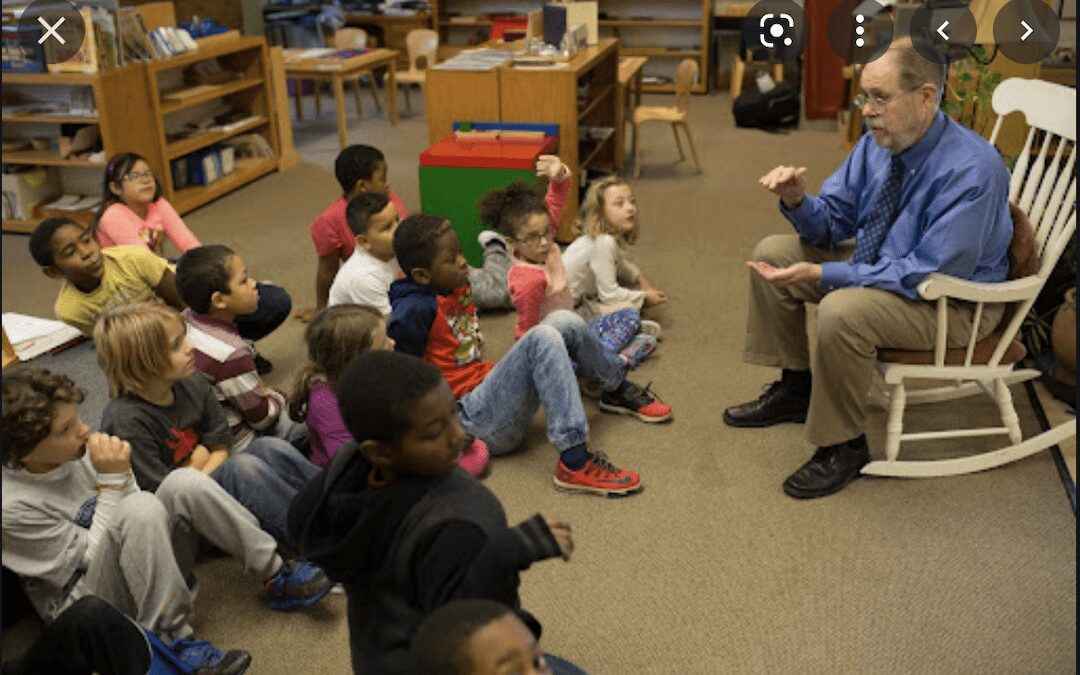
A Montessori elementary program is based on warmth, kindness, and respect. There is a strong sense of community among the children. The classes are more like little villages, with powerful friendships and a clear sense of group identity. Teachers are normally seen as mentors and friends.
Building Character and Teaching Universal Values
There is an old saying that if you abandon a garden, the weeds will run wild. Abandon a child’s moral and spiritual education, and the weeds of confusion, materialism, self-centeredness, and spiritual emptiness will take hold.
Dr. Montessori observed that the elementary years are a sensitive period for moral reasoning. The elementary program integrates character development and family involvement throughout the curriculum.
The teaching of kindness and courtesy, self-discipline and self-respect, and fundamental values is crucial in a child’s moral development, sense of dignity, and academic success. With proper guidance from parents and educators, children can and will excel.
Montessori Schools Strive to Create Global Understanding
They tend to attract teachers from all over the world.
It is normal to find an international student body in a Montessori school anywhere in the world.
Montessori schools generally teach at least one foreign language and often offer programs in several.
World geography, international cultural studies, and world history are central to the elementary Montessori curriculum.
Elementary Montessori students begin to understand the global economy.
As more Montessori schools develop strong upper elementary and middle school programs, many are beginning to sponsor travel-study programs. Some participate in the Montessori Model United Nations and foreign exchange programs.
Service
Children must be inspired to contribute to the betterment of the world. They often begin with projects that care for the environment: planting trees and flowers; composting garbage; controlling erosion around the campus; recycling; and cleaning up litter and debris in the local community. It is quite common for elementary classes to adopt an acre of rainforest in Costa Rica or work to support an environmental organization, such as the Wildlife Federation.
They will normally progress to projects that provide direct help to the needy. Younger children commonly collect canned goods, clothing, and toys for the homeless or needy families. As they are ready, most Montessori schools will take children out into the community.
As they reach the upper elementary class, Montessori children become quite concerned about issues of social justice and human rights. The rights of the poor, homeless, and hungry are of real concern. Some children will begin to explore the possibilities of supporting causes that are meaningful to them.
Elementary Classes Are Multi-Age Group Communities
Elementary Montessori classes continue to bring children of different age levels together. Classes span three age/grade levels, with the common divisions being ages 6 to 9 (grades 1-3) and ages 9 to 12 (grades 4-6). Some schools may follow a somewhat different scheme of grouping their children.
Elementary Montessori Educators Serve As Mentors, Guides, and Friends
The best elementary Montessori teachers tend to be renaissance men and women; individuals who are equally interested in mathematics, the sciences, the arts, architecture, literature, poetry, psychology, economics, technology, and philosophy. Elementary Montessori teachers are generalists rather than a single subject-matter instructor. They provide a blend of structure to ensure that the ‘basics’ are mastered while encouraging and guiding children to explore topics and ideas that capture their imagination.
The elementary Montessori curriculum is very demanding, and requires teachers to have a broad and thorough education of their own. With lessons that range from the history of mathematics to the physics of flight, mineralogy, chemistry, algebra, geometry, linguistics, and literature, to name just a few, the average teacher would be lost.
But beyond this, elementary Montessori educators need patience, understanding, respect, enthusiasm, and a profound ability to inspire a sense of wonder and imagination. Such teachers are very rare but absolutely magical!
Becoming an elementary Montessori teacher requires almost two years of graduate study and student teaching, and many hours of hard work to gather or create the curriculum materials that constitute a fully authentic elementary Montessori environment.
The Montessori Materials And The Passage To Abstraction
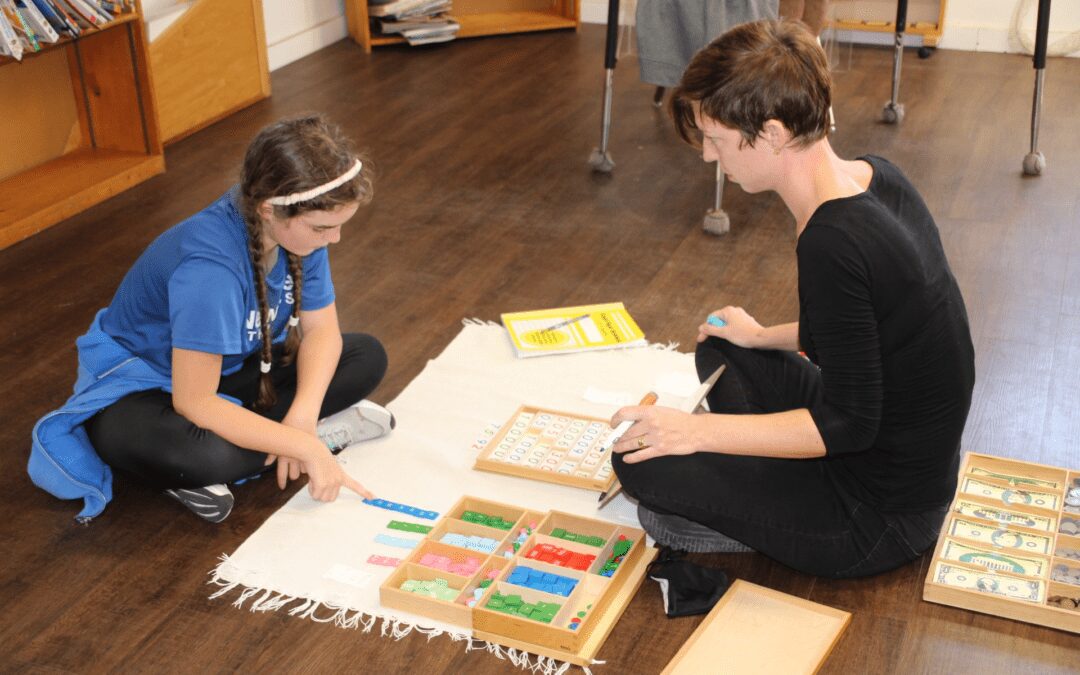
At the elementary level, learning continues to be a hands-on experience, as students learn by trial, error, and discovery.
The advanced elementary Montessori materials move on to more complex and abstract concepts in mathematics, geometry, and pre-algebra. The goal is to lead students away from a dependency on concrete models that visually represent abstract concepts towards the ability to solve problems with pen and paper alone.
Part of this is made possible by the growing child’s brain’s ability to grasp abstractions, but it has been greatly enhanced over the years by countless hours of work with the concrete materials that made the abstract real, and helped him visualize the abstraction.
Similar hands-on Montessori materials help students understand grammar, sentence analysis, geographical facts, and concepts in science.
Three Elements Of The Elementary Montessori Curriculum
1. Mastery of Fundamental Skills and Basic Core Knowledge
Montessori’s international curriculum evolved out of a tradition of academic excellence and offers a rigorous course of study even in the elementary years. Elementary Montessori students explore the realm of mathematics; science and technology; the world of myth; great literature; history; world geography; civics; economics; anthropology; and the basic organization of human societies. Their studies also cover the basics found in the traditional curriculum: the memorization of math facts; spelling lessons; the study of vocabulary, grammar, sentence analysis, creative and expository writing; and research skills.
2. Montessori’s Great Lessons
The Great Lessons are five key areas of interconnected studies traditionally presented to all elementary Montessori students in the form of inspiring stories, related experiences, and research projects.
The Great Lessons include the story of how the world came to be: the development of life on Earth; the story of humankind; the development of language and writing; and the development of mathematics. They are intended to give children a ‘cosmic’ perspective of the Earth and humanity’s (and their own) place within the cosmos.
3. Individually Chosen Research
Elementary students are encouraged to explore topics that capture their imagination. Most former Montessori students look back on this aspect of the elementary program with particular fondness in later years.
Montessori curriculum guides students to become proficient at research and inquiry. Elementary Montessori students rarely use textbooks. The approach is largely based on library research, with children gathering information, assembling reports, teaching what they have learned to their fellows, and assembling portfolios and handmade books of their own. Students are taught how to use reference materials, libraries, and the Internet to gather information and uncover the facts. Their oral presentations and written research reports tend to grow in sophistication and complexity every year.
Is Montessori Opposed To Competition?
No. Dr. Montessori simply observed that competition is an ineffective tool to motivate children to learn and work hard in school.
Traditionally, schools challenge students to compete with each other for grades, class rankings, and special awards. In Montessori schools, students learn to collaborate rather than mindlessly compete. In an atmosphere in which children learn at their own pace and compete only against themselves, they learn to not be afraid of making mistakes. They quickly find that few things in life come easily, and they can try again without fear of embarrassment.
Dr. Montessori, herself an extraordinary student and a very high achiever, was never opposed to competition on principle. Her objection was to using competition to create an artificial motivation to get students to achieve.
Homework, Tests, And Grades
Many parents have heard that Montessori schools do not believe in homework, grades, and tests. This is a misunderstanding. Because Montessori believes in individually paced academic progress and encourages children to explore their interests, rather than simply complete work assigned by their teachers, we don’t assign grades or rank students within each class according to their achievement.
Whenever students voluntarily decide to learn something, they tend to engage in their work with a passion and attention that few students will ever invest in tasks that have been assigned.
Providing Structure: Setting High, But Individually Tailored, Expectations
Montessori children normally work with a written study plan for the day or week. It lists the basic tasks that they need to complete while allowing them to decide how long to spend on each and what order they would like to follow. Beyond these basic individually tailored assignments, children explore topics that capture their interest and imagination, and share them with their classmates.
Montessori children usually don’t think of our assessment techniques as tests so much as challenges. Most elementary teachers will give their students informal, individual oral exams or have the children demonstrate what they have learned by either teaching a lesson to another child or by giving a formal presentation.
Standardized Tests
Montessori educators frequently argue that standardized testing is inaccurate, misleading, and stressful for children. Many feel that standardized tests are unnecessary, since any good teacher who works with the same children for three years and carefully observes their work, knows far more about their progress than a typical paper and pencil test reveals.
However, in our culture, test-taking skills are just another practical life lesson that children need to master. Most Montessori schools regularly give students quizzes on the concepts and skills that they have been studying, and many schools use standardized tests of one sort or another, with students over first grade. Often these may be formative tests that measure each student’s progress over the course of each year, and these will be only part of a comprehensive system of monitoring and documenting learning within the school.
When tests (formal and informal) are used as a feedback loop, at times indicating that a student needs a new lesson and more practice, instead of a mark of shame and failure, then they can be quite useful. Children will face tests throughout their education, and they certainly need to develop good test-taking skills.
Homework
Homework in an elementary Montessori class rarely involves busywork assignments; instead, they are extensions and enrichment of the curriculum. Some classes will allow the children to freely pursue projects that interest them at home, while others prefer to give children a number of optional assignments or challenges. In either case, the Montessori version of homework will rarely be boring and will normally challenge students to think, explore, and pursue tangible projects that give them a sense of satisfaction.
An Integrated Curriculum
Literature, art, music, dance, drama, history, social issues, political science, economics, architecture, science, and the study of technology all complement one another in the elementary curriculum. This integrated approach is one of the elementary Montessori program’s great strengths.
An Exceptional Curriculum In Language Arts And The Humanities
The elementary Montessori language arts program places great stress on the development of strong skills in composition and creative writing. Students are asked to write continuously, emphasizing, at first, the development of an enjoyment of the writing process, rather than the strict use of correct grammar and spelling. However, formal grammar, spelling, and sentence analysis are systematically taught.
Elementary children are normally very interested in words and sentences. They like to parse and analyze; for, in this way, they are clarifying their understanding of the structure of language that they absorbed unconsciously in the primary class. Montessori takes advantage of children’s natural interest and gives them a rich assembly of learning material; for while they study the theory of grammar, spelling, and sentence analysis, they are also perfecting their knowledge of written language.
Creative writing continues to be equally important, and students are encouraged to write and share with others their stories, plays, poetry, and class newspapers.
Finally, and most importantly, the key to the elementary language arts curriculum is the quality of the material Montessori gives children to read. They are introduced, from an early age to first-rate children’s books and fascinating works on science, history, geography, and the arts. Many elementary classes follow the Junior Great Books program, with formal literary studies continuing every year through graduation. By introducing students to the very best literature available for young people, Montessori cultivates a deep love for the world of books.
Unified Mathematics
Montessori math is based on the European “Unified Math” model, which introduces elementary students to the study of the fundamentals of algebra, geometry, logic, and statistics, along with the principles of arithmetic.
Montessori students learn to recognize complex geometric shapes and figures. They learn to define, calculate, and draw all sorts of geometric relationships: angles; polygons; circumference; area; volume; squares and square root, cubes of polynomials, to name just a few. In Montessori, arithmetic, algebra, and geometry are interrelated.
Elementary Montessori students gain hands-on experience by applying math in a wide range of projects, activities, and challenges, such as graphing the daily temperature and computing the average for each month or adjusting the quantities called for in a recipe for a larger number of people. Because children love to work outdoors, we try to prepare tasks that use the school grounds whenever possible.
History And Culture Come Alive In The Elementary Class
One of Montessori’s key objectives is to develop a global perspective, and the study of history and world cultures forms the cornerstone of the curriculum.
Physical geography begins in the elementary program with the study of the formation of the Earth, the emergence of the oceans and atmosphere, and the evolution of life. Students learn about the world’s rivers, lakes, deserts, mountain ranges, and natural resources. Elementary students study the customs, housing, diet, government, industry, arts, history, and dress of countries around the world. They also study the emergence of the first civilizations and the universal needs of humankind. In the upper elementary class, the focus is usually placed on early man, ancient civilizations, and American history.
International studies continue throughout the elementary years, integrating art, music, dance, drama, cooking, geography, literature, and science. The children learn to prepare and enjoy dishes from all over the world. They learn the traditional folk songs and dances in music and explore traditional folk crafts in art. They read traditional folk tales, literature, and reference materials about the cultures under study and prepare reports about them. Units often culminate in marvelous international festivals.
Montessori’s Hands-On Approach to Science
The Montessori science curriculum is focused on the study of life, the laws and structure of the universe, and how humanity has struggled throughout history to put our understanding to practical use.
Much of Montessori science takes place out of doors. Classes grow flowers and vegetables in small gardens. They often raise class pets and sometimes even small farm animals.
Students are encouraged to learn to recognize and name local trees, flowers, birds, and animals.
Older children begin to keep journals of their observations of classroom animals and write poems and stories that attempt to capture the sense of wonder and beauty all around us. Back in the classroom, they pursue their investigations using a wide variety of charts and displays, research materials, and reference books.
More formal elements of biology are taught as well, particularly at the upper elementary levels. Dr. Montessori found that systematic knowledge allows one to discriminate details among species, literally to see on a whole new level; therefore, we introduce the student to the classification of the plant and animal kingdom. The study of the internal and external anatomy of plants and animals likewise gives children a new level of awareness and sensitivity in their observation and study of life. They compare different anatomical systems among species, such as the eyes, teeth, hooves, and claws of various animals.
Elementary students also learn a wide range of important basic concepts of physics and chemistry, such as: the structure of atoms and molecules; the difference between elements and compounds; the chemical composition of familiar compounds; the three states of matter; and chemical and physical change. Students also enjoy doing research about the elements and have a first exposure to the Table of Elements.
Elementary children love to work with scientific apparatus and delight in seeing mixtures change color, testing liquids with litmus paper, experimenting with small electrical circuits, or building models of atomic compounds. Students learn to observe and record what takes place during their experiment. The goal is to teach both the scientific method and techniques for safely working with science equipment.
Foreign Languages
As part of the international studies program, most Montessori schools offer a second language. The primary goal in a foreign language program is to develop conversational skills, vocabulary, the ability to understand basic written information in the second language, and an appreciation for the culture of the countries where the language is spoken.
The Arts Are Integrated Into Every Subject
In Montessori schools, the arts are normally integrated into the rest of the curriculum. They are modes of exploring and expanding lessons that have been introduced in science, history, geography, language arts, and mathematics. For example, students might make a replica of a Grecian vase; study calligraphy and decorative writing; sculpt dinosaurs for science; create dioramas for history; construct geometric designs and solids for math; and express their feelings about a musical composition through painting.
Students participate in singing, dancing, and creative movement with teachers and music specialists. Students’ dramatic productions make other times and cultures come alive.
The ideal elementary Montessori health and physical education program challenges students to develop a personal program of lifelong exercise, recreation, and health management.
The Montessori approach to health and fitness helps children to understand and appreciate how their bodies work and the care and feeding of a healthy human body.
Field trips are often an integral part of elementary Montessori programs. Students take all sorts of trips over the years to planetariums, art galleries, the zoo, museums, and many other destinations. They visit the centers of local government, colleges, hospitals, veterinary clinics, wildlife refuges, libraries, laboratories, factories, and businesses.
Social Skills, Character, And Community Service
The elementary classroom is not only a community of close friends, it is a source of countless life lessons in social skills, everyday courtesy, and ethics. Montessori noted that elementary children not only enjoy each other’s company, they naturally form little social groups of friends, each with its own internal hierarchy and rules of conduct.
The elementary classroom takes advantage of this tendency by operating as a small social community in which children learn to work together, resolve conflicts peacefully, encourage and acknowledge each other, and work as committees to complete complex tasks. Dr. Montessori also noted that the elementary years are a time when children are developing their sense of justice and moral reasoning.
Most classes go beyond simple lessons in grace and courtesy to begin a serious exploration of moral philosophy. It is common to find elementary Montessori students discussing questions, such as: Why are some things considered a sin? What happens to us when we die? Why is it important for the fortunate to lend a hand to the poor? If kindness is so important, what can I do when I am feeling angry?
During the elementary years, Montessori children begin to seriously address the question of aid to the elderly, handicapped, critically ill, and economically disadvantaged. They explore international issues from the perspective of building bridges toward world peace. They study ecology, wildlife preservation, and conservation of natural resources.
Through these and many other efforts, we begin to introduce Montessori children to moral questions in personal relationships to encourage the awakening of their social conscience. n
Tomorrow’s Child/ November 2017/ Pg 18
Featured
-
 The Montessori Way, Revised and Expanded: An Education for Life; A Comprehensive Guide for Parents and Teachers
$25.00
The Montessori Way, Revised and Expanded: An Education for Life; A Comprehensive Guide for Parents and Teachers
$25.00
-
The Montessori Child: A Parent's Guide to Raising Capable Children with Creative Minds and Compassionate Hearts (The Parents' Guide to Montessori)
$20.00
-
The Montessori Toddler: A Parent's Guide to Raising a Curious and Responsible Human Being (The Parents' Guide to Montessori)
$20.00
-
Montessori in Action: Building Resilient Montessori Schools 1st Edition
$29.95
-
Bulk Order, 30 Copies of Montessori for Every Family: A Practical Parenting Guide To Living, Loving, And Learning
Original price was: $600.00.$510.00Current price is: $510.00.
Products
-
The Montessori Way, Revised and Expanded: An Education for Life; A Comprehensive Guide for Parents and Teachers
$25.00
-
The Montessori Child: A Parent's Guide to Raising Capable Children with Creative Minds and Compassionate Hearts (The Parents' Guide to Montessori)
$20.00
-
The Montessori Toddler: A Parent's Guide to Raising a Curious and Responsible Human Being (The Parents' Guide to Montessori)
$20.00
-
Montessori in Action: Building Resilient Montessori Schools 1st Edition
$29.95
-
Bulk Order, 30 Copies of Montessori for Every Family: A Practical Parenting Guide To Living, Loving, And Learning
Original price was: $600.00.$510.00Current price is: $510.00.